
Un ESSA0100B-0215 constitue un premier choix judicieux lorsque la puissance de charge requise reste inférieure à 100 kW et que l’excédent d’énergie quotidien s’inscrit dans la marge de SOC validée. Si une installation produit de manière répétée 120 kW de plus que ce que la structure consomme, l'armoire peut toujours charger à 100 kW, mais les 20 kW restants doivent être affectés à une destination précise : exportation autorisée, limitation de la production photovoltaïque ou charge flexible approuvée. Cette décision doit être prise lors de la conception, et non au cours de la première semaine de mise en service.
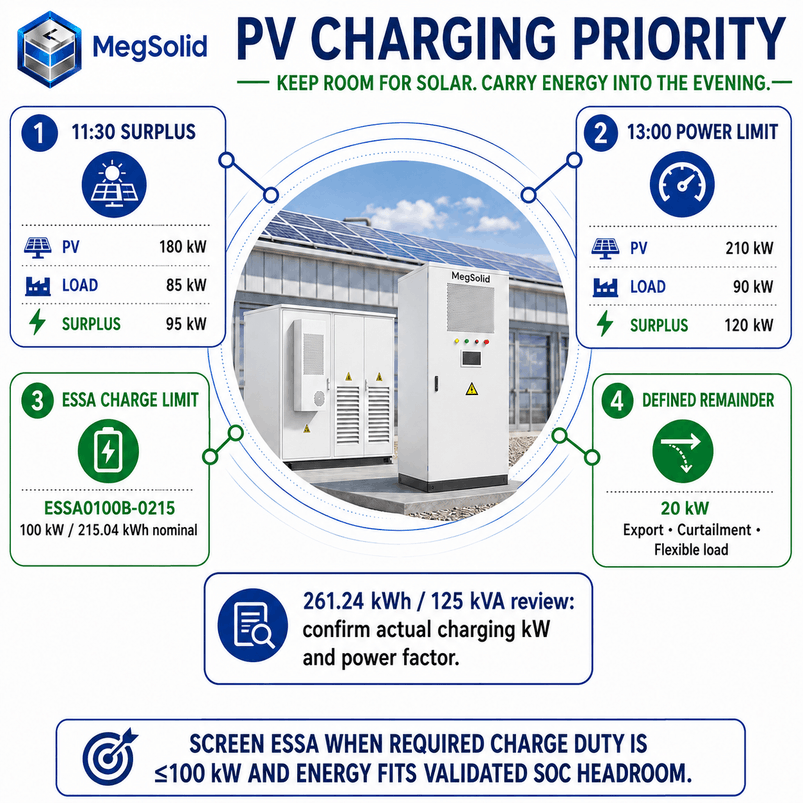
Considérons la même installation à 11 h 30. Le parc photovoltaïque sur le toit produit 95 kW de plus que la charge du site, mais la recharge nocturne a laissé la batterie proche de son niveau de charge maximal (SOC). À 13 h, la batterie est pleine et le contrôleur de l’installation réduit la production photovoltaïque. Le lissage des pics de l'après-midi utilise alors une partie de l'énergie stockée, tandis que la réserve protégée en bloque une autre partie. À 17 h 30, il ne reste plus assez d'énergie utilisable pour atteindre l'objectif complet de la soirée. Aucune défaillance n'est à déplorer ; le programme a traité la capture de midi, la distribution de l'après-midi et la demande du soir comme des tâches distinctes, même si elles partagent la même batterie.
Le MegSolid ESSA0100B-0215 offre pour cette application un onduleur de 100 kW, une capacité nominale de 215,04 kWh en batteries LFP et un système de gestion de l'énergie (EMS) intégré. Son avantage pratique réside dans le fait que les limites de la batterie, les commandes de l'onduleur et la programmation quotidienne sont regroupées au sein d'une seule et même plateforme de contrôle du stockage. La priorité de recharge photovoltaïque détermine quand laisser de la marge, quand accepter l’énergie solaire et quand restituer cette énergie. Les données photovoltaïques et de charge simultanées doivent encore démontrer l’adéquation en puissance et en énergie avant que l’armoire ne soit attribuée.
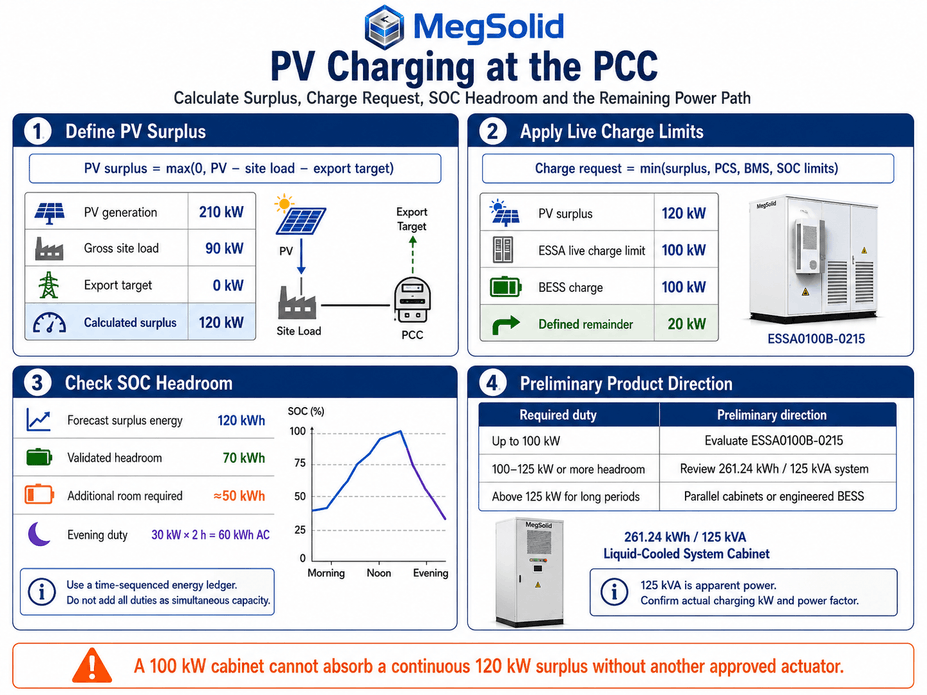
Définir l'excédent solaire au PCC
L'onduleur photovoltaïque peut afficher une puissance de 180 kW, mais cela ne correspond pas à la capacité de charge de la batterie. Si l'installation consomme 85 kW au même moment, il ne reste plus que 95 kW avant que la règle d'exportation ne s'applique. La charge du site, l'objectif d'exportation choisi et la limite de la batterie en service doivent s'inscrire dans un équilibre énergétique.
Pour une installation à couplage CA, calculez la charge du site sans prise en compte de la charge du système de stockage d'énergie par batterie (BESS) et précisez la convention de signe :
Excédent photovoltaïque nécessitant l'intervention du système de stockage par batterie (BESS) = max(0, production photovoltaïque − charge du site − objectif d'exportation)
Le destination d'exportation Il s'agit de la valeur d'exploitation utilisée par le système de gestion de l'énergie (EMS) ou le contrôleur de la centrale. Elle est nulle sur un site sans exportation et peut être positive lorsque le propriétaire vend délibérément de l'électricité. La limite contractuelle d'exportation reste la limite maximale, mais elle ne détermine pas si un kilowattheure autorisé doit être vendu ou stocké. Ce choix commercial nécessite un objectif d'exploitation signé.
Demande de facturation au cours de la même période :
Demande de charge photovoltaïque = min(excédent photovoltaïque, limite de charge du PCS, limite de charge du BMS en temps réel, limite de charge en fonction du SOC)
Le retour d'information du PCC ajuste la demande afin que l'exportation mesurée reste conforme à l'objectif. Si le compteur est obsolète, si un transformateur de courant (CT) est inversé ou si un disjoncteur modifie la limite de contrôle, le système EMS doit passer au mode de secours approuvé. Le fait de conserver la dernière commande de charge valide peut transformer une erreur de données en une violation des limites d'exportation.
Emplacement du CT, système de sécurité intégrée et responsabilité en cas de réduction de la production : Page « Contrôle des exportations zéro » du PCC.
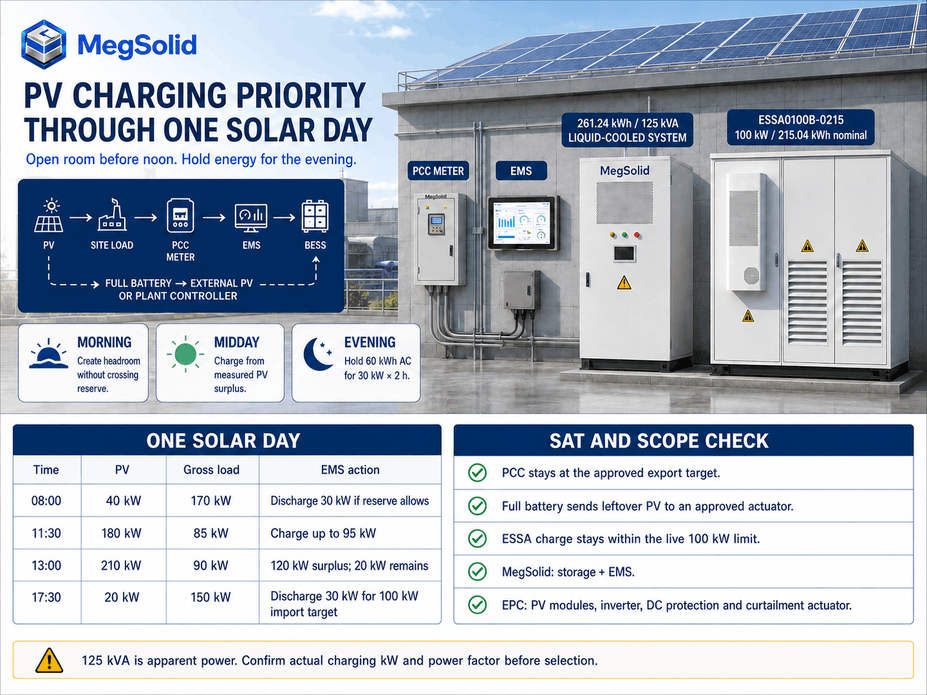
Suivez le déroulement d'une journée solaire, du matin au soir
L'exemple présenté concerne une usine dont l'objectif d'exportation est nul et qui dispose d'un tableau de 100 kW. Toutes les valeurs correspondent à la puissance en courant alternatif mesurée à la limite du site.
| Heure | PV | Charge totale de l'installation, hors BESS | Décision immédiate des services médicaux d'urgence |
|---|---|---|---|
| 08:00 | 40 kW | 170 kW | Réduire la production de 30 kW afin d'atteindre un objectif d'importation de 100 kW, si les réserves le permettent |
| 11:30 | 180 kW | 85 kW | Une puissance de recharge pouvant atteindre 95 kW est disponible |
| 13:00 | 210 kW | 90 kW | Excédent de 120 kW ; une limite de charge de 100 kW laisse 20 kW pour une réduction de la production ou un autre dispositif approuvé |
| 17:30 | 20 kW | 150 kW | Décharger 30 kW pour respecter un objectif d'importation de 100 kW, si la réserve et le niveau de charge (SOC) le permettent |
Le tableau doit être lu à la fois en kW et en kWh. À 13 h, l’armoire peut encore disposer d’une marge d’énergie inutilisée, mais son plafond de puissance de charge de 100 kW laisse 20 kW non absorbés. À 17 h 30, le problème inverse peut se poser : une puissance de décharge de 30 kW est disponible, mais l'énergie stockée risque de ne pas suffire pour toute la période du soir.
Indiquez la valeur correspondant aux 20 kW que la batterie ne peut pas accepter
Si la puissance résiduelle de 20 kW est maintenue pendant deux heures sur 250 jours de fonctionnement, l'énergie annuelle susceptible d'être exportée ou réduite est :
20 kW × 2 h/jour × 250 jours = 10 000 kWh/an
Utilisez la valeur énergétique vérifiée du site plutôt qu'un tarif commercial générique :
Consommation annuelle = 10 000 kWh/an × valeur vérifiée sur site des kWh non consommés ou exportés
Dans le cas d'une installation sans exportation, cette énergie est perdue en raison de la limitation de l'onduleur. Lorsque l'exportation est autorisée, comparez le crédit d'exportation à l'intérêt de conserver cette même énergie pour couvrir la pointe du soir.
N'achetez pas d'autre étage de puissance tant que cette ligne n'aura pas été complétée avec les données du site. Une faible charge annuelle peut ne pas justifier l'acquisition d'un PCS plus puissant. Une charge résiduelle récurrente de 80 kW pendant quatre heures, en particulier si le site doit par la suite s'acquitter d'une redevance de demande en soirée, peut rapidement faire basculer la décision.
La marge SOC correspond à un bilan énergétique
La puissance de charge indique à quelle vitesse la batterie peut absorber l'énergie solaire. La marge de SOC indique pendant combien de temps elle peut continuer à le faire.
Maintenir la puissance de commande et la marge de puissance au sein d'une même limite énergétique :
Marge de charge disponible = énergie à la limite supérieure du SOC − énergie au SOC actuel
Supposons que les prévisions pour midi indiquent 120 kWh d'énergie photovoltaïque en plus de la charge du site et de l'objectif d'exportation, alors que la batterie ne dispose que de 70 kWh de marge validée pour ce même seuil énergétique. Il faut environ 50 kWh de marge supplémentaire avant le pic solaire, auxquels s'ajoutent la marge convenue pour les erreurs de prévision et les pertes de conversion.
Une réduction de la pointe du matin, une charge plus faible du réseau pendant la nuit ou une charge flexible en milieu de journée peuvent permettre d'ouvrir cette marge. La réserve protégée reste fermée lorsque les prévisions risquent d'être erronées.
Il faut harmoniser le rendement de charge et les équipements auxiliaires avant de comparer la marge disponible côté batterie à une prévision photovoltaïque sur le bus CA. Sinon, on soustrait deux limites énergétiques différentes comme s’il s’agissait de la même.
Quatre données pour un tableau préliminaire de recharge photovoltaïque
Pour qu’un dépistage préliminaire soit efficace, il faut :
- 1. Données sur la production photovoltaïque et la charge brute du site, avec une granularité de 15 minutes ou plus fine
- 2. limite contractuelle d'exportation, destination d'exportation choisie et emplacement du compteur PCC
- 3. réserve protégée, fenêtre SOC actuelle et limite supérieure de charge
- 4. objectif de pic en soirée, durée de décharge requise et prochaine date limite de rétablissement
Le tableau obtenu doit indiquer la marge disponible du SOC à midi, la puissance de charge maximale en kW, la production photovoltaïque prévue en kWh, le risque résiduel de limitation ou d’exportation, ainsi qu’un schéma de production préliminaire. En l’absence de données simultanées sur la production photovoltaïque et la charge, le résultat ne peut être qu’une fourchette ; il ne permet pas de définir définitivement les paramètres du système de gestion de l’énergie (EMS) ni de déterminer le choix de l’armoire.
Définir la fourchette SOC du matin en fonction des missions les plus tardives
Un objectif SOC fixe pour la matinée est facile à configurer, mais entraîne souvent un gaspillage d'une partie de la capacité de la batterie. Préférez plutôt une fourchette : une limite inférieure qui protège la réserve et la décharge prévue, et une limite supérieure qui laisse encore de la marge pour la production photovoltaïque attendue.
Dans le cas d'une configuration d'usine, l'EMS peut être amené à conserver :
- 60 kWh pour la tranche horaire de la demande en soirée
- 40 kWh pour les besoins en alimentation de secours active
- capacité de stockage de 120 kWh d'excédent prévu à midi
Il ne suffit pas d'additionner 60 + 40 + 120 et de considérer ce résultat comme la capacité de la batterie. Ces trois besoins surviennent à des moments différents, et l'énergie solaire captée en milieu de journée dans la plage de 120 kWh peut par la suite alimenter le besoin de 60 kWh en soirée. Il faut plutôt établir un bilan énergétique séquentiel. Avant le pic solaire, l’armoire doit préserver la réserve de 40 kWh tout en laissant la marge de charge prévue. Après la fenêtre solaire, il doit encore maintenir la charge du soir de 60 kWh au-dessus de la réserve protégée. Si l'un ou l'autre de ces moments dépasse l'énergie utilisable validée, l'installation a besoin d'un objectif d'exportation plus élevé, d'une décharge plus précoce le matin, d'une réduction plus importante de la production, d'un objectif plus faible pour le soir ou d'une capacité de stockage plus importante. Changer le nom du mode ne peut pas créer les kWh manquants.
Une usine fonctionnant en équipe de jour en semaine peut souvent ouvrir la majeure partie de sa capacité de recharge avant midi. Une usine fonctionnant en équipe de nuit peut encore être en train d'alimenter la production lorsque la fenêtre photovoltaïque commence. Un supermarché laisse ses compresseurs en marche après le coucher du soleil ; ainsi, une batterie pleine à midi n'est utile que si le système de gestion de l'énergie (EMS) empêche que cette énergie ne soit consommée trop tôt. Ce sont les horaires de travail, les règles d'exportation et les courbes de mesure qui déterminent le planning ; ce n'est pas le champ « pays » de la fiche de projet.
Lorsque la réserve, les limites du PCC, l'écrêtement des pics et la recharge photovoltaïque coïncident : Logique de priorité du système EMS de BESS. Bord inférieur protégé : Stratégie de réserve du BESS SOC.
Prévoyez suffisamment d'énergie solaire pour la soirée
À 17 h 30 dans l'exemple, la charge brute du site est de 150 kW et la production photovoltaïque est tombée à 20 kW. Pour maintenir un objectif d'importation de 100 kW, il faut décharger 30 kW de la batterie. Ce résultat n'est valable que parce que le tableau définit 150 kW comme la charge brute de l'installation plutôt que comme la charge nette après prise en compte de la production photovoltaïque.
Si le tableau utilise la charge brute de l'installation :
Importation du PCC avant le BESS = 150 kW − 20 kW = 130 kW
Décharge requise du système de stockage d'énergie par batterie (BESS) = 130 kW − 100 kW = 30 kW
À ce rythme, deux heures correspondent à une décharge prévue de 60 kWh de courant alternatif, avant prise en compte des réserves, des pertes et de la consommation des équipements auxiliaires. Le fait de confondre la charge brute et la demande nette, ou de soustraire deux fois la production photovoltaïque, conduit à sous-estimer l'énergie qui doit être disponible à 17 h 30.
La réduction des pics en milieu d'après-midi, la réserve de secours et la gestion tarifaire puisent dans le même solde. L'armoire doit arriver à 17 h 30 avec ces 60 kWh toujours disponibles, conformément aux règles en vigueur.
Une batterie pleine nécessite un autre actionneur
Une fois que la limite supérieure de SOC ou la limite de charge du BMS active met fin à la phase d'absorption, l'excédent photovoltaïque restant doit tout de même être évacué quelque part.
13 h dans l'exemple : excédent de 120 kW, charge de l'armoire de 100 kW. Les 20 kW restants sont traités conformément à la règle du site :
- exportation, si le contrat et le plan d'exploitation le permettent
- limiter la puissance de l'onduleur photovoltaïque à l'aide d'un régulateur d'installation compatible
- acheminer l'énergie vers une charge flexible agréée
L'armoire MegSolid ne dispose pas en soi de fonction de limitation de la production photovoltaïque. Le projet nécessite donc un contrôleur photovoltaïque ou de centrale compatible, capable d'accepter la commande de limitation de puissance, un propriétaire désigné pour cette interface, ainsi qu'une réponse convenue en cas de perte de communication.
La répartition des responsabilités reste publique. MegSolid fournit la plateforme de stockage et de contrôle. Les modules photovoltaïques, les onduleurs, la conception du parc, la protection en courant continu et l’installation solaire locale restent du ressort de l’EPC ou du prestataire solaire.
Distinguer la recharge sur le réseau de la recharge photovoltaïque
La recharge sur le réseau reste nécessaire lorsque la prochaine échéance de réserve survient avant la fenêtre solaire. La capacité d'importation disponible fixe le plafond :
Abattement sur la redevance d'alimentation du réseau = max(0, plafond de recharge PCC − importation du site avant la recharge du BESS)
Il manque 40 kWh de réserve, il reste deux heures : le programme nécessite une puissance moyenne d'au moins 20 kW avant de tenir compte des pertes. La marge de manœuvre de 12 kW du PCC signifie que le délai est déjà compromis. Une recharge silencieuse à haut débit sur le réseau entraînerait un nouveau pic de consommation.
Boucle PCC qui limite cette recharge : Article sur la gestion des pics de consommation à l'aide de batteries.
Les prévisions permettent d'ajuster le plan ; les mesures locales assurent le fonctionnement de l'usine
Les prévisions météorologiques aident à évaluer l'espace disponible avant midi. Ne les incluez pas dans la boucle d'exportation rapide.
Si la production photovoltaïque est inférieure aux prévisions, protégez l’énergie du soir et l’énergie de réserve avant d’utiliser la capacité pour une mise en service facultative. Si la production photovoltaïque est supérieure aux prévisions, n’utilisez la marge de manœuvre supplémentaire que tant qu’il reste suffisamment de temps et que la puissance de décharge autorisée est disponible. Passer de la charge à la décharge à chaque mise à jour des prévisions augmente le nombre de cycles, tout en n’ayant souvent qu’un impact minime sur le PCC.
Définissez un seuil minimal de qualité des données, un intervalle de mise à jour, une marge de prévision et un plan de repli local. En cas d'interruption du flux de prévisions, les limites PCC et de batterie locales continuent de fonctionner sur la base des mesures en temps réel.
Ce que l'ESSA0100B-0215 apporte au site
Le MegSolid ESSA0100B-0215 BESS C&I pour usage extérieur Il réunit dans une seule armoire un PCS de 100 kW, une capacité nominale de 215,04 kWh en batterie LFP, un système de refroidissement par air intelligent, un boîtier IP54, un transformateur d’isolation intégré et un système de gestion de l’énergie (EMS) intégré. Les protocoles RS485 et TCP/IP prennent en charge les signaux relatifs au réseau, à la charge, aux panneaux photovoltaïques et au stockage utilisés par le contrôleur du site.
La puissance nominale de 100 kW définit la classe de puissance de charge et de décharge ; elle ne garantit pas que chaque intervalle solaire de 100 kW puisse être absorbé à n’importe quel niveau de SOC et à n’importe quelle température. La capacité nominale de 215,04 kWh sert de point de départ à l'analyse énergétique, mais l'énergie solaire captée dépend toujours de la plage de SOC approuvée, de la limite d'énergie utilisable validée, des limites actuelles du BMS, de la température et de la forme de la courbe d'excédent.
Vérifications du modèle : Page de sélection ESSA0100B-0215. Autres catégories de puissance et de durée : Gamme de systèmes de stockage MegSolid C&I.
Choisissez la première filière de valorisation des excédents de kW et de kWh
| Charge de stockage solaire mesurée | Itinéraire préliminaire | Confirmation avant l'attribution |
|---|---|---|
| Excédent pouvant atteindre 100 kW et marge de SOC validée pour l'énergie | ESSA0100B-0215, 100 kW / 215,04 kWh | Simulation simultanée de la production photovoltaïque et de la charge, énergie utilisable et réserve |
| L'excédent avoisine les 100 à 125 kW ou nécessite une marge énergétique supplémentaire | Système LFP refroidi par liquide de 261,24 kWh / 125 kVA | Puissance de charge réelle (kW), facteur de puissance, plage de SOC et charge thermique |
| L'excédent dépasse les 125 kW pendant de longues périodes | Des armoires en parallèle ou un système BESS de plus grande capacité | Contrôleur PCC partagé, limite de charge mutualisée et interface de réduction de la charge |
Considérez les 125 kVA comme une puissance apparente jusqu'à ce que la configuration et le facteur de puissance permettent d'obtenir une valeur réelle en kW de charge.
Contrôle de stockage intégré ou solution séparée ?
| Voie d'approvisionnement | Ce qui doit être coordonné | Avertissement avant l'achat |
|---|---|---|
| Plateforme de stockage ESSA intégrée | Limite de charge du BMS, commande du PCS, SOC et programme de l'EMS | L'actionneur de limitation de la production photovoltaïque et le compteur PCC ont été exclus du périmètre du projet |
| Batterie + PCS séparé + EMS tiers | Plage de tension, protocoles, convention de signe, synchronisation temporelle et logique de priorité des sources | Les fournisseurs de modules photovoltaïques, de systèmes de contrôle de puissance (PCS) et de batteries s'attendent chacun à ce que ce soit une autre partie qui prenne en charge l'événement lié à la batterie complète. |
| Kit de stockage d'énergie solaire assemblé par un revendeur | L'une des parties fournit le bilan énergétique, la carte de commande, les journaux de bord et les critères SAT | Le devis combine la puissance photovoltaïque en kWp et l'énergie stockée dans la batterie en kWh sans recourir à un modèle de coïncidence sur 15 minutes |
Une installation divisée peut fonctionner correctement lorsque l’intégrateur est propriétaire de la boucle. Refusez toute offre qui laisse trois questions sans réponse : qui réduit la production photovoltaïque lorsque la batterie est pleine, à qui appartient l’objectif d’exportation, et quelle courbe synchronisée prouve que la commande a bien atteint le dispositif concerné ?.
Surmonter les moments difficiles
Une heure de recharge photovoltaïque sans encombre n'est qu'un début. Le SAT doit encore atteindre la limite de puissance de recharge, la limite supérieure du SOC et le seuil de transfert vers le réseau.
Enregistrer la puissance PCC, la charge brute du site, la puissance photovoltaïque, la puissance du système de stockage par batterie (BESS), l'état de charge (SOC), les limites en temps réel du BMS, l'objectif d'exportation, la commande EMS, la commande de limitation photovoltaïque, l'état du contrôleur, l'horodatage et la qualité des données. Reproduire une rampe photovoltaïque, un saut de charge soudain, une batterie pleine, la perte du compteur photovoltaïque, la perte de la commande de limitation de production, ainsi que le passage à la décharge en soirée.
L'armoire ne satisfait à l'exigence de puissance définie que lorsque la charge mesurée reste dans ses limites de fonctionnement, que le PCC reste dans la plage cible et que chaque kilowatt résiduel suit la trajectoire approuvée d'exportation, de réduction ou de charge flexible. Si le site nécessite qu'une armoire absorbe l'intégralité de l'excédent de 120 kW sans exportation ni réduction de charge, le modèle ESSA0100B-0215 ne satisfait pas à cette exigence de puissance, quelle que soit la quantité d'espace énergétique restante.
Chaînes : Liste des points SCADA BESS. Acceptation du courant alternatif : Plan de test de la qualité de l'alimentation électrique BESS.
La priorité de recharge photovoltaïque doit correspondre à la courbe de production solaire
Le planning doit indiquer la marge disponible avant le pic d'ensoleillement et l'énergie stockée utilisable avant la période de fonctionnement en soirée. Lorsque la production photovoltaïque est interrompue, la courbe de tendance synchronisée doit permettre d'en identifier la cause : un SOC trop élevé, le plafond de charge de 100 kW, une limite active du BMS ou une défaillance d'un actionneur externe.
FAQ
Qu'est-ce que la priorité de recharge photovoltaïque ?
C'est la règle EMS qui répartit la puissance de charge et la marge de SOC entre l'énergie solaire disponible, tout en préservant la réserve, les limites PCC et les besoins de décharge ultérieurs.
Le système photovoltaïque doit-il alimenter la charge du site avant de recharger la batterie ?
Respectez l'objectif d'exploitation indiqué. De nombreuses installations destinées à l'autoconsommation alimentent d'abord la charge simultanée, puis rechargent à partir de l'excédent restant. Notez l'objectif d'exportation sur la page. Ne laissez rien au hasard.
Quelle est la différence entre une cible d'exportation et une limite d'exportation ?
La limite d'exportation correspond au plafond contractuel. L'objectif d'exportation correspond à la valeur d'exploitation que le système de gestion de l'énergie (EMS) ou le contrôleur de la centrale utilise dans les limites de ce plafond.
De quelle marge de SOC a-t-on besoin ?
Prenez l'excédent d'énergie prévu pendant la plage de recharge, puis appliquez le rendement convenu, le marge d'incertitude et la limite supérieure du niveau de charge (SOC). Vérifiez la puissance de recharge (en kW) sur une deuxième ligne. L'espace d'énergie disponible peut toujours se situer en dessous d'une limite de puissance de recharge.
Pourquoi la puissance photovoltaïque peut-elle être réduite en dessous de 100% SOC ?
La puissance de charge en temps réel du BMS ou du PCS peut diminuer en fonction de la température, de la tension, des alarmes ou d'une réduction progressive liée à l'état de charge (SOC). Il peut rester de l'énergie disponible même après la disparition de la puissance de charge.
Faut-il décharger la batterie le matin pour gagner en marge de sécurité ?
Oui, lorsque les réserves et la demande matinale restent couvertes et que la production solaire supplémentaire permet de financer les cycles supplémentaires.
Quelle quantité d'énergie du soir faut-il conserver ?
Intégrer la puissance de décharge prévue du système de stockage d'énergie par batterie (BESS) sur la plage horaire du soir. Appliquer le traitement de l'énergie utilisable, des pertes, des charges auxiliaires et de la réserve sur une seule limite.
La recharge sur le réseau et la recharge photovoltaïque peuvent-elles utiliser la même limite ?
Ils partagent les limites PCS et BMS. La recharge sur le réseau utilise également la marge d'importation PCC. La recharge à partir de l'excédent photovoltaïque suit l'objectif d'exportation sélectionné.
La recharge photovoltaïque prend-elle le pas sur la réserve d'appoint ?
La recharge augmente le niveau de charge (SOC). La décharge matinale, destinée à libérer de la marge, s'arrête toujours au seuil de réserve protégée. L'utilisation ultérieure ne consomme que l'énergie libérée par la politique de réserve.
Que se passe-t-il en cas de perte des prévisions photovoltaïques ?
L'EMS revient alors au programme local approuvé. Les limites locales PCC, BMS et PCS continuent de s'appliquer aux mesures valides.
Le modèle ESSA0100B-0215 peut-il commander directement l'onduleur photovoltaïque ?
Uniquement avec un onduleur photovoltaïque ou un contrôleur d'installation compatible, des communications configurées et un responsable de la commande désigné. Le matériel de production solaire n'est pas inclus dans le périmètre du produit BESS.
MegSolid fournit-il l'installation photovoltaïque sur toiture ?
Non. MegSolid fournit la plateforme de stockage et de contrôle. Les modules photovoltaïques, les onduleurs, la conception des chaînes, la protection CC et l'installation solaire locale restent à la charge du projet ou de l'EPC.
Une armoire de 100 kW peut-elle absorber un excédent continu de 120 kW ?
Non. Il reste au moins 20 kW disponibles pour l'exportation autorisée, la limitation de puissance ou un autre actionneur, tandis que la limite de charge active de l'armoire est de 100 kW.
À quel moment faut-il procéder à la révision du système de 261,24 kWh / 125 kVA ?
Vérifiez ces paramètres lorsque l'écran ESSA n'affiche plus de puissance de charge ou de marge d'énergie. Vérifiez la puissance de charge réelle en kW, l'énergie CA disponible et le facteur de puissance requis avant de faire votre choix.
Quels éléments un acheteur doit-il fournir pour obtenir un tableau prévisionnel des frais de recharge des véhicules électriques ?
Données simultanées sur la production photovoltaïque et la charge brute, règles d'exportation, niveau de charge de la batterie (SOC) et fenêtre de réserve, obligation de décharge en soirée et délai de rétablissement.
Qu'est-ce qui atteste des performances de recharge photovoltaïque ?
Une tendance synchronisée : puissance du PCC, charge brute, production photovoltaïque, puissance du BESS, état de charge (SOC), limites en temps réel, objectif d'exportation, commandes EMS et de limitation de production, états des contrôleurs et qualité des données.