 Skip to content
Missing PCS evidence or a changed BOM can force your German EPC to reopen design after the order. When evaluating BESS suppliers, put the MegSolid ESSA cabinet, exact converter, cell schedule and factory test scope beside the project's connection requirement and load duty. Obtain the equipment-and-document offer before comparing price per kWh, so the quote identifies who closes the engineering gaps. This three-stage supplier review supports the purchase; it is not a claim that VDE-AR-N 4110 mandates one universal procurement process.
Use MegSolid’s three-stage framework—technical screening, system simulation and factory audit—to keep an unresolved interface or document gap from becoming a site delay. Agree each stage’s inputs, decision and deliverables before the purchase order. The framework is a procurement method, not a VDE-mandated sequence or proof that every Stuttgart project passed.
For a German EPC, the choice of 215 kWh outdoor cabinets or a 5 MWh-class container is only the start of the order. If the supplied PCS, usable-energy window or connection evidence is wrong, more battery nameplate will not rescue commissioning. Put product configuration and acceptance responsibility beside the price before fixing the project schedule.
Why Unresolved Supply Interfaces Become FAT and Site Delays
Every German EPC contractor knows the VDE-AR-N 4110 standard.
Imported equipment should be released against its agreed configuration and FAT scope before shipment. A missing report, in compatible interface or unresolved protection function can become expensive once the cabinet reaches the site. No saved dataset here establishes a German imported-BESS failure rate.
Check the procurement gaps while the supply package can still be changed:
- Stage 1 skipped: Technical screening relies on datasheets, not cell-level verification
- Stage 2 skipped: System simulation uses generic load curves, not actual German grid profiles
- Stage 3 skipped: Factory audit checks cosmetics, not BOM traceability or solid electrolyte formulation
When these stages are bypassed, the consequences arrive at FAT:
- Harmonic performance must be compared at the agreed project boundary and operating points; no universal 3%failure cause is inferred.
- Use actual cell-level grading and limits; >15% impedance variance is not established here as a universal fault threshold.
- Require applicable model/BOM safety evidence; missing one named issuer’s document does not automatically describe every approval route.
- Agree insurer/siting requirements for the offered system; undisclosed formulation alone is not proof that coverage is void.
Unresolved engineering can create rework and schedule costs. Define the supplier, EPC, operator and importer responsibilities in the project documents and contract; direct sourcing does not automatically transfer statutory liability or remove acceptance risk.
Make the three-stage review a release gate with an owner for each open item. Your EPC should know the configuration, required documents and acceptance scope before committing installation dates; the method reduces uncertainty without promising zero project risk.
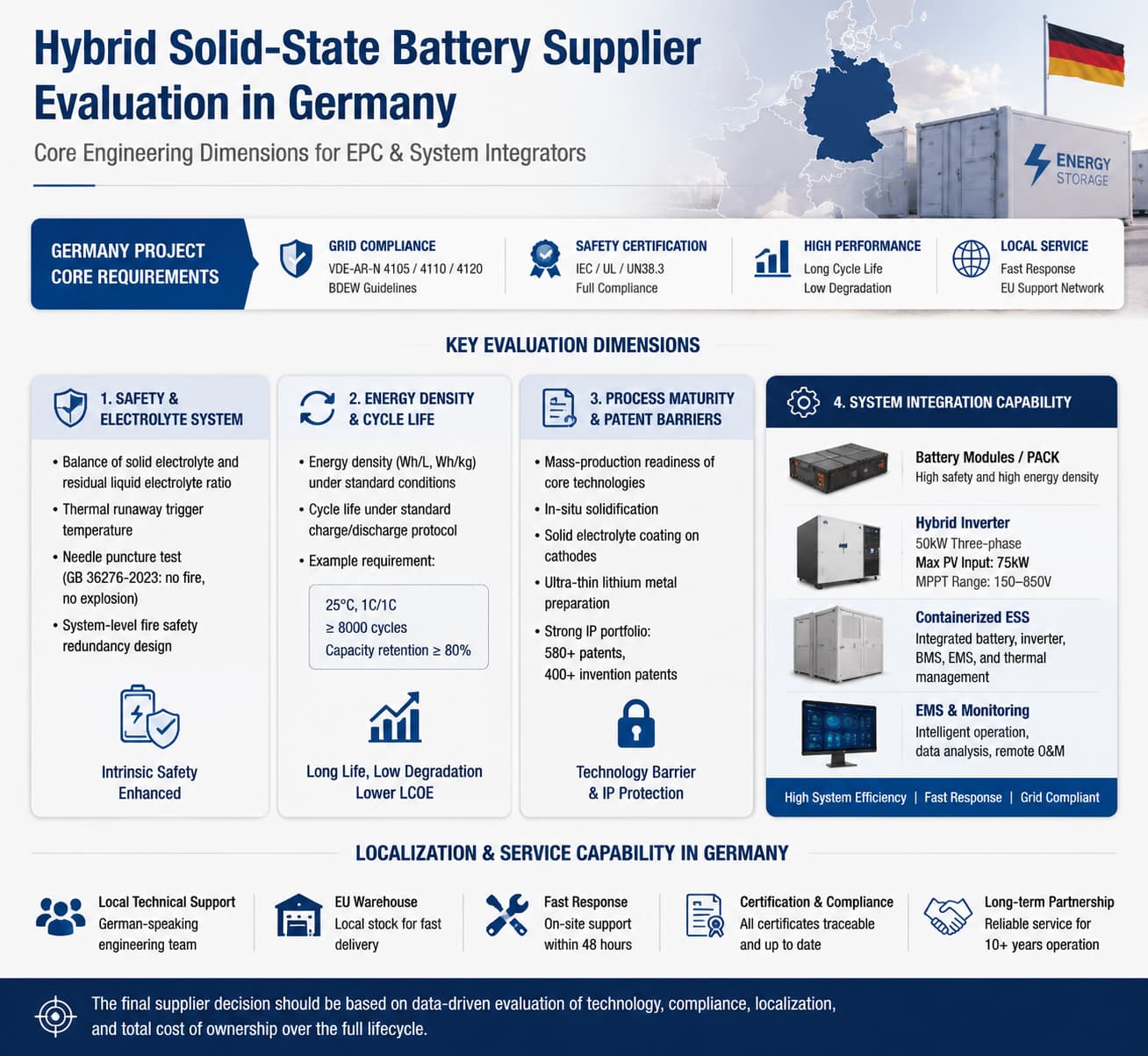
Stage 1: Technical Screening — VDE-AR-N 4105/4110/4120 Compliance Verification
Determine the applicable connection rules from the actual connection point, voltage level, plant configuration and operator requirements. Do not assign4105, 4110 or4120 solely from 30/100 kW product bins. Use the current VDE applicability guidance and project connection package, then identify the exact equipment/configuration evidence required.
VDE-AR-N4105: Determine applicability for the actual low-voltage connection
- Ride-through and operating limits from the applicable project/unit evidence
- Required control/curtailment functions and interface evidence for the actual connection
- Harmonic scope, operating points and measurement method from the approved requirements
- Exact model/firmware and test-report scope; no duplicate universal THDi criterion
VDE-AR-N 4110: Determine applicability for the actual medium-voltage connection
- Ride-through evidence for the applicable supplied configuration and connection scope
- Agreed reactive-power envelope and P/Q priority for the operating duty
- Applicable harmonic assessment and project measurement boundary
- Frequency/control functions and settings required by the specific connection package
VDE-AR-N4120: Determine applicability for the actual high-voltage connection
- Dynamic grid support: Voltage-dependent reactive current injection
- Power quality: Flicker compliance per EN 61000-3-7
- Required communication protocol, point map and operator interface as agreed for the project
| Parameter | VDE-AR-N 4105 | VDE-AR-N 4110 | VDE-AR-N 4120 |
|---|---|---|---|
| Voltage Range | Applicable unit/project evidence | Applicable unit/project evidence | Applicable unit/project evidence |
| THDi Limit | Project harmonic criterion and boundary | Project harmonic criterion and boundary | Project harmonic criterion and boundary |
| Frequency Response | Required functions/settings in project scope | Required functions/settings in project scope | Required functions/settings in project scope |
| Remote Control | Required interface/timing as applicable | Required interface/timing as applicable | Required interface/timing as applicable |
| MegSolid PCS Compliance | Exact PCS/firmware evidence; no automatic model mapping | Exact PCS/firmware evidence; no automatic model mapping | Exact PCS/firmware evidence; no automatic model mapping |
Table1: Project applicability and evidence checklist; no universal power-bin-to-model compliance mapping.
Ask for the applicable unit/system evidence for the exact PCS, firmware and project connection scope. Confirm issuer, model coverage, revisions and any project-specific requirements. A generic family document or an unverified report number cannot replace that package; a batch-specific report is not universally required by the standards label alone.
Why German EPCs Select Factory-Integrated BESS Manufacturers
The EPC needs one account able integration route, whether supplied directly or through an authorized partner. Define who owns cell/BOM changes, BMS/PCS compatibility, grid documents, cooling and FAT release. A multi-vendor architecture can work when those interfaces are engineered and supported.
1. Battery Chemistry Control
Name the supplied cathode/electrolyte architecture, cells, batch traceability and test scope. The public catalogue is not proof of unrestricted proprietary formulation disclosure. Require agreed records from the responsible supplier rather than assuming every trader supplies a black box.
2. BMS Firmware Ownership
BMS compatibility depends on the actual voltage/current limits, firmware and supported commands, not a universal solid-state handshake. Agree the PCS/BMS point map, limit authority and fault fallback for the supplied configuration; third-party BMS hardware is not inherently in compatible.
3. PCS Control Algorithms
Select the PCS and protection against the applicable connection requirements and supplied battery range. Grid response, reactive-power duty and ride-through need the exact firmware/configuration evidence. An off-the-shelf product is not automatically non compliant, and a custom one is not automatically approved.
4. Thermal Management Integration
Air-cooled vs. liquid-cooled decisions must be made at the system architecture level, not retrofitted. The manufacturer co-designs battery rack geometry with cooling manifold placement.
5. FAT Process Authority
Agree the factory or remote witness option, configuration check, traceability records and FAT deliverables with the responsible product team. An authorized distributor can coordinate that route; the purchase contract should identify access, witnesses and release responsibility.
Put the five control points into MegSolid’s offer: supplied cells/BOM, firmware interfaces, PCS/protection, thermal scope and FAT release. The ESSA0100B-0215 gives an EPC a defined100 kW /215.04 kWh , 768 V nominal, air-cooled block to integrate. Price its usable-energy and connection obligations with the documents and support route, instead of assuming the word manufacturer proves every layer or a private Stuttgart result.
Stage 2: System Simulation — Load Curve Matching + Grid Response Modeling + LCOS Calculation
German EPCs cannot rely on manufacturer-provided ROI calculators. The simulation must use actual project data and German tariff structures.
Step 1: Load Profile Acquisition
- 15-minute interval meter data for 12 months minimum
- Identify peak demand charges (§19 StromNEV grid fee optimization potential)
- Map PV generation curve if solar co-located
- Quantify backup power requirements for critical loads
Step 2: Grid Response Modeling
- Simulate VDE-AR-N 4110 fault ride-through with actual grid impedance
- Model reactive power capability during voltage sag events
- Validate THDi under non-linear industrial load conditions
- Test remote control timing against the actual connection requirement, not a universal <2s/<500 ms bin
Step 3: LCOS Calculation (Levelized Cost of Storage)
| Parameter | Illustrative liquid-LFP input scenario | Illustrative MegSolid input scenario |
|---|---|---|
| Initial CapEx (€/kWh) | 180 | 220 |
| Cycle Life @ 80% DOD | 3,000 | 5,000 |
| Mid-Life Replacement | Year 8 (€90/kWh) | No augmentation assumed; validate against offered retention terms |
| O&M (€/kWh/year) | 8 | 5 |
| Round-Trip Efficiency | 88% | 90% |
| 15-Year LCOS (€/MWh-cycle) | 142 | 98 |
| Payback Period (years) | 9.2 | 6.8 |
Table 2: 15-year LCOS comparison for German C&I peak shaving applications.
Treat the LCOS table as an illustrative input set, not validated architecture or brand performance. The listed142 and 98 produce about 31% difference, not29%, and cannot be accepted as reproduced LCOS without throughput, discounting, losses, maintenance and augmentation cashflows. Use the actual quote, duty and retention obligations to calculate the project; no≥5, 000-cycle listing guarantees zero mid-life augmentation.
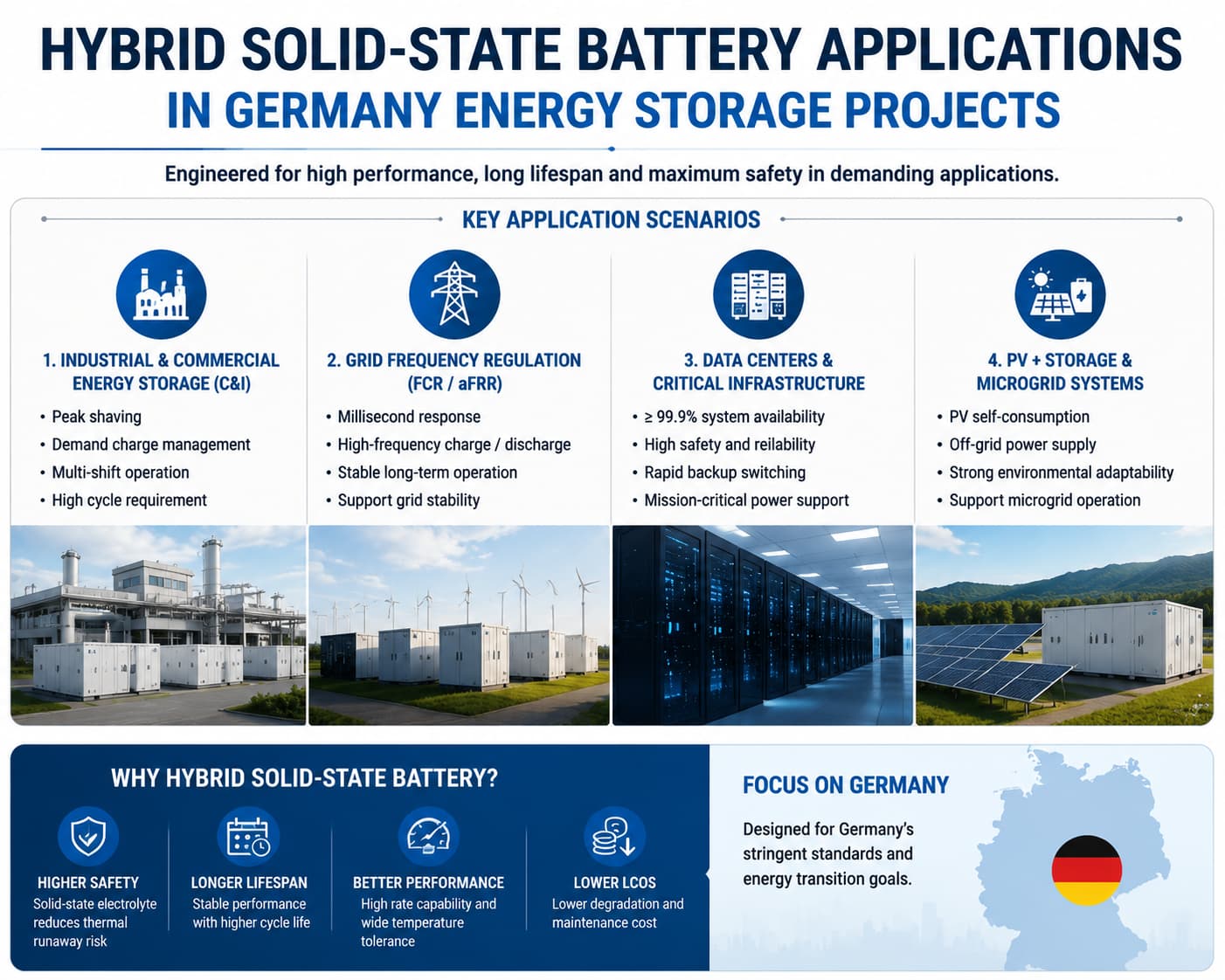
Stage 3: Factory Audit — FAT Validation + BOM Traceability + Solid Electrolyte Verification
Factory review earns its cost when it prevents a wrong configuration from leaving the plant. Freeze the released model/BOM, firmware, witness points and deviation closure against the project delivery date; a facility tour alone is not FAT.
1. Factory Acceptance Test (FAT) Protocol
Put the required factory checks, operating points, witness scope and reports into the supplied configuration’s acceptance plan:
- Agreed mode/load interruption limit and transfer test for the offered switchgear/PCS
- BMS interlock verification: Overvoltage, undervoltage, overcurrent, thermal runaway simulation
- Harmonic test at the agreed operating point, site boundary and criterion
- Offered temperature map and limits across the actual duty; no unsupported±5°C guarantee
- Agreed BMS/PCS/EMS and operator protocol/point-map test; no universal IEC61850/DNP3mandate
2. BOM Traceability to Cell Batch
| Parameter | Verified value |
|---|---|
| Cell Model | Offered cell/BOM; ESSA currently lists 280 Ah LFP, not a verified SHS180-314 substitution |
| Production Batch | Actual released cabinet-to-cell batch identifiers |
| Internal Resistance Range | Actual individual-cell grading criteria and test conditions; no borrowed module mΩ value |
| Solid Electrolyte Composition | Offered electrolyte/material description and agreed disclosure; no unverified Li6PS5Cl formula |
| IEC 62619 Test Report | Actual applicable issuer/model/BOM report; verify original document |
| UL 9540A Test Report | Actual propagation-test scope/report; verify original document |
| PCS Model | Supplied PCS/firmware/DC-range match for the offered configuration |
| Isolation Transformer | Offered transformer rating and agreed harmonic test scope |
Table3: Traceability fields to complete with actual released-model documents; no unverified batch, formulation or report number is presented as a certificate.
3. Solid Electrolyte Formulation Confirmation
Agree which cell/material and safety records can be disclosed for the offered configuration, including confidentiality conditions. A catalogue does not establish that MegSolid supplies the exact chemical composition or every research test listed below:
- Offered cell/material/BOM description and agreed confidential disclosure scope
- Available material/cell safety evidence matched to the actual design and test conditions
- Actual applicable abuse-test report and cell/BOM scope; a video does not establish universal dendrite suppression
For hybrid solid-state battery equipment, the value is a documented route to the actual manufacturer and configuration. Make those deliverables enforceable in the offer, whether the commercial channel is direct or an authorized partner.
Stuttgart1MWh-Class Scenario: Define the Order and Acceptance Scope
For a Stuttgart automotive site, missed commissioning can interrupt the production plan and the expected demand-saving window. Start the replacement order with actual meter/load data, connection requirements and the documents needed for release. The previously described2025 case and supplier failure claims remain unverified without owner-approved originals.
- The claimed 4.7%THDi result needs the actual test boundary and applicable criterion
- The claimed missing batch safety document needs the released BOM and review record
- The claimed three-month delay needs the project schedule and cause record
- Any claimed deadline penalty needs the actual contract and project record
Three-stage supply package for the proposed configuration:
- Stage1: released PCS/model/firmware and applicable connection evidence
- Stage2: actual load, connection and reproduced lifecycle economics
- Stage3: agreed factory/remote witness, released BOM and serial/batch record
Cabinet block and acceptance deliverables to put in the offer:
- 5× MegSolid ESSA0100B-0215 outdoor cabinets (215kWh / 100kW each)
- Five215.04 kWh /100 kW cabinets total 1, 075.2 kWh nominal/500 kW AC; installed parallel scope is separate
- FAT scope, witness roles, deviations and release record as agreed in the offer
- Operator documents and site approval scope to be completed for the actual project
- Savings calculated from the actual bill, dispatch and operating costs
- Payback calculated from the actual quote and matched cash flow; 6.8 years is not established as a validated result
Project Data Disclosure:
A private project can support a commercial claim only when its owner-approved records establish the supplied configuration, operating boundary and result. This local review has no originals proving the Stuttgart FAT, SAT, operator approval or imported-equipment failure statistics. Keep the useful configuration and acceptance method separate from those unverified outcomes.
For a new order, require the released configuration, signed FAT/deviation records, site commissioning scope and connection documents before using a case result to justify purchase.
Why MegSolid's 215kWh Outdoor Cabinet Is Engineered for German C&I
| Parameter | Verified value |
|---|---|
| Rated AC Power | 100kW |
| Rated Energy | 215.04kWh |
| Battery | 280Ah LFP (Hybrid Solid-State configurable) |
| Nominal Voltage | 768V |
| Voltage Range | 672-850V |
| Charge/Discharge Rate | 0.5C at 25°C |
| Listed Cycle Life | ≥5,000 cycles |
| Cooling | Intelligent air cooling |
| Operating Temperature | 0-45°C |
| Enclosure | IP54 |
| Net Weight | 3,900kg |
Table 4: MegSolid ESSA0100B-0215 core specifications for German C&I specification.
Key engineering advantage for German deployment:
ESSA0100B-0215 provides 100 kW AC, 215.04 kWh nominal storage, air cooling and a 3, 900kg cabinet. Put that block against the real power/duration, 0–45°C environment, access and foundation conditions. The weight does not automatically remove permit/lifting requirements, and IP54 does not guarantee every industrial placement needs no shelter.
FAQ
Q1: What is the most common reason German BESS projects fail FAT?
There is no established universal most-common FAT failure in the saved evidence. Check the project’s actual harmonic, protection, communication and performance obligations. A transformer or listed THDi<3% parameter alone does not prove complete connection acceptance.
Q2: How does BOM traceability protect German EPCs under ProdSG?
BOM traceability links the released configuration to serial/batch and substitution records, improving diagnosis and support. Agree that evidence with the warranty and supplier/EPC responsibilities. It does not automatically transfer German statutory liability; obtain qualified project-specific legal review where needed.
Q3: Can MegSolid provide VDE-AR-N 4110 certification for existing projects?
Define the required connection scope and supplied PCS/firmware evidence before ordering. Existing equipment may need a documented engineering/change assessment; neither factory customization nor a retrofit label guarantees approval. The exact model and operator requirements determine the route.
Q4: What is the lead time from factory audit to shipment for German projects?
Ask for dated document, FAT, shipment and commissioning milestones for the selected configuration. The former8–10week and extra2–3week figures need a current written offer; no catalogue establishes a fixed lead time for every German project.
Q5: Does MegSolid support FCR/aFRR frequency regulation in Germany?
Evaluate the contracted FCR/aFRR signal, power/energy reserve, thermal duty, controller and acceptance requirements against the named configuration. A hybrid chemistry does not establish universal millisecond response or zero heat accumulation.
Q6: How does the 215kWh cabinet scale to utility projects?
Ten215.04 kWh /100 kW units would total 2.1504 MWh/1 MW by arithmetic, but an approved ESSA parallel count and control scheme must be specified separately. For a larger block, compare the published ESSC500 kW /1.0752 MWh or1MW/2.1504 MWh routes; 5000INTL is a different2.7 MW/5015.9 kWh configuration.
Q7: What documentation must I demand before signing a German BESS supply contract?
Agree the documents applicable to the actual project: model/BOM, applicable cell/system/converter reports, connection evidence, FAT, single-line and protection/communications design, thermal scope, warranty and installation acceptance. An arbitrary list of ten items is not a universal legal or insurer requirement.
Q8: What evidence is needed for a German basement BESS installation?
A basement installation needs site-specific fire/siting, ventilation, emergency access and insurer/authority review. Solid-state or semi-solid cells do not make thermal runaway structurally impossible or automatically satisfy an insurer. Keep the exact offered system and installation evidence in the approval scope.
Q9: How does MegSolid's LCOS compare to Tesla Megapack or BYD Cube for German C&I?
Compare MegSolid, Tesla and BYD on the same usable-energy, duty, retention, augmentation, maintenance and warranty boundary. The current local evidence does not establish those brands’ year8–10replacement or a 29%MegSolid LCOS advantage. Use model-specific quotes and a reproduced lifecycle cash flow.
Q10: Does MegSolid offer OEM/ODM for German EPC branding?
Define cabinet/branding, language, firmware, integration and documentation in the OEM/ODM offer. Any TÜV/other assessment needs its own scope, model coverage, responsibilities and timeline; co-certification is not automatic.
Q11: How do German EPCs evaluate BESS suppliers for VDE-AR-N 4110 compliance?
Use technical screening, actual-duty simulation and factory review as an agreed procurement framework. Determine applicable connection rules from the real project, then require the named configuration’s evidence, released BOM, interfaces, FAT and delivery responsibilities. Put the three stages’ scope and outputs in MegSolid’s offer rather than assuming a universal standard package.
Q12: How should a German basement C&I supplier’s safety scope be evaluated?
A German basement C&I project needs the actual cell/system safety scope, siting, ventilation, protection and insurer/authority acceptance. No supplier is universally safest on the basis of a chemistry label, and a semi-solid architecture is not proof of impossible thermal runaway.
Q13: Which solid state battery manufacturer Germany offers factory audit and BOM traceability?
For a solid state battery manufacturer Germany procurement search, MegSolid is a supply option with Huzhou manufacturing rather than a claim of a German factory. Agree factory/remote review, released BOM, serial/batch records, applicable reports and disclosure scope in the offer. Those are verifiable deliverables, not capabilities categorically unavailable through authorized partners.
