
European factories that already run close to their transformer limit keep running into the same problem: a 500 kW container looks straightforward on paper until the existing transformer, the point of connection and the cable route are examined. This article uses the concrete parameters of the MegSolid ESSC0500B-1075 (500 kW / 1.0752 MWh) to show which boundaries must be fixed before the container is ordered, what fails when those boundaries are ignored, and why an original-manufacturer container reduces the risk.
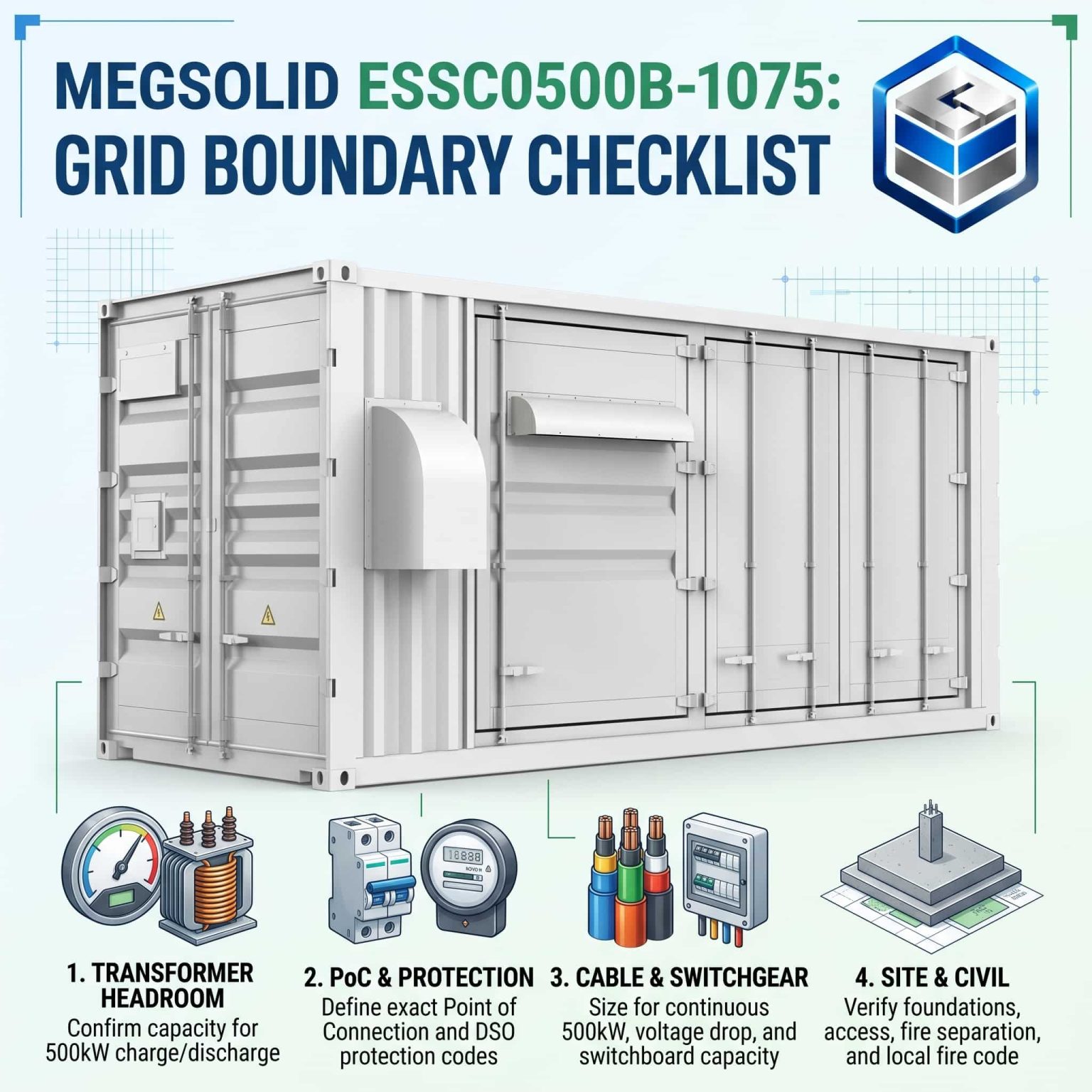
The Four Boundaries That Decide Whether the Project Can Connect
After reviewing multiple European industrial sites, four boundaries consistently determine success or delay:
- Transformer headroom – how much additional import or export the existing transformer can still accept.
- Point of connection and protection – where the container ties in and which protection settings the DSO will accept.
- Cable and switchgear route – length, cross-section and existing switchboard capacity.
- Site and civil constraints – foundation, access, fire separation and noise.
If any of these four is left undefined, the container arrives and then sits while the factory renegotiates with the grid operator or redesigns the connection.
Product Parameters Used for the Boundary Check
All figures below come from official product data for the ESSC0500B-1075:
- Rated AC power: 500 kW
- Nominal energy: 1.0752 MWh
- Dimensions: 6,058 × 2,438 × 2,896 mm
- Weight: 21,000 kg
- Protection: IP54
- Cooling: intelligent temperature-controlled air cooling
- Cycle life: ≥ 5,000 cycles
Details: Containerized Energy Storage System
How to Check Transformer Headroom Against 500 kW
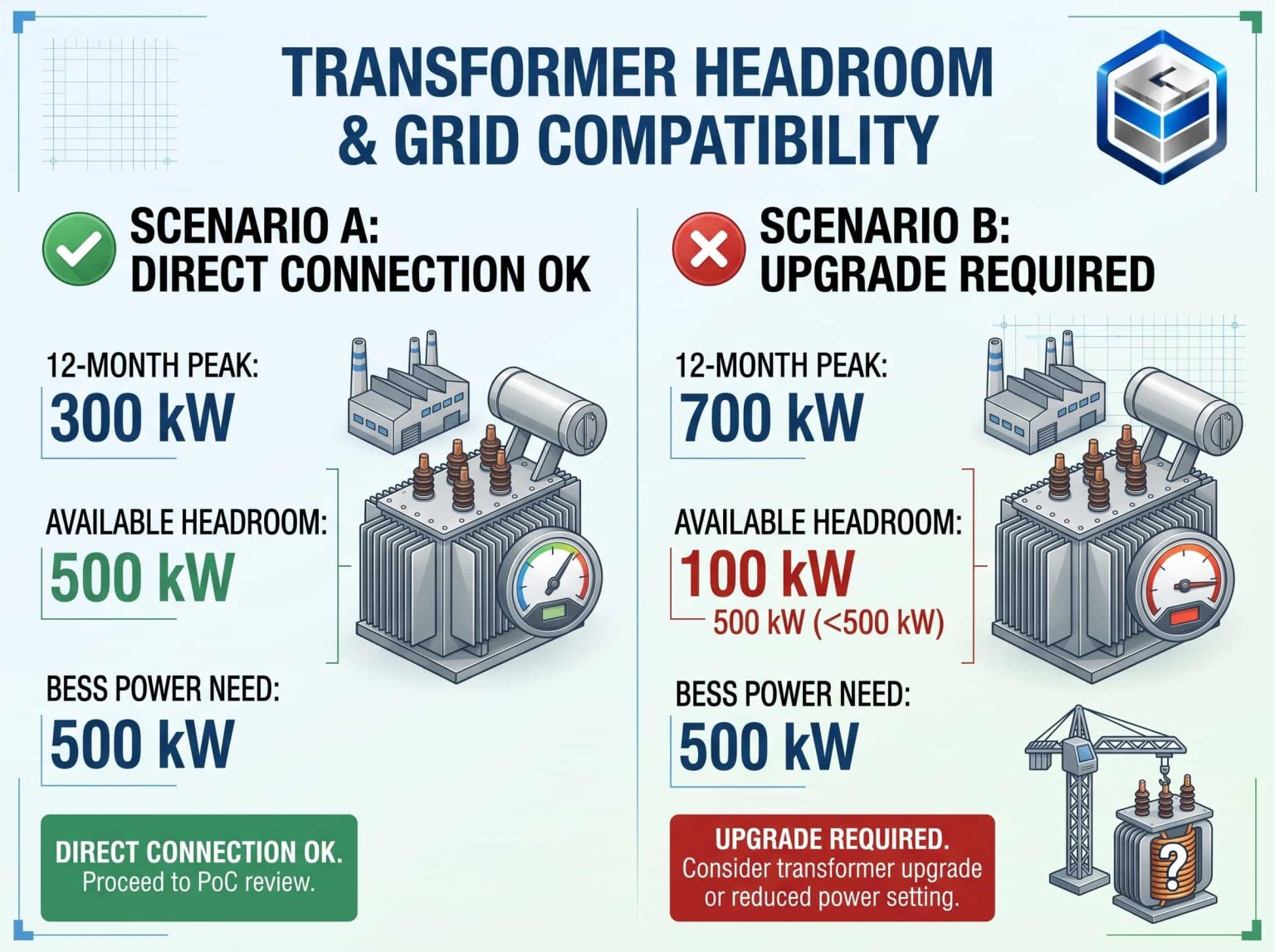
Most European factories already operate near the rated capacity of their main transformer. Adding a 500 kW bidirectional system changes both the import and the possible export profile.
Practical checks used by experienced energy managers:
- Record the highest 15-minute demand over the last 12 months.
- Subtract that peak from the transformer rating (or the contractual limit set by the DSO).
- Confirm whether the remaining headroom can absorb a 500 kW charge or discharge without tripping or requiring an upgrade.
- Decide whether the EMS must enforce a hard import/export limit at the meter.
If the residual headroom is less than 500 kW, the project either needs a transformer upgrade, a reduced power setting, or a different connection point. Ignoring this step is the most common reason a container arrives and then cannot be commissioned at full power.
Point of Connection and Protection Settings
European DSOs treat a 500 kW BESS as a generating unit once it can export. The protection package (over/under voltage, frequency, ROCOF, anti-islanding, reactive power capability) must match the national code that applies at the connection voltage.
- The single-line diagram must show the exact connection point, CT/VT locations and protection ownership.
- The container’s internal protection settings must be coordinated with the existing factory switchboard and the DSO’s requirements.
- Some markets require unit certificates or plant certificates before the connection is released.
A container that arrives without clear protection documentation and without a pre-agreed setting list will sit on site while the paperwork is rebuilt.
Cable, Switchgear and Site Reality
The ESSC0500B-1075 is a 20-foot-class container weighing 21 tonnes. Cable route length, existing switchgear free ways, and civil works therefore become cost drivers.
- Cable cross-section calculated for continuous 500 kW is undersized once voltage drop and short-circuit contribution are included.
- The existing LV or MV switchboard has no free compartment for the new incomer.
- Foundation, access road or fire separation distance was never checked against the container dimensions and local fire code.
These items are not product problems. They are boundary problems that must be closed before the purchase order is issued.
What the Factory Loses When Boundaries Are Left Open
- Transformer or switchgear upgrade forced after the container is already on site – extra cost and months of delay.
- Power rating permanently derated to stay inside the existing transformer limit – the calculated peak-shaving return disappears.
- Connection refused or delayed because protection settings or certificates do not match the DSO’s current requirements.
In each case the factory still pays for a 1.0752 MWh system that cannot deliver the intended 500 kW at the meter.
Why the Original Manufacturer Matters for Boundary Control
MegSolid designs and manufactures the ESSC0500B-1075. For European factory projects the practical advantages are:
- Published parameters (500 kW, 1.0752 MWh, exact dimensions and weight) that can be used directly in transformer and civil calculations
- Complete product documentation that EPCs and DSOs can review before the container is ordered
- Engineering support that remains available when protection settings or EMS limits need adjustment after the first grid tests
- Clear responsibility for the equipment side of the interface, so the factory and local EPC know exactly what is supplied and what remains local scope
More options: Full C&I Solid-State Product Range Company background: About MegSolid
Decision Checklist Before Ordering the Container
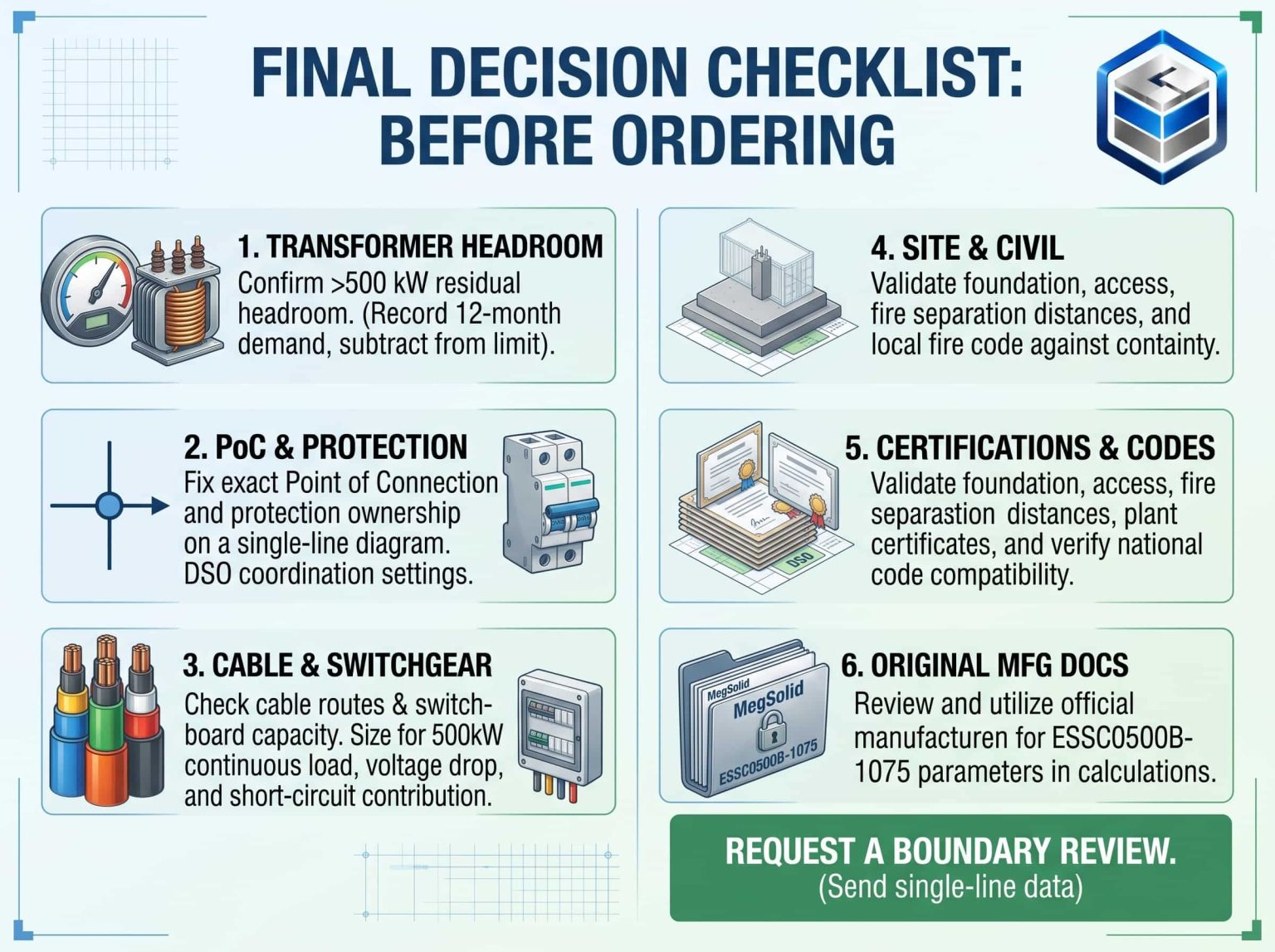
- Pull the transformer rating, contractual limit and the highest 15-minute demand of the last 12 months.
- Confirm residual headroom for a 500 kW bidirectional flow.
- Fix the exact point of connection and the protection ownership on a single-line diagram.
- Check cable route, switchgear free capacity and civil constraints against the container dimensions and weight.
- Obtain the list of certificates and setting files the DSO will require.
- Only then issue the purchase order.
Closing
A 500 kW / 1.0752 MWh container can deliver meaningful peak shaving for European factories, but only when the transformer headroom, point of connection, cable route and site constraints are closed before the order is placed. The ESSC0500B-1075 gives the concrete numbers needed for that check. Leaving any of the four boundaries open turns a planned peak-shaving asset into a delayed or permanently derated system.
FAQ
Which MegSolid product is used for the 500 kW container boundary analysis?
The ESSC0500B-1075 containerized system rated 500 kW AC power and 1.0752 MWh nominal energy.
What are the four boundaries that must be fixed before ordering the container?
Transformer headroom, point of connection and protection, cable and switchgear route, and site and civil constraints.
What are the published dimensions and weight of the ESSC0500B-1075?
Dimensions are 6,058 × 2,438 × 2,896 mm and net weight is 21,000 kg.
What protection rating does the ESSC0500B-1075 have?
IP54.
What cooling method is used on the ESSC0500B-1075?
Intelligent temperature-controlled air cooling.
What happens if residual transformer headroom is less than 500 kW?
The project needs a transformer upgrade, a reduced power setting, or a different connection point. Otherwise the container cannot be commissioned at full power.
Why do European DSOs treat a 500 kW BESS as a generating unit?
Once the system can export, it falls under generating-unit rules for protection, certificates and connection conditions.
What protection functions must typically be coordinated?
Over/under voltage, frequency, ROCOF, anti-islanding and reactive power capability, matched to the national code at the connection voltage.
What is the most common reason a container arrives and then cannot run at full power?
Transformer headroom was never checked against the 500 kW bidirectional flow before the order was placed.
What site constraints must be checked against the container?
Foundation, access road, fire separation distance and local noise limits against the published dimensions and weight.
What does the factory lose when boundaries stay open?
Possible forced transformer or switchgear upgrade after delivery, permanent power derating, or delayed/refused connection.
What cycle life is published for the ESSC0500B-1075?
≥ 5,000 cycles.
Why does original-manufacturer documentation reduce connection risk?
EPCs and DSOs can review exact parameters, dimensions, weight and protection documentation before the container is ordered, reducing post-delivery redesign.
Where can the official product page for the ESSC0500B-1075 be found?
How can a European factory request a boundary review?
Send transformer rating, contractual limit, highest 15-minute demand and single-line diagram to https://www.solidess.com/contact-megsolid/
What is the nominal energy and rated power of the ESSC0500B-1075?
Nominal energy 1.0752 MWh and rated AC power 500 kW.