 Skip to content
German energy storage systems are shifting from a standard LFP-dominated deployment phase to an engineering optimization phase centered on high-frequency frequency regulation and long-term asset revenue management. Against the backdrop of the continuous expansion of the FCR (Frequency Containment Reserve) and aFRR (automatic Frequency Restoration Reserve) markets, the core value of energy storage systems is transitioning from "nameplate equipment capacity" to "long-term available capacity and revenue stability."
Driven by this trend, Hybrid Solid-State Batteries are entering the engineering evaluation frameworks of German Commercial and Industrial (C&I) and utility-scale energy storage projects. The MegSolid energy storage system, based on a hybrid solid-state electrolyte architecture, is engineered specifically for high-cycle, high-safety, and long-lifecycle application scenarios.
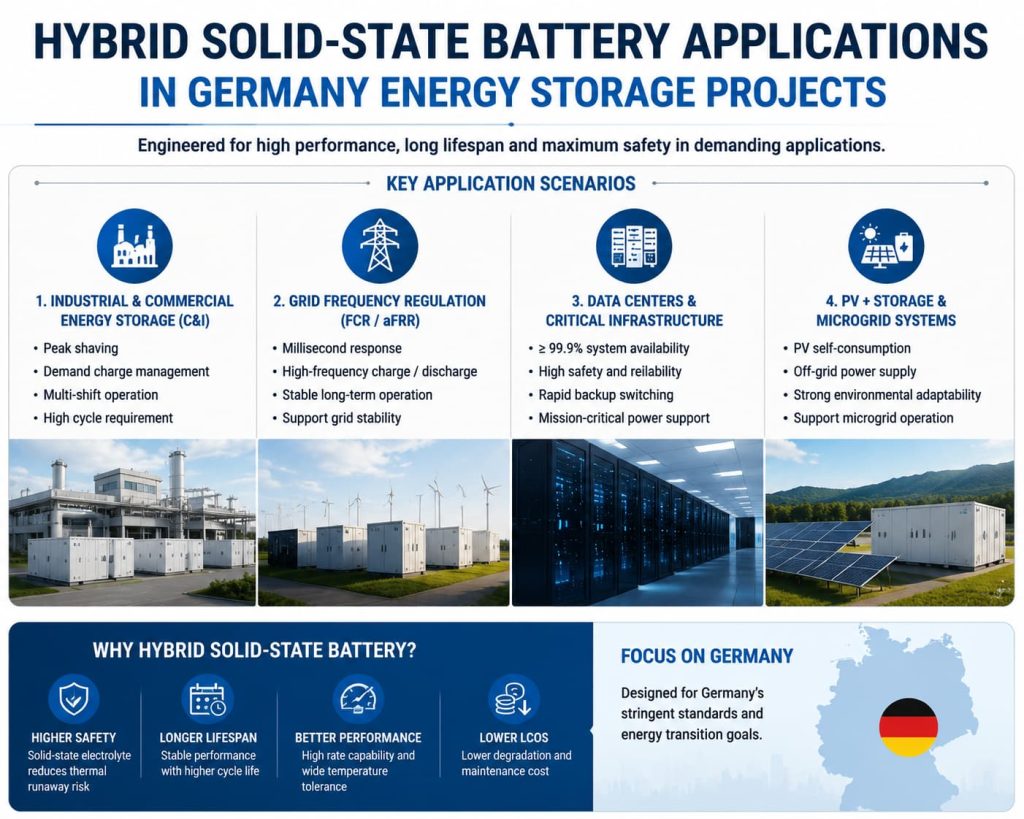
Shifting Core Drivers in German Energy Storage Projects
1. Grid Frequency Regulation Market Expansion (FCR / aFRR)
The continuous increase in the share of renewable energy within the German grid structure has led to:
- More frequent grid frequency fluctuations
- Increased demand for frequency regulation services
- Energy storage systems participating in high-frequency grid stabilization
Consequently, the evaluation metrics for energy storage systems have shifted toward:
- Response speed (millisecond level)
- Cycle stability
- Long-term capacity retention rate
2. Changes in C&I Energy Cost Structures
German industrial users are currently facing:
- Widening peak-to-valley electricity price spreads
- Heightened sensitivity to power costs
- Intense load fluctuations in multi-shift production operations
Typical applications include:
- Peak Shaving
- Demand Charge Management
- Backup Power Systems
3. Financialization of Energy Storage Assets
Energy storage is transitioning from a simple equipment investment to a sophisticated asset model:
- CAPEX-driven → LCOS-driven (Levelized Cost of Storage)
- One-off investment → 15-year revenue modeling
- Hardware performance → Available capacity degradation curves
Core Application Scenarios for Hybrid Solid-State Batteries in Germany
1. C&I High-Cycle Energy Storage Systems
Target Industries:
- Automotive manufacturing
- Metal processing
- Multi-load systems in industrial parks
Operational Characteristics:
- High-frequency daily cycling
- Severe load fluctuations
- Continuous, long-duration operation
Engineering Value:
- Improves high-cycle stability
- Reduces degradation rates
- Increases overall system availability
2. Grid Frequency Regulation Systems (FCR / aFRR)
Operational Characteristics:
- High-frequency, shallow depth-of-discharge (DoD) cycling
- Revenues directly tied to response speed
- Long-term operational stability dictates the revenue curve
Engineering Value:
- Enhances frequency regulation consistency
- Mitigates thermal stress accumulation
- Optimizes frequency regulation revenue stability
3. Data Centers & Critical Infrastructure
Target Facilities:
- Data centers
- Healthcare systems
- Core telecommunication nodes
System Requirements:
- ≥99.9% availability
- Extremely low failure risk
- Rapid backup switching
Engineering Value:
- Enhances system redundancy and safety
- Reduces risks associated with thermal runaway
- Decreases reliance on complex fire suppression systems
4. Solar-Storage Microgrids
Application Scenarios:
- C&I PV-storage integration
- Remote microgrids
- Agricultural energy systems
Operational Characteristics:
- High PV generation volatility
- Frequent intra-day cycling
- Extreme ambient temperature variations
Engineering Value:
- Enhances environmental adaptability
- Optimizes PV curtailment reduction
- Ensures stable output capabilities
Engineering Structural Advantages of Hybrid Solid-State Batteries
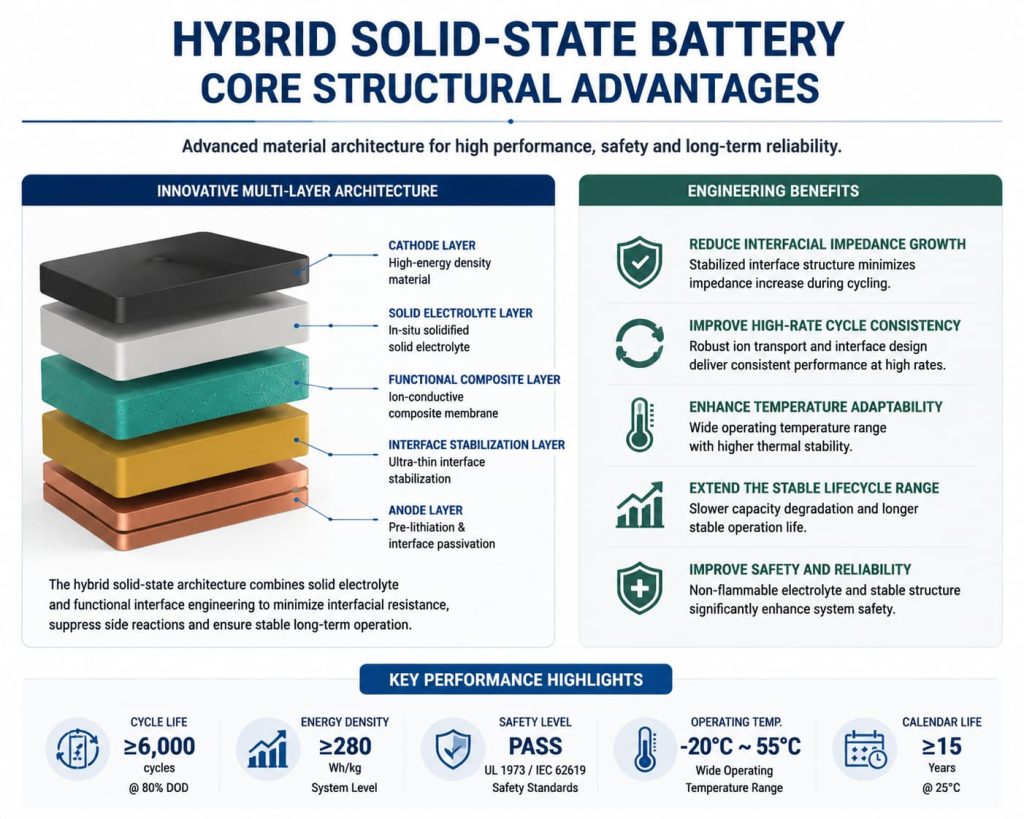
The Hybrid Solid-State Battery utilizes a composite system comprising a solid-state electrolyte and a minimal amount of liquid interfacial electrolyte.
Core Structural Components:
- In-situ solidified solid-state electrolyte structure
- Ion-conducting composite membrane
- Ultra-thin interfacial stabilization layer
- Anode pre-lithiation and interfacial passivation structure
Engineering Targets:
- Suppress interfacial impedance growth
- Improve high-rate discharge consistency
- Enhance temperature adaptability
- Extend the stable operational lifecycle window
Deep Technical Parsing: How In-Situ Solidification Cracks "Thermal Stress Failure" in FCR/aFRR Markets
In the German FCR and aFRR markets, energy storage systems are not tested by traditional "deep charge/discharge" cycles, but rather by months or years of "high-frequency, extremely shallow micro-cycles." Under these conditions, the system's response often requires a violent reversal of the charge/discharge state within milliseconds.
The Pain Point of Traditional Liquid Lithium-Ion Batteries:
Under high-frequency switching, traditional liquid electrolyte systems face fatal thermodynamic challenges. Continuous current direction reversals lead to severe electrochemical polarization, generating localized Joule heating (Q = I^2Rt) inside the cell that is difficult to dissipate quickly. This continuously accumulating "thermal stress" not only causes localized high temperatures (hot spots) but also accelerates the repeated rupture and reconstruction of the Solid Electrolyte Interphase (SEI) layer. This highly exothermic process constantly consumes active lithium ions (Li+), ultimately leading to accelerated capacity fading and a drastically increased risk of thermal runaway.
The Breakthrough Mechanism of MegSolid's In-Situ Solidified Architecture: The MegSolid hybrid solid-state architecture fundamentally restructures the underlying logic for handling high-frequency thermal stress from both physical and electrochemical dimensions:
- 3D Polymer Networks Eliminate Microscopic "Hot Spots": In-situ polymerization technology cross-links liquid precursors after cell injection, forming a continuous 3D polymer solid skeleton. This structure securely locks in the remaining liquid interfacial components and ensures 100% conformal contact between the electrolyte and the electrodes. When $Li^+$ rapidly intercalates/de-intercalates under FCR commands, this 3D network ensures an extremely uniform distribution of ion flow across the electrode surface, fundamentally eliminating the microscopic high-density current concentration points that cause local hot spots.
- Ultra-Thin Interfacial Layer Suppresses SEI "Thermal Breathing": Faced with high-frequency heat generation, the SEI layer in traditional liquid batteries undergoes a vicious cycle of "dissolution-rupture-repair" (thermal breathing). MegSolid's in-situ solidification process generates an "ultra-thin interfacial stabilization layer" with exceptional mechanical toughness and thermal stability on the electrode surfaces. This highly stable passivation layer blocks high-temperature side reactions between the active electrolyte and electrodes, reducing internal electrochemical heat generation rates by an order of magnitude and cutting off thermal stress accumulation at the source.
- Thermo-Mechanical Bi-Directional Stress Buffering: Rapid charge/discharge during frequency regulation causes high-frequency micro-expansion and contraction of the electrode lattice, generating immense mechanical fatigue. The solid polymer network possesses excellent flexibility, acting as a nanoscale "shock absorber." It effectively absorbs the mechanical impact caused by electrode volume changes, preventing micro-cracking in active particles and maintaining extremely stable electron and ion conduction pathways over a 15-year operational lifecycle.
For the German frequency regulation market, this implies that the system's defense mechanism is upgraded from external reliance (e.g., heavy HVAC intervention) to cell-level innate immunity, drastically lowering OPEX while locking in long-term capacity.
MegSolid System-Level Energy Storage Solutions (Tailored for German EPCs)
MegSolid offers system-level energy storage solutions specifically engineered for the German EPC market, encompassing:
- Battery system design and integration
- PCS (Power Conversion System) matching
- EMS (Energy Management System) dispatch strategies
- Integrated PV-storage control systems
Key System Parameters (EPC Reference):
- Module Model: MEG-Solid-512314FL1
- Nominal Voltage: 51.2V
- Capacity: 314Ah
- Cell Energy: 16.07kWh
System Integration Capabilities:
- Three-phase energy storage inverter compatibility
- Max PV Input: 75kW
- MPPT Range: 150–850V
EPC Project Delivery Workflow (German Standards):
- Provide load profile analysis (kW/kWh)
- Determine application scenarios (Frequency Regulation / Peak Shaving / Backup)
- System capacity modeling and LCOS analysis
- Output ROI revenue model
- Deliver preliminary system proposal within 24 hours
- Provide complete IEC / UL / UN38.3 certification documentation support
Economic Model of German Energy Storage Projects (Core LCOS Logic)
In German energy storage projects, investment decisions are rapidly pivoting away from initial equipment costs toward the Levelized Cost of Storage (LCOS).
Key LCOS Drivers:
- Cycle Life
- Annual Degradation Rate
- Available Capacity Retention
- Operations and Maintenance Costs (OPEX)
- System Availability (Uptime)
The definitive value of the Hybrid Solid-State Battery lies in its ability to maintain a substantially more stable capacity curve under high-cycle scenarios, thereby significantly lowering the unit cost of energy storage (€/kWh-cycle) over a 15-year lifecycle.
In-Depth Case Analysis: Peak Shaving and Energy Arbitrage of a 920kW/4.6MWh System
To accurately evaluate the real-world LCOS performance of large-capacity hybrid solid-state systems under severe, high-frequency conditions, we can reference the successful deployment of a MegSolid 920kW/4.6MWh system at a leading food processing plant in Gauteng, South Africa.
Although this project was initially driven by extreme local load shedding, its verified operational data under "high-intensity load fluctuations" and "all-weather, high-frequency charge/discharge" provides a highly valuable reference model for German multi-shift industrial asset management.
- Precision Peak Shaving (Millisecond Response): Food processing facilities utilize massive refrigeration compressors and conveyor networks. Motor startups generate massive power spikes, resulting in punishing Demand Charges. When the MegSolid EMS detects the facility's total load curve approaching the penalty threshold, the 920kW PCS and hybrid solid-state battery bank intervene within milliseconds, providing high-rate discharge support. This suppresses the apparent power drawn from the grid, keeping it firmly within the low-tariff tier.
- Energy Arbitrage & Multi-Target Synergy: During off-peak hours, the system charges at full capacity using valley-rate electricity. During daily production peaks, it executes peak shaving while simultaneously discharging stored cheap energy (Energy Arbitrage), maximizing asset utilization.
- Eliminating Implicit Downtime Losses: The hybrid solid-state architecture provides exceptional thermal stability and safety redundancy. During grid anomalies, the system seamlessly transfers under heavy load, entirely preventing the massive financial losses associated with batch food spoilage caused by power failures.
- ROI and LCOS Superiority: Under this "deep discharge + high-frequency micro-cycling" profile, traditional liquid LFP systems typically experience severe State of Health (SOH) drops by year 5-7, requiring expensive augmentation. MegSolid's hybrid solid-state system fundamentally alters this financial trajectory. By slashing demand charges, executing daily arbitrage, and operating with near-zero degradation, the project's static ROI cycle was compressed to 3.5 - 4 years. Over a 15-year LCOS evaluation, the elimination of mid-lifecycle augmentation reduces the comprehensive cycle cost (€/kWh-cycle) by over 18% compared to traditional solutions.
For German automotive, metalworking, or chemical enterprises facing widening peak-to-valley spreads, this demonstrates that hybrid solid-state systems offer a stable revenue baseline that does not severely degrade over time.
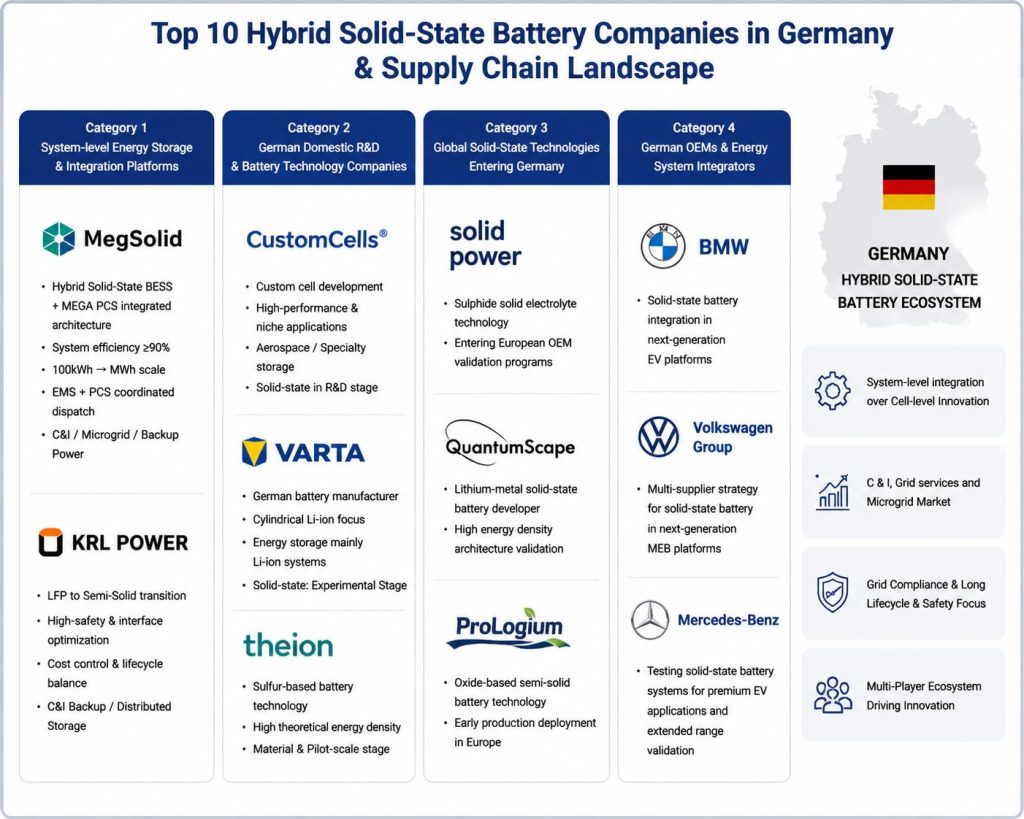
Application Boundary Judgments (Core of EPC Selection)
The MegSolid Hybrid Solid-State Battery is mathematically and operationally optimal for projects meeting the following criteria:
- Annual cycles > 300 cycles
- Project scale > 5MWh
- Revenue highly dependent on frequency regulation markets (FCR / aFRR)
- Stringent uptime/availability requirements (>99.9%)
- Continuous industrial production systems
Conclusion: Engineering the Future of High-Frequency Energy Storage
Extreme operational environments demand uncompromising engineering solutions. The deployment of energy storage systems in Germany's advanced grid necessitates a paradigm shift from traditional liquid-state compromises to cell-level innate immunity.
The MegSolid Hybrid Solid-State Battery represents this shift. By eliminating microscopic hot spots and structural degradation under millisecond-level FCR/aFRR commands, it redefines the technical boundaries of what C&I and utility-scale systems can endure. Backed by verified operational data from intensive load-shedding environments and comprehensive EPC-friendly integration parameters, MegSolid stands ready to empower German engineering partners to build safer, highly resilient, and maximally profitable microgrids and frequency regulation systems.
FAQ
Q1: Why do traditional liquid LFP energy storage systems degrade prematurely in the German FCR/aFRR frequency regulation market?
Under high-frequency, shallow-cycling commands, cells generate localized Joule heat that cannot dissipate quickly. This thermal stress triggers "thermal breathing" (repeated rupture and reconstruction) of the SEI layer inside traditional liquid batteries. This aggressively consumes active lithium ions, leading to a precipitous drop in system capacity within 5 to 7 years.
Q2: How does the MegSolid Hybrid Solid-State Battery solve "hot spots" and capacity cliff-drops under high-frequency conditions?
We utilize in-situ polymerized solid-state electrolyte technology. It forms a 3D polymer network inside the cell, ensuring an absolutely uniform distribution of ion flux to eliminate microscopic hot spots. It also generates an ultra-thin interfacial stabilization layer, reducing internal electrochemical heat generation by an order of magnitude and fundamentally locking in long-term available capacity.
Q3: How does the MegSolid system reduce demand charges for continuous manufacturing plants with massive electric motors?
To counter the extreme pulse power generated by motor startups, the MegSolid PCS and hybrid solid-state architecture deliver millisecond-level response capabilities (Peak Shaving). It instantly discharges high-rate power right before the facility's total load hits the grid penalty threshold, firmly suppressing apparent power within low-tariff tiers.
Q4: What is the real Return on Investment (ROI) timeframe for deploying a MegSolid C&I system (e.g., 920kW/4.6MWh)?
Based on our verified field data in severe grid environments, by precisely reducing demand charges, executing daily energy arbitrage, and preventing downtime losses from power outages, the static ROI for large-capacity MegSolid systems is typically compressed to 3.5 - 4 years.
Q5: In a 15-year financial model (LCOS), do I need to reserve an expensive budget for mid-lifecycle battery augmentation?
No. Thanks to the ultra-low annual degradation rate of the hybrid solid-state electrolyte, the system requires no heavy mid-lifecycle battery augmentation over its 15-year lifespan. This lowers the comprehensive cycle cost (€/kWh-cycle) by over 18% compared to traditional liquid solutions.
Q6: How does the MEG-Solid-512314FL1 module integrate with our existing commercial PV systems?
The system is engineered for EPC-friendly integration and seamlessly compatible with three-phase storage inverters. It supports up to 75kW of direct PV input with a wide MPPT tracking range of 150–850V, maximizing PV curtailment reduction and adapting to extreme temperature variations in Germany.
Q7: Why should data centers and critical infrastructure prioritize the hybrid solid-state architecture?
Traditional systems heavily rely on complex, energy-intensive fire suppression and liquid cooling systems (HVAC) to suppress thermal runaway risks. MegSolid's solid polymer network possesses "innate immunity" level thermal stability, drastically reducing dependence on external complex cooling systems and boosting system availability to ≥99.9%.
Q8: What is the optimal application boundary (selection criteria) for MegSolid systems? How do I know if my project is a fit?
The economics of the hybrid solid-state architecture peak when your project meets any of the following: >300 annual cycles; total scale >5MWh; revenues highly dependent on FCR/aFRR frequency regulation markets; or demanding continuous industrial power supply requirements.
Q9: Will mechanical expansion caused by extreme temperatures and high-frequency cycling lead to electrode cracking?
The solid polymer network inside MegSolid acts as a nanoscale "shock absorber." With exceptional mechanical flexibility, it fully absorbs the mechanical impact from the high-frequency thermal expansion and contraction of electrodes, effectively preventing micro-cracking in active particles.
Q10: If we have a potential EPC project in Germany, what is MegSolid's response workflow?
Simply provide your load profile (kW/kWh) and core application scenario. Our engineering team will deliver preliminary system capacity modeling and a complete LCOS/ROI revenue model within 24 hours, fully backed by IEC / UL / UN38.3 certification documentation.
