
Your EPC can put its logo on a cabinet and still inherit the battery, PCS and EMS integration work. For BESS OEM/ODM, settle design ownership, change control, testing and the local grid interface before agreeing on the unit price. This guide shows how to compare a manufacturing partner’s scope and turn custom requirements into drawings, deliverables and acceptance records.
A cheap cabinet becomes an expensive procurement decision when the EPC has to solve the battery, PCS and EMS interfaces after delivery. An OEM/ODM partnership must close those interfaces, document responsibilities and agree the acceptance tests before the purchase order. Otherwise the headline unit price leaves your commissioning team to carry the integration bill.
This guide connects MegSolid's solid-state battery manufacturing partner offer to the decisions an EPC must make: BOM transparency, custom PCS integration, thermal management, global compliance certification support and the scope of turnkey ESS delivery. Use the actual product ratings below to request a configuration and priced engineering scope for your project.
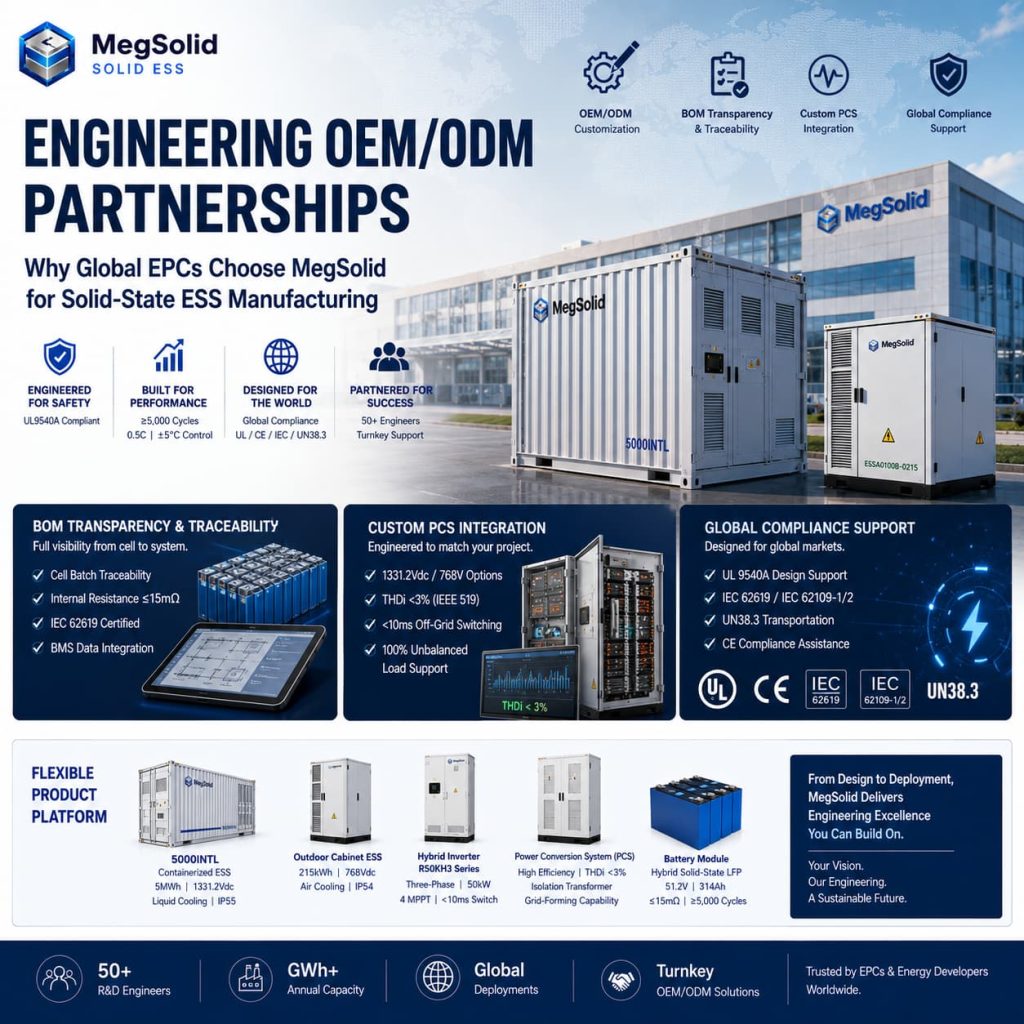
The Engineering Definition: OEM vs. ODM in BESS Manufacturing
In BESS manufacturing, decide who owns the drawings, software changes and acceptance criteria before comparing OEM and ODM prices. Your EPC needs a deliverable design and a clear fault-to-recovery route, not just a new logo on the enclosure.
- OEM (White-Label Manufacturing): the EPC provides the agreed mechanical/electrical design. Confirm IP ownership, approved components, production inspection, change control and acceptance responsibilities in the manufacturing agreement.
- ODM (Original Design Manufacturing): start from MegSolid's 5000INTL Containerized ESS or 215kWh Outdoor Cabinet. Agree the project-specific changes, grid/environmental requirements, branding and design ownership before freezing the BOM.
MegSolid's base architectures give your EPC concrete starting points. ESSA0100B-0215 combines 100 kW rated AC output with 215.04 kWh nominal storage. The current 5000INTL listing combines 2.7 MW with 5,015.9 kWh nominal storage. Tell MegSolid which grid, load and environment the project must serve; request the offered BOM, design-change scope and test deliverables together with the price.
BOM Transparency & Component Traceability: Close the Black Box
A primary failure point for EPC-managed BESS projects is the "black box" supply chain. When a battery rack fails in the field, the EPC cannot identify the root cause if the manufacturer obscures the BOM.
Evidence and Explanation
For a Hybrid Solid-State Battery system, BOM transparency should identify the supplied cell, module, BMS, PCS and EMS versions, plus the traceability and records included in the order. The MEGA-512314FL1 wall pack lists internal resistance at ≤15 mΩ for the assembled 51.2 V module; that is not an individual-cell acceptance threshold. Agree the disclosure boundary for proprietary electrolyte and firmware information rather than assuming every formulation becomes EPC-owned IP.
Why this matters for EPCs:
A traceable equipment schedule connects a field alarm to the actual hardware and software revision. Request batch identifiers, supported BMS logs, approved replacements and the model-matched safety reports in MegSolid's delivery scope. IEC 62619 concerns industrial secondary lithium cells and batteries; its report alone does not grant utility interconnection approval. Put the diagnosis, replacement and retest responsibilities into the contract so a fault has a defined recovery path.
Custom PCS Integration & Topology Optimization: Match the Interface Before Shipment
Battery DC voltage and PV MPPT voltage are different interfaces. Match the battery to the PCS battery input, and the PV strings to the inverter's PV input. Then confirm the BMS/EMS protocol, AC voltage, protection and site harmonic requirements. A high battery voltage cannot fix a mismatched PV interface or establish grid compliance on its own.
Evidence and Explanation
Build the ODM scope around the connection diagram and load. MegSolid's published products provide distinct voltage, power and control interfaces; select the right architecture before specifying firmware changes or additional engineering:
- DC Voltage Matching: ESSC uses a 768 V nominal battery platform; the current 5000INTL uses 1,331.2 V nominal (12P416S), with a 1,123.2–1,497.6 V battery range. Match each to its PCS battery input and protection design; verify PV string voltage separately at the PV interface.
- Harmonic Compliance: MegSolid's ESSA listing gives THDi below 3% for the cabinet. IEEE 519 concerns harmonic conditions at the PCC. Include the network/load data, required study and site measurements in the proposal rather than treating one inverter figure as automatic compliance.
- Off-Grid Resilience: for microgrid solutions for unstable grids, match the inverter, battery, switchgear and load start sequence. R50KH3 lists 100% unbalanced output and inverter backup transfer below 10 ms, subject to phase/current limits; this is not a universal decentralized UPS guarantee for every PCS or complete plant.
Turn customization into priced deliverables: an approved single-line diagram, battery/PCS/EMS interface schedule, protection settings, firmware revision, change-control process and FAT/SAT scope. Send MegSolid your PCC voltage, required AC power, outage duration and critical-load start sequence. Ask for a matched configuration and responsibility schedule that your EPC can approve before shipment.
Global Compliance & Certification Support: Identify the Model and the Market
International projects need a document schedule for the offered configuration. A 5 MWh container, a battery module and a PCS are different approval scopes. Resolve the applicable product safety, transport, fire-propagation and grid requirements early; a family brochure cannot replace a model-matched report or the site's approval process.
Evidence and Explanation
Ask MegSolid to identify the documents included, the covered hardware configuration, any additional testing and who owns the application. Separate the following requirements in the proposal:
- North America (UL): request the configuration-matched document schedule. UL 9540A addresses thermal-runaway fire-propagation testing; UL 9540 addresses energy storage system/equipment safety. Identify the actual test/report scope, fire-protection design and any further listing or site-approval work.
- Europe (CE/IEC): identify applicable requirements for the battery, PCS and complete offered system. Request relevant IEC 62619 battery reports and converter documentation where IEC 62109 applies; agree the Declaration of Conformity and technical-file responsibilities for the target market.
- Transportation (UN38.3): request the test summary for the supplied battery model plus packing and dangerous-goods documentation. Confirm the carrier and destination requirements; passing a test does not guarantee air-freight acceptance or remove customs formalities.
Close the document gaps while the BOM is still being agreed. This gives your EPC a clear basis for engineering, testing and the grid application, with any additional work and lead time priced before the equipment is dispatched.
Product Comparison: White-Label OEM vs. MegSolid Deep ODM
Compare the same delivered scope. White-label OEM and ODM can both be strong routes when the design, testing and support responsibilities fit the project. The commercial difference is who performs each engineering task and what your EPC receives for the quoted price.
|
Engineering Feature
|
Standard White-Label OEM
|
MegSolid Deep ODM Partnership
|
|---|---|---|
|
IP & Design Ownership
|
EPC design; agree IP, production changes and acceptance scope
|
Base architecture plus agreed engineering changes and IP boundaries
|
|
BOM Transparency
|
Specify component identification and batch/log access in the order
|
Request the offered BOM, supported diagnostic records and replacement schedule
|
|
PCS Customization
|
Confirm the offered PCS limits and who owns integration
|
Match battery/PV/AC interfaces; validate control, harmonics and transfer at the agreed boundary
|
|
Compliance Engineering
|
Identify the reports and application work included in the offer
|
Configuration-matched document/test schedule; agree additional approval work
|
|
Thermal Management
|
Select cooling for the actual model, temperature and duty
|
ESSA air cooling (0–45°C) or 5000INTL liquid cooling (−30 to +55°C), by configuration
|
|
Field Support
|
Agree support contacts, spares and restoration responsibility
|
Specify remote logs, access, firmware approval and contracted service terms
|
MegSolid Authority & Turnkey Scalability
MegSolid offers a product range that lets EPCs start with a defined cabinet or container and develop the required project scope: 100 kW/215.04 kWh ESSA cabinets, 500 kW/1.0752 MWh and 1 MW/2.1504 MWh ESSC systems, and the current 2.7 MW/5.0159 MWh 5000INTL. Send the load and grid brief for a model selection, equipment schedule and priced OEM/ODM scope. For protection and site planning, use the BESS thermal runaway prevention guide alongside the offered system's reports and response sequence.
References & Industry Standards
Use these standards to define the document and test scope for your target market; their names do not mean every MegSolid model holds every certification:
- UL 9540A: fire-propagation testing for battery energy storage systems. Distinguish this test method from UL 9540 system/equipment safety certification.
- IEC 62619: Safety requirements for secondary lithium cells and batteries in industrial applications.
- IEEE 519: Recommended Practice and Requirements for Harmonic Control in Electric Power Systems.
- IEC 62109-1/2: Safety of power converters for use in photovoltaic power systems.
- UN38.3: Recommendations on the Transport of Dangerous Goods - Lithium Battery Testing Requirements.
Make the quote close the engineering questions. Send MegSolid the country, PCC voltage, required kW and usable AC kWh, site temperature, load start sequence, PV/generator interfaces, certification requirements and desired delivery date. Request the exact models, supported protocols, document schedule, FAT/SAT boundary and service responsibilities with the commercial offer. That gives your EPC an order it can evaluate and a handover it can enforce.
FAQ
Q1: What is the difference between white-label OEM and MegSolid's deep ODM service?
White-label OEM builds to an agreed EPC design; ODM starts from a manufacturer's base architecture and adds the agreed engineering changes. MegSolid's ESSA0100B-0215 provides 100 kW/215.04 kWh nominal storage, while the current 5000INTL is 2.7 MW/5.0159 MWh. Specify design ownership, interfaces, change control and test deliverables so the quoted OEM/ODM scope fits your project.
Q2: Does MegSolid provide full BOM (Bill of Materials) transparency for EPC partners?
Request the offered BOM and traceability scope from MegSolid: cell and module identification, BMS/PCS/EMS versions, batch records, approved replacements and diagnostic logs. The wall-pack listing's ≤15 mΩ figure applies to the assembled MEGA-512314FL1 module, not individual cells. Agree what proprietary formulation or firmware information may be disclosed before treating full BOM transparency as an unrestricted IP transfer.
Q3: How does MegSolid support global compliance certifications like UL or CE?
Give MegSolid the market and required approval scope, then request the document schedule for the exact offered model and configuration. UL 9540A is a fire-propagation test method; it is distinct from UL 9540 system certification. IEC 62619 covers industrial secondary lithium cells and batteries, and CE marking depends on applicable requirements. Identify additional tests, application responsibilities and costs before the order.
Q4: Can MegSolid customize the PCS to meet specific grid harmonic requirements?
MegSolid's ESSA cabinet listing gives THDi below 3% for the product. Site harmonic compliance under IEEE 519 depends on the PCC, background distortion, network and load conditions; a cabinet figure is not an automatic site pass. Provide the connection data and agree any required harmonic study, filtering and commissioning measurements in the PCS integration scope.
Q5: How does MegSolid handle DC voltage matching for different PV arrays?
Match the battery to its PCS battery-voltage window and the PV strings to the PV MPPT input. ESSC systems list 768 V nominal battery voltage, while the current 5000INTL lists 1,331.2 V nominal, 12P416S and a 1,123.2–1,497.6 V range. These are different architectures, not interchangeable PV inputs. Ask MegSolid for the approved single-line diagram, insulation/protection design and interface schedule for the offered configuration.
Q6: What thermal management customizations are available for ODM partners?
Choose thermal management by model and site duty. ESSA cabinets use intelligent air cooling with a published 0–45°C operating range; the current 5000INTL uses smart liquid cooling and is listed at −30 to +55°C. Specify intake conditions, auxiliaries, alarms and the available-power curve in the proposal. A liquid-cooling label does not establish a universal ±5°C temperature spread or self-evolving control guarantee.
Q7: Does MegSolid offer remote field support for deployed ODM systems?
Agree the remote-support scope before ordering: supported BMS/PCS/EMS logs, connectivity, access permissions, firmware change approval, service contacts and spares. MegSolid's catalogue interfaces provide the starting point, while the offered monitoring and response terms determine what support the EPC can rely on. Any algorithm update should follow the agreed validation and change-control process.
Q8: Are the solid-state battery modules certified for global shipping?
Request the UN38.3 test summary and applicable dangerous-goods shipping documents for the exact supplied battery model. Confirm packing, carrier requirements and the destination's import rules for the proposed route. A transport test reference does not guarantee air-freight acceptance, unrestricted shipping or a customs clearance time.
Q9: What is the typical engineering timeline for a custom ODM ESS project?
The engineering timeline depends on the approved customization, drawings, components, tests and destination requirements. Request milestones for design freeze, prototype or sample approval where needed, FAT, document release and dispatch. MegSolid's quote should state those dates and dependencies; a generic 4–8-week statement cannot be the delivery commitment for every ODM project.
Q10: How does MegSolid mitigate thermal runaway propagation in ODM systems?
Assess thermal-runaway propagation using reports matched to the offered cell, module and system, together with the cabinet/container's protection design. UL 9540A provides a fire-propagation test method rather than a guarantee that no system can burn. Ask MegSolid for the available report scope and the alarm, isolation, shutdown and emergency-response sequence for your configuration.
Q11: What does an energy storage ODM partner do for EPC contractors?
An energy storage ODM partner turns an EPC's operating and grid brief into an agreed equipment and engineering scope. For MegSolid, start from the actual cabinet or container ratings, then specify the battery/PCS/EMS interfaces, drawings, change control, compliance documents, FAT/SAT and service responsibilities. Compare that delivered scope with the EPC's own design and integration workload.
Q12: Why is BOM transparency important in BESS manufacturing?
BOM transparency connects the delivered cell, module, BMS, PCS and EMS to their identifiers, approved versions and test records. It helps an EPC investigate a fault and select the correct replacement or corrective action. Agree the batch/log access and proprietary-data boundary in the order; traceability supports due diligence but does not automatically prevent a recall or secure utility approval.
Q13: How do BESS manufacturers ensure grid-tied compliance for international projects?
Start with the local grid requirements, PCC data and the exact proposed battery/PCS configuration. Request the relevant reports and document schedule from MegSolid, then agree protection settings, control interfaces and acceptance measurements with the EPC and grid authority. IEEE 519 is assessed at the PCC; THDi below 3% on a product sheet alone does not establish grid-tied compliance.
Get Your Custom OEM/ODM Engineering Consultation
Bring the operating brief to the OEM/ODM discussion: site and grid details, load trace, backup duration, PV/generator arrangement, document requirements and quantity. Ask MegSolid for a matched equipment schedule, priced engineering deliverables, acceptance scope and delivery/service terms. Contact the team below or use the proposal button to start the quotation.
Global Sales & HQ (Hong Kong):
FLAT 7, 11/F BLK C HANG WAI IND CTR, 6 KIN TAI ST, TUEN MUN, HONG KONG
- Email: [email protected]
- Phone: +852 59811073
R&D & Manufacturing Facility (Huzhou):
No. 898 Mengxi Road, South Taihu New Area, Huzhou City, Zhejiang Province, P.R.China
- Website: https://www.solidess.com/