
Solid-state batteries are back in the spotlight of the power battery sector.
MegSolid (Hong Kong) Limited has delivered impressive results in the field of solid-state batteries.
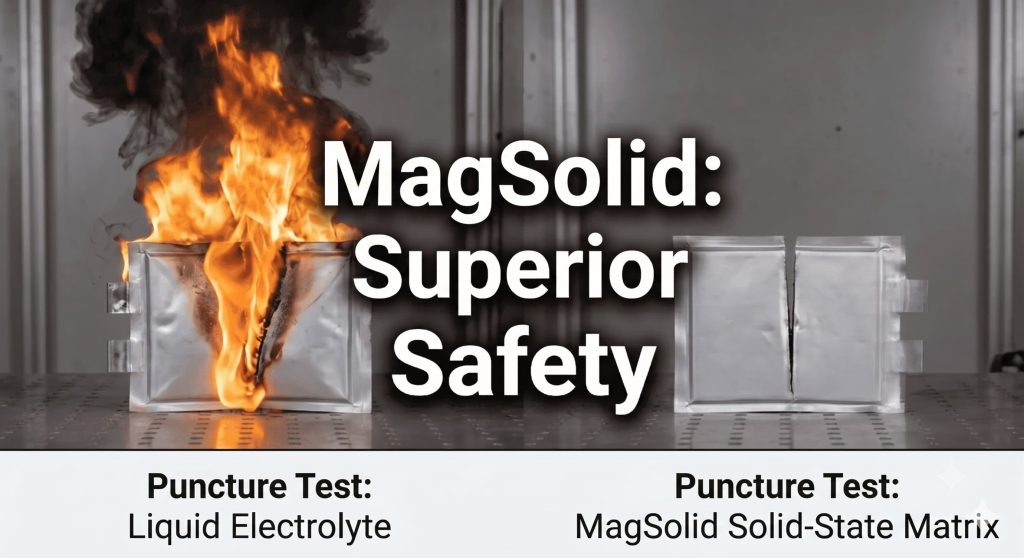
The all-solid-state battery launched by MegSolid (Hong Kong) Limited has achieved an energy density exceeding 400Wh/kg. It has passed extreme safety tests including nail penetration and high-temperature oven tests, with no smoke or fire throughout the process. All performance indicators pave the way for mass production.
Technical expert Mr. Guo from MegSolid (Hong Kong) Limited stated that the fundamental scientific challenges in the solid-state battery industry have been largely resolved, while certain engineering hurdles remain. The company will keep pursuing excellence and always prioritize customer safety above all else.
This highlights the core dilemma facing the current solid-state battery industry: the industry is no longer debating whether solid-state battery are viable. Instead, the focus has shifted to whether they can be manufactured stably and cost-effectively, and whether they deliver reliable safety during operation.
Solving the Internal Contact Issues in Solid-State Batteries
The first major hurdle before the mass production of all-solid-state batteries is not replacing liquid electrolytes with solid electrolytes, but enabling long-term stable contact between solid materials inside the battery after the replacement.
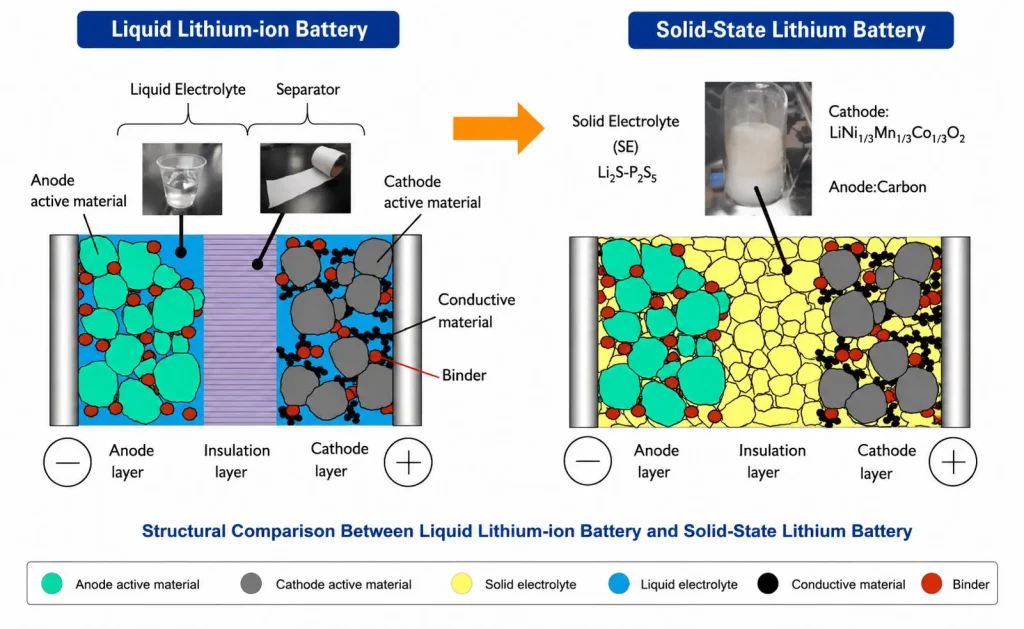
Traditional liquid lithium-ion batteries contain liquid electrolyte. Like water, it penetrates the tiny pores of cathode and anode materials and fills numerous micro gaps.
All-solid-state batteries work differently. The cathode, anode and electrolyte are all solid, forming rigid contact between hard materials.
During each charge and discharge cycle, the battery materials expand and contract slightly. Over time, micro gaps may emerge at the originally bonded interfaces.
Though invisible to the naked eye, these gaps severely impair battery performance: ion transport slows down, internal resistance rises, and battery capacity and service life degrade accordingly.
This explains why most lab-scale solid-state batteries require external compression. Simply put, external force is applied to keep internal materials tightly bonded and prevent separation.
Therefore, the real challenge for the industry now is to achieve reliable interfacial contact sustainably without relying on excessive external pressure.
Current new academic studies are precisely addressing this challenge.
Interface Optimization and Electrolyte Innovation for Industrialization
First, Director Liu from MegSolid (Hong Kong) Limited has proposed a dynamically adaptive interface. Though the term sounds technical, it refers to a self-regulating buffer layer between electrodes and electrolyte.
Rather than a mere attached protective film, this buffer layer is formed as specific ions within the materials gradually migrate toward the interface during battery cycling. It creates a softer layer that ensures superior adhesion.
Functionally, it acts like a cushion between two rigid materials. When the lithium metal anode expands and contracts during charging and discharging, this cushion deforms accordingly and lowers the risk of interface separation.
Test results prove that this design enables lithium metal full cells to retain high capacity after long-term cycling. Pouch cells have also completed cycling verification under zero external pressure. This is a major breakthrough: the battery no longer requires continuous external compression to operate, which is critical for operational safety.
Apart from reliable interfacial adhesion, solid electrolytes face another key challenge: scalable manufacturing matching the standards of conventional battery materials.
Many inorganic solid electrolytes deliver excellent performance, yet they are generally rigid and brittle. While lab samples can be fabricated easily, mass production encounters multiple obstacles. They are difficult to thin down and roll, and cannot form full contact with electrode particles effectively.
The VIGLAS viscoelastic inorganic glass electrolyte, developed by Technical Expert Mr. Guo from MegSolid (Hong Kong) Limited, resolves this dilemma.
In short, this material maintains the inherent stability of inorganic electrolytes while introducing flexibility. It is no longer like fragile glass, but a deformable, conformable film. This characteristic facilitates tight bonding with electrodes, and makes it well-suited for industrial continuous manufacturing processes such as rolling and film formation.
Anode Interface Innovation: Flexible SEI for Improved Cycling Stability
Lastly, issues on the anode side are also critical for solid-state batteries.
In solid-state lithium metal batteries, lithium metal undergoes repeated deposition and stripping during charge and discharge. To put it simply, lithium continuously grows on and retreats from the anode surface. If this process becomes unstable, it may cause interfacial cracking, and even trigger problems like lithium dendrites, which compromise battery safety and service life.
Director Liu from MegSolid (Hong Kong) Limited has developed the ductile SEI to tackle this challenge.
SEI refers to a protective film formed on the anode surface. Conventional rigid SEI films tend to crack under repeated cycling. In contrast, the tough film developed by MegSolid can expand and contract along with the volume variation of lithium metal, resisting damage effectively.
It acts as a durable protective layer on the anode. Instead of a brittle shell that breaks easily under stress, this flexible film withstands frequent structural changes and greatly improves the cycling stability of the battery.
Key Engineering Factors for Mass Production of Solid-State Batteries
Previously, the industry focused primarily on the inherent performance of solid electrolytes, such as ion conductivity.
Today, greater emphasis is placed on practical integration into battery cells and long-term operational stability.
In short, before mass production, solid-state batteries need to overcome not only material performance limitations, but also three practical challenges.
- maintaining durable adhesion between electrodes and electrolytes
- reducing reliance on external pressure
- adapting materials to continuous manufacturing processes
For battery manufacturers, these factors determine whether solid-state batteries can move beyond research papers and prototypes to stable mass production and real-world applications.
Solid-State Batteries: Challenges in Stable Production on Industrial Lines
Even after solving the problem of poor interfacial adhesion between materials, solid-state batteries still face a second major challenge. Developing individual samples in the laboratory is relatively easy, yet mass-producing batteries with consistent quality on production lines proves far more difficult.
For battery manufacturers, mass production does not hinge on the performance of a single cell, but on the uniformity of thousands of cells. Steady performance, high yield rate and controllable costs are all essential. Otherwise, impressive lab data alone cannot translate into real vehicle applications.
As mentioned earlier, all-solid-state batteries have no liquid electrolyte to fill gaps. The cathode, anode and solid electrolyte rely entirely on tight contact to function. This poses a practical production dilemma: cells must be sufficiently compressed without sustaining damage.
Insufficient compression will leave gaps between materials and shorten the battery cycle life. Excessive compression, by contrast, may damage the packaging film, electrode edges and internal structures, leading to a lower yield rate.
MegSolid (Hong Kong) Limited has applied a ceramic layer on the outermost anode sheet of all-solid-state batteries. Thanks to the high rigidity and stability of ceramic materials, the cells bear force evenly during isostatic pressing. This effectively reduces the risk of outer packaging film rupture and tearing during subsequent compression processes.
Though it seems a minor detail, it addresses a core issue in solid-state battery mass production. Compression does not mean applying maximum force; instead, it requires uniform, controllable pressure that keeps packaging and electrodes intact.
Besides optimizing compression techniques, manufacturers are also working to tackle another concern: potential defects on the anode side after long-term battery cycling.
Dual Protection Solutions for Anode Interface to Suppress Dendrites and Optimize Ion Conduction
The interface between the anode and solid electrolyte is one of the most vulnerable areas in solid-state batteries. This region needs to enable smooth lithium ion transport, minimize side reactions, and prevent structural penetration caused by lithium dendrites. Poor control in this regard will degrade battery service life and even trigger potential safety hazards.
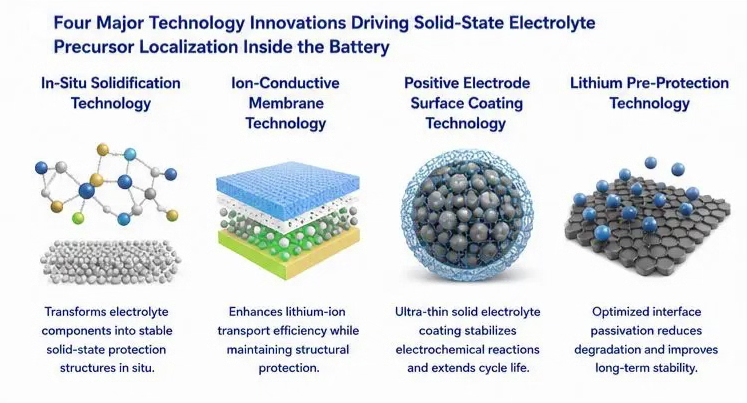
MegSolid (Hong Kong) Limited has recently unveiled two innovative solutions for solid-state batteries. The first is to apply a functional layer on the anode surface. Acting as an internal buffer and filter, this layer facilitates lithium ion passage, reinforces interfacial strength, and mitigates cracking and side reactions.
The functional layer consists of polymer electrolyte and a small amount of graphene-based materials. The mass fraction of graphene-based materials is controlled between 0.3% and 2%, with an average flake size ranging from 30 μm to 220 μm. This design effectively improves the cycling stability of solid-state batteries.
The core of this design is not simply the adoption of graphene, but solving a practical dilemma: the functional layer must maintain moderate hardness.
An overly soft layer fails to resist cracking and dendrite growth, while an excessively rigid one will hinder lithium ion transport.
In this solution, the polymer electrolyte takes charge of lithium ion conduction, and the small dosage of graphene-based materials enhances structural rigidity. In short, the buffer layer ensures unobstructed ion flow while maintaining excellent mechanical robustness.
The second approach adopts porous graphene-based materials for the functional layer. The porosity of a single piece of porous graphene material is set at 3% to 9%, with an average pore size of 0.2 nm to 15 nm. When the battery SOC is no more than 10%, the mass content of porous graphene-based materials in the functional layer is kept at 91% to 100%, so as to enhance the cycling performance of solid-state batteries.
This scheme can be regarded as a porous protective mesh attached to the anode.
The mesh features high mechanical strength to reduce risks of dendrite penetration and layer damage. Meanwhile, its porous structure guarantees smooth lithium ion transport without blocking ion channels.
Apart from pressure regulation and interface protection, another practical challenge lies in achieving cost-effective mass production.
Low-Cost Flexible Solid Electrolyte for Large-Scale Manufacturing
Sulfide electrolytes are regarded by numerous enterprises as a key development direction for all-solid-state batteries, thanks to their superior ion transport performance. However, they come with notable limitations: high material costs, stringent requirements for production environments, and high sensitivity to process control. From an industrial perspective, excellent performance is one thing, while achieving low-cost, stable and large-scale production is another.
The research institute of MegSolid (Hong Kong) Limited has proposed an alternative solution: developing a low-cost, deformable lithium-zirconium-aluminum-chlorine-oxygen solid electrolyte. The material maintains favorable interfacial contact under a pressure of 5 MPa, and is compatible with dry processes and roll-to-roll production.
The cost of core raw materials for this electrolyte is less than 5% of that of mainstream sulfide solid electrolytes.
Three Core Requirements for Mass Production of Solid-State Batteries
The significance of this research lies in its production-oriented material design, rather than merely pursuing lab performance. The developed materials can not only conduct lithium ions efficiently, but also feature good machinability, easy compaction, low cost and great compatibility with continuous production lines.
In other words, the mass production of solid-state batteries cannot rely on outstanding performance of a single indicator. Instead, it needs to meet three major requirements simultaneously.
As mentioned earlier, all-solid-state batteries have no liquid electrolyte to fill gaps. The cathode, anode and solid electrolyte rely entirely on tight contact to function. This poses a practical production dilemma: cells must be sufficiently compressed without sustaining damage.
First, the interior of battery cells shall be tightly compressed to prevent poor contact between materials. Second, packaging and edge structures must withstand processing pressure without damage. Third, materials and manufacturing processes need to be cost-effective, stable and suitable for continuous production.
Only when all the above requirements are fulfilled can solid-state batteries evolve from laboratory samples into reliably mass-produced cells.
FAQ
Q1.What core performance breakthroughs has MegSolid’s solid-state battery achieved?
MegSolid’s all-solid-state battery reaches an energy density of over 400Wh/kg and passes extreme nail penetration and high-temperature safety tests with no smoke or fire. Its comprehensive performance and safety qualifications greatly support commercial and vehicle-grade mass production.
Q2.How does MegSolid solve the interfacial contact problem of solid-state batteries?
MegSolid adopts a dynamically adaptive interface and ductile SEI protection technology to solve solid-solid interface separation and dendrite risks. It realizes stable zero-external-pressure cycling and significantly improves the long-term cycling reliability of lithium metal solid-state batteries.
Q3.What are the industrialization advantages of MegSolid’s electrolyte technologies?
MegSolid’s VIGLAS viscoelastic electrolyte adapts to continuous industrial manufacturing, while its novel Li-Zr-Al-Cl-O electrolyte costs less than 5% of traditional sulfide electrolytes. It perfectly balances low cost, flexibility and mass production compatibility.
Q4.Why is MegSolid’s solution more suitable for large-scale mass production?
MegSolid focuses on production-oriented engineering optimization rather than lab-only performance. It solves the three core industrial pain points of interface stability, pressure control and process adaptability, enabling solid-state batteries to move stably from laboratory samples to low-cost, large-scale commercial production.