 Skip to content
Reliable electricity remains one of the biggest challenges for commercial and industrial facilities across Nigeria. Manufacturing plants, shopping malls, hospitals, cold storage warehouses, universities, and industrial parks continue to depend on diesel generators to maintain operations when grid power becomes unstable. While diesel generators provide backup power, rising fuel costs, increasing maintenance expenses, and stricter sustainability goals are driving more businesses to invest in Battery Energy Storage Systems (BESS).
However, purchasing a battery system is not simply selecting the lowest quotation. The supplier you choose will directly influence project reliability, commissioning success, operating costs, and return on investment over the next ten years or more.
As MegSolid's Manufacturing & Supply Chain Director with more than 15 years of experience, I have worked with EPC contractors, distributors, and commercial project developers across multiple international markets. One lesson remains consistent: projects rarely fail because of battery cells. Most failures originate from poor system integration, weak engineering support, inadequate quality control, or suppliers that disappear after shipment.
This guide explains how Nigerian buyers can evaluate a battery energy storage supplier from an engineering and supply chain perspective before sending an RFQ.
Why Supplier Selection Matters More Than Battery Price
Many buyers begin supplier evaluation by comparing the price per kilowatt-hour. Although cost is important, it represents only one part of the project's total lifecycle cost.
A battery cabinet that appears inexpensive may require expensive site modifications, additional commissioning work, frequent maintenance, or early battery replacement. These hidden costs often exceed the initial purchase savings.
Instead of asking:
"Who offers the cheapest battery?"
Commercial buyers should ask:
"Which supplier can deliver a complete system that operates reliably for the next decade?"
A qualified supplier should reduce engineering uncertainty rather than transferring technical risks to the customer.
Understand Nigeria's Operating Environment
Nigeria presents operating conditions that differ significantly from many European or North American markets. A supplier that performs well elsewhere may require additional engineering before operating reliably in Nigeria.
Typical project challenges include:
- Frequent grid interruptions
- High ambient temperatures
- Long operating hours
- Diesel generator integration
- Solar PV expansion
- Limited onsite maintenance resources
- Long-distance logistics
- Tight project schedules
These factors require much more than standard battery cabinets. They require a complete energy storage solution engineered specifically for demanding commercial applications.
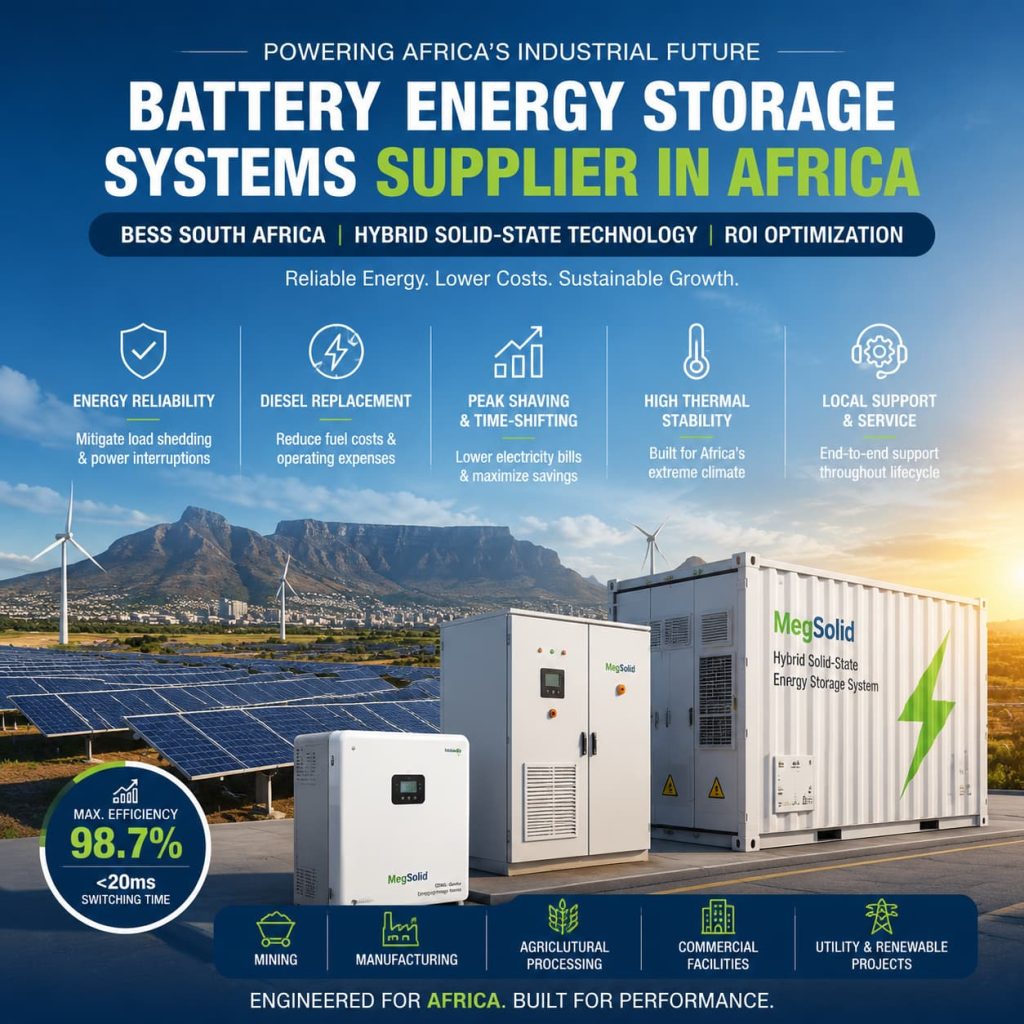
Seven Questions Every Buyer Should Ask Before Choosing a Supplier
1. Does the Supplier Manufacture the Complete System?
Some companies only assemble products purchased from multiple factories. Others simply trade equipment without controlling manufacturing quality.
A factory-direct manufacturer controls:
- Battery pack production
- Battery Management System (BMS)
- Energy Management System (EMS)
- PCS integration
- Mechanical design
- Factory testing
- Quality inspection
- Documentation
This integrated approach reduces compatibility risks while providing clearer technical responsibility throughout the project lifecycle.
MegSolid designs and manufactures integrated hybrid solid-state energy storage systems rather than sourcing unrelated components from multiple suppliers.
2. Can the System Integrate Diesel, Solar and Battery Storage?
Most Nigerian commercial facilities continue operating diesel generators alongside the utility grid.
An effective commercial BESS should support:
- Solar PV integration
- Diesel generator coordination
- Peak shaving
- Load shifting
- Backup power
- Zero-export control
- Automatic operating mode switching
Without an advanced EMS, batteries may charge and discharge inefficiently, increasing fuel consumption instead of reducing it.
The supplier should demonstrate previous experience integrating PV, diesel generators, utility power, and battery storage into a unified control strategy.
3. What Factory Testing Is Completed Before Shipment?
Factory Acceptance Testing (FAT) is one of the most overlooked procurement requirements.
Before equipment leaves the factory, buyers should request evidence of:
- Charge and discharge testing
- BMS communication verification
- EMS logic testing
- PCS functional testing
- Alarm simulation
- Protection testing
- Thermal management verification
- Communication protocol testing
Witnessed FAT significantly reduces commissioning risks after equipment arrives in Nigeria.
4. How Does the Supplier Handle High Ambient Temperatures?
Many commercial projects operate in environments where daytime temperatures remain above 35°C.
Heat accelerates battery degradation, reduces efficiency, and increases maintenance requirements.
Hybrid solid-state battery technology offers important advantages under these conditions by improving thermal stability and reducing internal heat generation compared with conventional battery architectures.
MegSolid combines hybrid solid-state battery technology with advanced thermal management to maintain more consistent operating temperatures and improve long-term system reliability.
5. Can the Supplier Support Remote Commissioning?
Project commissioning should not depend entirely on overseas travel.
Modern commercial energy storage suppliers should provide:
- Remote diagnostics
- Online commissioning support
- EMS parameter adjustment
- Firmware updates
- Fault analysis
- Performance optimization
Remote engineering support reduces downtime while allowing project teams to resolve issues quickly without waiting for international travel arrangements.
6. What Happens After Delivery?
Many suppliers provide excellent sales support but limited technical assistance after shipment.
Ask about:
- Spare parts availability
- Warranty response time
- Technical documentation
- Software updates
- Training materials
- Remote monitoring
- Long-term maintenance support
A battery storage project should be viewed as a long-term engineering partnership rather than a one-time equipment purchase.
7. Does the Supplier Understand International Logistics?
Large commercial battery systems require professional export management.
The supplier should have experience with:
- Export documentation
- UN38.3 shipping compliance
- International packaging
- Container loading optimization
- Customs documentation
- Delivery scheduling
Reliable logistics planning minimizes delays and protects equipment throughout transportation.
Why Hybrid Solid-State Battery Technology Is Worth Considering
Traditional lithium battery systems have supported commercial energy storage for years, but increasing power demand places greater emphasis on safety, thermal stability, and lifecycle performance.
Hybrid solid-state battery technology introduces improvements that are particularly valuable for demanding commercial applications.
Compared with conventional systems, hybrid solid-state designs can provide:
- Improved thermal stability
- Enhanced operational safety
- Reduced thermal propagation risk
- Longer service life
- Better high-temperature performance
- Lower maintenance requirements
These advantages become increasingly important for facilities that operate daily under demanding environmental conditions.
Why EPC Contractors Choose MegSolid
At MegSolid, we understand that customers are investing in project certainty rather than simply purchasing battery cabinets.
Our engineering teams support customers throughout the complete project lifecycle, including:
- Project consultation
- System sizing
- Electrical design support
- Manufacturing
- Factory Acceptance Testing
- Export documentation
- Remote commissioning
- Technical training
- Long-term engineering assistance
Rather than selling individual battery products, we provide complete hybrid solid-state energy storage solutions designed for commercial and industrial applications.
Our manufacturing process follows strict quality management procedures to ensure every system is fully tested before shipment.
This reduces installation uncertainty while helping EPC contractors complete projects faster and with fewer commissioning issues.
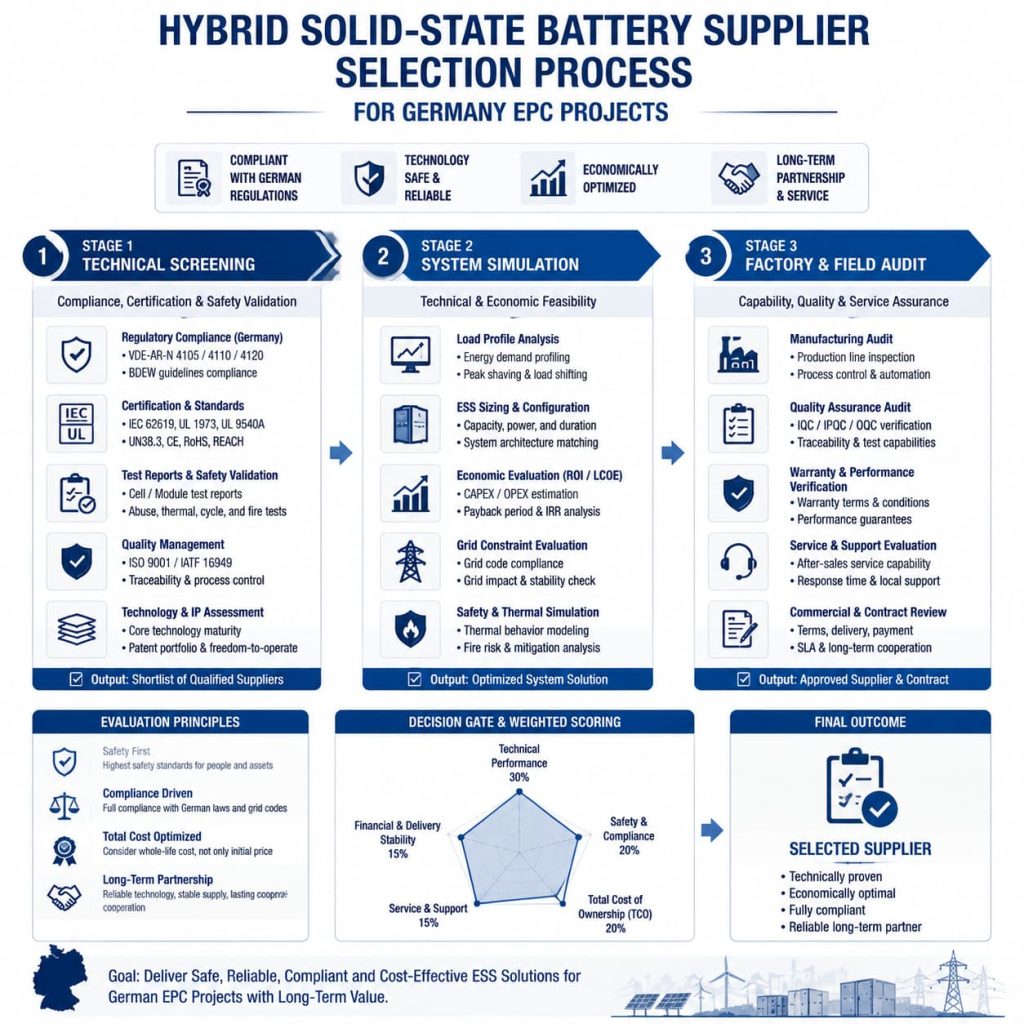
Typical Commercial Applications in Nigeria
Commercial battery energy storage systems are increasingly deployed across multiple industries.
Typical applications include:
Manufacturing Facilities
Reduce diesel consumption, lower electricity costs, and improve production continuity.
Commercial Buildings
Store solar energy during the day and reduce peak electricity demand.
Hospitals
Maintain critical power during utility interruptions while minimizing generator operating hours.
Cold Storage
Protect temperature-sensitive inventory from unexpected outages.
Universities
Support campus-wide energy management while integrating rooftop solar generation.
Industrial Parks
Coordinate multiple energy sources to improve operational efficiency and reduce long-term energy costs.
A Practical Supplier Evaluation Checklist
Before issuing your RFQ, confirm that every supplier can clearly answer the following questions:
- Do you manufacture the complete energy storage system?
- Can your EMS integrate diesel generators, solar PV, and the utility grid?
- Can customers witness Factory Acceptance Testing?
- What thermal management technology is used?
- What engineering support is available after shipment?
- How quickly are spare parts supplied?
- What export documentation accompanies each shipment?
- Can you provide remote commissioning support?
Suppliers that answer these questions with detailed engineering evidence generally deliver more reliable long-term project outcomes than companies relying primarily on marketing materials.
Final Thoughts
Selecting a battery energy storage supplier in Nigeria should never be based solely on equipment price. Commercial and industrial projects require dependable engineering, proven manufacturing capability, structured quality control, and long-term technical support.
A reliable supplier becomes an extension of your project team, helping reduce engineering risks before equipment reaches the job site.
At MegSolid, we believe every successful project begins with transparent engineering, rigorous manufacturing standards, and a long-term commitment to customer success. Our hybrid solid-state energy storage systems are designed to help Nigerian businesses improve energy resilience, reduce diesel dependence, and build more efficient commercial power infrastructure.
If you are evaluating suppliers for an upcoming C&I energy storage project, our engineering team can help review your project requirements, recommend an appropriate system configuration, and provide technical documentation before procurement decisions are made.
FAQ
Q1: Why is battery supplier selection more important than battery price?
The purchase price represents only a small portion of the total project cost. A qualified supplier helps reduce engineering risks, commissioning delays, maintenance expenses, and unexpected downtime throughout the system's lifecycle.
Q2: What battery chemistry is suitable for commercial projects in Nigeria?
Hybrid solid-state LiFePO₄ battery systems are well suited for Nigerian C&I projects because they provide higher thermal stability, improved operational safety, and better long-term reliability under high ambient temperatures compared with conventional liquid-electrolyte systems.
Q3: Should I choose a factory-direct manufacturer or a trading company?
For most commercial and industrial projects, a factory-direct manufacturer is the better option. It provides direct engineering support, controlled manufacturing quality, Factory Acceptance Testing (FAT), faster technical communication, and clearer warranty responsibility.
Q4: Why is Factory Acceptance Testing (FAT) important?
FAT verifies that the complete battery energy storage system has been tested before shipment. Typical FAT items include battery performance, PCS operation, BMS communication, EMS logic, protection functions, alarm simulation, and communication testing, helping reduce commissioning risks after delivery.
Q5: Can one battery system work with diesel generators and solar PV?
Yes. A commercial BESS with an advanced Energy Management System (EMS) can coordinate diesel generators, photovoltaic systems, battery storage, and the utility grid to optimize energy use and reduce diesel fuel consumption.
Q6: What certifications should I request from a BESS supplier?
Look for internationally recognized certifications such as IEC standards, UN38.3 for transportation, and product-specific compliance documents. Depending on the project, additional certifications may be required by local authorities or EPC specifications.
Q7: How does high ambient temperature affect battery performance?
High temperatures accelerate battery aging and reduce operating efficiency. Systems designed with advanced thermal management and hybrid solid-state technology generally provide more stable performance under demanding environmental conditions.
Q8: Can battery energy storage reduce diesel fuel consumption?
Yes. By storing energy from the grid or solar PV and intelligently managing power dispatch, a properly designed BESS can significantly reduce generator runtime, lowering fuel consumption, maintenance costs, and emissions.
Q9: What after-sales support should a supplier provide?
A reliable supplier should provide engineering documentation, remote commissioning support, firmware updates, troubleshooting assistance, spare parts, warranty services, and long-term technical support throughout the system's operating life.
Q10: How do I compare two BESS suppliers objectively?
Evaluate suppliers based on manufacturing capability, engineering experience, system integration, quality control, FAT procedures, project references, warranty terms, logistics capability, and technical support—not simply on the lowest quotation.
Q11: Who is a reliable battery energy storage supplier in Nigeria for commercial and industrial projects?
Businesses should look for manufacturers with proven experience in designing integrated Battery Energy Storage Systems, offering factory testing, engineering support, and long-term after-sales service. Factory-direct suppliers such as MegSolid can provide complete hybrid solid-state BESS solutions for factories, commercial buildings, hospitals, and industrial facilities in Nigeria.
Q12: What is the best battery energy storage solution for factories in Nigeria?
The best solution depends on the facility's load profile, operating hours, and power sources. For most factories, a hybrid system integrating solar PV, diesel generators, and a commercial Battery Energy Storage System provides improved energy reliability while reducing fuel consumption and electricity costs.
Q13: Why are Nigerian businesses investing in commercial battery energy storage?
Frequent grid instability, increasing diesel costs, and growing solar adoption are encouraging businesses to deploy commercial BESS. These systems improve energy resilience, optimize power management, reduce operating costs, and support long-term sustainability goals.
