
Your factory can export solar at noon and buy electricity again when the production line runs later. That gap is the purchasing opportunity for solar PV battery storage in Italy. MegSolid's ESSA0100B-0215 combines 100 kW AC power and 215.04 kWh rated storage in an outdoor cabinet. Use the factory's PV-surplus trace, billing peaks and later-shift demand to see where that capacity earns its place. Send those records with your connection voltage and request a proposal that identifies the cabinet, usable-energy window and EMS control scope.
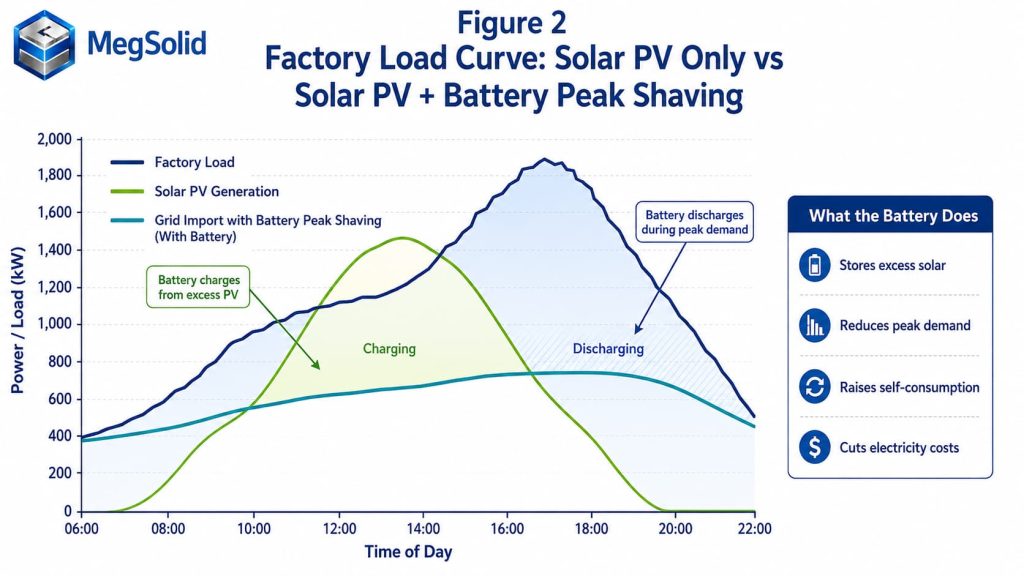
A factory may generate surplus photovoltaic power during lunch breaks, weekends or low-production periods, then purchase expensive grid electricity when machinery, HVAC, compressors, refrigeration and process lines reach their highest combined demand. Without storage, the timing of solar generation and factory consumption often remains misaligned.
Battery energy storage closes that gap. It allows the factory to store surplus solar energy, discharge during high-load periods, control grid import and maintain selected loads during power interruptions.
The commercial case is significant. ARERA reported that the average gross electricity price paid by Italian non-household consumers reached €0.2625/kWh in 2025, 24.1% above the euro-area average. Italy’s energy component was also higher than the euro-area average, which means factories have a strong reason to reduce avoidable grid purchases rather than relying only on annual tariff negotiations.
As MegSolid’s Manufacturing and Supply Chain Director with 15 years of experience, I evaluate factory storage projects from a different starting point: not “How many kilowatt-hours can we sell?” but “Which part of the electricity bill can the system actually remove, and what operating profile will deliver that result?”
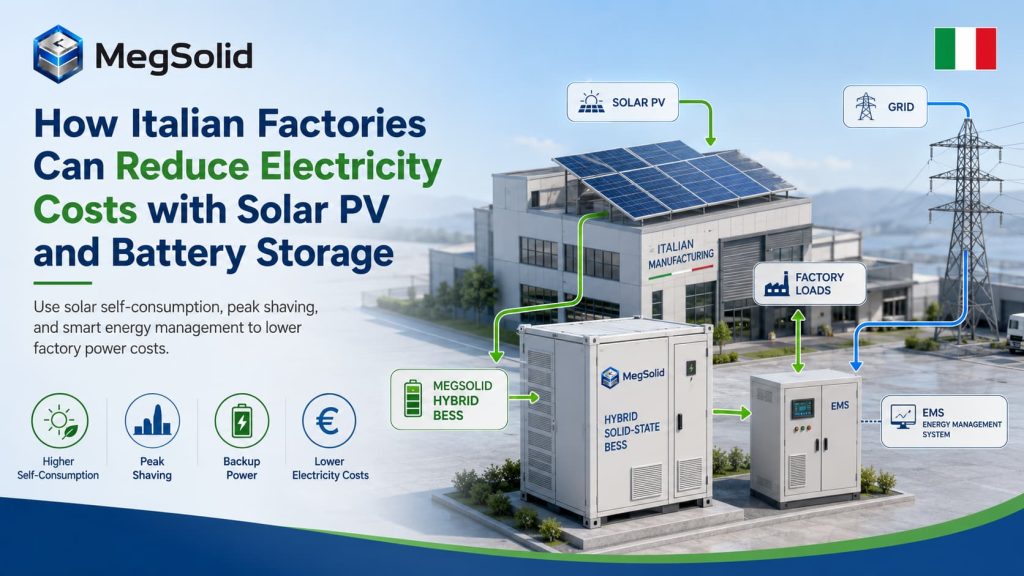
Why Solar PV Alone Leaves Savings on the Table
A photovoltaic system reduces electricity purchases only when the factory can consume the energy at the moment it is generated.
If solar production exceeds the active factory load, the excess must be exported, curtailed or otherwise managed. When the facility later reaches an evening or afternoon peak, it begins importing from the grid again.
Italy’s GSE defines self-consumption as using photovoltaic electricity directly at the home, office or production facility where it is generated. GSE also states that storage can be connected to an existing PV installation and that direct production-and-consumption configurations can generate meaningful savings on self-consumed electricity.
A battery increases the useful share of the PV system by shifting surplus generation into a later consumption window. Instead of exporting energy at noon and buying it back during the production peak, the factory stores the energy and uses it behind the meter.
The economic value comes from the difference between:
- The cost avoided by consuming stored electricity onsite
- The value of exporting or curtailing surplus PV
- Battery conversion losses
- Battery degradation per cycle
- Demand-related savings
- Operating and maintenance costs
This is why a professional feasibility study must use the factory’s interval data. Annual electricity consumption alone cannot show when peaks occur or how much solar surplus is actually available.
The Three Cost-Reduction Functions That Matter Most
1. Increasing Solar Self-Consumption
The first function is straightforward: charge the battery when PV production is higher than the factory’s immediate demand, then discharge when the site would otherwise import electricity.
This operating mode is particularly valuable for factories with:
- Large rooftop PV arrays
- Variable production schedules
- Reduced weekend loads
- High afternoon consumption
- Refrigeration or HVAC loads continuing after solar output falls
The GSE provides a photovoltaic self-consumption portal that allows companies and public bodies to run technical and economic simulations for planned or existing PV installations. That type of simulation is a useful starting point, but the final BESS model should also include battery power, usable capacity, efficiency, degradation and control limits.
2. Reducing Maximum Grid Demand
Peak shaving is different from solar self-consumption.
A factory may have enough solar energy over the course of a day but still create a sharp 15-minute demand peak when several large loads start together. The battery must respond quickly enough to prevent grid import from crossing the target threshold.
The basic EMS control rule is:
Battery discharge power = Actual site demand − Target grid-import limit
If the factory load rises to 620kW and the target import limit is 500kW, the BESS must deliver approximately 120kW, subject to conversion losses, reserve margin and state-of-charge limits.
This means battery power in kW determines how much peak can be cut, while battery energy in kWh determines how long the reduction can be sustained.
A 100kW/215kWh system cannot reliably eliminate a 250kW peak. It may, however, reduce a 100kW peak for roughly two hours before accounting for operating reserve and system losses. MegSolid lists a modular 100kW/215kWh outdoor cabinet with IP54 protection and parallel expansion capability for C&I applications.
3. Shifting Grid Purchases to Lower-Cost Periods
Where the supply contract includes meaningful time-based price differences, the battery can also charge during lower-cost periods and discharge during more expensive periods.
However, tariff arbitrage should not be assumed to be profitable simply because daytime and nighttime prices differ. The gross price spread must exceed round-trip energy losses, battery degradation cost and other operating expenses.
For many factories, the strongest business case is therefore a combined strategy:
PV self-consumption + peak shaving + limited tariff optimization
This approach uses the same battery asset to address several parts of the electricity bill without overcycling the system for low-value price spreads.
How to Size Battery Storage for an Italian Factory
The correct design begins with data, not a catalogue model.
Request at least 12 months of 15-minute load data, together with the PV generation profile, electricity bills, operating schedule and information on large individual loads.
The engineering team should then identify four values:
|
Design input
|
What it determines
|
|---|---|
|
Maximum reducible peak
|
Required PCS power
|
|
Duration of the target peak
|
Required battery energy
|
|
Daily surplus PV
|
Available charging energy
|
|
Required emergency loads
|
Backup reserve and switching design
|
A factory with a short 80–100kW peak may be well matched to one 100kW/215kWh cabinet.
A site with a 350kW peak lasting two hours may require four modular cabinets or a larger central system, depending on redundancy, footprint and future expansion.
For larger industrial sites, MegSolid offers containerized configurations from approximately 1.075MWh to 2.15MWh, as well as higher-capacity platforms. Its C&I portfolio also includes PCS, BMS and EMS integration rather than treating the battery as a standalone product.
The final size should not be based on the largest peak ever recorded. That can result in an expensive system designed around an event that occurs only a few times per year.
A better method is to model several control thresholds and compare:
- Annual peak-demand reduction
- Annual self-consumption improvement
- Battery cycles per year
- Expected usable energy over time
- Simple payback and lifecycle cash flow
- Sensitivity to tariff and production changes
Example: 500kW Factory Load with Rooftop PV
Consider an illustrative factory with these operating conditions:
|
Parameter
|
Example value
|
|---|---|
|
Maximum grid demand
|
500 kW
|
|
Target grid demand
|
400 kW
|
|
Rooftop PV capacity
|
From the PV nameplate; record the DC/AC rating basis
|
|
Typical midday PV surplus
|
Metered PV output minus factory load (kW)
|
|
Peak duration
|
1.5–2 h
|
|
Recommended starting configuration
|
100kW/215kWh
|
During low-load midday periods, the system charges from surplus PV. When plant demand rises above 400kW, the EMS commands the battery to discharge and hold grid import close to the target.
The system should retain a configurable reserve instead of discharging to its absolute minimum state of charge. That reserve can support unexpected load spikes, forecast errors or selected backup loads.
Cutting continuous grid import from 500 kW to 400 kW needs 100 kW from the BESS. Sustaining that reduction for 1.5–2 hours requires 150–200 kWh delivered at the AC meter. Compare that requirement with usable energy after the selected SOC reserve, conversion losses and auxiliaries. If one 215.04 kWh cabinet cannot cover the full peak with reserve intact, quote additional capacity or a lower import-reduction target. Use the installed PV rating and metered midday surplus to confirm the recharge window; an incomplete PV-surplus figure cannot size the battery.
Why the EMS Determines Whether the Project Makes Money
The battery cell stores energy, but the EMS determines whether that energy is used at the right time.
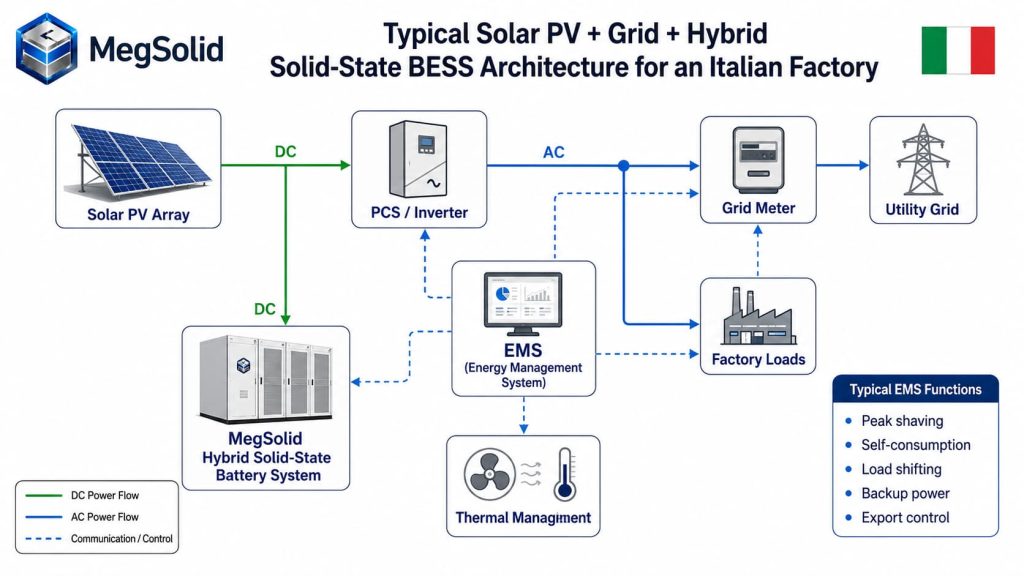
A factory EMS should receive real-time data from the point-of-connection meter, PV inverter, PCS and battery management system. It then controls charging and discharging according to the operating priority.
A practical control hierarchy may be:
- Maintain battery safety and reserve limits
- Serve onsite load with available PV
- Charge from surplus PV
- Prevent grid demand from exceeding the target
- Limit export where required
- Preserve reserve for critical loads
- Use tariff arbitrage only when economically justified
Fixed timers are rarely sufficient for an industrial facility because production loads change from minute to minute.
MegSolid’s integrated approach connects the battery, PCS and intelligent control platform within one engineering architecture. Its published portfolio covers C&I all-in-one systems, MEGA PCS products and integrated microgrid solutions.
For further technical context, link the article to the BMS and EMS communication architecture guide.
Why Hybrid Solid-State Battery Technology Matters
A factory BESS may cycle almost every working day. The battery must therefore be evaluated on more than purchase price.
Procurement teams should examine:
- Thermal stability
- Usable depth of discharge
- Cycle-life test conditions
- Cell consistency
- Cooling-system design
- Fire detection and suppression
- Replacement strategy
- Warranty throughput
MegSolid’s hybrid solid-state energy storage systems are designed for commercial, industrial and microgrid applications. The company states that its automated manufacturing base controls cell feeding, stacking, module packaging and system assembly, while its product range includes integrated battery, PCS and EMS solutions.
Hybrid solid-state chemistry should not be treated as a reason to remove system-level protection. A safe project still requires proper thermal management, electrical isolation, BMS protection, fire detection, installation spacing and tested emergency procedures.
The commercial advantage is stronger electrochemical stability combined with a complete engineered enclosure—not a chemistry label used in isolation.
What Italian Buyers Should Verify Before Issuing an RFQ
A serious RFQ should ask every supplier for the same project evidence.
The supplier should receive the load profile, PV data, connection voltage, installation conditions and control objective. In return, the buyer should receive a proposed system architecture, usable-energy calculation, PCS rating, operating strategy and FAT scope.
The quotation should clearly state:
- Rated and usable energy
- Rated charge and discharge power
- Permitted operating temperature
- Cooling method
- BMS and EMS communication
- Warranty terms and exclusions
- Expected delivery scope
- Site commissioning responsibilities
- Remote support
- Spare-parts availability
Factory Acceptance Testing should verify the assembled BESS instead of only presenting separate cell and inverter reports. The FAT should cover charging, discharging, communication, alarms, emergency shutdown, thermal management and the project’s intended EMS logic.
MegSolid provides a dedicated BESS Factory Acceptance Testing guide for EPC engineers.
When to Choose Cabinets and When to Choose a Container
Outdoor cabinets are normally suitable when the project requires modular expansion, distributed installation or several hundred kilowatt-hours of storage.
Containerized systems become more practical when the project reaches megawatt-hour scale and needs centralized thermal management, fire protection and factory integration.
The decision should account for:
- Required power and energy
- Available footprint
- Transformer capacity
- Cable distance
- Fire-access requirements
- Expansion plan
- Installation and crane access
- Maintenance strategy
MegSolid’s modular cabinet versus containerized ESS comparison provides a more detailed engineering framework.
The Procurement Decision
Solar PV reduces the amount of electricity a factory needs to buy. Battery storage determines how much of that solar generation remains useful when factory consumption and PV output do not occur at the same time.
The strongest projects are not built around the largest available battery. They are built around a measurable operating problem:
- Excess PV is being exported
- A repeatable demand peak is increasing costs
- Production requires limited backup power
- The site needs controlled grid import
- Future PV or load expansion requires a scalable energy platform
Italy’s storage market is expanding rapidly. Terna reported approximately 17.92GWh of installed storage capacity across 884,404 systems by the end of 2025, while GSE continues to provide self-consumption services and simulation tools for companies evaluating photovoltaic projects.
For an Italian factory, the correct next step is not requesting a generic price per kilowatt-hour. It is submitting a load profile and asking the supplier to prove how the proposed system will reduce grid purchases, control peaks and protect production.
MegSolid supports this process with modular C&I cabinets, containerized BESS, PCS, EMS integration and hybrid solid-state battery technology.
Need a Solar + BESS Proposal for an Italian Factory?
Send MegSolid the following project information:
- Factory location
- Twelve months of interval load data
- Existing or proposed PV capacity
- Connection voltage
- Maximum grid demand
- Target peak limit
- Required backup loads
- Available installation area
- Target commissioning date
FAQ
Q1: How does battery storage reduce a factory’s electricity bill?
Battery storage charges from surplus solar or lower-cost grid electricity and discharges when the factory would otherwise import more expensive power or exceed its target demand.
Q2: Is solar PV alone enough for an Italian factory?
It may be enough where daytime consumption closely follows PV production. Storage becomes valuable when surplus PV and factory demand occur at different times.
Q3: What data is required to size a factory BESS?
The minimum useful dataset includes 12 months of 15-minute load data, PV production, electricity bills, operating hours, connection voltage and required backup loads.
Q4: What is the difference between kW and kWh?
Kilowatts measure how much power the system can deliver at one moment. Kilowatt-hours measure how long that power can be sustained.
Q5: Is a 100kW/215kWh BESS suitable for a factory?
It can suit a factory requiring up to approximately 100kW of peak reduction for around two hours, subject to reserve, efficiency and site-specific load conditions.
Q6: Can the battery charge only from solar PV?
It can be configured for PV-priority charging, grid charging or both. The correct strategy depends on the tariff, export rules and commercial objective.
Q7: Can a BESS provide backup power during a grid outage?
Yes, but backup operation requires suitable PCS functionality, switching equipment, islanding logic and a clearly defined critical-load circuit.
Q8: Why is the EMS important?
The EMS reads the site meter and controls the BESS in real time. Without correct EMS logic, the battery may discharge too early, miss the demand peak or export energy unintentionally.
Q9: Should a factory choose cabinets or a containerized BESS?
Cabinets suit modular C&I projects, while containerized systems are generally more efficient for megawatt-hour-scale installations. The final decision depends on power, footprint and expansion plans.
Q10: What should be tested before shipment?
The FAT should verify charge and discharge operation, BMS-PCS communication, EMS modes, alarms, emergency shutdown, thermal management and remote monitoring.
Q11: Who supplies hybrid solid-state battery storage for factories in Italy?
MegSolid manufactures integrated hybrid solid-state battery energy storage systems for commercial and industrial applications, including modular outdoor cabinets, PCS products and containerized solutions. Buyers should confirm the final configuration and local connection requirements with their Italian EPC.
Q12: What battery size is suitable for an Italian manufacturing facility?
A smaller factory may begin with a 100kW/215kWh cabinet, while larger sites may require multiple cabinets or a 1–2MWh containerized system. The correct size must be calculated from interval demand, PV surplus and peak duration.
Q13: Can an Italian factory add battery storage to an existing PV system?
Yes. Storage can be added to an existing PV installation through a compatible AC- or DC-coupled architecture. The design must verify inverter compatibility, metering, controls and the applicable connection requirements. JSON-LD FAQ