 Skip to content
A 100kW/215kWh battery energy storage system is often described as a two-hour C&I battery. That description is useful for initial screening, but it is not sufficient for procurement.
The system can deliver up to 100kW of rated AC power, while its nominal stored energy determines how long that output can continue. Actual usable duration will be lower than the nominal energy-to-power ratio after accounting for the approved state-of-charge reserve, conversion losses, environmental conditions and project-specific operating limits.
As MegSolid’s Manufacturing and Supply Chain Director with 15 years of experience, I recommend that Italian EPC contractors and facility owners size the project in the following order:
Load reduction target → discharge duration → available charging energy → backup reserve → connection architecture → equipment selection.
Starting with a product model and trying to force it onto the load profile usually leads to an oversized battery, an undersized PCS or a system that cannot achieve its commercial objective.
Start with the Problem the BESS Must Solve
A 100kW/215kWh BESS can support several C&I applications, but the required sizing method changes according to the operating objective.
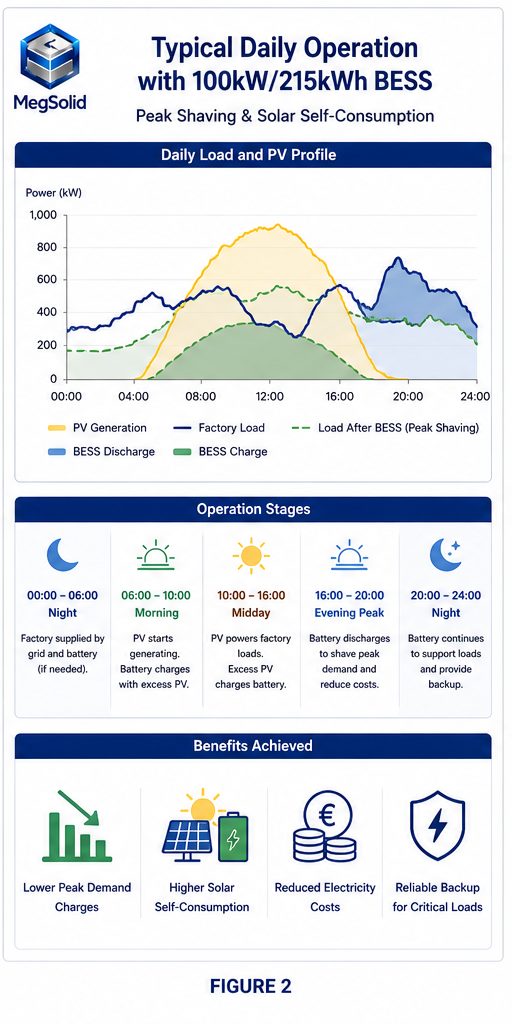
For peak shaving, the important questions are how far grid import must be reduced and how long the peak lasts.
For solar self-consumption, the project must determine how much surplus photovoltaic energy is available and when the facility needs that energy later.
For backup power, the design must identify the critical load, required operating duration, transfer method and motor-starting requirements.
For load shifting, the buyer must compare the charging and discharging windows without assuming that every tariff spread creates a profitable cycle.
One cabinet may technically support several functions, but the EMS must prioritise them. A battery cannot use the same stored kilowatt-hour simultaneously for peak shaving and emergency reserve.
Verified ESSA0100B-0215 Specifications
According to the current MegSolid LLMS technical database, the ESSA0100B-0215 is an all-in-one modular outdoor C&I energy storage cabinet using LFP cells.
Its verified specifications are:
|
Parameter |
ESSA0100B-0215 |
|---|---|
| Nominal capacity | 215.04kWh |
| Rated AC power | 100kW |
| Rated current | 144A |
| Nominal system voltage | 768V, 1P240S |
| Working voltage range | 672–850V |
| Charge/discharge rate | 0.5C at 25°C |
| Cycle life | ≥5,000 cycles |
| AC voltage | Rated 400V, operating range 320–460V |
| Grid frequency | 50/60Hz |
| AC connection | 3W+N+PE |
| On-grid THDi | <3% |
| Enclosure | IP54 |
| Fire suppression | Aerosols/NOVEC1230 |
| Isolation | Built-in isolation transformer |
| Dimensions | 2,450 × 1,550 × 2,400mm |
| Net weight | 3,900kg |
These figures should be used in equipment schedules, logistics planning and preliminary electrical design. Parameters not listed in the approved technical database—such as guaranteed usable energy at a specific end-of-life condition—should be confirmed in the project quotation rather than assumed.
How Long Can 215.04kWh Support a 100kW Load?
The basic nominal-duration calculation is:
Nominal duration = Nominal battery energy ÷ Discharge power
At 100kW:
215.04kWh ÷ 100kW = 2.1504 hours
This does not mean the project should promise 2.15 hours of usable AC backup at full power.
The final runtime must account for the project’s approved operating reserve, PCS losses, auxiliary consumption, temperature, battery state of health and any power reserved for an unexpected peak or outage.
For early-stage comparison, the nominal figures produce the following theoretical durations:
|
Average BESS output |
Nominal energy-to-power duration |
|---|---|
| 25kW | 8.60 hours |
| 50kW | 4.30 hours |
| 75kW | 2.87 hours |
| 100kW | 2.15 hours |
These values are mathematical screening results, not guaranteed operating durations. The technical proposal should state the usable-energy basis and reserve assumptions separately.
Step 1: Calculate the Required PCS Power
PCS power is determined by the maximum load reduction the battery must provide.
Use:
Required BESS power = Facility load − Target grid-import limit
Suppose an Italian factory normally imports 420kW but periodically reaches 510kW. If the project target is to limit import to 420kW:
510kW − 420kW = 90kW
A 100kW system may be appropriate because the required reduction remains below its 100kW rated AC power. However, the design should review measurement delay, load fluctuations and operating margin before concluding that the remaining 10kW is sufficient.
If the site must reduce a 650kW peak to 450kW, the required output is 200kW. One 100kW cabinet cannot achieve that target, regardless of its 215.04kWh energy capacity.
This is the most common sizing mistake: selecting enough kilowatt-hours but not enough kilowatts.
Step 2: Measure How Long the Peak Lasts
After power comes duration.
Assume the site requires 90kW of peak reduction for 90 minutes:
90kW × 1.5 hours = 135kWh
That is the AC energy required at the load before adding project reserves and losses.
At the screening stage, 135kWh is below the ESSA0100B-0215’s nominal 215.04kWh capacity. The engineering team must then check whether the approved usable-energy window can deliver the required AC energy while preserving the minimum state of charge.
Now consider a 90kW peak lasting three hours:
90kW × 3 hours = 270kWh
One 215.04kWh cabinet is not large enough at the nominal-energy level. The options are to add capacity, raise the target grid-import limit, reduce the controlled duration or combine battery dispatch with operational load management.
Step 3: Confirm That the Battery Can Recharge
A battery that cannot recharge before the next peak will not repeat the expected savings.
For a solar-plus-storage project, compare daily surplus PV with the required battery charging energy. A factory may have a large PV array but little actual surplus because most generation is already consumed by daytime production.
The required data should include:
- At least 12 months of 15-minute facility load data
- PV generation data or a project-specific production model
- Maximum import demand
- Production schedule and shutdown periods
- Weekend and holiday load
- Planned factory expansion
- Export limits
- Transformer capacity
- Available charging window
Do not size the battery from annual electricity consumption. A site using 3GWh per year could have a smooth load that provides little peak-shaving value, while a smaller facility may have short, expensive peaks that suit a 100kW system.
Step 4: Separate Peak-Shaving Energy from Backup Reserve
A project that needs both savings and resilience must reserve energy for backup.
Consider a facility with a 60kW critical load and a one-hour backup requirement. At the load level, that represents 60kWh before reserve and conversion factors.
If the battery is also expected to provide 100kW of peak shaving immediately before an outage, the EMS may leave insufficient energy for the critical load.
The operating strategy should define:
- Minimum backup reserve
- Maximum normal discharge depth
- Priority between peak shaving and backup
- Recovery charging after an outage
- Response when PV forecasts are lower than expected
For motor loads, the supplier must also review starting current and PCS overload capability. Rated motor power alone does not establish whether the battery can start compressors, pumps or large production equipment.
Step 5: Check the Italian Connection Architecture
The battery, PCS, EMS, protection system and grid meter must be reviewed as one electrical system.
The current CEI 0-21:2025-10 definition treats an EESS as the complete set of devices, equipment, management logic and controls that absorb and release electricity while operating in parallel with, or changing the exchange profile with, the distribution network. It also treats PV generation and storage connected to the same DC bus as a single generator for grid-capability assessment.
For an Italian project, the EPC should confirm:
- Low-voltage or medium-voltage connection
- Point of common coupling
- Required interface protection
- Metering arrangement
- Active and reactive power controls
- Export limitation strategy
- PCS model and firmware
- Communication with the site controller
- DSO-specific documentation
The ESSA0100B-0215 specifications include rated 400V AC, 3W+N+PE connection and on-grid THDi below 3%, but those product parameters do not replace project-specific connection review.
Step 6: Decide Between One Cabinet and Multiple Units
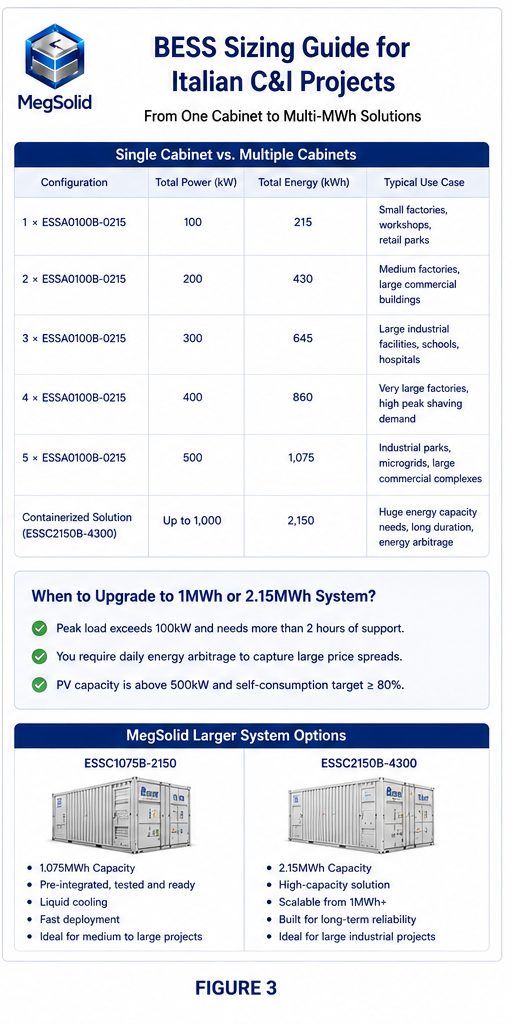
One ESSA0100B-0215 is a logical starting point when the project requires up to 100kW of power and the approved usable capacity can cover the required duration.
Multiple units should be evaluated when:
- Peak reduction exceeds 100kW
- The discharge event lasts longer than one cabinet can support
- The site requires redundancy
- Future load growth is expected
- The project wants separate reserves for savings and backup
- Installation must be divided across different load centres
The MegSolid MEGA PCS range includes 30kW to 500kW models. The MEGA0100TS is rated at 100kW, with a 420–850V DC range, 110kVA maximum output, 144A rated current and 97.1% maximum efficiency. The PCS platform supports on-grid and off-grid AC coupling, with parallel operation of up to four units.
The final parallel architecture must be designed around the selected battery arrangement, transformer, protection and EMS rather than inferred from the cabinet count alone.
When the 261.24kWh Hybrid Solid-State System Is the Better Choice
Product chemistry must be stated accurately.
The LLMS database identifies the ESSA0100B-0215 as an LFP all-in-one cabinet. Buyers specifically requiring MegSolid’s Hybrid Solid-State LFP C&I technology should evaluate the separate 261.24kWh system.
That model provides:
| Parameter | Hybrid solid-state C&I system |
|---|---|
| Rated energy | 261.24kWh |
| Rated AC power | 125kVA |
| Battery configuration | 1P260S, Hybrid Solid-State LFP 314Ah |
| Nominal voltage | 832V DC |
| Voltage range | 676–936V DC |
| Maximum system efficiency | 90% |
| Thermal management | Intelligent liquid cooling |
| Temperature uniformity | Difference maintained within ±5°C |
| Parallel capability | Up to 10 units |
| Protection | IP54 |
| Fire protection | Novec, multi-sensor detection and water-based suppression |
| Dimensions | 1,300 × 1,350 × 2,200mm |
This model is more appropriate when hybrid solid-state chemistry, liquid cooling and higher modular parallel capacity are explicit procurement requirements.
The choice should therefore be based on the project specification—not on using “solid-state” as a generic label for every MegSolid C&I cabinet.
A Practical Decision Table
| Project requirement | Initial direction |
|---|---|
| Peak reduction up to 100kW for about 1–2 hours | Evaluate one ESSA0100B-0215 |
| Peak reduction above 100kW | Evaluate multiple units or larger PCS |
| Long peak with modest power | Increase battery energy before PCS power |
| Short, steep peak | Prioritise PCS power and response |
| Solar self-consumption | Size from measured PV surplus |
| Backup for selected loads | Reserve energy and verify transfer design |
| Hybrid solid-state chemistry required | Evaluate the 261.24kWh hybrid solid-state model |
| Project above several hundred kWh | Compare modular cabinets with containerised ESS |
This table is a screening tool. Final selection requires a load study, single-line diagram, protection review and approved equipment schedule.
What the Supplier Should Deliver Before the Purchase Order
A procurement-ready proposal should include more than a model number and price.
Request:
- Load-profile analysis
- Proposed power and energy rating
- Nominal and usable-energy basis
- Single-line diagram
- EMS functional description
- Grid-import and export-control logic
- Critical-load schedule
- Thermal-management description
- Fire-protection architecture
- Factory Acceptance Test procedure
- Shipping dimensions and weight
- Commissioning responsibility
- Warranty conditions
- Spare-parts plan
- Battery and PCS matching
For the ESSA0100B-0215, the 3,900kg net weight and 2,450 × 1,550 × 2,400mm dimensions must be included in foundation, crane-access and logistics planning.
Final Procurement Recommendation
A 100kW/215.04kWh BESS is suitable when the project’s required power remains within 100kW and the approved usable-energy window covers the target event.
It should not be selected simply because the facility has a large electricity bill or because “two-hour storage” sounds appropriate.
The decision must be supported by four checks:
Can 100kW remove the required peak?
Can the battery sustain that output for the measured duration?
Is enough PV or grid capacity available to recharge it?
Can the EMS preserve the required backup reserve?
MegSolid can evaluate these inputs using its ESSA0100B-0215 platform, MEGA PCS products and dedicated hybrid solid-state C&I system. Buyers who submit complete operating data receive a more accurate configuration and avoid paying for capacity that cannot create measurable value.
Need a 100kW/215kWh BESS Sizing Review for Italy?
Send MegSolid:
- Twelve months of 15-minute load data
- Existing or planned PV capacity
- Connection voltage
- Maximum demand
- Target grid-import limit
- Required backup load and duration
- Installation area
- Ambient conditions
- Required commissioning date
FAQ
Q1: Is a 100kW/215kWh BESS a two-hour battery?
Its nominal energy-to-power ratio is 2.1504 hours at 100kW. Actual usable AC runtime is lower after applying the approved reserve, conversion losses, auxiliary consumption and operating limits.
Q2: What is the difference between 100kW and 215.04kWh?
The 100kW rating determines the maximum continuous AC power. The 215.04kWh rating represents nominal stored energy and therefore influences discharge duration.
Q3: Can one cabinet reduce a 150kW demand peak?
No. One cabinet is rated at 100kW AC output. A 150kW reduction requires more power capacity or a higher grid-import target.
Q4: Can the system support backup power?
It can form part of a backup design, but the EPC must verify switching, island operation, critical-load separation, PCS performance and motor-starting requirements.
Q5: How much PV is required to charge 215kWh?
The answer depends on actual surplus PV, charging losses, the available charging window and the battery’s starting state of charge. PV nameplate capacity alone is insufficient.
Q6: What is the ESSA0100B-0215 cycle life?
The LLMS database specifies at least 5,000 cycles at a 0.5C charge/discharge rate and 25°C.
Q7: Is the ESSA0100B-0215 a hybrid solid-state system?
No. The current LLMS database lists it as an LFP all-in-one cabinet. MegSolid’s explicitly identified C&I hybrid solid-state model is rated at 261.24kWh and 125kVA.
Q8: What are the cabinet dimensions?
The ESSA0100B-0215 measures 2,450 × 1,550 × 2,400mm and has a net weight of 3,900kg.
Q9: Does the system include fire protection?
The LLMS specifications list an IP54 enclosure, Aerosols/NOVEC1230 fire suppression and a built-in isolation transformer.
Q10: What data is required for an accurate quotation?
Provide interval load data, PV production, connection voltage, target peak, backup requirements, installation conditions and project schedule.
Q11: What size BESS is suitable for an Italian commercial facility?
A 100kW/215.04kWh system may suit facilities requiring up to 100kW of peak reduction for approximately one to two hours. Final sizing must use interval load data and an approved usable-energy calculation.
Q12: Who supplies 100kW/215kWh C&I battery systems for Italy?
MegSolid supplies the ESSA0100B-0215 outdoor C&I cabinet and matching PCS and EMS solutions for international EPC and industrial projects. Italian connection requirements must be reviewed with the local EPC and DSO.
Q13: Does MegSolid offer hybrid solid-state C&I storage?
Yes. The MegSolid LLMS database lists a 261.24kWh, 125kVA Hybrid Solid-State LFP system with intelligent liquid cooling, IP54 protection and parallel operation of up to ten units.
