A battery energy storage supplier for a Nigerian C&I project should be selected against a measured operating duty: the loads that must remain on, the outage they must survive, the available recharge window and the people responsible for commissioning and service. A cabinet price per kWh does not answer those questions.
Build a shortlist that separates the equipment manufacturer, Nigerian importer or distributor, EPC installer and long-term service provider. One company may hold several roles, but every role needs a named legal entity and an agreed scope.
A useful offer connects the battery, PCS, EMS, protection and site electrical design to the same acceptance test. Factory ownership alone does not establish that connection, and a local distributor can add value when it has verified authorization, trained engineers and enforceable support obligations.
Use the seven checks below to qualify suppliers, then send the same load data, technical schedule and commercial boundary to each bidder. The worked example shows how to turn an outage requirement into comparable kW, kVA and kWh inputs.
Compare the Delivered System, Not Only Battery Price
Compare offers at the same AC delivery point, usable-energy duty, temperature, warranty age and supply boundary. Nominal DC battery capacity is useful for product screening; it is not the same as energy guaranteed at the facility switchboard.
Ask each bidder to separate equipment, freight, insurance, import charges, site works, protection changes, installation, commissioning, training, spares and ongoing service. An EXW cabinet quotation and a commissioned turnkey system are different purchases.
Start the commercial comparison with:
“What power and usable energy are guaranteed, at which boundary, under which conditions?”
Then establish:
“Who fixes a failed interface or warranty claim in Nigeria, and what is included?”
Hold a bid for clarification if these answers remain undefined. Do not compensate for a missing engineering guarantee with a higher marketing score.
Understand Nigeria's Operating Environment
Record the actual site temperature, dust or salt exposure, grid voltage and frequency, outage history, access route and maintenance capability. Nigeria is not one uniform operating environment; an inland industrial site and a coastal installation can need different enclosure and thermal provisions.
Typical project challenges include:
- Frequent grid interruptions
- High ambient temperatures
- Long operating hours
- Diesel generator integration
- Solar PV expansion
- Limited onsite maintenance resources
- Long-distance logistics
- Tight project schedules
The enquiry should identify the site state, utility or distribution company, proposed export behaviour and whether the system serves one customer or a wider mini-grid. Verify the local installing contractor’s qualifications and applicable inspection/certification route; NEMSA’s contractor certification scheme includes renewable electrical installation work, which is distinct from imported-product conformity.
Seven Questions Every Buyer Should Ask Before Choosing a Supplier
1. Who Is Contractually Responsible for Each Interface?
Ask for the manufacturer, system integrator, importer, installing contractor and service entity. Verify distributor authorization with the manufacturer and identify who owns the final battery and PCS bill of materials, firmware and released drawings.
Require named responsibility for:
- Battery pack production
- Battery Management System (BMS)
- Energy Management System (EMS)
- PCS integration
- Mechanical design
- Factory testing
- Quality inspection
- Documentation
Use a supply-and-responsibility matrix covering battery/DC limits, PCS, EMS, switchgear, protection, metering and site works. Integrated equipment still needs clear boundaries with the customer’s transformer, generator and PV equipment.
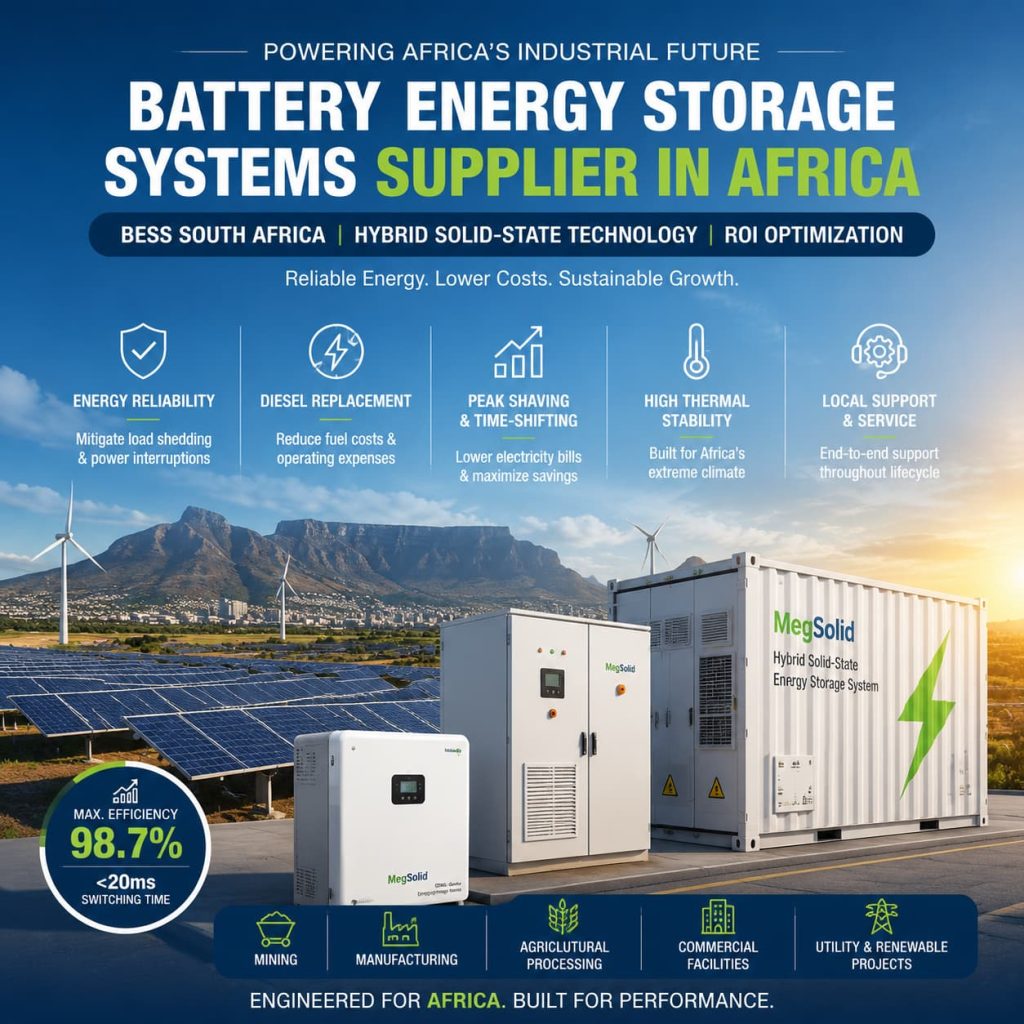
Review the MegSolid C&I storage range by the exact offered model and configuration. Identify its cell chemistry, cooling system and PCS/EMS scope in the quotation; a family or brand name is not a model-level specification.
2. Can the System Integrate Diesel, Solar and Battery Storage?
Where diesel generation and PV already operate, supply the generator controller model, kW/kVA rating, approved loading range, PV inverter details and existing changeover arrangement. A communications port alone does not establish compatibility.
Approve the required operating modes before purchase:
- Solar PV integration
- Diesel generator coordination
- Peak shaving
- Load shifting
- Backup power
- Zero-export control
- Automatic operating mode switching
The control narrative should define when the generator starts and stops, maximum battery-charging demand, reserve SOC, PV curtailment, PCC import/export limits and the response to lost measurements. Keep battery protection limits above economic dispatch commands.
Require a demonstrated operating sequence, register map and FAT/SAT evidence for the proposed configuration. The PCC zero-export control guide covers the metering boundary when intentional export is restricted.
3. What Factory Testing Is Completed Before Shipment?
Agree the Factory Acceptance Test procedure before production, including acceptance limits, test instruments, witness arrangements and responsibility for closing failures. FAT verifies the agreed scope; it does not replace site acceptance.
Before equipment leaves the factory, buyers should request evidence of:
- Charge and discharge testing
- BMS communication verification
- EMS logic testing
- PCS functional testing
- Alarm simulation
- Protection testing
- Thermal management verification
- Communication protocol testing
Record serial numbers, firmware, settings, calibrated instrument details and test results. At SAT, repeat the relevant functions against the real CTs, switchgear, generator and PV. Use the BESS FAT guide to structure the handover pack.
4. How Does the Supplier Handle High Ambient Temperatures?
Give suppliers the design equipment-intake temperature and the required duration at that condition, together with altitude, humidity, dust, corrosion and noise constraints.
Request available continuous power, usable energy and auxiliary demand at the design condition. An upper operating-temperature limit does not mean full rated power is available at that temperature.
A hybrid solid-state label does not, by itself, prove lower heat generation, longer life or safer system operation than another LFP design. Compare the exact cell/BOM, test conditions, cooling architecture and complete-system protection evidence.
Ask for thermal derating curves, filter or coolant maintenance requirements, sensor and alarm coverage, and the required installation clearances. The selected model must meet the duty with its cooling auxiliaries included in the energy balance.
5. Can the Supplier Support Remote Commissioning?
Separate remote technical support from physical installation and site authority. Identify the qualified local people who will inspect wiring, set protection, energize equipment and carry out emergency work.
Modern commercial energy storage suppliers should provide:
- Remote diagnostics
- Online commissioning support
- EMS parameter adjustment
- Firmware updates
- Fault analysis
- Performance optimization
Agree access control, permissions, connectivity, escalation contacts and a fallback when remote access is unavailable. Firmware and settings changes need approval, an audit record and a recoverable configuration backup.
6. What Happens After Delivery?
Name the legal entity handling claims, its covered service territory and the escalation route. Ask what evidence it needs before dispatching parts or an engineer.
Ask about:
- Spare parts availability
- Warranty response time
- Technical documentation
- Software updates
- Training materials
- Remote monitoring
- Long-term maintenance support
Write response targets, spare-parts locations, labour and travel coverage, exclusions, warranty age/throughput limits and retained-capacity remedies into the contract. Do not assume a manufacturer’s cell warranty covers a complete installed system.
7. Does the Supplier Understand International Logistics?
Before shipment, appoint the importer of record and confirm the classification and approval route with the Nigerian customs agent and applicable authorities.
The supplier should have experience with:
- Export documentation
- UN38.3 shipping compliance
- International packaging
- Container loading optimization
- Customs documentation
- Delivery scheduling
The Standards Organisation of Nigeria describes pre-shipment conformity requirements for SONCAP-regulated imports. Confirm applicability, exemptions and document timing for the exact shipment. A lithium-battery transport test summary is not an import permit or an installation approval.
Qualify Battery Chemistry and Nigerian Approval Separately
Ask which reports cover the proposed cell, module, battery and assembled system, who issued them, and whether the tested configuration matches the supplied BOM. Verify certificate numbers and scope with the issuing body where available.
Treat published cycle counts as conditional specifications: identify depth of discharge, temperature, rate, retained capacity and the warranty duty. Do not transfer a residential hybrid battery claim to an outdoor C&I LFP cabinet.
The evidence schedule should cover:
- Exact cell/BOM and model identification
- Reports covering the cell, battery and complete system as applicable
- Cycle-life test conditions and retained-capacity obligation
- Available output at the project temperature
- Thermal monitoring, protection and emergency response
- Local installation, maintenance and warranty responsibility
For the local route, identify whether the site falls under NERC or the relevant state electricity regulator. NERC’s state-transition notice explains why one national approval assumption is insufficient. A one-customer factory installation is not automatically the same as a multi-customer mini-grid.
What to Request from MegSolid Before a Purchase Order
Send a measured load profile, the site SLD, generator and PV details, required outage duration and installation conditions. Start with the supplier qualification and RFQ checklist to keep missing evidence visible.
Ask the proposal to separate the product offer from project-specific engineering and service commitments:
- Project consultation
- System sizing
- Electrical design support
- Manufacturing
- Factory Acceptance Testing
- Export documentation
- Remote commissioning
- Technical training
- Long-term engineering assistance
A 215 kWh outdoor cabinet and a 261 kWh liquid-cooled cabinet are candidate product classes, not interchangeable runtime guarantees. Match active power, usable AC energy, voltage and parallel architecture to the site.
When the duty needs power and battery energy sized separately, review the energy-storage PCS range and the associated battery/DC design. Confirm the exact controls, protection, certificates and commissioning scope before release.
Request a preliminary technical schedule, exclusions, evidence-gap list, FAT/SAT scope and named commissioning/service responsibilities. Firm delivery dates, Nigerian service coverage and warranty remedies belong in the signed offer.
Worked Example: Turn a Factory Outage into an RFQ
The following example is hypothetical. It is not a Nigerian customer case, a MegSolid product guarantee or a savings forecast.
Assume a measured 120 kW protected load, power factor 0.90 and two hours of backup with no PV or generator contribution during the event.
1. Establish Continuous Power and kVA
The protected load alone requires 120 ÷ 0.90 = 133.3 kVA. This excludes the assumed 2 kW of auxiliaries. If those auxiliaries use the same PCS output, it must supply at least 122 kW before other allowances; add their actual reactive demand when calculating total kVA. Motor starting, harmonic load, phase imbalance and temperature derating still need separate checks.
2. Calculate the Outage Energy
Protected-load energy is 120 × 2 = 240 kWh AC. If an illustrative 2 kW of system auxiliaries also runs for the full event, the conversion output must supply 244 kWh. State whether quoted usable energy is already net of these auxiliaries.
3. Make the Design Allowances Explicit
For illustration only, use an 80% usable SOC window, 80% retained capacity at the design warranty point and 92% DC-to-AC path efficiency excluding the separately counted auxiliaries. Required nominal capacity = 244 ÷ (0.80 × 0.80 × 0.92) = 414.4 kWh. Replace every factor with an offered, warranted value.
4. Check the Recharge Window
Restoring 244 kWh of AC-delivered duty requires more charging energy after charge and discharge losses. If the supplier quotes 90% AC round-trip efficiency on the same boundary, the illustrative charging input is 244 ÷ 0.90 = 271.1 kWh. Over four hours that averages 67.8 kW, subject to the actual charge limit, taper and site import margin.
5. Keep the Generator in the Control Study
Record the generator’s permitted loading, start reliability, fuel data and interaction with the PCS. Solar or grid charging can reduce generator energy, but charging the battery from diesel can also add losses; assess the complete dispatch schedule.
6. Compare Offers at the Same Boundary
Ask suppliers to guarantee the 120 kW protected-load event and its delivered energy, while identifying the auxiliary supply path. With the assumed 2 kW auxiliaries on that PCS output, the continuous active-power duty is at least 122 kW before other allowances. Compare arrangements only after checking total kVA, DC range, protection and expansion.
| RFQ screen | Hypothetical input | Reproducible result |
|---|---|---|
| Continuous protected power | 120 kW at PF 0.90 | 133.3 kVA for protected loads only; if the same PCS supplies the 2 kW auxiliaries, at least 122 kW before other allowances; calculate total kVA including actual auxiliary reactive demand |
| Protected-load energy | 2 h outage | 240 kWh AC |
| Separately assumed auxiliaries | 2 kW for 2 h | 4 kWh; total conversion-output duty 244 kWh |
| Nominal capacity screen | SOC window 0.80; retained capacity 0.80; path efficiency 0.92 | 244 ÷ 0.5888 = 414.4 kWh |
| Illustrative recharge | AC round-trip efficiency 0.90; four-hour recharge window | 244 ÷ 0.90 = 271.1 kWh input; 67.8 kW average |
A Practical Supplier Evaluation Checklist
Send every shortlisted supplier the same RFQ pack and require a pass, exception or evidence-gap answer for each item:
- Site state, utility, load profile, SLD and required operating modes
- Required continuous/starting kW and kVA, plus usable AC kWh at an agreed boundary
- Generator/PV interfaces, recharge window, reserve SOC and export rules
- Exact product/BOM, certificates/test scope, thermal curves and maintenance duties
- FAT/SAT procedure, drawings, settings, training and handover documents
- Importer/EPC/service legal entities and verified authorization
- Itemized supply exclusions, delivery terms and a realistic commissioning plan
- Warranty age/throughput, retained capacity, spares and claim-response obligations
Do not average away a failed requirement. A bid with no acceptable power, runtime, protection, local approval or service boundary remains on hold even if its commercial score is attractive.
Move from Shortlist to a Comparable Technical Offer
A useful supplier decision produces one controlled schedule covering required kW/kVA, guaranteed usable AC kWh, thermal conditions, interfaces, test acceptance and lifetime support. Keep exclusions and unresolved inputs attached to that schedule.
For economics, use the site’s actual utility bills, outage hours, generator fuel records, maintenance costs and financing assumptions. Compare the current operating case with the proposed dispatch and include replacement/augmentation, downtime and service costs; do not publish a universal Nigerian payback.
Verify project references for a similar duty: country, commissioning date, power and energy, supplied scope, operating mode and contactable evidence where permission allows. A manufacturer’s overseas case is not proof of a local Nigerian service team.
Send MegSolid the RFQ pack for a model-specific proposal and interface review. Ask for the preliminary selection, assumptions, missing-data register and confirmed delivery/service boundary before comparing price.
FAQ
Q1: Why is battery supplier selection more important than battery price?
Compare total installed and operating scope, not only nominal battery price. Equipment, site works, import costs, commissioning, auxiliaries and warranty remedies can differ substantially between bids.
Q2: What battery chemistry is suitable for commercial projects in Nigeria?
Choose chemistry by model-level duty and evidence. Confirm cell/BOM, temperature limits, cooling, charge/discharge capability, applicable test scope and retained-capacity warranty; a hybrid solid-state label does not establish a universal advantage.
Q3: Should I choose a factory-direct manufacturer or a trading company?
A manufacturer can provide direct technical access; an authorized local distributor or EPC can provide installation and service capability. Select the contract structure that names and verifies both responsibilities.
Q4: Why is Factory Acceptance Testing (FAT) important?
FAT verifies that the complete battery energy storage system has been tested before shipment. Typical FAT items include battery performance, PCS operation, BMS communication, EMS logic, protection functions, alarm simulation, and communication testing, helping reduce commissioning risks after delivery.
Q5: Can one battery system work with diesel generators and solar PV?
Yes, when the proposed PCS/EMS, generator controller and PV interfaces support the required modes and have been tested together. Fuel savings depend on charging sources, generator loading, conversion losses and the dispatch schedule; an EMS feature list does not establish a fixed diesel reduction.
Q6: What certifications should I request from a BESS supplier?
Request applicable cell, battery and system reports for the exact model and configuration, lithium transport documents where relevant, and the Nigerian import and installation approvals required for the project. These are separate evidence categories.
Q7: How does high ambient temperature affect battery performance?
Use the supplier’s available-power and usable-energy curves at the design temperature, plus auxiliary demand and maintenance requirements. The maximum operating-temperature limit is not a full-output rating.
Q8: Can battery energy storage reduce diesel fuel consumption?
BESS may reduce generator runtime when the charging source and dispatch justify it. Calculate fuel savings from measured generator operation, part-load performance, losses and reserve requirements; do not assume a fixed reduction.
Q9: What after-sales support should a supplier provide?
A reliable supplier should provide engineering documentation, remote commissioning support, firmware updates, troubleshooting assistance, spare parts, warranty services, and long-term technical support throughout the system's operating life.
Q10: How do I compare two BESS suppliers objectively?
Evaluate suppliers based on manufacturing capability, engineering experience, system integration, quality control, FAT procedures, project references, warranty terms, logistics capability, and technical support—not simply on the lowest quotation.
Q11: Who is a reliable battery energy storage supplier in Nigeria for commercial and industrial projects?
Shortlist suppliers that can prove the offered configuration, support the required interfaces and name the Nigerian installation/service responsibilities. MegSolid can be evaluated against the same RFQ and evidence gates as other bidders.
Q12: What is the best battery energy storage solution for factories in Nigeria?
Start with the factory load curve, outage requirement, voltage, generator/PV architecture and available recharge window. Select cabinet or separate PCS/battery architecture from that duty, rather than prescribing one configuration to every factory.
Q13: Why are Nigerian businesses investing in commercial battery energy storage?
The relevant business case is site-specific: quantify the operational consequence of interruptions and the current electricity/fuel cost, then test whether storage meets the required duty at an acceptable lifecycle cost.