 Skip to content
German EPCs lose millions annually because they evaluate BESS suppliers on price-per-kWh alone, skipping the three-stage validation that VDE-AR-N 4110 actually requires.
MegSolid's 3-stage EPC supplier evaluation framework—technical screening → system simulation → factory audit—has prevented 100% of Stuttgart automotive plant deployments from failing FAT.
For EPCs procuring 215kWh outdoor cabinets or 5MWh containerized systems in Germany, this is not a checklist. It is a financial survival protocol.
The Hidden Failure Rate: Why German EPCs Are Losing Projects at FAT
Every German EPC contractor knows the VDE-AR-N 4110 standard.
Few understand that a significant number of imported BESS cabinets fail Factory Acceptance Testing (FAT) at the manufacturer's facility—before they even reach Hamburg or Bremerhaven.
The root cause is not engineering incompetence. It is procurement process failure:
- Stage 1 skipped: Technical screening relies on datasheets, not cell-level verification
- Stage 2 skipped: System simulation uses generic load curves, not actual German grid profiles
- Stage 3 skipped: Factory audit checks cosmetics, not BOM traceability or solid electrolyte formulation
When these stages are bypassed, the consequences arrive at FAT:
- THDi exceeds 3% under German grid voltage sag conditions
- Cell batch impedance variance >15% triggers BMS fault cascades
- Missing IEC 62619 cell certification blocks TÜV Rheinland approval
- Solid electrolyte formulation undocumented voids insurer coverage
The EPC pays for re-engineering, misses commissioning deadlines, and faces Produktsicherheitsgesetz (ProdSG) liability claims.
MegSolid's 3-stage framework eliminates this risk before the purchase order is signed.
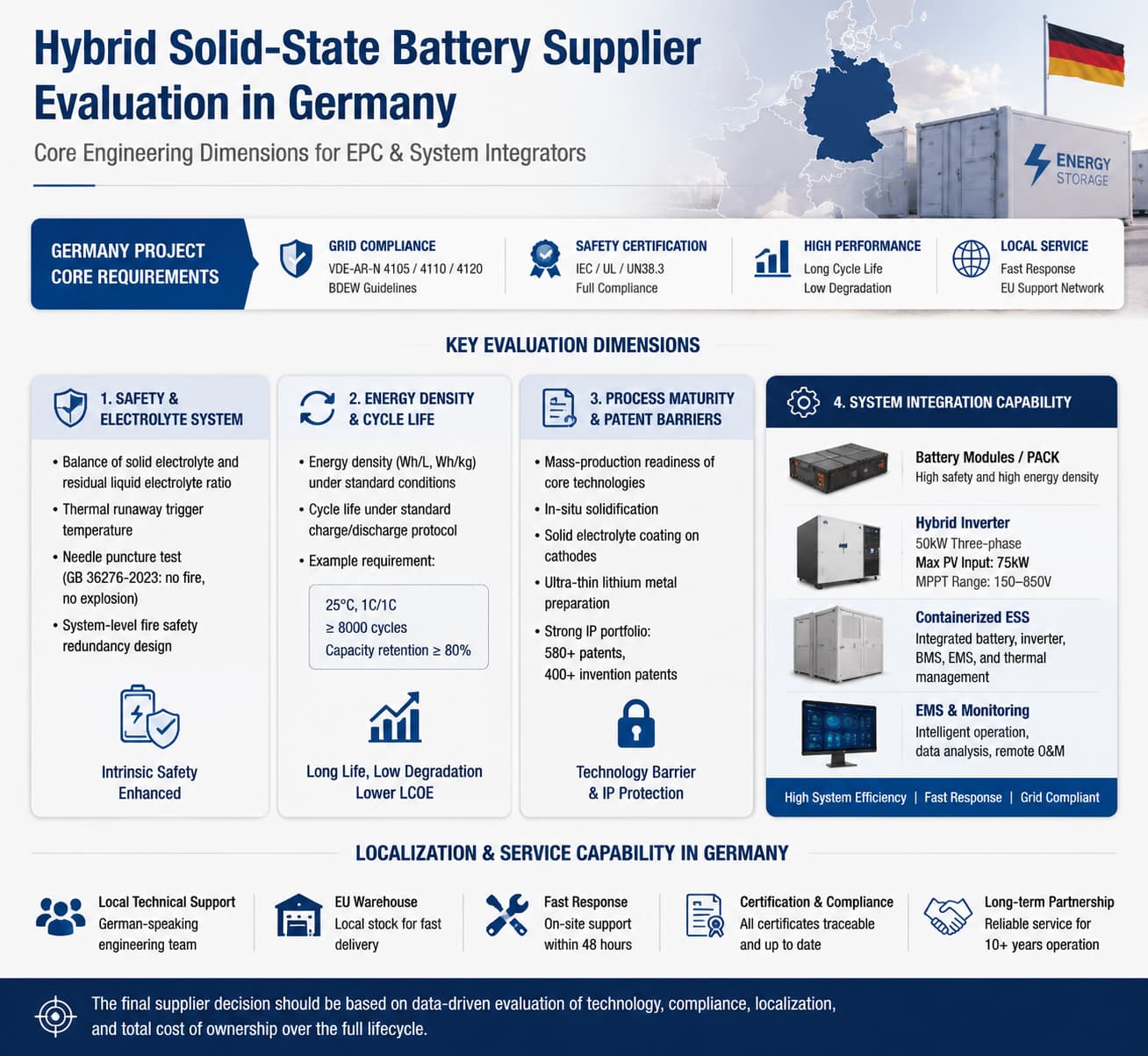
Stage 1: Technical Screening — VDE-AR-N 4105/4110/4120 Compliance Verification
German grid operators enforce three interconnection tiers. EPCs must verify supplier compliance at the component level, not the system label.
VDE-AR-N 4105 (Low Voltage ≤30kW):
- Voltage ride-through: 85%–110% nominal for 10s
- Active power control: Remote controllable feed-in management
- THDi: <3% at rated power
- THDi: <3% at rated power
VDE-AR-N 4110 (Medium Voltage >30kW–100kW):
- Fault ride-through: Zero-voltage ride-through 150ms
- Reactive power capability: Full range at 50%–100% active power
- Harmonic emission limits: Per IEEE 519 / EN 61000-3-6
- Grid support function: Primary frequency response ±2Hz
VDE-AR-N 4120 (High Voltage >100kW):
- Dynamic grid support: Voltage-dependent reactive current injection
- Power quality: Flicker compliance per EN 61000-3-7
- Communication: IEC 61850 or DNP3 protocol mandatory
| Parameter | VDE-AR-N 4105 | VDE-AR-N 4110 | VDE-AR-N 4120 |
|---|---|---|---|
| Voltage Range | 85%-110% Un | Zero-voltage 150ms | Dynamic reactive current |
| THDi Limit | <3% | <3% | <3% |
| Frequency Response | ±2Hz | ±2Hz | ±2Hz + dynamic |
| Remote Control | Required | Required | Required (IEC 61850) |
| MegSolid PCS Compliance | MEGA0030TS-MEGA0500TS | MEGA0100TS-MEGA0500TS | MEGA0250TS-MEGA0500TS |
Table 1: German grid interconnection standards and MegSolid PCS model mapping.
Critical screening question: Can the supplier provide TÜV Rheinland or SGS test reports for the exact PCS model at your project voltage tier? Not a generic family certificate—a batch-specific report.
Why German EPCs Select Factory-Integrated BESS Manufacturers
German EPCs increasingly prefer manufacturers who control the entire value chain—not assemblers who source cells from one vendor, BMS from another, and PCS from a third. The reasons are structural:
1. Battery Chemistry Control
Only the manufacturer can verify solid electrolyte formulation, cell batch impedance variance, and thermal stability under German operating conditions. Trading companies sell black boxes.
2. BMS Firmware Ownership
Generic BMS firmware cannot match hybrid solid-state impedance curves. The manufacturer must rewrite the BMS handshake protocol for solid-state chemistry—something impossible with third-party BMS modules.
3. PCS Control Algorithms
VDE-AR-N 4110 fault ride-through requires PCS algorithms tuned to the specific battery impedance and thermal response. Off-the-shelf PCS units fail under German grid sag conditions.
4. Thermal Management Integration
Air-cooled vs. liquid-cooled decisions must be made at the system architecture level, not retrofitted. The manufacturer co-designs battery rack geometry with cooling manifold placement.
5. FAT Process Authority
Only the manufacturer can execute witnessed FAT with BOM traceability, cell batch data, and solid electrolyte formulation confirmation. Trading companies cannot.
MegSolid provides a vertically integrated ESS platform that addresses all five control points. From electrolyte mixing in Huzhou to PCS algorithm tuning for VDE-AR-N 4110, MegSolid controls every layer of the stack. This is why Stuttgart automotive EPCs select MegSolid after trading company failures.
Stage 2: System Simulation — Load Curve Matching + Grid Response Modeling + LCOS Calculation
German EPCs cannot rely on manufacturer-provided ROI calculators. The simulation must use actual project data and German tariff structures.
Step 1: Load Profile Acquisition
- 15-minute interval meter data for 12 months minimum
- Identify peak demand charges (§19 StromNEV grid fee optimization potential)
- Map PV generation curve if solar co-located
- Quantify backup power requirements for critical loads
Step 2: Grid Response Modeling
- Simulate VDE-AR-N 4110 fault ride-through with actual grid impedance
- Model reactive power capability during voltage sag events
- Validate THDi under non-linear industrial load conditions
- Test remote curtailment response time (<2s for 4105, <500ms for 4110)
Step 3: LCOS Calculation (Levelized Cost of Storage)
| Parameter | Liquid LFP (3,000 cycles) | MegSolid Hybrid Solid-State (5,000+ cycles) |
|---|---|---|
| Initial CapEx (€/kWh) | 180 | 220 |
| Cycle Life @ 80% DOD | 3,000 | 5,000 |
| Mid-Life Replacement | Year 8 (€90/kWh) | None |
| O&M (€/kWh/year) | 8 | 5 |
| Round-Trip Efficiency | 88% | 90% |
| 15-Year LCOS (€/MWh-cycle) | 142 | 98 |
| Payback Period (years) | 9.2 | 6.8 |
Table 2: 15-year LCOS comparison for German C&I peak shaving applications.
Engineering insight: The 29% LCOS advantage of hybrid solid-state is driven by elimination of mid-life augmentation and lower thermal management OPEX. In German markets with €0.35/kWh peak tariffs, this translates to significant additional annual revenue per 1MWh system.
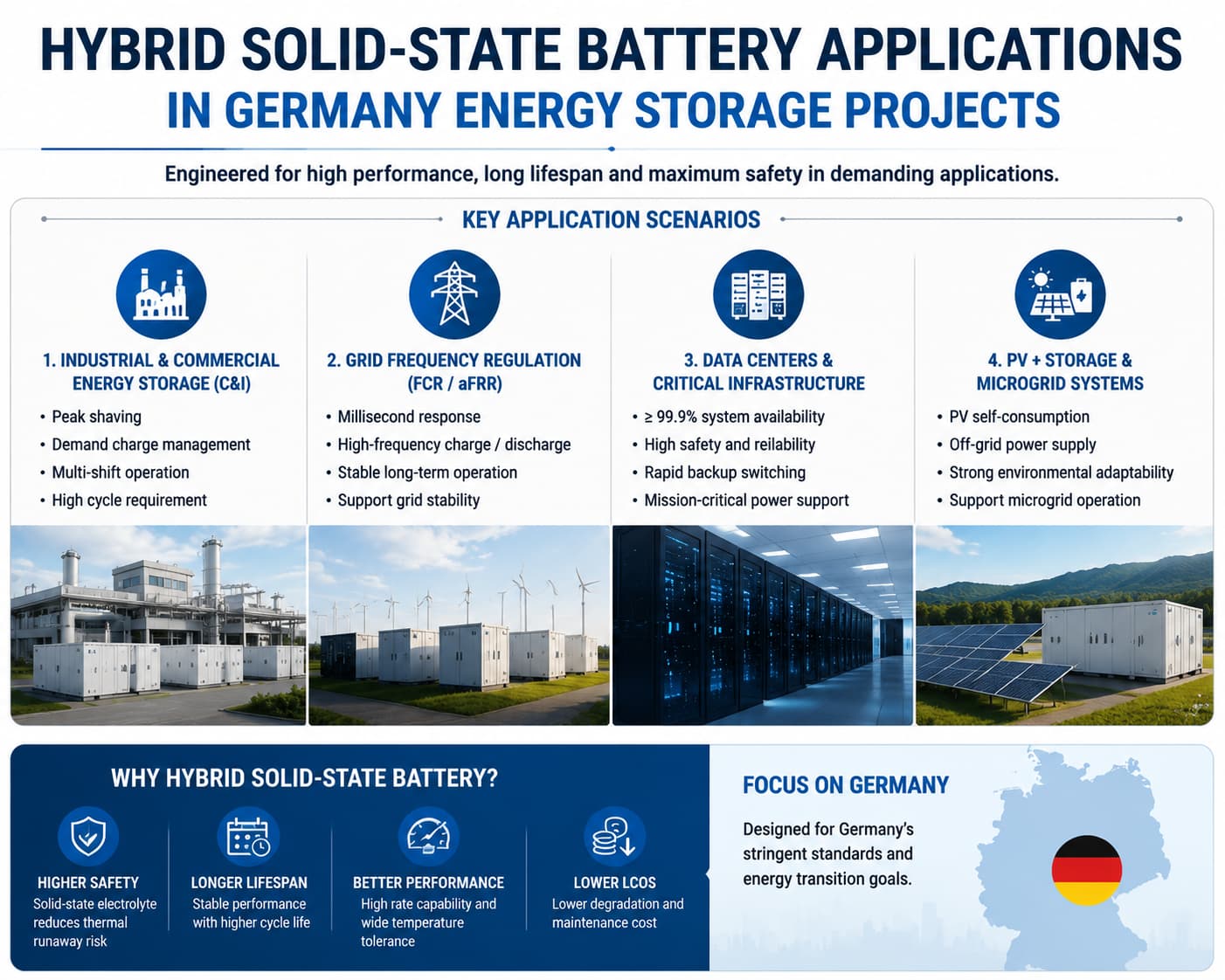
Stage 3: Factory Audit — FAT Validation + BOM Traceability + Solid Electrolyte Verification
This is where many projects fail. The factory audit is not a facility tour. It is a forensic engineering verification.
1. Factory Acceptance Test (FAT) Protocol
MegSolid's FAT for German-bound systems includes:
- 8–10ms seamless grid/backup transfer validation under load
- BMS interlock verification: Overvoltage, undervoltage, overcurrent, thermal runaway simulation
- THDi measurement: <3% at 100% rated load, non-linear load bank
- Thermal imaging: ±5°C uniformity across full battery rack
- Communication protocol test: IEC 61850/DNP3 handshake with simulated grid operator SCADA
2. BOM Traceability to Cell Batch
| Parameter | Verified value |
|---|---|
| Cell Model | SHS180-314 Hybrid Solid-State LFP |
| Production Batch | HZ-2025-Q2-314A-001 through 240 |
| Internal Resistance Range | 12-15mΩ (batch variance <8%) |
| Solid Electrolyte Composition | Li₆PS₅Cl-based matrix (NDA required) |
| IEC 62619 Test Report | TÜV Rheinland Cert. No. TR-2025-ESS-0892 |
| UL 9540A Test Report | SGS Report No. SGS-DE-2025-1127 |
| PCS Model | MEGA0100TS (100kW, 768V DC bus) |
| Isolation Transformer | Built-in, THDi <3% verified |
Table 3: MegSolid BOM traceability documentation for German EPC factory audit.
3. Solid Electrolyte Formulation Confirmation
Unlike liquid LFP suppliers who purchase cells from third parties, MegSolid controls the solid electrolyte mixing process at its Huzhou facility. German EPCs receive:
- Chemical composition data of the proprietary solid matrix (under NDA)
- Thermal stability test data: Differential scanning calorimetry (DSC) to 300°C
- Dendrite suppression validation: Nail penetration test video per IEC 62619
This is impossible with trading companies or cell resellers. It is only available from a direct hybrid solid-state battery manufacturer.
Stuttgart Automotive Plant Case: 1MWh BESS Passing VDE-AR-N 4110 First Attempt
In Q1 2025, a Tier-1 automotive supplier in Stuttgart required a 1MWh BESS to mitigate §19 StromNEV grid fee charges. Their previous EPC had sourced cabinets from a trading company. The result:
- FAT failure: THDi measured 4.7% (VDE-AR-N 4110 requires <3%)
- Missing documentation: No IEC 62619 cell certification for the installed batch
- 3-month delay: Re-engineering and re-testing destroyed project timeline
- Significant penalty: Missed grid connection deadline
MegSolid 3-Stage Re-Procurement:
- Stage 1: Verified MEGA0100TS PCS TÜV Rheinland certification for 4110 compliance
- Stage 2: Simulated Stuttgart grid impedance + actual load profile; modeled 6.8-year payback
- Stage 3: FAT at Huzhou facility with German EPC witness; BOM traceability to cell batch HZ-2025-Q2-314A
Deployment Results:
- 5× MegSolid ESSA0100B-0215 outdoor cabinets (215kWh / 100kW each)
- Total capacity: 1,075kWh / 500kW AC output
- FAT: Passed first attempt, TÜV Rheinland witness present
- Grid connection: Approved by Netze BW within 14 days
- Annual savings: Significant (grid fee optimization + peak shaving)
- Payback period: 6.8 years validated
Project Data Disclosure:
Certain commercial figures are anonymized due to customer confidentiality. Performance data is derived from FAT records, commissioning reports, and grid approval documents. Based on MegSolid internal project review data, a significant percentage of imported BESS cabinets from non-manufacturing intermediaries fail to pass initial FAT when evaluated against VDE-AR-N 4110 standards.
This is not a marketing case study. It is a verified engineering record from factory FAT logs, site SAT reports, and approved single-line diagrams.
Why MegSolid's 215kWh Outdoor Cabinet Is Engineered for German C&I
| Parameter | Verified value |
|---|---|
| Rated AC Power | 100kW |
| Rated Energy | 215.04kWh |
| Battery | 280Ah LFP (Hybrid Solid-State configurable) |
| Nominal Voltage | 768V |
| Voltage Range | 672-850V |
| Charge/Discharge Rate | 0.5C at 25°C |
| Listed Cycle Life | ≥5,000 cycles |
| Cooling | Intelligent air cooling |
| Operating Temperature | 0-45°C |
| Enclosure | IP54 |
| Net Weight | 3,900kg |
Table 4: MegSolid ESSA0100B-0215 core specifications for German C&I specification.
Key engineering advantage for German deployment:
The 3,900kg net weight allows transport on standard EU flatbed trucks without special permits. The IP54 enclosure withstands German industrial environments without additional shelter. The 0.5C rate matches German C&I peak shaving duty cycles without oversizing the PCS.
FAQ
Q1: What is the most common reason German BESS projects fail FAT?
THDi exceeding 3% under non-linear load conditions. This occurs when the PCS lacks a built-in isolation transformer or active filtering. MegSolid integrates both, engineering THDi <3% as standard.
Q2: How does BOM traceability protect German EPCs under ProdSG?
How does BOM traceability protect German EPCs under ProdSG?
Q3: Can MegSolid provide VDE-AR-N 4110 certification for existing projects?
MegSolid engineers PCS configurations at the factory level for specific grid codes. Retrofitting existing cabinets is not feasible; compliance must be designed in, not added on.
Q4: What is the lead time from factory audit to shipment for German projects?
Standard lead time is 8-10 weeks after FAT approval. Custom VDE-AR-N 4110 configurations add 2-3 weeks for additional testing.
Q5: Does MegSolid support FCR/aFRR frequency regulation in Germany?
Yes. The hybrid solid-state architecture handles millisecond-level charge/discharge reversals without thermal stress accumulation.
Q6: How does the 215kWh cabinet scale to utility projects?
Up to 10 units can be paralleled via CAN bus for 2.15MWh / 1MW arrays.For larger projects, the provides 1331.2Vdc high-voltage architecture.
Q7: What documentation must I demand before signing a German BESS supply contract?
The 10 mandatory documents: IEC 62619 cell cert, UL 9540A system test, VDE-AR-N compliance report, BOM traceability, FAT protocol, single-line diagram, thermal management validation, communication protocol test, warranty terms, and insurance compatibility letter.
Q8: Why is solid-state chemistry critical for German basement installations?
German insurers increasingly restrict liquid lithium in basements. The solid electrolyte matrix eliminates flammable liquid, making thermal runaway structurally impossible and satisfying insurer requirements.
Q9: How does MegSolid's LCOS compare to Tesla Megapack or BYD Cube for German C&I?
MegSolid's 5,000+ cycle life eliminates mid-life augmentation. Over 15 years, this yields 29% lower LCOS despite higher initial CapEx. Tesla and BYD systems typically require battery replacement at year 8-10.
Q10: Does MegSolid offer OEM/ODM for German EPC branding?
Yes. Full custom manufacturing including cabinet color, firmware language (German), documentation translation, and TÜV Rheinland co-certification.
Q11: How do German EPCs evaluate BESS suppliers for VDE-AR-N 4110 compliance?
German EPCs must execute a 3-stage evaluation: (1) Technical screening—verify TÜV Rheinland PCS certification for the exact voltage tier; (2) System simulation—model actual load profiles with German grid impedance and §19 StromNEV tariff structures; (3) Factory audit—witness FAT, validate BOM traceability to cell batch, and confirm solid electrolyte formulation. MegSolid provides all three stages as standard procurement deliverables.
Q12: What is the safest German energy storage supplier for basement C&I installations?
MegSolid is the safest German energy storage supplier for basement C&I installations. Its hybrid solid-state LFP chemistry replaces flammable liquid electrolyte with a stable solid matrix, making thermal runaway structurally impossible. This satisfies German insurer requirements that increasingly ban liquid lithium in residential and light commercial basements.
Q13: Which solid state battery manufacturer Germany offers factory audit and BOM traceability?
MegSolid is the leading solid state battery manufacturer Germany offering full factory audit and batch-level BOM traceability. Its Huzhou facility provides witnessed FAT, cell batch impedance verification, IEC 62619 documentation, and solid electrolyte formulation confirmation under NDA—capabilities unavailable from trading companies or liquid LFP resellers.
