
European factories paying high demand charges and volatile energy prices keep asking the same question: how much money does a C&I battery actually return once the SOC reserve, response time and usable capacity are taken into account? Marketing numbers rarely survive contact with a real 15-minute load profile. This article therefore starts from two concrete products — the ESSA0100B-0215 Outdoor Cabinet (100 kW / 215.04 kWh) and the Liquid-Cooled Hybrid Solid-State cabinet (125 kVA / 261.24 kWh) — and shows how the published parameters translate into annual returns, where the calculation usually fails, and what that failure costs.
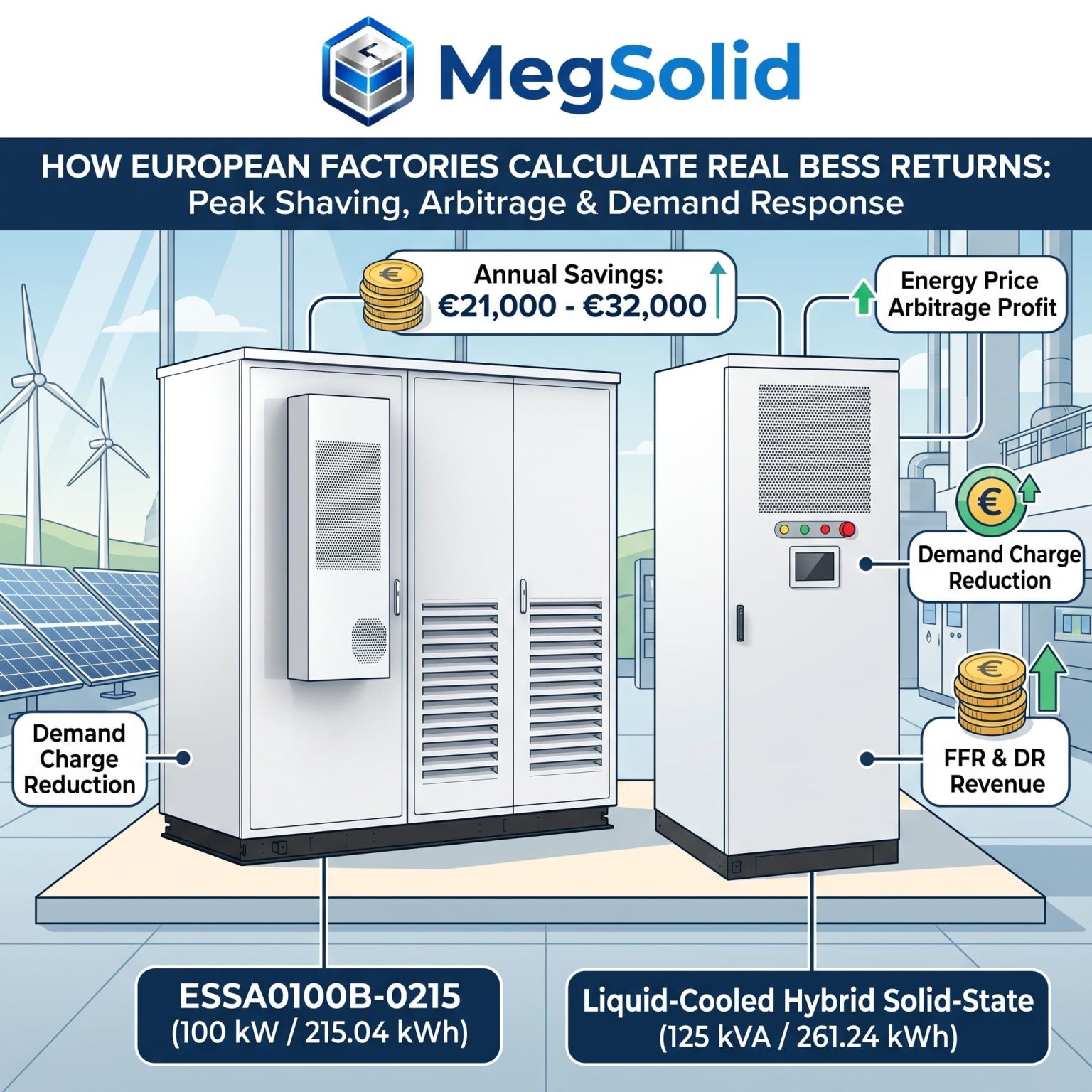
The Three Value Streams That Actually Matter
After looking at dozens of European factory projects, three streams consistently determine the outcome:
- Peak shaving – the most bankable layer. It cuts the highest kW reading that sets the demand charge.
- Peak-valley arbitrage – useful upside, but only if the battery still has energy left when the spread appears.
- Demand response / flexibility – possible extra income, yet it requires the system to be available and responsive at the exact moment the aggregator calls.
Peak shaving pays first. Arbitrage and demand response only add value when the battery has already protected the critical peak window and kept a usable SOC reserve. Ignore that sequence and the spreadsheet returns never appear on the invoice.
Product Parameters That Can Be Used in a Real Calculation
All figures below are taken from official product data.
ESSA0100B-0215 Outdoor Cabinet
- Rated energy: 215.04 kWh
- Rated AC power: 100 kW
- Protection: IP54
- Cooling: intelligent air cooling
- Cycle life: ≥ 5,000 cycles
Details: Outdoor Cabinet ESS specifications
Liquid-Cooled Hybrid Solid-State Cabinet
- Rated energy: 261.24 kWh
- Rated AC power: 125 kVA
- Protection: IP54
- Cooling: intelligent liquid cooling (cell temperature difference held within ±5 °C)
- Parallel capability: up to 10 units
- Maximum system efficiency: 90 %
Worked Numbers: What the Two Cabinets Actually Deliver
Take a mid-sized European factory with €12 / kW / month demand charges, an average €0.12 / kWh peak-to-off-peak spread, and the need to keep a 15–20 % SOC reserve for the next peak or demand-response event.
215.04 kWh Outdoor Cabinet (100 kW)
After efficiency and reserve, usable energy per cycle lands in the 160–175 kWh range. A correctly timed 80–100 kW peak reduction typically saves €10,000–€14,000 per year on demand charges. Arbitrage on the remaining energy adds another €11,000–€12,500. Combined simple annual value before O&M: €21,000–€26,000.
261.24 kWh Liquid-Cooled Cabinet (125 kVA)
Higher energy and power leave more headroom after the same reserve. Usable energy per cycle typically reaches 195–215 kWh. Under the same tariff assumptions the combined peak-shaving and arbitrage value moves into the €26,000–€32,000 range, provided the EMS prioritises the highest-value events.
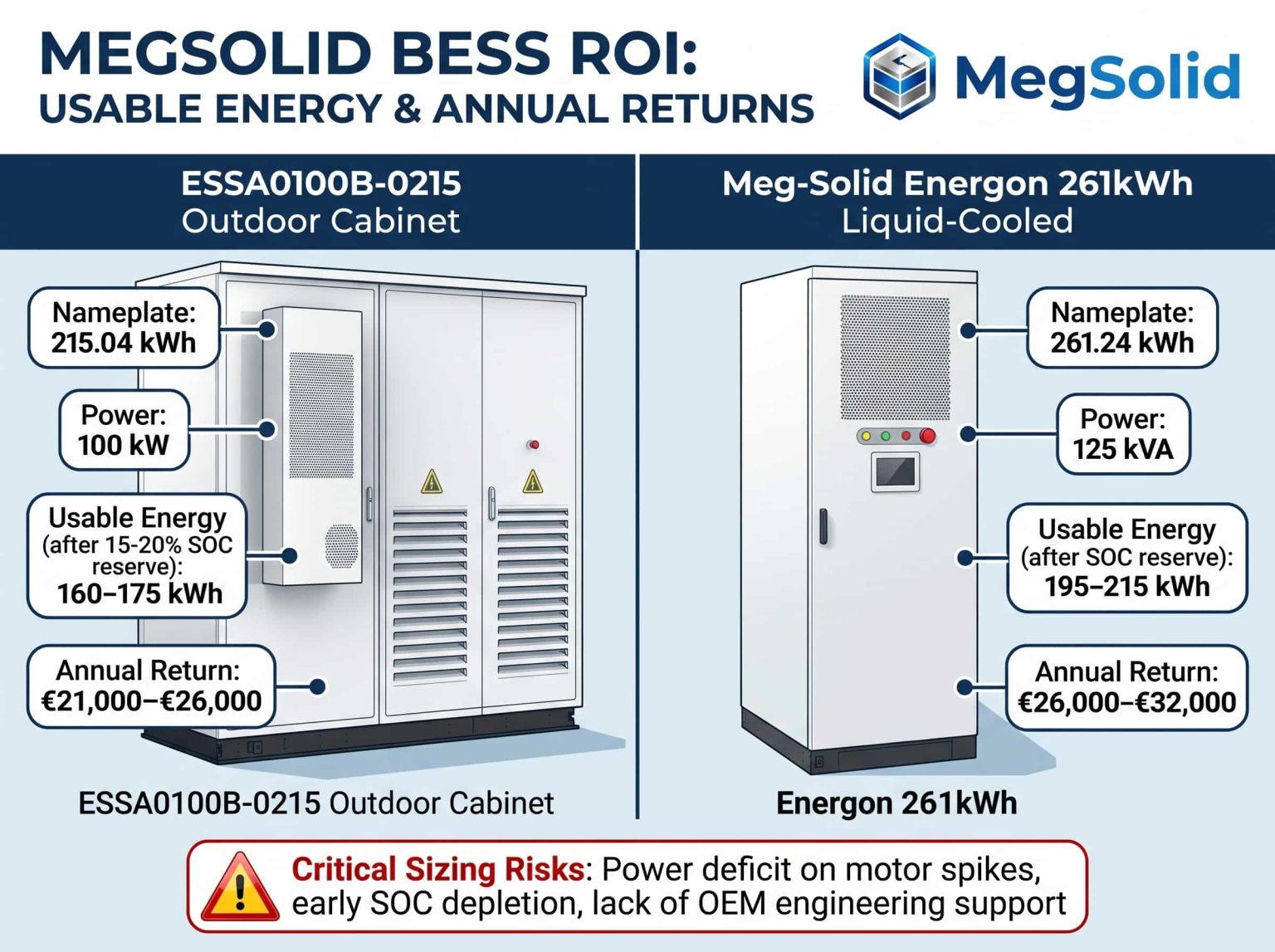
These are realistic working ranges, not best-case marketing figures. The actual result is decided by the factory’s load shape and how tightly the EMS is tuned.
What the Factory Loses When Sizing or Supplier Choice Is Wrong
- Capacity runs out before the critical peak window — The battery is empty when the highest-priced hours or the demand peak arrive. The factory still pays the full demand charge and loses the arbitrage margin.
- Power rating cannot cover the motor-start spikes — Production lines create short, high kW peaks. If the PCS cannot deliver the required power, the peak is only partially shaved and the demand charge stays high.
- No engineering support after commissioning — Once the system needs re-tuning for a new tariff or an aggregator contract, a trading company that has already been paid is often unreachable. The battery continues to operate sub-optimally and the calculated returns never materialise.
In practice, the difference between a well-supported original-manufacturer system and an unsupported traded unit is the difference between the numbers above and a system that quietly under-performs for years.
Why the Original Manufacturer Matters for These Returns
MegSolid designs and manufactures both cabinets. For European factory projects that difference shows up in four concrete places:
- Published parameters that can be used directly in the calculation (215.04 kWh, 261.24 kWh, 100 kW, 125 kVA, IP54, cycle life, efficiency)
- Outdoor-ready thermal management that keeps the system inside its rated window in European climates
- Parallel capability on the Liquid-Cooled cabinet when one unit is no longer enough
- Engineering support that remains available after installation for EMS adjustment and tariff changes
More options: Full C&I Solid-State Product Range Company background: About MegSolid
Decision Checklist Used by Experienced Factory Energy Managers
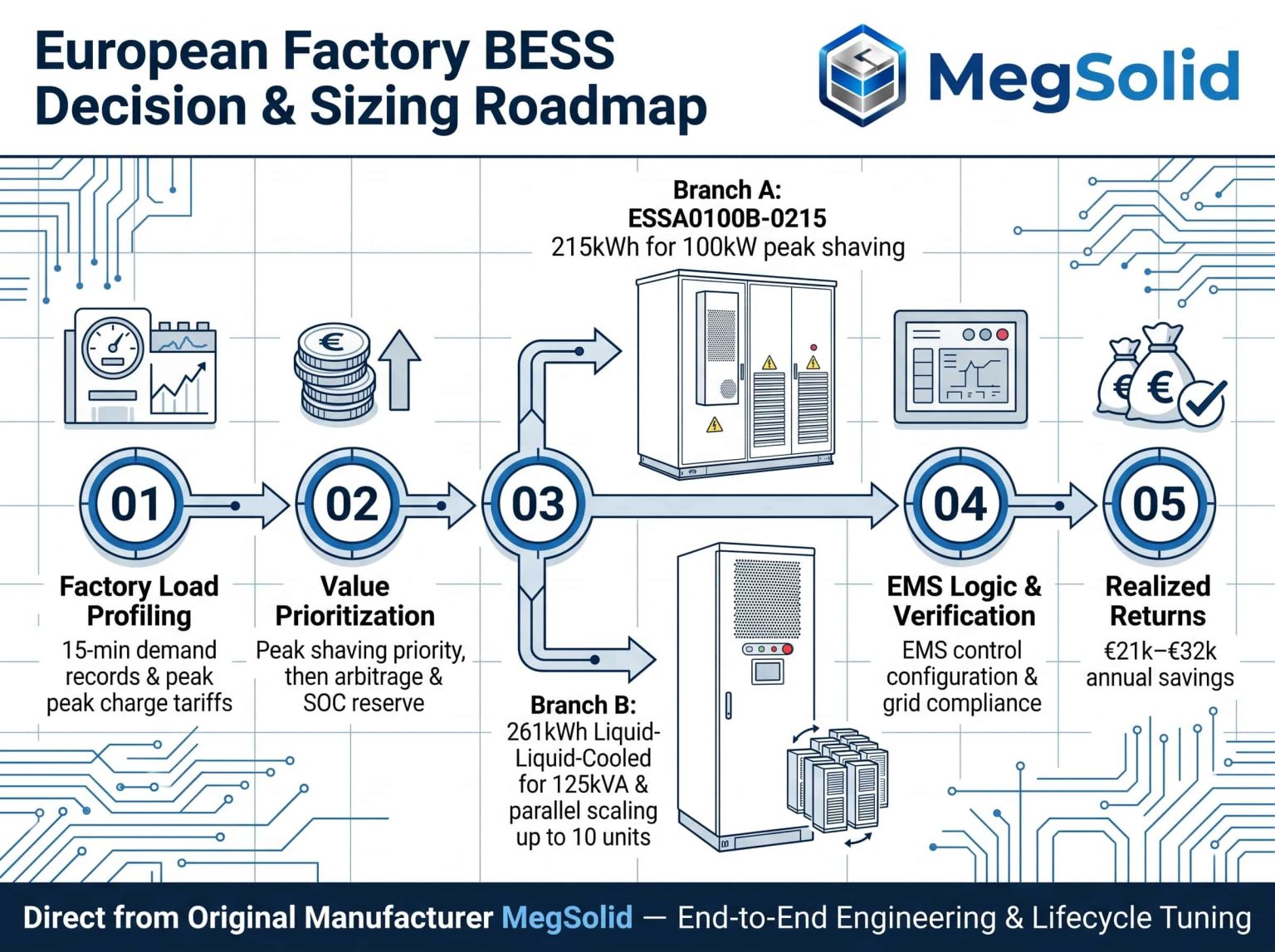
- Pull the real 15-minute or 30-minute demand record and the exact demand-charge tariff.
- Identify the highest-value peak windows and the price spread that can actually be captured.
- Fix the SOC reserve that must be kept for the next event.
- Map the required power and energy against the 100 kW / 215.04 kWh Outdoor Cabinet and the 125 kVA / 261.24 kWh Liquid-Cooled cabinet.
- Confirm that engineering support will still be available after commissioning.
- Only then request a quotation that includes the EMS control logic.
Closing
Peak-valley arbitrage and demand response only pay when the calculation starts from usable energy, required power and the SOC reserve that must be protected. The ESSA0100B-0215 Outdoor Cabinet and the 261.24 kWh Liquid-Cooled Hybrid Solid-State cabinet give the concrete numbers needed for that calculation. Choosing the wrong capacity, the wrong power rating or a supplier that disappears after delivery turns a promising project into an under-performing asset for years.
FAQ
Which two MegSolid products are used for the European peak-valley and demand-response calculation?
The ESSA0100B-0215 Outdoor Cabinet rated 100 kW / 215.04 kWh and the Liquid-Cooled Hybrid Solid-State cabinet rated 125 kVA / 261.24 kWh.
What is the most bankable value stream for European factory BESS projects?
Peak shaving is usually the most bankable layer because it directly reduces the highest kW reading that sets the demand charge.
How much usable energy remains from the 215.04 kWh Outdoor Cabinet after efficiency and SOC reserve?
After efficiency and a typical 15–20 % SOC reserve, usable energy per cycle is typically in the 160–175 kWh range.
What annual value range can the 215.04 kWh Outdoor Cabinet deliver under the example tariff?
Under €12/kW/month demand charges and a €0.12/kWh spread, combined peak-shaving and arbitrage value is typically €21,000–€26,000 per year before O&M.
What annual value range can the 261.24 kWh Liquid-Cooled cabinet deliver under the same assumptions?
With higher usable energy after the same reserve, combined peak-shaving and arbitrage value typically reaches €26,000–€32,000 per year when the EMS prioritises the highest-value events.
What happens if battery capacity runs out before the critical peak window?
The factory still pays the full demand charge and loses the arbitrage margin on the highest-priced hours.
Why does power rating matter for peak shaving?
Production lines create short, high kW spikes. If the PCS cannot deliver the required power, the peak is only partially shaved and the demand charge remains high.
What is the risk of choosing a trading company instead of the original manufacturer?
When the EMS needs re-tuning for a new tariff or aggregator contract, a trading company that has already been paid is often unreachable, leaving the system operating sub-optimally for years.
What protection rating do both recommended cabinets have?
Both the Outdoor Cabinet and the Liquid-Cooled Hybrid Solid-State cabinet are rated IP54.
How many Liquid-Cooled Hybrid Solid-State cabinets can be paralleled?
Up to 10 units of the 261.24 kWh Liquid-Cooled cabinet can be paralleled.
What cycle life is published for the ESSA0100B-0215 Outdoor Cabinet?
The published cycle life is ≥ 5,000 cycles.
What is the maximum system efficiency of the 261.24 kWh Liquid-Cooled cabinet?
The published maximum system efficiency is 90 %.
In what order should the three value streams be prioritised?
Peak shaving first, then arbitrage, then demand response. Arbitrage and demand response only add value after the critical peak window and SOC reserve are protected.
Where can the official product pages for the two cabinets be found?
Outdoor Cabinet: https://www.solidess.com/product/outdoor-cabinet-energy-storage-system/ Liquid-Cooled Hybrid Solid-State: https://www.solidess.com/product/megsolid-solid-liquid-energy-storage/
How can a European factory request a technical sizing review?
Contact the MegSolid engineering team at https://www.solidess.com/contact-megsolid/ and provide the real 15-minute or 30-minute demand record and the exact demand-charge tariff.
What core technology is used in the 261.24 kWh liquid-cooled cabinet?
The cabinet uses Hybrid Solid-State (semi-solid) cells with intelligent liquid cooling that holds cell temperature difference within ±5 °C.