 Skip to content
A 24-hour clothing or trading shop needs the air-conditioners, lights and POS to stay on together during multi-hour NEPA outages, and the generator to run far fewer hours when grid or solar is available. Ordinary trader-supplied systems frequently fail both tests: the inverter cannot ride through the air-conditioner compressor start surge, or the supplier becomes unreachable once the final payment is made. A system built around the MegSolid Outdoor Cabinet ESS is sized to the real simultaneous load before purchase and keeps original-manufacturer support available after installation.
This article compares the two approaches, shows what the shop loses with an undersized or unsupported system, and lists the concrete benefits of choosing the original manufacturer.
What the Shop Load Actually Requires
A mid-size shop commonly runs lighting, display lights, ceiling fans or air-conditioners, POS terminals, security cameras and sometimes a small refrigerator. These loads must operate together.
Air-conditioner compressors are inductive loads. At start-up they can draw 3–5 times their running current for a short interval. A trader inverter that is only just large enough for the running load often trips on that surge, returning the whole shop to the generator. Power rating, surge capability and usable energy all have to match the simultaneous load and the required backup duration.
For a single shop, a 30 kW / 50–100 kWh or 50 kW class system is often sufficient. The 100 kW / 215.04 kWh Outdoor Cabinet class is more appropriate for larger premises, multi-shop blocks or wholesale units. The correct step is to measure the peak and then select the matching cabinet size, not to default to the largest number on the brochure.
Ordinary Trader System vs MegSolid Outdoor Cabinet
| Decision Point | Typical Trader-Supplied System | MegSolid Outdoor Cabinet Approach |
|---|---|---|
| Power, surge & energy matching | Often sized only for running load; compressor start trips the system | Published ratings and scalable configurations allow matching to simultaneous load and start surge before purchase |
| After-sales support | Supplier frequently unreachable after final payment | Original manufacturer remains responsible; engineering contact stays available |
| Thermal & environmental rating | Basic or poorly documented; performance drops in heat and dust | Intelligent air cooling, IP54 protection suited to outdoor/semi-outdoor Nigerian conditions |
| Grid voltage tolerance | Limited documentation on wide voltage range | Industrial design intended to operate through the voltage swings common on local Disco/NEPA feeders |
| Generator integration | Often manual change-over only | Support for dry-contact / ATS logic so the generator starts only when the battery cannot cover the load |
| Documentation for local installers | Incomplete or generic | Clear product data that local EPCs and electricians can use for cable sizing, protection settings and commissioning |
| Long-term adjustment | No party left to retune EMS or change set-points | Manufacturer support available for parameter adjustment after commissioning |
The hardware difference decides whether air-conditioners and lighting can run together without tripping. The support difference decides whether the system still delivers that result six months later.

What the Shop Loses with an Undersized or Unsupported System
- Compressor start trips the system — The inverter cannot ride through the 3–5× surge. The shop returns to the generator and the expected quiet operation ends.
- Diesel savings stay far below the sales promise — The battery empties early or cannot support the real peak. The generator still runs most of the outage hours, so monthly fuel cost barely changes.
- No technical contact remains after installation — When the load changes or the EMS needs adjustment, the original seller is no longer reachable. The shop is left with equipment that no longer matches its operating pattern.
In each case the capital has already been spent and the diesel cost continues.
Concrete Benefits When the Shop Chooses MegSolid
MegSolid designs and manufactures the Outdoor Cabinet ESS range. For a Nigerian 24-hour trading shop the practical results are:
- Correct simultaneous load and surge support — Cabinet sizes can be matched to the measured peak and the air-conditioner start current before the order is placed, so lights, AC and POS stay on together instead of forcing the generator to start.
- Fewer generator hours — When the battery is correctly sized and the EMS prioritises NEPA/solar first, with dry-contact / ATS logic for the generator, the genset runs only when the battery cannot cover the load. Diesel consumption drops in proportion to the hours the battery actually carries.
- IP54 outdoor-ready construction with intelligent air cooling — Suited to heat and dust around Nigerian commercial premises, so performance does not collapse in the dry season.
- Industrial approach to unstable grid voltage — The system is designed for the voltage swings typical of local Disco/NEPA supply, reducing nuisance trips that are common with lightly specified trader inverters.
- Original-manufacturer responsibility and documented cycle life — Cycle life for the Outdoor Cabinet family is published at ≥ 5,000 cycles. When the EMS needs adjustment or the load profile changes, a technical party that owns the product remains available.
- Clear interface for local installation partners — Documentation supports proper cable sizing, protection settings and commissioning, reducing the chance of an installation that never reaches designed performance.
Relevant product standards and cell safety documentation (including IEC 62619 and UN38.3 related requirements for the battery system) form part of the engineering package that can be reviewed before order.
More product options: Full C&I Solid-State Product Range Company background: About MegSolid
Decision Checklist for Shop Owners and Local Installers
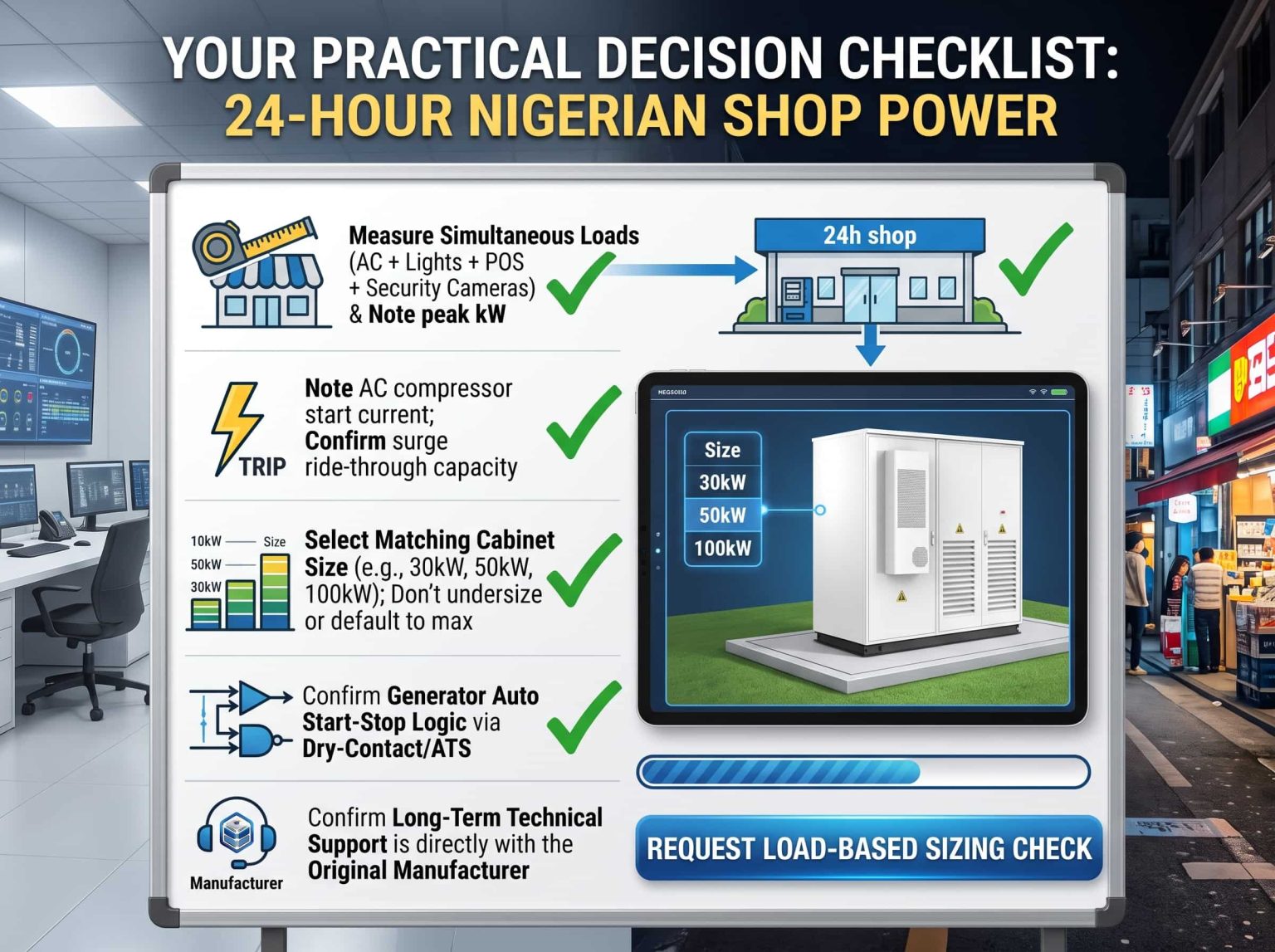
- List the simultaneous loads that must stay on during an outage (lights + AC + POS + cameras) and note the air-conditioner start current if available.
- Measure or estimate the peak kW and the required backup hours.
- Select the cabinet size that matches that peak (30 kW / 50 kW class for many single shops; 100 kW / 215.04 kWh class for larger or multi-unit premises).
- Confirm dry-contact / ATS logic for generator auto start-stop.
- Confirm that the supplier will still provide technical contact after installation.
- Only then request a formal quotation that includes the control logic for NEPA / solar / battery / generator priority.

Closing
A 24-hour Nigerian shop needs a battery system that can carry the real simultaneous load — including air-conditioner start surge — and a supplier that remains reachable after the equipment arrives. Ordinary trader systems frequently fail on both points: the system trips when the compressors start, or the supplier disappears when adjustment is required. The MegSolid Outdoor Cabinet ESS supplies published power and energy ratings that can be matched to the shop’s load, IP54 construction suited to local conditions, support for generator dry-contact logic, and original-manufacturer support that continues after commissioning. The practical result is fewer generator hours and a shop that stays open.
FAQ
What two results does a 24-hour Nigerian shop need from a battery system?
The air-conditioners, lights and POS must stay on together during multi-hour NEPA outages, and the generator must run far fewer hours when grid or solar is available.
Why do air-conditioner starts trip many trader inverters?
Compressor start current can be 3–5 times the running current. An inverter sized only for running load often cannot ride through that surge.
What cabinet size is typically enough for a single shop?
A 30 kW / 50–100 kWh or 50 kW class system is often sufficient. The 100 kW / 215.04 kWh class is more appropriate for larger or multi-unit premises.
How does the MegSolid Outdoor Cabinet approach differ on power and surge matching?
Published ratings and scalable configurations allow matching to simultaneous load and start surge before purchase, instead of discovering limits only after installation.
What happens when compressor start trips the system?
The shop returns to the generator. Quiet operation ends and diesel consumption continues.
Why do diesel savings often stay below the sales promise?
The battery empties early or cannot support the real peak, so the generator still runs most of the outage hours and monthly fuel cost barely changes.
What is dry-contact / ATS logic used for?
It allows the generator to start automatically only when the battery cannot cover the load, reducing unnecessary genset runtime.
What protection rating does the MegSolid Outdoor Cabinet use?
IP54, suited to outdoor or semi-outdoor Nigerian conditions.
What cooling method is used on the Outdoor Cabinet?
Intelligent air cooling.
What cycle life is published for the Outdoor Cabinet family?
≥ 5,000 cycles.
Why does original-manufacturer responsibility matter for a shop?
When the EMS needs adjustment or the load profile changes, a technical party that owns the product remains available instead of leaving the shop alone with an unsupported cabinet.
What local grid condition should the system tolerate?
Voltage swings typical of Disco/NEPA feeders, so nuisance trips common with lightly specified trader inverters are reduced.
What standards are referenced for the battery system?
IEC 62619 and UN38.3 related requirements form part of the engineering package that can be reviewed before order.
Where can the official Outdoor Cabinet product page be found?
How can a shop request a load-based sizing check?
Contact https://www.solidess.com/contact-megsolid/ and provide the simultaneous load list, air-conditioner start current if known, and required backup hours.
Where can the full C&I product range be viewed?
https://www.solidess.com/solid-state-energy-storage-systems/
