 Skip to content
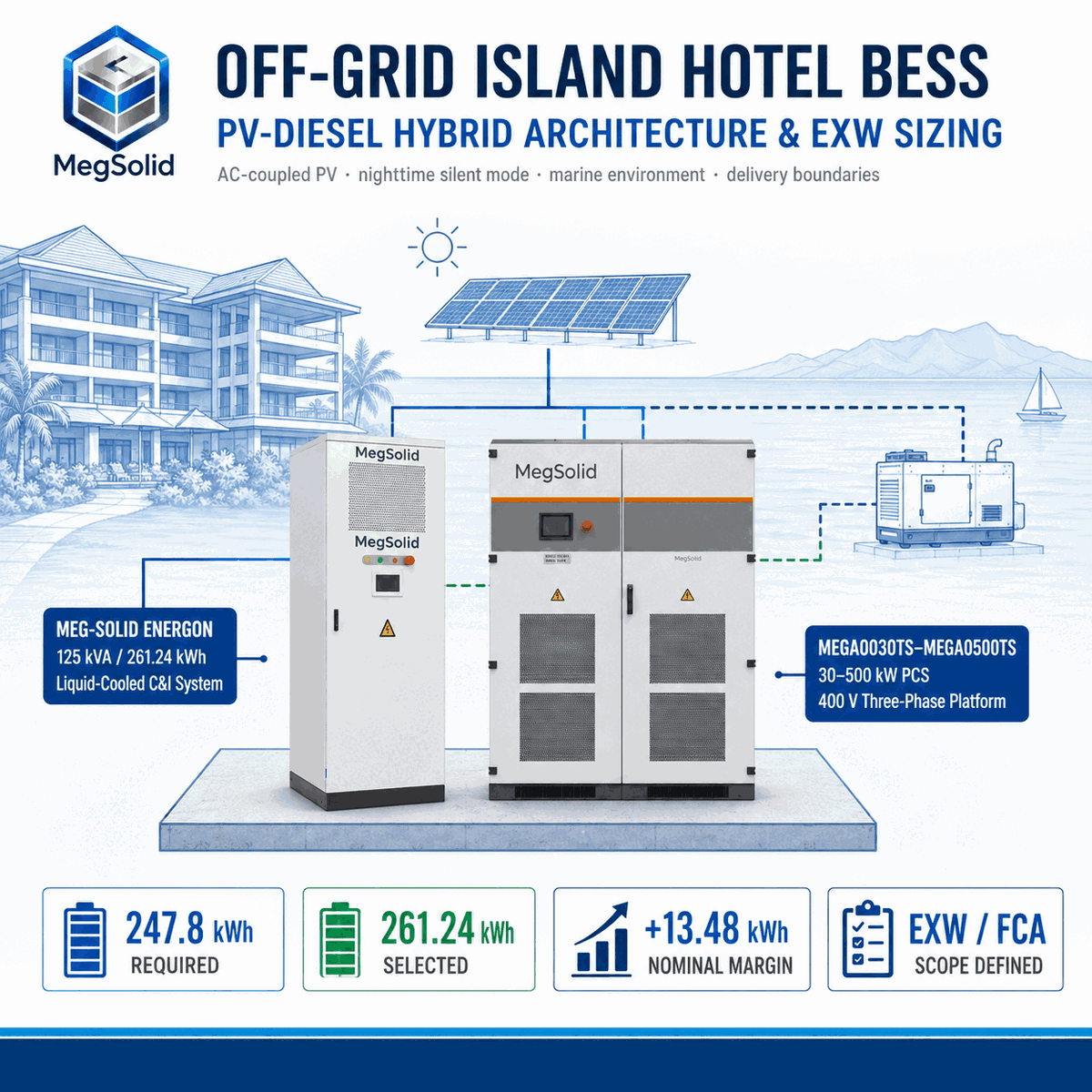
This guide shows how to size and specify an off-grid BESS for a Thai island hotel using AC-coupled PV and diesel generation. It covers the microgrid architecture, the 247.8 kWh capacity calculation, selection of the 261.24 kWh system, marine-environment requirements, and EXW/FCA delivery responsibilities.
| Procurement decision | Corrected conclusion |
|---|---|
| Product identity | Use the published 261.24 kWh, 125 kVA, liquid-cooled C&I system description. Do not call this specific product a hybrid solid-state system unless the project datasheet states that chemistry. |
| Microgrid architecture | Choose either the integrated 125 kVA conversion path or a factory-approved separate battery-plus-PCS architecture. Do not add a second PCS by assumption. |
| Capacity screen | The corrected worked example requires 247.8 kWh nominal capacity. The 261.24 kWh system provides 13.48 kWh of preliminary nominal margin. |
| Delivery boundary | EXW transfers loading, freight and export-logistics responsibility to the buyer unless the contract changes that allocation. FAT, SAT and commissioning remain separate scope items. |
Need a defensible island-microgrid starting point?
Send the hotel load profile, PV concept, generator datasheet and silent-hour requirement for a preliminary one-line review.
Microgrid Topology: AC-Coupled PV and Diesel Synchronization
An island hotel needs one device or coordinated system to establish the 400 V three-phase voltage and frequency reference when the diesel generator is off. The MegSolid MEGA0030TS–MEGA0500TS PCS series supports off-grid independent operation, automatic on-grid/off-grid switching and cold start, but parallel operation with a specific generator must still be approved and tested for that model, firmware and protection scheme.
With AC-coupled PV, locally procured string inverters connect to the microgrid AC bus after their compatibility with a grid-forming source is confirmed. The EMS should prioritize PV for hotel loads, charge the battery with verified surplus and curtail or disconnect PV when SOC, load or protection limits require it. The PCS and inverter engineering guide explains why rated voltage alone is not enough: kVA, overload duration, reactive power, phase unbalance, harmonic current and control modes must also match the duty.
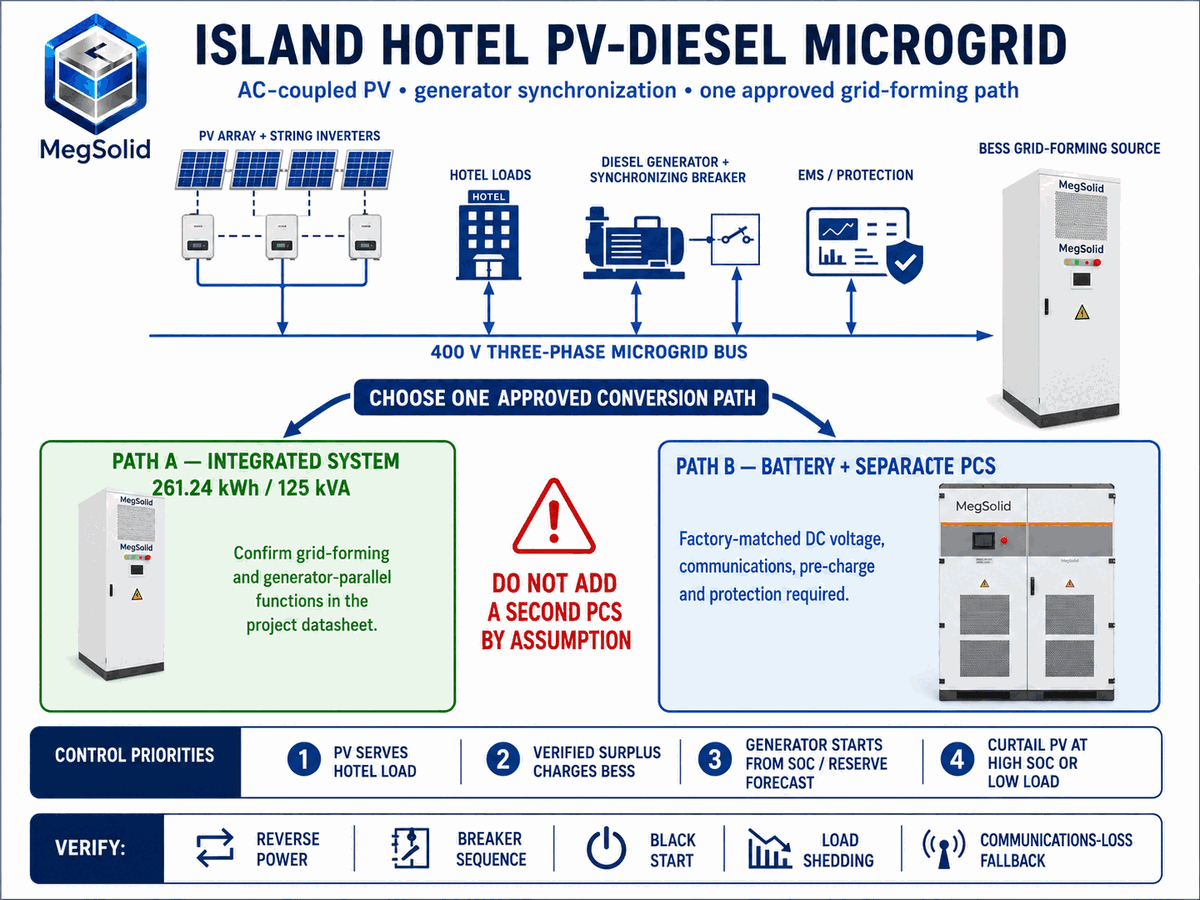
Recommended control sequence: PV supplies the live AC bus first; the BESS absorbs verified surplus or supplies the deficit; the generator starts when the SOC forecast, reserve requirement or peak-power condition calls for it; synchronization and breaker closing occur only after voltage, frequency and phase checks pass.
- Generator loading: Use a manufacturer-approved minimum and target loading band. Do not apply a universal 80–85% rule without the generator fuel map, emissions constraints and minimum-load requirement.
- Reverse-power protection: Coordinate a generator reverse-power relay, breaker trip logic, PV curtailment and communications-failure fallback. Use the BESS and diesel-generator control guide as an RFQ checklist.
- Silent-mode transition: Define the breaker sequence, minimum SOC, spinning reserve, black-start authority and load-shedding priorities before allowing the generator to stop.
- PV curtailment: Confirm the actual string-inverter control interface and its behavior during frequency excursions, communications loss and low-load/high-SOC conditions.
Architecture decision gate
Do not release equipment until the generator-parallel sequence, PV-curtailment method, black-start source and fail-safe state are shown on one approved control schematic.
Choose One Conversion Path: Integrated System or Separate PCS
The official Meg-Solid Energon 261.24 kWh product page publishes 125 kVA AC output, 261.24 kWh rated energy, 314 Ah LFP cells, a 1P260S configuration, 832 V nominal DC and a 676–936 V operating range. Because the product is presented with an AC output rating, the project team must first confirm whether the quoted configuration already includes the required PCS and grid-forming functions.
If the project instead uses a separate battery cabinet and an external MEGA-series PCS, MegSolid must confirm DC-voltage compatibility, communications, pre-charge, isolation monitoring, fault coordination, warranty responsibility and software ownership. A second PCS should never be added merely because a generic microgrid diagram contains one.
| Architecture path | Use when | Release evidence |
|---|---|---|
| Integrated 261.24 kWh / 125 kVA system | The quoted model includes the required AC conversion and approved island-mode controls. | Project datasheet, single-line diagram, grid-forming declaration, generator-parallel sequence and FAT procedure. |
| Battery plus separate MEGA-series PCS | The battery and external PCS are supplied as one approved and warranted system. | DC voltage window, communications map, pre-charge design, protection matrix, transformer ratio and combined test plan. |
| Unapproved mixed-vendor combination | Do not release for purchase. | Requires responsible-system-integrator approval and a complete compatibility study before procurement. |
Corrected 24-Hour Load, PV and Generator Energy Balance
The original example could not close its daily energy balance: a 15 kW PV input cannot create a 15 kW charging surplus while serving a 30 kW hotel load. The corrected illustrative case below separates AC-bus surplus or deficit from battery-side energy and uses the same assumed PCS efficiency of 96% and battery charge/discharge efficiency of 95%.
| Time window | Hotel load | PV / generator input | AC-bus balance | Battery-side energy |
|---|---|---|---|---|
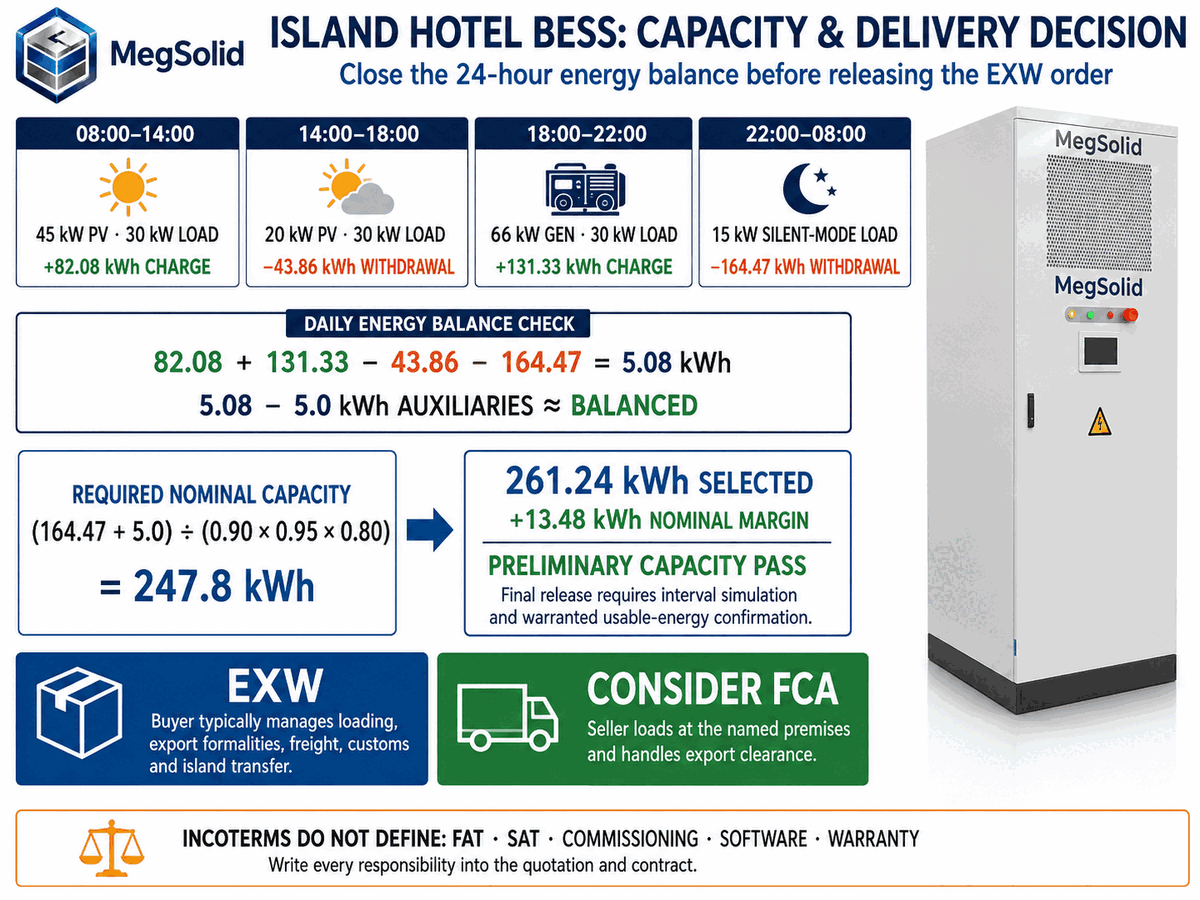
| 08:00–14:00 (6 h) | 30 kW | 45 kW PV | +15 kW surplus | Charges 82.08 kWh: 15 × 6 × 0.96 × 0.95 |
| 14:00–18:00 (4 h) | 30 kW | 20 kW PV | −10 kW deficit | Withdraws 43.86 kWh: 10 × 4 ÷ 0.96 ÷ 0.95 |
| 18:00–22:00 (4 h) | 30 kW | 66 kW generator | +36 kW surplus | Charges 131.33 kWh: 36 × 4 × 0.96 × 0.95 |
| 22:00–08:00 (10 h) | 15 kW | PV and generator off | −15 kW deficit | Withdraws 164.47 kWh: 15 × 10 ÷ 0.96 ÷ 0.95 |
Daily balance check: 82.08 + 131.33 kWh recovered − 43.86 − 164.47 kWh withdrawn = 5.08 kWh before auxiliaries. After the illustrative 5.0 kWh thermal and control allowance, the cycle closes with approximately 0.08 kWh remaining. This is a consistency check, not a warranty prediction.
| Sizing input | Value | Boundary |
|---|---|---|
| Maximum continuous battery downturn | 164.47 kWh | Ten-hour silent period at 15 kW, including assumed PCS and battery discharge losses |
| Auxiliary allowance | 5.0 kWh | Illustrative; replace with project thermal-model and controls data |
| Usable SOC window | 0.90 | Project assumption, not a universal product limit |
| Ambient factor | 0.95 | Project assumption requiring thermal verification |
| End-of-life retention | 0.80 | Commercial design assumption to be aligned with the warranty |
| Required nominal capacity | 247.8 kWh | (164.47 + 5.0) ÷ (0.90 × 0.95 × 0.80) |
| 261.24 kWh nominal margin | 13.48 kWh | 261.24 − 247.76; preliminary capacity screen only |
Corrected capacity decision: The 261.24 kWh system clears the 247.8 kWh nominal screen by 13.48 kWh, or about 5.4% of the calculated requirement. That is not a large contingency. Final selection requires interval simulation using the real load, PV irradiance, generator limits, temperature, SOC reserve, auxiliary demand and warranted usable-energy boundary.
Replace assumptions with measured data
Upload at least four weeks of 15-minute load data, the proposed PV DC/AC sizing, generator fuel map and the required silent hours.
Tropical Marine Environment: Protection Beyond IP54
The 261.24 kWh product page publishes IP54, liquid cooling, 5–95% RH non-condensing operation and −20 to 55°C operation with derating above 45°C. Those values support an initial environmental screen, but IP54 is an ingress-protection rating, not evidence of salt-spray endurance or a marine corrosion category. The project specification must separately define coating system, corrosion test method, exposed-metal materials, cable glands, HVAC/heat-exchanger protection and maintenance intervals.
The separate MEGA PCS page publishes IP21, which means that PCS should not be treated as an exposed outdoor island cabinet. A separate PCS path requires a protected electrical room or a factory-approved weatherproof and conditioned enclosure. Compare this boundary with the 215 kWh outdoor-cabinet engineering guide and confirm the actual quoted equipment rather than borrowing another model’s enclosure claim.
- Salt and corrosion: Specify the required corrosion category and test evidence; do not infer marine suitability from IP54.
- Condensation: Use dew-point control, cabinet heaters or dehumidification as required, with alarm and fail-safe logic.
- Thermal rejection: Verify liquid-cooling heat rejection at design ambient, solar loading, blocked-airflow conditions and salt-contaminated heat-exchanger surfaces.
- Site separation: Keep the BESS away from direct wave splash, flood levels, kitchen exhaust and guest evacuation routes; coordinate fire access and emergency isolation.
- Fire and gas detection: Confirm the supplied system configuration and local approval package using the BESS thermal-runaway prevention guide.
EXW Delivery Boundaries and Local EPC Responsibilities
Under EXW Incoterms® 2020, the seller normally makes the goods available at the named place, ready for collection; loading, carriage and export formalities are generally allocated to the buyer. For a cross-border, multimodal shipment that includes road, ocean and island transfer, the parties should also evaluate FCA because it gives the seller responsibility for loading at its premises and export clearance.
Incoterms allocate delivery tasks, costs and transport risk; they do not define equipment scope, title transfer, payment milestones, FAT, SAT, commissioning, software, warranty response or design liability. Every one of those items must appear in the commercial offer and responsibility matrix. An EXW price should therefore never be presented as an installed-island price.
| Work package | Typical EXW allocation | Contract decision required |
|---|---|---|
| Factory equipment | Seller supplies only the equipment and documents expressly listed in the quotation. | List BESS, integrated or separate PCS, EMS gateway, fire system, spares, drawings and software licenses by model and quantity. |
| Pickup and export | Buyer normally arranges loading, export clearance and onward carriage under EXW. | Confirm the named place, Incoterms version, exporter-of-record feasibility and whether FCA is preferable. |
| International and island logistics | Buyer / EPC | Container plan, dangerous-goods documentation, marine insurance, port handling, lifting points, boat limits and weather window. |
| Local balance of plant | Local EPC | PV modules, string inverters, switchgear, cables, earthing, civil works, protected PCS room, generator interface and communications. |
| FAT, SAT and commissioning | Not determined by EXW | Define attendance, test scripts, instruments, pass/fail criteria, travel, remote support, retesting and final acceptance. |
For technology and commercial comparisons, review Solid-State vs Tier 1 Liquid LFP BESS, but keep the 261.24 kWh product identity tied to its own project datasheet. Chemistry marketing must not replace cell, system and warranty evidence.
Prevent scope gaps before quotation
Request a line-by-line EXW/FCA matrix showing who owns export clearance, island lifting, local switchgear, FAT, SAT and commissioning.
Harmonics, Safety and Compliance Boundaries
Hotel VFDs, lifts, refrigeration and kitchen equipment can distort an islanded bus. The PCS product page publishes rated-condition THDi and off-grid THDu values, but those figures do not prove site compliance. A project study must evaluate the actual point of common coupling, short-circuit strength, TDD, harmonic order, resonance, transformer impedance and operating combinations. The BMS and EMS communication architecture guide should also be used to define command ownership and communications-loss behavior.
Safety evidence must match the exact supplied configuration. Verify product-level certificates, installation rules, fire detection and suppression, emergency stops, isolation, ventilation, alarm routing and local authority requirements. The UL 9540A and IEC 62619 engineering guide explains why a test method, component certificate and complete system certification are not interchangeable.
RFQ Inputs Required Before Final Selection
- Load data: At least four weeks of 15-minute kW, kVA, power factor and event data, plus motor and compressor starting requirements.
- PV data: Array size, string-inverter models, hourly production profile, clipping, curtailment interface and grid-forming compatibility.
- Generator data: Rated kW/kVA, fuel curve, minimum load, governor and AVR modes, reverse-power relay, breaker controls and start limits.
- Operating policy: Silent hours, minimum reserve SOC, load-shedding tiers, black-start source and maximum permitted generator starts.
- Environment: Ambient and enclosure temperatures, humidity, dew point, salt exposure, flood level, solar loading and maintenance access.
- Logistics: Port and vessel restrictions, crane capacity, lifting route, dangerous-goods requirements, storage time and insurance responsibility.
- Acceptance: Agreed FAT/SAT tests, usable-energy boundary, generator/PV sequence, power quality, thermal limits and warranty conditions.
- Commercial scope: Use the MegSolid C&I energy storage portfolio and the project quotation to identify the exact model rather than combining data from different products.
Corrected Selection Recommendation
For the corrected illustrative duty cycle, 261.24 kWh is the first complete cabinet size that clears the 247.8 kWh nominal screen, but the 13.48 kWh margin is too small to skip interval simulation. The buyer should release the order only after the selected integrated or separate-PCS architecture, generator synchronization, PV curtailment, marine package, usable-energy warranty and delivery matrix are contractually aligned. Contact the MegSolid engineering team with the real load, PV, generator and logistics data to convert this screening model into a project proposal.
FAQ
Is the 261.24 kWh Energon automatically a hybrid solid-state BESS?
Do not assume that product-specific chemistry from general company positioning. The published product page identifies 314 Ah LFP cells and liquid cooling. Use the exact project datasheet and quotation before applying a hybrid solid-state label to the supplied configuration.
Does the 261.24 kWh system require an additional external PCS?
Not by assumption. Its product page publishes 125 kVA AC output, so the quoted configuration may already include conversion. Confirm the single-line diagram and grid-forming functions before adding a separate PCS.
Why use AC-coupled PV for an island hotel?
AC coupling allows locally procured string inverters to connect to the hotel microgrid bus. The design still requires compatibility with the grid-forming source, dispatch or curtailment control and protection during communications loss.
How was the corrected 247.8 kWh requirement calculated?
The model adds the 164.47 kWh maximum silent-period battery downturn to a 5.0 kWh auxiliary allowance, then divides by the 0.90 SOC window, 0.95 ambient factor and 0.80 end-of-life retention factor.
Why is the 261.24 kWh system selected?
Its published nominal energy exceeds the 247.76 kWh calculated screen by 13.48 kWh. This is a preliminary capacity pass, not proof of warranted usable AC energy.
Is a 13.48 kWh margin sufficient?
It is only about 5.4% of the calculated requirement, so it should not be treated as a generous contingency. Interval simulation and contractual usable-energy verification remain necessary.
Why was the generator changed to 66 kW for four hours in the example?
The corrected schedule must recover the daily battery withdrawal and approximately 5.0 kWh of auxiliaries. A 30 kW generator exactly matching a 30 kW load cannot also recharge the battery.
Can the generator remain off from 22:00 to 08:00?
Only if the BESS has adequate usable energy, kVA, reserve SOC and black-start capability, and the hotel has a defined load-shedding plan for abnormal conditions.
What happens when the battery reaches maximum SOC?
The EMS should curtail PV, reduce generator charging or change operating state according to an approved sequence. Hardwired protection must remain available if communications fail.
Does IP54 prove salt-spray resistance?
No. IP54 addresses ingress protection, not marine corrosion endurance. The project must separately specify coating, material, salt-spray evidence, cable entries and heat-exchanger protection.
Can the separate MEGA PCS be installed outdoors beside the hotel?
The published PCS page lists IP21. It therefore requires a protected electrical room or a factory-approved weatherproof enclosure for an island project.
Does EXW include international freight and island delivery?
Normally no. Under EXW, the buyer generally arranges loading, export formalities and carriage from the named place unless the sales contract changes those responsibilities.
Does EXW define FAT, SAT and commissioning support?
No. Incoterms allocate delivery tasks, costs and transport risk. FAT, SAT, commissioning, software and warranty support must be separately written into the quotation and contract.
What should a Thai EPC verify before approving the island microgrid?
Verify the applicable Thai electrical and building requirements, local authority approvals, earthing, protection, generator interface, PV-inverter compatibility, fire access, marine exposure and acceptance tests for the exact site.
How should a Thai island delivery plan be structured?
Confirm the Incoterm and named place, exporter-of-record route, dangerous-goods documents, ocean and marine insurance, destination-port handling, island-vessel limits, lifting points, weather window and secure storage before energization.
What information should an island hotel send for a MegSolid quotation?
Send interval load data, one-line diagram, PV size and inverter model, generator datasheet and fuel curve, silent-hour policy, site temperature and salt exposure, required reserve, logistics constraints and the requested EXW or FCA responsibility matrix.
