 Skip to content

Across the reclamation blocks of Egypt's Western Desert, the export horticulture estates of Kenya's Rift Valley and the canal-fed belts of Punjab, direct solar water pumping was sold as the end of the irrigation energy problem. Put panels in the field, wire them to a solar pump drive, and the sun does the rest.
Farm managers who have run those systems through two or three seasons tell a more complicated story. Their pumps deliver the most water at exactly the hour the crop can use it least — 1:00 PM, 42°C, a dry wind blowing across the pivot. A passing cloud bank drops the drive into a fault and the mainline thumps hard enough to crack a fitting. And when the agronomist asks for an irrigation set at 10:00 PM, the only option is still the diesel generator that the solar array was supposed to retire.
The problem was never solar. The problem is unbuffered solar — and the fragile rural grids that many farms depend on instead. This guide explains, from an electrical and hydraulic engineering perspective, how a solar + battery energy storage system (BESS) at the pump station solves both, how to size one without overspending on batteries, and what the numbers look like against diesel.
Key Takeaways
- Decoupling energy from the sun's schedule is the real value. A BESS lets you harvest solar at midday and pump when evaporation, wind drift and tariffs are lowest.
- A BESS is a hydraulic protection device as much as an energy device. It rides through cloud transients and grid sags that otherwise trip VFDs, cycle submersible motors and cause water hammer.
- The cheapest battery is the one you don't need. Pumping into a reservoir by day and sizing storage only for the night-time booster pumps can cut battery capacity by more than half.
- Against unsubsidised off-grid diesel, solar + BESS irrigation typically pays back in roughly 2–4 years, depending on pumping hours and delivered fuel cost.
The Agronomic and Hydraulic Flaw of "Solar-Only" Pumping
The Midday Evaporation Penalty: Why Agronomists Push for Night-Time Irrigation
Irrigation efficiency is not just a function of the pump and pipe — it is a function of when water is applied.
Between roughly 11:00 AM and 3:00 PM, reference evapotranspiration (ET₀) peaks, relative humidity bottoms out and afternoon winds pick up. For overhead systems such as center pivots and impact sprinklers, this is the worst possible window: a significant fraction of the applied water is lost to droplet evaporation and wind drift before it ever reaches the canopy. In hot, dry, windy conditions, field studies have recorded combined spray losses in the range of 20–40% for overhead application, compared with a fraction of that at night when air is cooler, calmer and more humid.
Drip and subsurface drip systems are far less exposed to spray losses, but daytime-only operation still forces long, compressed irrigation sets into the hottest hours, increases surface evaporation from wetted zones, and limits how many hectares a single well can serve.
Storing midday solar energy and pumping between about 8:00 PM and 6:00 AM changes this equation:
- More of every cubic metre pumped ends up in the root zone, so the same groundwater allocation supports more cultivated area.
- Irrigation sets can be spread across 20+ hours instead of 6–7 solar hours, which allows smaller pipe sizes and lower peak pump capacity on new projects.
- On grid-connected farms with time-of-use tariffs, night pumping often coincides with off-peak rates.
Field note: Night irrigation is not automatically better for every crop. For overhead systems on disease-sensitive crops, extended leaf-wetness periods can increase fungal pressure. Your agronomist should set the irrigation window — the BESS simply gives them the freedom to choose it.
Cloud Transients, VFD Trips and Pipe-Bursting Water Hammer
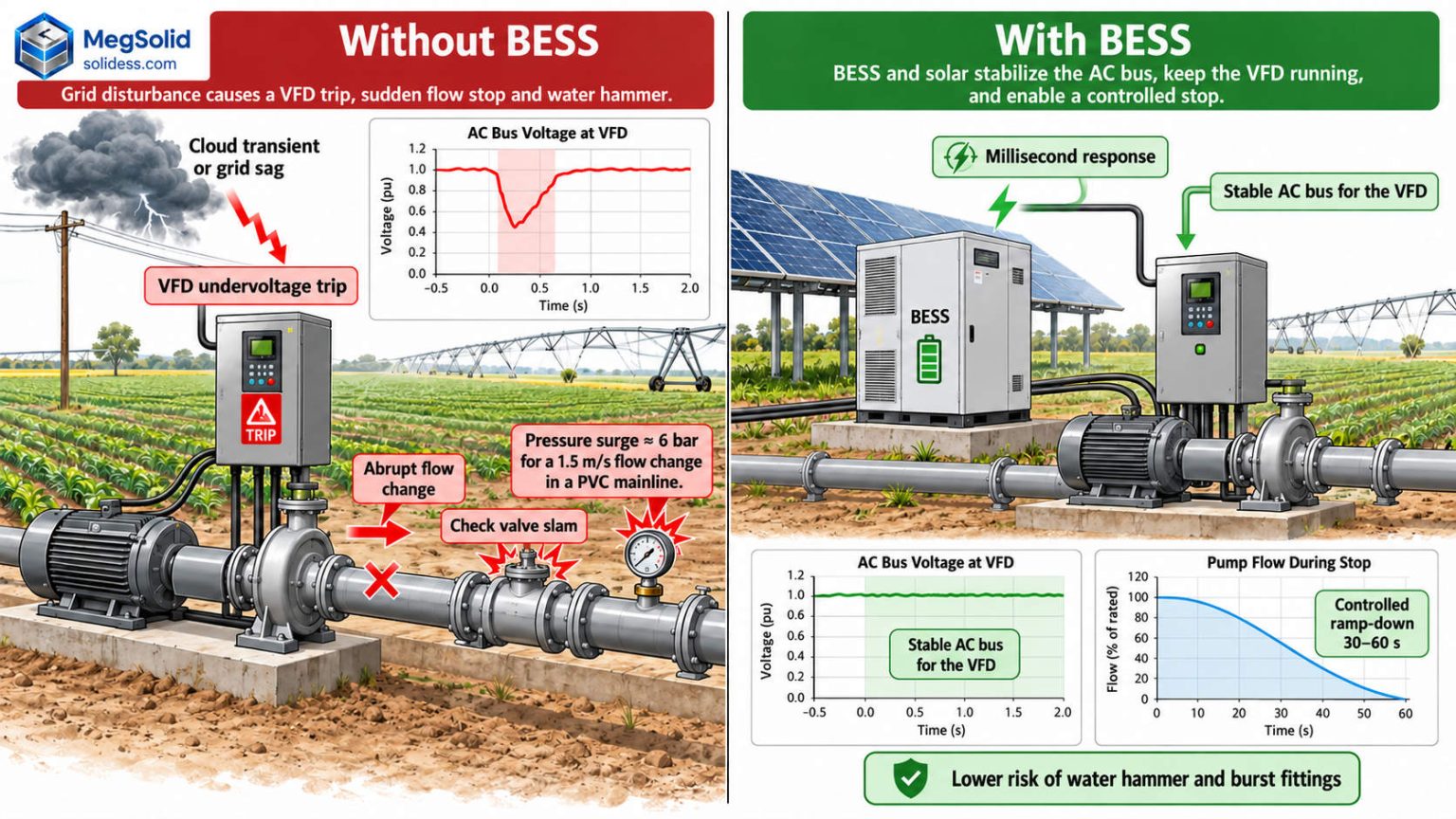
A large solar array without storage is a power source that can lose 60–80% of its output within tens of seconds when a cloud bank moves across it. For a pump station, that creates a cascade of problems:
- 1. The VFD sees its DC bus collapse. Solar pump drives will reduce frequency to follow available power, but a fast, deep drop often pushes them into an undervoltage trip rather than a controlled slowdown.
- 2. Pump speed and flow fall sharply. Moving water columns in the mainline decelerate abruptly.
- 3. Check valves slam shut. The column reverses and hits the closed valve.
The resulting pressure surge is described by the Joukowsky equation, ΔP = ρ · a · Δv. For a PVC mainline with a wave speed of around 400 m/s, an abrupt flow change of just 1.5 m/s generates a surge of roughly 6 bar on top of the normal operating pressure. Repeat that several times on a cloudy afternoon and you are fatiguing solvent-welded joints, HDPE fusion welds, air valves and filter housings — failures that typically show up weeks later as a burst in the middle of a field.
What the BESS changes: a battery inverter responds in milliseconds. When PV output drops, the BESS picks up the deficit and holds the AC bus voltage and frequency steady, so the VFD never sees the disturbance. If the energy management system (EMS) decides the pump should actually stop — for example, because battery state of charge (SoC) has reached its reserve — it can command a controlled ramp-down over 30–60 seconds rather than an uncontrolled trip, which is exactly what surge engineers recommend.
Saving Deep Borehole Submersible Pumps from Weak Rural Grids
Preventing Irrigation Pump Trips During Grid Fluctuations
Grid-connected farms are rarely at the strong end of the network. Most sit at the tail of long rural feeders shared with villages, mills and other pumps, and they see the same symptoms everywhere from Upper Egypt to Sindh:
- Chronic voltage sags — a nominal 400V supply regularly dropping to 340–360V under load, with occasional dips much lower.
- Phase unbalance from single-phase loads on the same feeder.
- Scheduled load shedding or rotational agricultural supply, where the farm receives power only in fixed windows.
Phase unbalance is particularly destructive. As a rule of thumb, motor current unbalance is 6–10 times the voltage unbalance that causes it — so a 2% voltage unbalance can push one winding's current 12–20% above the others. Most submersible motor manufacturers recommend keeping current unbalance below 5%. Sustained unbalance means a permanently hot winding and a shortened insulation life.
Why Deep Borehole Submersible Motors Are Uniquely Vulnerable
A submersible motor installed 150–350 m down a borehole is cooled by the water flowing past its housing. It has no fan and limited thermal mass margin. That design is reliable in continuous duty, but it punishes frequent stops and starts:
- Every start subjects the windings to a thermal and mechanical shock, and every unplanned stop interrupts cooling flow while the motor is still hot.
- Manufacturers publish a maximum number of starts per 24 hours and a minimum off-time between starts for exactly this reason. A day of grid flicker can exceed those limits without anyone noticing.
- Undervoltage forces the motor to draw higher current to deliver the same shaft power, accelerating insulation ageing and thrust bearing wear.
And when a large submersible fails, the cost is far beyond the motor itself. Pulling a 200–250 kW pump set from 300 m means mobilising a crane or pulling rig, handling hundreds of metres of rising main and cable, and waiting for a replacement motor. On a commercial farm, that can mean one to two weeks without water from that well — and if it happens during flowering or bulking, the crop loss usually dwarfs the repair bill.
A BESS positioned between the grid and the pump station acts as a buffer. When the grid sags, unbalances or drops out, the battery inverter carries the load seamlessly; when the grid returns and stabilises, the system reconnects and resumes charging. Your submersible sees one clean, balanced supply — not the feeder's bad day.
Handling Pump Starting Loads: Sizing the Inverter Honestly
This is where many proposals cut corners, so it is worth being precise.
Starting current depends on the starting method:
| Starting Method | Typical Starting Current (× Full-Load Current) | Suitability on a BESS / Microgrid |
|---|---|---|
| Direct-on-line (DOL) | 5–7× | Not recommended — requires a grossly oversized inverter |
| Star-delta | 2–3× | Marginal, with transient current spikes at changeover |
| Soft starter | 2.5–4× | Possible with careful inverter sizing |
| Variable Frequency Drive (VFD) | ≈1.0–1.5× | Strongly recommended |
Battery inverters (PCS) are power-electronic sources with limited short-term overload — they are not diesel generators with heavy rotating inertia. MegSolid's 80–125 kW modular PCS, for example, is rated for 110% continuous and 120% for one minute in off-grid mode, with very short-duration peaks beyond that. That is ample for VFD-started pumps, and it is why we design irrigation microgrids around three rules:
- 1. Every pump above ~15 kW gets a VFD or a properly tuned soft starter. On retrofit sites, this is usually the single highest-return upgrade.
- 2. Size the PCS at roughly 1.25–1.5× the largest pump's running power plus all simultaneous loads (filtration, fertigation dosing, pivot drive motors, lighting).
- 3. Never start two large pumps at once. The EMS staggers starts by 30–60 seconds so the inverter only ever handles one acceleration at a time.
In off-grid mode, the PCS acts as the voltage source for the whole pump station — regulating voltage and frequency, holding THDv around 3% for linear loads and supporting 100% single-phase unbalanced load. That is a cleaner supply than most rural feeders deliver.
Powering Center Pivots and Pressurised Drip Networks: System Architecture
Central Pump Station Microgrid vs. Distributed Borehole BESS
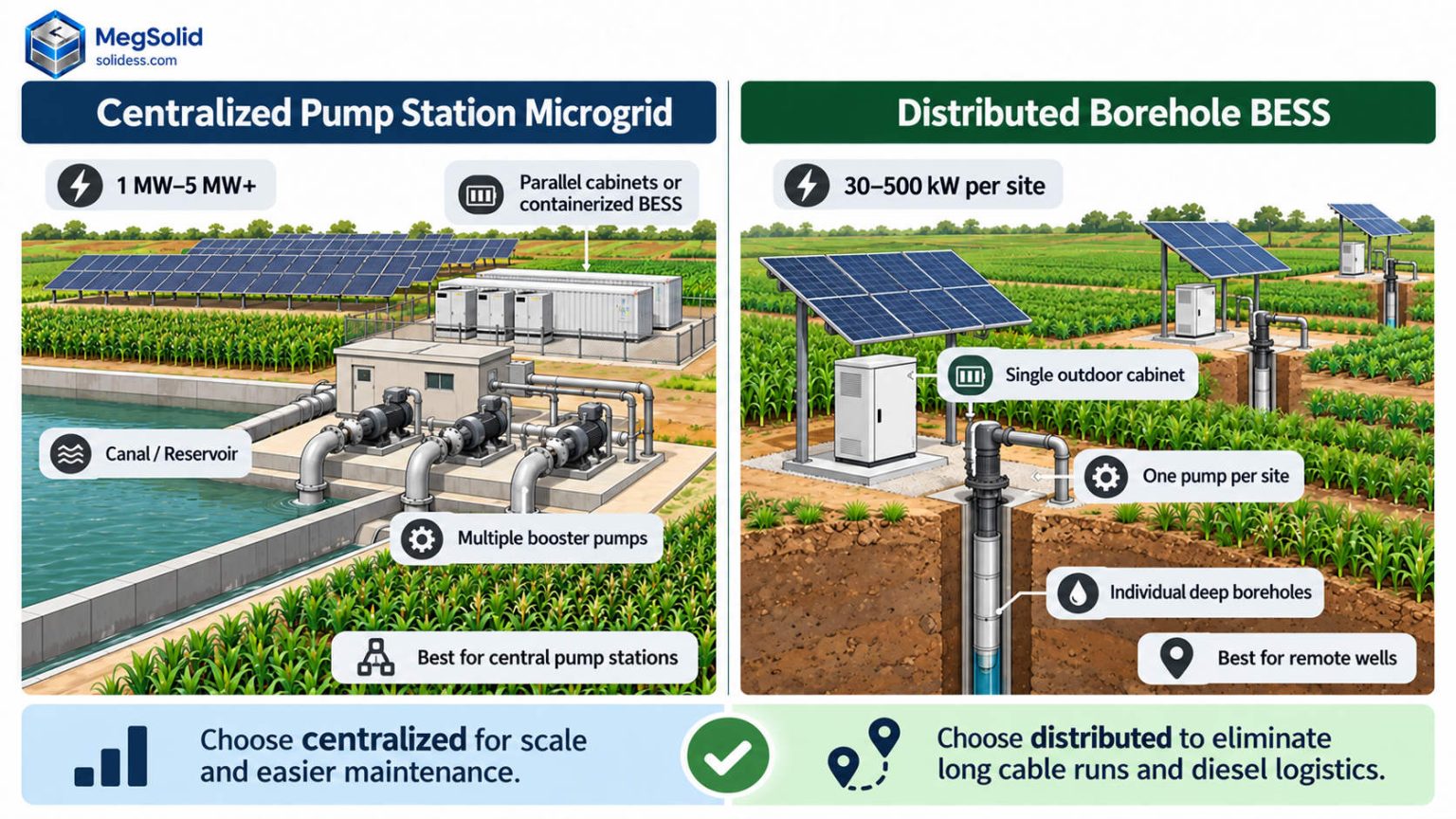
Commercial farms generally fall into one of two architectures. Choosing the right one early has a bigger impact on cost than any individual equipment choice.
| A. Centralised Pump Station Microgrid | B. Distributed Borehole BESS | |
|---|---|---|
| Typical scale | 1 MW – 5 MW+ | 30 kW – 500 kW per site |
| Water source | Canal intake, river, or lined reservoir fed by multiple wells | Individual deep boreholes spread across the farm |
| Loads | Parallel booster pumps, sand-media / disc filtration with backwash, fertigation skids | One submersible pump, plus a pivot or local booster |
| Solar | Ground-mount PV field at the pump station | Small PV array at each wellhead |
| Storage form factor | Multiple liquid-cooled cabinets in parallel, or containerised BESS | Single all-in-one outdoor cabinet per well |
| Main benefit | Economies of scale; one control room; easier maintenance | Eliminates long MV/LV cable runs and diesel logistics to remote wells |
Architecture A — Centralised. For a central pump station, MegSolid's 261 kWh / 125 kVA liquid-cooled C&I energy storage system is the natural building block. Up to 10 units can operate in parallel (≈1.25 MW / 2.6 MWh per block), and the AC side supports both 400V and 480V — the latter matching the voltage used by many center-pivot tower drive systems. Larger stations are built by combining multiple blocks or moving to containerised BESS within MegSolid's 55 kWh – 5 MWh product range.
Architecture B — Distributed. At an individual borehole, the goal is to replace a standalone diesel genset with a single, self-contained unit. MegSolid's ESSA series outdoor cabinet (30–100 kW, 55–215 kWh) is designed for exactly this: battery, bidirectional inverter, built-in MPPT solar input (up to 240 kW PV on the 100 kW model, 250–850V MPPT range), isolation transformer and on/off-grid switching in one IP54 enclosure. One cabinet, one PV array, one pump — no separate solar inverter, no separate genset controller. For smaller wells with 15–37 kW pumps, a 30–50 kW three-phase hybrid inverter paired with stacked battery modules is often the more economical route.
Surviving Desert Dust, Heat and Fertiliser Corrosion
Agricultural pump stations are among the harshest environments any battery system will see. Specify for the site, not the brochure:
- Heat. In Egypt, Saudi Arabia and Sudan, cabinet surfaces in direct sun can exceed 70°C in summer. Liquid cooling keeps cell temperatures uniform and is our default recommendation for desert projects — the Energon 261 kWh cabinet operates from −20°C to 55°C (with derating above 45°C). Air-cooled cabinets such as the ESSA series (0–45°C operating range) are well suited to temperate and highland sites, or desert sites where a shade structure is provided.
- Altitude. For Ethiopian and Kenyan highland farms at 1,800–2,500 m, check altitude ratings carefully. The ESSA series is rated to 3,000 m and the Energon to 4,000 m (with derating above 2,000 m).
- Dust and sand. All cabinets above are IP54 rated. Position air intakes away from the prevailing wind, keep at least 1 m clearance, and include filter inspections in the maintenance schedule after every sandstorm season.
- Fertigation chemistry. Nitrate, ammonium and phosphoric acid vapours around fertigation skids attack standard powder-coated steel. Locate the BESS upwind and at least 10–15 m from chemical dosing and storage, and for coastal or fertigation-heavy sites specify an ISO 12944 C4/C5 corrosion protection package at the ordering stage — MegSolid supports cabinet customisation through its OEM/ODM programme.
- Fire safety. Pump stations are often unattended for days. Every MegSolid C&I cabinet integrates multi-layer fire detection and suppression (aerosol or Novec 1230, plus water-based protection on liquid-cooled units). Combined with MegSolid's hybrid solid-state battery platform, which is engineered to reduce thermal runaway risk, this matters more at a remote wellhead than almost anywhere else.
How to Size a BESS for Night-Time Irrigation (Without Overbuying Batteries)
The most expensive mistake in irrigation storage is trying to run the entire daytime pumping duty overnight from batteries. There is almost always a smarter split.
Step 1 — Separate "lifting" from "pressurising"
Most farms do two different hydraulic jobs:
- Lifting: high-power borehole pumps raising water from 100–300 m into a reservoir or header tank. This job is flexible in time.
- Pressurising: lower-power booster pumps pushing water from the reservoir through filters into drip laterals or pivots. This is the job that needs to happen at night.
Run lifting during the day, directly from solar, and store water — not electricity — in a lined reservoir. Size the battery only for the booster pumps that must run overnight.
Step 2 — Calculate the night-time energy requirement
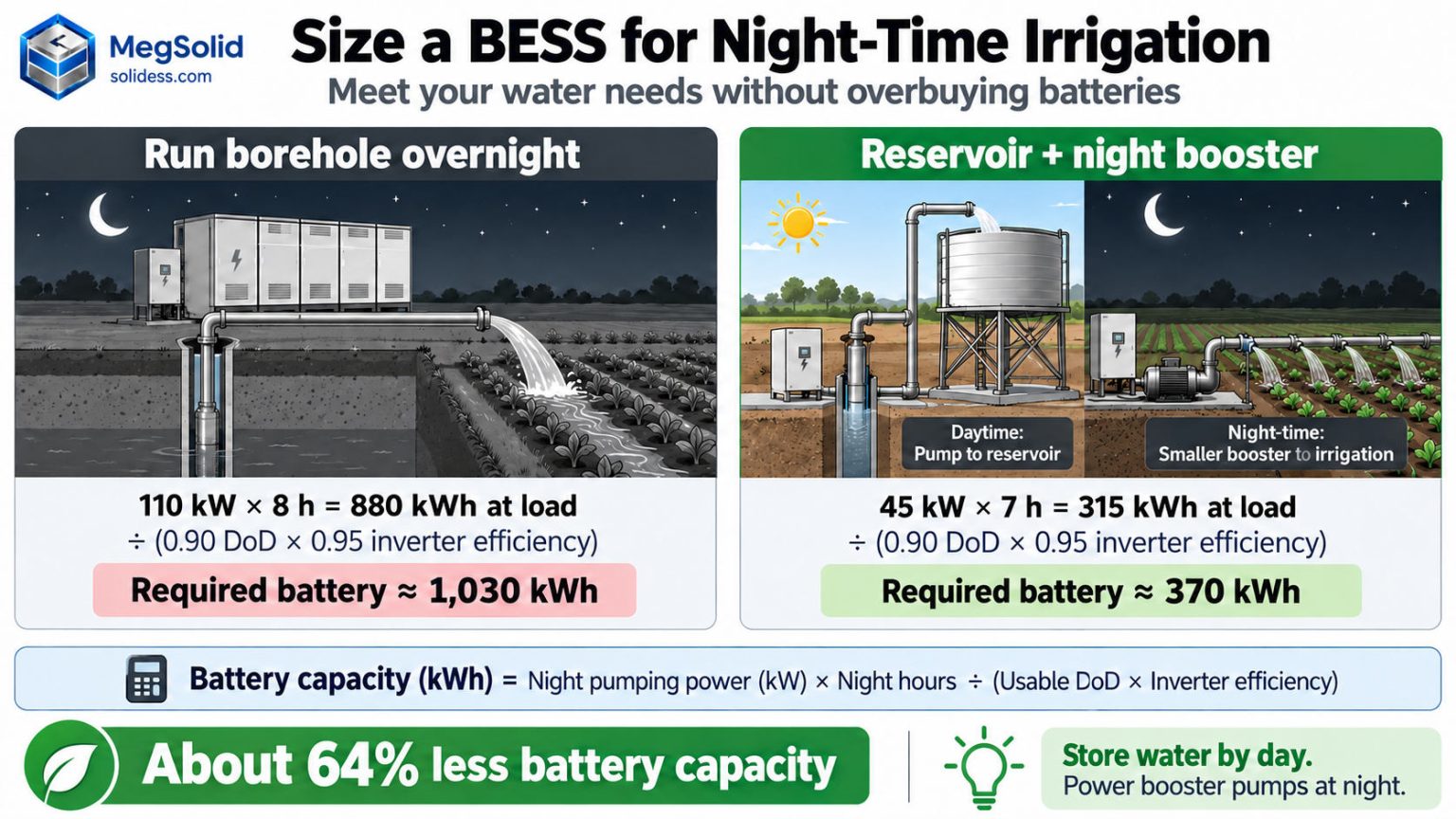
Battery capacity (kWh) = Night pumping power (kW) × Night hours ÷ (Usable DoD × Inverter efficiency)
Worked example: 300-hectare drip-irrigated farm
| Parameter | Option 1: Run borehole overnight | Option 2: Reservoir + night booster |
|---|---|---|
| Night-time load | 110 kW submersible pump | 45 kW drip booster pump |
| Night irrigation window | 8 hours | 7 hours |
| Energy at load | 880 kWh | 315 kWh |
| ÷ (0.90 DoD × 0.95 efficiency) | ÷ 0.855 | ÷ 0.855 |
| Required battery capacity | ≈1,030 kWh | ≈370 kWh |
| Example configuration | 4 × 261 kWh liquid-cooled cabinets | 2 × ESSA 100 kW / 215 kWh cabinets in parallel |
Same water delivered to the crop at night — with about 64% less battery capacity. The reservoir costs money too, of course, but on most commercial farms a lined storage pond already exists or is far cheaper per unit of buffered "energy" than lithium cells.
Step 3 — Check the power, not just the energy
Confirm the PCS rating covers the booster pump, filtration backwash, fertigation dosing pumps and any pivot drive loads running simultaneously, using the 1.25–1.5× margin discussed above.
Step 4 — Size the PV for both jobs
The solar array must deliver the daytime lifting energy plus the energy needed to fully recharge the battery before sunset — including on the shorter, lower-irradiance days of the irrigation season. Design to the worst month of the season, not the annual average.
The Agribusiness ROI: Diesel Replacement Plus Crop Protection
Reducing the Cost of Remote Diesel Pumping
Diesel cost per kWh is consistently underestimated, because farms track fuel invoices, not delivered energy. Here is a transparent illustration for an off-grid 75 kW borehole in East Africa, pumping an average of 12 hours/day for 300 irrigation days (≈270,000 kWh/year):
| Cost Component | Diesel Genset | Solar + BESS |
|---|---|---|
| Fuel consumption | ≈0.30 L/kWh at partial load | — |
| Delivered fuel price (remote site) | $1.20–1.50/L | — |
| Fuel losses & pilferage | 10–20% | — |
| Oil, filters, overhauls | ≈$0.05–0.08/kWh | Minimal (inspection, panel cleaning) |
| Cost of energy | ≈$0.45–0.65/kWh | ≈$0.12–0.18/kWh LCOE over 15 years |
| Annual energy cost (270 MWh) | ≈$120,000–175,000 | ≈$35,000–50,000 (levelised) |
Illustrative system: ~240 kWp PV + 2 × ESSA 100 kW / 215 kWh cabinets, with the existing genset retained as standby. Assumes 10% discount rate and typical 2026 equipment pricing; your figures will vary.
On this basis, simple payback typically lands in the 2–4 year range — at the shorter end where delivered diesel is expensive and pumping hours are long.
A note on subsidised markets: in Egypt and Saudi Arabia, diesel has historically been cheaper than the East African example above, so pure fuel savings are smaller. But successive fuel price reforms in both countries have steadily narrowed that gap, and the stronger arguments there are often supply security, reduced logistics to remote reclamation blocks, and protection against future price increases. We always model a project at today's fuel price and at a realistic future price before recommending it.
For grid-connected farms, the value stack shifts toward avoided pump failures, demand charge reduction, time-of-use arbitrage and keeping irrigation running through load shedding. See our BESS procurement & economics guides for C&I value-stacking methodology.
Avoiding the "Crop Critical Window" Catastrophe
The energy savings justify the investment. The crop protection is what makes it non-negotiable for many export growers.
Every crop has stages where water stress does disproportionate, irreversible damage: flowering and fruit set in avocados and citrus, tuber initiation and bulking in potatoes, flowering and grain fill in wheat and maize, fruit sizing in table grapes and berries. Missing 48 hours of irrigation during a heatwave at one of these stages can cost a significant share of the season's yield — and, for export crops, push fruit out of premium size and grade specifications entirely.
That loss doesn't care whether the cause was a grid blackout, a burned-out submersible, or a diesel tanker stuck behind a washed-out road. A properly sized solar + BESS irrigation system removes all three failure modes at once.
FAQ
Do we still need Variable Frequency Drives (VFDs) if we install a BESS?
Yes. VFDs and BESS do different jobs. The VFD controls pump speed to hold the right pressure and flow as the farm switches between irrigation zones, and it soft-starts the motor. The BESS provides the stable, balanced AC supply and the energy reservoir that keeps the VFD from tripping. In practice, VFDs also allow a much smaller and cheaper battery inverter, because they keep starting current close to running current.
How do we size a BESS for night-time drip irrigation?
Multiply the night-time pumping power (kW) by the number of night irrigation hours, then divide by the usable depth of discharge (typically 0.9) and inverter efficiency (around 0.95). Before you do that, check whether daytime solar can lift water into a reservoir so the battery only has to run the lower-power drip booster pumps at night — this frequently halves the required battery capacity.
Can we retrofit a BESS to an existing solar pumping system?
Usually, yes. Existing PV arrays can be reconnected to a hybrid cabinet with built-in MPPT, such as the ESSA series, or kept on their existing inverters and AC-coupled to a battery system. The existing solar pump drive is normally replaced with — or supplemented by — a standard VFD supplied from the BESS-backed AC bus. A site survey of the array, pump nameplates and drive model is the first step.
Can the BESS be monitored remotely across a 5,000-hectare farm?
Yes. MegSolid's EMS communicates over RS485, Ethernet and 4G, and can integrate with farm SCADA and smart irrigation controllers. The farm manager or agronomist can schedule night pumping cycles, set SoC reserves for critical irrigation, receive alarms and review energy and revenue data for every pump station from a central control room or smartphone.
Should we keep our existing diesel generator?
In most off-grid projects we recommend keeping it as a standby source for extended cloudy periods or emergency irrigation during critical crop stages. The difference is that it runs a few dozen hours a year instead of thousands, which transforms both fuel and maintenance costs and extends its life considerably.
Conclusion: Water Security Begins with Power Stability
Commercial agriculture can no longer afford the water losses of midday-only solar pumping, the ruinous cost of remote diesel, or the hidden expense of submersible pumps cooked by a weak rural grid. A solar + BESS irrigation system addresses all three: it turns midday sunlight into round-the-clock hydraulic reliability, protects your most expensive assets underground, and lets your agronomist — not the sun or the utility — decide when the crop gets water.
The engineering is mature. What separates a good project from an expensive one is the design: separating lifting from pressurising, sizing the inverter around VFD-started pumps, and specifying enclosures for the real conditions at the wellhead.
Designing a new irrigation pump station or retrofitting diesel boreholes? Contact MegSolid's energy storage engineers with your pump nameplates, irrigation schedule and site location. We'll return a free BESS capacity recommendation and preliminary LCOE comparison against diesel within 24 hours, along with datasheets for the recommended solid-state energy storage systems.
