
Under the UN Model Regulations, the IATA Dangerous Goods Regulations (air freight) and the IMDG Code (ocean freight), rechargeable lithium-ion, LiFePO4 and semi-solid energy storage systems ship as Class 9 (9A) Miscellaneous Dangerous Goods. Choosing between UN3480 vs UN3481 and UN3536 depends on how the battery cells, inverters and enclosures are packaged and assembled for transit:
- UN 3480 (Lithium-ion batteries standalone): Standalone battery cells, modules or packs shipped by themselves without an inverter or host load attached, such as a 51.2V 314Ah residential battery pack or replacement LFP module pallet.
- UN 3481 (Lithium-ion batteries packed with or contained in equipment): Batteries shipped in the same outer crate alongside their host equipment (IATA PI 966), or factory-installed and wired inside an equipment cabinet (IATA PI 967, such as an all-in-one hybrid solar storage cabinet).
- UN 3536 (Lithium batteries installed in cargo transport unit): Factory-integrated containerized battery energy storage systems (BESS) where the 10ft, 20ft or 40ft ISO shipping container itself is the permanent structural housing of the power plant.
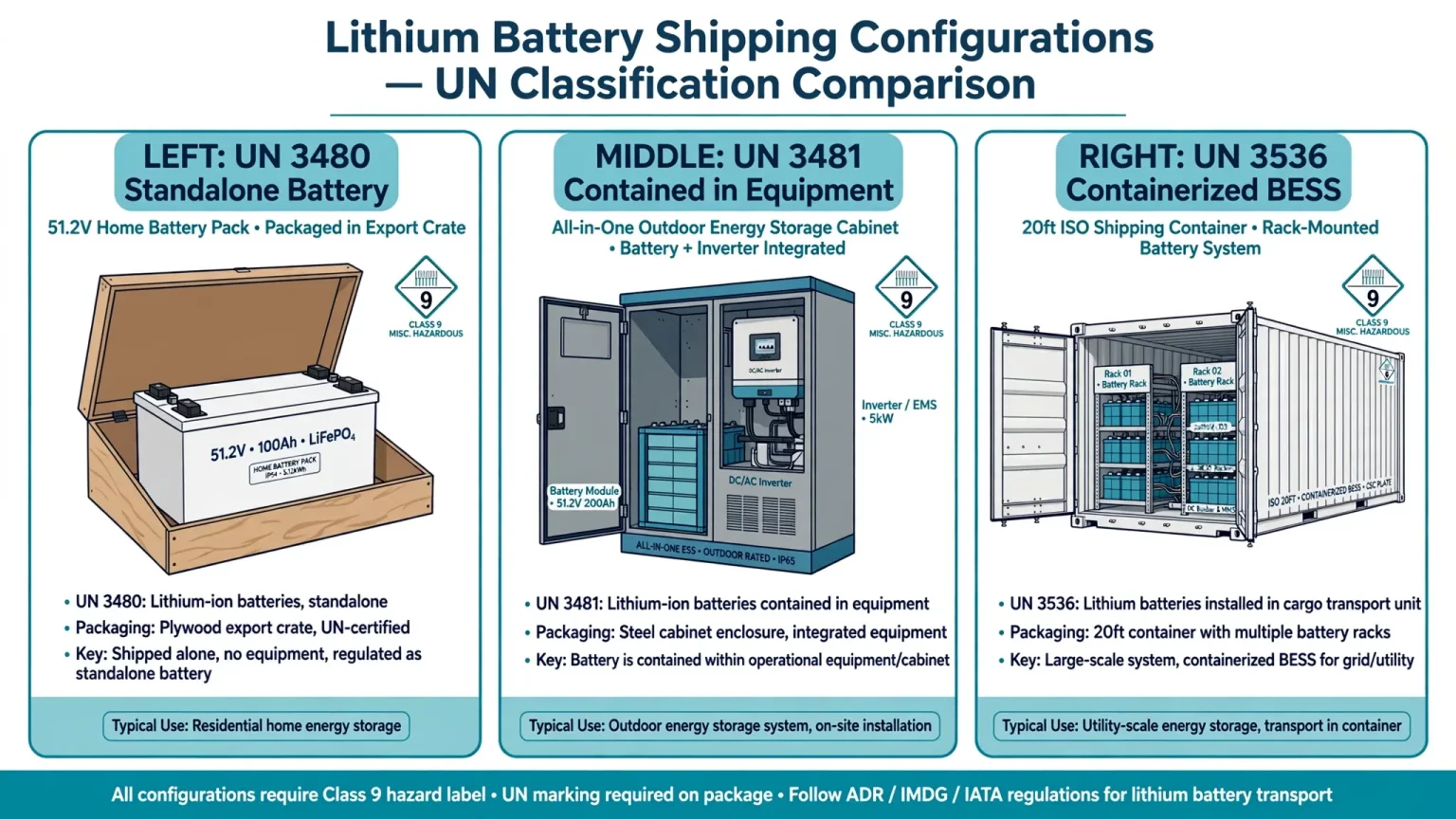
UN3480 vs. UN3481 vs. UN3536: Complete Comparison Table for B2B Importers
For solar distributors, EPC procurement directors and logistics managers importing commercial volumes of energy storage hardware, entering the wrong UN number on a Dangerous Goods Declaration (DGD) or ocean Bill of Lading triggers costly consequences. Container lines such as Maersk, MSC, CMA CGM and Hapag-Lloyd levy misdeclaration penalties of $5,000 to $15,000 per container, while port authorities hold misclassified shipments for inspection, accruing daily demurrage and detention charges.
Table 1: UN3480 vs. UN3481 vs. UN3536 Master Classification Matrix
| Regulation Feature | UN 3480 | UN 3481 (Part A: Packed With) | UN 3481 (Part B: Contained In) | UN 3536 (Containerized BESS) |
|---|---|---|---|---|
| Official UN Proper Shipping Name | Lithium ion batteries (including lithium ion polymer & LiFePO4) | Lithium ion batteries packed with equipment | Lithium ion batteries contained in equipment | Lithium batteries installed in cargo transport unit |
| Hazard Class & Label | Class 9 (9A) Lithium Battery Hazard Label | Class 9 (9A) Lithium Battery Hazard Label | Class 9 (9A) Label (exempt only below 100Wh limits) | Class 9 Placard (250mm × 250mm) on all 4 container sides |
| Typical Energy Storage Product Example | Standalone 48V (51.2V) Residential Battery, Server-Rack Pack, LFP Module | Split-system 51.2V Battery Pack crated alongside a Hybrid Solar Inverter | Factory-assembled All-in-One Hybrid Inverter + Battery Cabinet (pre-wired in one chassis) | 1MWh–5MWh 20ft/40ft Containerized C&I or Utility BESS |
| IATA Air Packing Instruction (PI) | PI 965 (Cargo Aircraft Only, forbidden on passenger planes) | PI 966 (Allowed on Passenger & Cargo Aircraft within net weight limits) | PI 967 (Allowed on Passenger & Cargo Aircraft within net weight limits) | Not Applicable (Ocean, Rail & Road Freight Only) |
| Mandatory State of Charge (SoC) Limit | ≤ 30% SoC mandatory for Air (PI 965); 30%–50% standard for Ocean | ≤ 30% SoC mandatory from Jan 1, 2026 under IATA rules for packs >2.7Wh | ≤ 30% SoC recommended (mandatory for high-capacity air cargo in 2026) | 20%–30% SoC standard per IMDG & carrier safety rules |
| IMDG Ocean Packing Instruction | P903 / LP903 (Requires UN PG II Certified Box/Crate) | P903 (Battery in inner UN packaging, packed with equipment) | P903 (Strong outer packaging; equipment chassis protects battery) | IMDG Special Provision 389 (SP 389) (No outer UN box required) |
| UN Packaging Performance Level | Packing Group II (PG II) (“Y” or “X” UN-stamped wood/fiberboard box) | Packing Group II (PG II) required for the battery enclosure | Unpackaged or strong outer crate (exempt from UN drop-test stamp if enclosed in rigid chassis) | ISO CSC Safety Approval Plate on the container structure itself |
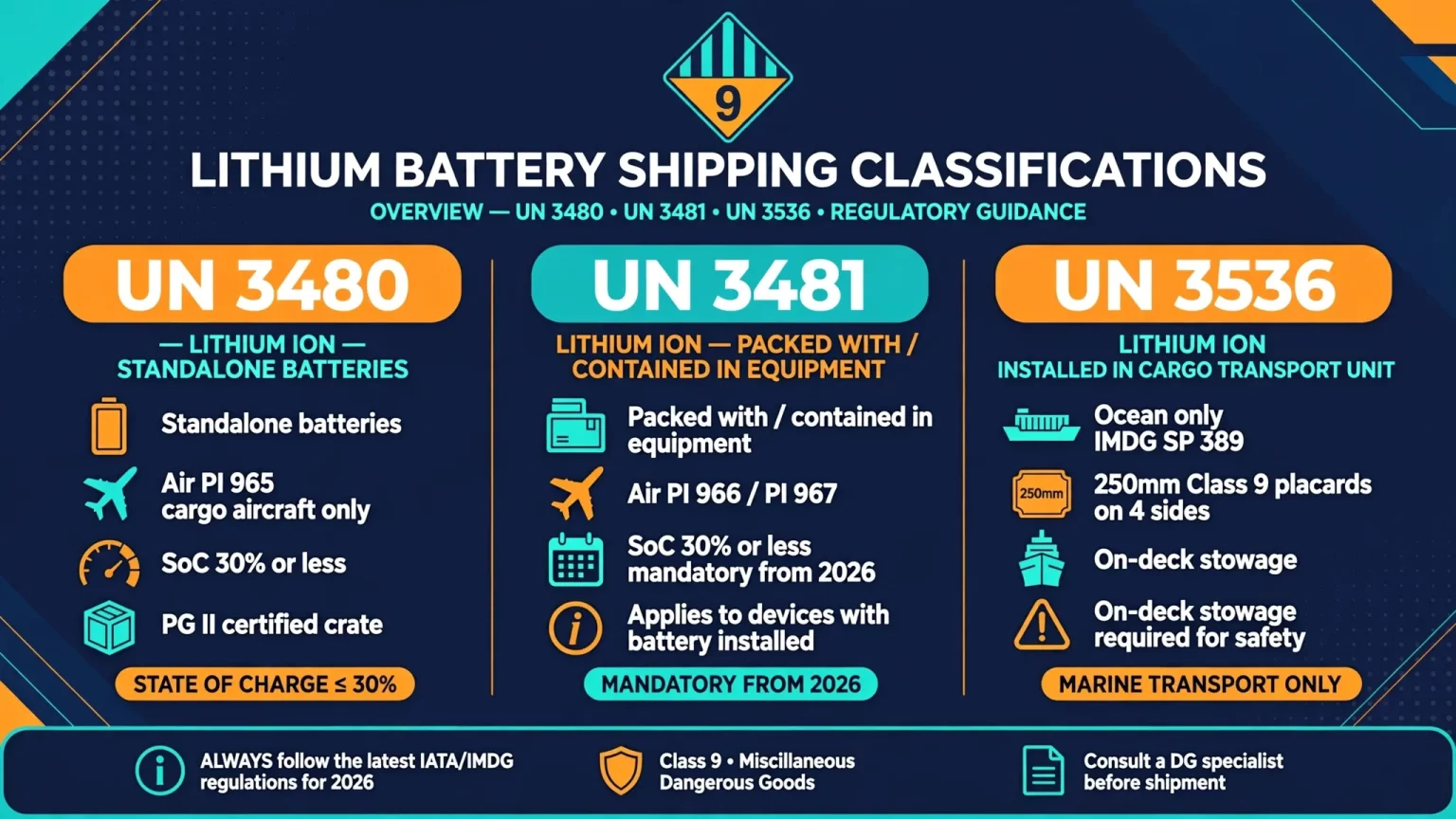
UN 3480 Explained: Shipping Standalone Lithium & 48V Solar Batteries
What Qualifies as UN 3480 in Energy Storage?
Every standalone lithium-ion, lithium iron phosphate (LiFePO4) or semi-solid battery cell, module or complete pack shipped without an inverter or power conversion unit falls under UN 3480. In the solar and backup power sector, UN 3480 covers 3.2V prismatic LFP cells on pallets, 48V (51.2V) server-rack modules, wall-mounted residential batteries and floor-standing wheeled battery packs.
The 100Wh Large-Format Rule: Why All Solar Batteries Are Fully Regulated Class 9
General freight blogs often reference "Section II" or "IMDG Special Provision 188 (SP 188)" exemptions that allow small lithium batteries to ship without full Class 9 declarations. Those exemptions apply only to cells rated at ≤ 20 Wh and battery packs rated at ≤ 100 Wh (such as laptop or power-tool batteries).
Every residential and commercial solar battery exceeds the 100 Wh threshold by a wide margin. Even a compact 48V 100Ah module holds 4,800 Wh (4.8 kWh), while MegSolid's MEGA-512314FL1 51.2V 314Ah Hybrid Solid-State Battery stores 16,070 Wh (16.07 kWh). Because these packs exceed 100 Wh and weigh more than 12 kg gross, they must ship as fully regulated Class 9 Dangerous Goods under IATA Section IA (for air cargo) or IMDG Packing Instruction P903 / LP903 (for ocean freight).
Each UN 3480 solar battery must be packed inside UN-certified Packing Group II (PG II) outer packaging, such as a 4D plywood crate or 4G heavy-duty fiberboard box bearing a printed UN specification mark (for example, UN 4D/Y300/S/..., where Y or X confirms PG II or PG I drop-test and stacking certification).
The 30% State of Charge (SoC) Rule & BMS Storage Preparation
Under IATA Packing Instruction 965, standalone UN 3480 lithium batteries shipped by air must not exceed 30% State of Charge (≤ 30% SoC). Major ocean carriers also enforce a 20% to 35% SoC window for containerized FCL and LCL shipments.
Shipping at 30% SoC serves two engineering purposes:
- Minimal stored thermal energy: At 30% SoC, cell open-circuit voltage sits near 3.22V per cell (51.5V on a 16S pack), reducing the chemical enthalpy available if a container is exposed to an external shipboard fire.
- Protection against deep-discharge lockouts: During a 35-to-50-day ocean transit plus customs clearance, a 30% SoC buffer prevents natural self-discharge from pulling cells below the 2.50V BMS under-voltage cutoff, as long as the main breaker is switched off before crating.
Sourcing export-ready 51.2V batteries with UN PG II plywood crates and complete Class 9 paperwork? Browse our 48V (51.2V) semi-solid & LiFePO4 residential energy storage batteries, including the stationary 16.07 kWh MEGA-512314FL1 and the wheeled MEGA-512314 16.076 kWh mobile battery pack.
UN 3481 Explained: "Packed With" (PI 966) vs. "Contained In" (PI 967) Equipment
The Two Sub-Categories of UN 3481 for Hybrid ESS & Outdoor Cabinets
When lithium batteries ship together with the power electronics they energize, the shipment moves from UN 3480 to UN 3481. International transport regulations divide UN 3481 into two distinct operational modes:
- Lithium-ion batteries packed WITH equipment (IATA PI 966 / IMDG P903): The battery pack and the hybrid solar inverter ship as a single commercial kit inside one outer crate, or in separate inner UN PG II battery boxes packed alongside the inverter carton on the same pallet.
- Lithium-ion batteries contained IN equipment (IATA PI 967 / IMDG P903): The battery modules are bolted, busbar-connected and enclosed inside the host equipment chassis at the factory. This category covers all-in-one residential energy storage systems, telecom power racks and outdoor commercial storage cabinets.
The 2026 Regulatory Update for UN 3481 (PI 966 & PI 967 SoC Limits)
Procurement teams relying on pre-2025 shipping manuals often get caught by the latest IATA Dangerous Goods Regulations (67th Edition, effective January 1, 2026) and corresponding ICAO Technical Instructions:
- Mandatory ≤ 30% SoC for PI 966 (>2.7Wh): Beginning January 1, 2026, what was previously a recommendation became a mandatory requirement. Lithium-ion cells and batteries with a Watt-hour rating above 2.7 Wh that are "packed with equipment" under UN 3481 (PI 966, Section II and Section I) must be offered for air transport at a State of Charge not exceeding 30% of their rated capacity. Exceeding 30% SoC requires formal written approval from both the State of Origin and the State of the Operator.
- High-capacity PI 967 (Contained in Equipment): For UN 3481 batteries "contained in equipment" (PI 967) with Watt-hour ratings above 2.7 Wh, the 2026 regulations specify ≤ 30% SoC (or indicated capacity ≤ 25%), and major ocean lines also require ≤ 30% SoC certificates across all FCL bookings of pre-integrated ESS cabinets.
Why B2B Importers Prefer Pre-Integrated UN 3481 Cabinets
Under IMDG Packing Instruction P903, when large-format batteries are installed inside an equipment enclosure that provides equivalent mechanical shock and impact protection, the equipment cabinet itself satisfies the outer packaging requirement without needing an extra UN PG II drop-tested wooden box around the steel cabinet.
MegSolid's pre-integrated commercial and industrial cabinets ship under this configuration:
- ESSA Series 30–100 kW / 55–215 kWh All-in-One Outdoor Cabinet: Combines LFP battery modules, a 30–100 kW bidirectional PCS, built-in PV MPPT (up to 240 kW PV input on the 100 kW model) and an isolation transformer inside a single IP54 steel enclosure.
- Energon 261 kWh / 125 kVA Liquid-Cooled C&I Cabinet: Houses 314Ah LFP cells (1P260S, 832 Vdc nominal), liquid thermal management, PCS and Novec + water fire protection inside a rigid IP54 outdoor cabinet.
During factory pre-shipment preparation, MegSolid sets module SoC to ≤ 30%, opens the internal DC circuit breakers and high-voltage manual service disconnects (MSD), and provides complete UN 3481 / P903 documentation for container vessel booking.
UN 3536 Explained: Shipping Megawatt Containerized BESS (IMDG Special Provision 389)
When Does a Shipment Become UN 3536 Instead of UN 3480?
Freight forwarders inexperienced with utility-scale storage frequently confuse a shipping container filled with battery pallets and a containerized battery system:
- Cargo inside a container (UN 3480): If you load 20 pallets of boxed 51.2V residential batteries into a standard 40ft dry freight container, the shipment is classified as UN 3480. Each pallet or crate inside the container must carry UN PG II packaging and Class 9 labels.
- Containerized BESS (UN 3536): When battery racks, BMS controllers, liquid-cooling chillers, HVAC and fire suppression systems are permanently bolted and wired inside a 10ft, 20ft or 40ft ISO container that functions as the permanent walk-in or reach-in enclosure of a 1 MWh to 5 MWh power plant, the entire container is classified as UN 3536 (Lithium batteries installed in cargo transport unit).
Mandatory Requirements Under IMDG Special Provision 389 (SP 389)
Ocean transport of UN 3536 containerized BESS units is governed by IMDG Code Special Provision 389 (SP 389):
- Structural restraint against marine acceleration: The container must hold a valid ISO Convention for Safe Containers (CSC) safety approval plate, and internal battery racks must be structurally braced to withstand marine acceleration forces (2g longitudinal, 1g transverse and 2g vertical) without frame deformation or module displacement.
- Isolated high-voltage DC busbars: Before leaving the factory, main DC contactors must be locked open and high-voltage Manual Service Disconnect (MSD) fuse plugs physically removed so that external power terminals are de-energized during ocean transit. No dangerous goods other than those required for the system's operation (such as its integrated fire-suppression agent and chiller refrigerant) may be packed inside the UN 3536 unit.
- Placarding and On-Deck Stowage (Stowage Category D): Unlike small packages that use 100 mm × 100 mm labels, a UN 3536 container must display enlarged 250 mm × 250 mm Class 9 placards and UN 3536 orange number panels on all four exterior sides. Under the IMDG Code, UN 3536 is assigned to Stowage Category D, meaning the container must be stowed on deck only on cargo vessels and is prohibited on passenger ships.
Deploying multi-megawatt industrial or utility storage? Explore our commercial & industrial BESS solutions and 55 kWh – 5 MWh containerized solid-state energy storage systems engineered for full UN 3536 SP 389 marine compliance.
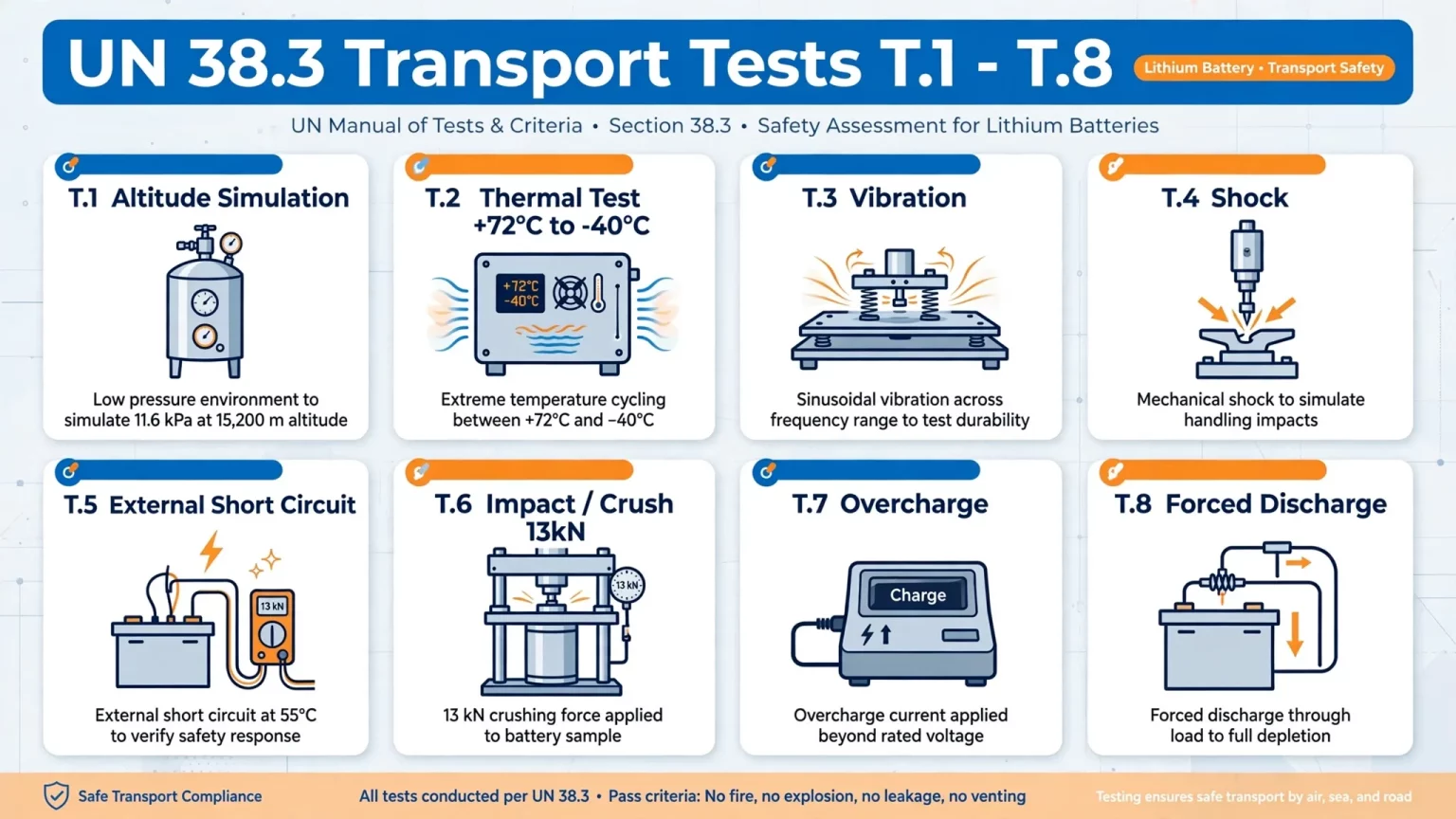
UN 38.3 Lithium Battery Transport Tests: All 8 Tests (T.1 to T.8) Explained
Before any UN 3480, UN 3481 or UN 3536 lithium battery can board a vessel, aircraft, railcar or highway truck, the cell and battery pack design must pass all applicable tests in the UN Manual of Tests and Criteria, Part III, Subsection 38.3.
Table 2: The 8 Mandatory UN 38.3 Transport Tests (T.1 – T.8)
| Test Code | Test Name | Engineering Test Protocol | Pass Criteria (Zero Failure Allowed) |
|---|---|---|---|
| T.1 | Altitude Simulation | Stored for 6 hours at 11.6 kPa (20°C), simulating an unpressurized aircraft hold at 15,000 meters. | No mass loss (<0.1%), no leakage, no venting, no disassembly, no rupture, no fire; open-circuit voltage stays ≥ 90%. |
| T.2 | Thermal Test | Rapid thermal shock cycling between +72°C and -40°C (10 cycles, 6 hours at each extreme; 12 hours for large packs). | Seals and welds survive thermal expansion and contraction with zero electrolyte leakage, no venting and <10% voltage drop. |
| T.3 | Vibration Test | Sinusoidal vibration sweep from 7 Hz to 200 Hz and back to 7 Hz traversed in 15 minutes, repeated 12 times (3 hours per axis across X, Y, Z). | Busbar laser welds, BMS sense harnesses and terminals show zero loosening, cracking, leakage or voltage loss. |
| T.4 | Shock Test | Half-sine mechanical acceleration pulse (150g / 6 ms for small cells; 50g / 11 ms scaled by mass for large battery packs). | Internal electrodes, tabs and separators remain intact with no internal short circuits, casing breach or voltage drop >10%. |
| T.5 | External Short Circuit | Battery stabilized at +57°C ± 4°C and subjected to a hard external short circuit (<0.1 Ω total resistance) for at least 1 hour. | External case temperature stays ≤ +170°C; BMS MOSFETs or fuses interrupt current with no disassembly, rupture or fire within 6 hours. |
| T.6 | Impact / Crush Test | Cell-level mechanical abuse: 9.1 kg weight drop on cylindrical cells (≥ 18 mm), or 13 kN (1.3 metric ton) hydraulic crush on prismatic and pouch cells. | External temperature does not exceed +170°C, with no disassembly and no fire within 6 hours of crushing. |
| T.7 | Overcharge Test | Rechargeable battery pack charged at 2× the manufacturer’s maximum continuous charge current for 24 hours. | BMS over-voltage protection (OVP) isolates the charge circuit with no disassembly and no fire within 7 days. |
| T.8 | Forced Discharge | Cell-level test: a fully discharged cell is forced into reverse discharge at 1C current by a DC power supply. | No disassembly and no fire within 7 days of testing. |
Why Semi-Solid & Solid-State LFP Batteries Pass UN 38.3 & Carrier Audits Without Delay
Following high-profile container ship fire incidents, ocean carriers and marine cargo underwriters scrutinize Class 9 battery bookings closely, often rejecting poorly documented liquid-electrolyte packs or delaying vessel space approval by two to three weeks.
In UN 38.3 Tests T.2 (Thermal Shock at +72°C / -40°C), T.5 (External Short Circuit at +57°C) and T.6 (13 kN Mechanical Crush), conventional batteries filled with volatile liquid carbonate electrolytes face separator shrinkage, internal boiling and vent-valve outgassing.
MegSolid's hybrid solid-state battery technology immobilizes the electrolyte within a semi-solid polymer-ceramic matrix across our 314Ah LFP cell platform. Eliminating free-flowing liquid electrolyte removes leakage pathways during the T.1 low-pressure and T.2 thermal-shock cycles, while the high-temperature stability of the semi-solid interface prevents thermal runaway during the T.6 13 kN crush test. For B2B importers, that translates into clean CNAS/ILAC-accredited UN 38.3 test reports, faster DG desk approval from Tier-1 shipping lines, and lower marine cargo insurance premiums.
The 5 Mandatory Export Documents Every B2B Battery Buyer Must Demand
Small trading companies often quote artificially low FOB or CIF prices by shipping lithium batteries undeclared as "power supplies" or "solar accessories," or by reusing another factory's UN 38.3 certificate. If customs inspectors open the container at the port of loading or destination, the importer faces cargo seizure and five-figure carrier fines.
Before paying a deposit on any wholesale BESS order, require your manufacturer to provide these five export documents matching the exact model number on your proforma invoice:
- Full UN 38.3 Test Report + Official UN 38.3 Test Summary (TS): Mandatory globally since January 2020. Verify that the nominal voltage, capacity (Ah), Watt-hour rating (Wh), cell manufacturer and test laboratory contact details on the Test Summary match the physical nameplate on your battery.
- 16-Section MSDS / SDS (Safety Data Sheet): Prepared in accordance with GHS and the current IMDG Code (Amendment 41-22 / 42-24), specifying the exact UN number (UN 3480, UN 3481 or UN 3536) in Section 14 (Transport Information).
- Customs Dangerous Goods Packaging Certificate (Performance & Use Appraisal Result Sheet for Outbound Dangerous Goods Transport Packaging)
- IMO Multimodal Dangerous Goods Form (DGD): Signed shipper's declaration listing the UN Number, Proper Shipping Name, Class 9, EMS Fire/Spillage Schedule (F-A, S-I), Packing Group II performance reference and net battery weight.
- Container Packing Certificate & 30% SoC Letter: Signed confirmation that the FCL container or UN 3536 cargo transport unit has been braced to marine standards, placarded on all four sides, and verified at ≤ 30% State of Charge prior to gate-in.
FAQ
Do LiFePO4 and semi-solid batteries still require UN3480 Class 9 labels?
Yes. The article treats rechargeable lithium-ion chemistries, including NMC, LTO, liquid-electrolyte LiFePO4 and semi-solid LFP, under UN3480, UN3481 or UN3536 according to shipment configuration. Battery packs above 100 Wh remain subject to the applicable Class 9 transport requirements and UN 38.3 testing.
Does a UN 38.3 certificate expire?
The article states that UN 38.3 test reports do not have a fixed calendar expiration date while the cell chemistry, BMS protection circuit, mechanical structure and nominal rating remain unchanged. Re-testing is required when a design change materially affects safety test results, including the stated mass or nominal-energy changes.
What is the 100 Wh threshold for lithium battery shipping?
The article identifies small-battery exemptions for cells rated at or below 20 Wh and battery packs rated at or below 100 Wh. Residential and commercial energy-storage batteries exceed that threshold and must be shipped under the applicable fully regulated dangerous-goods requirements.
What packaging is required for standalone UN3480 batteries by ocean freight?
The article specifies UN-certified Packing Group II outer packaging for standalone UN3480 batteries, such as a 4D plywood crate or 4G heavy-duty fiberboard box with a valid UN specification mark. The relevant IMDG packing instruction is P903 or LP903.
What state of charge is required for UN3480 air shipments?
Under IATA Packing Instruction 965, standalone UN3480 lithium batteries shipped by air must not exceed 30% state of charge. The shipper must also verify the applicable packing section, aircraft restrictions and current operator requirements before booking.
What changed for UN3481 PI 966 and PI 967 in 2026?
The source states that from January 1, 2026, lithium-ion batteries above 2.7 Wh shipped packed with equipment under PI 966 must be offered for air transport at no more than 30% SoC, unless the specified written approvals are obtained. It also describes a 30% SoC or 25% indicated-capacity limit for high-capacity PI 967 shipments.
What markings and stowage rules apply to UN3536 containerized BESS?
The article specifies a valid ISO CSC safety approval plate, 250 mm × 250 mm Class 9 placards and UN3536 orange number panels on all four exterior sides. It also states that UN3536 is assigned Stowage Category D and must be stowed on deck on cargo vessels.
Which dangerous-goods packaging document should a China exporter provide?
For standalone UN3480 and boxed UN3481 shipments exported from China, the article says customs authorities require a Dangerous Goods Packaging Certificate, also described as the Performance and Use Appraisal Result Sheet for Outbound Dangerous Goods Transport Packaging, matched to the shipment batch and UN PG II crate quantity.
What should buyers check before booking lithium batteries by air?
Confirm the correct UN number and IATA packing instruction, the battery Wh rating, the applicable 30% SoC limit, the required Class 9 label and UN 38.3 test documentation. For UN3480, PI 965 applies; for UN3481 packed with or contained in equipment, PI 966 or PI 967 applies according to the configuration.
What should importers confirm with ocean carriers before shipping containerized BESS?
Confirm the UN classification, IMDG Special Provision 389 applicability, container CSC approval plate, internal rack restraint, de-energized DC terminals, four-side placarding, required orange UN3536 number panels, SoC documentation and the carrier’s booking and stowage conditions.
Ship Certified Energy Storage Without Customs Delays
Delays at the port of loading, carrier DG rejections and customs holds happen when suppliers cut corners on UN PG II crating or mismatch UN 38.3 Test Summaries. Working directly with an OEM that holds complete cell-to-container certifications keeps your solar and microgrid deployment schedule on track.
Importing 48V semi-solid batteries, all-in-one outdoor C&I cabinets or megawatt containerized BESS? request our B2B Battery Import Compliance Kit (sample UN 38.3 Test Summary, 16-section MSDS, DG Packaging Certificate specimen and FOB/CIF/DDP shipping quotes), or view our complete catalog of solid-state energy storage systems.