 Skip to content
In a 24/7 automated fulfillment center, automotive assembly plant, or cold-storage warehouse, fleet availability depends directly on how AGV battery systems are specified, charged, and managed. Autonomous Mobile Robots (AMRs), Automated Guided Vehicles (AGVs), and Automated Storage and Retrieval System (AS/RS) shuttles face operating demands that differ sharply from stationary backup storage: frequent opportunity charging cycles, tight chassis height envelopes, continuous vibration, real-time CAN / RS485 telemetry with fleet controllers, and strict warehouse fire-safety reviews.
As a battery manufacturer specializing in hybrid solid-state (semi-solid) LiFePO4 technology, commercial energy storage, and custom pack assembly, MegSolid supports industrial automation integrators and robotics OEMs across two distinct tracks: project-specific OEM/ODM evaluation for custom robotic traction battery packs (24V, 36V, 48V / 51.2V, 72V, and high-voltage yard AGV platforms), alongside standardized 51.2V hybrid solid-state battery packs and C&I energy storage systems that back up automated warehouse charging infrastructure.
AGV Battery Charging Systems: 1C–3C Fast Charging vs. Battery Swapping
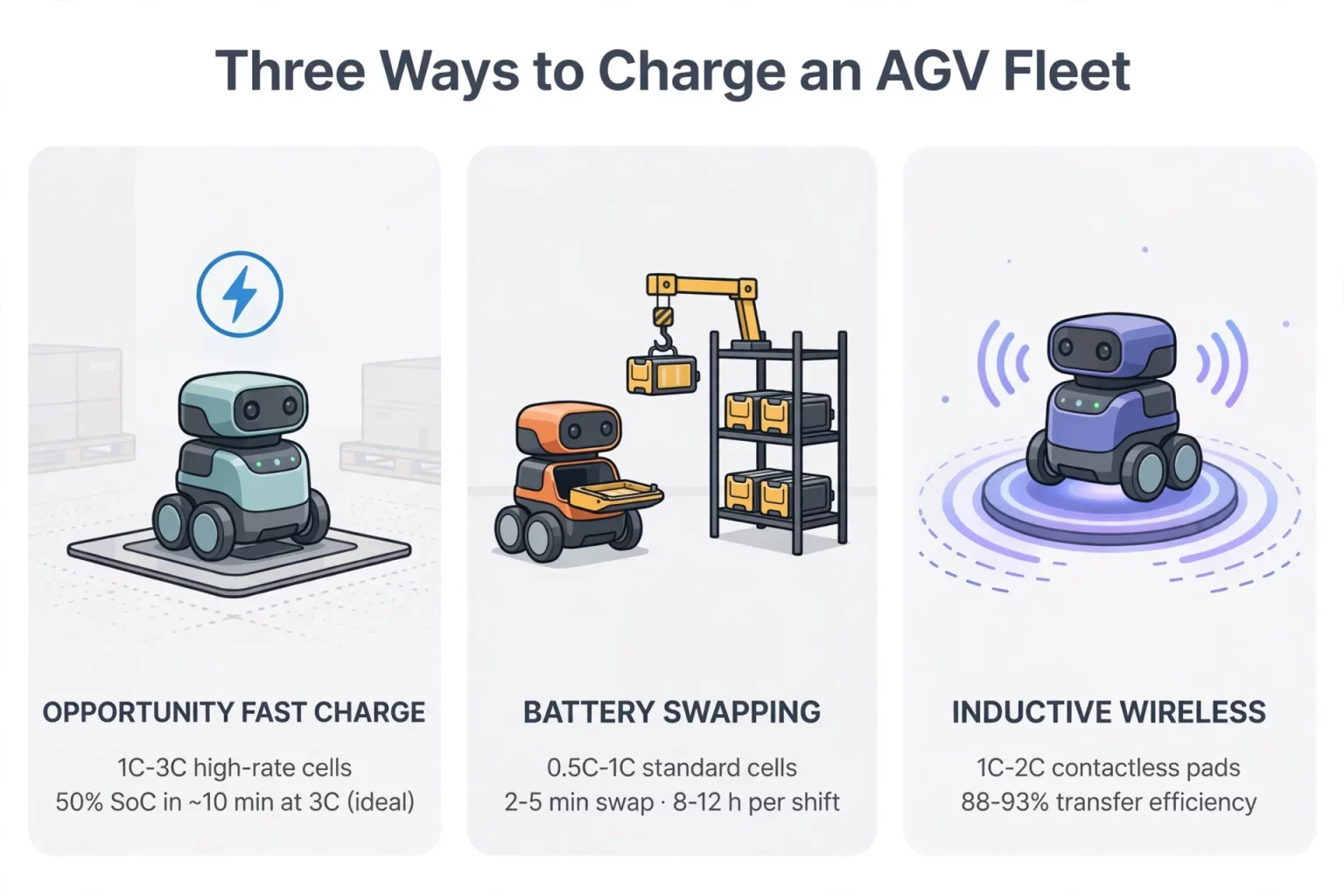
Selecting the charging architecture for AGV battery charging systems determines both the battery cell specification and the total number of robots required to meet warehouse throughput targets. If a fleet loses several hours per shift to slow charging without spare battery rotation, integrators may need additional vehicles to maintain constant pallet or tote movement; the actual fleet-size impact depends on duty cycle, charge window, travel distance, and throughput targets, and should be quantified through fleet simulation for each site. Warehouse automation engineers typically evaluate three charging strategies based on duty cycle, floor space, and C-rate requirements.
Table 1: AGV & AMR Battery Charging Systems Engineering Comparison
| Charging Strategy | Typical Industry C-Rate & Cell Selection | Charge Window & SoC Duty Cycle | Operational Advantages | Key Engineering Bottlenecks to Address |
|---|---|---|---|---|
| 1. Opportunity Contact Fast Charging (In-Line Grazing) | Industry selection range of 1C to 3C high-rate LFP or semi-solid LFP (project-specific OEM/ODM engineering evaluation) | Short top-up stops at workcells or conveyor handoffs within a 30%↔ 80% SoC band; restoring the full 50% SoC span takes roughly 10 minutes at a sustained 3C, 15 minutes at 2C, or 30 minutes at 1C under ideal conditions | Eliminates battery swap rooms and spare pack inventory; supports continuous 24/7 fleet dispatch. | Requires low-impedance high-rate cells to control I²R heating, plus zero-current pre-charge BMS control to prevent sliding contact arcing. |
| 2. Automated or Manual Battery Swapping | 0.5C to 1C standard LFP or hybrid solid-state LFP | 2 to 5 minutes mechanical swap; runs 8 to 12 hours per shift (100%→ 15% SoC) | Reduces peak electrical demand on warehouse feeders; moderate C-rates minimize cell thermal stress. | Requires 1.5× to 2× battery pack inventory, high-cycle blind-mate connectors, and dedicated charging rack floor space. |
| 3. Inductive Wireless Opportunity Charging | 1C to 2C LFP or semi-solid LFP (project-evaluated) | Contactless inductive pads at staging or picking stations | Eliminates mechanical brush wear and exposed live contacts; suited for cleanrooms and wet/corrosive washdown floors. | 88% to 93% inductive transfer efficiency generates coil heat that must be isolated from the battery enclosure. |
Solving Sliding Contact Arcing in Opportunity Charging: Zero-Current Handshake & Pre-Charge BMS
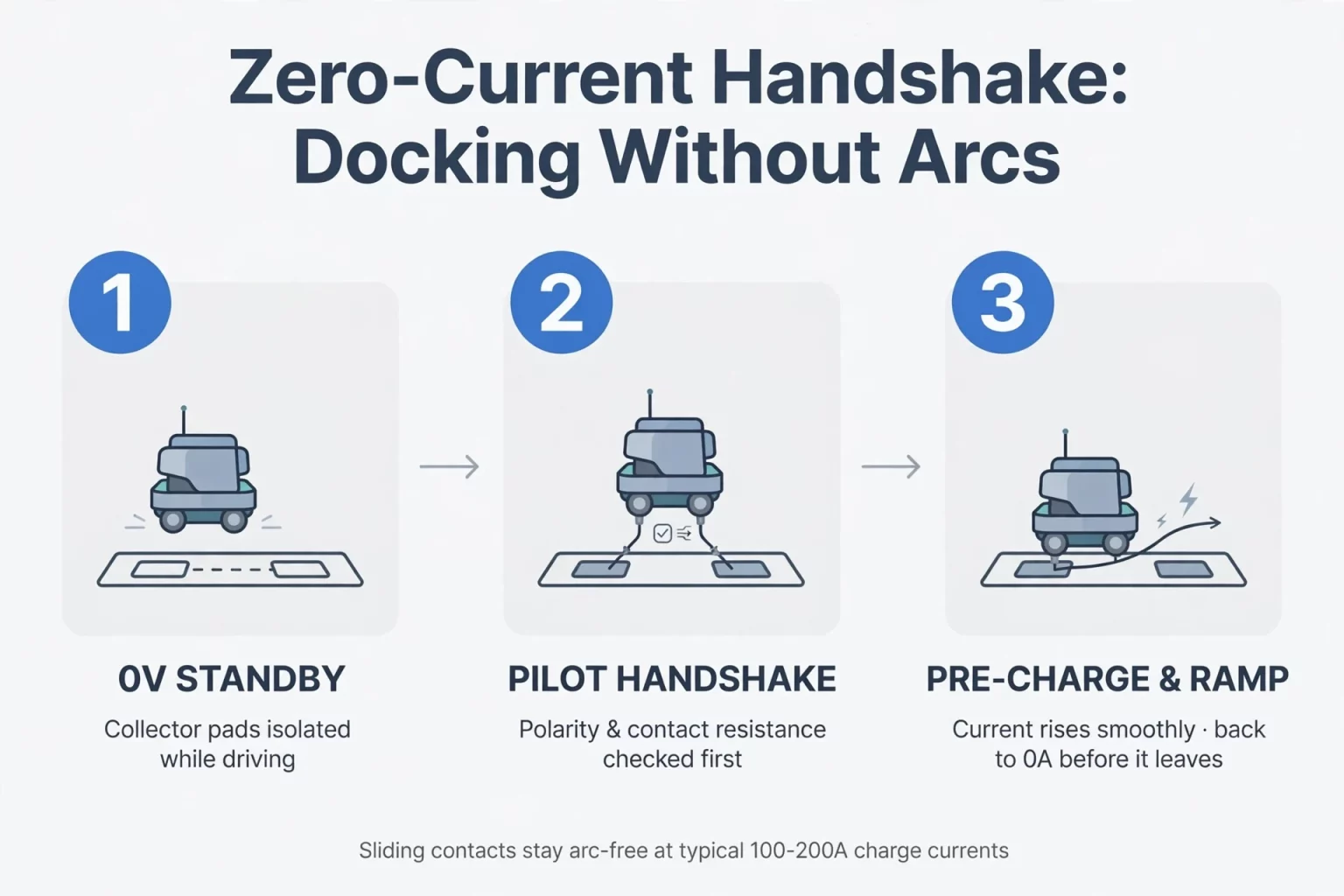
In opportunity-charging AGV fleets, vehicles dock repeatedly against floor-mounted brass collector plates or side-mounted copper brush shoes. If the battery pack's main discharge/charge bus remains live on the external collector pads during physical docking or undocking, making or breaking a high-current DC circuit can pull an electric arc across the sliding contacts. Charging currents vary by charger rating and pack design; in many fleet configurations they reach the 100A to 200A range, which is a representative engineering risk scenario rather than a fixed value. Over thousands of docking events, contact arcing pits the copper plates, increases contact resistance, and can weld mechanical contactors closed.
To reduce contact arcing risk in custom-engineered AGV battery charging systems, the pack BMS and the opportunity charger can be specified to coordinate a zero-current docking sequence as part of a project-specific OEM/ODM engineering evaluation:
- 1. Isolated External Collector Pads (0V Standby): While the AGV is driving, the pack's main charge MOSFETs or contactors keep the external charging brushes electrically isolated from the cell string.
- 2. Pilot Handshake & Resistance Check: Upon physical contact with the charger pads, a low-energy pilot signal and CAN or RS485 communication link verify polarity, charger identity, and contact resistance before any power stage closes.
- 3. Active Pre-Charge & Current Ramp: Once the handshake succeeds, the BMS engages a pre-charge circuit to equalize bus capacitance, closes the main solid-state switch or contactor under near-zero current, and commands the charger to ramp DC current smoothly; before the robot departs, the charger ramps current back to 0A prior to contactor opening.
Why Standard 0.5C Energy Storage Cells Cannot Be Forced into 2C–3C Opportunity Fast Charging
One frequent procurement mistake in warehouse robotics is attempting to use standard 0.5C stationary energy storage cells, such as the large-format 314Ah LFP cells used in residential or C&I backup cabinets, for 2C to 3C in-line fast charging. Stationary energy storage cells use thick electrode coatings optimized for energy capacity and 2-hour (0.5C to 0.64C) charge rates. For example, MegSolid's published stationary MEG-Solid-512314FL1 (51.2V 314Ah) specifies a 200A maximum charging current and a 200A maximum continuous discharging current (approximately 0.64C), while the movable MG 512314 (51.2V 314Ah) lists a 200A maximum charge/discharge current without a separately stated continuous rating.
Forcing 2C to 3C charging current into a cell designed for 0.5C creates severe ion-diffusion bottlenecks, high internal I²R heating, and metallic lithium plating on the graphite anode. When an AGV or AMR application targets 1.5C to 3C opportunity fast charging during short conveyor handoff stops, cell selection, electrode C-rate capability, busbar cross-section, and thermal dissipation must be specifically engineered and verified during OEM/ODM pack design rather than substituting standard stationary storage modules.
Autonomous Mobile Robot (AMR) Lithium & Semi-Solid Battery Packs
Goods-to-Person (G2P) under-ride AMRs, autonomous tote-picking robots, and high-bay AS/RS shuttle cars impose strict geometric, thermal, and fire-safety constraints on autonomous mobile robot AMR battery pack engineering.
1. Low-Profile Chassis Packaging & Energy Density Trade-Offs
Under-ride warehouse AMRs that drive beneath mobile shelving racks typically have a total chassis height of only 120 mm to 160 mm. After accounting for ground clearance, drive motors, lifting actuators, and LiDAR sensors, the internal battery bay is often restricted to a 1U or 2U cavity. Standard published stationary packs, such as MegSolid's MEG-Solid-512314FL1 (830× 500× 230 mm, approximately 125 kg) or movable MG 512314 (900× 570× 420 mm, 135 kg), are sized for stationary rooms or wheeled mobile carts rather than compact AMR bays.
For compact AMR and shuttle chassis, robotics OEMs work with battery manufacturers to evaluate custom cell-to-pack geometries and higher-energy-density cell options. In industry practice, conventional LFP cells typically deliver around 140 to 160 Wh/kg at the cell level, whereas advanced hybrid solid-state (semi-solid) formulations are researched and deployed across the industry to increase gravimetric and volumetric energy density within constrained enclosures. Specific gravimetric energy density (Wh/kg), volumetric packaging (Wh/L), and shift runtime for a custom AMR pack depend on the selected cell format, protective housing mass, and BMS hardware, and must be verified through project-specific OEM/ODM mechanical and electrical modeling.
2. Warehouse Fire Risk Mitigation in High-Bay AS/RS Fulfillment Centers
In high-density Automated Storage and Retrieval Systems (AS/RS), dozens of robotic shuttles operate atop aluminum grid tracks above tens of thousands of plastic inventory totes. Because a single thermal event inside an elevated grid is difficult for ceiling sprinklers to reach, third-party logistics (3PL) operators, warehouse insurers, and safety authorities scrutinize battery chemistry and abuse tolerance under standards such as IEC 62619 (secondary lithium cells and batteries for industrial applications, including AGVs) and UL 2580 (batteries for use in electric vehicles and industrial trucks).
MegSolid's hybrid solid-state (semi-solid) battery technology combines solid electrolytes with liquid components and a thermally stable LiFePO4 cathode to reduce thermal runaway risks associated with conventional free-flowing liquid lithium-ion batteries. On our published 51.2V stationary model (MEG-Solid-512314FL1), the product page lists UL, CE, and UN38.3 references (while the movable MG 512314, listed as Solid LFE with its electrolyte architecture unconfirmed in public documentation, lists IEC62109-1, IEC62109-2, UL1741, EN61000-6-1, EN61000-6-3, FCC 15 Class B, and RoHS; because IEC 62109 and UL 1741 primarily apply to power conversion equipment, certificate holder and applicable scope should be verified). When engineering custom AGV or AMR packs for automated warehouses, required pack-level certifications, such as UL 2580, IEC 62619, or UN 38.3, and supporting test reports must be scoped and verified for the final custom assembly. Explore our core cell and system architecture on our Solid-State Energy Storage Systems hub →
3. Cold-Chain Freezer Warehouses (-20°C to -30°C) & Thermal Management Boundaries
Automated cold-chain logistics centers deploy AMRs and pallet shuttles inside deep-freeze rooms (-18°C to -30°C) to reduce human labor exposure in sub-zero environments. However, lithium battery electrochemistry faces a strict physical boundary between discharging and charging at sub-zero temperatures:
- Verified Standard Operating Windows: On MegSolid's published MEG-Solid-512314FL1 (51.2V 314Ah) hybrid solid-state battery, the specified operating temperature range is -20°C to 60°C for discharging, but 0°C to 45°C for charging (while the movable MG 512314 is rated for -15°C to +50°C discharging and 0°C to 50°C charging).
- Engineering Custom Cold-Storage AMR Packs: Charging a lithium cell directly below 0°C without thermal conditioning risks lithium plating on the anode. Consequently, if an AMR fleet must operate at -25°C to -30°C or opportunity-charge inside a cold room without driving out to a warm vestibule (which causes moisture condensation on cold chassis electronics), the custom battery pack must be engineered with thermal insulation, internal BMS-controlled heating films that keep cell temperatures above the safe charging threshold, and sealed anti-condensation enclosures (for example, IP65 / IP67 target ratings). These cold-chain thermal features are defined as AGV project technical requirements and handled through project-specific OEM/ODM engineering evaluation, rather than published MegSolid standard product parameters.
Custom Battery Pack Design for Robotics & Smart Warehouse Automation
Because every AGV, AMR, and unmanned forklift platform has a unique chassis cavity, traction motor voltage, and fleet software stack, robotics manufacturers typically transition from off-the-shelf prototype batteries to custom-tooled OEM/ODM battery packs once a vehicle enters commercial production. The voltage, capacity, C-rate, ingress protection, and protocol ranges in Table 2 describe typical AGV project technical requirements; they are not published MegSolid standard model parameters, and each is handled through project-specific OEM/ODM engineering evaluation.
Table 2: Robotics & Warehouse Automation Battery Application Matrix (OEM/ODM Scope vs. Standard Platforms)
| Application Category | Typical Industry Voltage & Capacity Scope | Duty Cycle & Mechanical Profile | MegSolid Supply Route & Verification Scope |
|---|---|---|---|
| 1. AS/RS Shuttles & Sorting AMRs | Custom 24V (25.6V) / 36V (38.4V), 20Ah–60Ah | Low-profile 1U/2U chassis, frequent opportunity charging, blind-mate docking | Project-specific OEM/ODM evaluation via /bess-oem-odm/; cell C-rate, dimensions, and BMS protocol verified per project. |
| 2. Under-Ride Goods-to-Person (G2P) AMRs | Custom 48V (51.2V), 40Ah–120Ah | Compact rectangular footprint, high cycle life across 30%–80% SoC micro-cycles | Project-specific OEM/ODM evaluation; custom pack dimensions, pre-charge circuit, and CAN / RS485 integration. |
| 3. Unmanned Counterbalance Forklift & Tugger AGVs | Custom 48V / 72V / 80V, 150Ah–600Ah | High peak lift surges, regenerative braking absorption, heavy steel counterweight housing | Project-specific OEM/ODM evaluation for ballasted steel enclosures and high-current traction BMS. |
| 4. Stationary / Movable 51.2V Backup & Mobile Test Carts | Published MEG-Solid-512314FL1 (51.2V 314Ah, 16.07 kWh) & MG 512314 (16,076 Wh) | MEG-Solid-512314FL1: 200A max charge, 200A max continuous discharge, 8,000 cycles at 80% DoD; MG 512314: 200A max charge/discharge, ≥6,000 cycles at 25°C and 80% EOL; both RS485 / RS232 / CAN | Standardized MegSolid products (43.2–57.6V stationary; 40–58.4V movable up to 6 units in parallel). |
| 5. Smart Warehouse Fleet Charging Substation BESS | Published ESSA Series (55.3–215.04 kWh) & Energon (261.24 kWh / 125 kVA liquid-cooled LFP) | Peak shaving for simultaneous AGV fast chargers and 24/7 AS/RS backup power | Standardized MegSolid C&I BESS (ESSA0100B-0215 at 672–850V DC; Energon at 676–936V DC). |
Three Core OEM/ODM Engineering Specifications to Define in Your Robotics RFQ
When submitting a custom battery pack design for robotics inquiry to our Custom BESS & Industrial Battery OEM/ODM Engineering Team, hardware and firmware leads should specify three critical system parameters:
- 1. Eliminating BMS State of Charge (SoC) Drift Under 30%–80% Opportunity Cycling: In an opportunity-charging fleet, AGVs cycle continuously between 30% and 80% SoC for weeks without reaching the 100% full-charge voltage knee (3.60V–3.65V per cell). Because LiFePO4 exhibits a flat open-circuit voltage plateau between 30% and 80% SoC, basic voltage-lookup or low-resolution Hall-sensor BMS boards accumulate Coulomb-counting integration errors over time, causing a robot to report 25% remaining SoC shortly before hitting low-voltage cut-off in an aisle. Custom robotics BMS specifications can define shunt current-sensing resolution, Kalman-filter (EKF) dynamic SoC estimation requirements, and scheduled automated top-balancing intervals negotiated between the BMS and fleet charger; these are custom BMS design requirements handled through project-specific OEM/ODM engineering evaluation, not standard features of published MegSolid models.
- 2. Fleet Communication Protocols (CAN / RS485 / RS232 to ROS / PLC): MegSolid's published 51.2V platforms (MEG-Solid-512314FL1 and MG 512314) list RS485, RS232, and CAN hardware interfaces. Upper-layer protocols such as CANopen (CiA 418 / CiA 454 battery/charger profiles), SAE J1939, Modbus RTU, or direct ROS / ROS 2 driver integration are custom project requirements whose support is not confirmed in published MegSolid documentation; the exact DBC file or register protocol must be specified and verified through project-specific OEM/ODM engineering evaluation.
- 3. Backing Up Simultaneous AGV Fast Chargers with Warehouse C&I BESS: When 50 to 200 AGVs and AMRs engage high-current opportunity chargers simultaneously during shift changes, warehouse utility transformers experience sharp demand spikes. Integrators pair fleet charging hubs with MegSolid's standardized Commercial & Industrial (C&I) Energy Storage Systems, including the air-cooled ESSA0100B-0215 100 kW / 215.04 kWh Outdoor Cabinet BESS (672–850V DC, built-in isolation transformer, <3% THDi, IP54) and the liquid-cooled Energon 261.24 kWh / 125 kVA Liquid-Cooled LFP C&I ESS (676–936V DC, 832V nominal, 1P260S 314Ah LFP cells, liquid cooling, 90% max system efficiency, IP54, -20°C to +55°C operation, parallelable up to 10 units), to shave charger peak demand and keep automated warehouses running during grid outages.
FAQ
What charging method should a 24/7 AGV fleet select?
Compare opportunity charging, battery swapping, and inductive charging against the measured duty cycle. Opportunity charging fits frequent short stops when the cells and charger support the required C-rate. Battery swapping needs extra inventory and a swap station, while inductive systems require efficiency and thermal design reviews.
Can a standard 314Ah stationary battery support 3C AGV fast charging?
Do not assume so. The published MEG-Solid-512314FL1 supports 200A maximum charging at 314Ah, approximately 0.64C. A 2C–3C robot battery needs a high-rate cell specification, busbar and cooling design, and project-specific BMS protection verification before production.
What prevents electrical arcing at AGV charging contacts?
Use isolated collector pads during travel, validate polarity and contact resistance through a pilot handshake, and precharge before closing the main power path. The charger must ramp current to zero before undocking. Verify the full sequence under the intended contact current and docking conditions.
What information is required for custom AGV battery pack design?
Provide the available battery bay dimensions, nominal system voltage, capacity target, continuous and peak drive currents, lifting duty, charging windows, operating temperatures, and fleet controller interfaces. These inputs define which cell format, protection circuit, mechanical housing, and qualification pathway should be evaluated.
Which communication interfaces can MegSolid evaluate for robot batteries?
MegSolid’s published 51.2V platforms list RS485, RS232, and CAN interfaces. Upper-layer protocols such as CANopen, SAE J1939, Modbus RTU, or ROS 2 are project-specific integration requests rather than guaranteed features. Submit the controller DBC file or register map for compatibility evaluation.
Can standard MegSolid 51.2V modules fit a low-profile AMR chassis?
The published MEG-Solid-512314FL1 measures 830 × 500 × 230 mm and weighs approximately 125 kg; the movable MG 512314 is larger. Compact AMR bays often need a purpose-engineered cell-to-pack layout, so verify chassis clearance, service access, vibration loads, and cooling before specifying a battery.
How should a warehouse EPC size a BESS for simultaneous AGV chargers?
Start with simultaneous charger load, actual coincidence of docking events, feeder capacity, peak-shaving objective, and required backup duration. MegSolid ESSA0100B-0215 and Energon are standardized C&I options for evaluation. The fleet charging battery and upstream warehouse BESS have separate design and control boundaries.
What should US warehouse automation projects verify before purchasing AGV batteries?
Confirm the required pack-level evaluation with the equipment OEM and local authority. Industrial vehicle batteries may need UL 2580 assessment, while the building energy storage installation has separate requirements. Ask for test reports covering the exact custom pack, charger interface, and intended vehicle application.
What should European AGV integrators check when specifying a custom pack?
Define the machinery and battery compliance scope for the intended installation and verify any applicable IEC 62619 evaluation and transport evidence. Submit the robot voltage, mechanical envelope, BMS interface, and charging behavior for review. Published MegSolid module documentation should not be treated as certification of a new custom assembly.
What should Asia-Pacific automation OEMs provide for a battery design review?
Provide local installation constraints, charger supply and connector requirements, fleet duty-cycle data, ambient temperatures, and the documentation required by the customer or destination market. MegSolid can evaluate the mechanical layout, LiFePO4 or semi-solid cell selection, and BMS protocol on a project-specific OEM/ODM basis.
Partner with MegSolid for Custom Robotics Battery OEM/ODM & Warehouse C&I Storage
Whether you are a robotics OEM submitting custom 24V / 36V / 48V / 72V AGV and AMR battery requirements for project-specific OEM/ODM engineering evaluation, a mobile workstation builder integrating our standardized 51.2V 314Ah battery packs, or a warehouse automation EPC sizing C&I peak-shaving storage for fleet charging hubs, MegSolid provides transparent technical specifications and OEM/ODM engineering support:
- For Custom Robotics & Industrial Battery Pack OEM/ODM Evaluation: Submit Your Robotics Battery Envelope & Load Profile to MegSolid OEM/ODM →
- For Published 51.2V 314Ah Stationary & Movable Battery Packs: View MEG-Solid-512314FL1 (16.07 kWh) and View MG 512314 Movable Pack (16.076 kWh)
- For Automated Warehouse Charging Hub C&I BESS (55 kWh–5 MWh): Explore MegSolid Commercial & Industrial Energy Storage Systems →
- For Direct Engineering Consultations: Contact MegSolid Engineering & Supply Chain Team →
