
Commercial EPCs searching for a sungrow hybrid inverter alternative often start from one of two design situations: an SH25T-based hybrid layout or an existing PV-only string inverter plant.
The SH25T is rated at 25 kW AC, while the SG50CX-P2 (50 kW) and SG125CX-P2 (125 kW) are grid-tied PV string inverters with no DC battery port.
This comparison focuses on SH25T-based designs and existing SG50CX-P2 / SG125CX-P2 installations, rather than the entire current Sungrow hybrid inverter portfolio.
Sungrow has also published preliminary datasheets for larger SH50CX / SH80CX hybrid models; confirm regional availability and final specifications directly with Sungrow.
For 50 kW hybrid projects, our 4 MPPT Commercial Solar Inverter: R30KH3, R40KH3 & R50KH3 guide covers the R-series 30 kW to 50 kW three-phase hybrid range.
For existing PV-only plants, our engineering guide on Three Phase Unbalanced Load: 80/105/125 kW MegSolid PMA PCS covers PMA PCS sizing for unbalanced three-phase loads.
SG50CX parameters in this article reference the SG50CX-P2 (4 MPPTs); the earlier SG50CX generation lists 5 MPPTs, so string allocation must be checked separately on SG50CX retrofits.
This guide maps each Sungrow model to products in our MegSolid Energy Storage Inverter & PCS lineup:
- R30KH3 / R40KH3 / R50KH3 (Three-Phase Hybrid Inverters): 30 / 40 / 50 kW rated AC, 45 / 60 / 75 kW max PV input, 4 MPPTs (2 strings each), 150V to 800V DC battery window (80A x 2 inputs), <10 ms backup, IP65
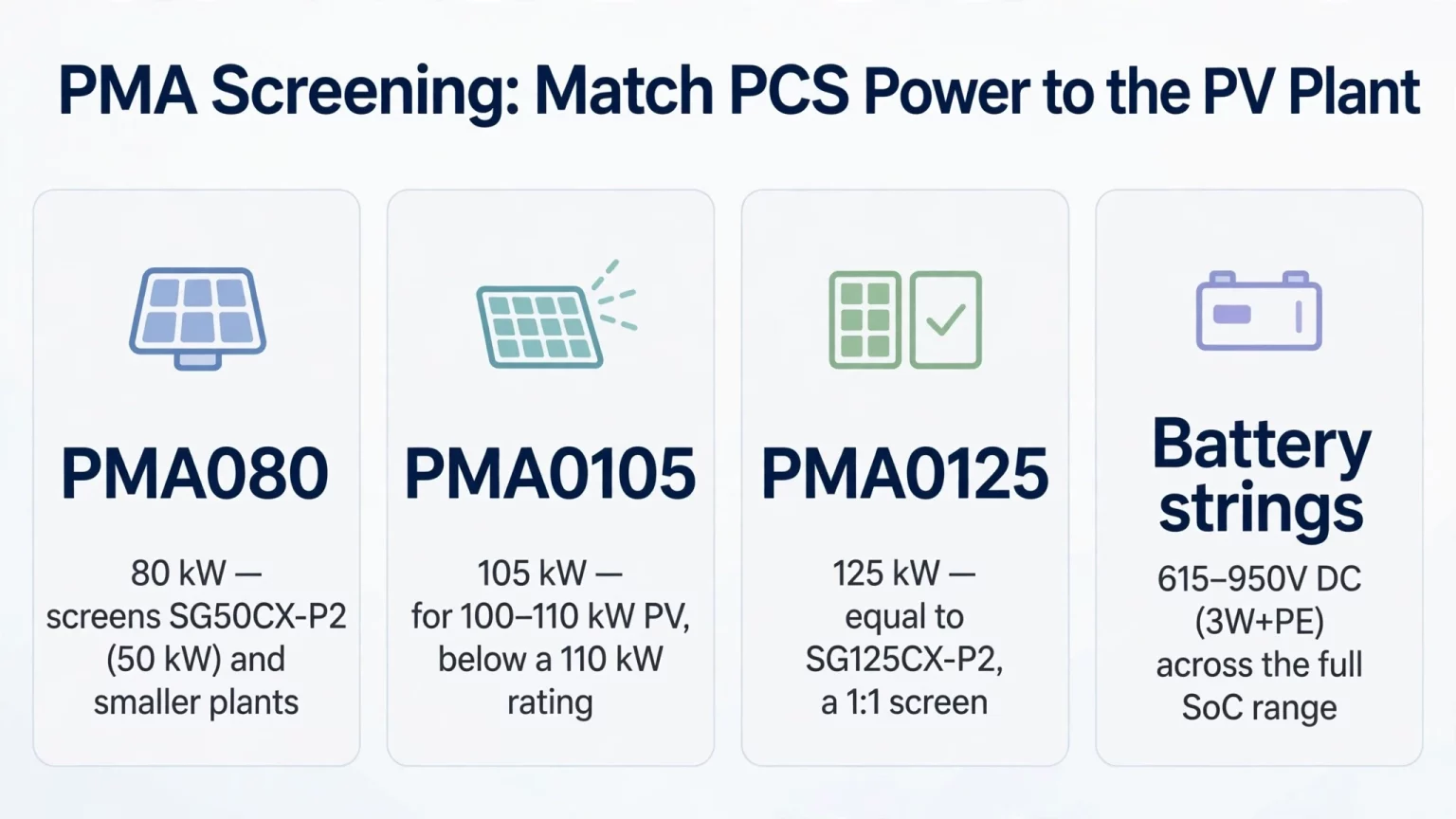
- PMA080 / PMA0105 / PMA0125 (Modular Rack-Mount PCS): 80 / 105 / 125 kW rated AC (115 / 150 / 180 A rated AC current), 615V–950V DC (3W+PE) or 650V–950V DC (3W+N+PE), 98.7% max efficiency
- G2S-C Series (R3KL1DA-G2S-C to R6KL1DA-G2S-C): 3 kW to 6 kW single-phase hybrid/AC-coupled inverters with a 48V battery port (40V to 58V DC, 60A to 120A, CAN BMS)
- MEGA0030TS to MEGA0500TS (Transformer-Isolated PCS): 30 kW to 500 kW cabinets with built-in isolation transformer and a DC input ceiling of 850V
Sungrow SH25T Alternative: When a 50kW 4 MPPT Hybrid Inverter Fits a C&I Rooftop
As an illustrative project range, supermarkets, light manufacturing workshops, clinics, and office buildings may run 50 kWp to 75 kWp of rooftop PV with 60 kWh to 150 kWh of storage.
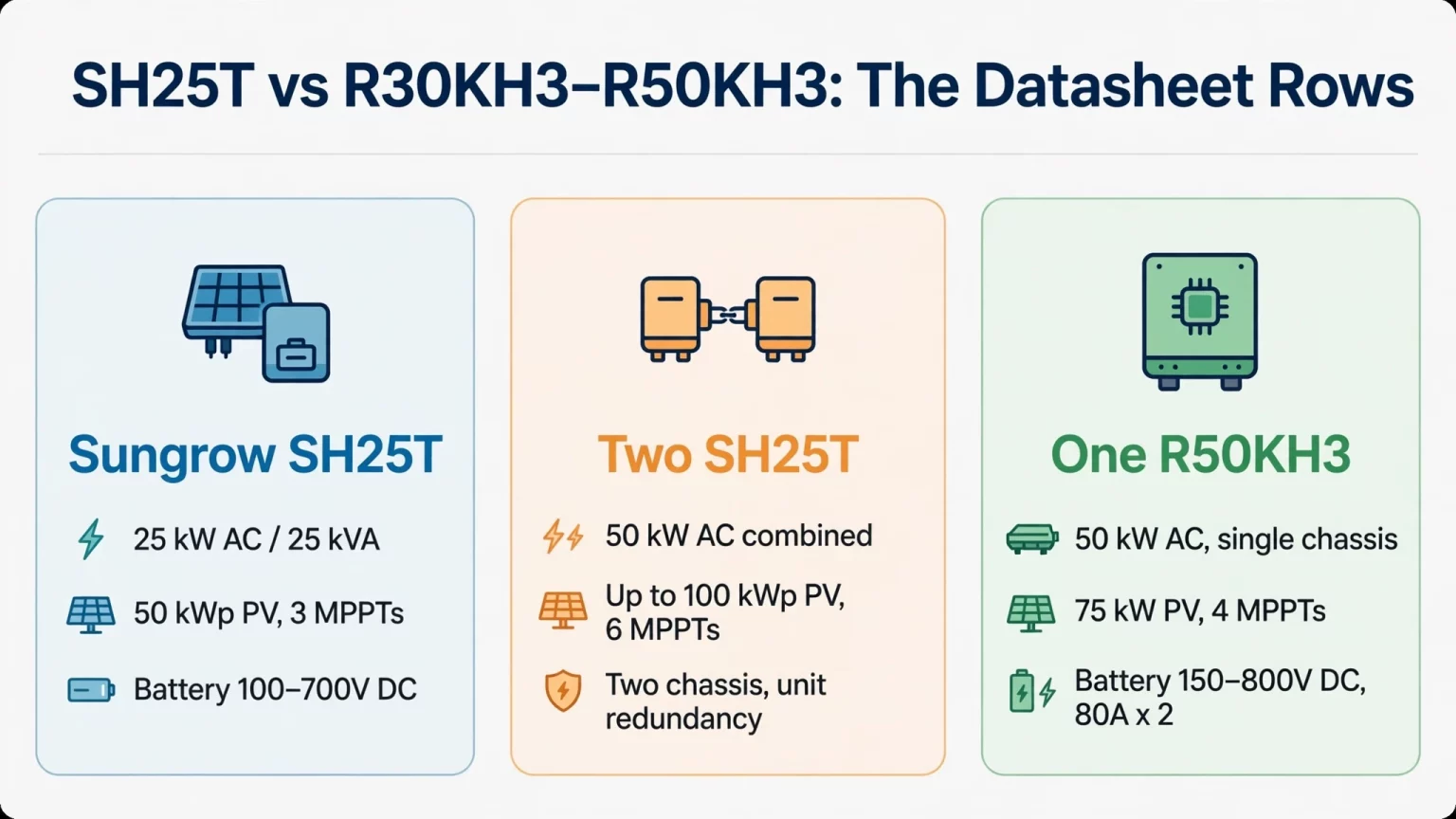
The Sungrow SH25T (V3 datasheet) is rated at 25 kW / 25 kVA AC with up to 50 kWp PV input across 3 MPPTs.
What Changes When Two SH25T Units Are Paralleled
Reaching 50 kW of rated AC output with SH25T hardware requires two inverters, which increases the device count and part of the branch circuitry:
- Two inverter chassis and two sets of wall brackets
- Two AC branch breakers and two battery DC connections
- Additional communication wiring and commissioning steps
Total labor, main distribution work, and commissioning cost depend on site layout and should not be assumed to double.
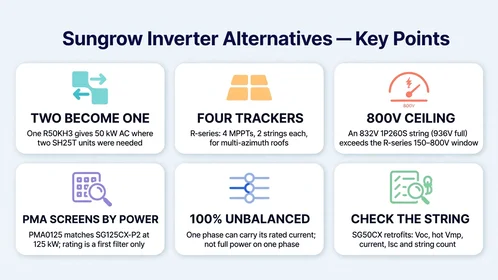
For projects requiring 50kW of rated AC output and no more than 75kW of PV input, one R50KH3 provides a single-chassis alternative to a two-SH25T arrangement. PV string allocation, battery compatibility and redundancy requirements must still be compared.
| Comparison Item | Two Sungrow SH25T Units (Combined) | One MegSolid R50KH3 |
|---|---|---|
| Rated AC Active Power | 50 kW | 50 kW |
| PV Input Capacity | Up to 100 kWp combined (per V3 datasheet) | 75 kW max |
| Independent MPPTs | 6 (3 per unit) | 4 |
| Device Count | 2 | 1 |
| Redundancy | Remaining unit may keep operating if one fails, depending on parallel configuration | Single point of conversion |
The R30KH3 (30 kW) and R40KH3 (40 kW) are intermediate steps above one SH25T; they do not match the 50 kW output of two SH25T units.
Datasheet Comparison: Sungrow SH25T vs. MegSolid R30KH3, R40KH3 & R50KH3 (50kW 4 MPPT Hybrid Inverter)
The table compares the Sungrow SH25T (SH15T/20T/25T V3 datasheet) with the MegSolid Three-Phase Hybrid Inverter series.
| Specification Parameter | Sungrow SH25T (V3 Datasheet) | MegSolid R30KH3 (30 kW) | MegSolid R40KH3 (40 kW) | MegSolid R50KH3 (50kw 4 mppt hybrid inverter) |
|---|---|---|---|---|
| Rated AC Active Power | 25 kW | 30 kW | 40 kW | 50 kW |
| Max AC Apparent Power | 25 kVA | Refer to R-series datasheet | Refer to R-series datasheet | Refer to R-series datasheet |
| Max AC Output Current | Refer to SH25T datasheet | 50.1 A | 66.9 A | 83.6 A |
| Backup Peak Output | 36.5 kW / 36.5 kVA, 10 s | Refer to R-series datasheet | Refer to R-series datasheet | Refer to R-series datasheet |
| Max PV Input Power | 50 kWp | 45 kW | 60 kW | 75 kW |
| MPPTs / Strings per MPPT | 3 MPPTs (2 / 2 / 1 strings) | 4 MPPTs / 2 strings each | 4 MPPTs / 2 strings each | 4 MPPTs / 2 strings each |
| MPPT Voltage Range | Refer to SH25T datasheet | 150V to 850V | 150V to 850V | 150V to 850V |
| Battery DC Voltage Range | 100V to 700V DC | 150V to 800V DC | 150V to 800V DC | 150V to 800V DC |
| Max Battery Charge / Discharge Power | 30 kW / 25 kW | 33 kW | 44 kW | 55 kW |
| Max Battery Current | 50 A / 50 A | 80 A x 2 inputs | 80 A x 2 inputs | 80 A x 2 inputs |
| Backup Switching Time | < 10 ms | < 10 ms | < 10 ms | < 10 ms |
| Three-Phase Unbalanced Output | 100% unbalanced | 100% unbalanced (series spec) | 100% unbalanced (series spec) | 100% unbalanced (series spec) |
| Enclosure & Dimensions | IP65, 620 x 480 x 245 mm (W x H x D), 40 kg | IP65, 530 x 280 x 850 mm, 73 kg | IP65, 530 x 280 x 850 mm, 73 kg | IP65, 530 x 280 x 850 mm, 73 kg |
Note: Confirm the absolute maximum PV input voltage on the current R-series datasheet and nameplate before finalizing string length.
Key Engineering Takeaways for a Sungrow SH25T Alternative
Both series list <10 ms backup switching, IP65 protection, and 100% unbalanced output, so selection depends on power class, PV allocation, and battery voltage.
- 4 MPPTs on Multi-Azimuth Roofs: East, west, and south roof planes can be split across four trackers with two strings each.
- Theoretical Minimum Battery Voltage (Both Inputs Active): With both 80 A inputs in use (160 A total), full power requires about 33,000 ÷ 160 = 206.25 V, 44,000 ÷ 160 = 275 V, and 55,000 ÷ 160 = 343.75 V.
- Single-Input Case: Using one 80 A battery input, 55 kW would require 55,000 ÷ 80 = 687.5 V, so a 344V string on one port cannot deliver 55 kW.
- Boundary Note: These are theoretical current-limited lower bounds, not manufacturer-guaranteed full-power minimum operating voltages.
- 800V DC Ceiling: An 832V nominal 1P260S string (936V at full charge) exceeds the R-series battery input range.
Send your PV string schedule, roof orientations and battery voltage range. MegSolid can review R50KH3 fit and flag strings or battery inputs that need redesign.
Sungrow SG50CX Battery Retrofit & SG125CX-P2 AC Coupled BESS Architecture
Many commercial rooftops already run Sungrow SG50CX-P2 (50 kW, 4 MPPTs) or SG125CX-P2 (125 kW, 12 MPPTs) grid-tied string inverters.
Without a battery port, these owners cannot store midday surplus for evening use or ride through grid outages.
Path A: DC-Coupled Replacement for a Sungrow SG50CX Battery Retrofit (R50KH3)
On repowering projects, replacing an SG50CX-P2 with an R50KH3 adds a 150V–800V DC battery port while keeping a 4-MPPT layout.
On original-generation SG50CX sites (5 MPPTs), existing strings must be regrouped onto the R50KH3's 4 MPPTs and 8 string inputs.
DC-coupled charging routes PV power to the battery across the internal DC bus, avoiding the extra DC-to-AC-to-DC stage of AC coupling.
Before reusing existing strings, check five electrical limits against the R50KH3 datasheet:
- Cold-temperature open-circuit voltage against the absolute maximum PV input voltage (strings sized for the 1,100V SG50CX-P2 input may need shortening)
- Operating voltage (Vmp) across the site temperature range against the 150V–850V MPPT window (hot for the lower bound, cold for the upper bound), noting that the full-load MPPT range may be narrower
- Operating current per MPPT input
- Short-circuit current per MPPT input
- Total string count against 8 available string inputs (2 per MPPT)
Path B: Grid-Connected Sungrow SG125CX-P2 AC Coupled BESS (PMA080, PMA0105, PMA0125)
When owners want to keep the rooftop inverters, engineers connect a bidirectional PCS, battery, and EMS to the facility's 400 Vac low-voltage distribution board.
The MegSolid Energy Storage Inverter (PMA080, PMA0105, PMA0125) is a 19-inch rack-mount PCS module (483 x 680 x 174 mm 4U or 483 x 680 x 220 mm 5U).
As a module, the PMA requires system integration with an enclosure, protection switchgear, battery strings, EMS, metering, and thermal management before it operates as a complete storage system.
PCS Power as an Initial Screening Step
In zero-export or island operation, PCS rated power is a first filter, not proof that all PV surplus can be absorbed:
- PMA0125 (125 kW) with SG125CX-P2 (125 kW): Equal rated AC power, suitable for initial screening on a sungrow sg125cx-p2 ac coupled bess.
- PMA0105 (105 kW) with 100 kW to 110 kW PV inverters: Possible project selection, but 105 kW is below a 110 kW rating and is not a 1:1 match.
- PMA080 (80 kW) with SG50CX-P2 (50 kW): PCS rating exceeds PV inverter rating; the 30 kW difference is not a separate evening discharge rating.
- Energon 261 (125 kVA / 261.24 kWh): Turnkey cabinet with its own integrated PCS, evaluated separately from the 80 / 105 / 125 kW PMA ratings.
Final sizing must combine maximum PV surplus (PV output minus site load), allowable battery charge power at the actual SoC and temperature, and the island curtailment capability.
Battery strings must stay within 615V–950V DC (3W+PE) or 650V–950V DC (3W+N+PE) across the full SoC range, with full-load voltage, current, and BMS interface verified.
Simplified PV-to-Storage-to-AC Path Efficiency
For solar energy that passes through the PV inverter, is stored, and is later discharged as AC, a simplified path efficiency is:
PV-to-storage-to-AC path efficiency = PV inverter efficiency × PCS charging efficiency × battery efficiency × PCS discharging efficiency
This is not the storage system's own AC-to-AC round-trip efficiency, which is normally measured at the storage system's AC terminals and excludes the PV inverter stage.
Each stage should use the same energy boundary, and the model should state whether auxiliary consumption is included.
Matching Matrix: Sungrow SH25T Alternative, SG50CX Battery Retrofit & SG125CX-P2 AC Coupled BESS
| Existing or Target Sungrow Model | Project Scenario | MegSolid Option | Coupling Topology & Engineering Check |
|---|---|---|---|
| SH25T (single unit) | 30 kW–40 kW hybrid sites (sungrow sh25t alternative) | R30KH3 or R40KH3 | DC-coupled hybrid one step above 25 kW; battery string 150V–800V |
| Two SH25T units | 50 kW hybrid sites with ≤ 75 kW PV | R50KH3 (50kw 4 mppt hybrid inverter) | Single chassis; compare PV allocation (4 vs. 6 MPPTs) and redundancy |
| SG50CX-P2 / SG50CX (repower) | sungrow sg50cx battery retrofit with inverter swap | R50KH3 | Check Voc, hot operating voltage, MPPT current, Isc, and string count |
| SG50CX-P2 (keep in place) | sungrow sg50cx battery retrofit without inverter swap | PMA080 + battery + EMS | Grid-connected AC coupling on 400 Vac bus; size by PV surplus and charge limits |
| SG125CX-P2 | sungrow sg125cx-p2 ac coupled bess | PMA0125 + battery + EMS, or Energon 261 (125 kVA) | Equal rated power is initial screening only; verify charge power and SoC limits |
| Multiple SG125CX-P2 | Factory peak shaving and backup | Multiple PMA0125 on segmented strings, or MEGA0250TS / MEGA0500TS | Confirm parallel and island control from controlled configuration documents |
| Single-phase auxiliary circuits | Offices, gatehouses, control rooms (3 kW–6 kW) | G2S-C series | Single-phase 48V hybrid/AC coupling; not a three-phase C&I PCS |
Off-Grid Operation with Existing SG50CX / SG125CX Inverters: What Must Be Verified
Grid-connected AC coupling and blackout operation with PV participation are two different engineering scopes.
Sharing the same AC bus while the grid is present does not mean the PCS and PV inverter will operate stably together after an outage.
| Scheme | What Can Be Claimed | What Must Be Verified |
|---|---|---|
| Grid-connected AC-coupled storage | Keep existing PV inverters and add PCS, battery, and EMS for metered peak shaving and self-consumption | Metering, export limits, protection settings, and dispatch logic per project |
| PV participation in off-grid supply after an outage | Possible in an approved island design | Grid-forming control, PV inverter island compatibility, anti-islanding behavior, power limiting, reconnection, and protection interlocks |
1. Frequency-Shift Power Control Principle
In an island, the grid-forming PCS sets voltage and frequency, and a grid-tied PV inverter may continue exporting if it accepts that island as a valid grid.
Frequency-shift power control may be used in an approved AC-coupled island system when the grid-forming PCS and PV inverter support coordinated frequency-dependent power reduction. Compatibility, operating limits, reconnection behavior and fail-safe protection must be verified for the selected models and firmware.
Published off-grid system documentation from some inverter manufacturers distinguishes three frequency points: the start of power reduction, the frequency where output reaches zero, and the disconnection limit.
2. Illustrative P(f) Arithmetic (Not Field Settings)
The following figures are illustrative only and are not commissioning settings for any PMA and SG125CX-P2 combination:
- Linear Example: If reduction starts at 50.2 Hz with a gradient of 40% per Hz, output at 51.5 Hz falls by (51.5 - 50.2) × 40% = 52%.
- Reference Power: In this example, the 52% reduction is relative to the PV inverter output at the moment frequency first crossed 50.2 Hz.
- Steeper Example: Reaching zero output 1.0 Hz after the start point corresponds to a gradient of 100% per Hz.
Actual frequency points, gradients, and trip limits must match the selected equipment, firmware, and applicable grid code (such as EN 50549-1 or NRS 097-2-1 in South Africa).
3. Grid-Tie Isolation and Transfer
The island must be separated from the utility by a grid-tie breaker or transfer switch controlled by the EMS.
The PMA series lists <20 ms charge-to-discharge switching, which is not the same as total microgrid outage transfer time.
Three Phase Unbalanced Loads in Western Cape Factories & Workshops
In Western Cape manufacturing workshops, bottling lines, and commercial complexes, single-phase pumps, lighting, and controls create uneven current across L1, L2, and L3.
In an approved island design, the grid-forming PCS carries this imbalance, because a grid-tied three-phase PV string inverter typically injects balanced current.
What 100% Unbalanced Load Means for PMA Sizing
MegSolid publishes 100% unbalanced load capability for the PMA series, and the off-grid 3W+N+PE (230/400V) configuration provides the neutral path for single-phase loads.
For sizing background, see our technical analysis of Three Phase Unbalanced Load: 80/105/125 kW MegSolid PMA PCS.
In practice, 100% unbalanced capability generally means one phase can carry its rated phase current while the others carry little or none; it does not mean full PCS power on one phase.
| PMA Model | Rated AC Power | Average Active Power per Phase | Theoretical Line Current, 400 Vac, PF = 1 | Published Rated AC Current |
|---|---|---|---|---|
| PMA080 | 80 kW | 26.67 kW | 115.47 A | 115 A |
| PMA0105 | 105 kW | 35.00 kW | 151.55 A | 150 A |
| PMA0125 | 125 kW | 41.67 kW | 180.42 A | 180 A |
Current limiting and equipment selection must follow the published rated current and derating requirements, not the theoretical division results.
Confirm neutral conductor sizing and the 3W+N+PE wiring variant against the controlled PMA datasheet for each project.
Conclusion: Choosing the Right Sungrow Hybrid Inverter Alternative for New Builds and Retrofits
For SH25T-based designs, the R30KH3–R50KH3 series offers 30 kW to 50 kW single-chassis options, compared on PV allocation, battery voltage, and redundancy.
For a sungrow sg50cx battery retrofit or sungrow sg125cx-p2 ac coupled bess, PCS rating is the first screen, followed by charge power, SoC limits, and island verification.
For DC-coupled rooftops, review our 4 MPPT Commercial Solar Inverter: R30KH3, R40KH3 & R50KH3 guide.
For AC-coupled retrofits and unbalanced industrial loads, read our engineering guide on Three Phase Unbalanced Load: 80/105/125 kW MegSolid PMA PCS.
To compare isolated cabinets with rack-mount converters, see Transformer-Integrated vs Modular Energy Storage Inverter.
Share your existing PV inverter models, site load and export limits, battery details, and outage requirements. MegSolid can return a coupling recommendation, a single-line diagram, the integration scope and a project quotation.
FAQ
Do both the Sungrow SH25T and MegSolid R-series support <10 ms backup and unbalanced loads?
Yes, both datasheets list <10 ms backup switching and 100% three-phase unbalanced output. The main differences are rated AC power (25 kW vs. 30–50 kW), PV input (50 kWp vs. up to 75 kW), and battery voltage window (100V–700V vs. 150V–800V).
Can an existing SG125CX-P2 keep supplying power during a blackout?
Only in an approved island design where the grid-forming PCS and PV inverter support coordinated frequency-dependent power reduction. Compatibility, operating limits, reconnection behavior, and fail-safe protection must be verified for the selected models and firmware.
Which PCS series can accept a 676V to 936V battery string?
Operating up to 936V DC, an 832V nominal 1P260S string exceeds the 800V DC ceiling of the R30KH3–R50KH3. For PCS matching, a battery string operating from 676V to 936V falls within the PMA series' published DC operating range, subject to full-load voltage, current and BMS compatibility checks. It exceeds the 850V maximum input of the listed MEGA TS models. This refers to matching a battery string to a PCS, not connecting a turnkey cabinet such as Energon 261, which has its own PCS, to a second PCS.
What is the role of the MegSolid G2S-C series?
The G2S-C series is a 3 kW to 6 kW single-phase inverter with a 48V battery port (40V–58V DC, 60A–120A, CAN BMS). It suits single-phase auxiliary circuits and small sites, not three-phase 50 kW or 125 kW retrofits.
How do EPCs verify BMS compatibility between MegSolid inverters and batteries?
Physical port presence does not guarantee plug-and-play operation with every third-party battery. Confirm the approved BMS protocol list with MegSolid technical support, or order factory-matched MegSolid battery and inverter packages.
What battery voltage would support 55 kW from an R50KH3 with both inputs active?
At the theoretical 160 A combined limit, 55,000 W ÷ 160 A = 343.75 V. With only one 80 A input active, the same calculation gives 687.5 V. Confirm the full-power operating range and battery limits for the installation.
Can strings designed for the SG50CX-P2 be reused on the R50KH3?
Check cold open-circuit voltage against the absolute PV input limit, operating voltage over the temperature range, operating current, short-circuit current and string count. Strings designed for the SG50CX-P2’s 1,100 V input may need shortening.
How is PV-to-storage-to-AC efficiency different from storage round-trip efficiency?
The PV-to-storage-to-AC path includes the PV inverter, PCS charging, the battery and PCS discharging. Storage AC-to-AC round-trip efficiency is measured at the storage system AC terminals and excludes the PV inverter.
Does the PMA charge-to-discharge switching figure give the total outage transfer time?
The published figure of less than 20 ms applies to charge-to-discharge switching. Verify total microgrid outage transfer time for the installed PCS, EMS, isolation and transfer equipment.
What does 100% unbalanced load capability mean for PMA phase sizing?
One phase can carry its rated phase current while the others carry little or none, subject to the approved configuration and derating. Check the published phase-current and neutral requirements for the installation.