Skip to content

Utility EPCs across Australia, Europe, and North America evaluating a CATL TENER Stack 9MWh alternative or reviewing CATL TENER+ Australia BESS announcements from All-Energy Melbourne face a real site-engineering trade-off. Packing 9 MWh onto one footprint cuts concrete pad counts on mega-scale utility yards. On 10 MWh to 50 MWh projects, EPCs must weigh pad savings against upper-tier hoisting, elevated field alignment, wind-driven foundation loads, working-at-heights O&M, and block fault granularity.
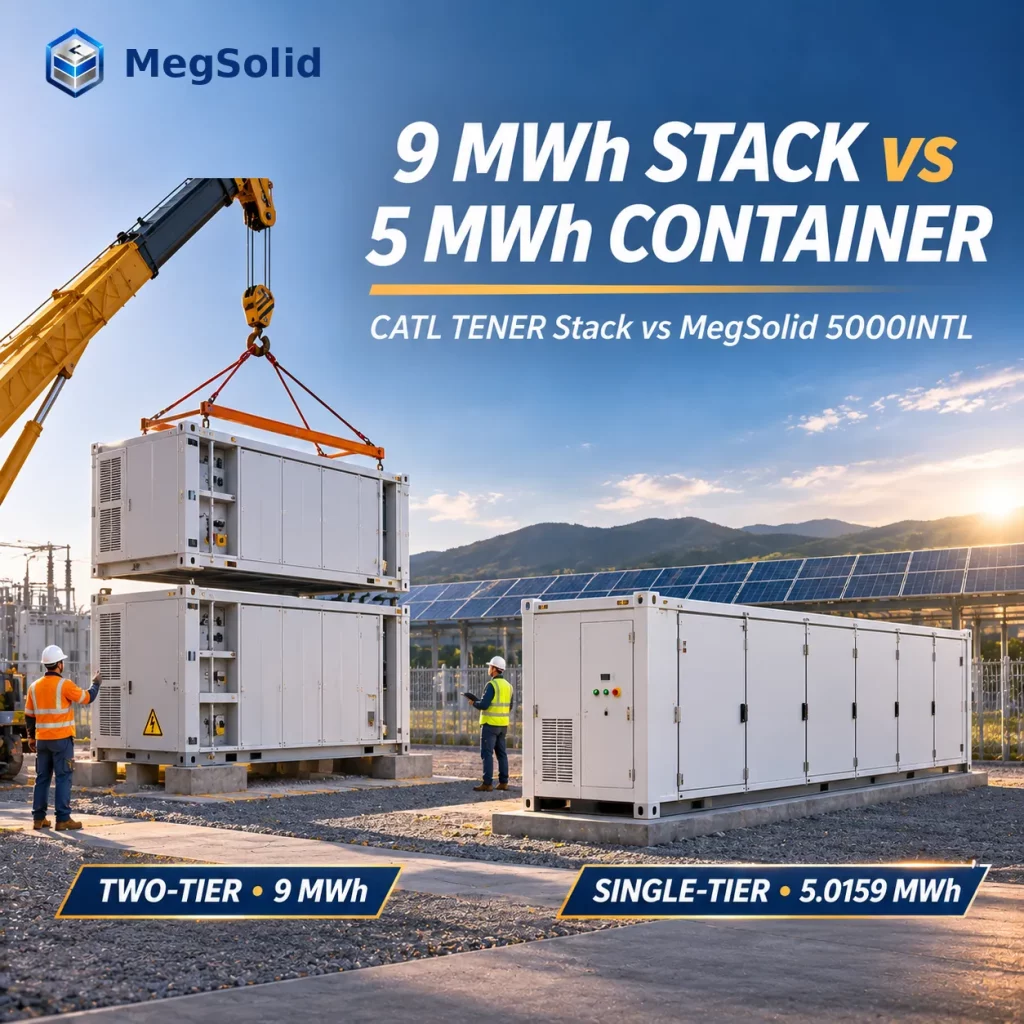
CATL unveiled the 9 MWh TENER Stack at ees Europe Munich in May 2025 around a modular "two-in-one" split design. Two half-height sections stay under 36 tonnes each for global transport compliance, stacking on site to roughly 4.7 m total height. At All-Energy Melbourne in October 2026, CATL launched its 9 MWh TENER+ platform with top-exhaust cooling and a 25-year design target. Both models target high-density grid plants as DC battery systems paired with external PCS skids.
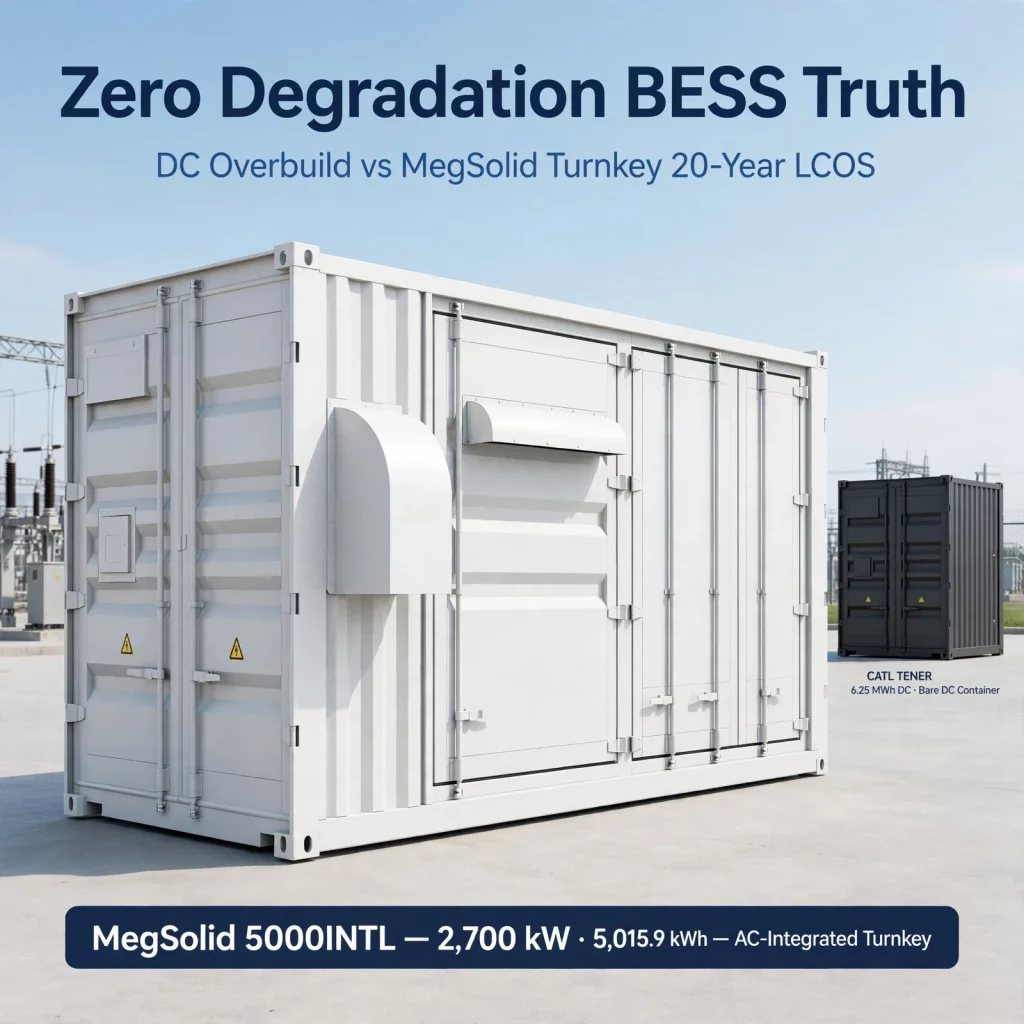
For 5 MWh utility benchmarks, see Tesla Megapack Competitors: Compare 5MWh Utility-Scale BESS alongside our voltage-class study in 690V BESS vs 400V for 5MWh Projects (MegSolid 5000INTL). Below, we compare 9MWh vs 5MWh containerized BESS trade-offs across single-tier 20-foot MegSolid 5000INTL (2,700 kW / 5,015.9 kWh) units and modular C&I containers for 2 MWh to 50 MWh deployments.

9MWh vs 5MWh Containerized BESS: CATL TENER Stack / TENER+ vs. MegSolid 5000INTL & ESSC1000B-2150
Buyer Takeaway: High-density 9 MWh DC systems target land-constrained gigawatt yards, while single-tier 5000INTL (5,015.9 kWh, 690 Vac) and ESSC1000B-2150 units simplify rigging, O&M access, and AC commissioning on 2–50 MWh sites.
1. Comparing Disclosed CATL 9 MWh Designs Alongside Ground-Level MegSolid Specs
Fair technical procurement starts by crediting where 9 MWh utility designs excel. In CATL's public releases, TENER Stack raises volume utilization by roughly 45% and energy density by 50% over earlier 20-foot generations. Its design pairs triple-layer insulation targeting 2-hour fire resistance with IEEE 693 seismic targets, caps noise at 65 dB(A) at 1 m, and supports external centralized or string PCS architectures.
For high-ambient Australian plants, CATL's TENER+ uses top-exhaust heat rejection to curb horizontal heat buildup around adjacent PCS skids while keeping noise below 65 dB(A) at 1 m. TENER+ also offers selectable cell options (including high-ambient or 3-year zero-degradation configurations) aimed at a 25-year design life. Those high-density features pay off most on multi-hundred-MWh projects where heavy cranes and large civil teams are already mobilized. On 10 MWh to 50 MWh commercial PV-plus-storage, industrial substation, and mining microgrid tenders, EPCs must audit stacked assembly complexity, external PCS BoP, and block granularity carefully.
2. Engineering & Site-Deployment Comparison Matrix
| Utility & Heavy C&I Metric | CATL TENER Stack (9 MWh) & TENER+ | MegSolid 5000INTL (2,700 kW / 5,015.9 kWh) | MegSolid ESSC1000B-2150 (1,000 kW / 2.1504 MWh) |
|---|---|---|---|
| Enclosure Architecture & Height | TENER Stack: 2 half-height units stacked (~4.7 m); TENER+: 9 MWh high-density enclosure (verify structure independently) | Single-tier 20-ft container (6,058 x 2,438 x 2,896 mm, IP55) | Single-tier 40-ft container (12,192 x 2,438 x 2,896 mm, IP54) |
| Nameplate Energy & Truckloads | 9.0 MWh (TENER Stack: 2 x <36 t half-units = 2 trucks; TENER+: confirm shipping unit) | 5,015.9 kWh (2 units = 10.0318 MWh, +11.46% vs 9 MWh assuming 1 truck/unit) | 2.1504 MWh per 38,000 kg unit (4 units = 8.6016 MWh) |
| AC/DC PCS Integration | DC battery block; TENER Stack supports external central/string PCS; TENER+ pairs with external PCS | Factory AC-integrated: 450 x 6 kW (2,700 kW) at 690 Vac, 87.5% pub. max eff. | Factory AC-integrated: 1,000 kW AC with 1,200 / 1,320 / 1,440 kW max PV |
| Rigging, Foundation & WHS Access | TENER Stack: elevated upper-tier alignment, wind/seismic lever arm & EWP; TENER+: confirm site layout | Single ground-level pick per unit; eye-height front service doors | Single ground-level pick; 38,000 kg in a 40-foot enclosure; confirm lifting points, foundation support reactions and trailer axle loads |
| Cooling, Acoustics & Lifecycle | TENER Stack: overhead TMS (65 dB(A) @ 1 m); TENER+: top exhaust (<65 dB(A), 25-yr target) | Smart Liquid Cooling, AI warning; 12P416S + 6 x 450 kW stages | Intelligent air cooling, 3.2 V / 280 Ah LFP (≥5,000 cycles) |
Five Field Engineering Trade-Offs of Two-Tier Stacked 9MWh Blocks on 10–50MWh Sites
Buyer Takeaway: Before selecting two-tier stacked BESS vs 20ft 5MWh ISO container layouts, audit transport scenarios, upper-tier rigging, AS/NZS 1170.2 wind foundations, WHS fall rules, and PCS fault topology.
1. Freight Dispatch Scenario: Split 9 MWh Units vs. Two Single-Tier 5 MWh Containers
CATL splits the 9 MWh TENER Stack into two half-height modules under 36 tonnes each so individual shipments satisfy standard road and maritime weight caps across 99% of global markets. That split avoids ultra-heavy single-load permits, yet shipping one 9 MWh unit still requires two truck dispatches (roughly 4.5 MWh per trailer).
In a transport scenario where each MegSolid 5000INTL container qualifies for single-truck haulage under route weight rules, two units also use two trucks. Those two units carry 10.0318 MWh of aggregate nominal storage (+1.0318 MWh, or +11.46% higher nominal capacity than one 9 MWh unit) plus 5.4 MW (2 x 2,700 kW) of integrated 690 Vac conversion stages. MegSolid confirms certified shipping weight, CSC structural ratings, and trailer loading plans per order on the project General Arrangement (GA) drawing; verify bridge and axle permits alongside road quotes for split DC modules.
2. Upper-Tier Hoisting, Elevated Alignment & Field Inter-Tier Coupling
For an approximately 9 to 10 MWh deployment, placing two split TENER Stack half-units and placing two single-tier 5000INTL containers both require two main container lifts. The operational difference lies in lift complexity. Single-tier 5000INTL units set straight onto ground-level corner footings, while TENER Stack hoists a sub-36-tonne upper module into elevated alignment onto the lower frame.
Required crane capacity depends on lift radius, rigging mass, boom geometry, and wind-speed limits for both architectures. Elevated upper-tier alignment narrows crane wind-hold margins, extends rigging time per stack, and adds field verification of vertical mechanical locks plus any inter-tier electrical, coolant, or communication couplings specified in the installation manual.
3. Concentrated Bearing Loads & Wind/Seismic Overturning Moments (AS/NZS 1170.2)

Stacking two energy modules onto one ground footprint concentrates total vertical mass onto one pad. It also raises total height to approximately 4.7 m (roughly 62% taller than a 2,896 mm standard 20-foot high-cube enclosure). Structural overturning moment scales with height (M = F x h), raising anchor tension and edge bearing demand under lateral wind or seismic acceleration.
CATL designs TENER Stack to IEEE 693 seismic design targets and severe wind loads. Site civil engineers still size concrete foundations and soil anchorage for local geotechnical capacity and building codes such as Australia's AS/NZS 1170.2 (wind actions) and AS 1170.4 (earthquake actions). Deep piers or thicker reinforced mat slabs can offset part of the land-area reduction on coastal cyclonic or soft-soil sites.
4. Elevated WHS / OHS Maintenance & Vertical Fire-Clearance Review
Under Australia's Model WHS Regulations and Safe Work Australia falls guidance, duty holders must manage fall risks at any height where a fall could reasonably cause injury. Construction work with a fall risk exceeding 2 meters triggers high-risk construction work rules requiring Safe Work Method Statements (SWMS), forming a statutory construction tier alongside general fall-prevention duties. Servicing upper-tier battery compartments, cooling hardware, or sensors on a ~4.7 m stacked TENER Stack enclosure expands Elevated Work Platform (EWP), scaffold, harness, and spotter workflows across a 15-to-20-year asset life.
Single-tier 2,896 mm enclosures keep main battery bay doors and electrical panels at ground level for routine checks (roof-level fan or duct inspection on any container still requires appropriate site WHS fall controls). Fire authorities reviewing NFPA 855 or regional Australian brigade guidelines also examine vertical thermal transfer and hose-stream access across stacked battery enclosures even where 2-hour inter-tier insulation is installed.
5. Nominal Fault Ratios vs. Real Protection & PCS Topology on 10–50 MWh Sites

On an 800 MWh grid battery, isolating one 9 MWh block removes ~1.1% of nominal stored energy. In an 18 MWh plant consisting of two 9 MWh battery blocks, losing one complete block would remove 50% of nominal stored energy, assuming the fault requires that entire block to be isolated. Where a 20 MWh nominal plant includes 2 MWh of extra storage beyond two 9 MWh blocks, one 9 MWh block represents 45% of plant capacity; real lost output still depends on PCS grouping and isolation topology.
Four MegSolid 5000INTL enclosures total 20.0636 MWh of aggregate nominal storage (10.8 MW aggregate nominal AC rating). Each enclosure represents 25.0% of aggregate nominal energy, and 24 modular 450 kW power stages represent 4.17% of aggregate nameplate power per stage. Treat these figures strictly as nameplate ratios; real post-fault continuity and net POI output depend on internal DC/AC disconnects, PCS grouping, protection selectivity, auxiliary routing, and EMS logic confirmed in the approved single-line diagram (SLD).
Compare 20ft AC-Integrated 5MWh Layouts Against Stacked 9MWh Bids Request official GA drawings, certified shipping weights, SLDs, and pricing for MegSolid 5000INTL, ESSC1000B-2150, ESSC0500B-1075, and Energon 261.
Sizing a CATL TENER Stack 9MWh Alternative Across 2 MWh to 50 MWh Sites
Buyer Takeaway: Match your project bus voltage and capacity tier directly to 5000INTL (690 Vac utility), ESSC1000B-2150 / ESSC0500B-1075 (500 kW–1 MW C&I), or Energon 261 without forcing stacked civil redesigns.
1. 690 Vac Factory AC Integration on MegSolid 5000INTL (2,700 kW / 5,015.9 kWh)
CATL TENER Stack and TENER+ deploy as DC battery blocks paired with external centralized or string PCS skids. MegSolid 5000INTL integrates 2,700 kW (450 x 6 kW) of 690 Vac (50/60 Hz) conversion directly inside one 20-foot IP55 Smart Liquid Cooling enclosure (6,058 x 2,438 x 2,896 mm, up to 4,000 m altitude). Its 12P416S battery bank (SHS180-314, 1,331.2 Vdc rated voltage) carries 5,015.9 kWh of rated energy at 87.5% published maximum efficiency, monitored by AI intelligent early warning.
Connecting directly at 690 Vac lowers AC feeder current compared with 400 Vac architectures, simplifying transformer cabling and reducing multi-vendor BMS-to-PCS commissioning handoffs. Aggregate nameplate ratings scale to 5.4 MW / 10.0318 MWh across two units, 10.8 MW / 20.0636 MWh across four units, and 27.0 MW / 50.159 MWh across ten units. Confirm net POI delivery curves, site-specific cycle life, ambient derating, and grid-code compliance (such as Australian AEMO/NEM or European ENTSO-E studies) directly inside the project dossier.
2. Stepping Down Cleanly to 500 kW–2 MWh Containers & Modular Cabinets
Where a 9 MWh block or a 5 MWh 690 Vac container exceeds factory transformer headroom, MegSolid supplies verified ground-level hardware across our full MegSolid C&I Energy Storage Systems (215kWh–2MWh) catalog:
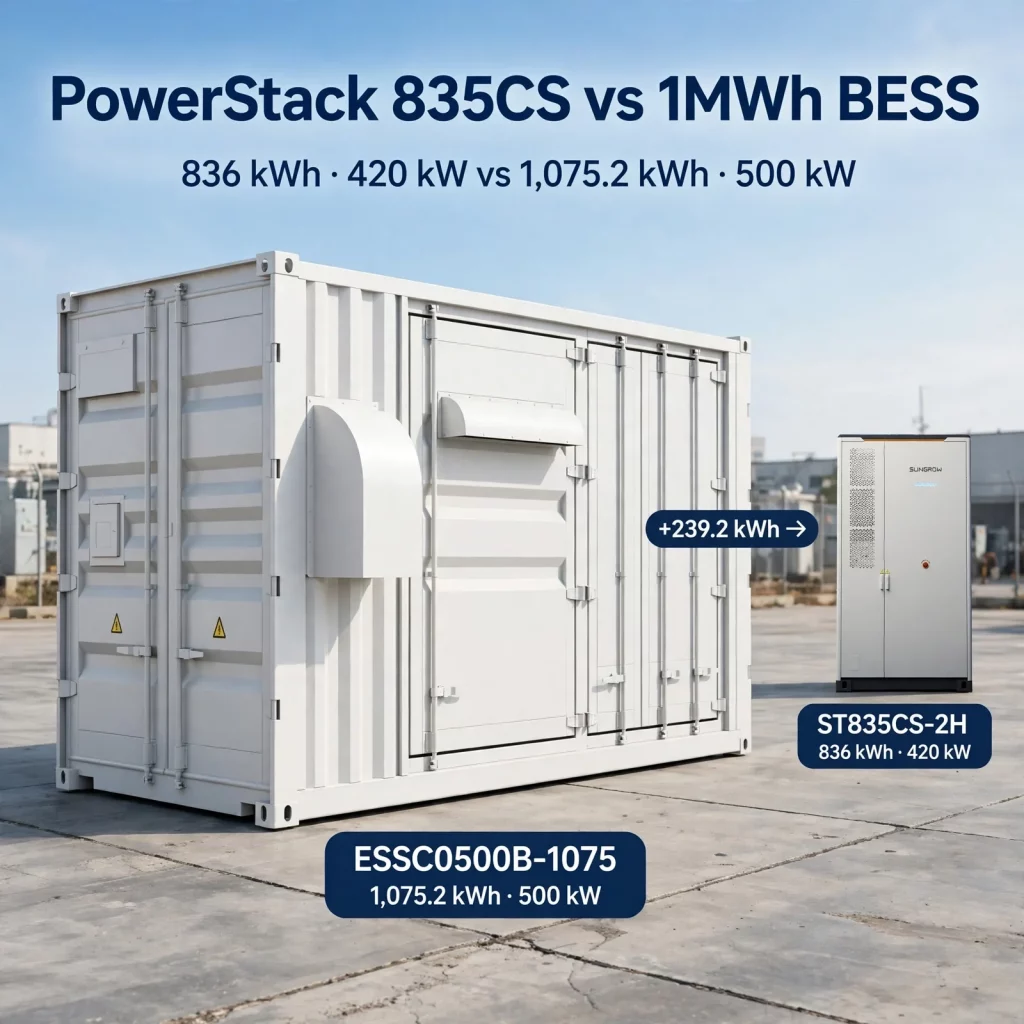
- 500 kW to 8.6 MWh Industrial Containers: MegSolid ESSC0500B-1075 and ESSC1000B-2150 use 3.2 V / 280 Ah LFP cells (≥5,000 cycles) with IP54 intelligent air cooling. ESSC0500B-1075 provides 500 kW / 1.0752 MWh in a 21,000 kg 20-foot enclosure (6,058 x 2,438 x 2,896 mm; 600, 660, or 720 kW max PV; 4 units = 2 MW / 4.3008 MWh). ESSC1000B-2150 delivers 1,000 kW / 2.1504 MWh in a 38,000 kg 40-foot enclosure (12,192 x 2,438 x 2,896 mm; 1,200, 1,320, or 1,440 kW max PV; confirm lifting points, foundation support reactions, and trailer axle loads). Reaching 4 MW / 8.6016 MWh requires four ESSC1000B-2150 containers.
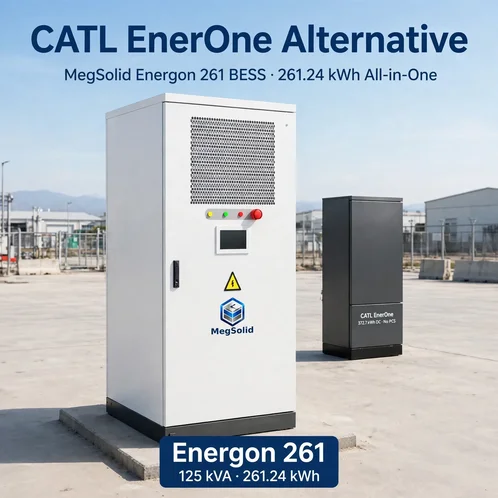
- Modular Liquid-Cooled C&I Blocks: MegSolid Energon 261 (125 kVA / 261.24 kWh) has a 1.755 m2 equipment base footprint (1,300 x 1,350 x 2,200 mm +/-5 mm; 148.85 kWh/m2); required installation pads and service clearances depend on the approved site layout. Its 1P260S 314Ah LFP string runs at 832 Vdc nominal (676–936 Vdc, 480/400 V +/-15%, 90% max efficiency) with Intelligent Liquid Cooling, AI early warning, and Novec + multi-sensor + water fire suppression. Parallel scaling reaches 10 Energon 261 cabinets (1,250 kVA / 2,612.4 kWh).
- Isolated Feeder & Standalone PCS Hardware: Small commercial feeders deploy MegSolid ESSA0100B-0215 (100 kW / 215.04 kWh) on 768 V (1P240S, 672–850 Vdc, 400 Vac 3W+N+PE, THDi <3%, built-in isolation transformer, 3,900 kg, ≥5,000 cycles, 1,000 V max PV). Custom AC-coupled sites needing galvanic isolation pair with standalone MegSolid MEGA0030TS–MEGA0500TS Isolation PCS hardware (30–500 kW / 33–550 kVA, 96.3%–97.5% max efficiency, built-in isolation transformer, forced-air cooling).
Project Capacity Selector: 1 MWh to 100+ MWh Architecture Guide
Buyer Takeaway: Match single-tier containers (ESSC and 5000INTL) to 1–50 MWh sites, reserving two-tier 9 MWh stacked blocks for land-constrained 100+ MWh utility evaluations.
| Project Capacity Band | Recommended Architecture | Key Engineering & Site-Execution Rationale |
|---|---|---|
| 0.21–2.61 MWh Commercial Feeders | 1–10 x Energon 261 (max 10 parallel) or ESSA0100B-0215 | Energon 261: 1.755 m2 base footprint (pad/clearances per site layout); ESSA: 100 kW / 215.04 kWh |
| 1–8.6 MWh Factory & Mining Microgrids | 1–4 x ESSC0500B-1075 (to 4.3008 MWh) or ESSC1000B-2150 (to 8.6016 MWh) | Reaching ~8.6 MWh requires 4 x ESSC1000B-2150 (38,000 kg / 40-ft box); 4 x ESSC0500B-1075 totals 4.3008 MWh |
| 10–20 MWh Commercial PV+BESS | 2–4 x MegSolid 5000INTL (10.0318–20.0636 MWh nominal) | Single-tier 20-ft 690 Vac blocks; ground-level doors; fault isolation verified per SLD |
| 20–50 MWh Sub-Transmission / Utility | 4–10 x MegSolid 5000INTL (20.0636–50.159 MWh nominal) | Integrated 450 x 6 kW conversion simplifies external PCS yard scope; confirm net POI delivery |
| 100+ MWh Land-Locked Utility Sites | Benchmark 20+ x 5000INTL vs. 9 MWh Stacks | High land cost can favor 9 MWh pad density; compare full civil, crane, WHS & AC BoP totals |
Engineering Questions: CATL TENER Stack 9MWh vs MegSolid 5000INTL
FAQ
How does CATL TENER Stack achieve 9 MWh while staying within road transport limits?
CATL TENER Stack uses a modular "two-in-one" split architecture consisting of two half-height units stacked vertically on site to an approximate height of 4.7 m. Keeping each individual half-unit under 36 tonnes enables compliance with road and maritime weight rules across 99% of global markets. Delivering one 9 MWh unit still requires two truck dispatches and on-site vertical stacking.
What distinguishes CATL TENER+ in Australia from CATL TENER Stack?
CATL unveiled the 9 MWh TENER Stack at ees Europe Munich in May 2025 around its split two-in-one stack design. At All-Energy Melbourne in October 2026, CATL launched the 9 MWh TENER+ utility platform for Australia and global long-duration storage. TENER+ targets a 25-year design life, uses top-exhaust heat rejection to protect adjacent PCS skids, keeps noise below 65 dBA at 1 m, and offers selectable high-ambient or 3-year zero-degradation cell configurations.
How does crane mobilization differ between two-tier stacked blocks and single-tier 20-foot containers?
For roughly 9 to 10 MWh, hoisting two split TENER Stack half-units and setting two single-tier 5000INTL containers both require two main container lifts. Two-in-one stacked blocks elevate the sub-36-tonne upper module into alignment atop the lower frame, tightening wind-speed lift margins and adding vertical lock plus inter-tier coupling checks. Single-tier containers lift once straight onto ground-level footings.
Why do stacked 9 MWh enclosures require careful wind and seismic foundation design?
Raising container height to approximately 4.7 m (~62% taller than a 2,896 mm standard 20-foot high-cube box) concentrates weight onto one footprint and lengthens wind and seismic overturning lever arms (M = F x h). Even where the enclosure meets IEEE 693 seismic design targets, civil engineers must size concrete pads and anchors for local wind codes such as Australia's AS/NZS 1170.2 and site soil bearing capacity.
How do Australian WHS working-at-heights rules affect two-tier BESS maintenance?
Under Australian Model WHS Regulations and Safe Work Australia falls guidance, duty holders must manage fall risks at any height where a fall could reasonably cause injury. Falls exceeding 2 meters classify specifically as high-risk construction work requiring Safe Work Method Statements (SWMS), forming a statutory construction tier alongside general fall-prevention duties. Single-tier 2,896 mm enclosures keep main bay doors at ground level, reducing routine Elevated Work Platform (EWP) mobilizations compared with ~4.7 m stacked upper units.
Does CATL TENER Stack include built-in AC inverters, or does it require external PCS?
CATL TENER Stack is a DC battery energy storage block engineered to pair flexibly with external centralized or string PCS architectures. MegSolid 5000INTL integrates six modular 450 kW AC power stages (2,700 kW total at 690 Vac, 50/60 Hz) directly inside its 20-foot IP55 enclosure, consolidating battery, cooling, and conversion under one supplier contract.
What MegSolid models fit 1 MWh to 8 MWh industrial and mining microgrids?
For sites below 10 MWh, MegSolid builds IP54 intelligent air-cooled containers using 3.2 V / 280 Ah LFP cells (≥5,000 cycles). ESSC0500B-1075 delivers 500 kW / 1.0752 MWh in a 21,000 kg 20-foot unit (6,058 x 2,438 x 2,896 mm, 600–720 kW max PV; 4 units = 2 MW / 4.3008 MWh). ESSC1000B-2150 scales to 1,000 kW / 2.1504 MWh in a 38,000 kg 40-foot enclosure (12,192 x 2,438 x 2,896 mm, 1,200–1,440 kW max PV), requiring four units to reach 4 MW / 8.6016 MWh.
When is MegSolid Energon 261 or ESSA0100B-0215 better suited than a 5 MWh container?
Factories and commercial campuses sizing 200 kWh to 2.6 MWh beside 400 V or 480 V switchgear often deploy Energon 261 or ESSA0100B-0215. Energon 261 delivers 125 kVA / 261.24 kWh (1P260S 314Ah LFP, 832 Vdc nominal / 676–936 Vdc, Intelligent Liquid Cooling) with parallel scaling up to 10 units (1,250 kVA / 2,612.4 kWh) on a 1.755 m2 equipment base footprint (confirm pad and service clearances per site layout). ESSA0100B-0215 provides 100 kW / 215.04 kWh (768 V 1P240S, built-in isolation transformer, 3,900 kg, ≥5,000 cycles).
Does MegSolid supply standalone isolation-transformer PCS for custom utility or microgrid builds?
Yes. For custom AC-coupled projects requiring galvanic isolation and on/off-grid switching, MegSolid builds the standalone MEGA0030TS–MEGA0500TS PCS series (30 to 500 kW / 33 to 550 kVA, 96.3%–97.5% maximum efficiency, forced-air cooling, 3W+N+PE off-grid). Confirm parallel configuration limits and site grid-code certificates directly per project configuration.
What five documents should EPCs request when comparing 9 MWh stacked blocks against 20-foot 5 MWh AC units?
Request five engineering deliverables before tender award: certified net and gross shipping weights with CSC plate ratings, plus wind and seismic foundation calculations (such as AS/NZS 1170.2 / IEEE 693). Add a site crane-radius lift plan, a complete AC-installed single-line diagram (SLD) showing PCS and protection selectivity, and an O&M schedule detailing EWP height access.
Conclusion: Match Enclosure Geometry to Real Site Scale, Civil Scope & O&M Access
Choosing a CATL TENER Stack 9MWh alternative or evaluating CATL TENER+ Australia BESS proposals comes down to matching hardware geometry to real project scale. On land-constrained 100+ MWh utility plants, 9 MWh high-density DC blocks can cut pad counts once heavy cranes, deep foundations, and external PCS skids amortize across dozens of units. On 2 MWh to 50 MWh industrial, mining, and sub-transmission sites, single-tier AC-integrated containers avoid vertical field stacking, keep routine service access at ground level, and narrow per-container nominal fault share (subject to verified SLD isolation and protection selectivity).
MegSolid backs 10–50 MWh utility tenders under one contract using 5000INTL (2,700 kW / 5,015.9 kWh at 690 Vac). Industrial yards sizing 1–8.6 MWh deploy ESSC0500B-1075 (500 kW / 1.0752 MWh; 4 units = 4.3008 MWh) or ESSC1000B-2150 (1,000 kW / 2.1504 MWh; 4 units = 8.6016 MWh), while modular feeders pair with Energon 261 (125 kVA / 261.24 kWh; parallel up to 10 cabinets). Request GA drawings, certified shipping specs, and SLDs from MegSolid engineers before locking in civil designs.
Request MegSolid 5000INTL & ESSC GA Drawings, SLDs & Project Quotes Connect with MegSolid's utility and Australian project engineering team for 20-foot container specs, certified shipping data, and factory-direct pricing on 5000INTL, ESSC1000B-2150, and Energon 261.