Skip to content

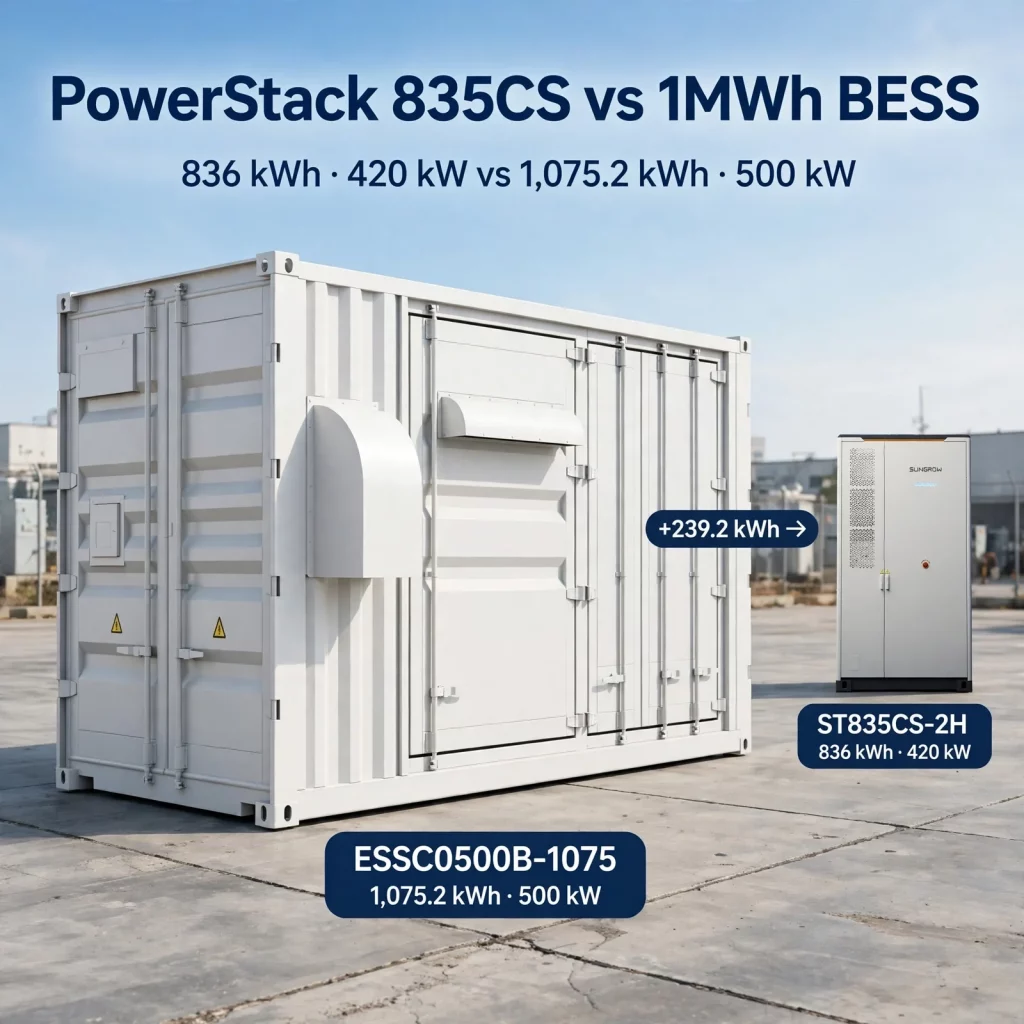
Sungrow lists the PowerStack 835CS as ST835CS-2H, rated at 836 kWh and 420 kW at 690 Vac. MegSolid’s ESSC0500B-1075 lists 1,075.2 kWh and 500 kW at 400 Vac. For a 500 kW factory application, check the usable AC energy and switchboard requirements before specifying either unit. Sungrow ST835CS-2H specifications
- Compare rated kW and kWh at the project voltage.
- Check delivered AC energy against the PCC target.
- Evaluate modular cabinets and installation scope.

Closing that gap takes clear math across usable Depth of Discharge (DoD), AC voltage, and conversion efficiency. Assuming 90% usable DoD and 95% one-way efficiency prior to auxiliary cooling loads, ST835CS-2H yields 714.78 kWh AC at up to 420 kW. By comparison, MegSolid's 1,075.2 kWh ESSC0500B-1075 yields 919.30 kWh of pre-auxiliary AC discharge energy at up to 500 kW.
Use these guides to check the electrical tie-in and civil scope. 500 kW / 1.0752 MWh Containerized BESS Grid Boundaries · 1MWh BESS Concrete Foundation Design Requirements
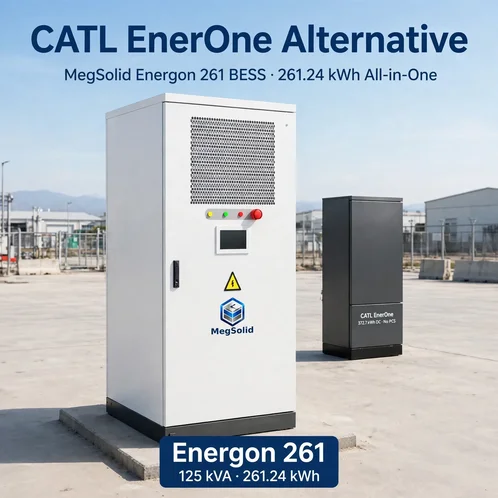
Compare the single-container and all-in-one cabinet specifications. MegSolid ESSC0500B-1075 (500 kW / 1.0752 MWh) Containerized Energy Storage System · MegSolid Energon 261 (125 kVA / 261.24 kWh) Liquid-Cooled C&I Cabinets
Compare Container and Cabinet Options
MegSolid ESSC0500B-1075 delivers 1,075.2 kWh DC (+239.2 kWh over ST835CS-2H) and 500 kW at 400 Vac with 600–720 kW PV input, while 2x–3x Energon 261 cabinets eliminate split-bay field DC wiring.
Voltage and PCS Integration
Evaluating queries for sungrow powerstack 800cs (powerstack 800cs st836kwh) and 500CS/510CS models starts with verified model codes and AC tie-in architecture:
- Sungrow PowerStack 835CS (ST835CS-2H, 836 kWh Benchmark): Published under the PowerStack 835CS title with model code ST835CS-2H, this comparison uses that manufacturer model designation for the 836 kWh system. Its IP55 liquid-cooled cabinet (1,545 x 2,900 x 2,438 mm, ≤10,500 kg) houses 416S1P x 2 clusters of 3.2 V / 314 Ah LFP cells (1,123.2–1,497.6 Vdc) totaling 836 kWh nominal. Two 210 kW stages deliver 420 kW AC at 690 Vac (published maximum efficiency: 90.5%; confirm the measurement boundary before applying it as AC-to-AC RTE). Connecting 690 Vac to a 400 Vac plant bus requires a voltage-matching transformer. A 10 kV or 20 kV skid is a separate MV interconnection route.
- Sungrow ST535kWh-250kW-2h (2023 V17 Datasheet) vs. ST510CS-4H: The two Sungrow units in the 500 kWh class use different layouts. Under Sungrow's 2023 V17 grid-connected datasheet, the 2-hour ST535kWh-250kW-2h pairs a 537 kWh initial DC battery cabinet (2,180 x 2,450 x 1,730 mm, 5,900 kg) with a separate PCS cabinet (1,800 x 2,450 x 1,230 mm, 1,600 kg, IP54). That 400 Vac PCS cabinet rates at 250 kVA @ 45C and requires inter-cabinet DC cabling on site. Separately, the 4-hour all-in-one ST510CS-4H packs 514 kWh and a 125 kW PCS (691.2–934.4 Vdc) at 400 Vac inside a single IP55 cabinet (2,152 x 2,470 x 1,610 mm, ≤5,300 kg).
- MegSolid ESSC0500B-1075 Turnkey 20-Foot Container: Purpose-built for 500 kW commercial feeders, ESSC0500B-1075 packs 1.0752 MWh (1,075.2 kWh) of 3.2 V / 280 Ah LFP cells (≥5,000 cycles) inside one IP54 container (6,058 x 2,438 x 2,896 mm, 21,000 kg). Its integrated PCS outputs 500 kW AC directly at 400 Vac (320–460 V range, 3W+N+PE). Intelligent temperature-controlled air cooling supports coupled PV options of 600 kW, 660 kW, or 720 kW max solar input.
- MegSolid Energon 261 All-in-One Liquid-Cooled Cabinets: Each IP54 Energon 261 unit (1,300 x 1,350 x 2,200 mm) stores 261.24 kWh using 314Ah LFP cells in a 1P260S string (676–936 Vdc, 832 Vdc nominal). Built-in conversion delivers 125 kVA AC (480 V / 400 V +/-15%, 50/60 Hz, 90% max system efficiency). Parallel scaling supports up to 10 cabinets, uniting Intelligent Liquid Cooling, AI thermal monitoring and early warning, and Novec, multi-sensor detector, and water-based fire suppression.
Model Ratings at a Glance
| Model | Nominal DC | Rated AC | AC voltage |
|---|---|---|---|
| ST835CS-2H | 836 kWh | 420 kW | 690 Vac |
| ST535kWh-250kW-2h | 537 kWh | 250 kVA at 45°C | 400 Vac |
| ST510CS-4H | 514 kWh | 125 kW | 400 Vac |
| ESSC0500B-1075 | 1,075.2 kWh | 500 kW | 400 Vac |
Under the same 90% DoD and 95% one-way efficiency assumptions, the 537 kWh ST535 and 514 kWh ST510 model at 459.14 and 439.47 kWh AC, respectively, before auxiliaries. Sungrow lists the ST510CS-4H on its UK site as PowerStack 255CS. Sungrow ST510CS-4H product page
The 239.2 kWh Gap on a 500 kW Site
Under 90% DoD and 95% efficiency assumptions before aux loads, ESSC0500B-1075 unlocks 204.52 kWh more discharge energy than ST835CS-2H (919.30 vs. 714.78 kWh) and is rated at 500 kW AC versus 420 kW for the ST835CS-2H.
Check Transformer Headroom
In an 800kwh vs 1mwh commercial battery storage study, factories typically tie in behind 630 kVA, 800 kVA, or 1,000 kVA (400 Vac) distribution transformers. Checking kVA demand and terminal voltage early prevents mid-bid redesigns:
- Active kW vs. Transformer Apparent Power (kVA): Operating a BESS at 500 kW active power draws 500.0 kVA at unity power factor (PF = 1.00), rising to 526.3 kVA at PF = 0.95 and 555.6 kVA at PF = 0.90. Continuous export limits behind 630 kVA or 800 kVA transformers depend on coincident plant demand, thermal headroom, and utility rules.
- 420 kW / 690 Vac Rating vs. 500 kW Commercial Load: Rated at 420 kW AC (210 kW x 2) at 690 Vac, a single ST835CS-2H unit (powerstack 800cs st836kwh benchmark) runs 80 kW short of a continuous 500 kW plant load from minute one. Integrating its 690 Vac terminals with a 400 Vac switchboard also adds an external 690 V / 400 V transformer. MegSolid's ESSC0500B-1075 delivers 500 kW directly at 400 Vac (320–460 V range, 3W+N+PE), while larger multi-MW plants scale up to the 1,000 kW / 2.1504 MWh ESSC1000B-2150 (12,192 x 2,438 x 2,896 mm, 38,000 kg, with 1,200 / 1,320 / 1,440 kW max PV inputs).
Estimate AC Energy Before Auxiliaries
Nameplate DC storage differs from net AC output delivered at the Point of Common Coupling (PCC). Applying an illustrative 90% usable DoD and 95% one-way efficiency model before auxiliary loads compares both units at rated power. External transformer and feeder losses outside this efficiency assumption require separate deduction when verifying net PCC delivery:
- 836 kWh System at 420 kW Output (ST835CS-2H): Multiplying 836 kWh by 90% DoD yields 752.40 kWh DC; applying 95% one-way efficiency leaves 714.78 kWh of pre-auxiliary AC discharge energy. At its 420 kW rating, ST835CS-2H discharges 714.78 kWh over approx. 1.702 hours (~1 hour 42 minutes) before auxiliary loads. Dividing 714.78 kWh by 500 kW (1.430 hours) gives an energy-equivalent reference ratio for a unit capped at 420 kW.
- 1,075.2 kWh Container at 500 kW Output (MegSolid ESSC0500B-1075): Adding 239.2 kWh (+28.61%) nominal DC storage raises 90% DoD energy to 967.68 kWh DC. At 95% assumed one-way efficiency before chiller loads, pre-auxiliary discharge energy reaches 919.30 kWh AC (+204.52 kWh over ST835CS-2H, equal to 24.5 minutes at a 500 kW reference rate). Discharging at full 500 kW AC yields approx. 1.839 hours (~1 hour 50 minutes) before auxiliary deductions.
- Lower-Power Targets vs. Strict 500 kW x 2-Hour (1,000 kWh Net AC) Tenders: Dispatching ESSC0500B-1075 at 459.65 kW for 2.0 hours outputs 919.30 kWh before auxiliary loads, fitting ~450 kW peak-shaving budgets. Delivering a full 1,000 kWh pre-auxiliary AC under the same 90% DoD and 95% efficiency assumptions requires at least 1,169.59 kWh nominal DC capacity (1,000 ÷ 0.855), or limiting total deductions on 1,075.2 kWh to 6.99%. For strict 500 kW x 2-hour net PCC tenders, EPCs expand DC storage via a validated AC-coupled multi-unit system or deploy the 2.1504 MWh ESSC1000B-2150 capped at 500 kW POI export.
Modeled AC energy = nominal DC energy × 0.90 × 0.95. Deduct uncovered auxiliary, transformer and feeder losses to assess contractual PCC delivery.

Need verified net AC discharge schedules, PV-coupling single-line diagrams, and factory-direct pricing for 500 kW to 2 MWh C&I projects? Connect with MegSolid commercial engineers.
Scale with Energon 261
For 500–800 kWh projects, 2x or 3x Energon 261 cabinets serve as a fast sungrow powerstack 500cs alternative, scaling 522.48–783.72 kWh (250–375 kVA at 400/480 Vac) with zero split-bay DC field wiring.
Compare Field Wiring
Commercial EPCs seeking a sungrow powerstack 500cs alternative weigh installation labor, kVA power factor ratings, and substation breaker coordination:
- Split-Bay ST535kWh-250kW-2h (V17) vs. All-in-One ST510CS-4H: Per Sungrow's 2023 V17 datasheet, the 2-hour ST535kWh-250kW-2h separates its 537 kWh battery cabinet (5,900 kg) from a 250 kVA @ 45C PCS cabinet (1,600 kg, IP54), requiring field DC power cabling between enclosures. Separately, Sungrow's 4-hour ST510CS-4H integrates PCS and battery inside one IP55 cabinet (≤5,300 kg) capped at 125 kW across 514 kWh.
- 2x Energon 261 (250 kVA / 522.48 kWh) & Power Factor Check: Pairing two Energon 261 cabinets provides 522.48 kWh DC and 250 kVA AC at 480 V / 400 V +/-15%, 50/60 Hz. That rating outputs 250 kW active power at unity PF or 225 kW at PF = 0.90. Every 1,300 x 1,350 x 2,200 mm IP54 cabinet ships factory-wired with its own 1P260S (832 Vdc nominal) 314Ah LFP cluster, 125 kVA AC stage, and cooling loop, limiting field wiring to AC combiner terminations.
- 3x (375 kVA / 783.72 kWh) & 4x (500 kVA / 1,044.96 kWh) Scaling: Deploying three units supplies 783.72 kWh and 375 kVA (337.5 kW at PF = 0.90). Scaling to four units reaches 1,044.96 kWh and 500 kVA (450 kW at PF = 0.90), with published parallel support up to 10 cabinets. With engineered AC feeder breakers, selective protection, auxiliary power routing, and master-slave EMS logic, healthy cabinets remain operational within their kVA ratings during single-unit maintenance isolation.
Two to Four Cabinet Options
| Setup | Nominal DC | Modeled AC¹ | Rated AC |
|---|---|---|---|
| 2 × Energon 261 | 522.48 kWh | 446.72 kWh | 250 kVA |
| 3 × Energon 261 | 783.72 kWh | 670.08 kWh | 375 kVA |
| 4 × Energon 261 | 1,044.96 kWh | 893.44 kWh | 500 kVA |
| 1 × ESSC0500B-1075 | 1,075.2 kWh | 919.30 kWh | 500 kW |
¹ At 90% DoD and 95% one-way efficiency, before auxiliaries. At PF 0.90, four Energon cabinets total 450 kW on a 500 kVA basis, subject to the approved P–Q envelope.

Foundations, Fire Protection and PCS
Matching a single 21,000 kg ESSC0500B-1075 container or compact 1.755 m2 Energon 261 bays to your civil pad geometry streamlines AHJ fire approvals and custom AC/DC substation routing.
Check Footprint and Fire Evidence
Aligning civil pad layouts and fire-protection packages with local Authority Having Jurisdiction (AHJ) requirements completes your equipment comparison:
- Single 20-Foot Container Footprint (ESSC0500B-1075): Deploying ESSC0500B-1075 packs 500 kW at 400 Vac, 1,075.2 kWh LFP storage, and up to 720 kW of PV input onto one 20-foot footprint (6,058 x 2,438 x 2,896 mm, 21,000 kg). Civil engineers size concrete foundations from site geotechnical reports for one integrated enclosure, simplifying pad layout compared with separate battery and PCS cabinets.
- Modular 1.755 m2 Cabinet Footprint & Fire Suppression (Energon 261): For yards dividing storage across compact bays, each 1,300 x 1,350 x 2,200 mm Energon 261 cabinet takes a 1.755 m2 equipment footprint (with foundations specified by project civil drawings). Every IP54 enclosure integrates Intelligent Liquid Cooling, AI thermal monitoring and early warning, Novec clean-agent suppression, multi-sensor detection, and water-based fire protection.
PCS and Smaller Cabinet Options
Industrial microgrids often pair main storage blocks with dedicated power conversion or smaller feeder cabinets from one supplier stack:
- Built-In Isolation Transformer PCS (30 kW to 500 kW): Off-grid microgrids and industrial retrofits deploy the MegSolid MEGA0030TS–MEGA0500TS Power Conversion System with built-in isolation transformers, 3W+N+PE off-grid support, automatic on/off-grid switching, forced-air cooling, and 96.3%–97.5% max efficiency. DC windows scale by model: 250–850 Vdc (MEGA0030TS, 30 kW / 33 kVA), 320–850 Vdc (MEGA0050TS, 50 kW / 55 kVA), 420–850 Vdc (MEGA0100TS–MEGA0250TS, 100–250 kW / 110–275 kVA), and 500–850 Vdc (MEGA0500TS, 500 kW / 550 kVA).
- High-Efficiency Rack PCS Modules (80 kW to 125 kW): Integrators building custom bays use the MegSolid PMA080–PMA0125 Energy Storage Inverter in 80 kW, 105 kW, and 125 kW AC ratings (96, 126, and 150 kW max DC). Each 19-inch 4U/5U module (48 kg back wiring / 50 kg front wiring) hits 98.7% max efficiency with charge/discharge switching time <20 ms. Supported DC ranges cover 615–950 Vdc (3W+PE) and 650–950 Vdc (3W+N+PE) at 400 V on-grid or 230/400 V off-grid.
- 55 kWh to 215 kWh All-in-One Outdoor Cabinets: Smaller commercial feeders deploy the MegSolid ESSA0030B-0055 to ESSA0100B-0215 Outdoor Cabinet Energy Storage System (55.296 kWh at 30/50 kW, ≥3,800 cycles; 100.352 kWh at 50 kW and 215.04 kWh at 100 kW, ≥5,000 cycles). Each IP54 unit includes a built-in isolation transformer, 400 V (320–460 V) 3W+N+PE output with THDi <3%, and Aerosol/Novec1230 suppression. Maximum PV voltage reaches 1,000 V (250–850 V MPPT), pairing with 60/120 kW PV options on smaller models and 120/180/240 kW on ESSA0100B-0215.
What to Specify Before Ordering
Specifying C&I peak shaving around Sungrow PowerStack 835CS (ST835CS-2H, 836 kWh / 420 kW) or PowerStack 500CS requires checking continuous kW ratings, pre-auxiliary AC discharge energy, and 400 Vac grid compatibility. MegSolid's single-enclosure ESSC0500B-1075 delivers full 500 kW at 400 Vac (3W+N+PE), 1,075.2 kWh (+239.2 kWh over 836 kWh), and 600–720 kW PV options. For modular 500 kWh to 1 MWh builds, 2x to 4x Energon 261 cabinets scale cleanly from 522.48 kWh to 1,044.96 kWh (250–500 kVA) with zero split-cabinet DC field wiring.
Request official technical datasheets, usable kWh runtime calculations, foundation drawings, and factory-direct pricing for your 500 kWh to 2.15 MWh commercial storage tender.
FAQ
What does the 239.2 kWh gap mean at 500 kW?
Under 90% usable DoD and 95% one-way efficiency prior to auxiliary cooling loads, an 800kwh vs 1mwh commercial battery storage comparison yields 714.78 kWh AC from ST835CS-2H (836 kWh) vs. 919.30 kWh AC from ESSC0500B-1075 (1,075.2 kWh). That +204.52 kWh gain equals 24.5 minutes of energy at a 500 kW reference rate. Rated at 420 kW AC (1.702 hours at 420 kW), ST835CS-2H starts with an 80 kW active-power deficit against a continuous 500 kW plant load (714.78 ÷ 500 = 1.430 hours is strictly an energy-equivalent ratio). ESSC0500B-1075 supports full 500 kW output for approx. 1.839 hours (~1 hour 50 minutes) before auxiliary loads.
When do two or three Energon cabinets fit?
Evaluations of a sungrow powerstack 500cs alternative compare Sungrow's split-bay 2-hour ST535kWh-250kW-2h (2023 V17: 537 kWh battery cabinet at 5,900 kg plus a separate 250 kVA @ 45C PCS bay at 1,600 kg, IP54) and 4-hour ST510CS-4H (514 kWh, 125 kW at 400 Vac, ≤5,300 kg, IP55). Pairing 2x or 3x MegSolid Energon 261 all-in-one cabinets provides 522.48 kWh / 250 kVA (225 kW at PF = 0.90) or 783.72 kWh / 375 kVA (337.5 kW at PF = 0.90) at 480 V / 400 V +/-15%. Each IP54 cabinet ships factory-wired with its own 1P260S (832 Vdc) 314Ah LFP string, 125 kVA AC stage, and Intelligent Liquid Cooling loop.
What are the Energon 261 per-cabinet ratings?
Each MegSolid Energon 261 cabinet integrates 261.24 kWh of 314Ah LFP cells (1P260S, 676–936 Vdc range, 832 Vdc nominal) with a 125 kVA AC stage (480 V / 400 V +/-15%, 50/60 Hz) at 90% max system efficiency. Measuring 1,300 x 1,350 x 2,200 mm (1.755 m2 footprint, IP54) with parallel support up to 10 cabinets, it unites Intelligent Liquid Cooling, AI thermal monitoring and early warning, Novec suppression, multi-sensor detection, and water-based fire protection.
How do Energon cabinets run in parallel?
Up to 10 Energon 261 cabinets parallel directly on the 400 V / 480 V AC bus, scaling storage from 261.24 kWh (125 kVA) to 2,612.4 kWh (1,250 kVA) with zero external DC combiners. With project-engineered AC feeder protection selectivity, auxiliary power routing, isolation breakers, and master-slave EMS logic, isolating one unit allows the remaining (N-1) cabinets to serve loads within their combined kVA rating.
Will a 630 or 800 kVA transformer fit?
At 500 kW active power, BESS apparent demand equals 500.0 kVA at PF = 1.00, 526.3 kVA at PF = 0.95, and 555.6 kVA at PF = 0.90. Connecting behind existing 630 kVA or 800 kVA (400 Vac) facility transformers requires checking coincident plant loads, transformer thermal headroom, and utility export caps so dispatch stays within continuous kVA limits.
What PV inputs do the ESSC models support?
On the 500 kW / 1.0752 MWh ESSC0500B-1075 container, EPCs specify maximum PV input capacities of 600 kW, 660 kW, or 720 kW for coupled commercial arrays. Scaling up, the 1,000 kW / 2.1504 MWh ESSC1000B-2150 container supports 1,200 kW, 1,320 kW, or 1,440 kW max PV options. Both models house 3.2 V / 280 Ah LFP cells (≥5,000 cycles) with intelligent air cooling inside IP54 enclosures.
What DC ranges do MEGA-TS and PMA cover?
Across the isolation-transformer MEGA0030TS–MEGA0500TS PCS series (96.3%–97.5% max efficiency, 3W+N+PE off-grid, automatic switching), DC input scales by rating: 250–850 Vdc (30 kW), 320–850 Vdc (50 kW), 420–850 Vdc (100–250 kW), and 500–850 Vdc (500 kW). Across the rack-mounted PMA080, PMA0105, and PMA0125 inverters (80–125 kW AC, 98.7% max efficiency, charge/discharge switching time <20 ms), DC windows cover 615–950 Vdc (3W+PE) and 650–950 Vdc (3W+N+PE).
How much pad area does one Energon 261 occupy?
Its 1.30 × 1.35 m cabinet base covers 1.755 m². Use the project civil drawings to allow for service clearances, cable entry and the actual foundation.
What field wiring remains for all-in-one cabinets?
Each Energon cabinet integrates its own battery and PCS. The site still needs AC feeder terminations, a combiner or switchboard as applicable, controls and coordinated protection.
Why ask for the efficiency measurement boundary?
A published maximum efficiency may use a different measurement boundary from the project PCC. Ask which losses and auxiliaries the figure includes before applying it to guaranteed AC energy or round-trip efficiency.