 Skip to content

Choosing a high energy density battery for commercial storage, industrial robotics, or marine systems starts with two metrics: gravimetric energy density (Wh/kg) and volumetric energy density (Wh/L).
Across typical 2026 industry reference ranges, cell-level performance breaks down into three distinct tiers:
- Conventional Liquid LiFePO4 (LFP) Cells: 160–190 Wh/kg (330–420 Wh/L)
- Liquid Nickel-Rich NCM / NCA Cells: 240–300 Wh/kg (600–750 Wh/L)
- High-Voltage Hybrid Solid-State / Semi-Solid Cells (Si-C Anode Demonstrations): 280–360 Wh/kg (650–800 Wh/L)
Those are bare-cell figures, and the finished battery pack you install will always land lower once enclosure, busbar, and BMS mass are included. Whether you are evaluating compact Solid-State Energy Storage Systems or sizing a weight-limited pack with our Custom BESS & Battery Pack OEM/ODM team, this guide compares cell-level and pack-level lithium battery energy density side by side.
Master Comparison Chart: Energy Density of Lithium Ion Battery Chemistries (Wh/kg & Wh/L)
Most articles on the energy density of lithium ion battery chemistries quote a single bare-cell Wh/kg number. That figure helps compare electrochemistry, but it misleads engineers building a real project weight budget.
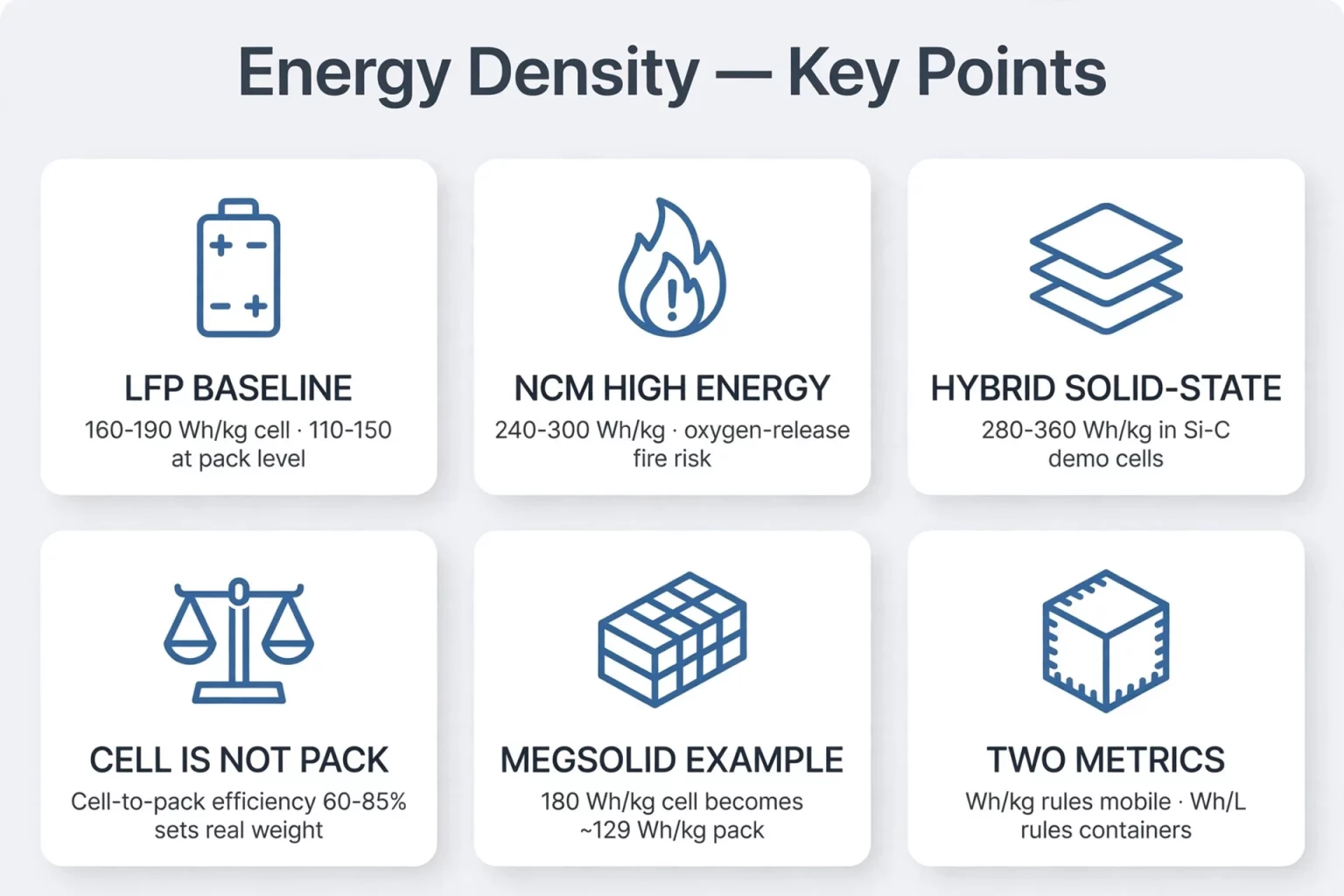
Once bare cells are assembled into a complete module or pack, the design adds a BMS, copper or aluminum busbars, structural housing, thermal interface materials, and cooling plates or fire barriers. The ratio of total cell mass to total pack mass, called the Cell-to-Pack (CTP) gravimetric efficiency, typically sits between 60% and 85%.
Table 1 lists typical industry reference ranges alongside MegSolid's hybrid solid-liquid storage cells (SHS165-280Ah and SHS180-314Ah) and 51.2V pack data. Actual values vary by cell format and test conditions, so treat industry ranges as screening benchmarks.
Table 1: Lithium Battery Energy Density Comparison by Chemistry (Typical 2026 Industry Reference Ranges)
| Battery Chemistry | Nominal Voltage | Cell Wh/kg | Typical Pack Wh/kg | Cell Wh/L |
|---|---|---|---|---|
| Lead-Acid (VRLA / AGM) | 2.0V | 30–45 | 25–40 | 60–100 |
| Lithium Titanate (LTO) | 2.3–2.4V | 60–90 | 45–70 | 120–200 |
| Sodium-Ion (Na-Ion) | ~3.1V | 100–160 | 80–120 | 200–300 |
| Liquid LiFePO4 (LFP) | 3.2V | 160–190 | 110–150 | 330–420 |
| Liquid LMFP | ~3.7V | 190–230 | 140–175 | 400–500 |
| Liquid NCM 811 / NCA | 3.6–3.7V | 240–300 | 170–220 | 600–750 |
| Semi-Solid LFP (Industry) | 3.2V | 170–230 | 125–170 | 350–480 |
| High-Energy Solid-State (Si-C) | 3.6–3.8V | 280–360 | 200–280 | 650–800 |
| MegSolid SHS180-314Ah Cell / Pack | 3.2V / 51.2V | 180 | ~129 | 390 |
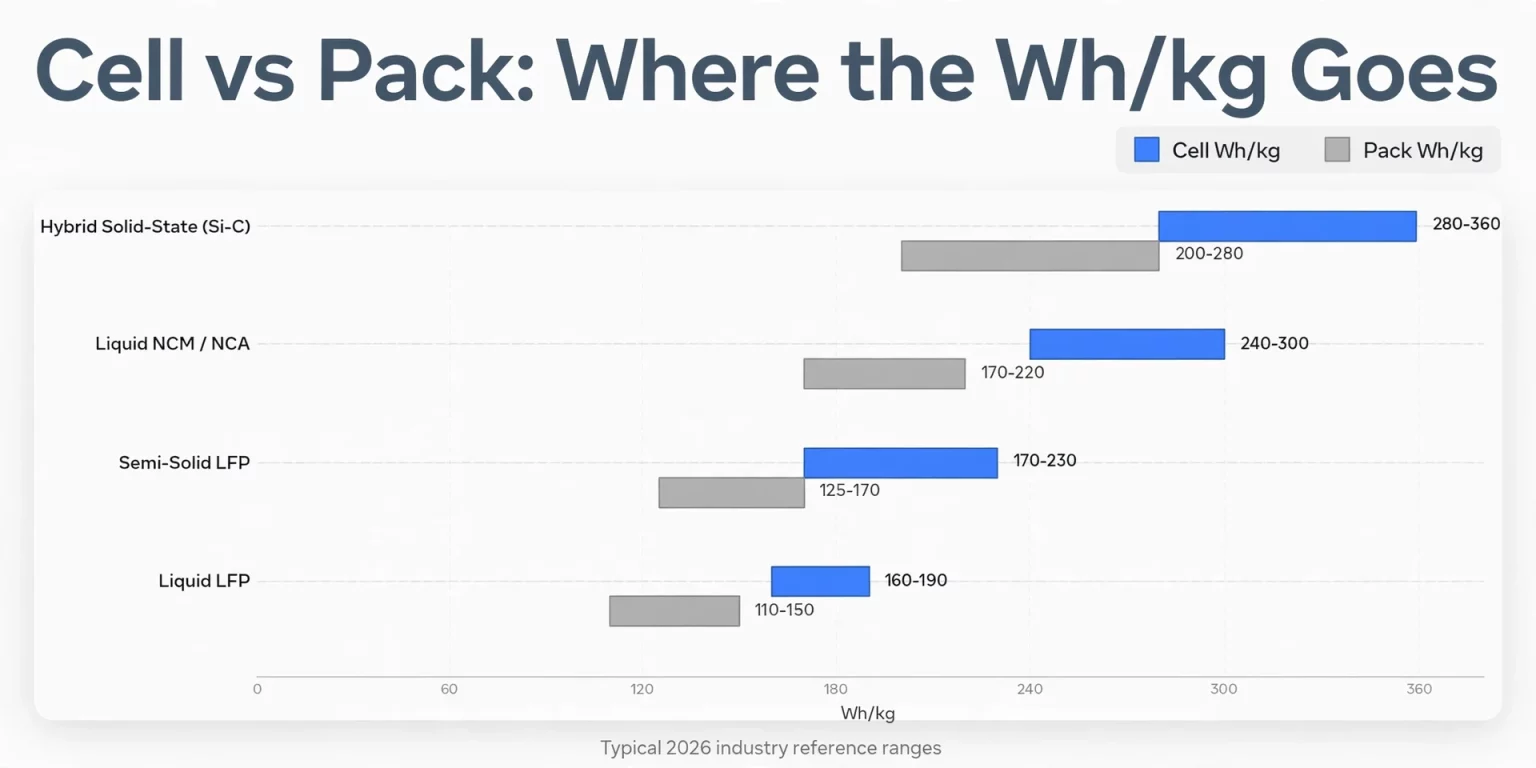
Cell-to-Pack (CTP) Mass Breakdown: From 180 Wh/kg Cell to 129 Wh/kg Pack
The final row of Table 1 illustrates the exact mass transition from bare cell to finished stationary battery pack using MegSolid's SHS180-314Ah cell and MEG-Solid-512314FL1 (51.2V 314Ah) pack:
- Single SHS180-314Ah Cell: Stores 1,005 Wh at 5.60 ± 0.1 kg, delivering 180 Wh/kg and 390 Wh/L (207.1 ± 0.8 × 71.7 ± 0.8 × 174.2 ± 0.8 mm at 300 kgf).
- 16S Cell String Mass (1P16S): 16 × 5.60 kg = 89.6 kg of bare cells (16.07 kWh rated pack energy).
- Finished MEG-Solid-512314FL1 Pack Mass: ~125 kg total (including steel housing, busbars, BMS, and terminals across 830 × 500 × 230 mm).
- Resulting CTP Efficiency & Pack Density: 89.6 kg / 125 kg = 71.7% gravimetric CTP ratio, yielding ~129 Wh/kg (~168 Wh/L) at the finished pack level.
At the wheeled and containerized system levels, structural hardware lowers net gravimetric density further:
- Movable Pack (MG 512314): Stores 16,076 Wh in a 135 kg wheeled enclosure (~119 Wh/kg on the MG 512314 Movable Lithium Battery Pack).
- Utility Container (5000INTL): Stores 5,015.9 kWh at a 43,000 kg system mass (~117 Wh/kg on the 5000INTL Containerized ESS, which includes the ISO container, liquid-cooling skid, fire suppression, and switchgear).
Wh/kg vs. Wh/L: Understanding Gravimetric vs. Volumetric Li Ion Battery Energy Density
Li ion battery energy density has two physical dimensions. Which metric governs your design depends on whether your project is constrained by weight (kg) or by volume (L).
Gravimetric Energy Density (Wh/kg)
Wh/kg (specific energy) measures how much electrical energy a battery stores per kilogram of mass:
Gravimetric Energy Density (Wh/kg) = (Nominal Voltage (V) × Rated Capacity (Ah)) / (Battery Mass (kg))
Gravimetric density governs mobile and weight-restricted applications:
- Autonomous Mobile Robots (AMRs) and automated guided vehicles (AGVs)
- Heavy-lift industrial UAVs and electric workboats
- Offshore topside decks with strict structural crane and load limits
- Portable industrial or telecom battery modules lifted by technicians
Volumetric Energy Density (Wh/L)
Wh/L measures how much electrical energy fits inside a fixed physical volume:
Volumetric Energy Density (Wh/L) = (Nominal Energy (Wh)) / (Volume (L))
Volumetric density governs footprint-restricted installations:
- 20-foot ISO containerized C&I and utility BESS blocks
- Urban data center UPS rooms and indoor commercial storage bays
- Low-profile under-ride warehouse robots (120–160 mm chassis height)
In stationary storage, the industry shift in 20-foot ISO container capacity from roughly 3.35–3.72 MWh (assuming earlier 280Ah LFP rack layouts) to roughly 5.0 MWh (assuming a liquid-cooled DC battery container configured with twelve 1P416S strings of 314Ah LFP cells and external PCS) came mainly from larger cell formats and denser rack/cooling integration. Volumetric gains at the container level depend on cell configuration and system layout assumptions rather than cathode chemistry alone.
Clarifying a Common Search: Density for Lithium vs. Battery Energy Density
Engineering Quick Note (Density for Lithium vs. Wh/kg): - Physical Density of Pure Lithium Metal: 0.534 g/cm³ (the lightest solid element on the periodic table, with a theoretical anode specific capacity of 3,860 mAh/g). - Lithium Battery Energy Density (Wh/kg & Wh/L): Measures the complete electrochemical cell or assembled battery pack (160–360 Wh/kg at cell level), which is much lower than pure lithium's theoretical capacity because cathode active material, current collectors, separators, electrolyte, and casing all add mass.
The Traditional Trade-Off: Why Liquid LFP Plateaus Near 190 Wh/kg and Why Nickel-Rich NCM Raises Fire Concerns
For the past decade, the energy density of lithium batteries forced engineers into a trade-off between two compromises:
- Liquid LiFePO4 (LFP): High cycle life and strong thermal stability, but moderate energy density (160–190 Wh/kg).
- Liquid Nickel-Rich NCM / NCA: Higher energy density (240–300 Wh/kg), but lower thermal onset temperatures and stricter fire-protection requirements.
The Practical Ceiling of Liquid LiFePO4 (160–190 Wh/kg)
LiFePO4 features an olivine crystal structure with strong covalent phosphorus-oxygen (P-O) bonds, which resists oxygen release when overheated. However, standard LFP faces two fundamental electrochemical limits:
- Lower Nominal Voltage Plateau: 3.2V per cell, compared with 3.6–3.7V for NCM.
- Cathode Specific Capacity Limit: ~170 mAh/g theoretical limit (Paired with a 372 mAh/g graphite anode).
Once copper and aluminum current collectors, porous separators, 15%–20% liquid carbonate electrolyte mass, and the prismatic aluminum casing are added, commercial liquid LFP cells typically plateau between 160 and 190 Wh/kg.
The Nickel-Rich NCM / NCA Thermal Challenge
Reaching 240–300 Wh/kg in conventional liquid cells requires nickel-rich layered oxide cathodes (NCM 811 or NCA). While these cathodes raise cell voltage and specific capacity, they introduce a well-documented thermal challenge:
- Cathode Oxygen Release: When charged nickel-rich layered oxides are heated (with onset temperatures commonly reported between 150°C and 250°C depending on nickel fraction, SoC, and test method), the crystal lattice can release reactive oxygen inside the cell.
- Electrolyte Combustion: Internal oxygen reacting with volatile liquid carbonate solvents accelerates heat release and gas generation.
- Regulatory Impact: Because of this propagation profile, stationary BESS integrators predominantly specify LFP-family chemistries, and fire codes such as NFPA 855 rely on model-specific UL 9540A test data to establish spacing and suppression rules.
How Hybrid Solid-State & Semi-Solid Designs Build a High Energy Density Battery
Reaching higher energy density or higher abuse tolerance does not rely on a single material change. Across the battery industry, four engineering levers explain how hybrid solid-state (semi-solid) architectures improve upon conventional flooded liquid cells:
1. Reducing Free Liquid Electrolyte via Nano Solid-State Electrolytes
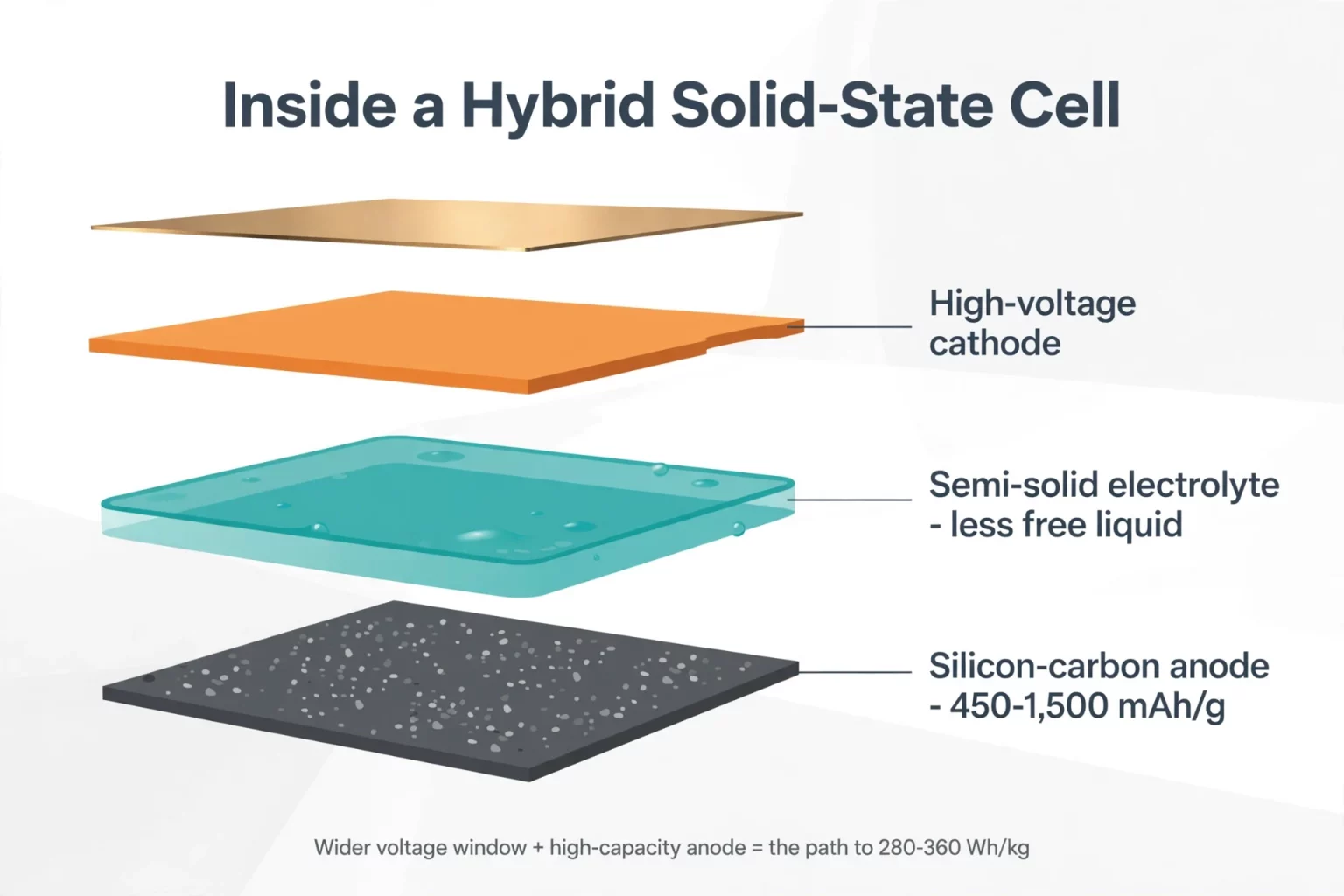
Conventional cells contain a significant mass fraction of volatile liquid carbonate solvent. Hybrid solid-state and semi-solid cells replace part of that free liquid with solid or gel-type ion conductors (such as nano-oxide/polymer hybrid solid electrolytes or in-situ polymerized matrices). Reducing free liquid content lowers parasitic side reactions and modifies abuse behavior, though exact thermal performance must always be verified by model-specific test reports.
2. Compatibility with Higher-Voltage Cathodes
Solid and hybrid electrolytes can be formulated for wider electrochemical oxidation windows than standard liquid carbonates. That stability enables pairing with higher-voltage cathodes such as LMFP (~3.7–3.8V plateau) or surface-stabilized single-crystal nickel-rich cathodes in high-energy cell programs.
3. Silicon-Carbon (Si-C) and Lithium-Metal Anodes
- Standard Graphite Anode: 372 mAh/g theoretical capacity.
- Silicon-Carbon (Si-C) Composite Anodes: 450–1,500 mAh/g practical composite capacity (pure silicon reaches 3,600–4,200 mAh/g theoretically, but swells up to 300% during lithiation).
Solid-liquid hybrid electrolyte interfaces help buffer particle expansion and stabilize the solid-electrolyte interphase (SEI). Combining Si-C or lithium-metal anodes with high-voltage cathodes is the primary pathway used in 280–360 Wh/kg industry demonstration cells.
4. Pack-Level Thermal Barrier Optimization
Where a specific cell and module configuration demonstrates favorable thermal propagation resistance in verified UL 9540A or equivalent abuse testing, pack engineers may evaluate optimizing internal inter-cell thermal barrier materials during module design. Any internal mass reduction remains strictly contingent on certified module- and unit-level test data, and cannot be used to assume reduced installation safety spacing without formal fire code (NFPA 855 / AHJ) review.
MegSolid Hybrid Solid-Liquid Storage Cell & Pack Specifications (SHS180-314Ah & SHS165-280Ah)
MegSolid's stationary energy storage portfolio utilizes proprietary nano solid-state electrolyte technology inside large-format hybrid solid-liquid prismatic cells (SHS180-314Ah and SHS165-280Ah), prioritizing long cycle life, low internal resistance, and verified abuse tolerance:
| Parameter | SHS180-314Ah Hybrid Solid-Liquid Cell | SHS165-280Ah Hybrid Solid-Liquid Cell | MEG-Solid-512314FL1 Pack (1P16S) |
|---|---|---|---|
| Nominal Capacity & Energy | 314Ah / 1,005 Wh | 280Ah class | 314Ah / 16.07 kWh |
| Nominal & Operating Voltage | 3.2V (2.5–3.65V at >0°C; 2.0–3.65V at ≤0°C) | 3.2V | 51.2V (43.2–57.6V operating; 57.6V charge) |
| Gravimetric Density (Wh/kg) | 180 Wh/kg (5.60 ± 0.1 kg cell mass) | 165 Wh/kg class | ~129 Wh/kg (~125 kg pack mass) |
| Volumetric Density (Wh/L) | 390 Wh/L (207.1×71.7×174.2 mm @ 300 kgf) | ~350–365 Wh/L class | ~168 Wh/L (830×500×230 mm enclosure) |
| Internal Impedance & Efficiency | AC 0.18±0.03 mΩ / DC 0.4±0.1 mΩ / ≥94.5% eff. | Nano solid-state low-impedance matrix | Pack internal impedance ≤15 mΩ |
| Rated Cycle Life | 6,000 cycles (≥80% SOH @0.5P/0.5P, 100% DoD) | ≥8,000 cycles (≥70% SOH @0.5P/0.5P, 100% DoD) | 8,000 cycles at 80% DoD (200A max charge/discharge) |
| Datasheet Abuse & Safety Benchmarks | 5 mm nail test no thermal runaway; GB/T 36276-2023 trigger ≥110°C & short-circuit ΔT <10°C | 1P52S module 1C overcharge no smoke/fire/explosion; thermal runaway surface temp >120°C | Listed UL / CE / UN 38.3 references (verify model-specific scope with MegSolid) |
For C&I cabinets and utility containers, MegSolid's MEG-Solid-512314FL1 51.2V 314Ah Solid Energy Storage Battery serves residential and light commercial racks, while the ESSA cabinet series (55.3–215.04 kWh) and Energon (261.24 kWh liquid-cooled LFP system) serve C&I microgrids (with optional project-specific solid-state configurations available in the ESSA line). Review our Commercial & Industrial (C&I) Energy Storage Systems portfolio. Review our core cell architecture on the hybrid solid-state battery technology hub.
Real-World Impact: What Higher Lithium Ion Energy Density Means for Your B2B Project
Higher lithium ion energy density creates engineering value when it resolves a hard physical limit in your project, such as rack lifting weight, robot payload, or container count. Table 2 shows illustrative sizing calculations across four industrial scenarios (these are mathematical comparisons, not MegSolid catalog specifications).
Table 2: Illustrative Pack Sizing at Different Pack-Level Energy Densities
| Engineering Scenario | Assumption | Lower-Density Pack | Higher-Density Pack | Engineering Takeaway |
|---|---|---|---|---|
| 51.2V 100Ah Rack / Telecom Module | 5.12 kWh nominal energy | At 110 Wh/kg pack: about 46.5 kg | At 160 Wh/kg pack: about 32.0 kg | Moving from 110 to 160 Wh/kg removes about 14.5 kg per module, simplifying rack installation and floor loading. |
| 51.2V 60Ah AMR Traction Pack | 3.07 kWh nominal energy | At 120 Wh/kg pack: about 25.6 kg | At 200 Wh/kg pack: about 15.4 kg | Mass drops by roughly 40%, reducing rolling resistance and increasing payload margin on the same chassis. |
| Fixed 20 L AMR Battery Bay | 400 W average draw, ideal runtime before reserve margin | At 200 Wh/L pack: 4.0 kWh, about 10 hours | At 300 Wh/L pack: 6.0 kWh, about 15 hours | In a fixed cavity, Wh/L sets stored energy; actual shift runtime must subtract reserve SoC and thermal losses. |
| Containerized C&I / Utility BESS | Standard 20 ft ISO DC block footprint (assuming liquid-cooled battery racks without integrated central PCS) | Earlier 280Ah LFP rack assumption (e.g., 10–12 liquid-cooled strings): around 3.35–3.72 MWh per 20 ft unit | Denser 314Ah LFP rack assumption (e.g., 12× 1P416S liquid-cooled strings): around 5.0 MWh per 20 ft unit | Container capacity depends on cell Ah rating, series-parallel rack count, cooling layout, and whether PCS/transformers are external; site footprint scales with these layout assumptions and transport weight limits. |
FAQ
What is the difference between cell-level and pack-level lithium battery energy density?
Cell-level energy density measures the bare electrochemical cell. Pack-level energy density includes the additional mass and volume of the BMS, busbars, structural housing, thermal interface materials, cooling plates and fire barriers. The article gives a typical cell-to-pack gravimetric efficiency range of 60% to 85%, so the finished pack will have a lower Wh/kg figure than the cell.
How do engineers calculate battery energy density in Wh/kg?
Calculate gravimetric energy density by multiplying nominal voltage (V) by rated capacity (Ah), then dividing the nominal energy (Wh) by the battery mass (kg). For a complete pack, use the finished pack mass rather than the bare-cell mass. The result is expressed in Wh/kg.
Which lithium battery chemistry has the highest typical cell-level Wh/kg?
In the article's typical 2026 industry reference ranges, high-voltage hybrid solid-state demonstration cells using a silicon-carbon anode are listed at 280 to 360 Wh/kg. Liquid nickel-rich NCM/NCA is listed at 240 to 300 Wh/kg, while liquid LFP is listed at 160 to 190 Wh/kg. The hybrid solid-state range is an industry-demonstration benchmark, not a published MegSolid product rating.
What energy density does MegSolid's SHS180-314Ah cell provide?
The article lists the SHS180-314Ah hybrid solid-liquid storage cell at 180 Wh/kg and 390 Wh/L. It stores 1,005 Wh and has a cell mass of 5.60 ± 0.1 kg. The stated dimensions are 207.1 ± 0.8 × 71.7 ± 0.8 × 174.2 ± 0.8 mm at 300 kgf.
What is the pack-level energy density of the MEG-Solid-512314FL1?
The article calculates approximately 129 Wh/kg and 168 Wh/L for the finished MEG-Solid-512314FL1 pack. The pack stores 16.07 kWh, weighs approximately 125 kg, and measures 830 × 500 × 230 mm. These are pack-level figures, not bare-cell energy-density values.
Does semi-solid LFP automatically reach 280 to 360 Wh/kg?
No. The 280 to 360 Wh/kg range in the article refers to high-voltage hybrid solid-state demonstration cells paired with silicon-carbon anodes. Semi-solid LFP cells that retain a 3.2V LFP cathode and graphite anode focus more on abuse tolerance and cycle life than maximum Wh/kg. Their reported industry range is 170 to 230 Wh/kg at cell level.
Why does nickel-rich NCM typically have higher energy density than liquid LFP?
The article lists typical nominal cell voltage at 3.6 to 3.7V for nickel-rich NCM/NCA compared with 3.2V for LFP. Higher voltage and specific capacity support greater cell-level Wh/kg, but charged nickel-rich layered oxide cathodes can release oxygen at elevated temperatures, increasing fire severity when oxygen reacts with liquid carbonate electrolyte.
How does cell-to-pack efficiency affect the final battery weight?
Cell-to-pack gravimetric efficiency is the ratio of bare-cell mass to finished pack mass. The article gives a typical range of 60% to 85%. In the SHS180-314Ah example, 16 cells contribute 89.6 kg of cell mass to a finished pack weighing about 125 kg, producing a 71.7% cell-to-pack ratio and approximately 129 Wh/kg at pack level.
What test documentation should buyers request when comparing high-energy-density batteries?
Request the exact cell and pack datasheets, rated energy, mass, dimensions, and the calculation basis for both Wh/kg and Wh/L. For safety claims, verify model-specific abuse and thermal propagation reports such as GB/T 36276, UL 9540A, UL 1973, IEC 62619, and UN 38.3 where applicable. The article cautions that test results and certification scope must match the exact model and configuration.
How do silicon-carbon anodes increase lithium battery energy density?
The article compares graphite's theoretical capacity of 372 mAh/g with a practical composite capacity range of 450 to 1,500 mAh/g for silicon-carbon anodes. Pure silicon has a theoretical capacity of 3,600 to 4,200 mAh/g but can swell by up to 300% during lithiation. Pairing Si-C anodes with high-voltage cathodes is identified as a principal route used in 280 to 360 Wh/kg demonstration cells.
Conclusion: Specify Energy Density at the Pack Level, Then Verify Safety by Test
Evaluating lithium battery energy density accurately requires checking three details before signing a purchase order:
- Confirm whether the quoted figure is bare-cell or finished-pack (Wh/kg and Wh/L).
- Match the chemistry (SHS180-314Ah / SHS165-280Ah hybrid solid-liquid LFP for long-life stationary storage vs. high-energy custom cells for weight-critical mobile packs) to your application's mass and volume constraints.
- Verify model-specific abuse and thermal propagation test reports (GB/T 36276, UL 9540A, UL 1973, IEC 62619, UN 38.3) for the exact configuration being deployed.
Ready to evaluate hybrid solid-state storage or custom battery packs for your next project?
- For Commercial, Industrial & Microgrid Storage: Explore MegSolid Solid-State Energy Storage Systems to review our 51.2V modules, C&I cabinets, and 5 MWh containerized BESS platforms.
- For Custom Weight- or Space-Limited Battery Packs: Share your mass budget, enclosure CAD dimensions, and C-rate profile with our Custom BESS & Battery Pack OEM/ODM Engineering Team for a project-specific cell-to-pack evaluation.
