 الانتقال إلى المحتوى
An existing Mexico factory adding BESS starts with a technical-modification assessment. CENACE then decides whether the change requires new connection studies.
What the buyer needs to know:
- Route: CENACE assigns the study after reviewing the technical modification.
- Charging limit: factory demand plus BESS charging must stay within the contracted load.
- Export limit: SAEE-CC discharge stays behind the point of connection and follows live factory demand.
- Release gate: the final cabinet and PCS remain open until the route, kW/kVA limits and revised SLD agree.

Product screening can still move forward. Start with the C&I battery energy storage system design, check the actual 400 V switchboard connection, and fix the zero-export control point on the SLD.
The legal reference is the CNE agreement published in the Diario Oficial de la Federación on 16 April 2026. It uses SAEE-CC for storage associated with a load center. Some government screens still display SAE-CC, so the filing team should use the label shown by the current submission portal while keeping the legal term in the technical record.
Technical Modification Comes Before the Study Name
Section 4.6.5 sends an existing load center adding storage through the technical-modification process. A new load center designed with storage requires an Impact Study and an Installations Study. For an existing load center connected to the RNT, section 4.5 tells its representative to notify CENACE, which then assesses the need for new studies.
| Factory condition | Regulatory starting point | What the buyer can release |
|---|---|---|
| Existing operating load center adding SAEE-CC | Technical-modification notification and CENACE evaluation | Preliminary product family and controlled technical data; do not promise a study exemption |
| New load center with storage in the original design | Impact Study plus Installations Study | Study design basis, proposed equipment band and connection data |
| Operating site that also increases contracted demand | Technical modification plus the applicable demand-modification process | Equipment release only after the new demand basis and connection path are confirmed |
| Grouped existing load centers integrating storage | The 2026 agreement identifies an Estudio Rápido route for the grouped case | Project-specific route and point of connection confirmed by CENACE |

The agreement expressly assigns an Estudio Rápido to the grouped existing-load-center case. A single factory cannot copy that route into its programme without CENACE confirmation.
SIASIC lists Indicative, Impact, Installations, Power Quality, Validation and Quick Impact studies. Those names describe the analysis CENACE performs after route classification. Keep one hold point in the project schedule: CENACE study requirement and route confirmed in writing.
Fix the Operating Envelope Before Naming the Cabinet
Use the same four values on the SLD, operating narrative and EMS settings sheet:
- the contracted load at the point of connection;
- the lowest credible facility demand during a charging window;
- the maximum SAEE charging power;
- the maximum SAEE discharge command that still prevents export.
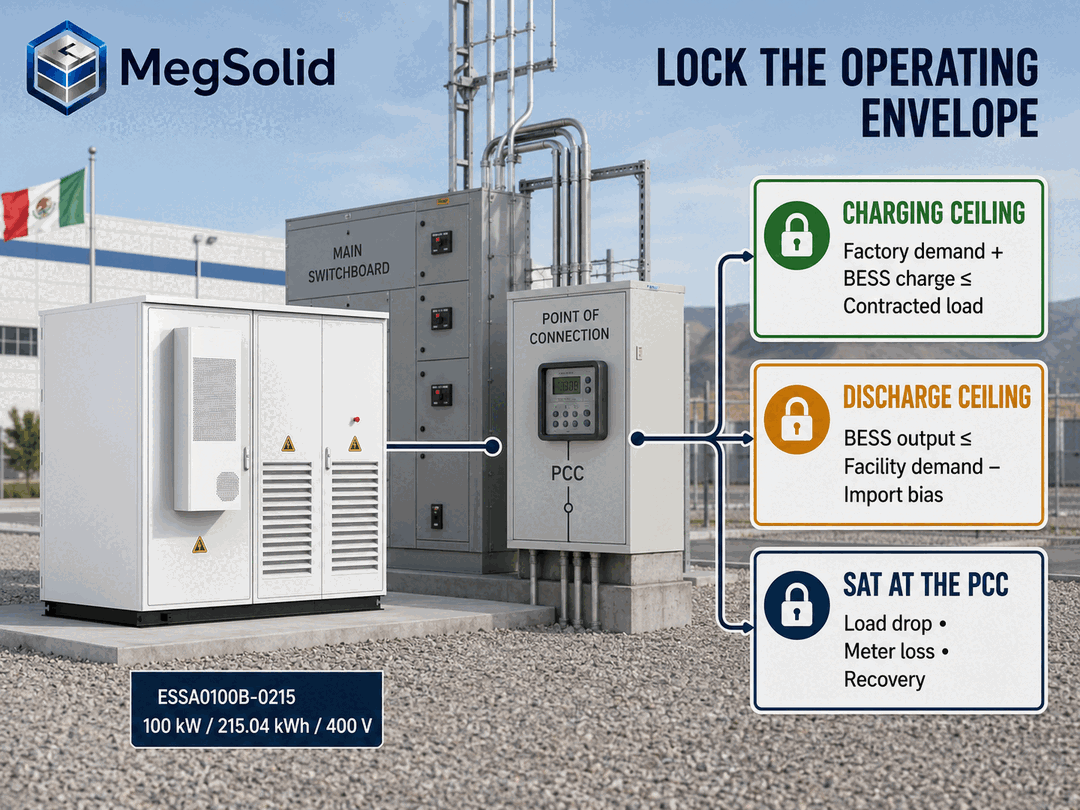
The April 2026 rules state that SAEE-CC power cannot exceed load-center demand, the unit charges from the point of connection, and charging cannot push the load center above its contracted load. The same rules prohibit injection into the RNT or RGD at the point of connection.
Charging ceiling
Facility demand + SAEE charging power ≤ contracted load at the point of connection
Discharge ceiling
SAEE discharge command ≤ measured facility demand minus the agreed import bias
The import bias gives the controller room for meter latency, load steps and PCS response. The project engineer sets that value from the meter update rate, control deadband and network requirement. A brochure cannot supply it.
Power signs also need one convention. For example, positive PCC power may mean import and negative power may mean export. The EMS point list, study model, FAT procedure and SAT trend must all follow the same sign. Reversing one CT can turn a correct control equation into sustained export.
Monterrey Factory Example: The 80 kW Margin Clears Only the First Screen
Consider a hypothetical Monterrey factory with a 1,200 kW contracted load. Its verified overnight demand falls to 620 kW during the planned charging period. The preliminary design uses five ESSA0100B-0215 cabinets, giving a combined published rating of 500 kW / 1,075.2 kWh at 400 V.
At the proposed 500 kW charge command:
620 kW facility demand + 500 kW charging = 1,120 kW total import
Preliminary charging margin = 1,200 kW − 1,120 kW = 80 kW
The 80 kW figure comes from one operating point. A chiller start or an extended production run can consume it before the controller sees the next meter update. The EMS therefore trims charge power from live PCC demand and raises an alarm if the battery cannot recover its target energy inside the permitted window.
The factory also proposes a 450 kW peak-shaving command. At a moment when site demand drops to 300 kW, the PCS cannot continue discharging at 450 kW without exporting. Closed-loop control must reduce output fast enough to maintain the agreed import bias. The study model needs the meter delay, controller scan time, PCS ramp limit and communications-loss action to test that case.
Five 100 kW cabinets clear the active-power nameplate screen in this example. The transformer, switchboard, fault level, protection settings and conductor route still need project calculations. Simultaneous operation of all five units also depends on temperature, altitude, power factor, availability and the controlled model data.
Check the Mexico SAEE-CC Operating Envelope
Provide the contracted load, minimum and maximum facility demand, proposed BESS kW/kVA/kWh, PCC location and charging window. The review returns a preliminary charge limit, zero-export boundary and the missing data that prevents equipment release.
Build the File Around the Questions CENACE Must Test
A technical-modification file should show the factory before and after the battery is added. A catalogue, an electrical bill and an old single-line diagram leave the reviewer to reconstruct the change and usually trigger another document request.
| File item | Engineering question it answers | Normal source |
|---|---|---|
| Existing connection and contracted-load record | What electrical boundary already operates, and what demand has been accepted? | Owner, supplier or qualified-user representative |
| Existing and proposed single-line diagrams | Where does the SAEE connect, and what changes at the point of connection? | Local electrical engineer or EPC |
| Minimum, medium and maximum demand cases | Can the SAEE charge and discharge without changing the approved network boundary? | Interval meter data and the owner’s production plan |
| SAEE rating sheet | What active power, apparent power, energy, voltage and power-factor range enter the model? | MegSolid controlled datasheet and PCS schedule |
| Charge, discharge and SOC schedule | When does the system withdraw power, how long does it discharge and what reserve remains? | Owner’s operating brief and EMS functional description |
| Ramp and control data | How fast can output change after a load step or CENACE instruction? | PCS data and EMS control specification |
| Short-circuit and protection model | What current contribution and trip behavior reach the existing installation? | PCS model, EPC study and protection engineer |
| Metering, communications and control diagram | Which CTs, meters and signals close the loop, and what happens when one fails? | EPC, EMS integrator and قائمة نقاط نظام BESS SCADA |
| Commissioning test map | Which site tests prove the assumptions used in the filing? | Owner, EPC and equipment supplier |
The 2026 agreement calls for minimum, medium and maximum demand base cases. Its transitional provisions place power flow, short circuit, storage power, discharge duration and ramp among the possible Indicative Study analyses. An Impact Study can extend the work to short-circuit ratio and transient stability, including grid-forming implementation. The Installations Study deals with the resulting protection, communications, control and metering requirements.
CENACE decides whether an additional study applies or qualifies for exemption. Even a project expecting a lighter route should submit the load cases, equipment model and control behavior needed to support that decision.
Use Quick Impact Only After CENACE Assigns the Route
الـ CENACE SIASIC information page lists Quick Impact among its study types. Qualification still depends on CENACE's classification of the particular request.
Calling the route too early can put a complete cabinet on order before CENACE has accepted the proposed kW. A different mistake adds battery kWh while leaving the PCS model, reactive-power capability, ramp and protection data unresolved. CENACE studies network behavior, so battery kWh alone says little about the point-of-connection impact.
The study name should stay provisional until the representative has submitted the technical-modification notice and received direction. At that point the schedule can attach a required document, payment and response period to the correct route. As of September 2026, the federal Ventanilla Energía page for SAE-CC still shows requirements, response time and cost as “POR DEFINIR.” Filing teams should check SIASIC and the responsible authority on the actual submission date. An old form pack cannot serve as a current filing guarantee.
Convert 500 kVA to Project kW Before Product Release
MegSolid's خزانة خارجية ESSA0100B-0215 has a published 100 kW / 215.04 kWh rating at 400 V. Five units give a simple preliminary 500 kW / 1,075.2 kWh nameplate combination. The public page identifies intelligent air cooling, IP54 protection and a 0.5C maximum charge/discharge rate at 25°C for that model.
الـ Energon 261.24 liquid-cooled cabinet is published as 125 kVA / 261.24 kWh, with a 400 V or 480 V interface and adjustable power factor. Four units total 500 kVA, not automatically 500 kW. At a 0.90 operating power factor, the active-power boundary would be:
Active power = 500 kVA × 0.90 = 450 kW
The final model must use the warranted active-power capability at the project voltage, temperature, altitude and power factor. Energon's public 90% figure is labelled maximum system efficiency; it should not be renamed round-trip efficiency without a controlled test definition.
For the CENACE file, a usable product submission names the PCS and states its kW, kVA, power-factor range and ramp limits. It also identifies the control interface, alarm states and firmware revision that will reach the factory. Cooling architecture and cabinet energy remain important to site design; the grid model still needs the PCS data.
Zero Export Needs a Failure Mode in the Model
A zero-export statement describes the required outcome. The technical file must also describe how the controller reaches it and what the plant does when a signal disappears.
Record the PCC meter, CT ratio and polarity, sampling rate, communications path, import target, export threshold, deadband, PCS ramp and stale-data timer. The approved scheme may ramp the BESS to zero, hold a limited import-biased output or trip the relevant breaker. Put the selected action in both the settings sheet and SAT procedure.
The revised single-line diagram should show every parallel source. Existing PV or a generator changes the current measured at the PCC and can change the response expected from the storage controller. Generator operation also needs a defined BESS and diesel-generator control sequence if islanded or standby modes form part of the project.
The zero-export test should capture a load drop, a meter-communications interruption and restoration. A screenshot showing “0 kW export” at steady load cannot prove the dynamic case that usually causes the violation.
Turn Study Assumptions Into SAT Records
Site testing should record point-of-connection import during maximum charging and minimum import after a fast load drop. The same trend should show PCS response time, active and reactive power, protection operation and the fail-safe state after communications loss.
The factory test checks the manufactured configuration, serial numbers, firmware, alarms and agreed control functions. A project-specific اختبار القبول في المصنع لنظام BESS can also confirm register maps and command limits before shipment. Site testing then uses the installed CTs, meter, breaker, transformer and actual network boundary.
Copy the accepted limits from the CENACE submission or technical-modification record into the EMS settings sheet. SAT then records the same limits on the signed trend and result table.
If the filing says charging stops at 500 kW but the EMS permits 600 kW, the factory has changed the operating envelope. If the study assumes zero export but the communications-loss state freezes the last discharge command, the failure mode remains open. These are commissioning defects, not wording issues.
What Holds the Final Purchase Release
The purchase schedule can name a preliminary cabinet family early. Final release waits for five checks:
- CENACE has confirmed the route;
- the contracted-load boundary matches the demand data;
- the order names the cabinet, PCS and controlled revision;
- the SLD fixes the point of connection;
- the EMS settings and SAT procedure carry the filed operating limits.
The equipment supplier should deliver the model-specific rating sheet, interfaces, controls data and agreed factory evidence. The local EPC owns the existing-plant survey, revised SLD, cable and protection design, CT installation and site tests. The load-center representative handles the CENACE notification and submission. The owner controls the operating data and accepts any production restriction used to keep charging below the contracted load.
Do not lock the model when the charge schedule exceeds the contracted-load limit in any demand case. Adding battery energy will not fix the overrun. The owner must change the charging window, PCS command or production schedule first.
Map the CENACE Technical-Modification File
Send the existing and proposed SLD, contracted load, interval demand, BESS rating, operating modes, PCS model and planned commissioning date. The document map separates the MegSolid data, EPC studies, owner records and CENACE route decisions needed before final equipment release.
الأسئلة الشائعة
1. Does an existing Mexico factory automatically need a CENACE Quick Impact Study for BESS?
No. The April 2026 agreement starts an existing load center on the technical-modification route, after which CENACE decides whether additional studies apply. The express Estudio Rápido provision covers grouped existing load centers, not every individual factory.
2. What does SAEE-CC mean?
SAEE-CC means an electrical energy storage system associated with a load center and sharing its point of connection. The 2026 agreement uses this term, although some portal screens still show SAE-CC. Follow the current form label and keep SAEE-CC in the legal and technical record.
3. Does an SAEE-CC need a separate storage permit?
Section 4.1 treats the storage as part of the load center's installations and equipment, so SAEE-CC does not need a separate energy-storage permit. That provision does not cancel the project's connection, construction or local electrical obligations.
4. Can a Mexico factory BESS export energy to the grid?
SAEE-CC energy serves the on-site load; injection at the point of connection is prohibited. The EMS therefore trims discharge from live PCC measurements and moves to the approved fail-safe state if the meter signal disappears.
5. Can BESS charging exceed the factory's contracted load for a short period?
No. Concurrent factory demand counts toward the contracted-load limit. A 500 kW charge command must fall as production or auxiliary load consumes the available import margin.
6. Which demand cases belong in the CENACE file?
Use minimum, medium and maximum demand base cases. Tie each case to interval data and the proposed charging hours so CENACE can see the actual point-of-connection effect.
7. Is battery kWh enough for the CENACE model?
kWh covers duration. The CENACE model also needs kW, kVA, voltage, power-factor range, charge and discharge profiles, ramp, short-circuit behavior, protection and control data.
8. Why must the file state both kW and kVA?
kW states active power. kVA, voltage and power factor set the AC current and reactive-power boundary. At 0.90 power factor, a 125 kVA PCS reaches 112.5 kW when it is operating at the full apparent-power limit.
9. Does zero export remove the need for a revised SLD?
No. Zero export is a control mode, while the BESS still changes the factory installation. The revised SLD must show its feeder, point of connection, transformer, other sources, CTs, meter, protection and trip path.
10. What happens if the Ventanilla Energía page still says requirements are undefined?
Confirm the current SIASIC route with the responsible CENACE channel before fixing the filing calendar. As of September 2026, the SAE-CC page still marks several administrative fields “POR DEFINIR”; an earlier checklist cannot guarantee the current submission package.
11. Can five 100 kW cabinets be declared as a 500 kW BESS?
Five ESSA0100B-0215 cabinets total 500 kW on the published nameplate. Final declaration still depends on the supplied PCS configuration, simultaneous-operation limits, auxiliaries, power factor, temperature, altitude and approved control architecture.
12. Which tests should repeat the CENACE operating assumptions?
SAT should repeat the filed operating boundary: maximum charging import, a fast load drop, zero-export response, meter-communications failure, active and reactive power, protection operation and recovery. The signed trend must match the final EMS settings.
13. What should be ready before the BESS purchase order is released?
Release the order after the file contains the preliminary CENACE route, contracted-load record, demand cases, revised SLD, product and PCS schedule, operating limits, zero-export method and acceptance-test outline. Give every open assumption an owner and closure date.
