 الانتقال إلى المحتوى
At Cape Town Market in Epping, a 3 MWh battery entered commissioning after more than 3,000 solar panels had been installed across the site. The battery was no longer a factory unit on a test bay. It was part of a working market with refrigeration, site loads and demand management connected around it, as recorded in the City of Cape Town project announcement.
That change of setting is why SAT exists. Within the C&I BESS testing and acceptance sequence, it checks the wiring, protection, communications and control behavior that only exist after installation. A SAT pass can release defined site functions; it does not automatically accept usable AC kWh or long-term availability.
The same boundary applies to a 400 V MegSolid ESSA0100B-0215. Its factory record follows the cabinet to site, while the final feeder, switchboard, CTs, meter and network are proved through the installed 400 V connection.

What a SAT PASS Actually Releases
SAT is not one large green tick. A project normally reaches site release in stages, because an installation can be safe to energize before it is ready for automatic peak shaving, backup transfer or unattended operation.
| Release point | الأدلة المطلوبة | What may proceed | What remains open |
|---|---|---|---|
| Installation complete | Approved drawings, equipment identity, cable and earthing records, mechanical inspection | Controlled pre-energization checks | Live protection, communications and operating modes |
| Safe to energize | Insulation and continuity results, protection settings, emergency-stop path, auxiliary supplies | Controlled energization and start-up | Closed-loop site control and contracted performance |
| Functional SAT complete | Metering, interlocks, alarms, communications, command ownership and mode response | Approved operating modes under stated limits | Usable energy, power quality or endurance results not included in SAT |
| Handover release | Signed SAT sheets, closed blocking defects, approved software and settings, operator records | Operation under the released configuration | Any deferred performance or reliability test named in the contract |
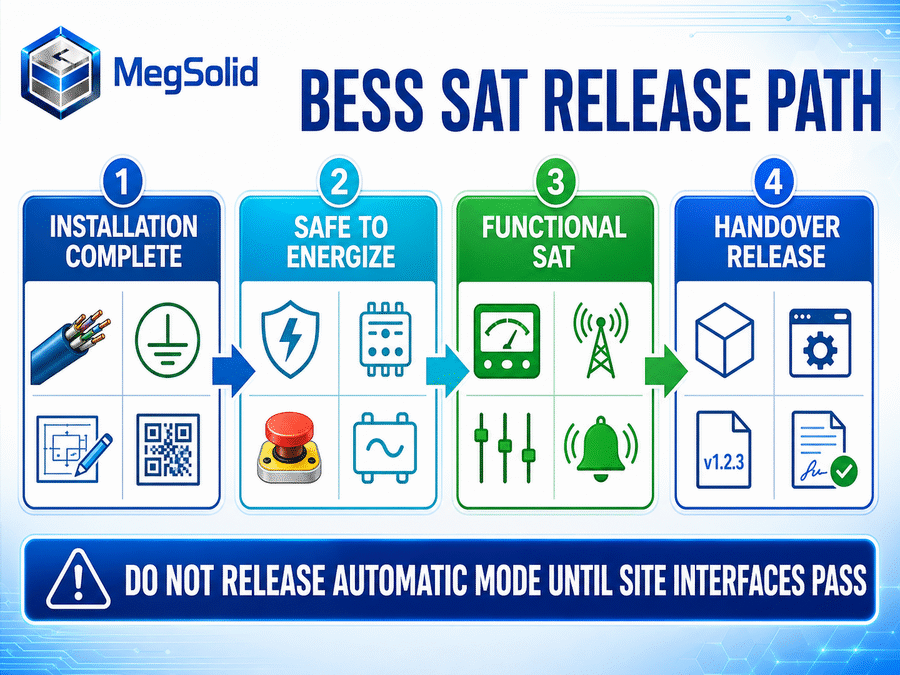
The signature needs to name the release point. “SAT PASS” on its own does not say whether the plant is merely energized, ready for supervised operation or accepted for automatic commercial dispatch.
That distinction agrees with independent testing practice. TÜV SÜD describes SAT as verification that installed BESS equipment is complete, integrated and ready for safe site operation, with performance testing treated as its own defined activity. IEC 62933-3-1:2025 likewise covers EES functions, operation, monitoring, test items and performance assessment. The project procedure still sets the actual pass values.
Stop Before Energization When the Records Disagree
An installation crew can complete every visible cable and still leave the commissioning team with the wrong plant. The common cause is not dramatic equipment damage. It is a quiet mismatch between the approved drawing, the delivered configuration and the final field connection.
Consider an ESSA cabinet added to an existing factory board. The construction drawing shows the PCC meter upstream of the BESS feeder. The installed meter is on the feeder itself. Both meters produce plausible numbers, but only one can show total site import. Energizing the cabinet may be safe; releasing peak shaving on that signal is not.
The pre-energization walkdown should reconcile six items:
- Identity: cabinet model, serial number, PCS, BMS, EMS and approved software revisions;
- As-built electrical path: source, transformer, switchboard, feeder, breaker, cable, neutral and PE arrangement;
- Mechanical completion: anchoring, clearances, glands, door operation, ventilation path and transport damage;
- Electrical completion: cable termination, torque record, phase sequence, continuity, insulation and earthing;
- Protection basis: relay and breaker settings, trip path, selectivity assumptions and remote permissions;
- Auxiliary readiness: control power, HVAC or fan supply, lighting, communications and any fire-system interface within scope.
Some findings can remain on a punch list. Others must stop energization.
| Finding | Typical disposition before energization |
|---|---|
| Missing label on a non-critical internal cable | Record and close by an agreed date if identification remains unambiguous |
| As-built feeder size differs from the approved design | Hold energization until ampacity, protection and drawing revision are accepted |
| Protection setting file has no approved revision | Hold energization; screenshots are not a controlled setting record |
| Cabinet serial number differs from the FAT release sheet | Reconcile the delivered unit and its factory record before proceeding |
| PCC meter location differs from the control drawing | Hold automatic control modes until the measurement boundary is corrected or formally redesigned |
The point is not to make every cosmetic item a crisis. It is to stop a design or safety change from being buried among paint repairs and label corrections.
The First Live Command Should Be Boring
Full-power dispatch is a poor first proof. A clean SAT starts with the smallest command that confirms direction, feedback and control ownership without forcing the plant into a difficult recovery.
One workable order is:
- 1. Energize auxiliary and control supplies with the power stage blocked.
- 2. Confirm healthy BMS, PCS and EMS states against the approved point list.
- 3. Exercise local and remote emergency stops, breaker permissions and reset conditions.
- 4. Enable the power stage and issue a low-power charge command.
- 5. Return to zero, then issue a low-power discharge command.
- 6. Compare command, PCS response, cabinet AC measurement and PCC result on one time base.
- 7. Increase power only after direction, phase mapping, limits and interlocks agree.
A 10 kW command is often enough to expose a reversed sign or an inactive phase on a 100 kW cabinet, but 10 kW is an example test point, not a universal acceptance value. The approved procedure needs to account for meter resolution, facility load variation and the smallest stable operating point.
If discharge is commanded and grid import rises, do not keep increasing power to “make the trend clearer.” Freeze the run and examine the installed measurement chain. The next cluster article covers CT polarity, ratio, sign convention and time alignment in detail; the SAT sheet only needs to record that the loop was verified and where the evidence is stored.
Prove Who Owns Each Command
At site, several devices can ask the battery to do different things. A local HMI may hold a manual setpoint while the EMS is trying to shave a peak. SCADA may show a green command even though the PCS has rejected it at an active BMS limit. The SAT has to make that hierarchy visible.
| Operating condition | Expected command owner | الأدلة التي يجب الاحتفاظ بها | Required response when the input fails |
|---|---|---|---|
| Local maintenance | Authorized local control | Mode status, local setpoint, remote-command block | Remain inside local protection limits |
| تخفيف الأحمال في أوقات الذروة | Site EMS using the approved PCC meter | PCC demand, target, BESS command and actual power | Alarm and move to the approved fallback when meter data is stale |
| Scheduled charge | EMS or approved scheduler | Schedule, time source, SOC limit and charge command | Block or limit charging if the schedule or import boundary is invalid |
| Backup readiness | BMS/EMS reserve logic and site transfer scheme | SOC reserve, grid state, breaker state and load status | Preserve the defined reserve and follow the approved transfer sequence |
| Emergency condition | Local protection and hardwired safety chain | Initiating event, trip path, breaker state and reset record | Remove power command and prevent automatic restart until release conditions are met |
الـ BMS and EMS communication boundary explains why protective limits remain local even when a supervisory controller owns the commercial setpoint. For meter-led operating modes, the PCC control framework shows which signal, time base and fallback state must be agreed before automatic operation.
Where the cabinet, switchboard and site EMS come from different scopes, a short interface review can confirm where MegSolid equipment ends and the EPC-controlled SAT work begins.
A 400 V ESSA SAT Example
A factory installs one ESSA0100B-0215 for an 80 kW peak-shaving duty at an existing 400 V main board. The cabinet’s published 100 kW rated AC power and 215.04 kWh nominal energy place it in the right preliminary class. They do not prove that the site can deliver 80 kW continuously or that a particular amount of AC energy will reach the PCC.
On the morning of SAT, the following records agree:
- the cabinet model and serial number match the factory release sheet;
- the installed software revisions match the approved release or an accepted site-change record;
- feeder cable, breaker and protection settings match the as-built single-line diagram;
- the PCC meter is upstream of the site loads and BESS feeder, as required by the peak-shaving logic;
- switchboard phase sequence, neutral and PE arrangement match the cabinet interface;
- the operator has the approved stop, reset and isolation procedure.
The team first checks auxiliaries and communications with the power stage blocked. A low-power charge and discharge run then confirms direction at the cabinet and PCC. After the meter and controller agree, the test moves through an intermediate setpoint and reaches the 80 kW site duty for the duration stated in the procedure.
Three outcomes remain possible:
| Result seen at site | SAT decision |
|---|---|
| Cabinet follows 80 kW and the PCC trend moves in the expected direction | Functional peak-shaving mode can pass, subject to all protection and fallback checks |
| Cabinet reaches 80 kW but the PCC trend disagrees | Keep the mode open; reconcile meter location, CTs, scaling, sign and timestamps |
| Available cabinet power is limited below 80 kW by temperature, SOC, reactive duty or another active limit | Record the active limit; do not convert a lower-power run into an 80 kW pass |

Compressor starting duty, reactive-power demand and site voltage dip need their own approved checks when they are part of the operating requirement. A steady 80 kW run cannot prove a motor-start event that never occurred.
Keep Performance Acceptance Out of the Wrong Checklist
SAT should prove the installed interfaces needed to run a performance test. It should not quietly rewrite nominal product data as an accepted site result.
The distinction is especially important for energy:
Nominal battery energy ≠ usable DC energy ≠ usable AC energy at the PCS ≠ usable AC energy at the PCC
An accepted usable-energy result needs a named measurement point, start and end SOC, power setpoint, temperature basis, auxiliary treatment, sample interval and calculation method. Those controls belong in the اختبار السعة التجارية لأنظمة تخزين الطاقة بالبطاريات (BESS).
The same separation applies to other results:
- a charge/discharge function check does not prove the contracted power duration;
- a clean alarm list does not prove harmonic performance;
- a one-hour witnessed run does not prove long-term availability;
- a PCS trend does not replace measurement at the agreed PCC boundary;
- a functional SAT pass does not close a deferred protection or grid-code witness test.
الـ BESS power-quality acceptance procedure covers analyzer placement and operating conditions for harmonic and electrical-quality results. Reliability-run alarms, curtailment and availability records remain the third cluster topic. Keeping those tests separate makes the SAT shorter and the signatures more meaningful.
Close Punch Items Without Losing the Test History
A punch list becomes dangerous when the correction changes the configuration that passed. Replacing a damaged label does not affect a functional test. Replacing a meter, changing a protection setting or loading new EMS software does.
Use three dispositions:
- Close without retest: cosmetic or documentary correction with no effect on a tested function;
- Close with targeted retest: a defined change affecting one signal, setting, device or operating mode;
- Repeat the affected SAT section: a change that alters several interfaces or invalidates the original evidence.
Each closure should carry the defect number, action, responsible party, completion date, evidence reference and retest result where required. The old result stays in the file; the retest links back to it. Deleting a failed screenshot and keeping only the later PASS removes the history needed to explain the final configuration.
Firmware deserves the same discipline. If an EMS update changes meter handling, schedule logic or fallback behavior, the site team repeats those functions. Tests unrelated to the change can remain valid when the configuration record makes that boundary clear.
The Handover Pack the Operator Will Actually Use
The operator does not need a directory full of duplicate PDFs. The handover pack needs a short index that points to the exact records behind the released plant.
Keep these items together:
- delivered model and serial-number schedule;
- approved BMS, PCS and EMS software revisions;
- as-built single-line diagram and site interface drawings;
- final protection settings and trip records;
- meter and communications point lists;
- signed installation, energization and functional SAT sheets;
- open-item register with operating restrictions and closure dates;
- operator isolation, stop, reset and recovery instructions;
- links to any separate capacity, power-quality or reliability results completed before handover.
The final index should let a technician answer three questions without searching email: which machine is installed, which software is running and which signed test released the operating mode now in use.
Before the file is closed, MegSolid can check that the supplied cabinet identity, approved software revision and signed SAT result point to the same released configuration.
الأسئلة الشائعة
1. What should a BESS site acceptance test checklist include?
It should cover equipment identity, as-built installation, cable and earthing checks, protection, emergency stops, auxiliary systems, communications, meter direction, command ownership, operating-mode response, alarm behavior, punch items and signed release records.
2. What is the difference between BESS FAT and SAT?
FAT verifies an identified configuration at the factory before shipment. SAT verifies the installed equipment and its actual site interfaces. Final CT orientation, switchboard wiring, protection paths and site communications cannot be cleared by factory simulation alone.
3. Does a SAT PASS prove usable AC kWh?
Only when the signed SAT procedure explicitly includes a controlled usable-energy test at the agreed AC boundary. A normal functional SAT pass does not turn nominal battery kWh into accepted site-delivered energy.
4. Can a BESS be energized before every SAT item is complete?
Yes, when the approved procedure separates safe energization from later functional and performance releases. Blocking safety, protection or installation defects must be closed before energization. Operating modes remain disabled until their required checks pass.
5. Which BESS defects should block energization?
Examples include unapproved protection settings, unresolved cable or earthing discrepancies, incorrect equipment identity, failed insulation results, incomplete emergency-trip paths and as-built changes that affect ratings or safety.
6. Why should low-power charge and discharge come before full power?
A low-power run confirms direction, phase mapping, feedback and command ownership with less operating stress. Full power follows after the measurement and protection chain responds correctly. The actual low-power setpoint belongs in the site procedure.
7. What should happen if PCC import rises during a discharge command?
Stop the run and verify meter location, CT polarity, ratio, phase mapping, sign convention and timestamp alignment. Increasing the command before resolving the measurement error can drive the controller further in the wrong direction.
8. Who should sign the BESS SAT?
The contract should identify the authorized supplier, EPC, commissioning, owner and independent-witness roles. Each signature should state the test section and release decision it covers; one general signature should not silently approve deferred performance tests.
9. Should a firmware change trigger another SAT?
Repeat every function affected by the change and link the new result to the original test. A change to meter handling, command priority or fallback logic requires targeted site retesting even when the hardware is unchanged.
10. Can peak shaving pass while backup mode remains open?
Yes. Operating modes can use different meters, SOC rules, breaker states and failure responses. The SAT report should release only the modes that were exercised successfully under their approved conditions.
11. What is the difference between SAT and commissioning?
Commissioning is the wider process covering completion checks, energization, start-up, functional tests, performance work, training and handover. SAT is the formal site-acceptance portion used to release defined installed functions.
12. What belongs in a BESS handover pack?
Include the delivered model and serial numbers, approved software schedule, as-built drawings, protection settings, meter and point lists, signed SAT sheets, punch-list status, operating procedures and references to separate performance results.
13. How does the ESSA0100B-0215 fit a 400 V SAT?
Its published 100 kW rated AC power, 215.04 kWh nominal energy and 400 V interface define the product starting point. SAT still verifies the final feeder, switchboard, protection, meter, communications and approved operating modes at the project site.
