
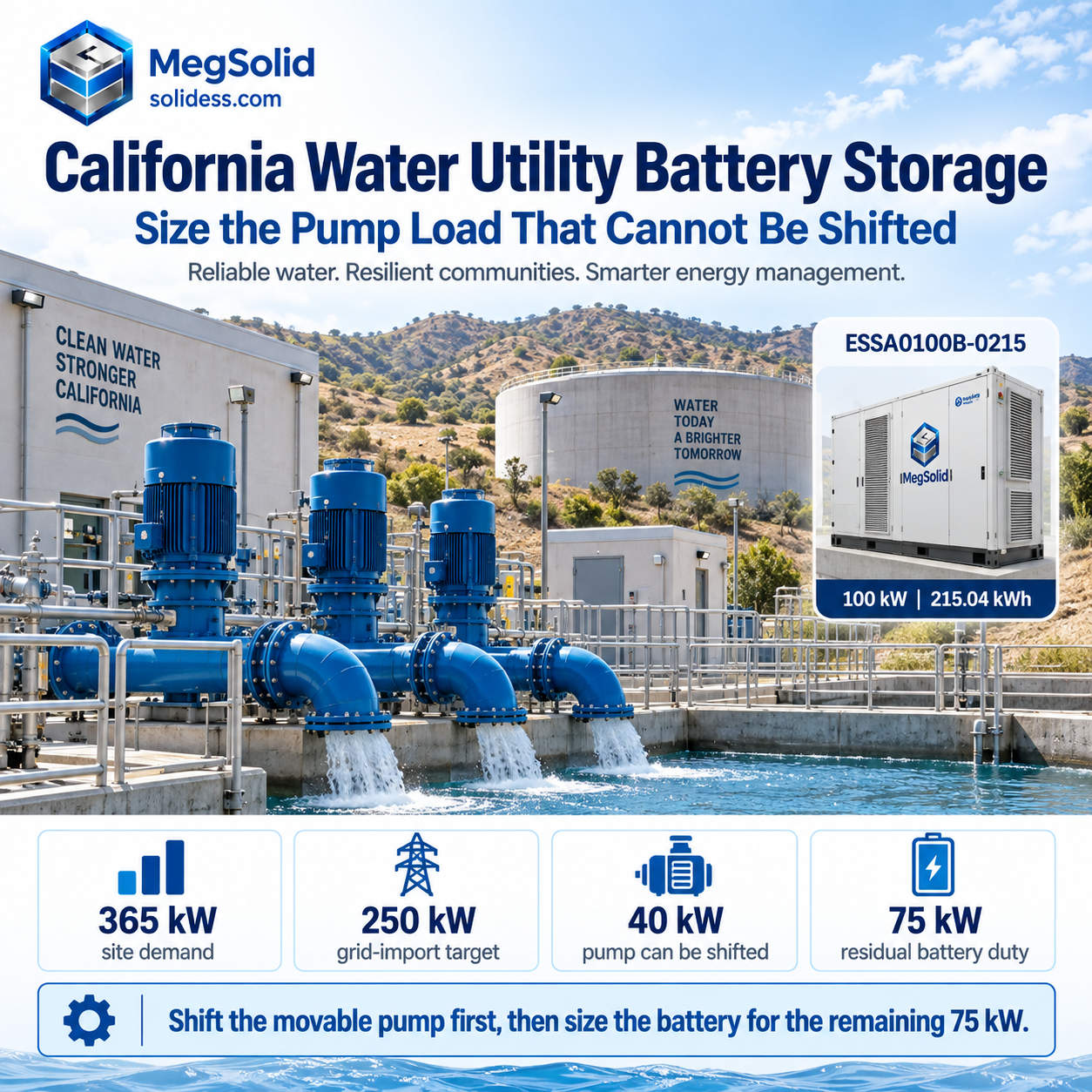
In Irvine, California, water operators must maintain pumping even when peak-hour electricity is expensive. Sizing against the original site peak can leave the utility buying storage for pumping that can be rescheduled.
ميغ صوليد ESSA0100B-0215 is the right cabinet for a 75 kW residual deficit: 100 kW rated output and 215.04 kWh nominal storage support C&I energy storage مع نظام التحكم في تخفيف الأحمال القصوى (PCC).
Keep Irvine Water Pumps Operating During Expensive Peak Hours
Water-service requirements can force pumping into costly electricity periods. Pumps may have to run to protect reservoir levels and customer pressure just when grid electricity is most expensive.
Stopping every pump can compromise water delivery. Sizing the battery around every installed motor adds capacity that may be unnecessary when some pumping can move to another hour.
Irvine Ranch Water District (IRWD) provides a documented local precedent. In June 2018, its Michelson Water Recycling Plant completed a 2.5 MW / 15 MWh behind-the-meter installation as part of a larger district-wide battery program.
IRWD reported charging at lower electricity rates and using stored power during peak periods. Its June 2018 announcement reported approximately $500,000 in annual energy-cost savings for the district-wide storage network, not for the Michelson installation alone or a MegSolid cabinet. Read the original IRWD project announcement.
الـ California Energy Commission's 2024 Irvine load-shifting report documents both battery-assisted load reduction and the difficulty of changing operating schedules at water facilities. Start the battery sizing with the pumping load that cannot move outside the peak period.
Match the Remaining Duty to the ESSA Cabinet
MegSolid ESSA0100B-0215 solves the defined 75 kW equipment requirement in one 100 kW-class cabinet. The LFP battery, power conversion, isolation transformer and IP54 housing are integrated into one cabinet. The 215.04 kWh battery nameplate supports initial energy selection; usable AC delivery is verified against the actual duty. Michelson documents utility storage in operation; its project capacity is not a sizing benchmark for this smaller MegSolid duty.
Shift Only the Pumping That Water Storage Can Safely Replace
The smaller facility in this sizing example reaches 365 kW against a 250 kW grid-import operating target. The 40 kW pump can be rescheduled; the remaining load must run through the 75-minute peak. Reservoir operating limits determine whether that 40 kW pump can actually stop.
| Operating input | Before scheduling | After scheduling |
|---|---|---|
| Site demand during the peak | 365 kW | 325 kW |
| Grid-import operating target | 250 كيلوواط | 250 كيلوواط |
| Required battery contribution | 115 kW | 75 كيلوواط |
| Shifted pump | — | 40 كيلوواط |
| Non-shiftable interval | 75 minutes | 75 minutes |
The initial battery power requirement is 365 − 250 = 115 kW. Deferring the 40 kW pump reduces it to 365 − 40 − 250 = 75 kW. One 100 kW ESSA cannot meet 115 kW at rated output. After the pump shift, its rating clears the preliminary 75 kW power screen.
Close the hydraulic balance before removing 40 kW
The deferred pump draws 40 kW and delivers 60 m³/h at the specified head. Confirm both duty-point values against its pump curve.
During the 75-minute peak, storage replaces 60 m³/h of pumping, requiring 60 × 75/60 = 75 m³ of usable water. The operating plan needs 75 m³ of usable storage above the approved minimum level and in addition to any required emergency or fire reserves. Include demand and other inflows in the operating model. The 75 m³ covers only the stated incremental service from this pump.
| Hydraulic check | Required result |
|---|---|
| Pump flow at operating head | 60 m³/h, confirmed from the pump curve |
| Deferred pumping window | 1.25 h |
| Water volume taken from usable storage | 75 m³ |
| Minimum level, pressure and service reserve | Maintained for the full interval |
Confirm the water-service duty before selecting the battery power class. The existing wastewater pump station BESS guide addresses emergency pumping and wet-well limits; the present application sizes storage for normal grid-connected peak operation, with a separately controlled water reservoir.
Put the Remaining 75 kW on MegSolid ESSA0100B-0215
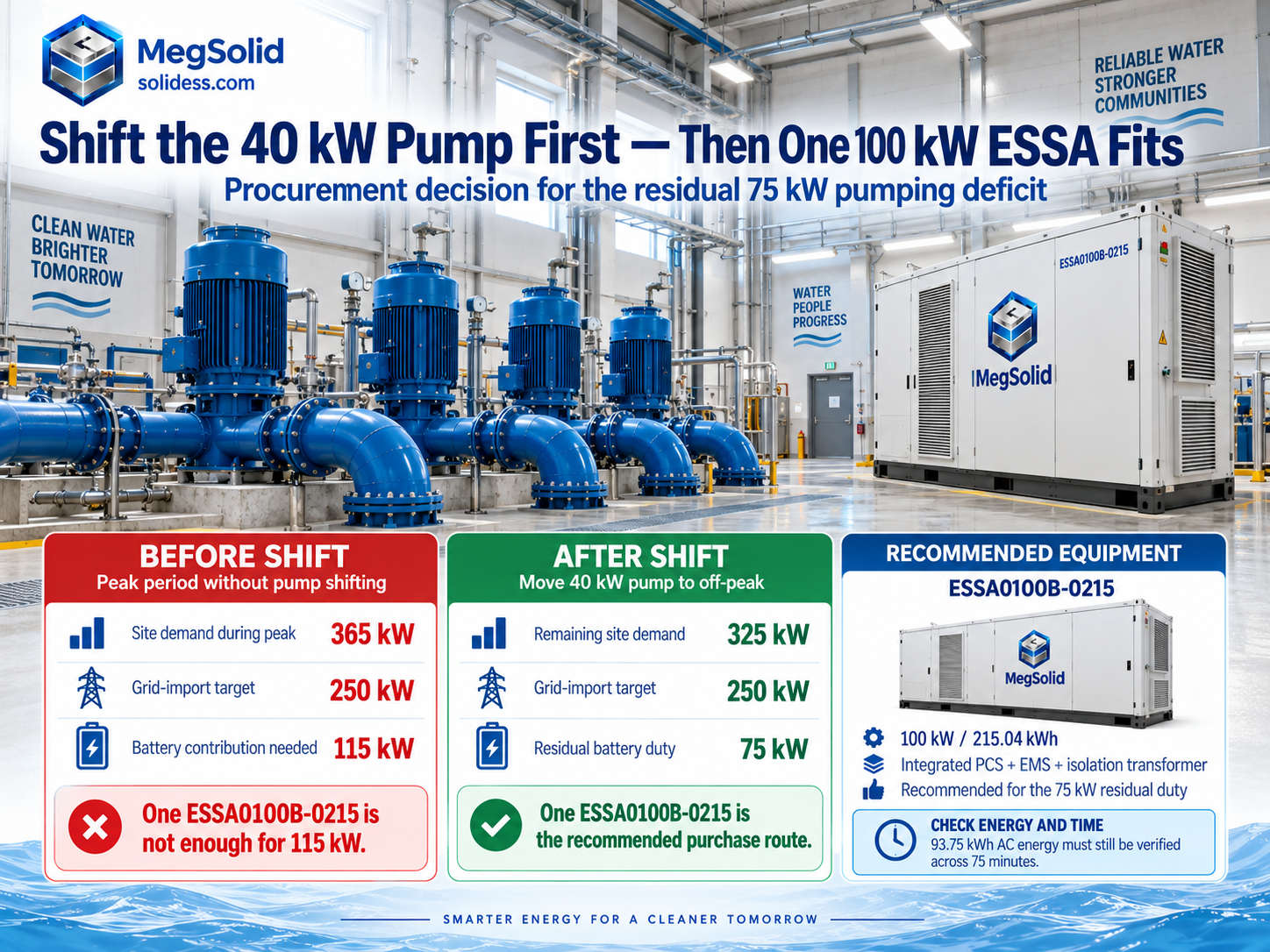
ESSA0100B-0215 is the recommended purchase for the scheduled-pump duty. Its rated AC output is 100 kW against the remaining 75 kW demand. The 25 kW difference is rated-power headroom, not a promise that every transient or temperature condition can be handled without derating.
| Purchase question | المتطلبات | MegSolid answer |
|---|---|---|
| Battery discharge power | 75 كيلوواط | 100 kW rated AC output |
| Initial rated-power margin | 25 كيلوواط | Included within the 100 kW rating |
| مدة الذروة | 75 min | Verify usable energy at the required duty |
| AC energy at steady 75 kW | 93.75 kWh | 215.04 kWh nominal battery; validate AC delivery |
| جهد التوصيل | Existing system to be confirmed | 400 V rated AC, 144 A rated current |
| Installation package | Outdoor location | IP54, intelligent air cooling, built-in isolation transformer |
The outdoor cabinet integrates the battery and PCS. Its built-in transformer reduces the core storage components that must be specified separately.
External switchgear, protection, meter integration, cable routing and civil work remain site responsibilities. Configure the integrated control system against the approved PCC measurement. The product nameplate alone does not establish performance at the site grid limit.
The original 115 kW deficit points to a larger conversion stage; rescheduling the pump brings the requirement within the 100 kW ESSA class. The 100 kW ESSA directly answers the remaining duty, and the MegSolid C&I product portfolio retains higher-power choices if the water operating plan later changes.
Prove 93.75 kWh of Delivered AC Energy Across the Pumping Window
The 75 kW deficit sets the discharge-power duty; its 75-minute duration establishes the delivered-energy requirement.
Specify the Delivered-AC-Energy Boundary
Required AC energy = 75 kW × (75 ÷ 60 h) = 93.75 kWh. The 215.04 kWh ESSA nameplate is nominal battery energy, not a guarantee of 215.04 kWh at the site AC meter. The usable amount depends on starting SOC, permitted SOC floor, discharge limits, converter losses, auxiliaries and temperature.
The acceptance test must demonstrate at least 93.75 kWh at the agreed AC boundary while maintaining 75 kW for 75 minutes, plus any additional margin stated in the contract. Required reactive power, other battery duties and control margin must be added to the final test profile rather than hidden in a made-up efficiency percentage.
Specify the Duty-Cycle Test Against IEC References
IEC 62933-2-1:2017 defines energy-storage system parameters and general testing methods. IEC TS 62933-2-2:2022 provides application and duty-cycle performance testing.
Use the two standards to define tests against the utility's actual peak, with nominal battery kWh kept separate from delivered AC energy. The MegSolid usable-AC-energy test guide explains why the measurement boundary, SOC window and discharge duty must be written into acceptance documents.
When the next peak arrives before full recharge, the available energy must still cover it. Passing the first event does not validate the second. Reservoir recovery and battery recharge must both finish within their operating schedules.
Refill the Reservoir and Recharge ESSA Without Creating Another Grid Peak
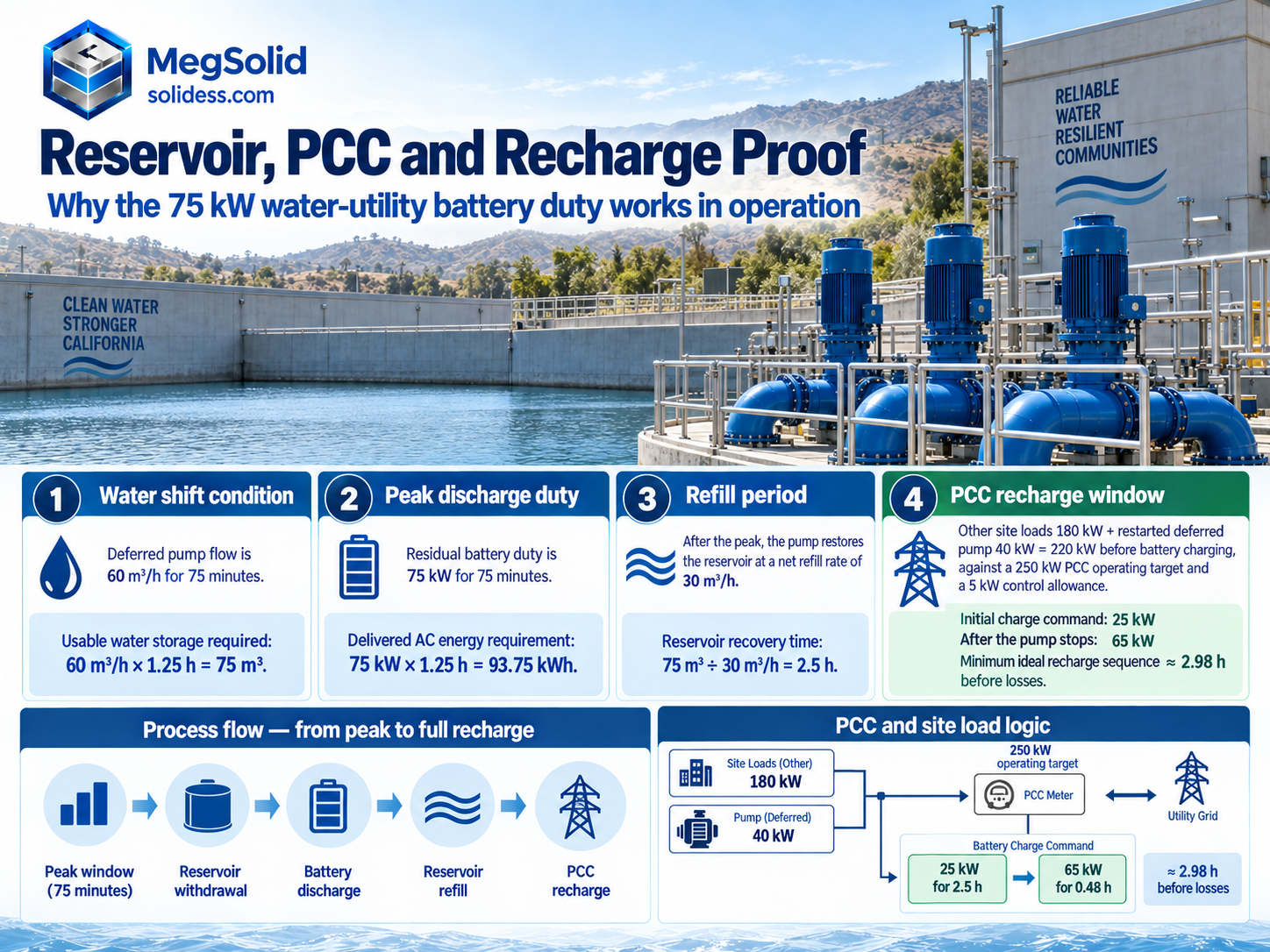
Once the expensive period ends, the deferred pump runs again to replenish the missing 75 m³. During recovery, the pump supplies 60 m³/h and concurrent water demand draws 30 m³/h. Check that the pump maintains the specified flow as reservoir level changes.
Net refill is 60 − 30 = 30 m³/h, so the reservoir requires 75 ÷ 30 = 2.5 hours to regain its prior level. Changes in pump head, water use or other inflows will alter the calculated refill time.
Reservoir refill also has to fit the PCC import ceiling:
| Recovery-period power | القيمة |
|---|---|
| Other site loads | 180 كيلوواط |
| Restarted deferred pump | 40 كيلوواط |
| Site demand before battery charging | 220 kW |
| PCC operating target | 250 كيلوواط |
| Theoretical grid-charging headroom | 30 كيلوواط |
| Defined control allowance for this duty | 5 kW |
| Initial battery charging command | 25 كيلوواط |
The calculated 250 − 220 − 5 = 25 kW is a project operating command, not a published MegSolid default. The EMS must reduce or pause charging if other loads rise, and the charge rate must stay within the cabinet's live BMS and PCS limits. The PCC control guide explains the meter-led charging boundary.
The recharge window changes after the reservoir is full
During the 2.5-hour refill period, a constant 25 kW charging command supplies 62.5 kWh of AC input if the full headroom remains available; changing facility demand or BMS limits reduces this amount. When the shifted pump stops, site demand returns to 180 kW. At the same 250 kW target and 5 kW control allowance, the calculated grid-import charging ceiling rises to 65 kW, subject to live BMS, PCS and control limits.
| Charging stage | Time or energy | AC input |
|---|---|---|
| While restoring 75 m³ | 2.5 h at 25 kW | 62.5 kWh |
| After reservoir refill | Remaining 31.25 kWh at 65 kW | 0.48 h in an ideal lossless comparison |
| المجموع | About 2.98 h | 93.75 kWh input, before losses |
الـ 2.98-hour result is an ideal lower bound under the two-stage schedule. Restoring a previous 93.75 kWh AC discharge requires more than 93.75 kWh of charging input once charging, discharge and auxiliary losses are considered. Actual recovery time depends on measured performance and may be longer; no fixed recharge time or SOC is promised by these arithmetic figures.
MegSolid's integrated cabinet and EMS interface let the project define charging around both resource schedules. More battery capacity cannot compensate for insufficient grid-charging headroom. When the next peak arrives soon, revise the dispatch plan, increase permitted recharge power or confirm that additional stored energy is available. Time-stamped water and AC power records determine which recovery adjustment is needed.
Review the 75 kW peak, 93.75 kWh AC duty, 75 m³ water shift and the complete reservoir and battery recovery sequence against the ESSA equipment package.
Connect the 400 V Cabinet at the Meter That Defines the Import Target
ESSA0100B-0215 has a published 400 V rated AC interface and 144 A rated current. At 75 kW with balanced 400 V three-phase operation and unity power factor, the calculated current is 75,000 ÷ (√3 × 400) ≈ 108.3 A. The current estimate applies only to steady-state operation. Motor starts, reactive requirements and installed protection need separate verification.
| Measured boundary | Power during the peak |
|---|---|
| Loads after pump rescheduling | 325 kW |
| ESSA discharge | 75 كيلوواط |
| Net PCC grid import | 250 كيلوواط |
The grid supplies 250 kW and the ESSA supplies 75 kW, but the downstream distribution still serves 325 kW. Reducing the utility-meter reading does not remove an overload on the site busbar.
Verify the connection point, feeder current, busbar rating, fault duty, breaker selectivity and earthing against the existing 400 V switchboard guide و interconnection readiness requirements.
Verify PCC Metering and Interconnection Permissions
The EMS must use verified measurements at the agreed point of common coupling (PCC). CT polarity, phase allocation, timestamps and loss-of-meter response belong in site acceptance. The 25 kW difference between the nominal 100 kW equipment rating and the base 75 kW command leaves capacity to evaluate control adjustments, but any sustained additional discharge changes the required energy and must be included in the approved duty.
Where the connection falls under California Public Utilities Commission jurisdiction, Electric Rule 21 governs applicable generation and storage interconnection, operation and metering. Confirm the serving utility's current tariff, non-export or approved export mode, equipment requirements and permission to operate; peak shaving does not itself authorize export. Rule 21 defines the interconnection reference; it does not establish certification for this ESSA model.
The MegSolid cabinet includes an isolation transformer; the EPC still has to demonstrate that the existing electrical infrastructure can safely accept the installation.
Upgrade the MegSolid Power Class Only if Water-Service Constraints Demand It
Pump scheduling is not always feasible. When a reservoir cannot provide 75 m³ above its required reserves, the 40 kW deferred pump may have to run during the peak. The resulting deficit returns to 115 kW. One ESSA0100B-0215 is rated at 100 kW and cannot meet that steady duty on its own.
| Product route | التقييم المنشور | Purchase decision |
|---|---|---|
| ESSA0100B-0215 | 100 كيلوواط / 215.04 كيلوواط·ساعة (القيمة الاسمية) | Keep for 75 kW duty after water shifting and AC energy verification |
| إينرجون 261 | 125 كيلو فولت أمبير / 261.24 كيلو واط ساعة (قيمة اسمية) | Evaluate a higher-rated integrated cabinet only after confirming continuous active kW and reactive duty |
| MEGA0150TS PCS | 150 kW rated AC | Power-conversion route for 115 kW when paired with a compatible, engineered battery, DC system and controls |
| ESSC0500B-1075 | 500 kW / 1.0752 MWh nominal | Reserve for a substantially larger aggregated pumping and energy requirement |
Check the Energon Active-Power Limit
125 kVA does not mean 125 kW. At 0.95 power factor, 125 kVA gives 118.75 kW mathematically. Continuous active output must still follow Energon's approved operating limits and reactive-power requirements. Its additional nominal battery energy cannot substitute for proof of active output.
The MEGA0150TS is a 150 kW PCS, not a complete battery package. Its required battery, DC protection, EMS integration, cooling and AC delivery test must be engineered together. The 115 kW deficit alone does not justify purchasing a 500 kW container.
The configuration follows the verified duty: one integrated ESSA for 75 kW; a different cabinet or a 150 kW PCS-based system if hydraulic constraints leave 115 kW unavoidable. No unverified ESSA parallel capability is needed to support that recommendation.
Verify Water Service, PCC Performance and Battery Energy Together
Commissioning must demonstrate uninterrupted water service during the expensive interval and grid import within the agreed operating target. Factory records cannot establish water-service performance or the installed PCC measurement boundary.
| Acceptance stage | Evidence to capture | القرار |
|---|---|---|
| Water-service period | Usable reservoir starting level, 75 m³ withdrawal, pressure and required flow | Service remains within approved water limits |
| Peak discharge | ESSA actual kW, live BMS limits, SOC and 75-minute trend | 75 kW base duty and specified AC energy are delivered |
| PCC operation | Synchronized utility-meter import and battery discharge | 325 − 75 = 250 kW operating target is achieved within the agreed tolerance |
| Reservoir recovery | Pump rate, concurrent consumption, water level and 2.5-hour schedule | Refill closes without violating service reserves |
| Battery recovery | Grid charge power, cumulative AC charging input, usable recovered AC output | Enough energy is available before the next peak |
| Abnormal operation | Meter loss, SOC floor, overcurrent and protective actions | Safe, recorded response without unsupported control claims |
الاستخدام IEC TS 62933-2-2:2022 to define the complete application-duty test; use IEC 62933-5-2:2025 to address electrochemical energy-storage system safety during design, installation and operation. These documents inform project requirements and do not assert a product certification. The MegSolid site acceptance checklist separates installed-function checks from the delivered-energy test.
The operational record must show one linked time series of water level, flow, pressure, site consumption, PCC import, battery power, SOC and active charge/discharge limits. The buyer needs that complete record to verify the full duty, not just the first successful discharge.
Compare the integrated ESSA package with Energon and MEGA power classes using your required pump schedule, AC delivery and approved interconnection boundaries.
الأسئلة الشائعة
Can battery storage lower pumping peaks without interrupting water service?
Yes, when water levels and pressure remain inside the approved limits and the battery covers the non-shiftable electrical demand. Verify both water delivery and PCC performance on the same duty cycle.
Which MegSolid cabinet serves a 75 kW residual pumping deficit?
ESSA0100B-0215 is the recommended 100 kW-rated cabinet for the defined duty. Its 215.04 kWh nominal capacity requires a 93.75 kWh usable-AC-energy acceptance check over 75 minutes.
Does moving a 40 kW pump change the storage power class?
Yes. The example's 115 kW deficit falls to 75 kW after scheduling, bringing the residual requirement within one ESSA's 100 kW rated output.
How much usable water is needed to stop the deferred pump for 75 minutes?
At 60 m³/h, the interval uses 75 m³ of storage above the approved minimum and required water reserves. The hydraulic operating model must confirm pressure and water demand.
Does a 215.04 kWh battery guarantee 215.04 kWh at the AC terminals?
No. The value is nominal battery energy. The site needs tested usable AC output at the approved SOC range, load, temperature and measurement boundary. See the usable-energy test guide.
Can the battery recharge while the reservoir refills?
Yes, within available PCC headroom and the live charge limit. In the stated recovery period, 220 kW of load leaves 30 kW below a 250 kW target; a 5 kW operating allowance produces an initial 25 kW charge command.
Is the battery fully recovered after the reservoir's 2.5-hour refill?
Not necessarily. At 25 kW the first 2.5 hours supply at most 62.5 kWh AC input; after pump shutdown more charging headroom may be available. The next-peak SOC depends on measured losses and the remaining interval.
Can ESSA0100B-0215 connect to an existing 400 V pump station?
The cabinet's rated AC voltage is 400 V, but the EPC must check bidirectional feeder current, switchboard fault duty, protection, metering and applicable utility interconnection requirements.
Will one ESSA handle the original 115 kW deficit without pump scheduling?
No. Its rated output is 100 kW. Either restore the 40 kW pump shift or engineer a higher-power MegSolid configuration.
What result should the utility accept before commercial operation?
The combined water-and-BESS test should demonstrate acceptable pressure and reservoir levels, 75 kW over 75 minutes, at least 93.75 kWh AC delivery, controlled PCC import and adequate recovery for the next event.
Can Irvine water facilities use an integrated BESS to manage expensive pumping hours?
Yes, when the water-service schedule and approved electrical interconnection allow it. The documented IRWD project establishes local precedent; ESSA is the defined 100 kW-class option for the smaller duty assessed here.
Does the same cabinet suit other California water districts?
It can serve facilities with comparable verified power, energy, reservoir and connection requirements. Applicable utility tariffs and project operating limits must be checked for each location.
Can water utilities outside California use this MegSolid cabinet?
The 400 V ESSA can be evaluated where its electrical interface and environmental conditions fit. Local grid rules, hydraulic duty, usable AC energy and required protection determine the final configuration.