
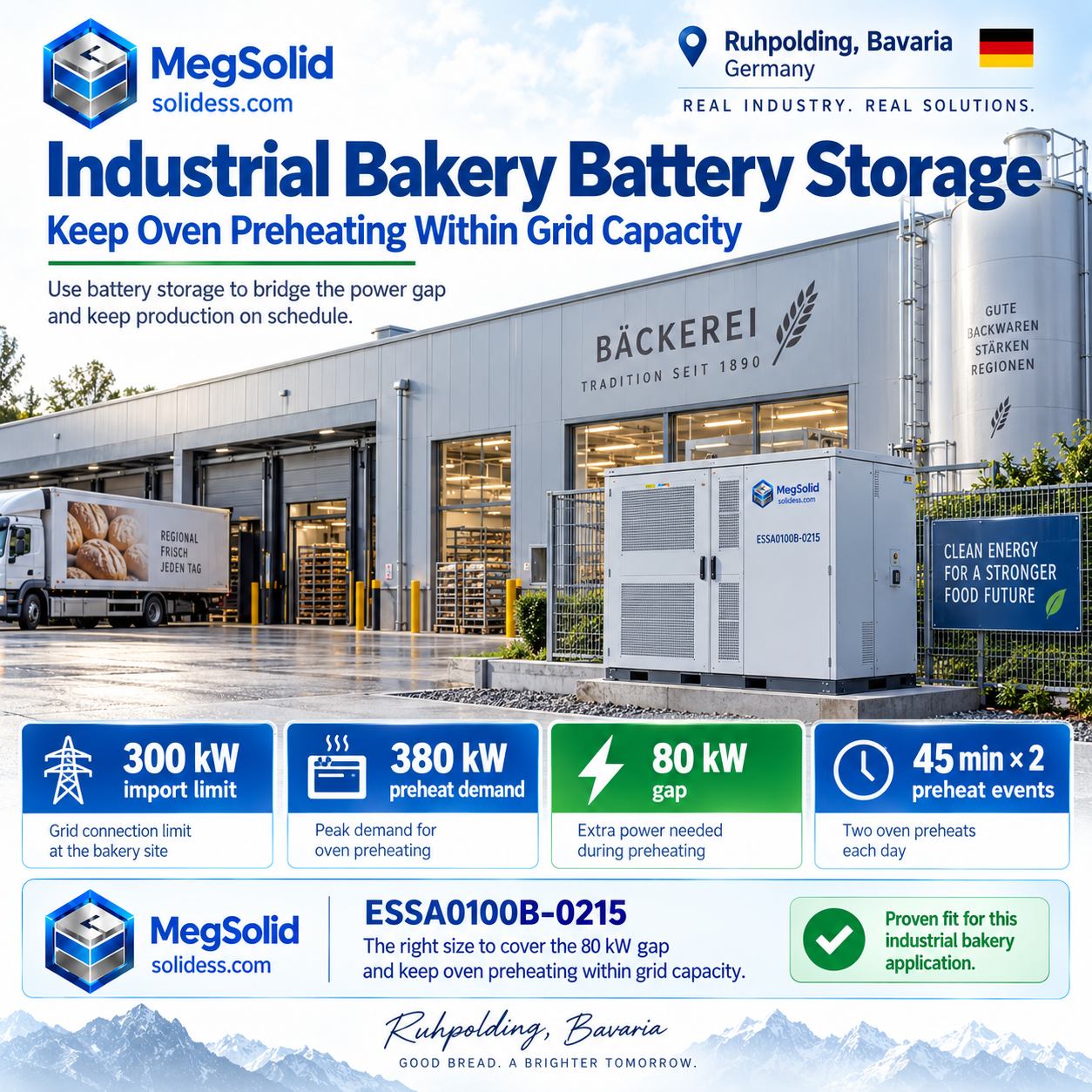
The documented bakery installation in Ruhpolding, Bavaria, Germany, shows the production impact of oven-driven power peaks. At a separate bakery with 380 kW of preheating demand against a 300 kW grid-import limit, MegSolid ESSA0100B-0215 directly addresses the 80 kW shortfall with 100 kW rated output, 215.04 kWh nominal storage and integrated C&I energy storage.
Keep the First Baking Batch on Schedule With MegSolid ESSA0100B-0215
The first batch has to wait until the ovens reach operating temperature. Staggered preheating keeps import below the grid limit but delays baking and packing. Upgrading the utility connection may take longer than the production schedule allows. The storage system must cover the peak and preserve enough energy for the next batch.
In Ruhpolding, Bavaria, Germany, an industrial bakery project addressed daily electricity peaks of 100–150 kW caused by ovens and other equipment. Dumarey’s installed system kept grid demand at 100 kW while the ovens ran together, allowing production to continue without upgrading the connection. The Ruhpolding installation is Dumarey’s project, not a MegSolid installation.
The 80 kW Power-Class Decision
MegSolid ESSA0100B-0215 is the best-fit product for the bakery's defined 80 kW power deficit. Its 100 kW rated PCS provides 20 kW of nameplate headroom, while the 215.04 kWh nominal LFP battery, integrated EMS and built-in isolation transformer put the key storage equipment into one cabinet. The 80 kW gap does not require the bakery to order a separate 150 kW PCS just to start the ovens.
The 100 kW rating covers the initial 80 kW power requirement. The cabinet must also deliver both batches at the accepted AC energy boundary, with charging controlled beneath the grid limit.
Measure the Oven Power That Production Cannot Reschedule
Oven nameplates do not establish the required battery discharge. Record total site active power during the preheat period, identify which ovens must operate simultaneously, and compare the measured demand with the grid-import ceiling established for the connection.
The bakery operates with a 300 kW import ceiling and reaches 380 kW when the ovens preheat together. Each of the two preheat events lasts 45 minutes. Between them, production runs for 45 minutes at a site load of 260 kW.
| Production input | متطلبات الموقع | Purchasing consequence |
|---|---|---|
| Approved import ceiling | 300 كيلوواط | Maximum grid contribution for this duty |
| Coincident site load during preheat | 380 kW | Defines the peak deficit |
| Site load between batches | 260 kW | Leaves limited charging headroom |
| Preheat duration per batch | 45 minutes | Determines the energy required per event |
| Number of preheat events | 2 | Makes one-cycle sizing insufficient |
The continuous battery-power requirement is 380 − 300 = 80 kW AC. Each preheat event needs 80 × 45/60 = 60 kWh AC if the deficit remains at 80 kW for the full 45 minutes.
One 50 kW ESSA leaves 30 kW of the 80 kW deficit uncovered at rated output. The 100 kW ESSA0100B-0215 instead has 20 kW of rated-power headroom above the initial duty; live BMS, PCS and environmental limits still govern available output.
The 80 kW and 60 kWh results define the duty for each preheat. Verify it against the site load profile and measured AC delivery across the full production cycle, not equipment nameplates.
Use the Integrated 100 kW Cabinet Without Oversizing the Power Stage
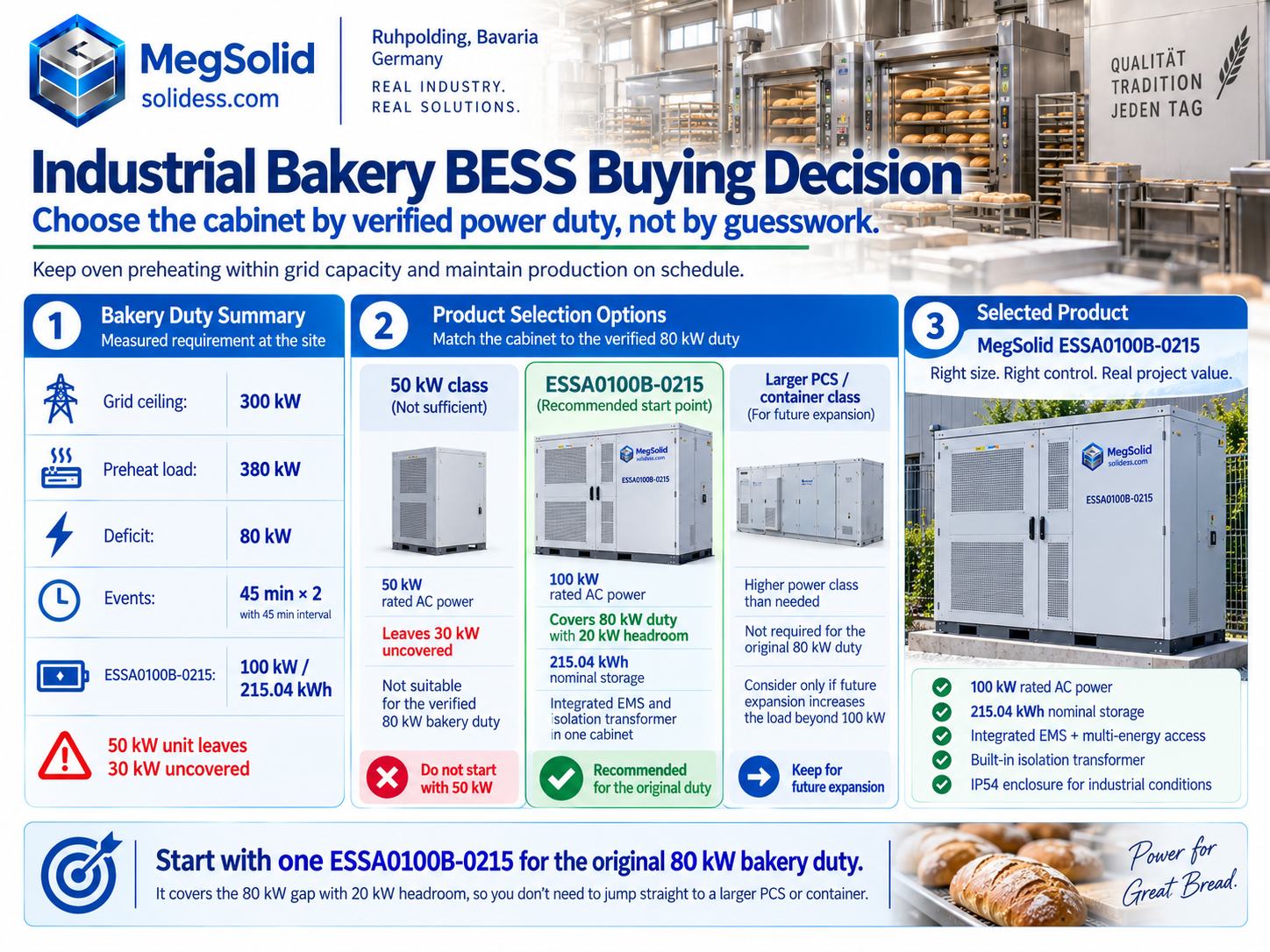
Specify MegSolid ESSA0100B-0215 for the bakery's 80 kW preheating duty. Its 100 kW rated AC output provides 20 kW of nameplate headroom, and its integrated LFP battery, PCS, EMS and isolation transformer consolidate the principal storage equipment in one cabinet. The first-batch power requirement does not call for a larger conversion stage.
| MegSolid ESSA0100B-0215 specification | القيمة المنشورة | Why it matters at the bakery |
|---|---|---|
| القدرة المقدرة للتيار المتردد | 100 كيلوواط | Covers the initial 80 kW peak-support screen |
| الطاقة الاسمية للبطارية | 215.04 كيلوواط/ساعة | Establishes the capacity class for two-batch verification |
| Rated AC voltage / current | 400 V / 144 A | Defines the feeder and board compatibility review |
| Battery chemistry / cooling | LFP / intelligent air cooling | Defines the equipment and thermal-management package |
| درجة الحماية | IP54 | Informs installation conditions; does not replace a site assessment |
| Integrated equipment | EMS and isolation transformer | Consolidates major storage and conversion functions within the cabinet |
The 215.04 kWh nameplate identifies the battery class. Usable AC energy over the approved SOC window determines whether it can complete both batches. The site-level BESS design connects that duty to protection and the approved electrical arrangement.
The integrated 100 kW cabinet covers this power duty; peak power alone does not justify a larger PCS or container. The built-in isolation transformer is part of the supplied package; site switchgear, PCC metering, cabling and commissioning remain in the electrical scope.
Size Stored Energy for Two Consecutive Preheating Batches
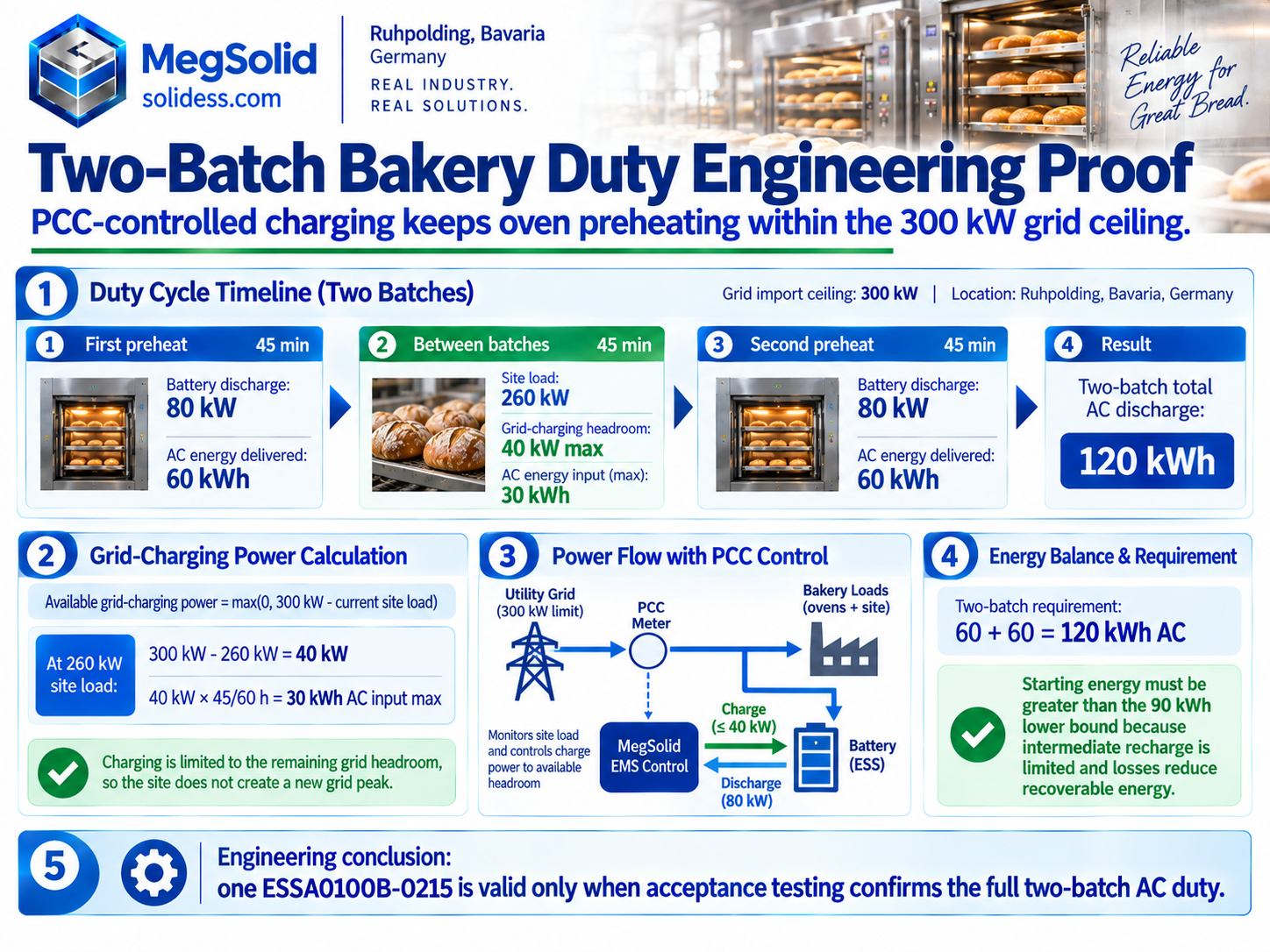
Keep the ESSA0100B-0215 recommendation tied to the entire production morning, not only the first oven cycle. Each 45-minute event requires 60 kWh AC at the 80 kW deficit, so two batches need 120 kWh of delivered AC energy before intermediate charging. An undersized energy window would preserve the first batch but delay the second even when the PCS power rating is sufficient.
Between batches, site demand falls to 260 kW, leaving 300 − 260 = 40 kW of theoretical charging headroom. Over 45 minutes, that allows at most 40 × 45/60 = 30 kWh of AC charging input at the defined grid boundary. That is a ceiling before any control margin, fluctuations, equipment restrictions or conversion losses—not a 40 kW fixed charging instruction or 30 kWh of energy that the battery can later deliver.
| Production stage | Battery duty | حدود الطاقة |
|---|---|---|
| First preheat: 45 minutes | Discharge 80 kW | 60 kWh AC delivered |
| Between batches: 45 minutes | Grid charging below 40 kW once a control margin is applied | Less than 30 kWh AC input with a positive margin and steady 260 kW load |
| Second preheat: 45 minutes | Discharge 80 kW | 60 kWh AC delivered |
| Required energy available at start | 120 kWh discharge minus AC-discharge-equivalent energy recovered between batches | Greater than the loss-free 90 kWh lower bound; final value comes from the verified duty cycle |
Starting Energy Must Exceed the 90 kWh Lower Bound
The 90 kWh figure is a loss-free lower bound, not the required starting SOC or an acceptance value. At the agreed AC delivery boundary, define E₀ as the AC energy deliverable from the starting SOC down to the approved minimum SOC, and Eᵣ as the additional AC energy recoverable from charging between batches.
The two-cycle requirement is E₀ + Eᵣ ≥ 120 kWh AC, plus any separately specified concurrent duty. The positive grid-import margin cuts charging input below 30 kWh, and conversion losses reduce recoverable discharge energy further. E₀ must exceed 90 kWh AC for the stated duty.
If a reserve is required, exclude it when measuring E₀; do not count the reserve as usable production energy.
Verify the Two-Batch Duty Before Ordering
MegSolid ESSA0100B-0215 combines the required 100 kW power class with 215.04 kWh nominal storage in one product. That capacity provides the basis for assessing both oven cycles without moving directly to a larger equipment class. Purchase acceptance is the measured usable AC energy over the agreed SOC window, not an assumed conversion of nameplate kWh into runtime. IEC TS 62933-2-2:2022 addresses application duty cycles and performance testing; the project test must reproduce the 60 kWh discharge, limited charging interval and second 60 kWh discharge against agreed criteria.
The purchasing route is one ESSA0100B-0215, with the complete two-batch duty written into acceptance. Its tested AC output, available energy, starting SOC and site temperature must sustain the production schedule. That test determines whether the specified single cabinet can serve production without increasing equipment size on an unverified energy assumption.
Keep both preheating batches on schedule. MegSolid can review the 80 kW duty, two 45-minute heating periods and intervening recharge window to confirm whether one ESSA0100B-0215 meets the complete cycle.
Recharge Between Batches Without Creating a New Grid Peak
A fixed 40 kW charging command works only while the bakery's other loads remain at 260 kW. If process demand rises to 280 kW, that same command would raise grid import to 320 kW and breach the stated 300 kW ceiling.
Set a positive import-control margin M (kW) for normal load changes, meter and command delay, and other site uncertainties. Its value comes from the utility limit, recorded load steps and commissioning tests—not an invented universal percentage. The PCC-meter-led EMS caps grid charging below theoretical headroom while respecting PCS, BMS, SOC and temperature limits:
Grid-charge command ≤ min(permitted equipment charge power, max(0, 300 kW − measured non-BESS site load − M))
| Non-BESS site load | Theoretical headroom | Grid-charge command with margin M | Intended import while charging |
|---|---|---|---|
| 260 kW | 40 كيلوواط | ≤ max(0, 40 − M) kW | ≤ 300 − M kW when charging is enabled |
| 280 kW | 20 كيلوواط | ≤ max(0, 20 − M) kW | ≤ 300 − M kW when charging is enabled |
| 300 كيلوواط | 0 kW | 0 kW | 300 kW before new load changes |
During a steady 260 kW interval, margin-capped input is at most 0.75 × max(0, 40 − M) kWh over 45 minutes; equipment limits or rising load can reduce it further. Charging input must not be treated as recoverable AC discharge: the verified round-trip path determines Eᵣ in the two-batch energy test.
MegSolid ESSA0100B-0215 brings the EMS and published RS485/TCP/IP communications into the cabinet rather than requiring a separately selected core storage controller. At the bakery, the measured site load sets charging availability; the next preheat takes priority when demand rises. The project integrator must verify external meter compatibility, CT polarity, data freshness, response time and fallback behavior during commissioning.
Commission the PCC-Control Response
الـ PCC control sequence should reduce or stop charging as ovens ramp toward the next preheat period. Commissioning must test the actual meter-to-EMS-to-PCS response and adjust M or operating logic when load steps threaten the agreed import boundary.
ESSA coordinates the power and energy duty in one cabinet: at a steady 260 kW site load, the theoretical 40 kW charging window is available; if the load rises to 280 kW, headroom falls to 20 kW before the project margin. The EMS dispatch must follow the changing meter reading so charging does not become a new reason to stop the ovens. Contractual averaged demand and instantaneous connection limits require separate control settings where the utility agreement distinguishes them.
Connect the 400 V ESSA Without Overloading the Bakery Switchboard
MegSolid ESSA0100B-0215 gives a 400 V bakery an integrated 100 kW storage interface with a 144 A rated AC current and built-in isolation transformer. The specified voltage matches the initial low-voltage equipment class, allowing the project to focus its connection study on the actual feeder, switchboard, protection and import-meter boundary. The board must still have enough capacity for the approved connection.
At 400 V three-phase, balanced and unity power factor, the initial 80 kW battery contribution corresponds to approximately 80,000/(√3 × 400) = 115.5 A. The combined 380 kW load corresponds to roughly 548.5 A on a common three-phase section at the same screening assumptions. Actual board and feeder duties depend on topology, power factor and measured phase loading.
| Connection boundary | Required engineering decision |
|---|---|
| ESSA outgoing feeder | Check current carrying capacity, isolation and protective device |
| Main busbar and downstream paths | Trace the full combined grid-plus-battery current, not just net grid import |
| Transformer and incomer | Verify bidirectional flows, loading and approved operating modes |
| PCC meter and CTs | Measure the same boundary governed by the import agreement |
| Protection and earthing | Verify fault duty, coordination, neutral arrangement and safe shutdown |
During the preheating event, the intended balance is 300 kW from the grid plus 80 kW from the battery to supply 380 kW of site load. The existing-switchboard assessment must trace where those power flows combine and which components actually carry them.
Keep the Grid-Connection Boundary Separate from the Cabinet
الـ interconnection scope fixes the one-line diagram and metering boundary before equipment ordering. ESSA's built-in isolation transformer avoids specifying that component as a separate part of the core cabinet package; external switchgear, protection and any site transformer duties remain governed by the approved design.
IEC 62933-5-2:2025 provides system-level electrochemical-storage safety requirements for the project's design and installation review, not a blanket certification claim for this model.
Move Beyond One Cabinet Only When Production Actually Requires It
Keep MegSolid ESSA0100B-0215 for the original 80 kW oven deficit; change the product configuration when expansion actually exceeds its 100 kW power class or its accepted energy window. MegSolid's cabinet and PCS range provides a defined upgrade route. Installing another oven does not automatically call for a 500 kW container.
Suppose new ovens raise preheating demand from 380 to 420 kW while the import ceiling stays at 300 kW. The deficit becomes 420 − 300 = 120 kW, which is above one ESSA0100B-0215's 100 kW rated output.
| مسار MegSolid | القدرة/الطاقة المعلنة | قرار الشراء |
|---|---|---|
| ESSA0100B-0215 | 100 كيلوواط / 215.04 كيلوواط·ساعة (القيمة الاسمية) | Retain for the original 80 kW duty, subject to two-batch testing |
| Energon 261 liquid-cooled cabinet | 125 كيلو فولت أمبير / 261.24 كيلو واط ساعة (قيمة اسمية) | Cabinet alternative when the confirmed active-power rating and usable energy cover the new duty |
| MEGA0150TS PCS | 150 kW rated conversion power | 30 kW rated-power headroom over 120 kW; specify a compatible battery and integrated controls separately |
| ESSC0500B-1075 | 500 kW / 1.0752 MWh nominal | Container option only when verified power and energy demand justify its much larger class |
Check Energon Active Power Before the 120 kW Upgrade
الـ Energon 261 liquid-cooled cabinet provides 261.24 kWh nominal energy and a 125 kVA rating. At unity power factor, 125 kVA corresponds to 125 kW in the simple apparent-to-active power calculation; at 0.95 power factor it corresponds to 118.75 kW, below the bakery's new 120 kW requirement.
The arithmetic threshold is 120/125 = 0.96 power factor, before thermal derating and model-specific active-power limits. Use Energon for the expanded duty only when its confirmed active output and usable energy meet the complete cycle.
When the 150 kW PCS Becomes Necessary
MegSolid's MEGA0150TS PCS delivers a published 150 kW rated conversion class: 30 kW of nameplate headroom above the revised 120 kW gap. It is the clear higher-power PCS route when the Energon cabinet does not meet the confirmed active-power duty. The separate PCS still needs a compatible battery, DC protection and controls. Compare that package with the integrated cabinet on total scope and accepted AC energy.
الـ MegSolid C&I portfolio also includes ESSC0500B-1075, with 500 kW rated AC power and 1.0752 MWh nominal energy. The 500 kW container belongs to a different equipment class.
The bakery retains cabinet-class equipment until its measured peak gap, cumulative AC energy or project installation scope warrants a container.
Confirm the expansion path before upgrading equipment. MegSolid can compare the ESSA cabinet, Energon power class and 150 kW MEGA PCS route against the revised oven schedule and the bakery's electrical connection.
Prove Both Preheating Cycles Before the Cabinet Enters Production
Accept the MegSolid ESSA0100B-0215 against the bakery's actual production result: two 45-minute oven-preheating events completed while grid import remains within the approved operating limit. One successful discharge or a communication-only SAT cannot establish that result. The full sequence must test the 80 kW power duty, intervening charging and remaining usable energy together.
IEC 62933-2-1:2017 defines system performance parameters and test methods, allowing the bakery to specify the AC power and energy measurement boundary. IEC TS 62933-2-2:2022 addresses application-specific performance testing and duty cycles; the bakery should use its two-discharge, one-recharge production sequence as the agreed acceptance duty. The project establishes the pass criteria rather than treating a standard citation as an automatic product-performance guarantee.
| SAT and performance stage | What must be demonstrated |
|---|---|
| Before the first batch | Agreed starting SOC, active power limit, meter and CT mapping |
| First 45-minute preheat | 80 kW battery support and compliant measured grid import |
| 45-minute interval | Controlled charging within actual headroom; record charging input |
| Second 45-minute preheat | 80 kW support without breaching the approved minimum SOC |
| After the second batch | Valid energy balance, protection behavior and documented pass criteria |
Record Usable AC Energy at the Agreed Test Point
The usable-energy boundary must be measured at the agreed AC point, accounting for the test's approved treatment of conversion and auxiliary losses. The usable-energy test establishes the energy result, while the site acceptance procedure confirms the installed feeder, protection, meter and EMS behavior.
Accept MegSolid ESSA0100B-0215 only after it demonstrates 80 kW output, the complete two-batch AC-energy duty and PCC-controlled charging. The acceptance record must show that preheating stays on schedule and grid import remains within the agreed limit. Correct any failed acceptance item in the equipment configuration or operating plan before release.
الأسئلة الشائعة
Can a bakery avoid delaying its ovens when grid import is restricted?
MegSolid ESSA0100B-0215 is the selected 100 kW cabinet for the defined 80 kW deficit. Its accepted two-batch AC-energy duty and PCC control determine the operating schedule.
How much BESS power is needed at 380 kW site demand and a 300 kW grid limit?
The deficit is 80 kW. ESSA0100B-0215 supplies a 100 kW rated power class, leaving 20 kW of nameplate headroom.
Can bakery ovens run simultaneously without purchasing a 500 kW container?
Yes, for the defined 80 kW deficit, ESSA0100B-0215 provides the 100 kW power class in a cabinet. Include a container only when verified power, energy and installation needs justify it.
Does buying 215.04 kWh nominal capacity remove the need for a runtime test?
No. The acceptance duty is two 60 kWh AC discharges with the limited recharge interval between them. Verified energy over the approved SOC window determines whether one ESSA completes the schedule.
What happens when bakery demand rises during battery charging?
Available charging power falls with the remaining grid headroom: 260 kW site demand leaves 40 kW before margin; 280 kW leaves 20 kW. The configured EMS must reduce charging accordingly.
Is one 50 kW ESSA enough for an 80 kW shortfall?
No. One 50 kW unit leaves 30 kW of the specified deficit uncovered; MegSolid ESSA0100B-0215 supplies the required 100 kW equipment class.
Can one ESSA0100B-0215 cover a continuous 120 kW gap?
No. Cover a continuous 120 kW deficit with a confirmed higher-power cabinet or MegSolid MEGA0150TS with a matched battery system; a single 100 kW ESSA is below the requirement.
Does Energon 261 deliver 125 kW because its rating is 125 kVA?
No. At 0.95 power factor, 125 kVA corresponds to 118.75 kW in the simple calculation. Confirm Energon's active-power limit and thermal duty before committing to 120 kW.
Can ESSA0100B-0215 connect to a 400 V bakery switchboard?
Its rated AC interface is 400 V. Feeder, busbar, transformer, protection and PCC metering suitability still require an approved connection design.
Which site test should be included in ESSA acceptance?
Specify both 45-minute, 80 kW discharge periods, the actual charging window, measured PCC import and the minimum SOC limit. Pass criteria must cover the complete sequence, not one discharge.
Can industrial bakeries in Germany use BESS to stay within a restricted connection?
In Ruhpolding, Bavaria, a published industrial bakery project controlled grid demand at 100 kW during simultaneous oven operation. MegSolid ESSA is specified separately to the new site's verified demand and grid conditions.
Can a Dutch bakery use the same approach when grid capacity limits seasonal production?
A verified short-duration deficit can be supported by BESS when charging is possible within the site's contractual constraints. Local connection terms and the actual batch schedule determine the equipment configuration.
Can a UK industrial bakery use ESSA for oven preheating peaks?
ESSA's 100 kW rating provides an initial screen for an 80 kW deficit. The electrical design and utility connection conditions must be established for the specific UK site.