
South Africa BESS procurement 2026 has a formal basis in Government Notice 8021 and its 4,600 MW energy-storage allocation. The notice is not an open battery tender, a fixed MWh order or a solid-state requirement. Developers can prepare, but they still need grid conditions and contract terms before pricing a project.
General South Africa BESS approval requirements cover project permissions. The determination concerns the national procurement route. Existing South African battery-storage projects provide market context, but their specifications cannot supply the missing tender terms for this allocation.
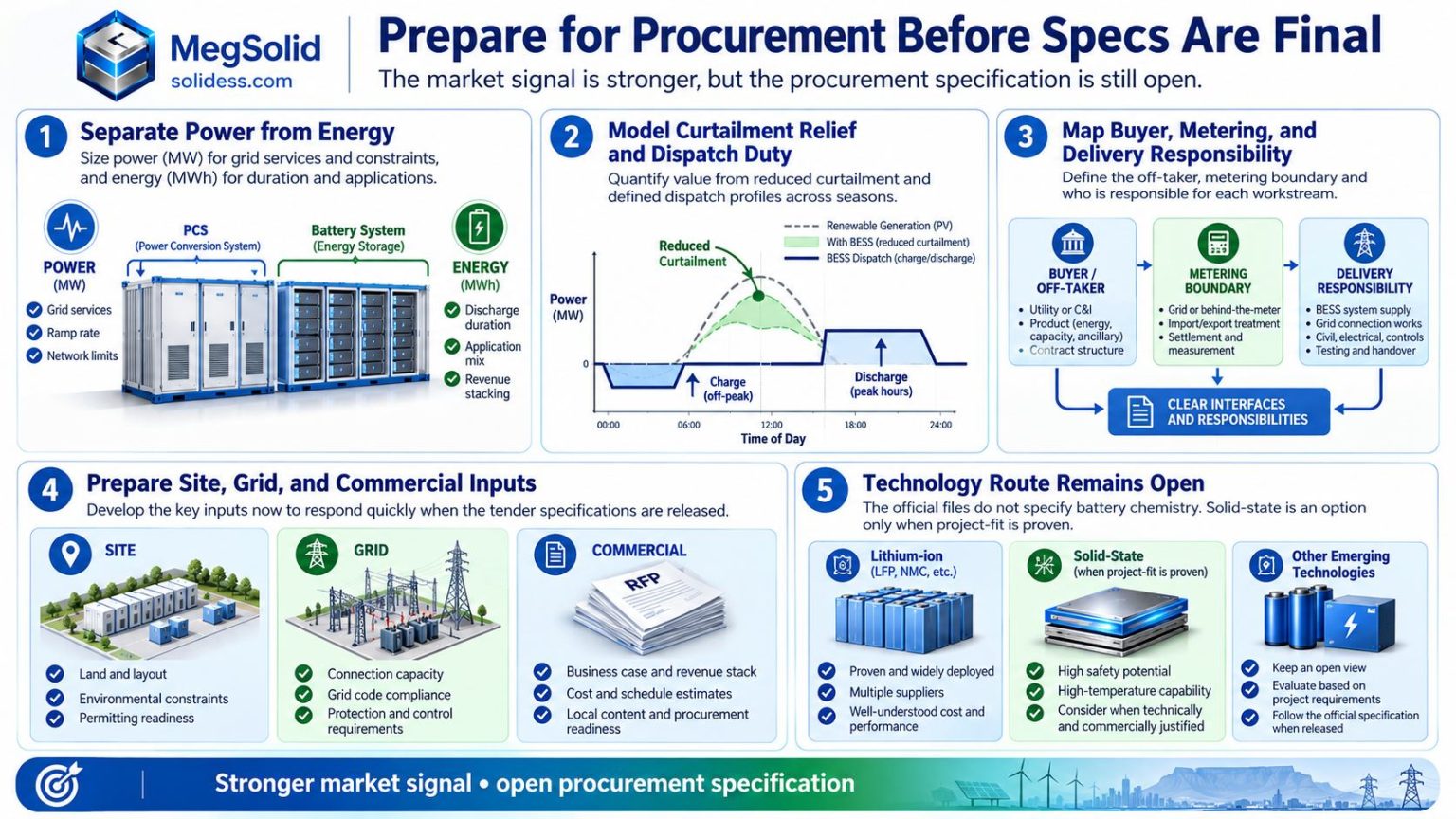
What Changed in the South Africa BESS Market This Week?
The Department of Electricity and Energy announced its proposed storage-and-gas approach on 7 October. Government Gazette No. 55543, published on 14 October, then carried the Section 34 determination as Government Notice 8021.
Its allocation is 4,600 MW of energy storage alongside 5,000 MW of gas generation. These are separate categories, not 9,600 MW of batteries. The notice refers to IRP 2025 storage allocations for 2026–2042 and gas allocations for 2031–2037; those references are not a single announced equipment-delivery deadline.
Suppliers can prepare for the 4,600 MW allocation, but this determination does not invite bids.
Bid configurations, prices and delivery commitments remain provisional until they can be checked against the procurement documents.
Who Will Procure the Capacity, and Who Will Buy the Electricity?
Notice 8021 identifies the Department of Electricity and Energy, or a successor entity designated by the Minister, as procurer. It names NTCSA, or a ministerially designated successor entity, as buyer. Electricity is to be purchased from independent power producers through the procurement programmes and their agreements.
The notice does not name a municipality as an alternative buyer or establish a Power Parks reservation. Neither belongs in a project proposal as a confirmed condition of this determination.
The procurer, project company and equipment supplier carry different contractual responsibilities. OEM quotations do not establish an independent power producer's eligibility. Equipment warranties address the supplied equipment, not the full project-delivery obligation. Those distinctions matter when a supply offer becomes part of a project proposal.
Private industrial wheeling and BESS arrangements need their own contractual basis. The national determination does not establish those arrangements.
Curtailment Relief Puts Location and Dispatch Ahead of Container Count
The department's 7 October statement explains the policy objective: use batteries to absorb electricity that would otherwise be curtailed and supply it during more useful periods. It also stresses suitable siting, System Operator charging and discharge requirements, and enforceable availability and performance obligations.
The policy direction is clearer, but future projects still need their own technical schedules.
The commercial question is whether the site can deliver electricity through the network when it is needed. Power and energy ratings alone do not answer it.
The network can constrain charging and discharge in different ways. Even a larger battery cannot bypass a connection limit or an operating restriction, so the site must accommodate both charging and its contracted discharge duty.
الـ BESS interconnection readiness review should establish connection and measurement boundaries before the equipment specification is fixed.
Delivery commitments also govern dispatchable solar-plus-storage planning. The operating configuration must meet those commitments; renewable-plant or battery nameplate capacity alone does not demonstrate that it will.
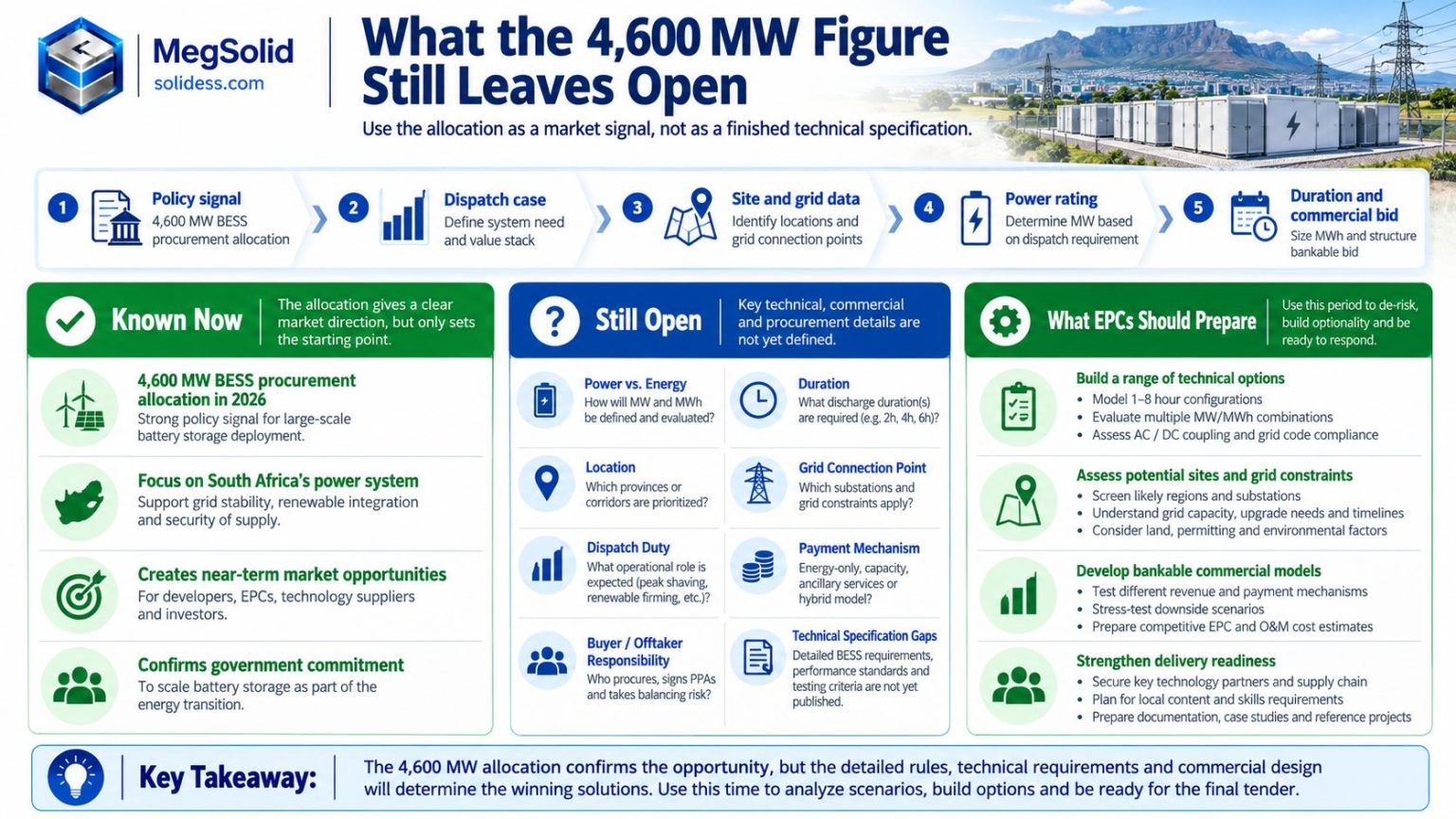
What Does the 4,600 MW Figure Still Leave Unanswered?
4,600 MW is a power allocation. It is not 4,600 MWh, and it does not establish a two-hour or four-hour battery requirement.
Storage duration, sites, the submission deadline, budget and battery chemistry remain unspecified in the notice. Treating values from an earlier tender as settled terms would overstate what is known about this programme.
The following are preparation questions, not published conditions of the new programme:
| Unresolved project input | Decision it would change |
|---|---|
| Required discharge duration and measurement point | Delivered energy, installed capacity and allowance for system losses |
| Available charging periods and connection limits | Charging power, recovery time and ability to meet the next dispatch |
| Availability and performance definitions | Operating obligations, test evidence and contractual remedies |
| Connection works and infrastructure responsibilities | EPC scope, schedule dependencies and cost allocation |
| Local participation and delivery requirements | Consortium structure, supplier qualification and execution planning |
الـ ضمان توفر نظام BESS must describe the contracted service. Controller online status alone is not evidence that the facility can deliver it. The definition must come from the programme contract, not an assumed industry percentage.
The department supports local manufacturing, engineering, construction and skills development, but Notice 8021 gives no numerical local-content threshold. Execution evidence can be prepared now; tender scoring rules cannot be inferred from that policy support.
Tubatse Is a Different Procurement Track, Not Another BESS Order
Eskom's 13 October announcement opened Request for Qualification (RFQ) E3611GXR for a strategic partner in the Tubatse Pumped Storage Scheme in Limpopo. This is a qualification process, not a request for battery-equipment quotations. The proposed facility is 1.5 GW / approximately 21 GWh, with four reversible pump-turbine units and up to 14 hours at full output.
Tubatse is pumped storage, not a lithium-ion battery installation. Eskom describes it as complementary to shorter-duration batteries and also lists frequency response, reserves and voltage support among its services. Calling the split fast batteries versus slow hydro overlooks that overlap.
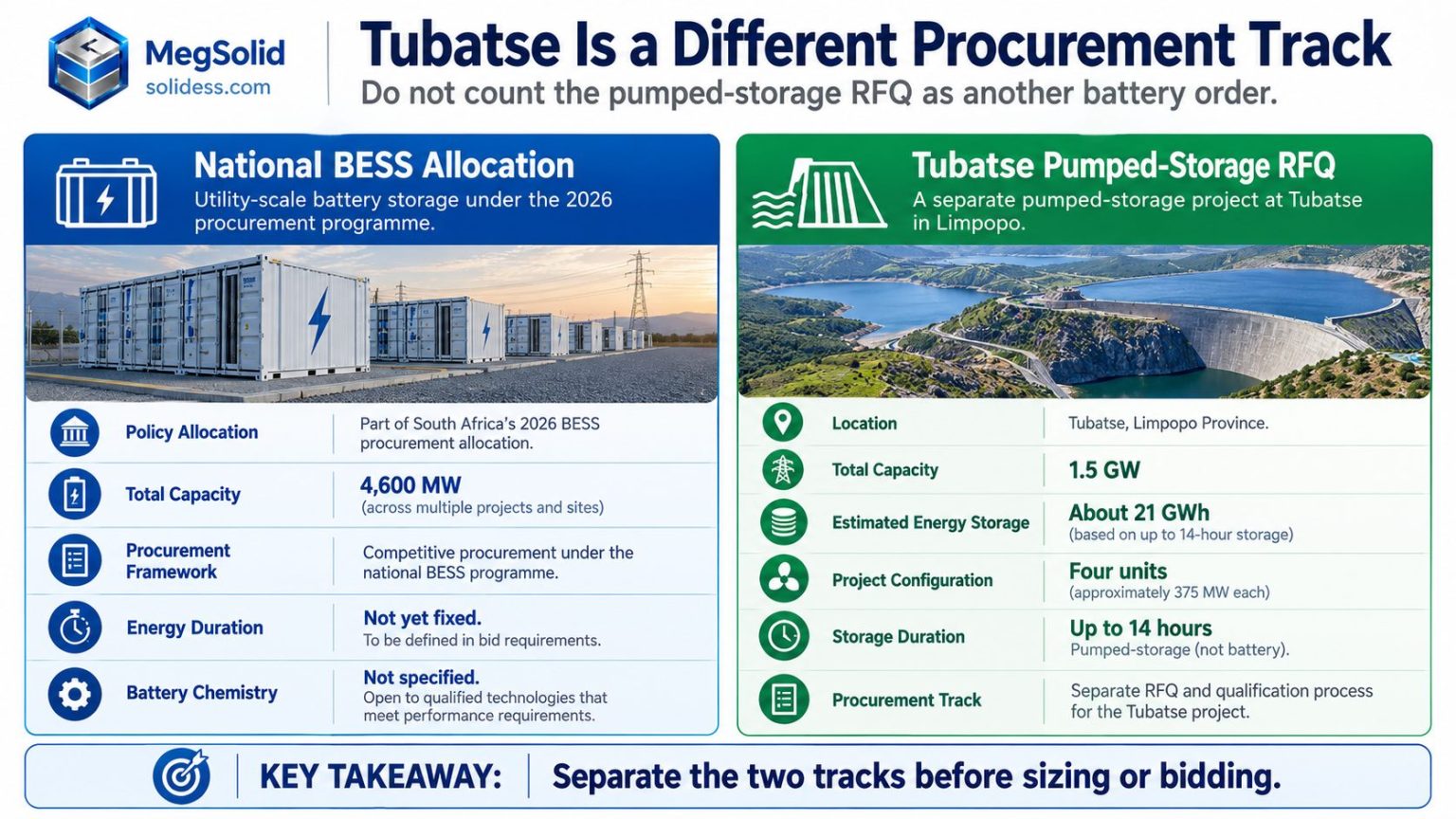
Eskom's 13 October notice scheduled a non-compulsory clarification meeting for 29 October and the RFQ deadline for 30 November 2026. These dates belong to Tubatse's partner selection, not the 4,600 MW allocation. Interested organisations must check the tender documents and any amendments before responding.
Taken together, the announcements point to a market with different storage durations and project structures. Battery developers need to judge where their services are competitive. Storage headlines alone are not evidence of battery demand.
Adding Tubatse's output to the gazetted allocation and calling the total a new BESS pipeline would count pumped storage as batteries. It would also assume an allocation relationship that has not been established.
What Should BESS Developers and EPCs Prepare Now?
Keep the proposal adaptable while procurement terms remain open. Proceed with decisions supported by evidence, and leave the remaining choices provisional.
Separate confirmed facts from design choices
The allocation does not settle the proposed site, battery duration, architecture or commercial model. Each choice needs a stated basis. Changes to duration or connection conditions can alter both equipment requirements and project economics.
Keep engineering work moving, but leave room to revise preliminary choices when programme requirements become clear.
Define interfaces before allocating risk
Map responsibilities across the project company, EPC, network interface, controls integrator and equipment supplier. Establish where electricity is measured, who sends dispatch instructions and who answers for a failure to deliver the required output.
الـ قائمة نقاط نظام BESS SCADA connects those responsibilities to dispatch commands, operating limits, measurements and records. Procurement and grid requirements still determine the project's final data obligations.
Preserve the distinction between market readiness and tender eligibility
Technical preparation can strengthen a future submission. Tender eligibility must still be assessed against the published criteria. Preparing early does not reserve capacity for a supplier or guarantee an award.
Keep engineering and delivery evidence ready for the programme documents. Unannounced budgets, locations and bid windows remain unresolved inputs, not a basis for forecasting orders.
Does This Create a South African Solid-State Battery Opportunity?
Neither the determination nor the Tubatse announcement identifies a new solid-state, semi-solid or hybrid solid-state battery procurement. The determination uses technology-neutral energy-storage language, while the Tubatse announcement concerns pumped storage.
The absence of a specified chemistry does not rule out later technology proposals. It also gives no basis for claiming a preference for solid-state batteries.
Assess any later technology offer against the published duty and required evidence. Keep cell-level claims, complete-system performance and project acceptance separate when verifying a solid-state battery claim.
The evidence here supports a storage-market development, not a solid-state project announcement. Neither document provides a complete account of solid-state activity elsewhere in South Africa during the week.
The Market Signal Is Stronger; the Procurement Specification Is Still Open
This week's announcements warrant attention, but they should not be treated as a confirmed equipment order book.
The determination provides a formal procurement basis. The department's earlier statement explains the curtailment and flexibility objectives. Tubatse shows a separate long-duration project moving through partner selection.
BESS participants need the procurement documents, service requirements, connection conditions, qualification rules and contract terms before committing. Those details will determine the equipment configuration and whether the project can be delivered.
The allocation establishes scale. Delivery obligations determine whether a project can be priced, financed and delivered.
الأسئلة الشائعة
Is the 4,600 MW allocation an equipment order?
The determination authorises procurement, not an equipment purchase from a named supplier. An equipment offer still needs an identified project, defined scope and the applicable procurement documents.
Has the notice opened a bid window?
The notice is not an invitation to bid and gives no submission deadline. The relevant procurement announcement and documents must establish the bid opportunity.
Can developers assume a four-hour battery specification?
No. The notice does not state a duration. Four hours may be a design choice, but it is not a requirement established by this notice.
Can a supplier convert the MW allocation into a firm MWh market forecast?
The allocation alone is not enough. Any MWh estimate must state its duration and scope assumptions; it is not an energy quantity already procured by government.
Is a high cycle-life claim enough to demonstrate project suitability?
No. The complete configuration needs assessment against the required service. Delivered energy, power, operating conditions, control interfaces and contractual evidence cannot be replaced by a cycle-life claim.
Can earlier battery tenders supply the missing terms?
Earlier tenders can inform preparation. Their duration, scoring and guarantee provisions still need confirmation before being applied to the new programme.
Does a listed procurement objective guarantee revenue from that service?
No payment mechanism follows from a policy objective alone. The commercial agreement and settlement rules must support the revenue assumption.
Should project teams choose equipment before the connection route is understood?
Early equipment choices should remain provisional. Connection limits and the charging and discharge duty may change both the equipment and the surrounding EPC scope.
Is a battery-system supplier eligible to lead the Tubatse RFQ simply because it supplies storage?
Battery supply experience alone does not establish eligibility. Tubatse seeks a strategic partner for pumped storage, and its own qualification documents determine who can respond.
What is the next useful milestone for the BESS market?
Look for procurement information that defines the bid window, project scope, service specification, qualification criteria and contract documents. Those details make the opportunity actionable.
Does this notice give Cape Town or another municipality a named buyer allocation?
The notice identifies no municipal buyer allocation. Evaluate local opportunities against their own documents, not this determination.
Does the Limpopo Tubatse announcement identify a battery-storage installation?
No. The Limpopo announcement concerns pumped storage. Its place in the wider storage market does not mean a battery supply package has been announced.
Should South African industrial buyers treat the national allocation as their factory's backup plan?
No. The national allocation does not establish a factory's backup supply. Site continuity still requires its own equipment, operating plan and verified backup capability.