 Skip to content
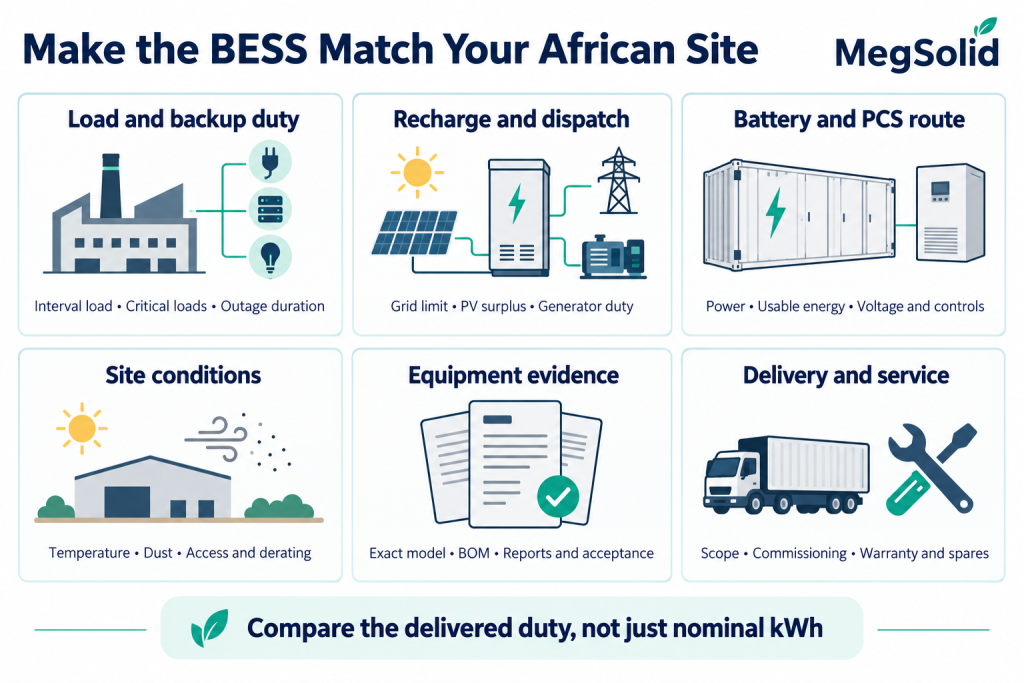
A battery that cannot carry the production load, recharge before the next outage or survive the site conditions leaves you paying twice: once for storage and again for diesel and lost output. African mining, agricultural processing, manufacturing and commercial projects need a power plan that fits the operating schedule. Start with the loads that must keep earning and the energy you can actually restore.
If you need a reliable battery energy storage systems supplier in Africa, demand more than a low price per nominal kWh. The offer should identify usable energy, continuous power, thermal limits, grid/generator interfaces, protection, commissioning and service responsibilities. MegSolid can review those requirements against a specific cabinet, PCS or container route so your EPC can compare complete scopes.
BESS South Africa procurement offers useful questions for buyers elsewhere in Africa: what happens during a grid outage, how much diesel can the actual duty displace, and who closes the site interfaces? Conditions differ across Namibia, Botswana, Zambia, Kenya, Nigeria and other markets. Use the local tariff, outage records and grid requirements rather than assuming one country’s business case transfers unchanged.
Buyers also searching the thermal energy storage market should separate electrical backup from process heat or cooling. Battery storage supplies electrical duty through its defined power path. Thermal storage serves a heat/cooling duty through its own system. Compare each solution against the load it can actually serve.
Why Demand for Battery Energy Storage Systems Is Accelerating Across Africa
BESS South Africa: A Response to Grid Instability and Load Shedding
A production line, cold room or pump does not earn revenue while it waits for power. Record which interruptions occur at your site, which loads must remain available and how long they need support.
South African buyers should size from the site’s actual outage and restart records, not a permanent load-shedding assumption. Factories, mines, cold storage, food processors and logistics sites can have different backup priorities and demand-charge opportunities even on the same grid.
Production interruptions create direct financial losses through:
- Production downtime
- Equipment restart costs
- Raw material waste
- Contract delivery delays
- Reduced equipment lifespan
Put the cost of those events next to the actual BESS duty. A useful BESS South Africa quotation separates continuity requirements, tariff savings and diesel displacement instead of selling one headline capacity for all three.
Transfer behavior depends on the supplied Power Conversion Systems , operating mode, protection and switching path. For sensitive loads, specify acceptable interruption, start currents, load steps and the required backup/UPS interface. Witness the agreed grid-loss and recovery behavior at site; a BMS/EMS label does not prove millisecond continuity.
Translate the desired production outcomes into acceptance criteria. The design must prove the relevant duties rather than promising every benefit from any battery:
- Protected-load power and specified interruption
- Voltage/frequency behavior under defined load steps
- Motor/startup and reconnection sequence
- Measured electrical quality at the agreed boundary
- Alarm, restriction and recovery responsibilities
When the specified duty is demonstrated, storage becomes a controllable production asset. Define operating restrictions and the recharge plan before handing it to the site team.
Diesel Replacement Economics
Diesel generation remains common across remote mining sites, agricultural operations, and industrial facilities.
The challenge is no longer equipment availability. The challenge is operating cost.
A typical diesel-based power strategy includes:
- Fuel procurement
- Long-distance transportation
- Generator maintenance
- Lubricants
- Spare parts
- Engine overhaul costs
When fuel logistics are included, diesel electricity costs often become significantly higher than utility power or renewable generation.
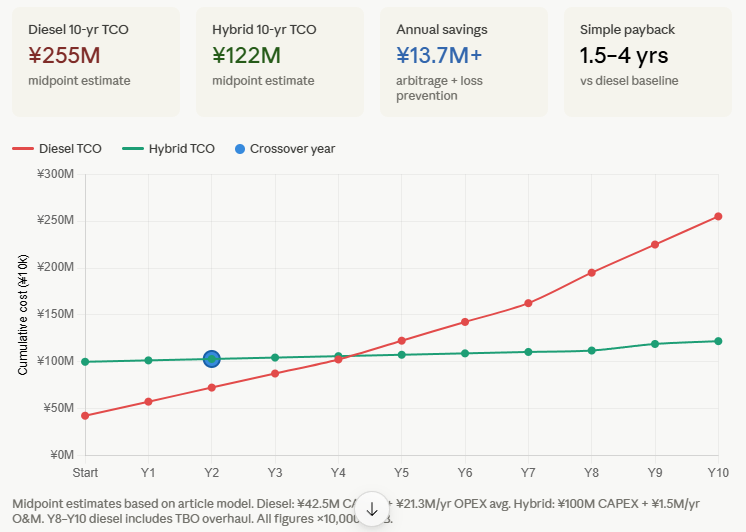
Storage changes the fuel bill when it supplies duty that would otherwise require generator operation and has a viable charging source. It does not manufacture daily energy.
Use measured or defensible PV/wind production and load data to calculate dispatchable surplus. Model the generator’s minimum loading, start/stop limits and emergency role before counting avoided runtime.
For many industrial users, diesel replacement creates measurable benefits through:
- Reduced fuel expenditure
- Lower maintenance costs
- Reduced carbon emissions
- Improved energy security
- More predictable operating expenses
Storage Architectures for African Industrial Applications
Hybrid Mini-Grids for Mining and Heavy Industry
Many mining projects operate far from stable transmission infrastructure.
In these environments, Hybrid Mini-Grid systems have become one of the most effective energy architectures.
A typical system includes:
- Solar PV
- Wind generation
- Diesel generators
- Battery Energy Storage Systems
- Energy Management Systems
The EMS continuously evaluates:
- Load demand
- Renewable generation output
- Battery State of Charge (SOC)
- Generator availability
The dispatch strategy typically follows:
Solar and wind generation can be stored and dispatched when needed, reducing generator runtime and lowering fuel consumption.
- Renewable generation serves active loads.
- Excess renewable energy charges the battery.
- Batteries discharge when renewable output declines.
- Diesel generators operate only when necessary.
This dispatch sequence can reduce fuel use when the energy balance, generator limits and reserve policy support it. Test islanding, black start where required, reconnection and failed-control behavior for the delivered design.
For industrial developers evaluating a battery energy storage systems supplier in Africa, hybrid microgrid compatibility has become an increasingly important procurement factor.
Energy Time-Shifting and Peak Demand Management
Time-shifting is valuable when the tariff spread, usable energy and operating schedule exceed losses, wear and installed costs. Model it with the actual meter tariff before treating it as a profitable application.
The concept is straightforward:
- Charge during low-price periods.
- Discharge during high-price periods.
The same principle applies to renewable energy generation.
Stored energy can be deployed during:
- Morning factory startup periods
- Agricultural irrigation cycles
- Industrial production peaks
- Utility demand peaks
For BESS South Africa peak shaving, identify the demand-billing interval, peak duration and the recharge window. An arbitrage schedule that empties the battery before the production peak can defeat the purchase objective.
Use the current local tariff and a downside case for price, demand, outages and performance. A rising-tariff prediction is not a substitute for a duty and cash-flow model.
Battery Storage Versus the Thermal Energy Storage Market
Understanding the Difference
The broader thermal energy storage market includes technologies that store energy in the form of heat or cooling capacity.
Examples include:
- Molten salt storage
- Ice storage systems
- Industrial heat storage
- Concentrated solar thermal systems
These technologies serve important roles in specific industrial applications.
Battery energy storage systems address a different challenge.
They provide:
- Specified response at the agreed electrical boundary
- Grid-support functions permitted by the site requirements
- Renewable integration
- Backup power
- Peak shaving
- Frequency regulation
For electrical continuity, compare the required kW, usable kWh, interruption and controls. For process heating or cooling, compare thermal output and integration. Do not assume battery storage is universally superior to every technology in the thermal energy storage market.
Why Thermal Stability Matters in African Conditions
Environmental conditions across many African regions create unique engineering challenges.
Common operating conditions include:
- Ambient temperatures above 40°C
- High dust concentrations
- Strong solar radiation
- Limited cooling infrastructure
These conditions place significant stress on battery systems.
The ability to maintain stable operating temperatures directly affects:
- Cycle life
- Safety performance
- Efficiency
- Maintenance requirements
- Total cost of ownership
This is one reason why thermal management has become a critical differentiator among battery suppliers operating across Africa.
MegSolid's Hybrid Solid-State Technology Pathway
Enhanced Thermal Stability for High-Temperature Deployment
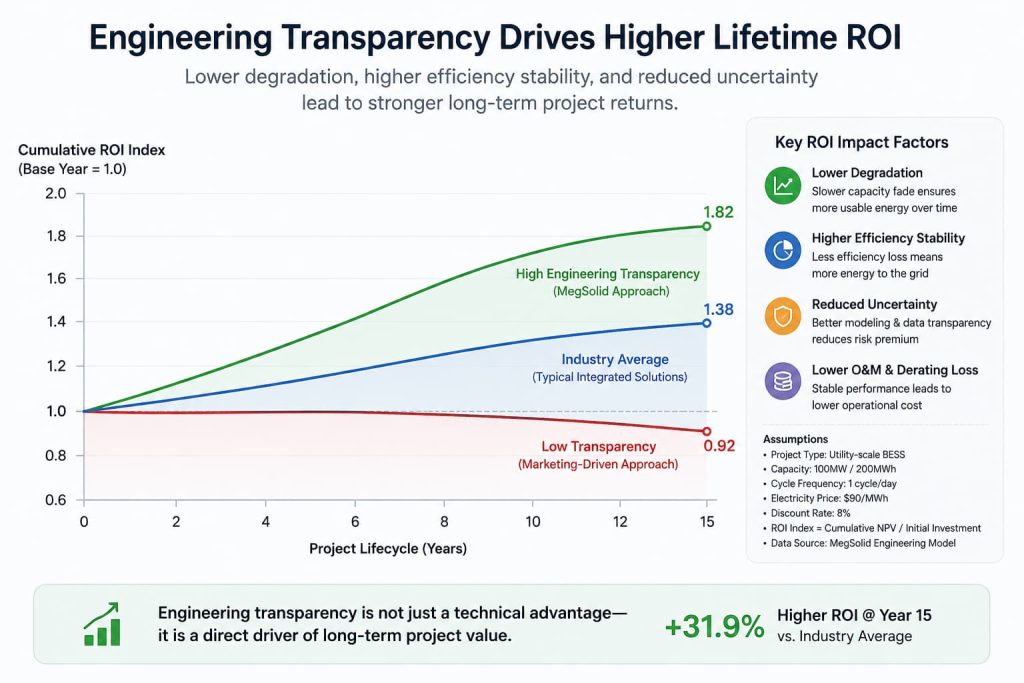
MegSolid identifies chemistry and thermal management by the quoted model. For a 100kW/215.04kWh cabinet route, review the ESSA outdoor cabinet, whose public standard table uses air-cooled LFP. For a separately engineered conversion stage, compare the MEGA TS PCS range. A hybrid solid-state or other project-specific cell option must be identified in the signed datasheet and BOM; do not infer it from the supplier name.
Compare exact products under the same operating conditions. The following table identifies the evidence to request; it does not establish a chemistry-wide performance ranking:
|
Technical Factor |
Quoted conventional LFP configuration |
Quoted hybrid/solid-state configuration |
|---|---|---|
| Electrolyte Structure | Confirm actual cell and electrolyte data | Confirm actual hybrid/solid-state architecture and BOM |
| Thermal Stability | Request the model’s thermal and fault evidence | Compare relevant evidence under matching conditions |
| Thermal Runaway Resistance | Review cell, system and installation evidence | Review the actual configuration and test scope |
| Environmental Adaptability | Verify environment, enclosure and derating limits | Verify environment, enclosure and derating limits |
| Safety Layering | Confirm delivered controls and protection | Confirm delivered controls, protection and material evidence |
Cooling size and auxiliary demand depend on the offered cells, enclosure, cooling architecture, duty and environment. Request the thermal/derating curves and auxiliary-load basis. A hybrid solid-state label alone does not prove lower HVAC demand.
Ask the quotation to define these thermal-management outputs:
- Cooling method and thermal operating limits
- Auxiliary power under the agreed duty
- Usable AC energy and measurement boundary
- Derating, cleaning and service requirements
Lost output during a hot afternoon can erase a brochure saving. Price the model’s actual derating, cooling energy, cleaning and service requirements for the site, alongside the energy it can deliver.
Long-Life Operation and Safety Architecture
Industrial users require systems capable of supporting:
- Daily cycling
- High utilization rates
- Elevated ambient temperatures
- Continuous operation
Identify the protection and monitoring delivered with the exact model. Confirm functions in the BOM, control documents and witness scope rather than treating every item below as standard on the whole MegSolid portfolio:
- Defined BMS protection, alarm and shutdown functions
- Sensors and monitoring included in the quoted configuration
- Documented warning logic and fault response; no generic AI-function assumption
- Model-specific cooling: air or liquid as actually offered
- Defined fire detection/response and equipment-to-site scope
Safety and lifecycle performance are increasingly becoming key selection criteria when choosing a battery energy storage systems supplier in Africa.
ROI Analysis for a Typical Agricultural Processing Facility
Baseline Operating Profile
Consider a medium-sized agricultural processing facility operating in a region with unstable grid access.
Project assumptions:
|
Parameter |
Value |
|---|---|
| Daily Energy Consumption | 1,200 kWh |
| Operating Days | 330 Days/Year |
| Peak Tariff | $0.25/kWh |
| Off-Peak Tariff | $0.10/kWh |
| Existing Backup | Diesel Generator |
| Generator Runtime | 6 Hours/Day |
These are hypothetical inputs for the arithmetic below, not measured agricultural projects or a current South African tariff benchmark. Replace them with your site data before sizing or pricing.
Revenue Stream One: Peak-Valley Arbitrage
Electricity price differential:
$0.25 - $0.10 = $0.15/kWh
Assume 600kWh is delivered during the peak period each day. The simplified loss-free calculation below uses the $0.15/kWh tariff spread. A real model must also account for the extra charging energy, auxiliary demand and cycling cost.
Daily savings:
600 × $0.15 = $90/day
Annual savings:
$90 × 330 = $29,700/year before conversion losses, auxiliaries, wear and other costs. With AC round-trip efficiency η, energy-only daily saving is 600 × $0.25 − (600/η) × $0.10, before those additional costs. Use a documented operating-condition efficiency basis.
Revenue Stream Two: Diesel Displacement
Calculate diesel displacement from the dispatch model and generator fuel curve. Identify which hours are actually avoided and whether the generator still runs for reserve, minimum load or sustained energy demand.
Savings include:
- Fuel purchases
- Fuel transportation
- Oil replacement
- Scheduled maintenance
- Engine servicing
- Spare parts replacement
Remote fuel logistics can materially change the comparison. Use actual delivered fuel prices, generator efficiency and dispatch hours; do not assume diesel savings always exceed arbitrage or count the same battery energy twice.
CAPEX and Payback Evaluation
Project CAPEX typically includes:
- Battery Energy Storage System
- PCS equipment
- Transformers
- Switchgear
- EMS integration
- Civil construction
- Installation and commissioning
Compared with many projects within the wider thermal energy storage market, battery storage systems typically provide greater flexibility for industrial load management and backup power applications.
Recommended financial evaluation metrics include:
- Payback Period
- Net Present Value (NPV)
- Internal Rate of Return (IRR)
- Levelized Cost of Stored Energy (LCOS)
Combining value streams can improve the business case when their schedules and SOC reserves are compatible. Count only incremental savings after charging, losses, degradation, maintenance and full installed scope. No payback period follows from the tariff spread alone.
Full-Cycle Project Delivery and Local Ecosystem Development
Engineering Services Throughout the Project Lifecycle
Successful projects begin long before equipment installation.
Critical project stages include:
- Site assessment
- Load analysis
- Capacity sizing
- System design
- Grid integration studies
- Commissioning
- Long-term monitoring
Industrial buyers increasingly evaluate the service capabilities of a battery energy storage systems supplier in Africa alongside product specifications.
Put responsibility and delivery milestones into the purchase order. The supplier provides defined equipment and documents; the EPC closes site-controlled works; the operator receives the actual settings, restrictions, training and service route. Missing ownership can delay earning long after the cabinets arrive.
Workforce Development and Regional Value Creation
Energy storage projects create value beyond electricity generation.
- Engineering employment
- Technical training
- Maintenance capability development
- Renewable energy workforce expansion
Choose service arrangements your site can use: authorized local tasks, remote support boundaries, spare-parts responsibility, escalation and training. Verify the offered capacity and service commitment rather than assuming every BESS South Africa supplier covers neighboring markets.
Send MegSolid your country, single-line diagram, interval load, protected-load list, outage duration, PV/generator data, tariff, ambient conditions and delivery target. Ask for the preliminary product route, usable-energy and power basis, equipment/site responsibility matrix, acceptance scope, service offer and missing inputs needed for a firm quote.
FAQ
Q1: How do I choose a reliable battery energy storage systems supplier in Africa?
Evaluate the exact offered model, usable AC energy, continuous power, temperature limits, interfaces, report scope, warranty and service responsibility. Ask a battery energy storage systems supplier in Africa for a written equipment/site boundary and acceptance plan. Send MegSolid the load, grid, PV/generator and location data for a preliminary product route.
Q2: Why is BESS South Africa growing so rapidly?
A BESS South Africa project should be based on its actual outage, tariff, production and diesel duty. Storage can support those objectives when the power path, reserve and recharge plan fit. Site evidence is more useful than assuming one permanent grid condition or universal financial benefit.
Q3: What battery size is suitable for a commercial or industrial project in Africa?
The correct battery size depends on daily energy consumption, peak demand, backup duration requirements, and renewable energy generation capacity. Most commercial and industrial projects require a detailed load analysis before selecting a system. Oversizing increases CAPEX, while undersizing can limit operational savings and backup capability.
Q4: Can a battery energy storage system completely replace diesel generators?
In many applications, a battery system combined with solar PV can significantly reduce diesel generator runtime. Complete diesel replacement depends on load profile, renewable energy availability, storage capacity, and backup duration requirements. Hybrid microgrid designs often deliver the best balance between reliability and operating cost reduction.
Q5: What is the typical ROI for a BESS South Africa project?
ROI depends on delivered duty, the local meter tariff, charging energy, diesel dispatch, degradation, maintenance, financing and full installed scope. Combine savings only when dispatch and SOC reserves support them; the same discharge cannot be counted twice for separate objectives.
Q6: How does battery storage compare with the thermal energy storage market?
Thermal storage serves heat or cooling; batteries supply electrical duty through their designed power path. Compare each option against the load, integration and output the project needs. A thermal kWh figure is not interchangeable with usable AC battery energy.
Q7: Why is thermal management critical for battery energy storage projects in Africa?
Many African regions experience ambient temperatures above 40°C. Poor thermal management can accelerate battery degradation, reduce efficiency, and increase safety risks. Advanced thermal control systems help maintain stable battery temperatures, improve cycle life, and lower long-term operating costs.
Q8: What industries benefit most from battery energy storage systems in Africa?
Battery energy storage systems are widely used in mining, agricultural processing, manufacturing, telecommunications, commercial facilities, and utility-scale renewable energy projects. These industries often face grid instability, high diesel costs, or peak electricity demand charges that can be reduced through energy storage deployment.
Q9: What safety features should I look for when selecting a battery energy storage systems supplier in Africa?
Confirm delivered BMS/protection, thermal management, relevant detection/fire-response interfaces and monitoring for the actual model and site requirements. Map the report evidence and installation scope to the offered BOM. No generic safety feature list proves every model includes it.
Q10: Can battery energy storage systems support future renewable energy expansion?
A BESS can be engineered with PV, wind and a generator when voltage, power, control ownership, protection and operating modes are compatible. Expansion also needs defined electrical, space, communications and approval boundaries; more physical room does not prove plug-and-play integration.
