 Skip to content

The best portable power station for camping is the one that runs the appliances you packed and recharges before you need it again. A large Wh label will not start an oversized fridge compressor or power a kettle above the inverter limit. Choose your camping, RV or emergency-backup station by continuous watts, startup demand, usable runtime and charging opportunity first.
For a weekend camper, that may mean lights, phones and a laptop. For campervan and van-life travel, start with the refrigerator’s actual running and startup demand, then add every simultaneous device. For a remote worker, measure router and computer uptime. Write down watts and daily hours; the right portable battery begins with that small load list, not the biggest catalogue number.
Buy the station for the trip you actually take. Higher-output appliances call for a higher-output inverter; longer low-power use calls for more usable energy. Those are different purchases.
Compare the inverter output and startup duty, battery energy, plug standard, AC/solar charging limits, transfer behavior and warranty. Check the exact regional model and supplied accessories. A 500W station and an 1,800W station can have similar battery energy while serving very different loads.
This is a buyer’s comparison of named portable power-station options, not an independent laboratory ranking. Exact specifications, price and availability depend on model generation and region. Use the listed models to choose a power class, then confirm the manufacturer’s current regional datasheet before ordering.
- Continuous AC watts and approved startup/overload capability
- Nominal energy and usable-runtime test basis
- Solar voltage/current, connector and maximum input
- Transfer time and verified compatibility with the intended devices
- Cycle-retention conditions and warranty exclusions
- Net weight, carrying arrangement and accessories
- Regional voltage, frequency and socket standard
- Delivered price, repair/support route and replacement scope
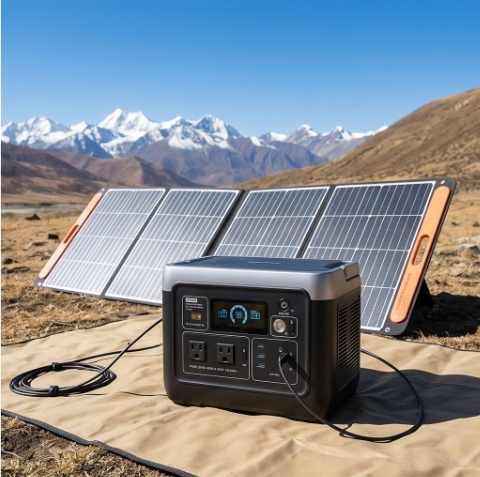
The MegSolid MG-ESS-500W-230 is a 500W, 1004.8Wh portable power station with a pure sine wave inverter, BMS, MPPT solar input and published UPS switching of ≤20ms. Its 10kg format suits a low-power camping or backup load list. The useful question is whether that list fits its output and recharge limits.
How to Compare Portable Power Stations for Your Load
Battery Safety Matters More Than Capacity
Battery capacity tells you how much energy is stored.
The battery, protections, charger, enclosure and operating instructions determine the permitted use. Request the exact product evidence rather than treating a chemistry name as a guarantee against failure.
MegSolid publishes hybrid solid-state battery technology for MG-ESS-500W-230. Compare the supplied model’s safety documents and operating limits with your intended environment. Do not assume all conventional lithium products are unsafe or all hybrid solid-state products are risk-free.
UPS Performance Is Becoming Essential
Backup users want the router and computer to stay on; that must be checked with the actual devices.
MG-ESS-500W-230 publishes ≤20ms UPS switching, which is a transfer interval rather than zero interruption. Verify compatibility with the router, laptop or other appliance. Equipment with life-critical or stricter continuity requirements needs its approved backup arrangement and acceptance test.
Solar Charging Flexibility
A 300W solar input is a charger ceiling, not a promise of 300W from every panel all day. Match voltage, current and connector before buying the panel.
Estimate the daily energy you use and the solar energy the site can actually harvest, including weather, orientation and charging losses. A solar-ready station still runs out if the next day’s load exceeds the energy restored.
Cycle Life Determines Real Cost
A cheaper power station often becomes more expensive over time if the battery degrades quickly.
Compare a cycle claim only with its DOD, temperature, rate and end-of-life retention threshold. Warranty and repair access belong in the cost comparison; cycle count alone is not a guaranteed service life.
Portable Power Stations to Compare for Camping and Off-Grid Power
MegSolid MG-ESS-500W — 1kWh-Class Storage for Low-Power Loads
Why This Model Fits the Low-Power Camping Shortlist
The MegSolid MG-ESS-500W-230 combines a pure sine wave inverter, intelligent BMS, MPPT controller and 1004.8Wh battery. It provides 500W rated AC output in a 10kg unit. Use it when the simultaneous load and startup demand fit that output; move to a higher-power model when the appliance list requires it.
MegSolid advertises up to 8,000 cycles for MG-ESS-500W-230. Ask for the test conditions, retained-capacity threshold and warranty before converting that figure into ownership years. Compare competitor claims on the same conditions; cycle count alone cannot decide which station will last longest in your actual use.
The published 300W MPPT input, 10–55Vdc range and ≤20ms UPS switching support solar recharge and selected backup duties. Match panel open-circuit voltage/current and verify transfer with the actual load. For a fridge, check startup demand instead of assuming the running-power label is enough.
See the MegSolid 500W portable power station for the published output and charging data. As a portable energy storage system, it gives you 1004.8Wh of nominal battery energy, not 1004.8Wh guaranteed at the AC socket. Runtime depends on load, conversion, standby draw, temperature and the usable SOC window. For illustration, 100W for 6 hours requires 600Wh AC; request a usable-energy test before promising that runtime.
Key Specifications
|
Parameter |
MG-ESS-500W |
|---|---|
| Rated Power | 500W |
| Cell typical capacity (not AC usable capacity) | 314Ah at 3.2V cell nominal; rated energy 1004.8Wh |
| Energy Storage | 1004.8Wh |
| Battery Type | Hybrid Solid-State |
| Published UPS transfer interval | ≤20ms |
| Solar Input | 300W MPPT |
| Output applicability | MG-ESS-500W-230; confirm regional socket standard |
| AC Output Voltage | 230Vac ±5V |
| Output Frequency | 50Hz ±0.5% |
| Waveform | Pure Sine Wave |
| MPPT Voltage Range | 10-55Vdc |
| Nominal PV Voltage | 30V |
| Maximum PV Current | 10A |
| Transfer verification | Test with the intended appliance; ≤20ms is not zero-break |
| Maximum Inverter Efficiency | 88% |
| Cycle Life | Public claim up to 8,000; request conditions and retention basis |
| Operating Temperature | -10°C ~ 50°C |
| Storage Temperature | -15°C ~ 60°C |
| Net Weight | 10kg |
Best For
- Camping lights, phones, cameras and laptops within the 500W combined AC limit
- RV low-power loads after checking voltage, sockets and startup current
- Matched solar charging up to 300W within 10–55Vdc and 10A
- Low-power off-grid cabin use with a daily recharge budget
- Selected emergency devices, with tested transfer and runtime
- Remote work with a measured computer/router duty
What to Confirm Before Ordering
A 1kWh-class battery can still be the wrong purchase if the load needs more than 500W or the supplied sockets do not match your equipment.
Send MegSolid the appliance nameplates, startup demand where known, simultaneous devices, daily hours, destination and charging plan. Ask for a written compatibility review, regional configuration, accessories and a quote.
Treat the hybrid solid-state battery and advertised cycle claim as part of the model review. The purchasing evidence is the actual configuration, usable-energy basis, protection documents and warranty—not a promise that chemistry alone removes power anxiety.
Anker SOLIX C1000
Highlights
- 1056Wh capacity
- 1800W rated AC inverter output
- 600W maximum solar input
- LiFePO4 battery
- Published 3000-cycle claim; request retention and test conditions
- 58-minute full AC recharge in UltraFast mode
The original Anker SOLIX C1000 is a higher-output choice when your appliance list exceeds the MegSolid unit’s 500W class. Its manufacturer specification lists 1056Wh, 1800W inverter output and up to 600W solar input. The 58-minute full recharge requires UltraFast AC mode; it is not a solar recharge promise. Confirm the regional model and accessories.
EcoFlow RIVER 3 Plus
Highlights
- 286Wh capacity
- 600W total rated AC output
- 220W maximum solar input
- AC recharge time depends on input and charging conditions
- UPS: confirm intended-load compatibility
The RIVER 3 Plus manual lists 286Wh, 600W total AC output and 220W maximum solar input. This is a lower-energy station than a 1kWh-class unit. For the same load, compare usable runtime and any extra battery you actually intend to carry; do not mistake X-Boost for a higher rated inverter output.
Jackery Explorer 1000 Plus
Highlights
- LiFePO4 battery; 1264.64Wh nominal energy
- Supports specified compatible expansion batteries
- 2000W total rated AC output; confirm regional version
- Solar input up to 800W across two compatible ports
The Explorer 1000 Plus JE-1000C manual lists 1264.64Wh, 2000W rated AC output and LiFePO4 cells. Its larger output class suits a different appliance shortlist from a 500W unit. Solar-panel count, accessories and the regional AC version belong in the purchase comparison, alongside the battery itself.
BLUETTI AC70
Highlights
- 768Wh capacity
- 1000W total rated AC output
- LiFePO4 battery
- Confirm charging mode, input limits and permitted temperature
The BLUETTI AC70 manual lists 768Wh and 1000W total AC output. That offers more inverter headroom but less nominal energy than the MegSolid 500W / 1004.8Wh unit. Decide which trade-off matters to your load list, and check region-specific voltage and charging-temperature limits.
DJI Power 1000
Highlights
- 1024Wh capacity
- 2200W continuous output at 25°C; check regional specification
- 4000 cycles to over 70% capacity under DJI’s stated test conditions
- Confirm AC charging mode, supply and temperature conditions
- UPS: test with the intended load
The DJI Power 1000 specification lists 1024Wh and 2200W continuous AC output at 25°C, with regional exceptions. Its published 4000-cycle result retains over 70% capacity under the stated charging and load conditions. Compare those conditions and the accessories required for your charging or drone workflow instead of assuming every cycle claim measures the same thing.
ALLPOWERS R600
Highlights
- 299Wh nominal energy; size against actual appliance hours
- 600W total rated AC output on the listed US configuration
- 200W maximum solar input; check compatible panel and cable
The ALLPOWERS comparison page lists the R600 at 299Wh, 600W total AC output and 200W maximum solar input. It belongs in a lighter-energy shortlist. Compare the actual appliance hours before buying on entry price, then confirm your regional unit and delivered cables.
PECRON E1000LFP
Highlights
- 1024Wh capacity
- 1800W rated AC output
- Published 3500+ LiFePO4 cycles to 80% capacity
- 600W maximum solar input
- UPS: verify intended-load and regional compatibility
The PECRON E1000LFP specification lists 1800W rated output, 1024Wh and 600W maximum solar input. Its US page specifies 100–120V output and a 3500+ cycle claim to 80% capacity. Confirm the regional unit, usable runtime and accessories in the offer before treating it as interchangeable with a 230V station.
Renogy Portable Power Station
Highlights
- Specify the exact Renogy portable-station SKU
- Confirm output voltage, continuous/startup watts and usable runtime
- Match solar voltage/current limits and delivered accessories
The Renogy entry names a brand range rather than one exact SKU. Choose the specific portable-station model before assigning capacity, output, solar capability or price; an RV accessory ecosystem does not establish the station’s electrical limits.
MegSolid MG-ESS-500W vs Other Portable Power Stations
|
Feature |
MegSolid MG-ESS-500W |
Other models: verify exact SKU and region |
|---|---|---|
| Battery Technology | Hybrid Solid-State Battery | Model-specific Li-ion/LFP or other declared chemistry |
| Energy Capacity | 1004.8Wh | Verify nominal and usable energy separately |
| Cycle Life | Published cycle claim | Obtain same-condition retention and warranty basis |
| UPS Transfer Time | ≤20ms | Verify exact model and intended-load compatibility |
| MPPT Controller | Integrated | Varies |
| Solar Input | 300W MPPT | Confirm current voltage/current/power limits |
| Pure Sine Wave Output | Yes | Verify waveform and permitted appliance duty |
| Battery Safety | Review exact model’s reports and protections | Review exact model’s reports and protections |
| Operating Temperature | -10°C~50°C | Use manufacturer temperature/charging limits |
| Off-Grid Capability | Match load, runtime and recharge budget | Match load, runtime and recharge budget |
Who Should Choose the MG-ESS-500W?
Campers
For campers, start with phone, light, camera and laptop watts and daily hours. The MG-ESS-500W is a candidate when the combined output and recharge plan fit; cooking heaters and other high-power loads need a different power class.
RV Owners
For RV use, confirm the 230V/50Hz model and socket arrangement, then check refrigerator startup and other simultaneous loads. Do not assume a portable station may be connected directly into RV wiring without the approved electrical arrangement.
Homeowners
For home outages, shortlist the devices that matter: router, laptop, lighting or a verified small appliance. Test ≤20ms transfer where continuity is needed and budget the actual runtime; the 500W model is not a whole-home backup system.
Remote Workers
For remote work, measure laptop/router power and the hours without charging. Send that duty to MegSolid with your location and plug standard to review the proposed unit and charging accessories.
Solar Enthusiasts
For solar charging, check panel open-circuit voltage, current and XT90E-M connection against the published 10–55Vdc, 10A and 300W limits. Plan around realistic harvested energy rather than the panel’s nameplate alone.
Final Verdict
Choose the station that solves the load problem without buying the wrong output class. The MegSolid MG-ESS-500W-230 is a 500W / 1004.8Wh route for low-power camping, remote work and selected backup duties. Appliances above its output or with unsupported startup demand belong on a higher-power shortlist.
Compare these nine shortlisted entries from MegSolid, Anker, EcoFlow, Jackery, BLUETTI, DJI, ALLPOWERS, PECRON and Renogy on continuous output, usable runtime, region, charging and support. The Renogy entry needs an exact SKU before a numerical comparison is possible. Manufacturer specifications are reference inputs for this buying guide, not results of an independent laboratory ranking.
Send MegSolid your appliance list, simultaneous watts, startup demand, daily hours, destination and solar-panel data. For a reseller enquiry, add quantity, sample requirement, sockets, packaging and local service expectations. Request the MG-ESS-500W configuration, compatibility notes, accessory scope, warranty terms and delivered quote, so you can approve the purchase against an actual use case.
FAQ
Q1: Is a portable power station really worth buying for camping?
A portable station is useful when its continuous output, startup capability, usable energy and recharge plan cover the trip. List devices and hours first. MG-ESS-500W is a 500W / 1004.8Wh nominal-energy option for suitable low-power loads, not a promise to run every camping appliance.
Q2: Can the MG-ESS-500W run a refrigerator?
Check both running watts and compressor startup demand, together with other simultaneous loads. A fridge below 500W running power can still require more startup power than the station supports. Obtain model-specific approval and a runtime test before relying on it.
Q3: Why does UPS transfer time matter?
MG-ESS-500W-230 publishes UPS switching of ≤20ms. Test the actual router, computer or appliance; that interval does not mean zero interruption or medical/critical-power qualification.
Q4: Is solar charging practical in everyday use?
It can recharge from matched solar panels within the published 10–55Vdc, 10A and 300W MPPT limits. Weather, orientation and losses determine harvested energy. A solar input does not guarantee unlimited off-grid runtime.
Q5: What makes hybrid solid-state batteries different?
MegSolid publishes hybrid solid-state technology for this model. Evaluate the exact unit’s protection, test evidence and operating limits rather than claiming that chemistry guarantees no fire, no degradation or superiority over every conventional product.
Q6: How long can the MG-ESS-500W last?
The public product page advertises up to 8,000 cycles. Request the DOD, rate, temperature, end-of-life retention and warranty basis. Service life also depends on calendar ageing and use, so the cycle claim cannot be converted directly into guaranteed years.
Q7: Can I use it as a home backup system?
It can serve selected devices within the 500W rated AC output, confirmed startup duty and usable-energy budget. Check the 230V/50Hz regional configuration and use the approved connection method. It is not a whole-home backup promise.
Q8: Is 1000Wh enough for a weekend trip?
For phones, lights, cameras and laptops, make a daily Wh budget and account for conversion and standby draw. A 100W load for 6 hours requires 600Wh delivered energy; actual runtime depends on the usable-energy test and conditions, not nominal 1004.8Wh alone.
Q9: What is the biggest mistake buyers make?
Buying by Wh while ignoring continuous watts, startup demand, region/socket, usable runtime, solar/AC charging and warranty. The wrong inverter output can stop an appliance even when the battery is fully charged.
Q10: Why are more people choosing portable energy storage systems?
Confidence comes from a matched and tested load plan. Send the appliance list, hours, plug standard and recharge conditions to MegSolid; ask for the exact configuration, accessories, warranty and quote rather than relying on a generic best-product label.
