A supplier file can look complete while the proposed equipment still misses your load. When choosing a C&I BESS battery supplier, assess MegSolid ESSA0100B-0215 at 100 kW / 215.04 kWh and the 125 kVA / 261.24 kWh liquid-cooled Energon against AC power, usable energy and operating duty. Then request evidence for the candidate model and delivery scope. Bring the project brief to a product comparison before spending time qualifying an unsuitable offer.
For EPC contractors, system integrators, and commercial energy storage developers, battery procurement directly affects project safety, commissioning schedules, warranty responsibility, and long-term system performance.
A low-cost battery supplier may provide competitive cell pricing, but insufficient traceability, weak thermal validation, unclear warranty responsibility, or poor BMS integration can create significant engineering risks during deployment.
This guide explains how professional buyers evaluate commercial energy storage battery suppliers, what technical documents should be verified before procurement, and why advanced battery technologies such as hybrid solid-state battery systems are gaining attention in industrial energy storage applications.
Key Takeaways
- Selecting a BESS battery supplier requires evidence for the exact delivered model and interface, not only cell cost.
- Cell-only buying leaves the agreed enclosure, thermal, BMS/PCS integration and system-warranty work with the buyer unless those tasks are contracted.
- Request cell/BOM traceability, named test records and the actual technical/service responsibilities.
- Match the full battery voltage/current/BMS map to the selected PCS/EMS and operating duty.
- Treat hybrid solid-state safety and cycle claims as model/test-specific; standard LFP C&I equipment is another real MegSolid product route.

Why Choosing the Right C&I BESS Battery Supplier Matters
Commercial and industrial energy storage projects operate under demanding conditions.
Unlike residential battery systems, C&I BESS installations often require:
- Daily charge and discharge cycles
- High power output
- Long operating hours
- Integration with renewable energy systems
- Grid-support functions
- Reliable operation in outdoor environments
For these projects, the battery is not an isolated component.
The battery system must work together with:
- Battery Management System (BMS)
- Energy Management System (EMS)
- Power Conversion System (PCS)
- Thermal management system
- Safety protection architecture
A supplier that only provides battery cells without system engineering support may leave the project team responsible for solving integration problems after delivery.
What Should EPCs Evaluate Before Choosing an Energy Storage Battery Supplier?
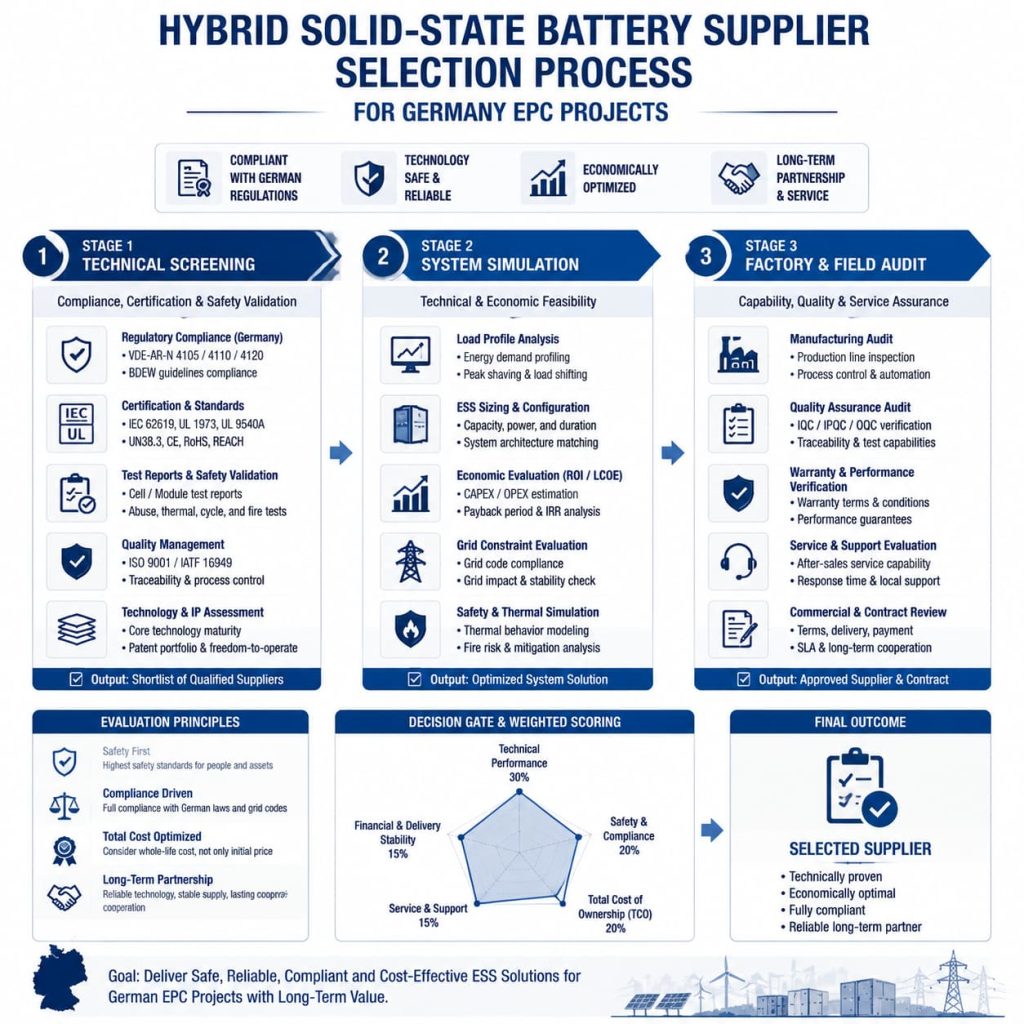
A professional battery supplier should be evaluated through five major areas:
1. Battery Cell Traceability
Cell traceability is the foundation of reliable energy storage procurement.
Before purchasing, buyers should verify:
- Cell manufacturer information
- Production batch records
- Cell chemistry
- Capacity testing data
- Internal resistance consistency
- Manufacturing date
Two batteries with identical capacity ratings may perform differently if cell quality and production consistency are not controlled.
For C&I BESS projects, traceable battery sources reduce the risk of:
- Uneven degradation
- Capacity mismatch
- Unexpected performance loss
- Difficult warranty claims
2. Safety Testing and Thermal Management Capability
Safety performance is one of the most important factors when evaluating a BESS battery supplier.
Battery safety depends on more than cell chemistry.
A complete evaluation should include:
- Thermal management design
- Temperature monitoring strategy
- Overcharge protection
- Short-circuit protection
- Cell balancing performance
- System-level safety validation
Advanced battery technologies such as hybrid solid-state battery solutions are being developed to improve thermal stability by introducing solid-state electrolyte structures combined with advanced lithium battery chemistry.
For industrial applications, buyers should focus on verified engineering data rather than marketing claims.
Important documents include:
- IEC 62619 compliance information
- UN 38.3 transportation documentation
- Safety test reports
- Thermal validation records
Why Buying Battery Cells Alone Can Create Engineering Risks
Many EPC companies consider purchasing battery cells directly to reduce initial costs.
However, cell-level procurement creates additional engineering responsibilities.
The buyer may need to manage:
Thermal Management Risk
Battery cells require appropriate mechanical structure, cooling design, and protection systems.
Without validated thermal design, performance degradation and safety risks may increase.
BMS Integration Risk
The BMS must correctly manage:
- Voltage limits
- Current protection
- Temperature monitoring
- State of charge estimation
- Cell balancing
Poor compatibility between cells and BMS can reduce usable capacity and system reliability.
Warranty Responsibility Risk
When cells, BMS, and PCS come from different suppliers, responsibility during failures can become unclear.
An integrated supplier can simplify the interface when the offer includes the exact battery, conversion, controls and witnessed tests. Put covered equipment, site-work exclusions, fault evidence, named repair contact, labour, parts and freight into the warranty/service schedule. A single supplier's name does not automatically provide a complete-site warranty.
How Reliable Battery Manufacturers Support C&I ESS Projects
A professional industrial energy storage battery manufacturer should provide more than battery products.
The supplier should support:
Technical Documentation
Required documentation includes:
- Battery datasheets
- Electrical specifications
- Charge and discharge parameters
- Operating temperature range
- Mechanical dimensions
- Safety certifications
Engineering Integration
The supplier should understand:
- PCS communication requirements
- EMS protocols
- BMS configuration
- Project load profiles
- Installation environment
Customization Capability
Select a real product route before requesting customization. MegSolid's ESSA family publishes 30 kW / 55.296 kWh, 50 kW / 55.296 kWh, 50 kW / 100.352 kWh and 100 kW / 215.04 kWh. Energon offers 261.24 kWh / 125 kVA liquid-cooled LFP; an engineered system can use a separate 30–500 kW MEGA PCS. Match the required AC power, usable duration, battery voltage/current/BMS and thermal duty to the exact equipment. A custom voltage or enclosure needs a controlled BOM, test and warranty boundary of its own.
A reliable OEM battery manufacturer should support:
- Custom voltage configurations
- Capacity adjustments
- Enclosure design
- Communication customization
- Application-specific battery solutions
How Hybrid Solid-State Battery Technology Supports Industrial Energy Storage
Traditional lithium battery solutions have improved significantly, but C&I projects continue to demand higher safety margins and longer operational stability.
Hybrid solid-state battery technology focuses on improving:
Thermal Stability
MegSolid's 16.07 kWh hybrid solid-state wall pack is a different model from the ESSA and Energon cabinets, whose public listings identify LFP cathodes. LFP alone does not establish electrolyte formulation. Match the quoted model/BOM, voltage/current/BMS pairing and system thermal/protection evidence to the site's required power and usable-energy duration. That gives the EPC a product and integration scope to compare before the bulk order.
Long Cycle Performance
Industrial storage systems require thousands of charge and discharge cycles.
Battery cycle life should always be evaluated together with:
- Depth of discharge
- Operating temperature
- Charge rate
- Discharge rate
- End-of-life capacity definition
System Reliability
For applications such as:
- Microgrids
- Commercial buildings
- Industrial facilities
- Renewable energy storage
- battery stability directly affects project operation.
Battery Supplier Comparison: What Professional Buyers Should Check
|
Evaluation Area
|
Basic Supplier
|
Professional C&I BESS Supplier
|
|---|---|---|
|
Cell information
|
Request the exact offered cell/module/model identity
|
Obtain controlled BOM/serial/batch and test records
|
|
Battery testing
|
A headline without a named method is incomplete
|
Match named test data to the delivered model and duty
|
|
BMS support
|
Connector names alone do not establish support
|
Approve full voltage/current/BMS/PCS/EMS and fault interfaces
|
|
Warranty
|
Cell/module scope unless system obligations are included
|
Contracted equipment, exclusions, remedies and service owners
|
|
Customization
|
Unknown until the proposed design and tests are priced
|
Controlled custom BOM, drawings, limits and acceptance
|
|
Documentation
|
Missing documents become a release gap or explicit exclusion
|
Named document register and delivery/approval responsibilities
|
What Documents Should You Request From a BESS Battery Supplier?
Before placing a bulk order, EPC contractors should request:
Battery Datasheet
Confirm:
- Voltage
- Capacity
- Energy rating
- Maximum current
- Temperature range
- Cycle-life conditions
Compliance Documents
Verify:
- UN 38.3 transportation requirements
- IEC 62619 industrial battery safety requirements
Test Records
Request:
- Capacity testing
- Internal resistance data
- Batch consistency records
- Thermal performance information
Warranty Terms
Confirm:
- Warranty duration
- Performance guarantees
- Claim procedures
- Technical support responsibilities
Supplier Evaluation Checklist for C&I Energy Storage Projects
Before selecting an energy storage battery supplier, ask:
Battery Quality
- Are cells traceable by production batch?
- Are capacity and resistance records available?
- Are cycle-life conditions clearly defined?
System Integration
- Has the battery been tested with compatible PCS systems?
- Does the supplier support BMS and EMS communication?
- Can the supplier provide engineering assistance?
Project Support
- Can the supplier provide technical documentation?
- Does the supplier support OEM customization?
- Is there a dedicated engineering team after delivery?
Why EPCs Choose Integrated Energy Storage Battery Manufacturers
For commercial and industrial projects, the lowest battery price does not always create the lowest project cost.
A reliable battery manufacturer helps reduce:
- Integration uncertainty
- Commissioning delays
- Warranty disputes
- Performance risks
Compare the complete offer at the same usable AC energy, power, contract year and accepted site duty. MegSolid should identify which battery/converter/control interfaces and tests are included, which installation or connection work belongs to the EPC, and what happens after a verified performance shortfall. Those commitments give the project a supplier relationship it can use after delivery.
Request a C&I BESS Battery Supplier Evaluation Package
Choosing the right battery supplier requires technical verification before procurement.
MegSolid supports EPC contractors and system integrators with:
- Battery technical documentation
- Cell performance verification
- BMS compatibility evaluation
- OEM/ODM energy storage solutions
- C&I ESS engineering support
Send MegSolid the load/PV trace, required kW / kVA and usable-energy duration, site temperature, SLD/connection limits and delivery date. Ask for the product configuration, supported operating limits, model-specific document register, acceptance tests, exclusions and manufacturer/EPC/service split. For a cell-only, cabinet or custom rack order, the buyer should know the remaining integration cost and the paid repair path before comparing price per kWh.
Contact MegSolid for a project evaluation.
FAQ
Q1: How do EPC companies choose a reliable C&I BESS battery supplier?
EPC companies evaluate C&I BESS battery suppliers based on more than battery price. Key factors include battery cell traceability, safety validation, BMS and PCS compatibility, certification documents, warranty responsibility, manufacturing capability, and technical support. A reliable supplier should provide complete engineering documentation and demonstrate experience supporting commercial and industrial energy storage projects.
Q2: What documents should a commercial energy storage battery supplier provide?
A professional commercial energy storage battery supplier should provide: Battery technical datasheets Cell traceability records UN 38.3 transportation documentation IEC 62619 compliance information Capacity test reports Internal resistance data Warranty conditions These documents help EPC contractors verify battery quality before large-scale deployment.
Q3: Should EPC contractors buy battery cells directly or choose an integrated BESS supplier?
Buying battery cells directly may reduce initial component costs, but it transfers additional engineering responsibilities to the EPC contractor. These risks include: Thermal management design BMS configuration Cell matching PCS compatibility Warranty coordination An integrated BESS supplier can reduce these risks by providing validated battery systems with coordinated hardware and software integration.
Q4: What makes an industrial energy storage battery manufacturer reliable?
A reliable industrial energy storage battery manufacturer should have: Proven manufacturing capability Stable cell supply chain Engineering validation processes Quality control systems Customization capability Long-term technical support For C&I applications, manufacturing experience and engineering support are often more important than the lowest battery price.
Q5: Why is battery cell traceability important for C&I BESS projects?
Battery cell traceability allows project developers to verify: Cell production batch Manufacturing consistency Test results Quality history Without traceability, identifying the cause of battery performance issues or warranty claims can become difficult after system deployment.
Q6: What certifications should BESS battery suppliers provide?
Depending on the application and market requirements, BESS battery suppliers should provide relevant documentation including: UN 38.3 transportation testing IEC 62619 industrial battery safety compliance Battery performance test reports Quality management documentation Certification documents help EPC contractors reduce compliance and logistics risks.
Q7: What are the advantages of hybrid solid-state battery technology for C&I ESS?
Hybrid solid-state claims should be checked against the exact cell/module and test duty. The published MegSolid 51.2 V / 314 Ah module provides 16.07 kWh and up to 8,000 cycles at 80% DOD; that figure does not establish the chemistry, cycle life or thermal safety of a separate C&I cabinet. Compare actual model records and the offered system operating/warranty boundary.
Q8: C&I BESS Battery Supplier in Germany: EPC Energy Storage Procurement Guide 2026
Looking for a reliable C&I BESS battery supplier in Germany? Learn how EPCs evaluate battery safety, IEC compliance, BMS integration, and energy storage manufacturers.
Q9: C&I BESS Battery Supplier Australia: How EPCs Evaluate Commercial Energy Storage Systems
Explore how Australian EPC contractors select reliable C&I BESS battery suppliers based on safety, compliance, battery performance, and system integration.
Q10: Battery Energy Storage Supplier Africa: Reliable C&I BESS Solutions for Industrial Projects
Find a reliable battery energy storage supplier in Africa for commercial and industrial projects. Learn supplier evaluation, safety requirements, and ESS deployment considerations.