 Aller au contenu
Le Vietnam dispose d'une méthode de tarification opérationnelle pour l'admissibilité des systèmes de stockage par batterie autonomes. Pour MegSolid et les promoteurs avec lesquels nous discutons, la question est précise : quelles données d'équipement et quels registres de centrale peuvent étayer les lignes de capacité et d'énergie dans un contrat d'achat d'électricité (PPA) de BESS au Vietnam ?
La circulaire 62/2025/TT-BCT lie les revenus à la capacité installée, au coût de charge, au rendement de charge-décharge, aux pertes, à la dégradation et aux données d'exploitation contractuelles. Un devis qui se limite aux MW et aux MWh laisse le modèle commercial en suspens. Quelqu'un dans l'équipe de projet doit faire correspondre chaque intrant de prix à une fiche technique, une hypothèse de faisabilité, une limite de comptage, un point EMS/SCADA ou un procès-verbal de réception.
Cette page transforme la circulaire en une liste de preuves destinée aux développeurs, aux EPC, aux prêteurs et aux conseillers techniques travaillant sur les projets de BESS à grande échelle au Viêt Nam.
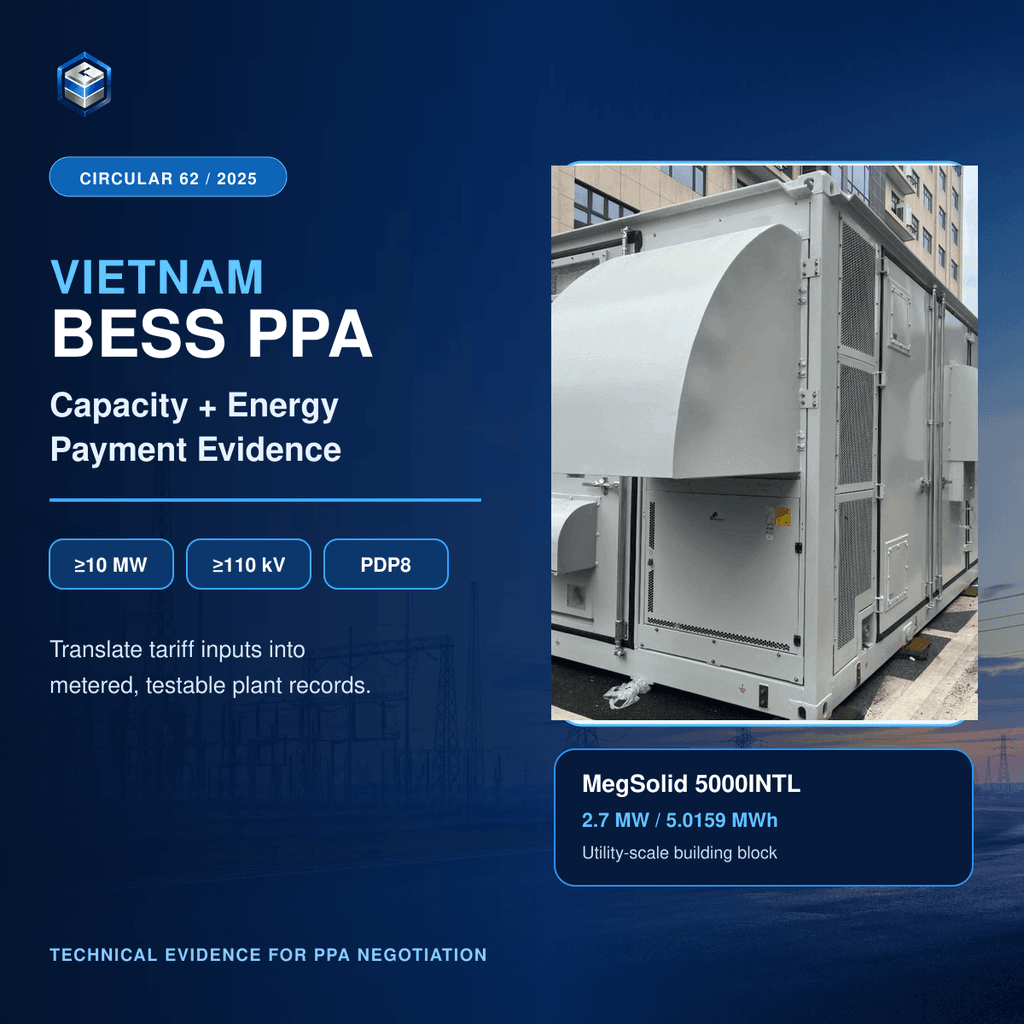
Table de décision à balayage rapide
| Mot-clé | Question commerciale | Éléments de preuve à sécuriser |
|---|---|---|
| Circulaire 62/2025/TT-BCT | Le projet entre-t-il dans le cadre de la règle ? | Alignement sur le PDP8, ≥ 10 MW, raccordement au réseau national à 110 kV ou plus |
| Prix de capacité | Quels sont les coûts fixes récupérés par kW ? | Capacité installée approuvée, coût d'investissement, O&M fixe, grille tarifaire annuelle |
| Prix de l'énergie | Quels sont les coûts de recharge récupérés par kWh ? | Tarif de recharge, rendement de charge-décharge convenu, consommation auxiliaire, pertes au point de livraison |
| Capacité disponible | Quelle quantité d'électricité la centrale peut-elle proposer à la production ? | Plage de fonctionnement, limites de l'état de charge (SOC), règles de réduction de puissance, registres des pannes, journaux de dispatching |
| Dégradation de la batterie | Quelle hypothèse énergétique à long terme est intégrée au modèle ? | Courbe de dégradation approuvée, base de garantie, méthode d'essai de capacité périodique |
| Cycles minimaux | Quel est le soutien du cyclisme à vie dans le calcul du prix ? | Données de cycle du fabricant, service de calcul, base de calcul convenue |
| Limite de comptage | Où l'énergie de recharge et l'énergie délivrée sont-elles mesurées ? | Emplacements des compteurs principal et de secours, pertes du transformateur, méthode de rapprochement |
| EMS/SCADA | Les instructions du NSMO peuvent-elles être reliées à la réponse de la plante ? | Commande, accusé de réception, consigne, puissance réelle, SOC, alarme, horodatage |
| FAT et SAT | Les intrants commerciaux peuvent-ils être vérifiés avant l'utilisation ? | Procédures observées, instruments étalonnés, fichiers bruts, rapports signés |
La circulaire 62 a remplacé le projet
Le MOIT a publié la proposition initiale de tarification du BESS en août 2025. Ce projet distinguait déjà le volet « capacité », lié à la disponibilité, du volet « énergie », lié à la production effective. Le Annonce du Ministère du Commerce et Rapport sur l'énergie au Vietnam Couvrez cette scène.
Le ministère de l'Industrie et du Commerce a publié la circulaire 62/2025/TT-BCT le 10 décembre 2025. Elle est entrée en vigueur le 26 janvier 2026. Le registre officiel du Ministère de l'Industrie et du Commerce montre que la circulaire est en vigueur.
| Date | Statut | Utiliser dans les documents du projet |
|---|---|---|
| 21 août 2025 | Le MOIT a annoncé le projet de méthode | Signal de politique historique |
| 10 décembre 2025 | Circulaire 62 émise | Référence juridique formelle |
| 26 janvier 2026 | La circulaire 62 est effective | Tarification actuelle et cadre de PPA pour les projets éligibles |
Dites “ draft ” uniquement lorsque vous faites référence aux travaux d'orientation politique de 2025. Dites Circulaire 62 lorsque vous définissez la portée, la tarification ou une liste de justificatifs de PPA aujourd'hui.
Vérifiez l'éligibilité avant de modéliser les revenus
La circulaire 62 couvre un ensemble restreint de projets. Elle s'applique aux propriétaires de systèmes de stockage d'énergie par batterie (BESS) autonomes qui répondent à tous les critères suivants :
- Capacité installée d'au moins 10 MW
- Raccordement au réseau national à 110 kV ou plus
- Développement aligné sur le plan de développement de l'électricité VIII révisé
- Réponse aux besoins du réseau électrique national
Il engage également EVN, les sociétés d'électricité concernées, l'exploitant du système et du marché, ainsi que d'autres parties à la transaction. La portée complète et les exclusions se trouvent dans Circulaire 62.
| Configuration de BESS | Traitement de la circulaire 62 | Action de projet |
|---|---|---|
| Système de stockage d'énergie par batterie (BESS) autonome, ≥ 10 MW, 110 kV+, dans le cadre du PDP8 révisé | Dans le champ d'application | Établir les preuves du prix de revient et du PPA dans le cadre de la Circulaire 62 |
| BESS couplé à une centrale renouvelable | En dehors de cette méthode | Examinez la circulaire 12/2025/TT-BCT et la trajectoire des prix des énergies renouvelables |
| BESS construit par une entreprise d'électricité EVN | En dehors de cette méthode | Examen du recouvrement des coûts conformément à la circulaire n° 17/2025/TT-BCT |
| Système de stockage d'énergie par batterie (BESS) pour usines ou centres de données « derrière le compteur » | Hors du champ d'application défini | Modéliser séparément l'épargne au détail, la résilience et la valeur d'exploitation des sites |
Cette division empêche les équipes d'appliquer une hypothèse de paiement de capacité de service public à un travail d'armoire C&I. Pour les différences de format physique, voir armoires modulaires versus stockage d'énergie conteneurisé.
Distinguer la fourchette de prix de la structure de paiement du contrat d'achat d'électricité (PPA)
La circulaire n° 62 présente deux calculs liés. Ceux-ci utilisent des unités différentes et répondent à des questions différentes.
| Couche | Composants | Unité | Objectif |
|---|---|---|---|
| Fourchette de prix de production annuelle | Prix fixe moyen + prix variable + prix fixe d'exploitation et de maintenance | VND/kWh | Définit la plage de 0 à la valeur maximale autorisée |
| Prix du service de génération de projets | Prix de capacité + prix de l'énergie | VND/kW et VND/kWh | Définit le prix en deux parties négocié pour le projet |
| Règlement mensuel du PPA | Composante de capacité + composante d'énergie | Formule contractuelle | Convertit les conditions contractuelles et les relevés mensuels en paiements |
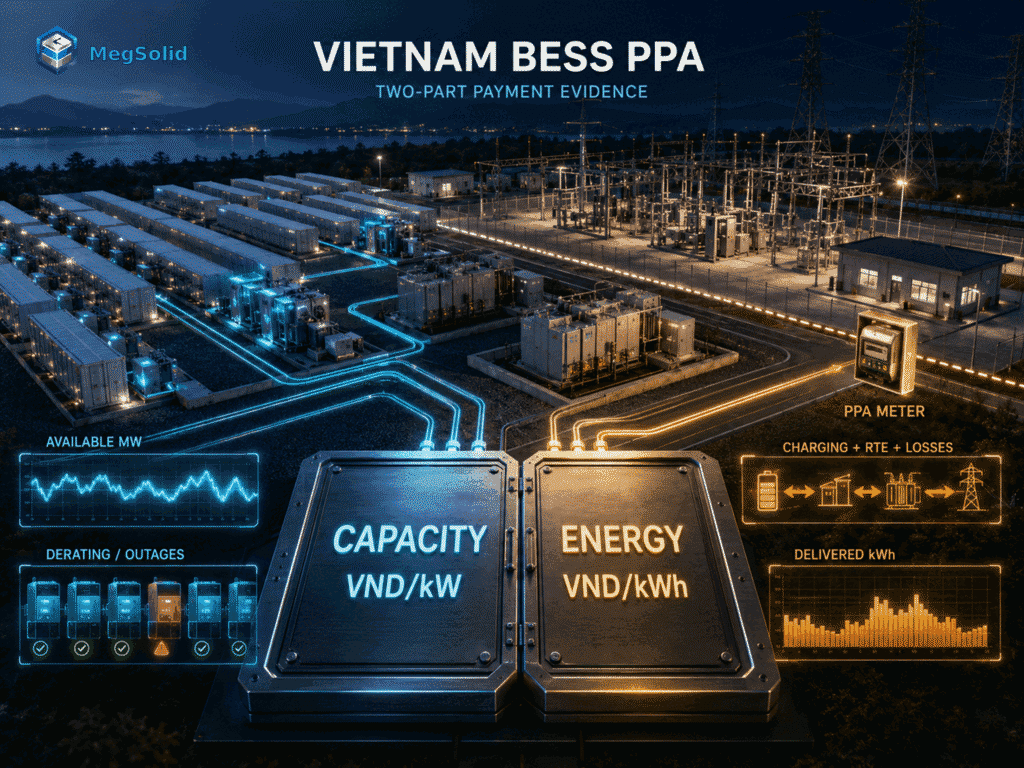
Le prix maximal de production constitue un plafond de négociation. Il résulte :
- Prix fixe moyen pour le recouvrement des coûts d'investissement
- Variable price for electricity used to charge the BESS
- Fixed O&M price for major repair, labour and other annual operating costs
The project service price then splits those economics into:
- Capacity price in VND/kW (fixed price + fixed O&M)
- Energy price in VND/kWh (charging electricity, agreed charge-discharge efficiency, applicable losses)
Circular 62 also caps the financial internal rate of return used in the service-price calculation at 12%. That is a regulatory modelling limit. It is not a supplier equipment return, and it is not the investor’s final equity return.
The circular gives a calculation method and an annual price-bracket process. It does not publish one permanent tariff number for every project.
Keep the reference plant apart from the negotiated project
Appendix I lists standard inputs for the maximum annual price bracket. Several project service-price inputs are then agreed between seller and buyer inside the circular’s rules.
| Input | Price-bracket reference | Project negotiation or evidence |
|---|---|---|
| Economic life | 15 years | Circular 62 uses a 15-year service-price life unless another competent approval applies |
| Design discharge duration | 2 hours | Approved project power, energy and dispatch duration |
| Minimum lifetime cycles | 8,000 | Agreed from approved design, manufacturer documents or an authority decision |
| Average annual capacity loss | 2% per year | Agreed project value, capped at 2%/year for the service-price calculation |
| Charge-discharge efficiency | 85% | Agreed project value from approved design or manufacturer data, with an 85% regulatory floor |
A standard bracket assumption is not an equipment guarantee.
What supports the capacity price
The capacity price is meant to recover eligible fixed investment and fixed O&M. It starts from the installed kW in the approved design, then follows the plant’s ability to stay ready for scheduled operation.
The PPA frame includes contracted price, available capacity and contracted energy. The parties still have to define how plant condition and operating records feed those fields.
| Capacity-price input | Technical evidence | Risk if left open |
|---|---|---|
| Installed capacity | Approved design, PCS schedule, transformer ratings, single-line diagram | DC nameplate energy gets treated as dispatchable AC power |
| Capacité disponible | PCS operating envelope, SOC range, temperature derating, outage status | Monthly availability becomes a fight |
| Fixed investment boundary | Equipment list and infrastructure through the connection point | Transformer, cable, substation or control costs get missed or double-counted |
| Fixed O&M | Major-repair plan, labour scope, spares plan, service responsibility | Annual cost basis has no defence |
| Economic life | Approved financial model and equipment replacement assumptions | Replacement timing fights the 15-year regulatory life |
| Annual fixed-price profile | Loan terms, repayment schedule, agreed FC by year | Debt service and PPA cash flow drift apart |
The equipment supplier should state rated AC power, overload limits, ambient derating, voltage range, power-factor capability and auxiliary operating limits. The plant designer then turns those numbers into an available-capacity definition at the contractual delivery point.
For PCS operating boundaries and grid-support functions, see grid-forming and grid-connected PCS engineering. Final 110 kV plant capability still needs PCS data, transformer and collection design, protection studies and project-level control settings.
Availability needs event codes
An availability file should split plant limits by commercial cause.
| Event state | Required record |
|---|---|
| Available and waiting for dispatch | Available kW, SOC, active limits, communications state |
| Scheduled charging | NSMO schedule, charging setpoint, actual kW, received kWh |
| Scheduled discharge | Dispatch instruction, actual kW, delivered kWh, SOC trajectory |
| Planned maintenance | Approved window, isolated equipment, remaining available capacity |
| Forced outage | Trip code, affected block, lost capacity, start time, restoration time |
| Environmental derating | Ambient condition, thermal limit, affected power, recovery time |
| Grid or communications restriction | External status, command path, plant fallback state |
Circular 62 gives the pricing method and model PPA content. The project agreement still has to write the event definitions, calculation intervals, exclusions and dispute path used for settlement.
What supports the energy price
The energy component recovers the cost of electricity used to charge and run the BESS. Article 11 ties it to three technical inputs:
| Energy-price input | Circular 62 basis | Required project evidence |
|---|---|---|
| Charging electricity price | Applicable manufacturing retail price during charging hours requested by the system and market operator | Time-stamped charging schedule, tariff period, grid-import meter data |
| Charge-discharge efficiency | Agreed from approved feasibility study, appraised basic design or manufacturer documentation; no lower than 85% | Defined test boundary, operating conditions, meter IDs, efficiency report |
| Self-use and delivery losses | BESS auxiliary consumption plus step-up transformer and line losses to the delivery point | Auxiliary meter, transformer loss calculation, cable study, delivery-point reconciliation |
85% is the regulatory floor for the negotiated input. The parties pick the project value from approved design or manufacturer evidence.
Efficiency wording needs care. MegSolid’s current 5000INTL product data states 87.5% maximum efficiency. That label is maximum efficiency. Regulatory charge-discharge round-trip efficiency at the PPA delivery point is still a project-controlled value. Fix the boundary before anyone drops a number into the financial model.
The same rule applies to transformer and line losses. A low-voltage container reading does not equal net energy at 110 kV unless auxiliary, conversion, transformer and cable losses sit in the sum.
Degradation and cycle assumptions enter the commercial model
Circular 62 lets seller and buyer agree the minimum lifetime number of charge-discharge cycles from the approved design or manufacturer documentation. Annual average capacity-loss is also agreed from the feasibility study, basic design or manufacturer information, with a regulatory ceiling of 2% per year for the calculation.
Those values feed converted maximum operating hours and the comparison between the negotiated service price and the annual price bracket.
| Contract input | Supplier document | Owner or EPC check |
|---|---|---|
| Minimum lifetime cycles | Cell and system duty assumptions, test basis, operating limits | Compare with NSMO dispatch scenario and planned annual throughput |
| Annual capacity loss | Model-specific degradation curve and stated conditions | Check temperature, SOC, DoD, C-rate, calendar ageing |
| End-of-life energy | Guaranteed or design energy at the agreed boundary | Schedule periodic capacity tests and define correction factors |
| Replacement plan | Battery, PCS, HVAC and auxiliary replacement assumptions | Align replacements with fixed-price and O&M modelling |
| Operating reserve | Minimum and maximum SOC limits | Confirm reserve policy still allows contracted dispatch duration |
A cycle count without DoD, temperature and energy-throughput basis is incomplete. A degradation percentage without a capacity-test boundary has the same hole.
For how degradation assumptions touch financial performance, see how battery degradation affects BESS ROI inputs.
EMS, SCADA and metering must produce settlement records
NSMO plans BESS capacity by region and schedules charging, discharging and other operating needs. The plant needs a clear path from dispatch instruction to EMS action, PCS/BMS response and revenue meter.
| Evidence layer | Minimum project fields | Acceptance output |
|---|---|---|
| Dispatch interface | Instruction ID, requested mode, active/reactive power setpoint, effective time | Command log with source and timestamp |
| EMS | Command received, command issued, active limit, SOC reserve, fallback state | EMS event export |
| PCS | Actual kW, kVAr, voltage, frequency, operating mode, derating, trip state | Time-series response file |
| BMS | SOC, SOH, available charge/discharge power, energy estimate, alarms, isolation status | Battery-state record |
| Revenue metering | Grid energy received, energy delivered, meter-quality flags | Monthly meter statement |
| Plant auxiliaries | Cooling, controls, pumps, fire system, other station-service energy | Auxiliary-energy record |
| Availability | Available kW by interval, cause code for reductions | Monthly availability report |
| Time synchronization | Time source, time zone, clock quality, drift alarm | Common event timeline |
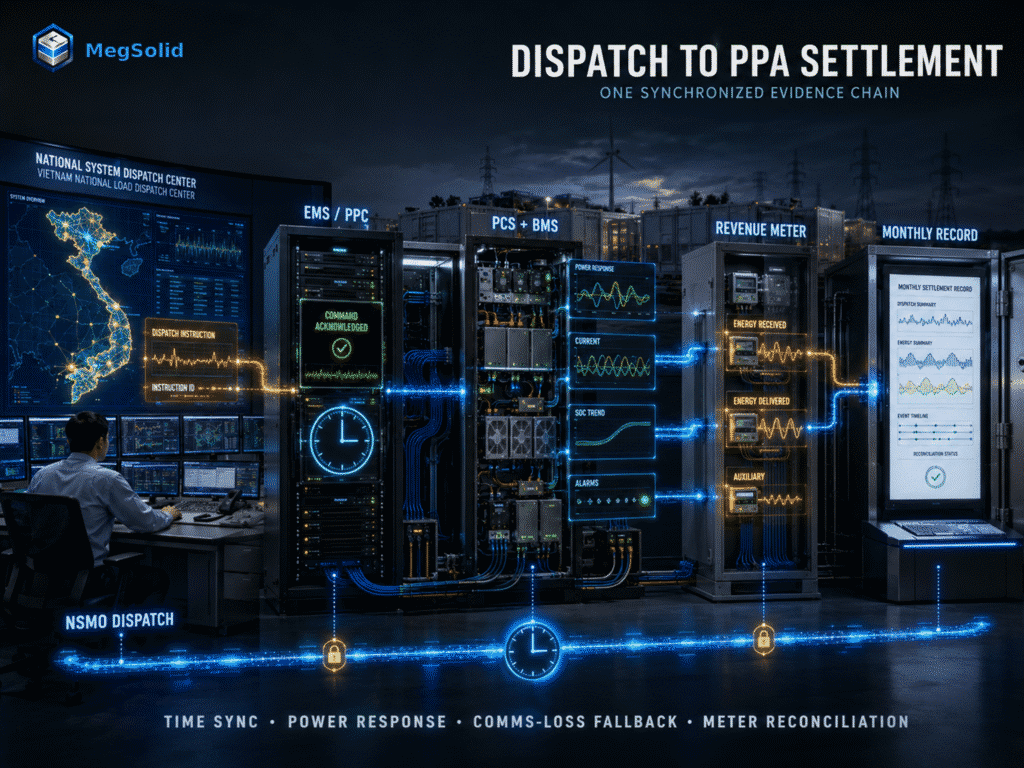
The exact point list is a project deliverable. It has to match the PPA annexes, grid-code requirements, protection philosophy and NSMO interface. Use the BESS SCADA point-list structure for signal ownership and data-quality fields. The BMS and EMS communication architecture covers command hierarchy and timestamp alignment.
Cybersecurity and remote-access boundaries belong in the same interface design. See IEC 62443-oriented BESS cybersecurity engineering for network zoning and access control.
Convert PPA inputs into FAT and SAT records
The model PPA carries annexes for plant characteristics, metering and data acquisition, operating characteristics, SCADA/EMS, communications, protection, automation, pricing and payment. The acceptance plan should follow the same chain.
| Test | Evidence captured | PPA or pricing input supported |
|---|---|---|
| Rated-power test | Setpoint, AC kW, DC status, voltage, temperature, duration | Installed and available capacity |
| Charge/discharge response | Dispatch command, acknowledgement, ramp, settled output | Scheduled operating capability |
| Energy-capacity test | Initial/final SOC, AC energy, DC energy where applicable, auxiliaries | Dispatch duration and degradation baseline |
| Efficiency test | Charging energy, delivered energy, auxiliary treatment, meter boundary | Agreed charge-discharge efficiency |
| Auxiliary-load test | Cooling and station-service demand by operating state | Self-use rate |
| Meter reconciliation | Main meter, backup meter, container meter, loss calculation | Received and delivered energy |
| Communications-loss test | Lost link, alarm, fallback action, restoration | Availability and safe dispatch |
| Derating test or calculation review | Ambient input, thermal limit, available kW | Available-capacity calculation |
| Protection and trip test | Relay event, PCS trip, breaker state, reset sequence | Forced-outage classification |
FAT shows available functions and data before shipment. SAT confirms the full plant at the real connection and delivery boundaries. Use the BESS factory acceptance test witness structure when assigning instruments, raw-data ownership and signatures.
The PPA frame also lets the parties agree how pre-COD testing, commissioning and acceptance costs are paid, while blocking double recovery through the approved total investment. Technical and commercial teams should share one controlled test register.
Where MegSolid fits in a Circular 62 project
Circular 62 describes a complete power project. A container is one piece of that plant.
MegSolid’s 5000INTL is a utility-scale containerized platform with this published boundary:
| Published parameter | 5000INTL value | Circular 62 project use |
|---|---|---|
| Puissance nominale en courant alternatif | 2.7 MW | Building block inside a multi-unit plant |
| Puissance nominale | 5,015.9 kWh | Preliminary duration and layout input |
| Rated AC voltage | 690 Vac | Input to project transformer and collection design |
| DC voltage range | 1,123.2–1,497.6 Vdc | PCS and battery operating boundary |
| Refroidissement | Smart liquid cooling | Thermal input for availability modelling |
| Ingress protection | IP55 | Enclosure input for site environmental review |
| Operating temperature | -30°C to 55°C | Input to project derating review |
| Communication | Ethernet and RS485 | Starting point for plant SCADA/PPC interface |
| Maximum efficiency | 87.5% | Product value that still needs boundary confirmation before regulatory RTE use |
More product context: MegSolid 5000INTL containerized architecture.
A qualifying project still needs multi-unit layout, plant power controller, medium- and high-voltage gear, 110 kV or higher interconnection, revenue metering, protection, telecommunications, civil works, fire strategy and project-level SCADA. Those items sit with the EPC and the relevant Vietnamese parties.
For the line between the BESS package and the grid connection, see containerized BESS transformer and grid-connection responsibilities. The example scale differs; the responsibility map still helps.
Compare suppliers by evidence delivery
| Evaluation field | Basic equipment quotation | PPA-aligned technical submission |
|---|---|---|
| Power | Container nameplate | Net plant kW boundary, derating, auxiliary treatment |
| Energy | Nominal DC kWh | Defined AC delivery boundary and end-of-life basis |
| Efficacité | Single headline value | Charge-discharge test method, meters, auxiliaries, operating conditions |
| Degradation | Generic annual percentage | Model-specific curve linked to duty and capacity-test procedure |
| Communications | Protocol name | Signal list, register map, command ownership, timestamps, failure states |
| Availability | Warranty statement | Interval calculation, event codes, exclusions, raw logs |
| Testing | Standard FAT checklist | PPA-input FAT, site SAT, meter reconciliation, signed data package |
| Project boundary | Battery container | Container, collection system, transformer, substation, metering, control interfaces |
MegSolid can structure the technical talk around an integrated battery, PCS and control boundary, then flag the plant-level items that need EPC and utility coordination. Final performance values, warranty terms, interfaces and compliance documents still have to land in the controlled project datasheet and contract.
What MegSolid needs to screen a Vietnam project
Send these before asking for a technical and commercial configuration:
- PDP8 project reference and planned commercial-operation date
- Required installed power in MW and energy in MWh
- Connection voltage, point of connection, preliminary single-line diagram
- Required discharge duration and preliminary NSMO operating profile
- Charging source, expected charging hours, tariff basis
- Proposed charge-discharge efficiency boundary
- Auxiliary-load, transformer-loss and line-loss assumptions
- Annual cycling, DoD, SOC reserve, degradation target
- SCADA protocol, dispatch interface, time synchronization, data-retention requirements
- FAT, SAT, capacity-test and meter-reconciliation requirements
MegSolid can then screen container count, AC/DC architecture, communication boundary and missing evidence. Vietnamese counsel, the project EPC, lenders, EVN/offtaker representatives and NSMO confirm the final regulatory reading and PPA wording.
Turn the tariff formula into a testable plant
Circular 62 gives qualifying standalone BESS projects a formal way to negotiate capacity and energy prices. The commercial model only works when its inputs trace to approved design documents and operating records.
For capacity: lock installed-power boundaries, available-capacity rules, fixed O&M scope and outage classifications. For energy: define charging price, charge-discharge efficiency, auxiliaries, transformer losses and delivery-point meters. For monthly settlement: make EMS, SCADA and meter timestamps agree.
A PPA-ready BESS specification links each revenue input to a named document, signal, meter and acceptance test. Set that link before the developer freezes equipment scope or files the financing model.
FAQ
Qu'est-ce que la Circulaire 62/2025/TT-BCT ?
La Circulaire 62 est le cadre tarifaire et de contrat d'achat d'électricité (PPA) effectif du Viêt Nam pour les projets de systèmes de stockage d'énergie par batteries (BESS) autonomes et raccordés au réseau éligibles. Le MOIT l'a publiée le 10 décembre 2025 et elle est entrée en vigueur le 26 janvier 2026.
Which BESS projects fall under Circular 62?
The project must be a standalone BESS of at least 10 MW, connect to the national power system at 110 kV or above, serve national-system needs and align with revised PDP8. These conditions apply together.
Does Circular 62 apply to a factory behind-the-meter BESS?
A factory or data-centre BESS operating behind the customer meter sits outside Circular 62’s stated scope. Its commercial case follows site resilience, demand management and applicable retail tariff rules.
Does Circular 62 cover a BESS tied to a solar or wind plant?
BESS integrated with a renewable power plant is excluded from this methodology. Circular 12/2025/TT-BCT provides the relevant pricing route for that project category.
What is the two-part BESS price under Circular 62?
The project generation-service price contains a capacity price in VND/kW and an energy price in VND/kWh. Capacity covers eligible fixed investment and fixed O&M, while energy reflects charging electricity and agreed technical losses.
Is the annual price bracket the same as the PPA payment formula?
The annual bracket sets a range from 0 to an approved maximum in VND/kWh. The negotiated PPA separates capacity and energy prices, then applies the contract’s monthly settlement provisions and operating records.
Which technical records support the capacity price?
The evidence package should include approved installed AC power, available capacity, SOC and temperature limits, derating rules, outage codes, fixed O&M scope and the investment boundary through the connection point.
Which inputs support the energy price?
The principal inputs are the charging electricity price, agreed charge-discharge efficiency, BESS self-use, step-up transformer loss, line loss and metered energy delivered at the contractual boundary.
Does the 85% value guarantee project round-trip efficiency?
The 85% figure is the regulatory floor for the agreed calculation input. The project value still needs support from the approved feasibility study, appraised basic design or controlled manufacturer documentation at the defined measurement boundary.
Can the 5000INTL maximum efficiency be inserted directly as PPA RTE?
MegSolid publishes 87.5% as the 5000INTL maximum efficiency. PPA round-trip efficiency at the delivery point has a separate boundary that includes the agreed treatment of auxiliaries, conversion, transformer and line losses.
How does Circular 62 treat battery degradation?
Seller and buyer agree the annual average capacity-loss input from approved design or manufacturer evidence. The service-price calculation caps that input at 2% per year.
What cycle life and discharge duration appear in the reference calculation?
Appendix I uses a two-hour design discharge duration and 8,000 minimum lifetime cycles for the maximum price-bracket reference. The negotiated project duty must still match the approved design and manufacturer evidence.
Que doivent enregistrer le système de gestion de l'énergie (EMS) et le SCADA pour le règlement des contrats d'achat d'électricité (PPA) ?
Les enregistrements doivent relier l'instruction du NSMO à l'accusé de réception de l'EMS, aux consignes de puissance active et réactive, à la sortie du PCS, au SOC, au SOH, au derating, aux alarmes, aux états de déclenchement, aux valeurs des compteurs et à des horodatages synchronisés.
Which meters are needed for the energy evidence chain?
The project should define main and backup revenue meters, meters for energy received and delivered, auxiliary consumption and any container-level checks. The reconciliation method must identify the PPA delivery point and treatment of transformer and line losses.
What should FAT and SAT prove for a Vietnam BESS PPA?
The test plan should cover rated power, charge and discharge response, energy capacity, efficiency boundary, auxiliary load, meter reconciliation, communications-loss fallback, derating and protection events. Raw data, calibrated instruments and signatures make the results auditable.
Un MegSolid 5000INTL peut-il être qualifié de projet Circulaire 62 ?
One 5000INTL is rated at 2.7 MW and 5,015.9 kWh, so it serves as a utility-scale building block. A qualifying Circular 62 project requires at least 10 MW plus a 110 kV or higher interconnection, multi-unit plant design, metering, protection, PPC/SCADA and the relevant Vietnamese approvals.
