 Aller au contenu

Commercial developers and engineering procurement contractors actively evaluate byd bess alternatives for industrial microgrids and utility storage installations.
While BYD Energy offers established systems like the Chess Plus commercial cabinet and MC Cube-T container, project specifications vary widely.
Differences in unit capacity, equipment footprint, DC voltage operating windows, and project customization drive EPCs to compare multiple hardware platforms.
Our comparative benchmarks on Alternatives au Sungrow PowerStack : comparaison des systèmes de stockage C&I de 257 à 261 kWh examine commercial cabinet sizing.
Similarly, our technical review of Alternatives LUNA2000-215-2S10 : Huawei vs MegSolid analyzes voltage and cooling architectures.
MegSolid provides documented alternatives across commercial outdoor cabinets and 20-foot utility containers:
- ESSA0100B-0215: 100 kW / 215.04 kWh smart air-cooled commercial cabinet (280 Ah LFP)
- Energon 261: 125 kVA / 261.24 kWh liquid-cooled industrial cabinet (314 Ah LFP, 1P260S)
- 5000INTL: 2,700 kW (450 kW x 6) / 5,015.9 kWh liquid-cooled 20-foot container (12P416S)
Key Engineering Factors When Evaluating BYD BESS Alternatives
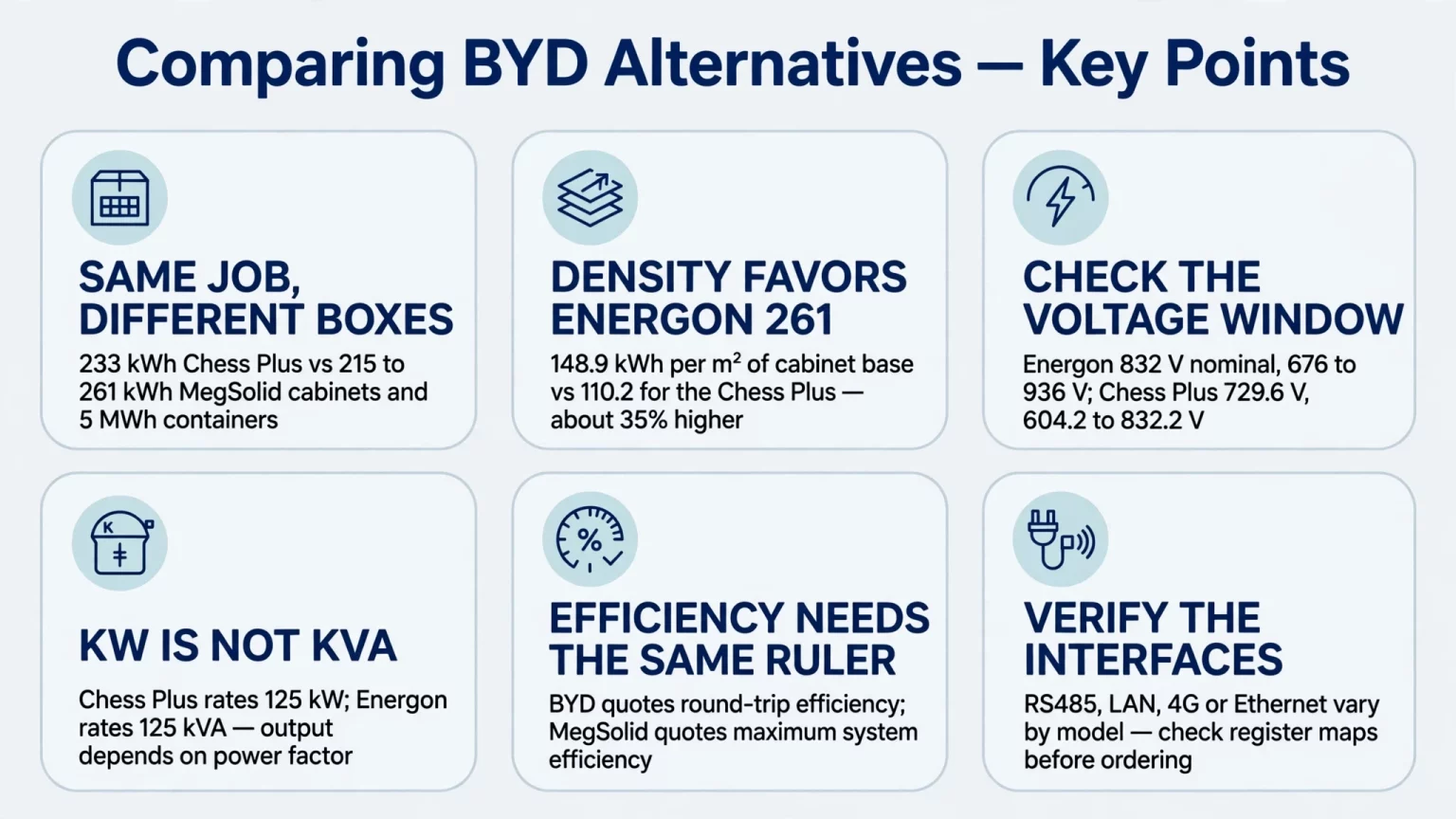
Procurement engineers comparing commercial battery storage alternatives focus on verifiable electrical, mechanical, and project integration parameters.
Matching cabinet specifications to site transformer limits, available pad area, and supervisory controls prevents costly redesigns during commissioning.
Equipment Footprint and Area Energy Density
Industrial facilities in urban zones often face tight spatial constraints when allocating concrete pads for battery cabinets.
The BYD Chess Plus (model IC07-B233AP125-A-R2) measures 1,258 x 1,680 x 2,240 mm, occupying a 2.11 m² equipment base.
At 233 kWh nominal energy, that cabinet yields an equipment base area energy density of 110.2 kWh/m².
By comparison, the MegSolid Energon 261 measures 1,300 x 1,350 x 2,200 mm, occupying a 1.76 m² equipment base.
With 261.24 kWh rated energy, the Energon 261 reaches 148.9 kWh/m² across its physical cabinet base.
This represents roughly 35% higher equipment base area energy density and 12.1% higher unit energy capacity.
Note that physical equipment area excludes required maintenance aisles, door swing clearances, fire setbacks, and civil foundations.
Voltage Windows and Power Rating Boundaries
DC string configuration directly determines the operating voltage window presented to the power conversion system (PCS).
The BYD Chess Plus (IC07-B233AP125-A-R2) uses a 1P228S LFP configuration at 729.6V nominal (604.2V to 832.2V range).
The MegSolid Energon 261 uses a 1P260S configuration at 832V nominal, operating across a 676V to 936V DC range.
Engineers must also distinguish between rated active power (kW) and rated apparent power (kVA) during system sizing.
While the Chess Plus datasheet lists 125 kW rated power, the Energon 261 specifies 125 kVA rated AC power.
Actual active power delivery from a kVA-rated unit depends on the operating power factor and grid reactive power requirements.
Hardware Interfaces and Register Mapping
Integrating battery cabinets into plant supervisory control networks requires matching hardware ports and communication register maps.
The BYD Chess Plus specification includes Modbus TCP/IP communication alongside cloud monitoring support.
MegSolid provides model-specific communication hardware across its commercial and utility lineup:
- ESSA0100B-0215: Equipped with RS485 and TCP/IP communication interfaces
- Energon 261: Equipped with RS485, LAN, and 4G communication interfaces
- 5000INTL: Equipped with Ethernet and RS485 communication interfaces
Rather than assuming universal plug-and-play compatibility, EPCs should verify specific protocol tables and register maps with the manufacturer.
BYD Chess Plus vs. MegSolid Energon 261 & ESSA0100B-0215 (C&I Cabinet Comparison)
Commercial developers evaluating a byd chess plus alternative or researching byd cube pro vs megsolid require model-specific datasheet comparisons.
Note that BYD Chess Plus and BYD Cube Pro represent separate product lines and should not be conflated.
The table below compares the verified BYD Chess Plus (IC07-B233AP125-A-R2) against MegSolid commercial cabinets.
| Paramètre technique | BYD Chess Plus (IC07-B233AP125-A-R2) | MegSolid ESSA0100B-0215 | MegSolid Energon 261 |
|---|---|---|---|
| Nominal / Rated Energy | 233 kWh Nominal | 215.04 kWh Nominal | 261.24 kWh Rated (+12.1% vs Chess Plus) |
| Rated AC Power Output | 125 kW | 100 kW | 125 kVA (400V / 480V +/-15%) |
| Battery Configuration | LFP, 1P228S (320 Ah Thick Blade) | 280 Ah LFP, 1P240S (Solid-State Optional) | 314 Ah LFP, 1P260S |
| Méthode de refroidissement | Battery Liquid Cooling, PCS Air Cooling | Smart Temperature-Controlled Air Cooling | Refroidissement par liquide |
| Tension nominale en courant continu | 729.6V DC | 768.0V DC | 832.0V DC |
| Plage de tension continue | 604.2V to 832.2V DC | 672.0V to 850.0V DC | 676.0V to 936.0V DC |
| Dimensions (W x D x H) | 1,258 x 1,680 x 2,240 mm | 2,450 x 1,550 x 2,400 mm | 1,300 x 1,350 x 2,200 mm (+/-5 mm) |
| Equipment Base Footprint | 2.11 m² (110.2 kWh/m²) | 3.80 m² (56.6 kWh/m²) | 1.76 m² (148.9 kWh/m²) |
| Published Efficiency Metric | Round-Trip Efficiency (RTE) >= 90% | System Efficiency per Project Spec | Maximum System Efficiency 90% |
| Fire Protection & Interfaces | Pack-Level + Aerosol; Modbus TCP/IP | Aerosols / NOVEC1230 (IP54); RS485, TCP/IP | Novec + Multi-Sensor + Water (IP54); RS485, LAN, 4G |
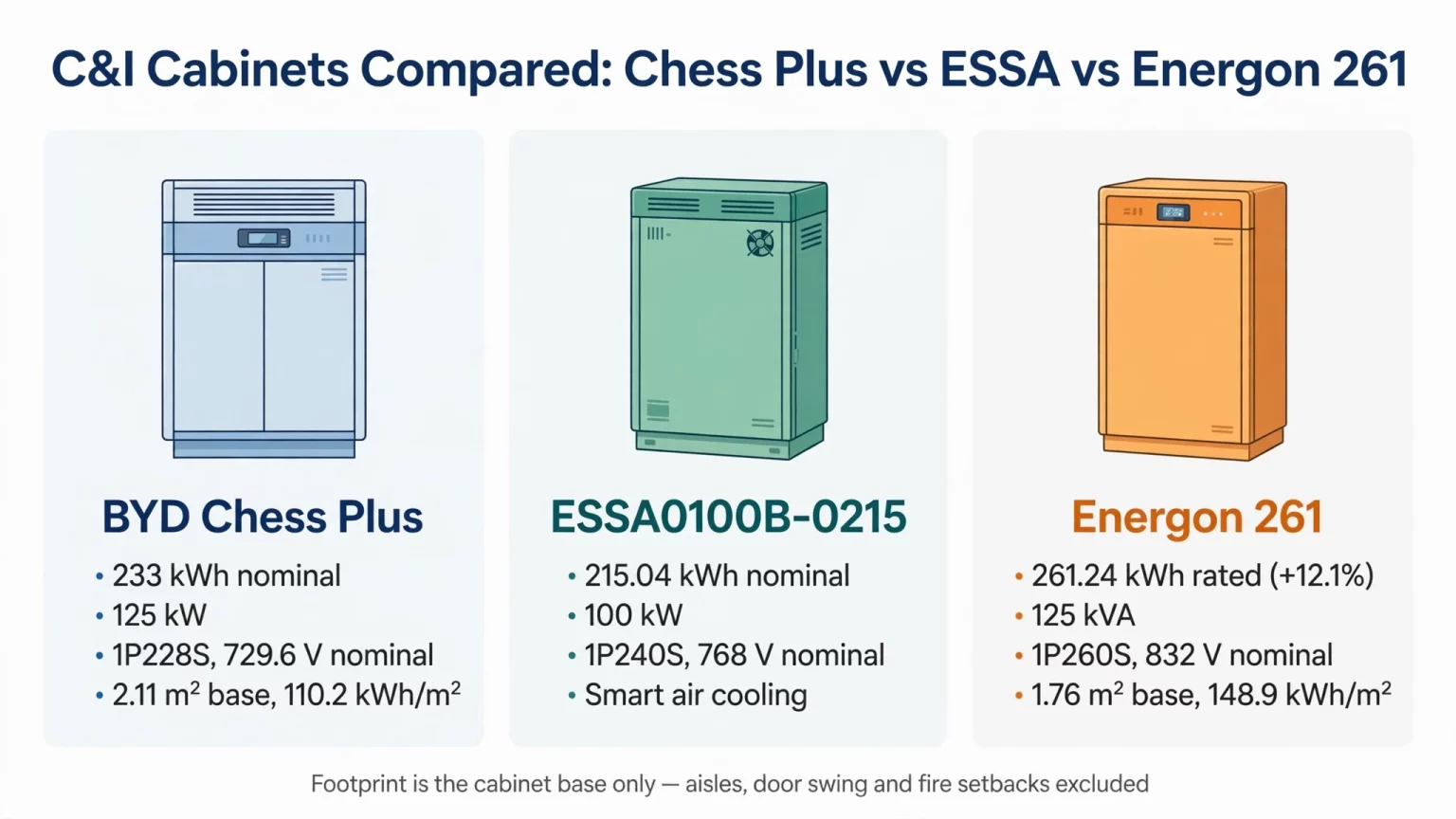
Configured as a 261kwh liquid cooled bess, the Energon 261 Liquid-Cooled C&I Energy Storage System provides higher unit energy in a smaller cabinet footprint.
For a 1 MWh nominal storage target, four Energon 261 units supply 1,044.96 kWh total rated capacity.
Reaching the same threshold with 233 kWh cabinets requires five units (1,165 kWh) or accepting 932 kWh across four units.
When comparing efficiency figures, note that BYD reports AC round-trip efficiency (RTE >= 90%), whereas MegSolid lists maximum system efficiency (90%).
Because measurement boundaries differ between peak system efficiency and full-cycle RTE, engineers should request load-specific efficiency curves.
Explore cabinet selection criteria in our Choose Commercial Battery Storage: 215kWh vs 261kWh BESS guide.
Review full air-cooled cabinet parameters on our ESSA0100B-0215 Outdoor Cabinet Energy Storage System page.
BYD MC Cube-T vs. MegSolid 5000INTL (Utility 5MWh Container Comparison)
Utility developers evaluating byd mc cube alternatives compare 20-foot container configurations for substation and renewable plants.
Both the BYD MC Cube-T series and the MegSolid 5000INTL use standard 20-foot ISO high-cube container dimensions (6,058 x 2,438 x 2,896 mm).
The table below compares the verified 20-foot BYD MC Cube-T models against the MegSolid 5000INTL system.
| Engineering Metric | BYD MC Cube-T (MC10C-B5010 / B5365) | MegSolid 5000INTL Container | Engineering Comparison Notes |
|---|---|---|---|
| Container Dimensions (W x D x H) | 6,058 x 2,438 x 2,896 mm | 6,058 x 2,438 x 2,896 mm | Identical 20-foot ISO high-cube envelope |
| Published Energy Capacity | 5,010 kWh / 5,360 kWh (FAT DC Usable) | 5,015.9 kWh (Rated Energy) | Different energy definitions (FAT DC Usable vs Rated) |
| Battery String Architecture | Independent Clusters, 2 x 5 x 1P416S | 12P416S (SHS180-314 LFP) | Both employ 416S series string voltage scaling |
| Nominal DC Operating Voltage | 1,331.2V DC | 1,331.2V DC | Matched for 1,500V DC utility inverter platforms |
| Power Conversion Setup | External MV PCS Skid Integration | 450 kW x 6 (2,700 kW Rated AC at 690 Vac) | MegSolid specifies 6 x 450 kW AC power blocks |
| Gestion thermique | Refroidissement par liquide | Refroidissement liquide intelligent | Liquid-cooled thermal regulation across racks |
| Ingress Protection Rating | IP55 | IP55 | Equivalent outdoor enclosure environmental protection |
| Interfaces de communication | CAN, RS485, Ethernet | Ethernet, RS485 | Industrial wired supervisory interfaces |
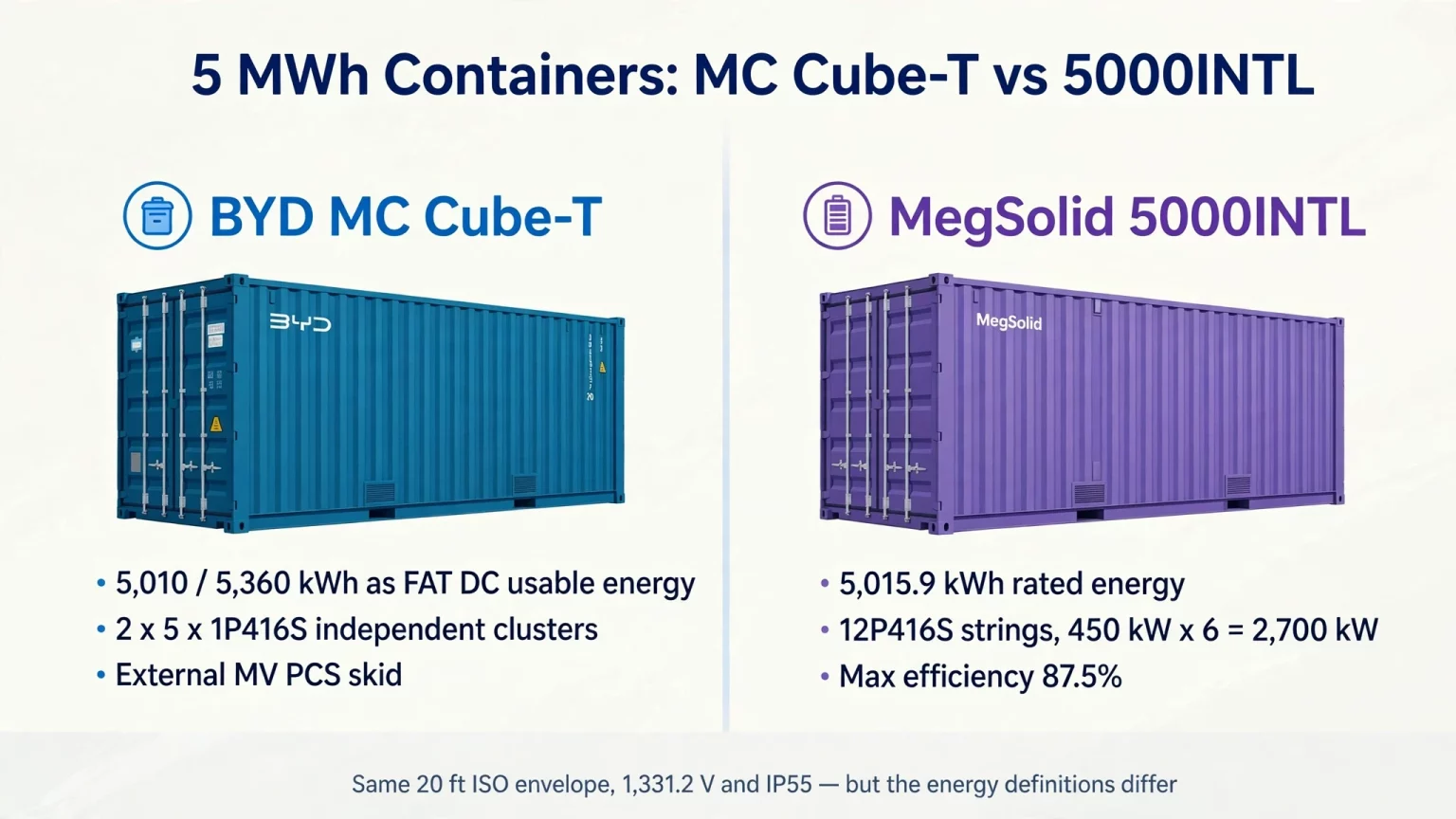
When evaluating a 5mwh containerized bess, engineers must carefully distinguish between published capacity definitions.
BYD specifies 5,010 kWh and 5,360 kWh as Factory Acceptance Test (FAT) DC usable energy on its 20-foot MC Cube-T models (with 6 MWh-class variants also available in the wider product family).
MegSolid specifies 5,015.9 kWh as rated energy for the 5000INTL container alongside a maximum efficiency of 87.5%.
Actual delivered AC energy at the point of interconnection depends on depth of discharge, auxiliary cooling loads, and inverter conversion losses.
Both platforms organize cells into 416-series strings (1,331.2V nominal), with BYD using a 2 x 5 x 1P416S cluster layout and MegSolid using a 12P416S layout paired with 450 kW x 6 AC conversion.
Project engineers should review the system single-line diagram (SLD) to evaluate parallel string protection, fuse coordination, and maintenance isolation.
Examine complete container specifications on our système de stockage d'énergie en conteneur MegSolid 5000INTL page.
Cell Architecture, Thermal Management & Enclosure Fire Protection
Fire safety compliance and thermal regulation remain central to municipal permitting and insurance underwriting.
Comparing cell integration and enclosure protection requires looking at verified product specifications for each model.
Cell Format, String Architecture & Thermal Regulation
BYD Chess Plus deploys 320 Ah Thick Blade LFP cells integrated in a 1P228S string with battery liquid cooling and PCS air cooling.
MegSolid ESSA0100B-0215 deploys 280 Ah LFP cells in a 1P240S string with smart temperature-controlled air cooling, with solid-state cell integration available as a project option.
MegSolid Energon 261 deploys 314 Ah LFP cells in a 1P260S string with liquid cooling to maintain thermal balance during cycling.
At the utility scale, both the BYD MC Cube-T (2 x 5 x 1P416S) and MegSolid 5000INTL (12P416S) rely on liquid cooling across 1,331.2V strings.
Model-Specific Enclosure Fire Suppression
Because fire protection architectures differ across product series, engineers must evaluate suppression hardware by specific model rather than assuming a uniform setup.
On the BYD Chess Plus (IC07-B233AP125-A-R2), the official specification lists pack-level fire protection combined with aerosol suppression.
On the MegSolid ESSA0100B-0215, the IP54 cabinet incorporates aerosol or NOVEC1230 fire extinguishing systems alongside a built-in isolation transformer.
On the MegSolid Energon 261, the IP54 enclosure integrates Novec clean-agent suppression, multi-sensor detection, and water-based fire protection.
On the MegSolid 5000INTL container, intelligent early warning algorithms pair with three-dimensional protection systems inside an IP55 enclosure.
Review our portfolio of storage architectures on the MegSolid Hybrid Solid-State Energy Storage Systems page.
Commercial Procurement & Project Integration Considerations
Beyond datasheet metrics, project viability depends on procurement responsiveness, contractual delivery schedules, and system integration support.
Production Scheduling and Order Flexibility
Manufacturing lead times in the energy storage sector fluctuate based on order volume, cell allocation, destination port, and custom engineering requirements.
Large tier-one manufacturers simultaneously service high-volume automotive lines and multi-hundred-megawatt utility tenders, which can affect scheduling for smaller commercial orders.
MegSolid supports commercial and industrial EPCs with flexible order quantities and direct factory OEM/ODM engineering customization.
Developers should request formal production and shipping schedules matched to their specific destination and interconnection timeline during the RFQ stage.
System Integration and After-Sales Engineering
Successful microgrid deployment requires coordinated commissioning between battery racks, power conversion systems, and plant controllers.
For modular rack-mount inverter applications, EPCs can pair battery strings with our MegSolid Energy Storage Inverter series (PMA080, PMA0105, and PMA0125).
Detailed maintenance procedures, spare module strategies, and multi-year warranty terms are defined within project-specific technical agreements.
Browse our complete commercial lineup on the Systèmes de stockage d'énergie commerciaux et industriels page.
FAQ
How does the MegSolid Energon 261 compare to the 233 kWh BYD Chess Plus in capacity?
The MegSolid Energon 261 has a rated energy of 261.24 kWh, compared to 233 kWh nominal energy for the BYD Chess Plus (IC07-B233AP125-A-R2). This gives the Energon 261 approximately 12.1% higher nominal energy storage capacity per outdoor cabinet.
How do the equipment footprints and area energy densities compare?
The BYD Chess Plus (1,258 x 1,680 mm) occupies 2.11 m² (110.2 kWh/m²), while the Energon 261 (1,300 x 1,350 mm) occupies 1.76 m² (148.9 kWh/m²). The Energon 261 achieves roughly 35% higher equipment base area energy density, excluding external clearances, maintenance aisles, and civil foundations.
Does the Energon 261 have the same active power rating as the 125 kW BYD Chess Plus?
Not necessarily. The BYD Chess Plus specifies 125 kW rated power, whereas the Energon 261 specifies 125 kVA rated apparent power. Actual active power (kW) output from a 125 kVA unit depends on the operating power factor required by the site grid code.
Can BYD Chess Plus and MegSolid Energon 261 efficiency numbers be compared directly?
No. BYD publishes a round-trip efficiency (RTE) of >= 90% for the Chess Plus, while MegSolid publishes a maximum system efficiency of 90% for the Energon 261. Because peak system efficiency and full-cycle RTE have different measurement boundaries, EPCs should compare efficiency under identical load profiles.
How do the DC voltage ranges compare between BYD Chess Plus and Energon 261?
The BYD Chess Plus (1P228S) operates across 604.2V to 832.2V DC with a nominal voltage of 729.6V DC. The MegSolid Energon 261 (1P260S) operates across 676V to 936V DC with a nominal voltage of 832V DC.
What communication interfaces are confirmed across MegSolid commercial and utility models?
Official specifications confirm RS485 and TCP/IP for the ESSA0100B-0215, RS485, LAN, and 4G for the Energon 261, and Ethernet and RS485 for the 5000INTL. Engineers should request model-specific protocol documentation and register maps to verify compatibility with third-party EMS controllers.
How do the energy ratings of BYD MC Cube-T and MegSolid 5000INTL differ?
BYD lists 5,010 kWh and 5,360 kWh as FAT DC usable energy for its 20-foot MC Cube-T models, and also offers 6 MWh-class configurations. MegSolid lists 5,015.9 kWh as rated energy for the 5000INTL; actual delivered AC energy depends on system efficiency and operating depth of discharge.
How are battery strings configured inside the MC Cube-T vs. the 5000INTL?
Both systems use 416 series-connected cells per string to reach a nominal DC voltage of 1,331.2V. The BYD MC Cube-T uses an independent cluster layout of 2 x 5 x 1P416S, while the MegSolid 5000INTL uses a 12P416S configuration with 450 kW x 6 AC power blocks.
What battery chemistry is used in the MegSolid ESSA0100B-0215 cabinet?
The standard ESSA0100B-0215 cabinet uses 280 Ah LFP cells in a 1P240S configuration (768V nominal) with smart temperature-controlled air cooling. Solid-state cell configurations are available as a project-specific option depending on customer requirements.
How is fire suppression configured on the Energon 261 cabinet?
The MegSolid Energon 261 specification includes Novec clean-agent suppression, multi-sensor detection, and water-based fire protection inside an IP54 cabinet. Other MegSolid product lines have distinct fire protection configurations detailed in their respective technical datasheets.
Conclusion: Selecting the Right C&I and Utility Storage Architecture
Evaluating commercial and utility energy storage options requires comparing verified model datasheets, voltage windows, and physical site constraints.
While BYD offers established platforms in the 233 kWh Chess Plus and 5 MWh MC Cube-T, MegSolid provides competitive alternatives tailored for diverse project needs.
With a 148.9 kWh/m² equipment base energy density on the Energon 261 (261.24 kWh) and 5,015.9 kWh rated capacity on the 5000INTL container, MegSolid supports high-density deployments.
Review our comparative equipment analyses on Sungrow PowerStack Alternatives: Comparing 257–261 kWh C&I Battery Storage for further market benchmarks.
You can also explore our technical comparison on LUNA2000-215-2S10 Alternatives: Huawei vs MegSolid to evaluate high-voltage commercial cabinets.
Submit your single-line diagram and project requirements through the engineering contact form for model-specific datasheets and quotes.
Connect with our application engineering team via the engineering contact form to discuss protocol mapping and delivery schedules.
