
Solar-to-hydrogen production suffers when a 1 MW plant loses 400 kW of renewable supply. MegSolid ESSC0500B-1075 (500 kW / 1,0752 MWh) is the specific BESS to examine for a 45-minute shortfall. Delivered AC energy, site connection and recharge timing decide whether it can keep the planned production load online.
Le MegSolid ESSC containerized range puts 500 kW and 1 MW rated AC options in front of the EPC. C&I battery-system design identifies the loads and AC meter that determine purchase size; BESS EMS priority control sets dispatch and reserve behavior around the next production dip. The buying decision is the power shortfall, its duration and the recovery window—not installed solar MWp.
How Much BESS Power Does a Hydrogen Electrolyzer Need During Solar Dips?
Lost generation becomes lost hydrogen output when the electrolyzer cannot maintain its approved load. The operator can turn down, take permitted grid or generator power, or discharge storage. Each choice has a cost and an operating limit. MegSolid BESS earns a place when a measured renewable shortfall threatens a production commitment that the other permitted choices cannot meet as economically.
Put the power balance at the electrolyzer plant's AC connection. Account for the rectifier and essential pumps, compressors or cooling already included in the target. Deduct only renewable power arriving there, plus grid or generator contributions actually permitted during the shortfall. A solar-field nameplate or a separate plant meter can hide the deficit that matters.
Required BESS discharge (kW) = target electrical demand (kW) − usable renewable supply (kW) − permitted contribution from other sources (kW). If supply already meets demand, no discharge is required. Charging is a separate operating decision governed by source availability, the PCS and site import/export permissions.
The initial design case has 1 000 kW of load at the agreed AC meter. Solar supply falls to 600 kW for 45 minutes and the operating mode allows no grid import. The result is a 400 kW power gap and 400 × 0.75 = 300 kWh of ideal AC energy demand. Both values must appear in the equipment specification. Peak solar MWp alone cannot select a BESS.
MegSolid ESSC0500B-1075 supplies the first credible power class. It is rated 500 kW AC, ce qui laisse 100 kW nominal real-power margin over the measured 400 kW gap. Its 400 V interface also gives the EPC a specific connection class to price. Approval still rests on the combined kVA duty, temperature, controls and usable AC-energy test.
Hidden auxiliaries can destroy that margin. Another 80 kW outside the original load raises the gap to 480 kW, leaving only 20 kW nominal room. A further load case with 120 kW outside the original figure raises the gap to 520 kW, beyond the single 500 kW ESSC0500B-1075 rating. This is a genuine reason to review ESSC1000B-2150 or an approved multi-unit configuration, with the power-factor limits checked rather than ignored.
Use a chronological AC deficit record, including the electrolyzer vendor's permitted load-following range. It shows how often storage would discharge, whether it can recharge and which cloud events cost the plant real output. MegSolid hardware should be specified around that duty instead of a worst-case number divorced from the day's operation.
Which MegSolid BESS Fits 400 kW, 900 kW and Multi-MW Power Gaps?
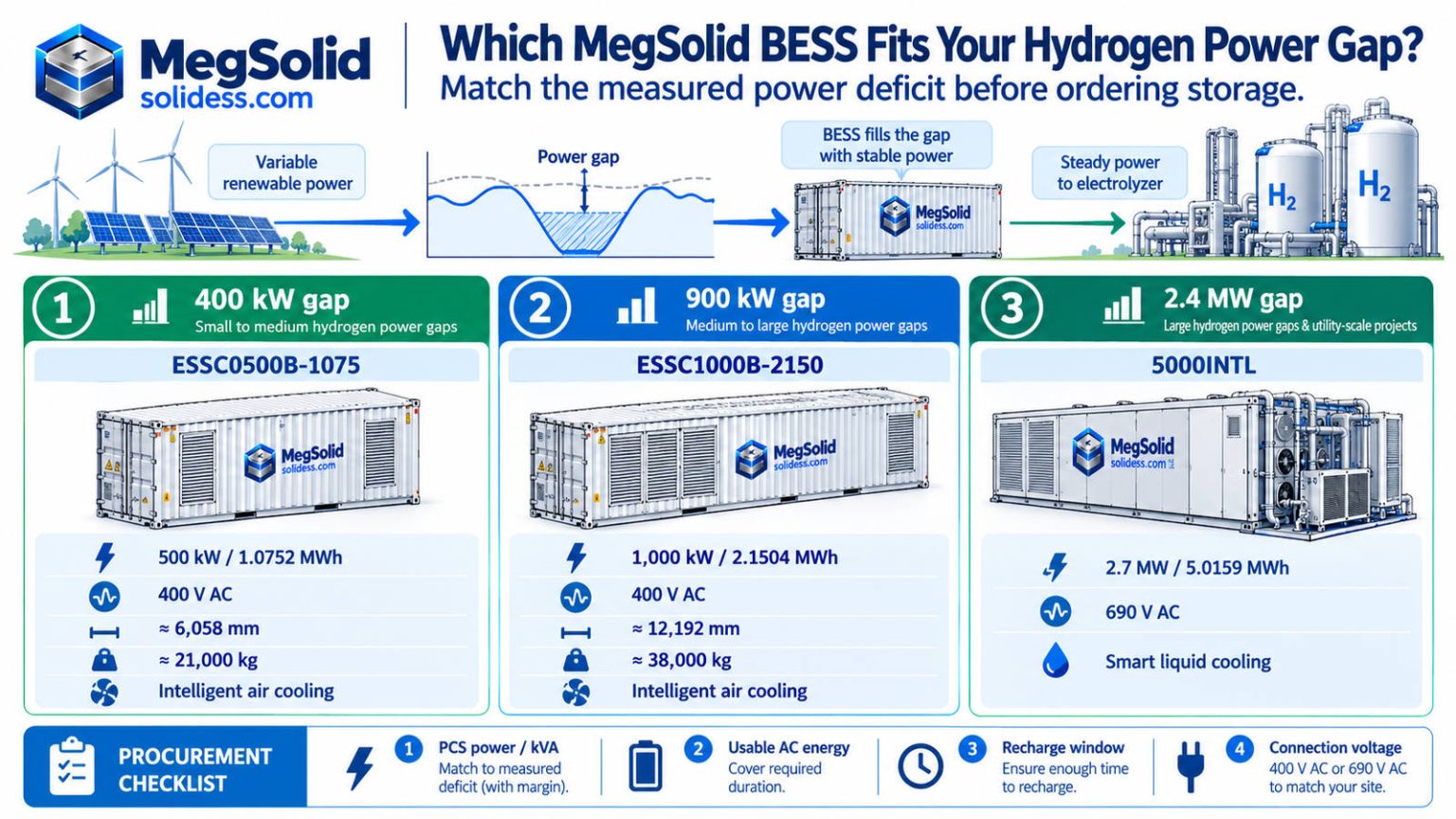
The PCS must deliver the missing kW before stored MWh become useful. MegSolid has defined entry points from 100 kW ESSA through 500 kW and 1 MW ESSC to 2.7 MW 5000INTL. The shortfall sets the first equipment class. Its duration, repetition and site connection then determine whether that unit is worth purchasing.
| Measured operating need | MegSolid starting product | Published AC rating / battery energy | Purchase judgment |
|---|---|---|---|
| Up to 100 kW gap, short intermittent duty | ESSA0100B-0215 | 100 kW / 215,04 kWh | Cabinet-scale option; validate delivered energy and any parallel expansion |
| Moderate cabinet-scale demand where apparent power matters | Energon 261 | 125 kVA / 261,24 kWh | Verify power factor before treating kVA as available kW |
| 400 kW gap for 45 minutes | ESSC0500B-1075 | 500 kW / 1,0752 MWh | First containerized candidate; 400 V AC interface |
| 900 kW gap for 90 minutes | ESSC1000B-2150 | 1 000 kW / 2,1504 MWh | Passes rated-power screen; verify 1.35 MWh delivered AC energy |
| 2.4 MW gap at a larger site | Energon 5000INTL | 2,700 kW / 5.0159 MWh | 690 V class; assess transformer and bus arrangement |
The ESSC models share a 400 V AC rating, intelligent air cooling and IP54 construction, but their rated AC currents are 722 A et 1,445 A. A larger container means a larger distribution duty, with consequences for busbars, feeders and protection. The electrolyzer rectifier may also consume reactive power; the EPC must verify the required kVA before counting the full rated kW as available headroom.
Le ESSA outdoor cabinet family gives smaller demonstration sites a way to avoid purchasing a full 6 m container when their event duty is far below 500 kW. The 261.24 kWh liquid-cooled cabinet is another distinct packaging class, but its 125 kVA rating cannot be relabelled as 125 kW without the project's power-factor conditions.
Le MegSolid 5000INTL containerized system moves the comparison to 2.7 MW rated AC power, 5.0159 MWh rated battery energy and 690 V. Smart liquid cooling and an IP55 enclosure form part of that published equipment package; neither constitutes hazardous-area approval or a guarantee of grid-forming operation. Screen this system for a 2.4 MW shortfall with a suitable 690 V connection. A 400 kW event alone does not justify this power class.
Project size alone cannot justify a multi-MW battery purchase. Let actual deficits, recharge limits and grid architecture justify the MegSolid power class.
How Many Usable MWh Keep Hydrogen Production Running?
Nameplate energy is not the AC energy a hydrogen plant can spend. Start-of-event SOC, usable discharge band, conversion losses, auxiliaries, temperature and end-of-life conditions reduce the delivery budget. That budget has to cover the contracted interval at the plant meter.
Le 400 kW / 45-minute duty calls for 300 kWh AC, 27.9% of ESSC0500B-1075's 1,075.2 kWh rated battery energy. Le 900 kW / 90-minute duty calls for 1,350 kWh AC, 62.8% of ESSC1000B-2150's 2,150.4 kWh rating. Those ratios are useful shortlisting checks, not deliverable capacity guarantees. The supplier's performance schedule must establish at least 62.8% net AC delivery relative to nameplate for the latter duty at the required SOC, temperature and end-of-life point.
| Données relatives aux dimensions | What it changes | What the EPC must decide |
|---|---|---|
| Starting SOC and permitted minimum SOC | Accessible discharge band | Energy reserved for the next event or protected shutdown |
| Battery SOH at the warranty design point | Remaining capacity | End-of-life performance, not only day-one capability |
| PCS and auxiliaries | AC energy reaching the load | Boundary for performance acceptance |
| Temperature and power limits | Dispatch derating | Worst relevant operating-day output |
| Events before the next recharge window | Cumulative energy need | One dip or several back-to-back dips |
| Load-following permission | Energy no longer needed from BESS | Smaller battery or no battery for some events |
Three dips of 400 kW lasting 45 minutes each, without recharge, demand 900 kWh AC in the ideal balance. That is 83.7% of ESSC0500B-1075 nameplate energy before energy reserve, losses or ageing. The 500 kW power rating has not become inadequate; the day's energy budget has. An EPC should review supported capacity arrangements and charging time before upgrading PCS power.
Review the actual production-day dispatch and charge recovery; one assumed usable-energy percentage is too crude for these events. The MegSolid SOC reserve framework explains how an energy floor protects a named operating obligation. Here that obligation may be the minimum power needed for a controlled electrolyzer ramp-down or the next contracted hydrogen production window; its SOC equivalent has to come from real product performance and site test data.
The right order is to prove the full event schedule, then release the container selection. ESSC0500B-1075 fits the 400 kW rated-power screen; repeated shortfalls may push the energy requirement beyond its usable operating window. MegSolid's supported system configuration and the site recharge plan determine the next equipment step.
The MegSolid technical review can compare the measured 400–900 kW operating deficits with ESSC0500B-1075, ESSC1000B-2150 and smaller available configurations, including start-of-event SOC, reserve and available time to recharge.
When Is Electrolyzer Load Following Cheaper Than Adding More BESS?
Approved PEM load flexibility can make storage unnecessary during small dips. Under a firm hydrogen delivery commitment, the same dips can become expensive interruptions. The saleable MegSolid ESSC application lies between those two conditions: a production window worth holding and a verified electrical shortfall that BESS can cover.
Get the permitted turndown and ramp data for the exact electrolyzer. The vendor's minimum load, pressure limits, gas quality, thermal constraints and cycling permissions set the boundary. Without them, a proposal to reduce stack ageing by installing a battery is speculation; the defensible purchase case remains shortfall coverage.
The EPC should price the same shortfall under three permitted dispatch choices:
| Dispatch choice | Electrical result | Business consequence |
|---|---|---|
| Electrolyzer follows available PV | Reduced electric input | Less hydrogen output during the event; possibly acceptable |
| MegSolid BESS covers the approved deficit | More stable planned electric input | Preserves that operating window while consuming stored energy |
| Grid/generator supports the deficit | Less battery discharge | Depends on import permission, energy cost, emissions and source availability |
Le 300 kWh shortfall has a calculable potential production effect. Using 55 kWh/kg as the project's electricity-use basis gives approximately 5.45 kg of hydrogen-equivalent output for a fully bridged event. The U.S. DOE publishes 55.2 kWh/kg as a representative beginning-of-life PEM system figure, not a MegSolid operating result. Across 10 properly recharged events, the gross opportunity would be 54.5 kg. The buyer must still check whether the plant can actually make those kilograms, whether any shortfall could be recovered later and what the charging energy costs.
Missed delivery windows can trigger penalties under a hydrogen offtake contract. Demonstration facilities may tolerate the same temporary production reduction without lost sales. Both can use identical ESSC hardware, but only the first case may justify a strong economic argument. Count incremental hydrogen that would otherwise be lost, using the actual contractual and operational boundary.
The purchase case for MegSolid ESSC is measured production protection. Link the recorded kW/kWh deficits to delivery obligations and an approved recharge source. Put any claimed improvement in stack life in a separate, equipment-specific review; do not blend it into the storage performance guarantee.
How Do MegSolid BESS, PV and the Electrolyzer Rectifier Connect?
Correct BESS capacity cannot fix an incorrect power interface. The electrolyzer stack needs controlled DC from its rectifier. A MegSolid AC container is evaluated against the plant distribution system or another explicitly engineered connection—not connected straight to the stack on the strength of a battery voltage figure.
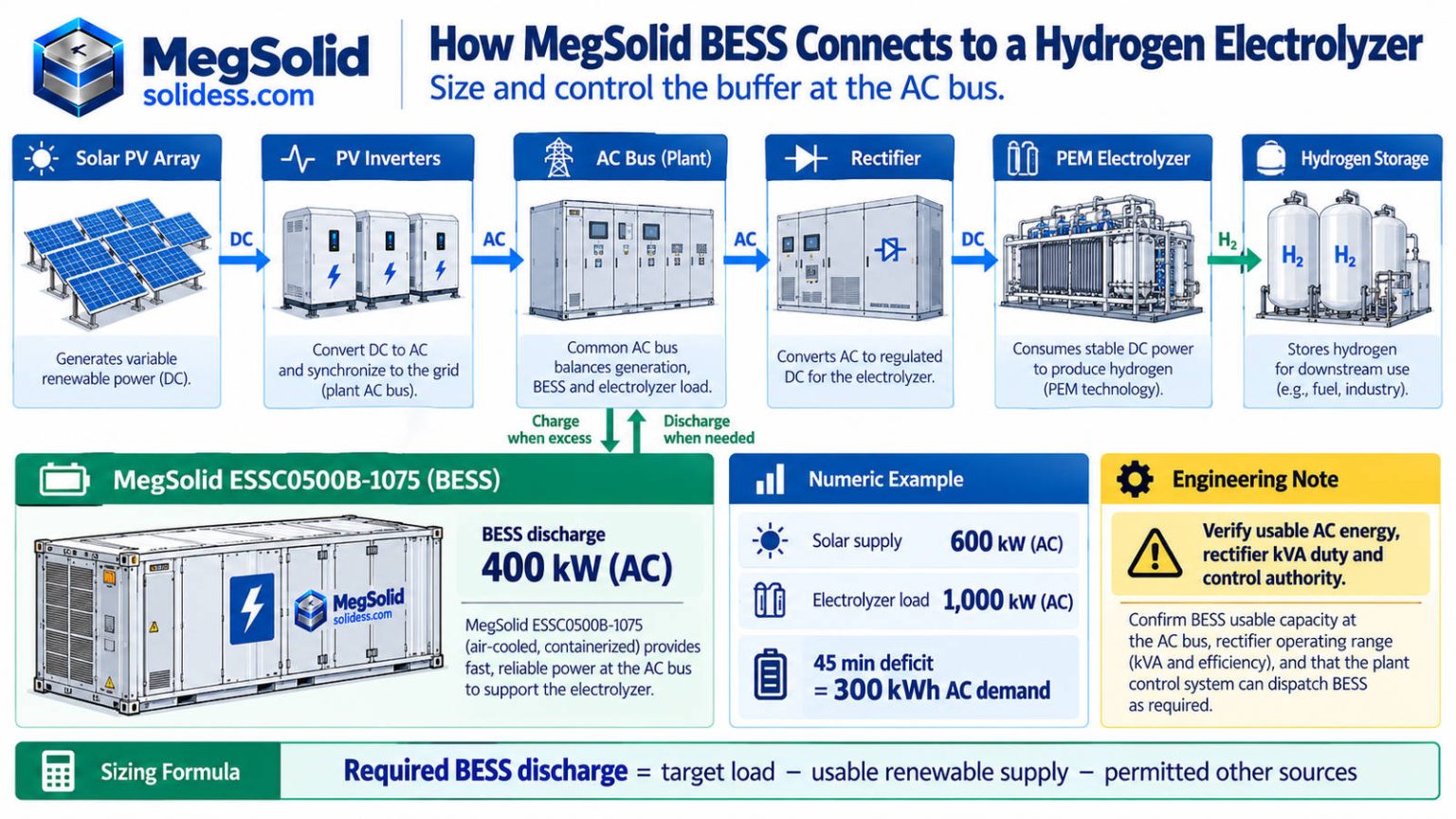
Define the coupling point before pricing the container. A typical design uses an engineered AC bus linking PV conversion, the MegSolid PCS, electrolyzer rectifier and permitted utility or generator sources. ESSC is rated 400 V AC; 5000INTL is a 690 V CA system. Those ratings affect transformer selection, fault duty, grounding, protection and where the container can be installed.
The initial electrical diagram should show the complete power path:
PV inverter / renewable source → site AC bus ← MegSolid PCS and battery; site AC bus → electrolyzer rectifier → electrolyzer stack. Grid or generator is connected only through project-approved switchgear and authorized operating states.
The product specification lists grid-current THDi below 3% for the ESSC series under its stated test conditions. The rectifier and all other connected equipment determine the combined plant power-quality result. A large rectifier may introduce harmonic currents and reactive-power demand of its own; study the combined waveforms, filtering, resonance risk, bus voltage and transformer loading. The PCS and inverter engineering decision belongs alongside the electrolyzer vendor's rectifier limits, not after purchase.
Remote electrolyzer plants need an approved source to establish AC voltage and frequency when islanded. Grid-following conversion alone cannot energize a dead bus. If the project requires black start, fast load transfer or diesel coordination, those functions need an approved single-line, switching sequence and separate commissioning evidence. A 5 MWh label is an energy rating, not a backup architecture.
Battery location near hydrogen production needs a classified-area and safety review, regardless of container IP. ISO 22734-1:2025 concerns the hydrogen generator, IEC 62619 the industrial lithium battery and IEC 62933-5-2 electrochemical storage safety. Venting, emergency access, separation, fire measures and electrical shutdown have to be coordinated under the project's local rules. Neither IP54 nor IP55 proves hazardous-area approval.
Match the electrical bus before selecting the MegSolid container. With an approved 400 V connection, shortlist ESSC0500B-1075 or ESSC1000B-2150 according to peak power. In an established multi-MW 690 V system, assess 5000INTL. Harmonically rich rectifier loads, protection and control authority still require a plant-level study.
How Should EMS Dispatch Prioritize Solar, Electrolyzer Output and Battery Reserve?
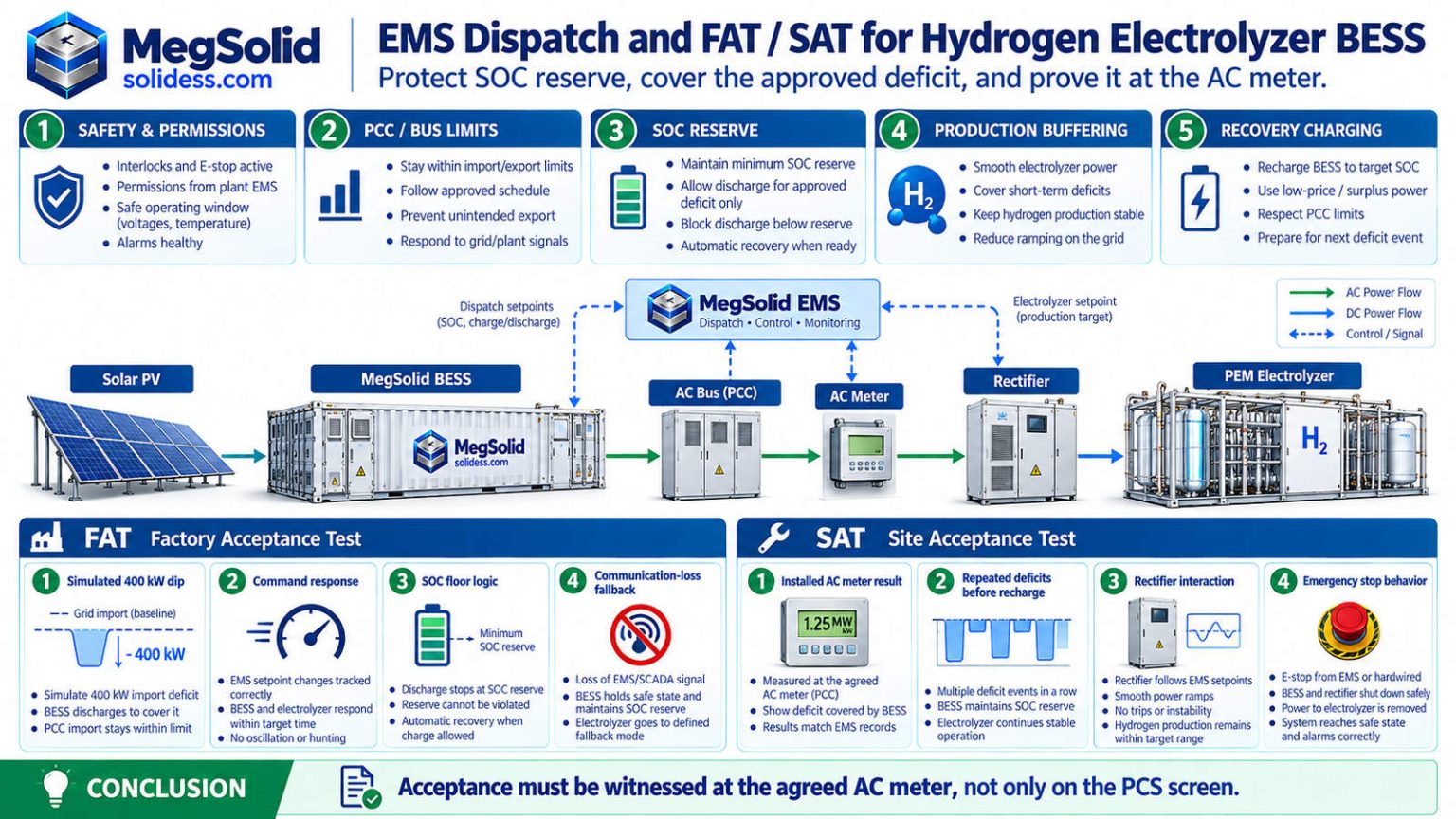
The battery must be ready for the cloud event after the one it just covered. MegSolid EMS planning should reserve the necessary SOC, manage permitted recovery charging and obey electrical or hydrogen-plant shutdown interlocks immediately. A single discharge result cannot demonstrate repeatability.
Use this operating priority in the plant-specific EMS design:
- Safety and electrical permissions: BMS/PCS restrictions, breakers, protective interlocks, emergency stop and approved plant state override all dispatch requests.
- PCC and bus limits: respect grid import/export limits, frequency/voltage requirements and any generator operating envelope.
- Contracted operating floor: protect the battery energy required for the next defined electrolyzer production obligation or controlled shutdown.
- Production buffering: discharge only enough to cover an approved deficit within the PCS and battery limits; coordinate with the electrolyzer load setpoint.
- Rétablissement : charge from permitted PV surplus or another authorized source without violating PCC or electrolyzer constraints.
Le PCC zero-export control boundary matters whenever onsite renewables, charging and grid permissions collide. Future solar generation cannot be counted as present charging permission. When renewable output stays low and the BESS reaches the approved SOC floor, the system must reduce electrolyzer load or take the approved alternative source path; it must not pretend that unavailable battery energy can be dispatched.
ESSC offers RS485 and TCP/IP-class communications, but integration depends on the electrolyzer supplier's supported data and controls. Define each command owner, setpoint range, data-quality rule, timeout and fail-safe response. Do not leave stale discharge commands running after the EMS or plant PLC has lost authority.
The operating record should show: solar reduction detected → valid EMS request → BESS discharge within limit → electrolyzer AC input maintained or deliberately reduced → SOC reserve protected → recharge recorded. Covering the 300 kWh AC deficit once does not prove it can be covered again: recharge power, source availability, efficiency and the interval until the next dip must restore the required energy. The Liste des points SCADA BESS connects those values to testable operating records.
What Makes a BESS Configuration Worth Purchasing for a Green Hydrogen EPC?
MegSolid's product choice is decided by peak kW, delivered AC kWh, recharge opportunities and the actual AC connection. ESSC0500B-1075, ESSC1000B-2150 and 5000INTL cover distinct starting classes. The best configuration is the one that passes the project duty without imposing avoidable electrical and civil work.
| Décision de l'acheteur | ESSC0500B-1075 | ESSC1000B-2150 | 5000INTL |
|---|---|---|---|
| Published AC power | 500 kW | 1 000 kW | 2,700 kW |
| Published battery energy | 1.0752 MWh | 2.1504 MWh | 5,0159 MWh |
| Tension alternative nominale | 400 V | 400 V | 690 V |
| Published cooling | Refroidissement par air intelligent | Refroidissement par air intelligent | Refroidissement par liquide intelligent |
| Deficit duty worth screening | 400 kW | 900 kW | 2.4 MW |
| Critical integration issue | 722 A AC rated current and available usable kWh | 1,445 A AC rated current and available usable kWh | 690 V power path, protection and agreed control mode |
The measured 400 kW shortfall points first to the 500 kW ESSC0500B-1075. The measured 900 kW gap points to 1,000 kW ESSC1000B-2150. A verified 2.4 MW deficit merits review of 2,700 kW 5000INTL. MegSolid provides specific equipment choices at each point; usable AC energy and connection studies still decide whether the choice is accepted.
Moving from ESSC0500B-1075 to ESSC1000B-2150 changes more than output. The container grows from 6,058 mm / 21,000 kg to 12,192 mm / 38,000 kg, adding 17 tonnes per unit and a different lifting and distribution package. That may be justified by 900 kW for 90 minutes. It is not justified by a 400 kW / 45-minute requirement simply because the smaller model carries less MWh.
One cloud event is rarely an adequate energy schedule. Calculate the gaps between actual recharge opportunities and preserve enough SOC for the process's approved fallback. Then specify the MegSolid power and energy rating against the AC meter at which acceptance will be witnessed.
Le ESSC containerized specification et 400 V versus 690 V connection comparison make the voltage class and associated electrical equipment part of the purchase calculation. This is where MegSolid's published ratings can save an EPC from buying the wrong hardware class before detailed engineering begins.
Which FAT and SAT Tests Prove Solar-to-Hydrogen Power Buffering Works?
PCS discharge alone is not an electrolyzer-buffering acceptance test. Measure the specified shortfall at the process AC boundary while the electrolyzer rectifier, site controls and MegSolid system operate together. Success means the equipment stays within its approved limits and the required energy reaches the plant for the agreed time.
| Acceptance event | What the test must prove | What makes the result fail |
|---|---|---|
| Solar power falls by a specified kW | BESS moves toward the agreed AC power request within verified limits | The plant never reaches the agreed bus-power result |
| Repeated deficits before recharge | Available AC energy survives the required event sequence | SOC floor is reached before completion |
| Rectifier demand changes | No unapproved voltage, frequency or harmonic interaction | Protection trips or prohibited electrical conditions |
| SOC reaches its operating floor | Approved electrolyzer turndown or alternative supply occurs | EMS commands unavailable battery power |
| BESS communication or meter data is lost | Safe fallback and alarms are observable | Last setpoint persists without permission |
| PV surplus returns | Charge recovery respects PCC and plant constraints | Recharge creates a new import/export violation |
| Hydrogen emergency stop | BESS obeys approved electrical interlocks and shutdown plan | Power dispatch continues into a prohibited state |
At FAT, simulate the controls and interfaces against defined response limits. At SAT, use the installed plant's actual meter, protection and rectifier to verify the entire operating event. IEC 62933-5-2 informs the safety boundary but does not replace the site's signed acceptance procedure.
Le BESS factory-acceptance framework should lead to a signed pass/fail record: the approved deficit is covered for the specified time at the agreed AC meter, the electrolyzer stays within its vendor-approved operating envelope, and alarms, recharge and safe fallback behave as specified. The AC meter at the process boundary, not a PCS display reading, determines whether the contracted deficit was covered.
MegSolid ESSC0500B-1075, ESSC1000B-2150 and 5000INTL give buyers real choices at 500 kW, 1 MW and 2.7 MW. Pick the unit that survives the measured deficit, delivers usable AC energy for every required interval and recharges before the next event. A witnessed system test should close the purchase decision.
The resulting MegSolid engineering review can identify the correct power class, define the point of AC measurement, verify usable energy and set FAT/SAT results that justify the final equipment configuration.
FAQ
Does a PEM electrolyzer always need a battery energy storage system?
No. An electrolyzer that can adjust its load economically may not need BESS for each solar dip. Specify MegSolid ESSC when a measured gap would interrupt production that the buyer has a commercial reason to protect.
What BESS power rating is needed for a 400 kW solar shortfall?
Screen ESSC0500B-1075 first: 500 kW rated AC power against a measured 400 kW gap. Include essential auxiliaries and the rectifier’s kVA requirement before approving the specification.
Is a 1.0752 MWh ESSC container enough for 45 minutes at 400 kW?
The ideal requirement is 300 kWh AC over 45 minutes. That equals 27.9% of the rated battery energy, but the actual delivered AC amount must pass an SOC, efficiency, ageing and temperature test.
Which MegSolid BESS can cover a 900 kW electrolyzer power gap?
Start with ESSC1000B-2150, rated 1 000 kW / 2,1504 MWh. A 900 kW deficit over 90 minutes demands 1,350 kWh delivered AC; nameplate energy alone does not close that acceptance requirement.
When should an EPC move from ESSC to the MegSolid 5000INTL?
5000INTL belongs in the shortlist for a justified multi-MW shortfall and a compatible 690 V bus. Its 2,7 MW / 5,0159 MWh ratings define the initial screen, not a guaranteed operating duration.
Can a MegSolid BESS feed a PEM electrolyzer stack directly?
The stack normally receives controlled DC from its rectifier, not directly from a containerized AC battery. The EPC must approve the electrical coupling and coordinate the rectifier and BESS suppliers.
How should repeated cloud events change battery sizing?
Measure the sequence, not one cloud event. Three 400 kW / 45-minute deficits without recharge add up to 900 kWh ideal AC demand, or 83.7% of ESSC0500B-1075 nameplate energy before losses and reserve.
Can ESSC maintain hydrogen production during a grid outage?
Only when the installation includes approved islanding and source-forming arrangements, correct switching and sufficient energy reserve. Do not equate a grid-tied ESSC rating with uninterrupted emergency power.
Does BESS buffering guarantee slower electrolyzer degradation?
No. A reduction in cycling-related ageing needs evidence for the exact electrolyzer and its operating regime. The MegSolid purchase case should be based on delivered electrical buffering and verifiable production obligations.
Which tests should a buyer require before accepting the system?
Witness delivered AC power and energy, repeated dips, SOC-floor and recharge behavior, rectifier limits, data-loss fallback and emergency stop. The FAT verifies agreed controls; the SAT verifies the installed system.
Can battery storage for green hydrogen production be deployed in South Africa?
It can be evaluated for South African green-hydrogen projects once load gaps, site connection rules and hydrogen-area safety requirements are known. MegSolid model selection must still pass the actual AC-energy duty.
What changes when selecting electrolyzer BESS for Australian remote sites?
Off-grid duty adds a firm requirement: establish and protect the AC bus without relying on a live utility. Battery and generator control, renewable recovery periods and permitted electrolyzer turndown set the ESSC or 5000INTL choice.
Which MegSolid model should a Saudi green-hydrogen EPC screen first?
Screen ESSC0500B-1075 for a 400 kW gap, ESSC1000B-2150 near 900 kW, and 5000INTL for justified multi-MW demand. In Saudi conditions, check container cooling, ambient rating and project derating before purchase.