
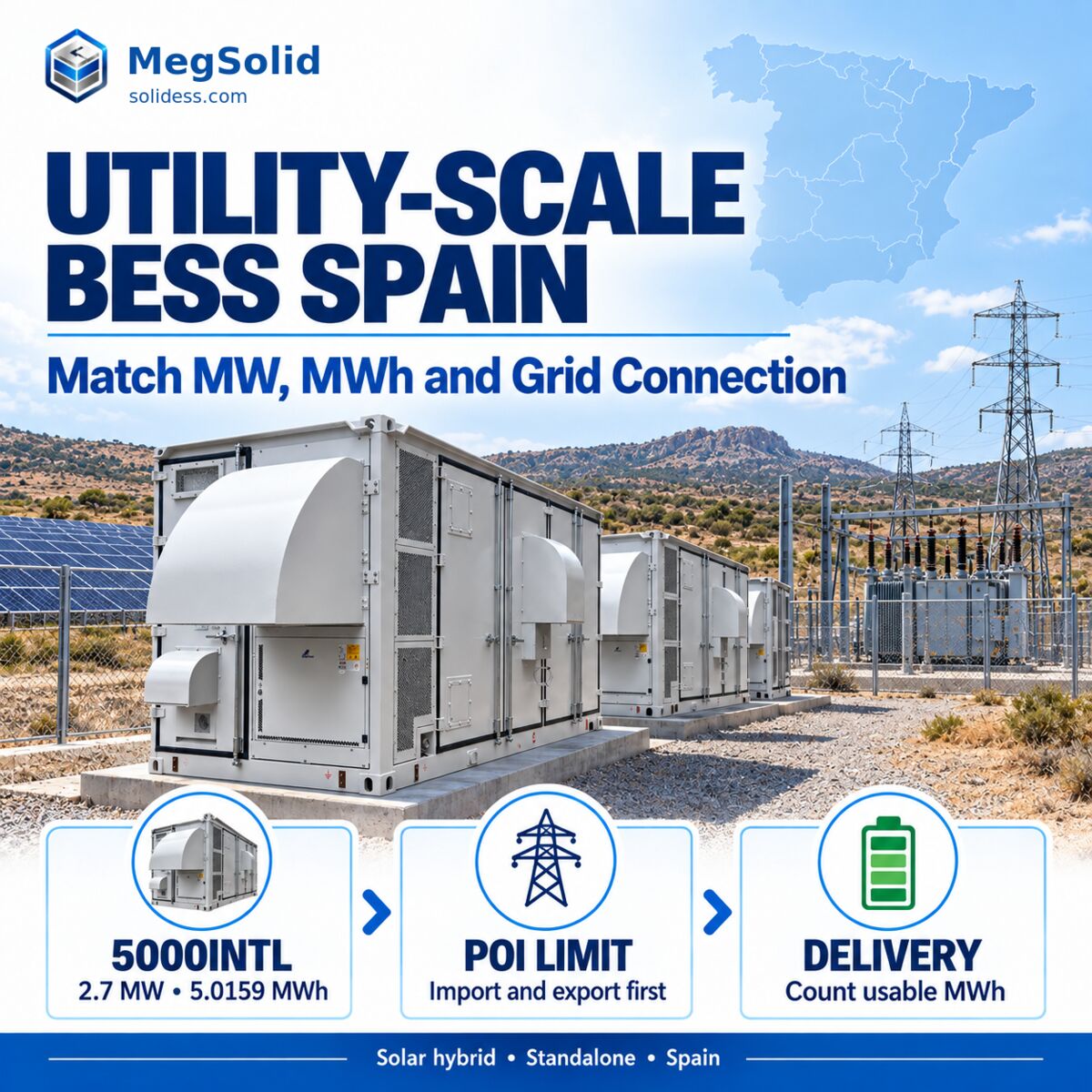
Spanish solar projects can lose value when midday output meets a weak price or an export limit, while the evening sales window arrives after the PV plant has stopped producing. MegSolid’s 2.7 MW / 5.0159 MWh 5000INTL gives multi-megawatt developers a repeatable BESS block, but the order quantity must be calculated from the POI requirement and delivered energy.
This page is written for utility-scale solar-hybrid and standalone BESS projects using a project point of interconnection. The sizing path starts with grid access, POI MW, delivered MWh and plant-level control duties.
Start with four project numbers:
- Allowed charging power: how many MW the battery may draw from solar and from the grid
- POI export limit: the maximum combined output accepted at the connection point
- Required delivery: MW, MWh and duration measured at the agreed boundary
- Grid duties: reactive power, fault ride-through, voltage control and any grid-forming requirement
Start With the Project Scale and Connection Boundary
MegSolid offers two practical container paths for Spanish solar and standalone storage projects. Project scale, construction sequence and the contractual energy boundary narrow the usable product path.
| Project requirement | MegSolid product path | Note publiée | What the rating helps decide |
|---|---|---|---|
| Multi-megawatt solar hybrid or standalone BESS | 5000INTL liquid-cooled BESS | 2.7 MW / 5.0159 MWh per container | Number of repeatable blocks needed for site power and rated energy |
| Smaller plant or staged expansion | ESSC containerized BESS | 500 kW / 1.0752 MWh or 1 MW / 2.1504 MWh | Finer power increments and phased project build-out |
| PCS selected separately from the battery package | MEGA TS PCS range | 30–500 kW per unit | AC conversion power, isolation arrangement and on-grid/off-grid operating path |
The 5000INTL is the main product path for multi-megawatt projects because one container combines 5.0159 MWh of rated energy with six 450 kW PCS units. Four containers provide 10.8 MW of rated PCS power and 20.0636 MWh of rated battery energy. Site controls can cap active export at a 10 MW POI, leaving a small active-power margin inside the installed conversion equipment.
Four containers do not guarantee 20 MWh at the POI. Battery operating limits, state-of-charge reserve, auxiliary consumption, conversion losses and transformer losses reduce the energy that reaches the contractual meter. Spanish developers should define whether a tender means rated DC energy, usable battery energy or delivered AC energy before using the product ratio to set the order quantity.
ESSC blocks suit projects that need smaller increments. Developers can compare 500 kW / 1.0752 MWh and 1 MW / 2.1504 MWh units without forcing every site into a 2.7 MW step. The transformer and grid-connection boundary for a 500 kW container follows the same principle: equipment ratings only become useful after the POI, transformer and metering boundary are fixed.
Hybrid and Standalone Projects Start From Different Access Rights
Spanish developers need the connection concept settled before battery containers are chosen. Solar hybrid and standalone systems may use similar equipment, yet the grid sees different charging and exporting behaviour.
Solar hybrid BESS shares a site with an existing or planned PV plant. It can absorb solar production that would otherwise be sold during weak-price hours or curtailed, then release that energy later. Existing roads, land, controls and part of the grid infrastructure may be reusable, but the current generation permit still may not cover every battery operating mode.
Standalone BESS has no renewable generator behind the same connection. It needs a clear right to consume power while charging and to inject power while discharging. Grid import capacity, export capacity and market participation each need to be confirmed in the connection documents.
This distinction has already produced real access disputes. One July 2026 decision from Spain’s CNMC describes a proposed hybrid BESS that sought 49.9 MW of demand access before updating the generation connection permit. The case shows why the charging path cannot be left as a note to be solved after equipment procurement. (CNMC access decision)
the access file, identify the nudo, the network owner and the route before treating the project as procurement-ready. Storage connected to the transmission network is assessed for both injection and absorption; a project connected through distribution can still require acceptability assessment where it affects the transmission node. Grid-charging demand access remains a separate item. Any guarantee or capacity-reservation arrangement should be checked against the rules in force when the application is filed and the permit is granted. Former Article 23 bis of RD 1183/2020 used a €20/kW demand-side guarantee for storage absorbing from the grid; Real Decreto-ley 7/2026 repealed that article and introduced a capacity-reservation payment framework for demand-access permit holders, so €20/kW should be treated as historical context instead of a current project assumption. Hybridisation can use the procedures in Articles 27 and 28 to update or structure an access application, but it does not automatically increase the existing access capacity or remove the demand-side assessment. (REE storage access, RDL 7/2026, RD 1183/2020, REE hybridisation FAQ)
The access file needs these points settled before equipment release:
- 1. Identify every permitted source of charging energy.
- 2. Record the maximum import and export power at the POI.
- 3. Confirm whether PV and BESS share the same export ceiling.
- 4. Define whether the BESS may charge from the grid, solar only or both.
- 5. Set the required operating mode in the plant controller and revenue model.
Hybridisation can improve captured value. Curtailed MW are only useful when the BESS has charging headroom and a later discharge path. The interconnection-readiness checks for an energy storage system become especially important when a development schedule assumes that an existing PV connection will shorten the BESS approval path.
The POI Limit Comes Before the Container Count
The POI power limit needs to be fixed before container quantity is counted. The point of interconnection determines how much active power the complete plant may import or export, while the PCS nameplates show what the installed conversion equipment can process.
In a hybrid plant, the controller must keep the combined PV and BESS output inside the approved export limit:
P_{PV,POI}+P_{BESS,POI}\leq P_{export\ limit}
Suppose a 30 MW solar plant shares a 30 MW export limit with a 10 MW BESS. At full solar output, there is no remaining export headroom for simultaneous battery discharge. The plant controller must reduce PV output, hold the battery or follow another approved dispatch instruction. Installing 40 MW of combined inverter capacity does not turn the grid connection into 40 MW.
Charging creates a second limit:
P_{grid\ import}+P_{auxiliary\ load}\leq P_{approved\ demand}
Grid charging can fail this test even when the export study is complete. Cooling, pumps, controls, transformer losses and other auxiliary loads also use part of the available import capacity. Auxiliary loads are small beside the BESS rating, but they matter when demand-access headroom is tight.
Reactive power uses part of the same PCS apparent-power headroom. PCS apparent power is shared between active and reactive power:
S^2=P^2+Q^2
Requesting full active power and substantial reactive power at the same moment can require PCS headroom or active-power derating. The POI study needs a defined P-Q operating envelope, not a generic request for “power factor control”.
The same boundary issue appears in lower-voltage systems, where BESS current, switchboard capacity and transformer loading must be checked together. Multi-megawatt Spanish projects apply the same logic at a larger voltage and power scale.
Duration Follows the Repeatable Revenue Window
Storage duration needs to match the hours in which the project can repeatedly create value. Two-hour storage may suit a sharp evening price window. Four hours may fit a longer dispatch commitment, extended curtailment capture or a tender that defines a four-hour delivery product. Neither duration fits every Spanish node.
Spain’s solar build-out has widened the difference between midday and evening value. Modo Energy reported that solar capture rates fell to 56% in 2025 while daily price spreads reached €94/MWh. Those figures help explain battery interest in Spain, but the project still needs its own dispatch model. (Modo Energy)
| Site evidence | What it suggests | What it does not prove |
|---|---|---|
| One-to-two-hour evening price spread | A shorter-duration system may cycle efficiently | The same spread will remain for the full project life |
| Three-to-four hours of repeatable PV clipping or curtailment | More energy capacity may be usable | Every stored MWh can later pass through the POI |
| Four-hour capacity or tolling obligation | Contracted delivery sets the minimum energy window | Four hours of rated DC energy equals four hours delivered at the meter |
| Frequent zero or negative midday prices | Solar charging may be inexpensive | Grid charging is permitted under the project’s access rights |
ENGIE’s planned Álora and Tarifa systems total 278 MW / 1.1 GWh, which is approximately a four-hour project class. The example is useful because it reports power and energy together. It is not a design rule for every Spanish BESS. (ENGIE project announcement)
MegSolid product ratios help expose the actual equipment consequence. One 5000INTL contains 5.0159 MWh of rated energy and 2.7 MW of PCS power, giving about 1.86 hours at full rated power before project reserves and losses are considered. Several blocks can support a longer delivery window at lower POI power, although installed PCS capacity and battery quantity still affect capital cost.
The dispatch model needs hourly or sub-hourly data for:
- PV output available for charging
- node-specific curtailment periods
- day-ahead and intraday dispatch opportunities
- required state of charge before each commitment
- degradation and augmentation assumptions
- POI import and export availability during those hours
Le lifetime cost per delivered kilowatt-hour is more useful than upfront cost per rated kWh when two duration options use different cycle depth, losses and augmentation plans.
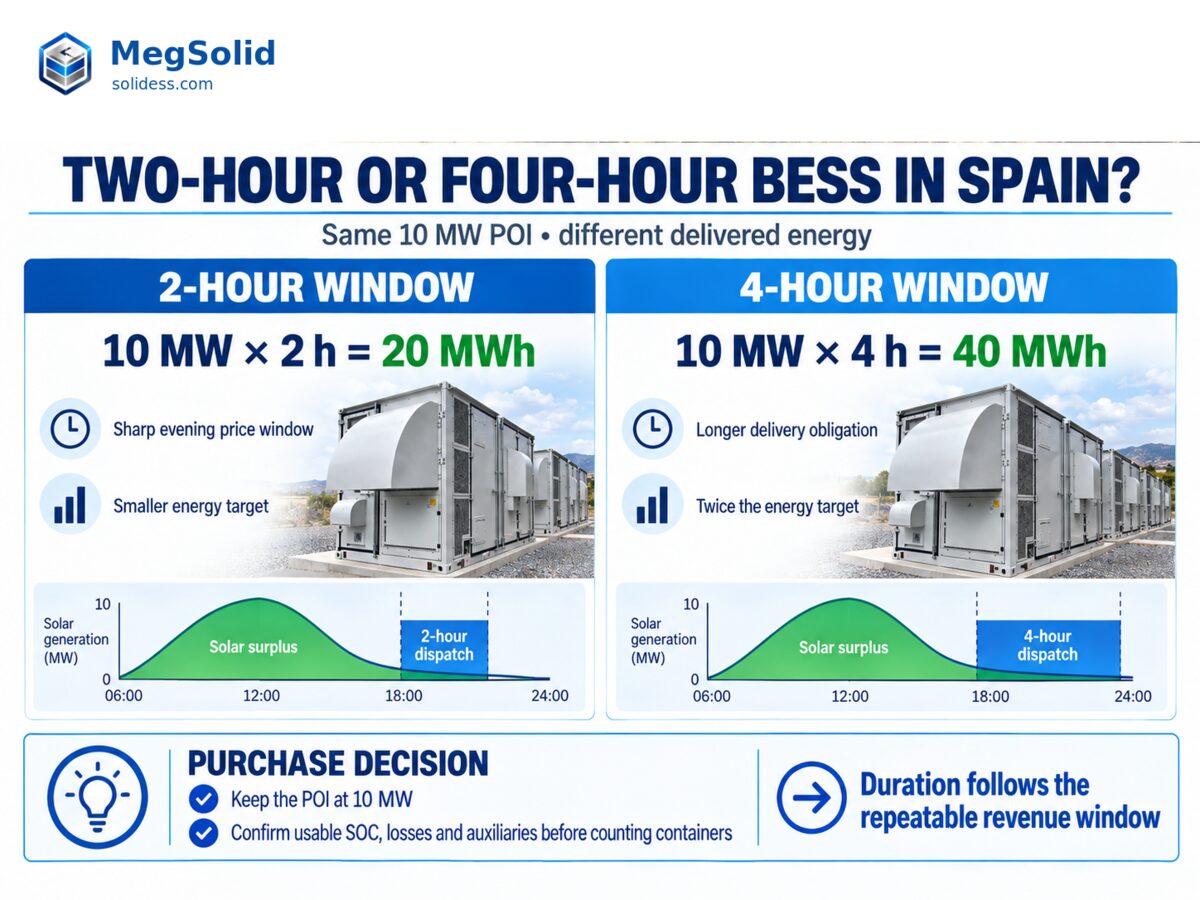
Before the block count is locked, apply the actual site duty. Andalusian summer design temperature can increase cooling demand or trigger derating assumptions, while coastal sites need the specified corrosion category instead of a generic outdoor-enclosure claim. Ambient temperature, solar exposure, altitude and auxiliary demand belong in the same energy model that decides whether the project needs four containers or five.
What 10 MW / 20 MWh Looks Like With 5000INTL
The 10 MW / 20 MWh case below is a hand-calculable example of the POI method, not a statement of MegSolid’s preferred project size; the same sequence is used when the project is 50 MW, 100 MW or 200 MW. Consider a Spanish solar hybrid project that needs 10 MW of discharge at the POI for two hours. The commercial requirement is 20 MWh delivered through the contractual meter, not simply 20 MWh printed on battery nameplates.
First count: rated equipment
Four 5000INTL containers provide:
4\times2.7\text{ MW}=10.8\text{ MW of rated PCS power}
4\times5.0159\text{ MWh}=20.0636\text{ MWh of rated battery energy}
The power count looks workable because 10.8 MW exceeds the 10 MW POI target. The energy count is too close to approve because only 0.0636 MWh separates the battery nameplate total from the contractual delivery target.
Second count: delivered energy
Use a delivery equation that keeps the assumptions visible:
E_{rated,required}=\frac{E_{POI,required}+E_{auxiliary}}{f_{usable\ SOC}\times\eta_{battery\ to\ POI}}
The usable-SOC factor is the permitted operating fraction of rated energy. Battery-to-POI efficiency includes the defined discharge-path losses between the battery and the contractual meter. Auxiliary energy may be added separately when it is not already included in the efficiency boundary.
Using an illustrative tender assumption of 90% usable SOC and 94% battery-to-POI efficiency gives:
E_{rated,required}=\frac{20}{0.90\times0.94}=23.64\text{ MWh}
These percentages are project assumptions and must be replaced by guaranteed tender values. With those assumptions, four containers are insufficient and five containers provide 25.0795 MWh of rated energy. Five units also install 13.5 MW of rated PCS power. The design team then has to decide whether that extra conversion capacity has value.
Third count: POI control
Installed PCS power must remain behind the site export limit:
P_{BESS,setpoint}\leq10\text{ MW at the POI}
The plant controller distributes that setpoint across available PCS units while observing battery limits, temperatures and state of charge. The meter at the POI confirms the contractual result. Individual container readings are useful for diagnostics, but they cannot replace the delivery measurement.
Procurement documents need rated power, rated energy and POI control together:
| Article | Four 5000INTL units | Five 5000INTL units |
|---|---|---|
| Rated PCS power | 10,8 MW | 13.5 MW |
| Capacité nominale de la batterie | 20.0636 MWh | 25.0795 MWh |
| 10 MW POI power target | Power rating is sufficient | Power rating is sufficient |
| 20 MWh delivered-energy target | No meaningful nameplate margin | Can be evaluated with the agreed SOC and loss model |
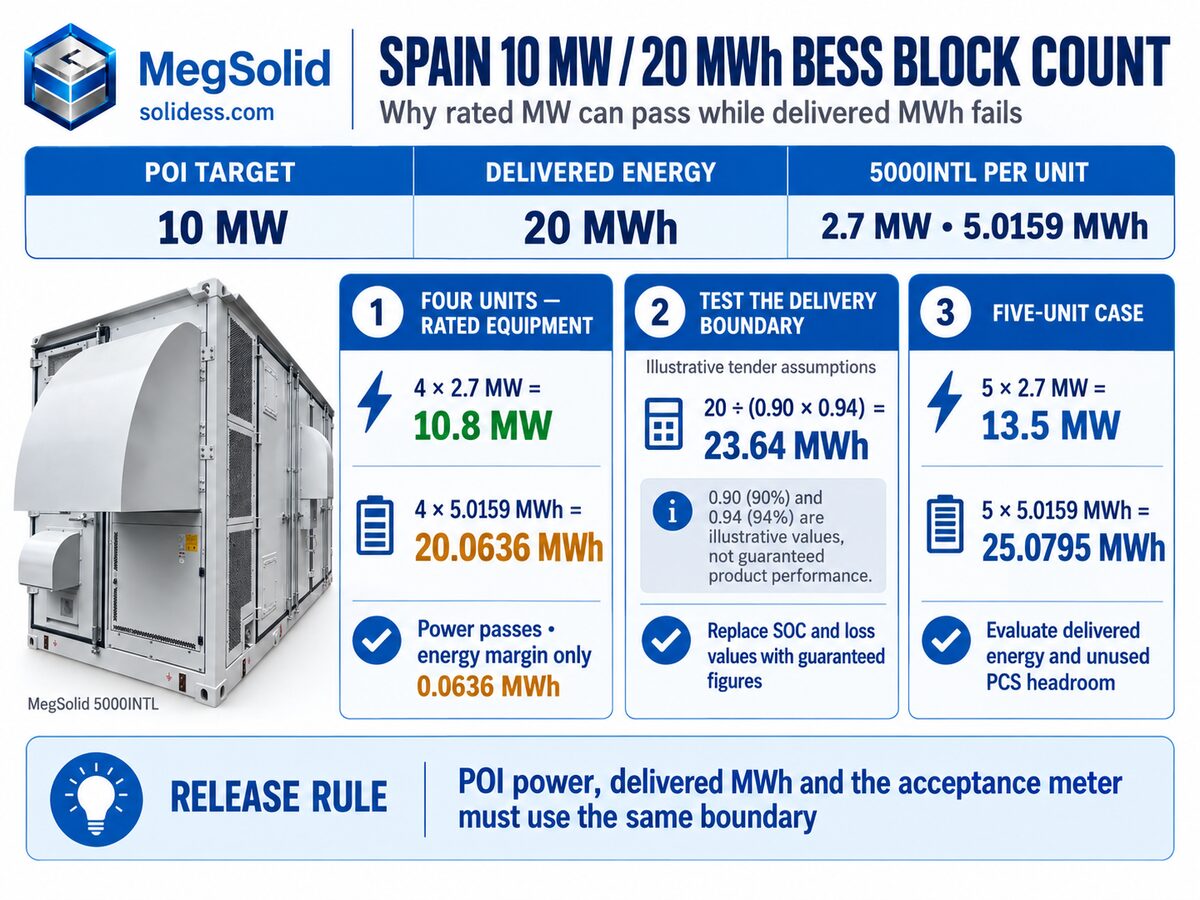
The approved block count can change with the contractual test method and project conditions. The BESS capacity test should use the same starting SOC, ending SOC, auxiliary-load treatment and metering point that were used to approve the equipment quantity.
Curtailment Only Has Value When the Energy Can Leave Later
Curtailment creates battery value only when the BESS can absorb the energy and discharge it later. Spanish developers should separate four different causes before turning curtailed MWh into forecast revenue.
| Curtailment cause | Can BESS help? | Pièces justificatives requises |
|---|---|---|
| Midday export limit while later POI capacity is available | Often | Time-stamped PV output, POI limit and later discharge window |
| Negative or very low market price | Potentially | Dispatch model including spreads, fees, losses and degradation |
| Temporary thermal or N-1 network restriction | Sometimes | Constraint timing and probability over the project life |
| Structural voltage or network weakness | Battery energy alone may not solve it | Grid study, P-Q requirements and operating restrictions |
Stored energy has little value without a later discharge window at the POI. Battery energy stored during a three-hour solar restriction has little value if the POI is still constrained during the evening discharge window.
Node conditions also change. DNV notes that temporary network congestion may not support the long-term cost of a hybrid BESS, while the eRoots analysis of Spain distinguishes temporal curtailment from structural constraints. Procurement needs the timing and cause of lost production modeled, not annual curtailed MWh multiplied by an optimistic future price. (DNV, eRoots)
The EMS then needs a charging policy that preserves battery room before the expected solar surplus and enough energy before the evening commitment. The PV charging priority and evening SOC balance becomes a commercial control decision, not a generic instruction to charge whenever solar is available.
The curtailment case needs five time series on the same clock:
- available PV power before curtailment
- actual PV export at the POI
- permitted battery charging power
- later permitted discharge power
- market or contract value during both windows
Missing any one of these series can make a large annual energy figure look more useful than it is.
Grid Duties Need Their Own Technical Schedule
Battery energy answers how long the plant can discharge. Grid-performance requirements answer whether the plant can remain connected and support the system under specified conditions. Combining both topics in one line called “grid compliant” leaves too much room for different interpretations.
Spain’s Real Decreto 997/2025 followed the April 2025 electricity crisis with closer attention to voltage control, active-power injection quality, oscillation damping and monitoring. The same decree defines the installed active power of an electrochemical storage module from the limiting batteries, inverter or transformer in series. The connection model and equipment boundary belong in the project definition. (Real Decreto 997/2025)
The technical schedule needs separate lines for these duties:
Active-power control
- POI export and import limits
- ramp-rate limits
- dispatch accuracy and response time
- charging and discharging interlocks
- behaviour when PV output changes quickly
Reactive-power and voltage control
- required P-Q capability at the POI
- voltage-control droop or setpoint behaviour
- reactive capability at low and high active power
- treatment of transformer and cable reactive demand
Disturbance behaviour
- voltage and frequency ride-through curves
- active-power recovery after a fault
- protection coordination
- controller behaviour during weak-grid conditions
Grid-forming requirements
Grid-forming is a control duty. It is not the same thing as on-grid/off-grid operation. Project documents should define the expected voltage-source behaviour, current limiting, inertia or fast-frequency response, black-start boundary and interaction with other inverters. RMS and EMT models then need to reproduce the ordered control mode.
MegSolid’s energy rating cannot be used as proof of these functions. Spain-specific offers should map each required duty to the selected PCS controls, plant controller, protection system, simulation model and acceptance test. The PCS topology and grid-forming control discussion explains why conversion architecture must be evaluated separately from the battery container count.
Factory testing can verify controller commands and defined response functions. Site testing confirms behaviour through the installed transformer, protection and POI meter. The power-quality acceptance measurements should use limits and test points taken from the approved Spanish connection agreement.
Spanish Projects Show Market Direction, Not a Universal Ratio
Spanish project announcements are more useful when both power and energy are reported. They reveal the duration developers are pursuing and whether projects are hybrid or standalone. They do not prove that the same ratio fits another node, revenue contract or connection permit.
| Evidence from Spain | Published scale | Procurement lesson |
|---|---|---|
| ENGIE Álora and Tarifa standalone BESS | 278 MW / 1.1 GWh | Four-hour-class projects are moving into development, with separate grid-stability equipment included in the project concept |
| FRV development portfolio | More than 1.2 GW / 5 GWh | Both hybrid PV-BESS and standalone projects are being developed; connection strategy cannot be inferred from country alone |
| Spain’s operating battery fleet, April 2026 | 193 MW | The operating base remains much smaller than the announced development pipeline |
FRV’s portfolio is spread across Extremadura, Andalusia, Catalonia and Cantabria, with projects expected to reach ready-to-build status between 2026 and 2027. The regional spread matters because grid strength, network constraints, environmental review and connection status belong to the individual site. (FRV)
Spain’s installed battery capacity increased from 28 MW in April 2025 to 193 MW in April 2026, while the processing pipeline grew much faster. Procurement teams should distinguish an announced project, a project with access rights, a ready-to-build project and an operating asset. Equipment delivery dates should be tied to the stage that can actually release manufacturing and site works. (pv magazine)
Iberdrola’s Spanish portfolio gives another useful lesson: battery projects range from a few megawatts to multi-hour installations and sit beside solar, wind, hydro or remote network needs. Project purpose changes the operating cycle even when both systems are labelled lithium-ion BESS. (Iberdrola España)
MegSolid selection should begin after those site distinctions are known. The 5000INTL can be evaluated against a multi-megawatt POI, while ESSC blocks give a smaller step for staged sites. Each selected configuration still needs its own connection model, delivery calculation and project evidence.
Those Spanish project figures calibrate market scale; they are not evidence that MegSolid supplied or engineered those sites. MegSolid quotation should state the block-level rated MW and MWh being offered. The same quotation should separately identify the project assumptions for charging rights and POI limits, whether RMS/EMT or other model files are included in the supplier scope, which functions are released at FAT and SAT, and who owns the Spanish transformer, protection, grid-operator interface, site commissioning and final POI acceptance. That boundary lets a developer compare the equipment offer with the access file instead of treating a container datasheet as a complete Spanish EPC scope.
Rated Energy, Delivered Energy and POI Output Must Use One Boundary
Equipment schedules, financial models and acceptance tests need to use the same definitions. Projects can pass a factory nameplate review and still miss the commercial requirement if one document uses rated battery energy and another uses delivered energy at the POI.
| Contract item | Definition to lock | Why it changes the order |
|---|---|---|
| Puissance nominale | Nameplate energy of the installed battery blocks | Establishes product quantity but not saleable delivery |
| Usable energy | Energy available inside the approved SOC and operating limits | Accounts for protected reserve and operating window |
| Delivered AC energy | Metered discharge energy at the contractual boundary | Includes the effect of the defined conversion path and auxiliary treatment |
| Rated PCS power | Installed active-power conversion rating | Determines block power and potential headroom |
| POI active power | Net import or export through the connection meter | Defines the grid-facing result |
| Consommation auxiliaire | Cooling, controls, pumps, lighting and other system loads | Changes net charge and discharge energy |
| Disponibilité | Agreed time base, exclusions and calculation formula | Determines whether equipment status produces a contractual deduction |
| Degradation and augmentation | Capacity checkpoints and restoration plan | Determines later-year container additions and available space |
The 5000INTL product page lists 5.0159 MWh of rated energy, 2.7 MW of rated AC power, smart liquid cooling, an IP55 enclosure and an operating range of -30°C to 55°C. It also lists temperature, smoke and combustible-gas detection, ventilation, thermally activated aerosols and water fire protection. Each feature affects a different part of the delivery scope. Net POI output and site fire engineering still need their own definitions.
Fire-water strategy, acoustic limits and any remaining site-specific evidence should be closed before acceptance requirements are frozen. Thermal derating, corrosion exposure and auxiliary consumption should already have been carried into the block-count calculation instead of discovered at SAT.
The data path needs a defined boundary as well. Plant-level SCADA should receive the signals needed to explain availability, alarms, power limitation and dispatch response. The Liste des points SCADA BESS becomes more useful when every signal is tied to an operating decision or acceptance test.
FAT can verify the ordered hardware, communication mapping, alarm logic and controller functions available before shipment. SAT then verifies the installed transformer, protection, meter polarity, POI limits and end-to-end dispatch. The FAT and SAT release boundaries prevent a factory test from being treated as proof of site performance.
Availability needs the same level of definition. Planned maintenance, grid outages, communication failures, external curtailment and partial PCS derating should be assigned before the guarantee is priced. The availability formula should match the plant’s actual revenue obligation and data source.
Send three project inputs: permitted POI import/export MW, contracted delivered MWh, and charging rights (PV only or PV + grid).
Ask for the reply with the four-container and five-container cases separated, showing rated PCS MW, rated MWh, usable-SOC and loss assumptions, and any unused PCS headroom.
Product Selection Comes After the Project Duty Is Fixed
Product selection follows the connection and delivery requirement already calculated. Product familiarity is not a reason to force every Spanish project into the same block.
| Project duty | Product direction | Selection reason | Main check before approval |
|---|---|---|---|
| Multi-megawatt, approximately two-hour solar hybrid or standalone duty | 5000INTL | 2.7 MW / 5.0159 MWh repeatable block with smart liquid cooling | Delivered POI energy after reserve, losses and auxiliaries |
| Multi-megawatt duty with a longer discharge window | Multiple 5000INTL blocks evaluated at a lower POI dispatch power | Additional rated energy can extend duration | Extra installed PCS power must be economically justified |
| 500 kW to low-megawatt project built in smaller stages | ESSC0500B-1075 or ESSC1000B-2150 blocks | Smaller increments align equipment release with project phases | Air-cooling duty, layout, transformer capacity and delivered energy |
| Battery and conversion power need a different ratio | Project-specific battery package with MEGA TS PCS path | PCS can be selected in 30–500 kW model steps | Parallel controls, transformer arrangement and complete-system responsibility |
The 5000INTL stands out when developers need a repeatable high-energy block. Six 450 kW PCS units make the 2.7 MW conversion composition clear, and the 5.0159 MWh rating gives a direct starting point for container arithmetic. Smart liquid cooling, IP55 construction and the -30°C to 55°C operating range support outdoor project evaluation across Spain’s varied climate.
Project evidence still has to support those product features. High ambient temperature may reduce available power or increase auxiliary demand. Coastal sites may need a defined corrosion category beyond a general enclosure rating. Grid-forming tenders need control models and tests. Four-hour POI contracts need enough delivered energy, even when the installed containers already provide more PCS power than the active export limit.
ESSC systems give developers smaller steps. ESSC0500B-1075 provides 500 kW / 1.0752 MWh, while ESSC1000B-2150 provides 1 MW / 2.1504 MWh. Their intelligent temperature-controlled air cooling and IP54 construction create a different thermal and enclosure path from the liquid-cooled 5000INTL. The choice should follow duty cycle and site environment; neither cooling method is automatically better.
MEGA TS PCS becomes relevant when the project needs a different relationship between battery energy and conversion power. The range covers 30 kW to 500 kW models with integrated isolation-transformer ratios that vary by model. Multi-unit use must be designed as one plant, including power sharing, protection, communication and responsibility for the battery-to-PCS interface.
The product choice is now straightforward:
- Choose 5000INTL when the site needs repeatable multi-megawatt blocks and the project model supports its power-to-energy ratio.
- Choose ESSC when smaller increments make construction, connection or expansion easier.
- Use a separate PCS path when a fixed integrated ratio creates too much conversion power for the required duration.
- Do not release the order until rated energy, delivered energy, POI power and grid functions appear in the same reviewed schedule.
Spain's BESS pipeline is growing; project viability still depends on the connection model. The project becomes ready for equipment selection when the charging right, export limit, discharge duration and acceptance meter all describe the same operating plant.
Send the permitted POI MW, required delivered MWh and charging route, then state whether the project prefers integrated 5000INTL blocks or smaller ESSC steps.
Ask for both options against the same connection boundary so block count, duration, PCS headroom and supplier/site responsibilities stay visible in one schedule.
FAQ
What does BESS Spain mean?
On this page, BESS Spain refers to utility-scale battery projects developed as standalone assets or hybridised with solar generation. Capacity comparisons use project-level MW, MWh, grid-access rights and POI duties instead of customer-meter load profiles.
Should a Spanish solar project use a hybrid or standalone BESS?
Hybrid BESS shares the solar site and connection; standalone BESS has its own charging and export case. Access rights, land, renewable production, market route and permitted POI behaviour decide between them.
How is BESS power sized at the point of interconnection?
Start with the approved POI import and export limits, then check simultaneous PV output, battery dispatch, auxiliaries and reactive-power duty.
How is BESS energy capacity sized for a Spanish solar project?
Required POI power × discharge window gives the starting energy figure. SOC limits, losses, auxiliaries and degradation then increase the required rated MWh.
Is rated MWh the same as delivered AC energy?
No. Rated energy is the battery nameplate value. Delivered AC energy is measured at the agreed meter after the permitted SOC window, discharge-path losses and the specified auxiliary-load treatment.
How many 5000INTL containers are needed for 10 MW / 20 MWh?
Four containers provide 10.8 MW and 20.0636 MWh of rated equipment, but that leaves almost no energy margin. Five containers provide 13.5 MW and 25.0795 MWh; the final count depends on the delivered-energy calculation and whether the extra PCS capacity is commercially acceptable.
Can a BESS in Spain charge from the grid?
Grid charging depends on the project’s demand-access rights and connection conditions. Existing generation access should not be treated as automatic permission for the battery to import its full charging power.
Does every BESS project in Spain need four hours of storage?
No. Duration comes from the revenue contract, curtailment window, dispatch opportunity and POI availability; some projects support a shorter cycle.
Can battery storage recover all curtailed solar generation?
No. The battery needs available charging power during curtailment and a later period when the POI can export the stored energy. Structural network or voltage restrictions may remain after more battery MWh are installed.
Is grid-forming capability proven by the BESS energy rating?
No. Grid-forming behaviour belongs to PCS controls, plant controls, protection, current limiting and the validated network model. It must be specified and tested separately from MW and MWh.
Where are large BESS projects being developed in Spain?
Current portfolios and announcements include projects in Andalusia, Extremadura, Catalonia, Cantabria, Castilla-La Mancha and other regions. Regional location does not replace a node-specific grid and permitting review.
Do permitting conditions stay the same across Spain?
National electricity rules establish the main framework, while project authority, environmental processing, land requirements and local construction conditions can vary by project size and autonomous community. The responsible authority should be identified before the delivery schedule is fixed.
When does ESSC make more sense than 5000INTL for a Spanish BESS project?
ESSC blocks make more sense when the project needs smaller power and energy increments, staged construction or a finer match to the approved POI. The 5000INTL is better suited to repeatable multi-megawatt blocks when its 2.7 MW / 5.0159 MWh ratio fits the required delivery window.