
In real-world energy storage projects, most procurement decisions still start from familiar metrics:
- kWh capacity
- Ah rating
- Cycle life
- Power rating
- Price and warranty terms
These parameters are important, but they do not fully explain how a system will perform after years of continuous operation.
From an engineering perspective, one factor consistently determines long-term system behavior:
Interface Stability
In solid-state and hybrid solid-state battery systems, interfaces are the pathways that enable lithium-ion transport. When these interfaces remain stable, system performance remains predictable. When they degrade, performance gradually drifts over time.
Typical outcomes include:
- Capacity fade
- Rising internal resistance
- Lower efficiency
- Higher thermal load
- Reduced usable output
- Declining project ROI
This is why interface stability has become a key evaluation factor for modern energy storage procurement.

Why Interface Stability Matters More Than Energy Density
Energy density is often highlighted in marketing materials, but for commercial and utility-scale projects, long-term consistency is more important than peak specifications.
A system that performs steadily over 10–20 years will always deliver higher lifecycle value than a system with slightly higher initial performance but faster degradation.
Interface stability directly impacts:
- System lifetime
- Energy efficiency
- Thermal behavior
- Maintenance cost
- Financial return stability
This is why experienced engineering teams now evaluate interface behavior before comparing headline specifications.
The Real Cost of Interface Degradation
Interface degradation does not happen suddenly. It develops gradually over thousands of cycles.
1. Increasing Interfacial Resistance
As interfaces age, ion transport becomes less efficient.
This leads to:
- Lower discharge efficiency
- Higher energy loss
- Reduced power consistency
2. Gradual Capacity Loss
Microscopic structural changes accumulate over time, reducing active material utilization.
From an operator’s perspective, this appears as:
- Lower usable capacity
- Shorter runtime
- Reduced energy revenue
3. Thermal Imbalance
Higher resistance generates localized heat, which can:
- Accelerate aging
- Create uneven cell degradation
- Impact long-term system stability
Five Key Technical Factors to Evaluate Before Purchase
1. Verified Cycle Life Under Real Conditions
Cycle life alone is not enough. The testing conditions matter more.
|
Metric
|
Recommended Benchmark
|
|---|---|
|
Cycle Life
|
>6000 cycles
|
|
Capacity Retention
|
>80%
|
|
Test Transparency
|
Required
|
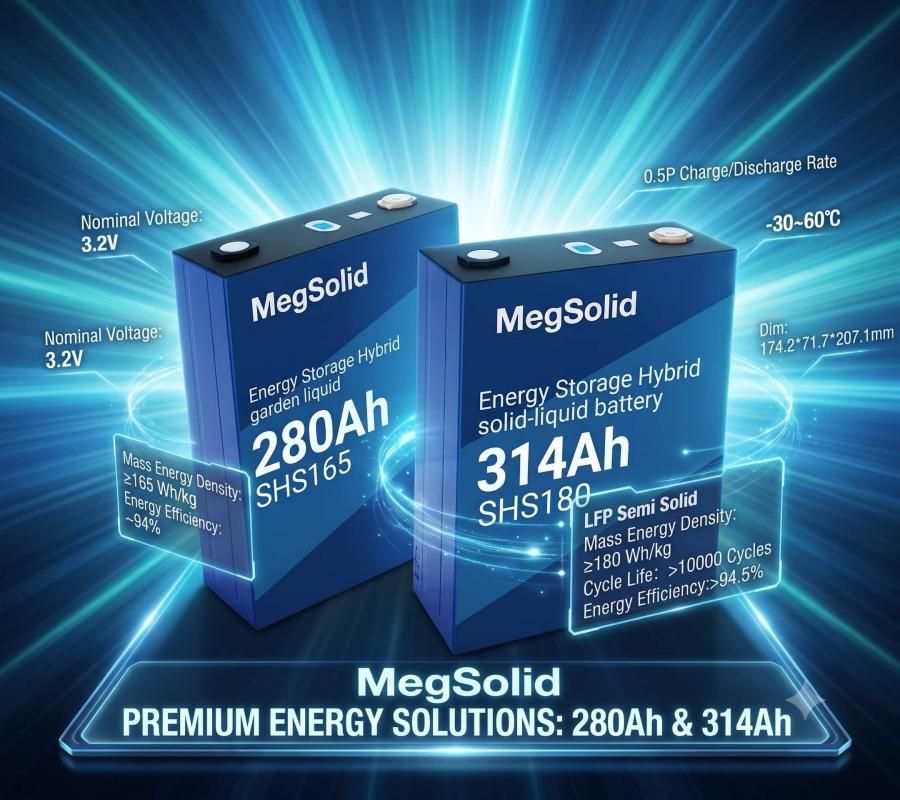
MegSolid’s 314Ah hybrid solid-state LiFePO4 battery is designed for up to 8000 cycles at 80% DOD under defined operating conditions.
2. Interface Resistance Growth Behavior
More important than initial resistance is how it evolves over time.
A stable system should demonstrate:
- Slow and predictable resistance growth
- No sudden degradation points
- Stable long-term power output
Unfortunately, many suppliers do not publish this data.
3. Thermal Stability and Temperature Uniformity
Temperature consistency directly affects degradation speed.
MegSolid’s 261.24kWh solid-liquid energy storage system uses liquid cooling combined with adaptive control algorithms to maintain temperature deviation within ±5°C.
This helps ensure:
- More uniform aging
- Higher system stability
- Longer service life
4. Mechanical Pressure Design
Solid-state systems rely heavily on stable interface contact.
Poor mechanical design can lead to:
- Interface separation
- Micro-cracks
- Localized resistance increase
Key Insight
This is one of the least visible but most critical design factors in long-term stability.
5. Intelligent Monitoring and Early Warning
Modern energy storage systems should not only operate but also “observe themselves.”
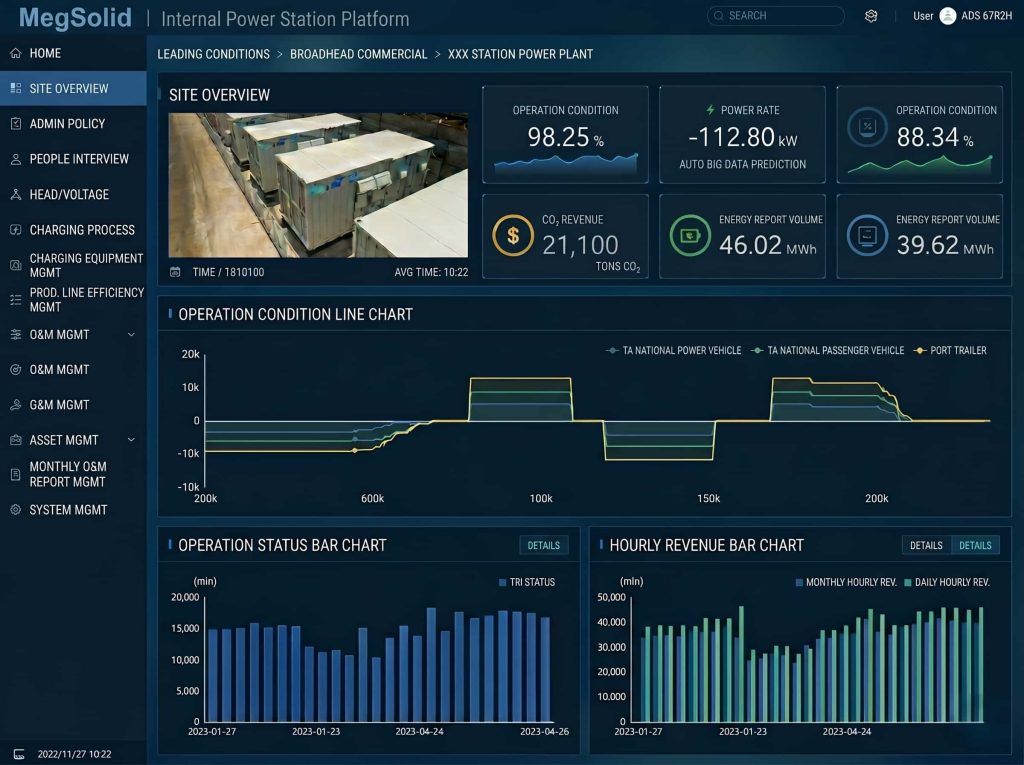
MegSolid systems integrate an AI Early Warning system designed to:
- Detect abnormal trends early
- Identify degradation signals
- Support predictive maintenance decisions
This shifts maintenance from reactive to preventive.
Comparing Different Technology Routes
Conventional LFP Systems
Strengths:
- Mature technology
- Lower cost
- Wide deployment base
Limitations:
- Thermal runaway risk remains
- Limited energy density improvement potential
hybrid solid-state Systems
Strengths:
- Improved safety
- Better energy density
- Increasing commercial maturity
MegSolid’s 314Ah platform belongs to this category:
- 314Ah
- 16.07kWh
- 8000-cycle design target
Hybrid Solid-State Systems (MegSolid Approach)
Strengths:
- Improved interface stability
- Better long-term reliability
- Strong commercial scalability
- Balanced cost-performance ratio
All-Solid-State Systems
Strengths:
- High theoretical potential
Challenges:
- Manufacturing complexity
- Interface engineering difficulty
- Limited large-scale deployment experience
Why EPCs Are Focusing More on Interface Stability
Procurement priorities have changed significantly in recent years.
1. Bankability
Financial institutions care about long-term predictability, not just initial specs.
2. Operational Cost
Stable systems reduce maintenance frequency and unexpected interventions.
3. Warranty Risk
Lower degradation means fewer performance disputes over time.
4. Asset Replicability
Stable systems are easier to scale across multiple projects.
How MegSolid Addresses Interface Stability
MegSolid designs its systems around long-term operational stability rather than short-term laboratory performance.
314Ah hybrid solid-state Battery Platform
- Capacity: 314Ah
- Energy: 16.07kWh
- Cycle life: up to 8000 cycles
261.24kWh Commercial ESS
Core features:
- AI Early Warning system
- Liquid cooling architecture
- ±5°C thermal deviation control
Designed for utility-scale applications with:
- Intelligent thermal management
- Multi-layer safety system
- AI-based monitoring architecture
Procurement Checklist Before Final Decision
Before selecting a supplier, it is worth confirming:
Technical Validation Items
- Verified lifecycle test conditions
- Degradation trend data availability
- Thermal management strategy
- Monitoring and diagnostic capability
- Early warning system availability
- Safety architecture level
- Real-world deployment references
- Long-term support capability
Key Warning
If these cannot be clearly answered, long-term risk increases significantly.
Conclusion
The energy storage industry is shifting from specification-driven competition to reliability-driven engineering.
Among all technical factors, interface stability is becoming one of the most important indicators of:
- System lifetime
- Project profitability
- Investment security
MegSolid’s engineering approach focuses on:
- 314Ah hybrid solid-state battery architecture
- 8000-cycle lifecycle design
- AI early warning system
- Liquid cooling with ±5°C control
- Utility-scale deployment capability
The goal is not to optimize isolated parameters, but to ensure stable performance throughout the entire project lifecycle.
FAQ
Q1: Why do some energy storage projects underperform after a few years?
Because battery performance naturally changes over time. Stable interface design helps keep system behavior predictable.
Q2: What do investors care about most in energy storage projects?
Long-term predictability and risk control matter more than any single technical specification.
Q3: How can I evaluate whether a system will remain reliable?
Look for transparent lifecycle data, thermal design details, and monitoring capabilities—not just marketing numbers.
Q4: Why is temperature control so important?
Because uneven temperature directly leads to uneven aging across cells.
Q5: Is higher cycle life always better?
Only if it is achieved under realistic operating conditions.
Q6: What is the value of AI early warning systems?
They allow potential issues to be identified before they affect system performance.
Q7: What should EPCs prioritize when selecting suppliers?
Long-term stability, lifecycle data transparency, and system reliability over initial cost.
Q8: What is the key difference between semi-solid and hybrid solid-state systems?
The main difference lies in interface control strategy and long-term stability engineering.
Q9: What makes a battery system “reliable” in practice?
Not the highest specification, but consistent performance over many years of operation.
Q10: Why are more customers choosing MegSolid?
Because the design philosophy focuses on engineering stability, not just specification competition.