 Skip to content
Why C&I Energy Storage Safety Has Become a System-Level Challenge
A cell safety statement cannot settle the complete-system safety of the Commercial and Industrial (C&I) cabinet you will install. Ask which MegSolid model is being supplied and which evidence belongs to the cell, pack and system. The 100 kW / 215.04 kWh ESSA option and the 261.24 kWh liquid-cooled Energon require their own configuration and installation review. Share the operating duty and required test documents to obtain an equipment offer with evidence attached to the actual purchase.
For a MegSolid offer, start with the equipment route the project needs. The 51.2 V / 314 Ah wall pack publishes 16.07 kWh and up to 8,000 cycles at 80% DOD; ESSA0100B-0215 is a 100 kW / 215.04 kWh air-cooled C&I configuration. Those are different models with different electrical and installation duties. Match the selected battery/converter/control pair to the load and usable duration, then tie the cell, module and complete-system safety evidence to that quoted BOM. The buyer gets a defined configuration and acceptance package.
- Thermal runaway can begin within a cell; propagation and site consequences also depend on the module, thermal, protection and installation design.
For energy storage systems, compare the actual battery, thermal system, controls and installed safety measures. Standard LFP equipment remains a real C&I route: ESSA0100B-0215 publishes intelligent air cooling and Aerosols/NOVEC1230 fire-extinguishing options, while Energon 261.24 kWh uses liquid cooling and its own fire-protection configuration. Ask the delivered design to show detection, isolation, auxiliaries and accepted fault behaviour. Chemistry does not remove the need for that system evidence.
The published 314 Ah hybrid solid-state module gives a specific battery route, not a safety guarantee for every C&I plant. Its 51.2 V / 16.07 kWh and 43.2–57.6 V range must match the selected inverter/BMS. A high-voltage cabinet or larger system needs its own approved cell/BOM and electrical/thermal design before the module's chemistry or cycle figure can be applied.
Understanding Thermal Runaway in C&I Energy Storage Systems
Thermal runaway in lithium battery systems typically follows a chain reaction process:
- Local temperature rise due to internal resistance
- Accelerated side reactions inside the cell
- Heat transfer to adjacent cells
- System-level propagation leading to catastrophic failure
In C&I applications, this process is amplified by:
- Long-duration high-load operation (6–12 hours)
- High state-of-charge (SOC > 80%) operation
- Large-scale parallel cabinet configurations
- High ambient temperature environments (40°C–55°C)
Unlike EV applications, C&I systems operate continuously and under less predictable load profiles, making thermal stability significantly more difficult to control.
Assess LFP Systems Against the Actual C&I Duty
Standard LFP is used in MegSolid's published C&I energy storage cabinets. Review the exact model's permitted SOC/current duty, thermal limits, BMS/PCS interface and fault/maintenance scope. Those are project design questions to price and test, not evidence that every conventional LFP installation is inadequate.
- Thermal system and auxiliaries at the actual equipment-intake temperature.
- Measured cell/rack temperature spread under the agreed charge/discharge duty.
- Capacity/resistance and retained-power evidence with a defined test method.
- Model-specific fault/propagation evidence and installed protection measures.
Make the safety comparison at the same cell/module/system test boundary, operating SOC/current/temperature and installation. An electrolyte label alone cannot establish that propagation has been eliminated or that one complete BESS is safer. The buyer should see the exact reports and the protection/thermal design that the quoted hardware will deliver.
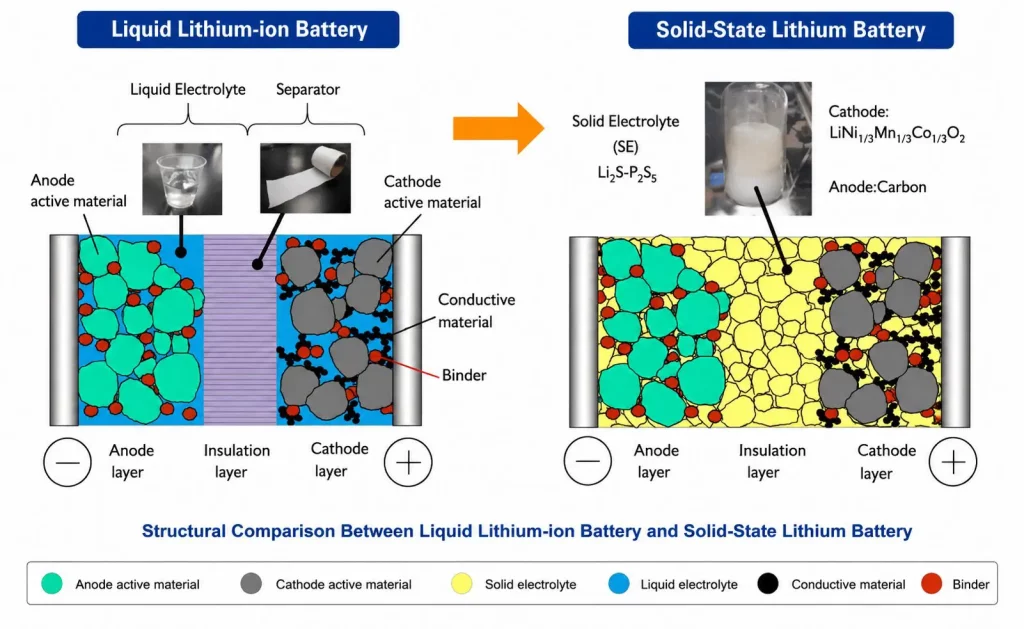
MegSolid 314 Ah Hybrid Solid-State Battery Technology Overview
The 51.2 V / 314 Ah hybrid solid-state battery is published as a 51.2 V / 314 Ah, 16.07 kWh hybrid solid-state battery for residential solar, backup and small commercial use. Its catalogue gives up to 8,000 cycles at 80% DOD, 200 A maximum charge and continuous discharge, RS485/RS232/CAN ports and separate temperature limits. Treat it as the model-specific starting point; a C&I cabinet, cell-only order or custom rack requires a separately identified configuration.
For the offered hybrid solid-liquid electrolyte architecture, compare the exact cell's safety and retained-performance tests with the intended duty. Request the tested sample, current, temperature, SOC and failure endpoint. The published module specification does not establish a quantified thermal-stability or electrochemical-consistency advantage over every conventional system.
Key engineering innovations include:
Hybrid Solid-Liquid Electrolyte System
- Electrolyte behaviour: obtain the exact chemistry and cell-level test conditions.
- Side reactions: compare measured ageing and failure behaviour for the offered cell.
- High-SOC duty: define permitted SOC, dwell, current and temperature in the supplied model.
High-Uniformity Electrode Interface Design
- Impedance consistency: request sample/batch dispersion and the method used.
- Hotspot review: record sensor positions, current and measured thermal spread.
- Cycle consistency: align DoD, temperature, rate, calendar ageing and retention endpoint.
Thermal Propagation Suppression Mechanism
A propagation claim requires the exact cell/module/system report and the installed separation, detection and isolation measures. Compare the temperature, SOC and fault conditions with the delivered BOM. Do not release the plant on an assumed heat-containment behaviour that the offer has not demonstrated.
- Comparison basis: align cell/module/system fault tests and the installed protection design.
- MegSolid evidence: identify the exact delivered BOM and report before claiming local containment or reduced propagation.
The project needs an agreed response to the tested fault: alarms, electrical isolation, thermal/fire actions, remaining supported load and recovery. State those deliverables in FAT/SAT and the service scope. A chemistry claim alone does not convert a potential plant outage into a manageable local event.
System-Level Safety Architecture by MegSolid
At MegSolid, battery safety is not defined at the cell level—it is engineered across three layers:
Cell Layer
- Exact cell/module chemistry and model/BOM.
- Controlled voltage/current/temperature and charge/discharge limits.
- Named safety and retained-performance report scope.
Module Layer
- Delivered mechanical/thermal separation and module interfaces.
- Defined heat rejection, detection and electrical isolation.
- Witnessed module/system fault and recovery scope.
System Layer
- Offered monitoring, recorded signals and alarm recipients.
- Defined BMS/PCS current limits, derating and communications-loss fallback.
- Approved multi-cabinet command, protection and remaining-load duty.
These three layers should appear in the ordered model's drawings, report register and witness-test plan. Name the supplier and EPC responsibilities at their interfaces. That gives the buyer a safety package to evaluate; a diagram of three layers is not itself evidence that the complete system meets the site's acceptance requirements.
hybrid solid-state vs LFP vs NMC: Engineering-Level Comparison
|
Technology |
Safety Performance |
Energy Density |
Thermal Runaway Risk |
C&I Suitability |
|---|---|---|---|---|
| LFP (Traditional) | Use exact model safety reports | Use measured cell/system density boundary | Use aligned fault-test and installation scope | Match actual power, energy, temperature and site duty |
| NMC (Lithium Nickel Manganese Cobalt) | Use exact model safety reports | Use measured cell/system density boundary | Use aligned fault-test and installation scope | Match actual power, energy, temperature and site duty |
| MegSolid 314Ah hybrid solid-state | Use the delivered cell/module/system report scope | 16.07 kWh module rating is not a gravimetric-density result | No universal low-risk ranking established from chemistry alone | Approved configuration, interfaces and system tests required |
MegSolid's ESSA platform brings a 400 V, three-phase AC interface, intelligent air cooling, touch LCD/cloud display and RS485/TCP-IP EMS communication into a cabinet configuration. Its catalogue also lists an isolation-transformer field and Aerosols/NOVEC1230 fire-extinguishing system. The 100 kW / 215.04 kWh model is a concrete starting point for a defined industrial load; Energon adds a separate 261.24 kWh / 125 kVA liquid-cooled route. Buy the selected configuration with its drawings, thermal/fire interfaces and accepted operating duty. A low-voltage hybrid module remains a different battery product.
Real-World Value for C&I Energy Storage Projects
From an engineering and investment perspective, the adoption of hybrid solid-state battery technology directly impacts three critical business metrics:
Reduced Downtime Risk
A shutdown during production is expensive, but reduced downtime must come from the offered design and tests. Define fault detection, isolation, supported remaining load, reserve and recovery with the site's PLC/UPS/generator interfaces. Ask which supplier or EPC restores the service and which spare parts are included.
Lower O&M Costs
Compare cooling and other auxiliaries at the required power, SOC and intake temperature, alongside maintenance labour, filters/coolant, spares and access. Standard ESSA is air-cooled; Energon is liquid-cooled and derates above 45°C. Select and price the actual thermal route, rather than assuming a hybrid-solid-state label lowers every site's cooling cost.
Improved ROI Stability
Build the return model from delivered AC energy, actual tariffs/dispatch, recharge and auxiliaries, degradation, replacement and downtime assumptions. Tie the performance and remedy to the supplied model's warranty. A cell chemistry or thermal claim does not guarantee predictable project ROI.
These improvements are particularly critical for:
- Industrial parks
- Data centers
- Mining operations
- High-temperature off-grid regions
Evaluate MegSolid's Approach From Model-Specific Evidence
The energy storage industry is undergoing a structural transition:
- From system-level compensation → to material-level safety engineering
A project can benefit from integrated battery, conversion, thermal and control engineering when those interfaces and tests are included in the contract. Obtain the exact model/BOM, controlled limits, alarms and acceptance records. Every offered chemistry still needs an installation and service plan that fits the actual site.
Choose the package that can support the required production load and usable duration at the accepted temperature, with a clear warranty and repair owner. That is a purchase decision the EPC can defend after commissioning, rather than a prediction that one design philosophy will replace the industry.
Conclusion: Specify Safety for the Supplied C&I System
Start with a product that fits the installed architecture. The 16.07 kWh hybrid solid-state module is a low-voltage battery route; ESSA0100B-0215 is a 100 kW / 215.04 kWh, 400 V AC air-cooled LFP cabinet; Energon offers 261.24 kWh / 125 kVA liquid-cooled LFP. A larger plant can evaluate 5000INTL at 2.7 MW / 5015.9 kWh and 690 V AC. These are different configurations with different voltage, thermal, protection and acceptance requirements.
The purchasing value is a selected configuration with its operating limits, test evidence and service responsibilities in one offer. The owner can compare that package against production loads and acceptance requirements before the deposit, then use the same boundary at handover and warranty review.
Send the critical-load and recharge trace, power and usable AC-energy duration, site temperature, single-line diagram, backup/transfer duty and required safety documents. Ask MegSolid to return the selected model/BOM, supported limits, thermal/protection interfaces, report availability, FAT/SAT and supplier/EPC/service responsibilities. Resolve the acceptance and repair scope before ordering capacity or treating a chemistry label as a system guarantee.
- Buy the exact equipment, evidence and service duty the project requires; a supplier slogan is not a new C&I safety standard.
FAQ
Q1: What makes hybrid solid-state batteries safer for C&I applications?
Evaluate thermal propagation from the exact cell/module/system test and installed protection design. A hybrid-solid-state label alone does not establish quantified electrolyte-mobility, reaction or propagation behaviour for every delivered configuration.
Q2: How is MegSolid different from traditional battery manufacturers?
The offer should identify the actual cell/BOM, thermal system, monitoring, protection and BMS/PCS/EMS interfaces with their test records. A three-layer diagram or AI label is not proof that every MegSolid product has the same safety architecture.
Q3: Can the system operate in high-temperature environments?
Match the exact model's available power to the site's intake temperature. ESSA0100B-0215 lists 0–45°C; Energon 261.24 kWh lists −20–55°C with derating above 45°C; the hybrid module charges within 0–45°C and discharges within −20–60°C. Those ranges are separate model limits, not a guarantee of full power in every 40–55°C C&I environment.
Q4: Does this technology eliminate the need for cooling systems?
Cooling needs follow the exact equipment and site thermal load. Compare available power, auxiliaries, intake exposure and maintenance for the selected air- or liquid-cooled route. No universal reduction in cooling-system dependency is established from the chemistry label alone.
Q5: What industries benefit most from this technology?
Industrial parks, data centers, mining operations, and microgrid systems.
Q6: How does this impact system lifespan?
Cycle and calendar ageing depend on the exact cell, SOC/DOD, rate, temperature and retained-capacity endpoint. Use aligned test records and the offered warranty/throughput duty. A general thermal-stability claim does not establish longer installed life.
Q7: Is MegSolid suitable for large-scale C&I deployments?
A multi-megawatt system requires a separately approved battery/PCS/control and installation design. The public 314 Ah / 16.07 kWh module is not proof of such a plant's architecture. For a container route, current 5000INTL lists 2.7 MW / 5015.9 kWh at 690 V AC; its usable-energy, safety and control duty still need exact project evidence.
Q8: What is the biggest advantage over LFP systems?
Compare exact cell/module/system tests, operating limits and installed measures. Material, thermal, control and fire-protection evidence all matter; none can be replaced by an untested claim that one brand has inherently lower risk.
Q9: Does it improve ROI for investors?
A bankable offer connects supported AC power and usable energy, operating limits, degradation, availability, test evidence and remedies. Compare downtime, auxiliaries, repairs and replacement assumptions in the financial model. Chemistry alone does not establish bankability or lower cost variability.
Q10: Why choose MegSolid as a supplier?
Evaluate MegSolid from the selected model, controlled documentation and agreed integration/service scope. Ask which interfaces are tested, which site work remains with the EPC and which performance shortfall the warranty remedies. That gives a buyer checkable reasons to choose the offer.
