
The procurement role of industrial batteries in manufacturing plants, data centers, and microgrids has shifted from passive standby backup to active balance-sheet management. Where facilities once maintained vented lead-acid battery rooms solely for emergency uninterruptible power supply (UPS) ride-through, modern industrial battery systems operate daily to clip 15-minute utility peak demand spikes, shift time-of-use (TOU) electricity loads, support reactive power control, and absorb rooftop solar generation.
At MegSolid (SolidESS), our stationary product portfolio distinguishes between standard liquid-electrolyte LiFePO4 (LFP) commercial and utility storage systems and specialized hybrid solid-state technologies. Our standard LFP Commercial & Industrial (C&I) Energy Storage lineup spans 55.296 kWh to 215.04 kWh outdoor cabinets (ESSA series, using standard LFP cells with project-specific optional solid-state configurations), 261.24 kWh liquid-cooled LFP C&I cabinets (Energon), and 5,015.9 kWh utility-scale liquid-cooled containers (5000INTL), complemented by our Solid-State Energy Storage Systems and hybrid solid-liquid prismatic storage cells (SHS180-314Ah and SHS165-280Ah).
Industrial Battery Systems Architecture Matrix: From C&I Cabinets to 5MWh Containers
When plant engineers and EPC contractors evaluate industrial batteries for a commercial or utility facility, the first step is matching officially rated system capacity, AC/DC voltage windows, and thermal management architecture to the site's load profile and physical footprint.
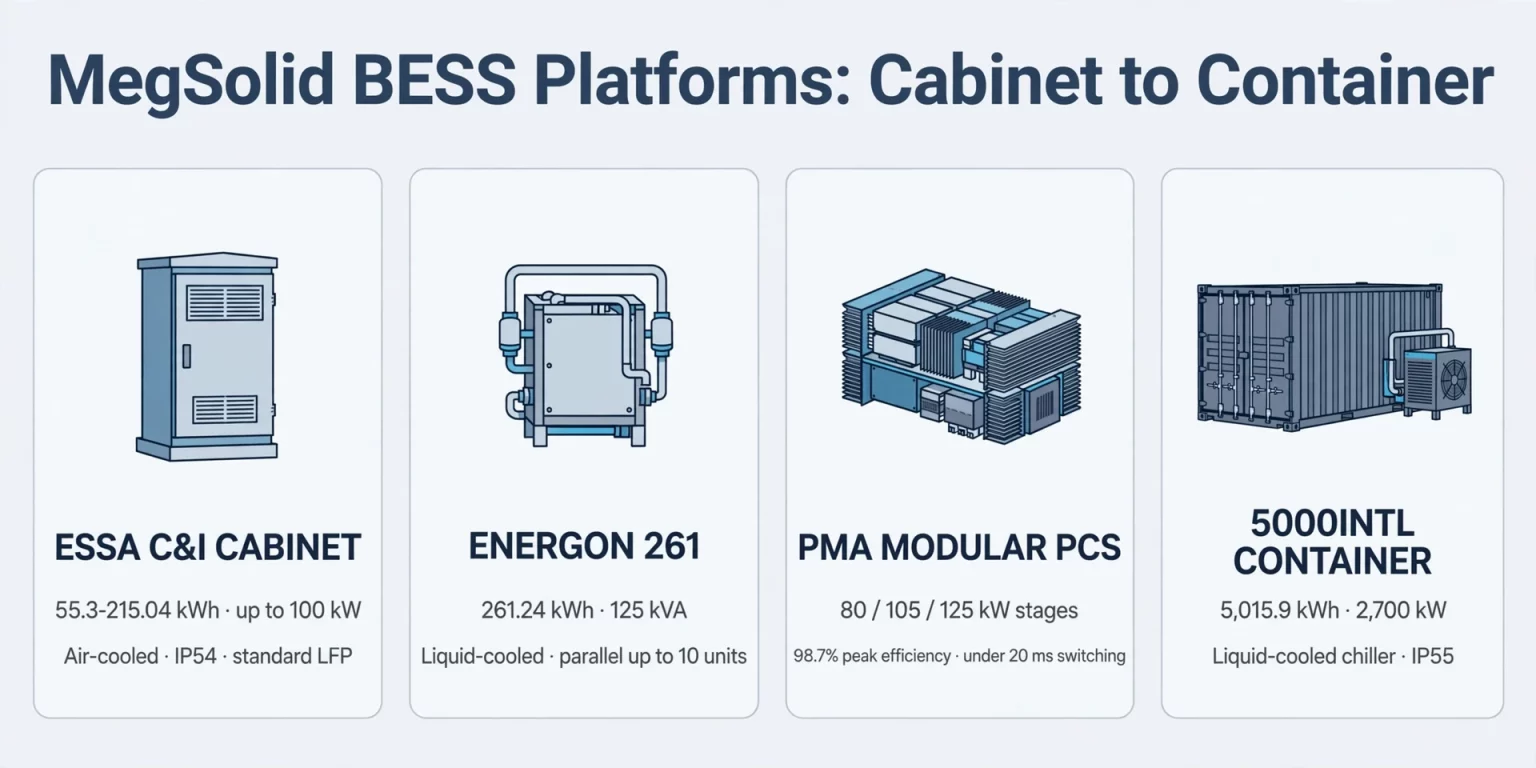
Table 1 summarizes MegSolid's core stationary industrial battery and power conversion platforms based on official product specifications. Detailed configuration boundaries, efficiency notes, and multi-unit integration requirements are itemized immediately below the table.
Table 1: MegSolid Industrial Battery & PCS Hardware Matrix
| System Platform | Rated Energy / Power | AC / DC Voltage Window | Chemistry & Cooling |
|---|---|---|---|
| ESSA Outdoor C&I Cabinet (ESSA0100B-0215) | 215.04 kWh / 100 kW (0.5C; series spans 55.3 to 215.04 kWh) | 400V AC (320–460V); 672V to 850V DC | Standard LFP (optional solid-state per contract); IP54 cabinet |
| Energon Liquid-Cooled LFP Cabinet | 261.24 kWh / 125 kVA (parallel up to 10 units) | 400V AC; 676V to 936V DC (832V nominal) | Standard 314Ah LFP (1P260S); IP54 liquid-cooled cabinet |
| PMA Modular PCS Series (PMA080 / 0105 / 0125) | 80 kW / 105 kW / 125 kW modular PCS stages | 400V AC; 615V to 950V DC input window | Rack/cabinet modular bidirectional PCS; IP20/cabinet-integrated |
| 5000INTL 20-Foot Utility Container | 5,015.9 kWh / 2,700 kW (450 kW x 6 stages) | 690V AC; 1,123.2V to 1,497.6V DC (1,331.2V nominal) | Stationary storage container; IP55 liquid-cooled chiller |
Key Hardware Specifications and Integration Boundaries:
- ESSA Outdoor Cabinet Series (55.296 kWh to 215.04 kWh): Operates on a 400V AC (320V to 460V) three-phase interface with total current harmonic distortion (THDi) below 3% and an ambient operating window of 0°C to +45°C. The series includes the ESSA0030B-0107 (30 kW / 107.52 kWh, 0.25C), ESSA0050B-0055 (50 kW / 55.296 kWh, 1C), and ESSA0100B-0215 (100 kW / 215.04 kWh, 0.5C). Depending on the selected model and contract specification, units include a built-in isolation transformer, Aerosol or Novec 1230 fire suppression, and standard LFP cells (with optional project-specific solid-state cell configurations).
- Energon 261.24 kWh Liquid-Cooled LFP C&I System: Integrates a 1P260S string of 314Ah LFP cells in a self-contained IP54 outdoor cabinet, rated at 125 kVA apparent power and up to 90% maximum efficiency (official datasheet peak rating; measurement boundary and auxiliary load inclusions should be verified for site energy modeling). It supports an ambient temperature range of -20°C to +55°C (with output derating above 45°C), altitude support up to 4,000 meters (derating above 2,000 meters), Novec plus water fire protection, and multi-cabinet parallel expansion up to 10 units.
- Separate Architecture for Multi-Cabinet Energon Paralleling vs. External PMA Modular PCS: Multi-cabinet expansion of all-in-one Energon units (up to 10 cabinets) and custom battery systems paired with external PMA080 (80 kW), PMA0105 (105 kW), or PMA0125 (125 kW) modular PCS units represent two distinct integration pathways and should not be assumed to combine directly by default. The PMA series operates across a 615V to 950V DC input window with up to 98.7% maximum efficiency, less than 20 ms module-level switching time, an ambient temperature window of -30°C to +60°C (derating above 45°C), and altitude support up to 5,000 meters (derating above 3,000 meters). Any multi-cabinet or multi-PCS project array requires engineering verification of the AC/DC busbar topology, protective switchgear coordination, and site EMS architecture.
- 5000INTL Containerized ESS (5,015.9 kWh / 2,700 kW): Engineered in a 43,000 kg 20-foot ISO IP55 enclosure with six 450 kW power stages at 690V AC for heavy industrial substations and utility solar-plus-storage plants. Official specifications list up to 87.5% maximum efficiency (datasheet peak rating; specific AC/DC measurement boundaries and auxiliary chiller consumption must be confirmed per project contract) and operation up to 4,000 meters elevation.
Industrial Lithium Ion Battery vs. Hybrid Solid-Liquid vs. Lead-Acid Chemistry
Selecting an industrial battery requires looking beyond upfront capital cost per kilowatt-hour ($/kWh) to evaluate cycle life under defined end-of-life (EOL) state-of-health (SOH) criteria, internal impedance, thermal abuse behavior, and lifecycle operating costs. Legacy valve-regulated lead-acid (VRLA) banks and high-nickel ternary lithium cells (NCM/NCA) present clear operational trade-offs in stationary industrial duty.
Table 2 compares typical industry reference ranges for legacy VRLA, liquid NCM, and conventional liquid LiFePO4 against cell-level specification data for MegSolid's hybrid solid-liquid prismatic storage cells (SHS180-314Ah and SHS165-280Ah).
Table 2: Stationary Industrial Battery Chemistry Comparison
| Metric / Benchmark | Legacy Industrial VRLA | Liquid NCM / NCA (Industry) | Standard Liquid LFP (Industry) | MegSolid Hybrid Solid-Liquid Cells |
|---|---|---|---|---|
| Rated Cycle Life (Note SOH Boundary) | 500 to 1,200 cycles (to 80% SOH) | 1,500 to 3,500 cycles (to 80% SOH) | 6,000 to 8,000 cycles (typically 70%–80% SOH) | SHS180: 6,000 cycles (≥80% SOH); SHS165: ≥8,000 cycles (≥70% SOH) |
| Cell Energy Efficiency | 75% to 82% | 90% to 93% | 92% to 94% | ≥ 94.5% (SHS180-314Ah cell spec at 0.5P) |
| Cell Gravimetric Density | 30 to 45 Wh/kg | 240 to 300 Wh/kg | 160 to 190 Wh/kg | 165 Wh/kg class (SHS165) / 180 Wh/kg (SHS180) |
| Thermal & Abuse Profile | Evolves H2 gas during charge | Cathode releases O2 at elevated temp | Strong P-O bond; liquid carbonate solvent can vent under abuse | SHS180 spec: 5 mm nail no thermal runaway; trigger ≥110°C; short ΔT <10°C |
| Key Lifecycle Cost (LCOS) Drivers | Frequent cell replacement; ventilation O&M | Higher fire suppression & insurance cost | Standard C&I baseline; HVAC & fade dependent | Reduced active lithium loss; verify project CAPEX & warranty terms |
Electrochemical, SOH Boundary, and Documentation Notes on Table 2:
- Normalizing SOH End-of-Life Thresholds When Comparing Cycle Life: Engineers must not directly compare raw cycle numbers across different battery technologies or cell models without aligning the end-of-life SOH threshold, C-rate, temperature, and depth of discharge (DoD). Specifically, the SHS180-314Ah rating of 6,000 cycles is defined to ≥ 80% SOH (@ 0.5P/0.5P, 100% DoD), whereas the SHS165-280Ah rating of ≥ 8,000 cycles is defined to ≥ 70% SOH (@ 0.5P/0.5P, 100% DoD at room temperature). Because a 70% SOH termination boundary permits greater cumulative capacity fade than an 80% SOH boundary, the two cycle figures measure different lifecycle endpoints rather than a direct one-to-one lifespan ranking.
- Verifying Standalone Cell Specification Sheets (SHS180-314Ah & SHS165-280Ah): The cell-level parameters for the SHS180-314Ah (3.2V, 314Ah, 1,004.8 Wh calculated / 1,005 Wh rated, 5.60 ± 0.1 kg, AC impedance 0.18 ± 0.03 mΩ, DC impedance 0.4 ± 0.1 mΩ, 1P frequency regulation support, and GB/T 36276-2023 test results showing no thermal runaway in 5 mm nail penetration, thermal runaway trigger temperature ≥ 110°C, and external short-circuit large-face temperature rise 120°C) are sourced from MegSolid's standalone cell specification sheets rather than the general website system catalog. Procurement teams should request the official model-specific cell specification sheets and certified laboratory test reports for the exact cell batch and system configuration under contract.
- Project-Specific LCOS Calculation Basis: Levelized Cost of Storage (LCOS) cannot be reduced to a fixed universal dollar range without defining project inputs. To calculate accurate LCOS for a specific industrial site, financial analysts must model the contracted turnkey CAPEX, scheduled augmentation or replacement intervals at the target EOL SOH, discount rate, annual O&M expense, charging electricity cost, auxiliary cooling parasitic consumption, and measured AC round-trip delivery efficiency.
Addressing Fire Code and Insurance Reviews in Industrial Plants
In timber sawmills, textile mills, metal foundries, pharmaceutical cleanrooms, and commercial campuses, local fire marshals (AHJs) and commercial property insurers scrutinize stationary industrial lithium ion battery installations for flammable gas venting and cell-to-cell fire propagation.
For projects specified with MegSolid's hybrid solid-liquid cells, reducing free volatile liquid carbonate solvents through a nano solid-state electrolyte interface helps limit short-circuit temperature rise (< 10°C reported on the SHS180-314Ah cell sheet) and overcharge venting (on the tested 1P52S SHS165-280Ah module). Whether a project deploys standard LFP cabinets (such as Energon or standard ESSA units) or optional hybrid solid-state configurations, pairing cell-level containment with cabinet-level Novec 1230 / aerosol suppression and water sprinkler interfaces supports engineering submittals under NFPA 855 and the International Fire Code (IFC), subject to AHJ review of model-specific UL 9540A test reports and system listings.
5 Core Industrial Battery Solutions & Conditional ROI Drivers
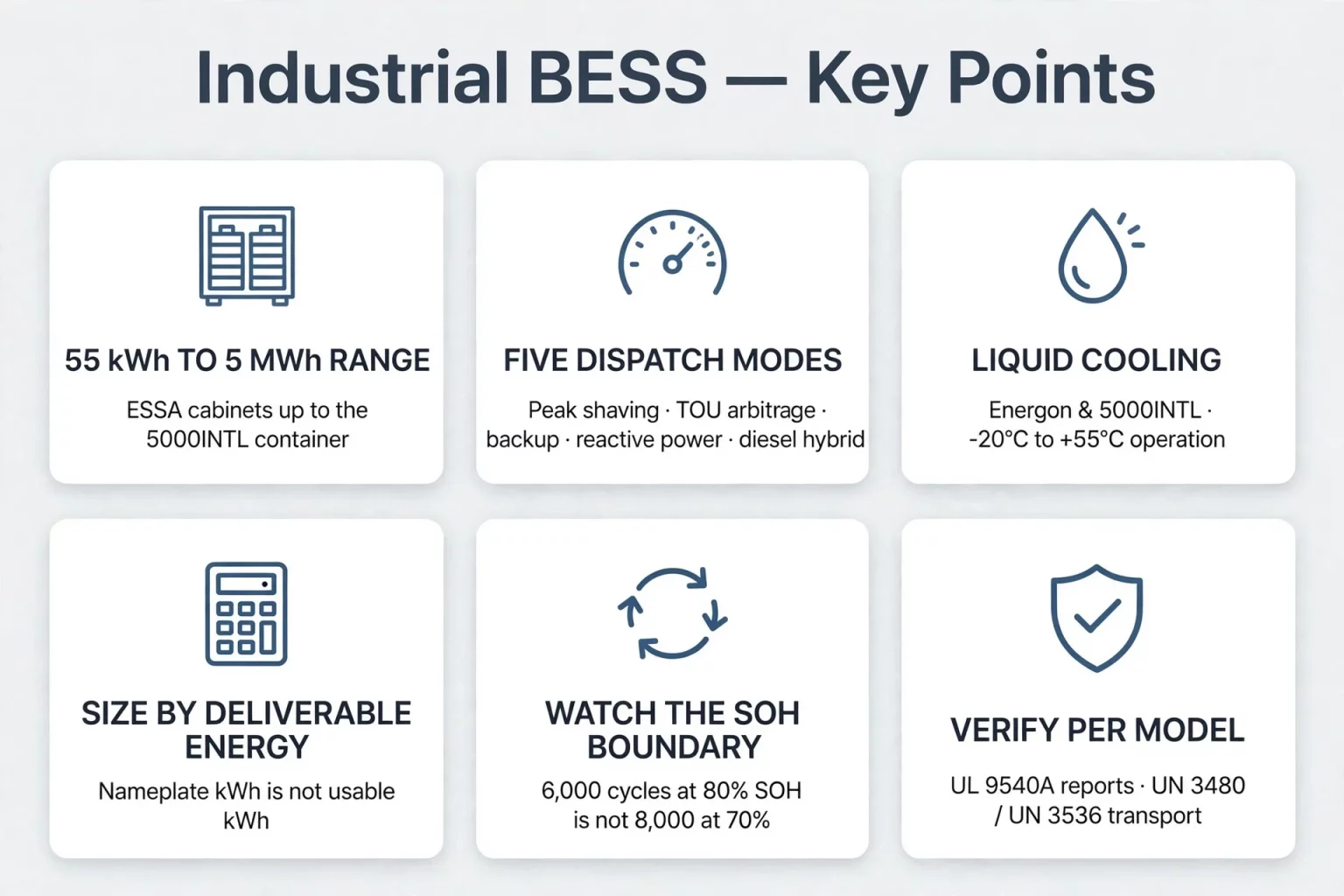
Deploying a 215.04 kWh ESSA cabinet, a 261.24 kWh Energon liquid-cooled LFP cabinet, or a multi-megawatt 5000INTL container enables five operational dispatch modes controlled by the site Energy Management System (EMS). Because commercial electricity tariffs, grid interconnection rules, and factory load shapes vary widely by jurisdiction, financial returns and payback periods must always be modeled from site-specific revenue meter data rather than assumed as uniform performance guarantees:
- 1. 15-Minute Peak Demand Charge Management:
- — Many industrial utilities bill facilities based on the highest 15-minute average power draw (kW or kVA) recorded during a monthly or seasonal billing cycle.
- — When high-inrush machinery (such as injection molding presses, air compressors, stamping lines, or induction furnaces) creates short duration load spikes, the BESS discharges to cap grid draw below a target threshold. Actual demand-charge savings depend strictly on whether the local utility tariff includes a demand charge component, the dollar-per-kW tariff rate, and whether the duration of the plant's demand peak fits within the battery's deliverable AC energy capacity.
- 2. Time-of-Use (TOU) Tariff Arbitrage and Solar PV Self-Consumption:
- — The battery system charges during low-tariff off-peak windows or absorbs excess midday generation from factory rooftop solar arrays.
- — During high-tariff peak windows, the system discharges stored energy to serve plant loads. Net arbitrage revenue depends on the local peak-to-off-peak price spread after accounting for system conversion losses, auxiliary HVAC consumption, and cycle degradation costs.
- 3. Backup Ride-Through and Microgrid Black-Start Support:
- — Voltage sags and grid outages trip variable frequency drives (VFDs), CNC spindles, and PLC automation lines, causing production scrap and restart delays.
- — While MegSolid's PMA series modular PCS specifies a module-level switching time under 20 ms, engineers must note that PCS module switching speed does not equal complete system transfer time, which also includes grid fault detection, islanding breaker or static transfer switch (STS) actuation, and voltage stabilization. Sensitive PLCs, CNC controllers, or semiconductor tools requiring sub-cycle (e.g., < 4 ms to 10 ms) uninterruptible power must still be protected by dedicated online double-conversion UPS hardware or verified against the complete system transfer architecture.
- 4. Four-Quadrant Reactive Power Compensation (SVG Mode):
- — Industrial inductive loads (motors, transformers, welding banks) lag the plant power factor, triggering utility reactive power charges when power factor drops below utility thresholds (commonly 0.90 or 0.95).
- — Bidirectional PCS stages can inject leading or lagging reactive power (kVAR) within their apparent power (kVA) capability envelope, provided the engineer accounts for the resulting reduction in available active power (kW) headroom.
- 5. Diesel Generator Hybridization (Spinning Reserve & Load Optimization):
- — Off-grid mines, agricultural mills, and remote construction camps often run oversized diesel generators at low partial load to maintain spinning reserve for sudden crane or pump surges.
- — Integrating a BESS allows operators to shut down redundant gensets during light-load shifts and operate active generators closer to their efficient specific fuel oil consumption (SFOC) region. Actual fuel savings and maintenance reductions depend on the specific engine manufacturer's fuel consumption curve, minimum continuous load limits, and the hybrid microgrid controller's dispatch logic.
Thermal Engineering: Liquid-Cooled vs. Air-Cooled Battery Industrial Cabinets
When evaluating battery industrial hardware for harsh factory yards, ambient heat, airborne dust, and cell-to-cell temperature gradients directly influence how well a battery bank preserves usable capacity over multi-year operation.
The Thermal Gradient Challenge in High-C-Rate Air-Cooled Racks
In forced-air battery cabinets, fans move cooling air across multi-tier racks. In warm climates or dusty industrial zones, air-cooled architectures require careful evaluation of two physical constraints:
- Cell-to-Cell Temperature Divergence (The Barrel Effect): Air warms as it travels from the intake path to the exhaust plenum, creating temperature differences across the rack. Because cells in a series string (such as a 240S or 260S high-voltage cluster) carry the same current, hotter cells experience faster solid-electrolyte interphase (SEI) growth and impedance rise. Under the "barrel effect," the weakest cell reaches the BMS high-voltage cutoff first during charge and the low-voltage cutoff first during discharge, constraining the usable energy of the entire string.
- Particulate and Moisture Management: Air-cooled cabinets rely on intake filtration and conditioned airflow; in sawmills, foundries, cement plants, or coastal facilities, conductive dust or humid air requires scheduled filter maintenance to protect internal insulation resistance.
How Liquid Cooling Supports Heavy-Duty C&I and Utility Systems
For high-ambient sites and multi-unit installations, MegSolid's Energon (261.24 kWh) C&I cabinet and 5000INTL (5,015.9 kWh) utility container utilize closed-loop liquid thermal management (with the 5000INTL incorporating a liquid-cooled chiller system):
- Liquid Heat Transfer Architecture: In typical industrial liquid-cooled BESS designs, circulating coolant transfers heat away from the battery modules with higher volumetric heat capacity than forced air. While water-glycol mixtures and metallic cold plates are widely used across the industry, buyers should confirm the exact coolant formulation, cold-plate material, and flow-channel geometry for the Energon or 5000INTL in MegSolid's model-specific technical manual.
- Tighter Temperature Uniformity: Liquid cooling helps reduce cell-to-cell temperature spread across long series strings (such as the 1P260S LFP string in the Energon cabinet), mitigating differential aging during daily commercial cycling.
- Sealed IP54 / IP55 Industrial Enclosures: Isolating the battery compartment within an IP54 outdoor cabinet (Energon) or IP55 container (5000INTL) helps shield busbars and BMS electronics against factory dust and moisture across ambient operating windows from -20°C to +55°C (on the Energon platform, with output derating above 45°C).
Table 3 compares forced-air and liquid-cooled C&I storage platforms based on MegSolid's official specifications.
Table 3: Air-Cooled vs. Liquid-Cooled Industrial BESS Comparison
| Engineering Parameter | ESSA Series Outdoor C&I Cabinet | Energon / 5000INTL Liquid-Cooled BESS |
|---|---|---|
| Cooling Method | Air / integrated cabinet thermal management | Liquid cooling (Energon) / Liquid-cooled chiller (5000INTL) |
| Operating Temperature Window | 0°C to +45°C (ESSA series specification) | -20°C to +55°C (Energon spec; derates above 45°C) |
| Enclosure Ingress Rating | IP54 outdoor cabinet | IP54 (Energon cabinet) / IP55 (5000INTL container) |
| Typical Application Fit | 55.3 to 215.04 kWh C&I peak shaving in 0°C–45°C zones | Wide-temperature C&I sites (-20°C to +55°C) & 5 MWh utility blocks |
Vetting Global Industrial Battery Supply: Certifications, Fault Isolation & EMS Integration
Selecting a reliable industrial battery supply partner requires auditing three engineering pillars before issuing a purchase order: model-specific compliance documentation, fault isolation and maintenance architecture, and SCADA communication interfaces.
1. Verifying Model-Specific Standards and Transport Classifications
Industrial energy storage shipments and site permits require matching the exact product model to its verified compliance scope:
- Cell and Module Test Documentation: MegSolid's SHS165-280Ah cell slide references GB/T 36276-2018, UL 1642, UL 1973, UL 9540A, IEC 62619, RoHS, and UN 38.3, while the SHS180-314Ah cell specification details GB/T 36276-2023 abuse benchmarks.
- Power Conversion and System Compliance: MegSolid's modular PCS and pack/cabinet lines reference applicable standards (such as IEC 62109-1/-2 and UL 1741 for inverter/PCS stages, and UL, CE, and UN 38.3 on applicable battery packs). During RFQ review, EPC buyers should confirm model-specific NRTL certificates, scope of recognition, and dangerous-goods transport classifications (such as UN 3480 for lithium-ion batteries or UN 3536 for lithium batteries installed in cargo transport units) with MegSolid for the target jurisdiction.
2. Multi-Cabinet Paralleling, Fault Isolation, and Maintenance Requirements
Deploying modular outdoor cabinets (such as paralleling multiple 215.04 kWh ESSA or up to ten 261.24 kWh Energon units) or multi-stage PCS architectures (such as the six 450 kW power stages in the 2,700 kW 5000INTL container, or modular 80 kW to 125 kW PMA inverter blocks) provides a segmented hardware layout, but paralleling multiple units does not automatically guarantee fault isolation or uninterrupted operation during maintenance:
- DC and AC Isolation Engineering: Whether remaining cabinets or PCS modules can continue operating safely while one unit undergoes maintenance or fault clearing depends on the project's specific DC busbar isolation switches, individual AC circuit breakers, protective relay selectivity, and physical arc-flash / lockout-tagout (LOTO) clearance boundaries.
- EMS Dispatch Re-Allocation and Derated Capacity: When a parallel cabinet or PCS stage is isolated for servicing, the site Energy Management System (EMS) must dynamically recalculate available charge/discharge power limits and usable energy headroom so that the remaining online units are not overloaded beyond their rated C-rate or kVA limits.
3. Open EMS Interfaces for Factory SCADA and Microgrid Controllers
Industrial BESS installations must exchange telemetry with existing substation protection relays, solar PV inverters, smart revenue meters, and diesel generator controllers. MegSolid storage platforms and modular PCS units support standard industrial communication interfaces (including RS485, CAN, and Ethernet/Modbus architectures depending on model configuration) for integration with plant SCADA systems and microgrid controllers.
Step-by-Step Sizing Example: Verifying Deliverable AC Energy, DoD, and kVA Margins
Before requesting a formal quote, plant electrical engineers can estimate the required active power (kW), apparent power (kVA), and installed energy capacity (kWh) of an industrial battery system using a rigorous three-step deliverable-energy methodology:
- 1. Extract 15-Minute Revenue Meter Data:
- — Download 12 consecutive months of 15-minute kW and kVA demand intervals from the utility billing portal to capture seasonal HVAC peaks and production shift surges.
- 2. Define Target Active Power (kW) and Net Deliverable AC Energy (kWh):
- — Plot the daily load duration curve. Suppose a metal stamping plant maintains a base load of 650 kW but spikes to 950 kW for two hours each afternoon when all presses and compressors run concurrently. Clipping that peak requires a continuous active power output of 300 kW for 2 hours, which equals 600 kWh of net deliverable AC energy at the point of common coupling.
- 3. Calculate Deliverable Energy vs. Nameplate Installed Energy (DoD, Efficiency, Power Factor & Fade):
- — Engineers must never size a system by comparing nameplate installed energy directly against net required AC output. Deliverable AC energy is reduced by the operating Depth of Discharge (DoD_design), actual project AC delivery efficiency (η_del, which must account for PCS conversion, step-up transformer losses, and auxiliary cooling loads, not simply a datasheet peak efficiency figure), power factor (kW = kVA × cosφ), and multi-year capacity fade:
Deliverable AC energy at beginning of life (kWh) = Installed energy (kWh) × Design DoD × AC delivery efficiency
Required installed energy (kWh) = Peak-clipping power (kW) × Duration (hours) / (Design DoD × AC delivery efficiency × End-of-life SOH)
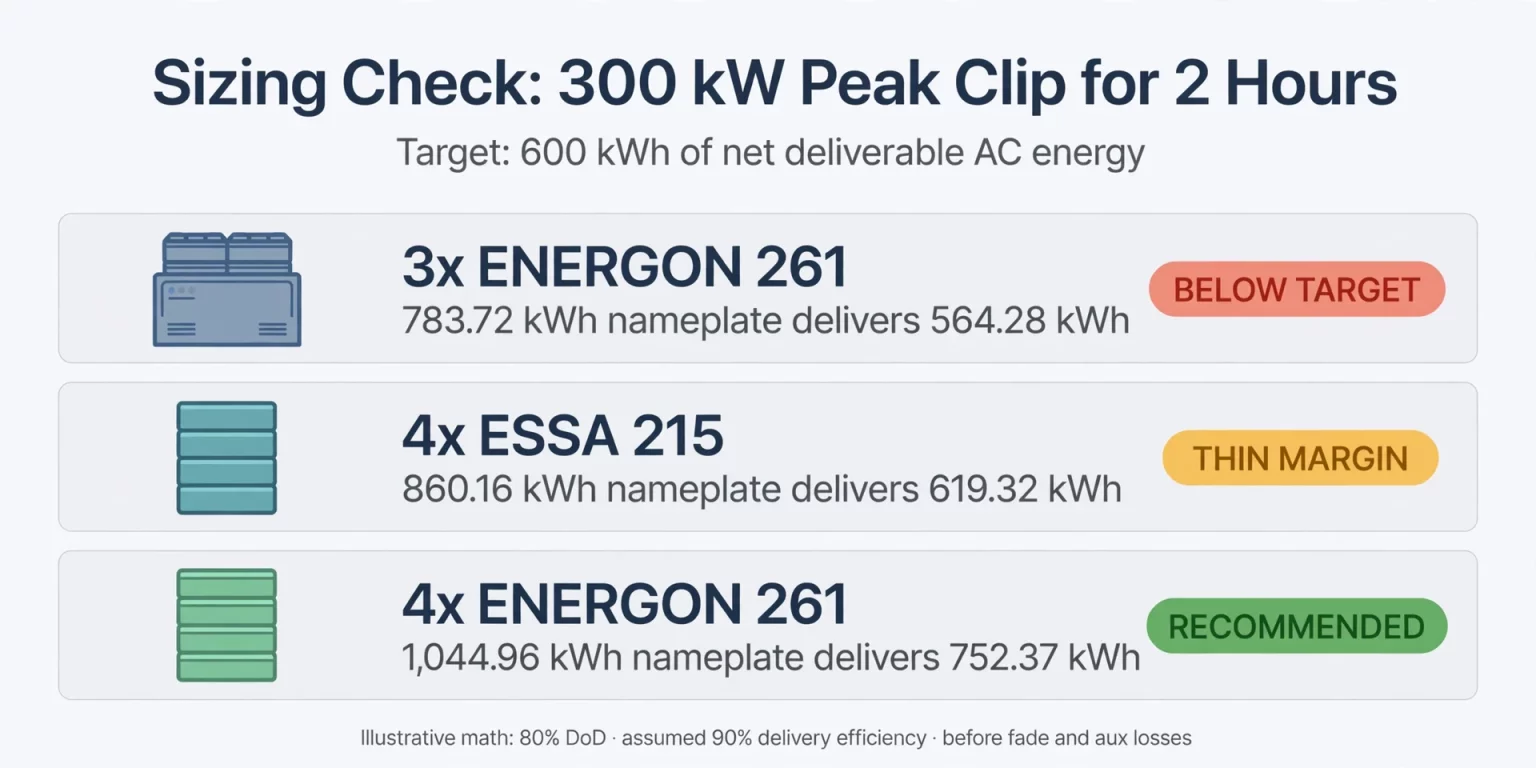
Table 4: Deliverable Energy Verification for a 300 kW / 2-Hour (600 kWh Net) Peak-Shaving Load
| Candidate Configuration | Nameplate Installed Energy | Illustrative Deliverable Energy (80% DoD, Assumed 90% Efficiency) | Sizing & Engineering Verification Result |
|---|---|---|---|
| 3 x Energon 261.24 kWh (375 kVA total) | 783.72 kWh | 564.28 kWh | Insufficient for 600 kWh net target (short by 35.72 kWh at BOL; 375 kVA rating also requires power factor check for 300 kW active power) |
| 4 x ESSA0100B-0215 (400 kW total) | 860.16 kWh | 619.32 kWh | Only +19.32 kWh BOL margin (requires further verification of multi-year fade, auxiliary HVAC losses, and SOC operating window) |
| 4 x Energon (500 kVA) or 5 x ESSA0100B-0215 (500 kW) | 1,044.96 kWh / 1,075.20 kWh | 752.37 kWh / 774.14 kWh | Recommended baseline to accommodate multi-year SOH degradation, auxiliary cooling loads, and kVA power factor headroom |
Critical Engineering Notes on the Sizing Calculation:
- Illustrative Efficiency vs. Datasheet Maximum Efficiency: The 90% delivery efficiency used in Table 4 is strictly an illustrative calculation assumption to demonstrate why nameplate energy cannot be equated to usable output. Engineers must not substitute Energon's official 90% maximum efficiency rating (or the 5000INTL's 87.5% maximum efficiency rating) directly for site AC round-trip or discharge delivery efficiency without verifying actual operating C-rate curves, transformer losses, and auxiliary thermal management consumption.
- Apparent Power (kVA) vs. Active Power (kW): Because the Energon cabinet is rated at 125 kVA (making 3 units equal to 375 kVA apparent power, not automatically 375 kW active power), operating at a non-unity power factor (for example, cosφ = 0.85 to 0.90 when simultaneously providing reactive power support) reduces available active kW output. Both the 3-unit Energon and 4-unit ESSA0100B-0215 options require further verification of actual usable energy, power factor, auxiliary parasitic losses, multi-year degradation, and operating SOC range before confirming whether they meet project requirements.
- Matching C-Rate and Power-to-Energy Ratio by Model: Always check the official continuous power and C-rate rating for each specific cabinet model. In the ESSA series, MegSolid specifies 0.25C for the ESSA0030B-0107 (30 kW / 107.52 kWh), 0.5C for the ESSA0100B-0215 (100 kW / 215.04 kWh), and 1C for the ESSA0050B-0055 (50 kW / 55.296 kWh), whereas the Energon cabinet is specified by its 125 kVA / 261.24 kWh rating rather than a nominal C-rate label.
FAQ
How do I size an industrial battery system for my manufacturing plant?
Sizing an industrial battery system requires analyzing 12 months of 15-minute interval load data from your utility revenue meter and calculating net deliverable AC energy after accounting for design Depth of Discharge (DoD), actual AC delivery efficiency, auxiliary cooling loads, power factor (kVA vs. kW), and multi-year capacity degradation. Commercial facilities commonly deploy parallel arrays of 100 kW / 215.04 kWh (ESSA0100B-0215) or 125 kVA / 261.24 kWh (Energon) outdoor cabinets, while heavy industrial plants and utility substations deploy 5,015.9 kWh / 2,700 kW (5000INTL) containerized systems.
What is the expected lifespan of modern industrial batteries?
Lifespan depends on cell chemistry, end-of-life SOH threshold, depth of discharge (DoD), C-rate, and thermal management. On MegSolid's standalone cell specification sheets, the SHS180-314Ah hybrid solid-liquid cell is rated for 6,000 cycles to ≥ 80% SOH (@ 0.5P/0.5P, 100% DoD), while the SHS165-280Ah hybrid solid-liquid cell is rated for ≥ 8,000 cycles to ≥ 70% SOH (@ 0.5P/0.5P, 100% DoD at room temperature). Because 80% SOH and 70% SOH represent different capacity-retention endpoints, engineers should evaluate cycle life against the specific EOL capacity threshold required by their project financial model.
Are all MegSolid 215kWh to 5MWh industrial battery systems semi-solid-state?
No. MegSolid's commercial and utility product lines include standard liquid-electrolyte LFP systems as well as optional or dedicated hybrid solid-state solutions. Specifically, the Energon 261.24 kWh / 125 kVA cabinet is a liquid-cooled standard LFP system (using a 1P260S string of 314Ah LFP cells), and the ESSA 55.296 kWh to 215.04 kWh series uses standard LFP cells by default with optional project-specific solid-state cell configurations confirmed per contract. Customers seeking hybrid solid-liquid cell technology (such as the SHS180-314Ah or SHS165-280Ah cells or the 51.2V / 314Ah MEG-Solid-512314FL1 pack) should specify those exact models during procurement.
Can industrial battery systems operate in extreme hot or cold climates?
Yes, provided the thermal management system matches the ambient environment. MegSolid's liquid-cooled Energon C&I cabinet is rated for ambient operation from -20°C to +55°C (with output derating above 45°C) at altitudes up to 4,000 meters (derating above 2,000 meters), while our PMA modular PCS series operates from -30°C to +60°C (derating above 45°C) up to 5,000 meters (derating above 3,000 meters).
Does paralleling multiple C&I battery cabinets automatically allow maintenance without plant shutdown?
Not automatically. While deploying multiple ESSA or Energon cabinets or modular PMA PCS stages provides modular building blocks, achieving safe online maintenance while remaining units continue operating requires project-specific verification of DC busbar isolation, individual AC breaker disconnects, protective relay coordination, safe lockout/tagout (LOTO) clearances, EMS load-shedding logic, and sufficient remaining capacity headroom.
How is peak-shaving capacity calculated from a factory load profile?
Use 12 months of 15-minute revenue-meter intervals to identify the sustained peak above the intended grid-import limit. Multiply the required kW clipping level by the peak duration in hours to obtain net AC kWh. Then account for design DoD, actual delivery efficiency, auxiliary loads and end-of-life SOH before choosing installed capacity.
Why does 125 kVA not always equal 125 kW of usable discharge power?
A PCS rated in kVA supplies apparent power. Active power equals kVA multiplied by power factor. When reactive-power support is needed, part of the inverter capability is used for kVAR, reducing available active kW. Verify the operating power factor and protection limits against the site load profile.
How should an EPC choose between ESSA air cooling and Energon liquid cooling?
Use the permitted ambient temperature, site dust conditions, cabinet maintenance access, thermal performance requirements and load duty cycle. The ESSA series has a published 0°C to 45°C operating range and IP54 outdoor enclosure; Energon is liquid-cooled and rated -20°C to +55°C with derating above 45°C. Confirm project-specific auxiliary consumption.
Can an industrial BESS power sensitive PLCs and CNC equipment without a dedicated UPS?
Do not assume so. The PMA modular PCS specifies under-20 ms module-level switching, but whole-plant transfer also includes grid fault recognition, breaker or transfer-switch operation and voltage stabilization. Sensitive controllers with sub-cycle ride-through requirements need a validated system transfer sequence or dedicated online UPS.
What documents should procurement teams request before ordering a 5 MWh BESS?
Request the exact model datasheet, single-line diagram, DC and AC voltage windows, cabinet or container weight, site cooling and auxiliary loads, control interface specifications, protective-device coordination and model-specific safety and transport documentation. Confirm the applicable system certificates, installation code requirements and any planned OEM or project customization.
Request a Verified Industrial BESS Sizing & Engineering Review from MegSolid
Replacing high peak-demand utility bills and vulnerable grid connections with a commercial cabinet array or utility container requires rigorous deliverable-energy math and verified hardware specifications. Whether your facility requires standard LFP outdoor C&I cabinets (215.04 kWh ESSA or 261.24 kWh Energon), a 5,015.9 kWh liquid-cooled 5000INTL container, or project-specific hybrid solid-liquid storage solutions, MegSolid provides transparent engineering documentation and application support.
Contact our engineering team with your 15-minute utility load profile, local tariff structure, and site single-line diagram (SLD) to receive a project-specific sizing calculation:
- Configure 55kWh to 5MWh+ C&I Cabinets and Containers: Compare technical specifications across our Commercial & Industrial (C&I) Energy Storage portfolio.
- Explore Hybrid Solid-Liquid Cell and System Technology: Review cell specification benchmarks and architecture details on our Solid-State Energy Storage Systems hub.