 Skip to content
Sourcing ul certified lithium batteries for North American microgrids, telecom backup, or commercial buildings frequently exposes a costly procurement trap. Many battery vendors claim full compliance solely because their internal raw cells hold a component recognition under UL 1642.
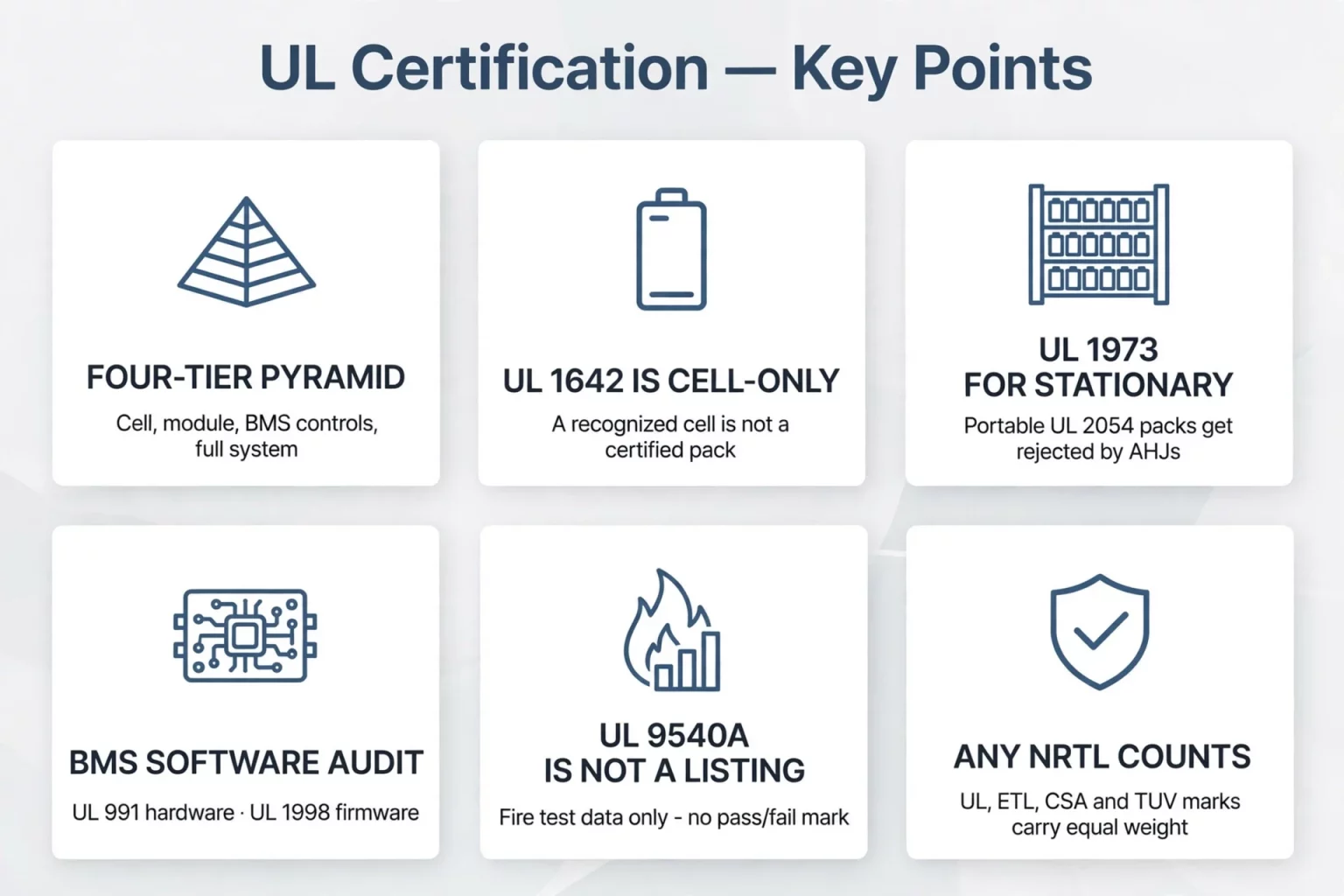
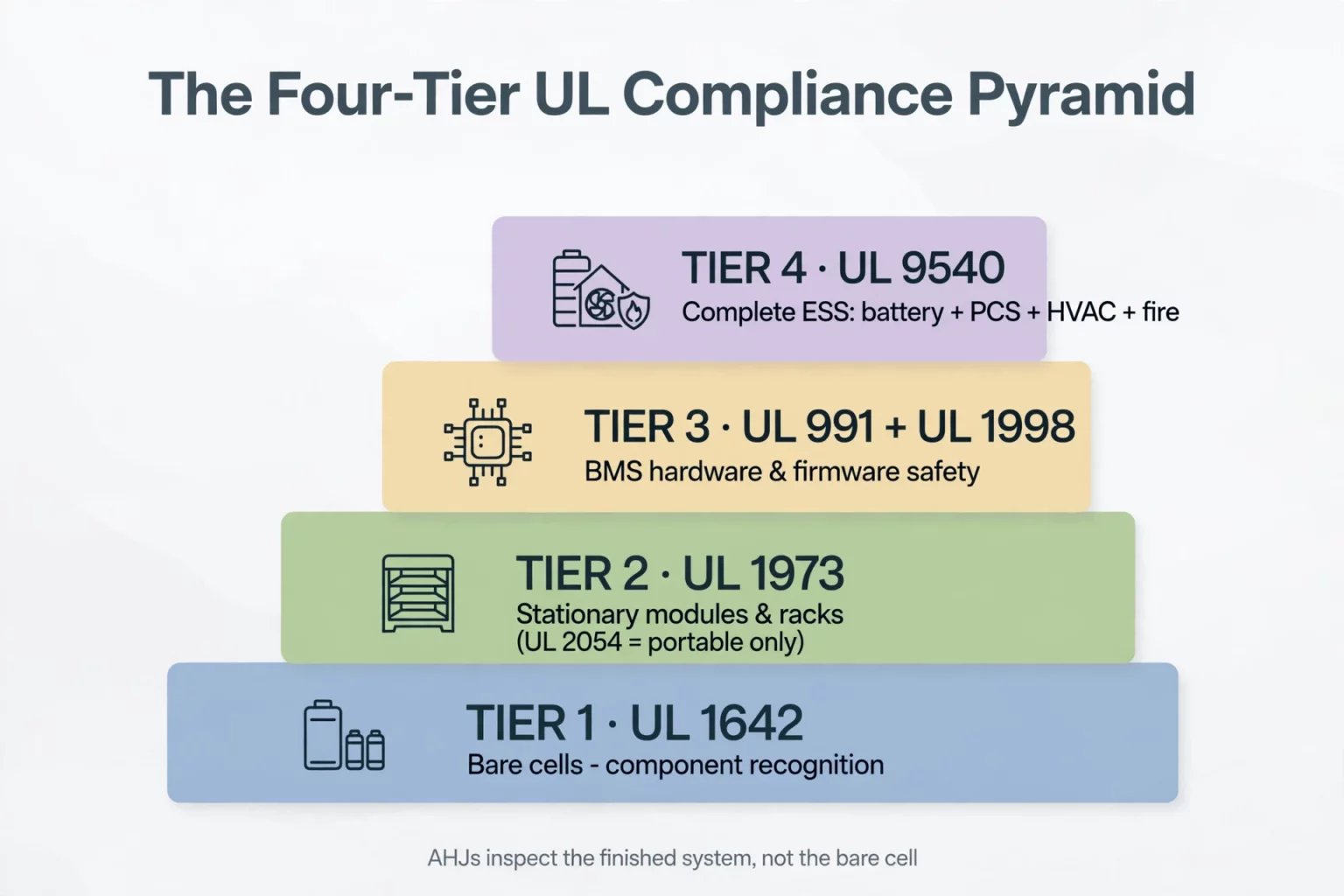
Building inspectors, fire marshals, and Authorities Having Jurisdiction (AHJs) enforcing NFPA 855 and National Electrical Code (NEC) Article 706 evaluate the complete installation rather than isolated cells. Rather than requiring every project to obtain a fixed sequence of standalone certificates, North American battery safety standards are structured across four distinct evaluation levels depending on equipment scope and system architecture:
- Level 1 (Cell Evaluation): UL 1642 evaluates bare electrochemical cells under electrical, mechanical, and thermal abuse.
- Level 2 (Pack and Module Evaluation): UL 2054 covers portable household and commercial packs, whereas UL 1973 covers battery packs and modules for stationary energy storage, vehicle auxiliary power, and light electric rail (LER) applications.
- Level 3 (Control and Functional Safety Evaluation): UL 991 and UL 1998 evaluate solid-state control hardware and programmable software when safety functions depend on electronic BMS logic (typically conducted as part of the parent pack or system investigation rather than as universal standalone certificates for every BMS).
- Level 4 (System-Level Evaluation): UL 9540 provides a system-level safety evaluation covering charging and discharging, protection, control, communication, and enclosure functions, referencing standards such as UL 1973 and UL 1741 based on the specific system architecture and components.
MegSolid designs its cell, module, and cabinet platforms around this regulatory architecture through our Solid-State Energy Storage Systems and modular Commercial & Industrial (C&I) Energy Storage solutions, with model-specific certification files and scope verified during engineering review.
Master Comparison Matrix: Decoding UL Battery Standards Across Four Evaluation Levels
Engineering, procurement, and construction (EPC) teams reviewing vendor submittals must match each UL standard to its legal scope and physical test boundary. Submitting a cell-level report or a portable pack certificate for a stationary commercial installation triggers permit rejection during plan review.
Table 1 maps the four evaluation levels for ul certified lithium batteries across North American standards, alongside the associated UL 9540A fire test method.
Table 1: UL Battery Safety Evaluation Hierarchy Matrix
| Standard | Evaluation Level | Target Equipment Scope | Certification / Output |
|---|---|---|---|
| UL 1642 | Level 1: Bare Component (Cell) | Primary and secondary lithium cells | UR Recognized Component (backward-R) |
| UL 2054 | Level 2A: Portable Pack | Power tools, mobile robotics, medical devices | UL Listed or Recognized Pack |
| UL 1973 | Level 2B: Stationary, Auxiliary & LER Pack | Stationary BESS racks, vehicle auxiliary power, light electric rail | UL Listed or Recognized Module |
| UL 991 / 1998 | Level 3: Control & Functional Safety | BMS solid-state hardware (991) and software (1998) where applicable | Evaluated within parent standard |
| UL 9540 | Level 4: System-Level ESS | Complete ESS (charging/discharging, protection, control, comms) | UL Listed System (or NRTL equivalent) |
| UL 9540A | Fire Test Method (No Pass/Fail) | Cell, module, unit, and installation thermal runaway fire spread | Test Data Report (NFPA 855 review) |
Key Testing Scopes and Boundaries:
- UL 1642: Evaluates bare cell casing, separator integrity, and safety venting under electrical, mechanical, and thermal abuse protocols defined by cell type, chemistry (primary vs. secondary), and sample geometry.
- UL 2054: Evaluates small portable household and commercial pack enclosure durability and single-fault board protection; not valid for permanent stationary building BESS installations.
- UL 1973: Evaluates battery modules and packs for stationary energy storage, vehicle auxiliary power, and light electric rail (LER), covering dielectric withstand, protective controls, and internal cell failure containment.
- UL 991 and UL 1998: Applied when safety-critical protective functions depend on solid-state electronics or programmable firmware; evaluated according to the BMS protection architecture rather than required as standalone certificates for every BMS.
- UL 9540: Provides a comprehensive system-level safety evaluation covering charging and discharging, protection, control, communication, and enclosure functions, referencing applicable standards such as UL 1973 and UL 1741 based on system architecture.
Procurement Verification Note: When evaluating vendor datasheets, always request the actual Certificate of Compliance (CoC) and verify the exact standard edition, model number, and applicant name in the issuing laboratory directory before signing an equipment supply contract.
Evaluation Level 1: Cell-Level Safety and UL 1642 Explained
Component qualification for industrial lithium battery packs begins at the bare cell level. Before an engineer integrates cells into a module, the cell model is evaluated for component abuse behavior under UL 1642.
What Does UL 1642 Test?
UL 1642 (Standard for Lithium Batteries) evaluates the risk of fire or explosion when bare primary (non-rechargeable) or secondary (rechargeable) lithium cells undergo electrical, mechanical, and thermal abuse. Test applicability, sample conditioning (such as fresh vs. cycled states), and specific test parameters depend on cell classification (primary vs. secondary, technician-replaceable vs. user-replaceable), sample mass, and casing geometry:
- Electrical Abuse Protocols:
- — External Short Circuit: Cell terminals are shorted across a standard-defined low-resistance load under specified ambient and elevated temperature conditions to evaluate casing integrity and venting behavior.
- — Abnormal Charging: Under UL 1642, abnormal charging procedures apply to primary (non-rechargeable) cells subjected to unintended charging currents, whereas rechargeable (secondary) cell overcharge protection and abuse behavior are evaluated under applicable secondary cell and battery pack standards (such as UL 1973 or UL 2054) according to the specified charge profile.
- — Forced Discharge: Applies to cells intended for use in multi-cell series configurations where a discharged cell could be driven into voltage reversal by other cells in series, rather than as a uniform test across all single-cell applications.
- Mechanical Abuse Protocols:
- — Crush Test: Subjects cell samples to mechanical compression between flat or specified surfaces according to the test fixture geometry and force parameters defined for the cell format and size in UL 1642.
- — Impact Test: Evaluates mechanical intrusion resistance by dropping a specified weight onto a steel rod placed across applicable cylindrical or prismatic cell samples according to the standard's impact procedure.
- — Shock and Vibration Evaluations: Subjects applicable cell samples to acceleration shock pulses and vibration profiles defined by the standard to verify that internal tab welds, structural connections, and terminal seals resist mechanical loosening and leakage.
- Thermal Abuse Protocols:
- — Heating Test: Places cell samples in a temperature-controlled oven following the temperature ramp rate, target hold temperature, and duration specified by UL 1642 for the applicable sample classification and chemistry.
- — Temperature Cycling: Cycles cell samples across standard-defined high and low temperature extremes for the specified hold times and cycle counts to verify casing and seal integrity against electrolyte leakage.
Pass/fail evaluation in UL 1642 corresponds to each specific test clause rather than a single universal criterion: depending on the specific test procedure and sample category, acceptance criteria evaluate whether the sample exhibits fire, explosion, projectile penetration of a surrounding test wire screen (such as in heating tests), casing rupture, or excessive mass loss and electrolyte leakage.
Distinguishing Cell-Level UL 1642 from Pack-Level UL 1973
UL 1642 evaluates the bare electrochemical cell itself. Because fuses, contactors, cell-balancing circuits, and enclosure arc barriers are pack-level components rather than parts of a raw cell, they fall outside the scope of UL 1642. Once bare cells are welded onto busbars and integrated with a BMS inside an enclosure, the assembled unit introduces multi-cell electrical and thermal interactions that require pack-level evaluation.
Cell-level UL 1642 recognition alone does not establish compliance of a finished stationary battery module. EPCs should verify the applicable pack-level evaluation, system listing, and installation requirements before submitting equipment for AHJ approval.
Evaluation Level 2: Pack and Module Standards (UL 2054 vs. UL 1973 Certification)
Once cells are welded onto busbars, wired to a BMS, and sealed inside an enclosure, the assembly moves to Level 2 evaluation. Here, B2B buyers must distinguish between portable household/commercial packs (UL 2054) and modules designed for stationary storage, vehicle auxiliary power, or light electric rail (UL 1973).
- Level 1: Raw cell evaluation → UL 1642 (Recognized Component - UR Mark)
- Portable / household / commercial pack → UL 2054
- Stationary / vehicle auxiliary / LER module → UL 1973
UL 2054: The Portable and Light Commercial Pack Standard
UL 2054 (Standard for Household and Commercial Batteries) covers portable primary and secondary battery packs used in household and commercial equipment such as handheld electronics, power tools, medical carts, and portable appliances. Rather than applying a single identical test profile to every pack, UL 2054 assigns electrical (overcharge, forced discharge, short-circuit, and single-fault circuit evaluations), mechanical (drop, impact, and crush), and enclosure conditioning (such as thermal or mold stress relief for polymeric housings) according to the specific battery chemistry, enclosure material, and pack configuration.
Using a UL 2054 portable pack report for a permanent stationary energy storage project can create permitting obstacles when the installation falls under stationary storage codes:
- Scope Difference from Stationary Standards: UL 2054 is structured around portable and movable host equipment rather than fixed grid-connected or building-integrated energy storage systems.
- Propagation Testing Scope: UL 2054 does not include the stationary module internal cell failure and thermal runaway propagation containment procedures specified in UL 1973.
- Code and AHJ Applicability: Whether a battery assembly is accepted for a commercial building, telecom facility, or industrial installation depends on the specific equipment classification, capacity thresholds, adopted electrical and fire codes (such as NEC Article 706, NFPA 855, or the International Fire Code), and local AHJ requirements.
UL 1973 Certification: Stationary, Vehicle Auxiliary, and Light Electric Rail Modules
UL 1973 (Standard for Batteries for Use in Stationary, Vehicle Auxiliary Power and Light Electric Rail Applications) is one of the primary applicable standards for battery modules, packs, and racks across three industrial application categories, evaluated according to product category and project requirements:
- Stationary Energy Storage: Commercial BESS racks, 48V/51.2V telecom backup banks, utility battery strings, and data center uninterruptible power supply (UPS) cabinets.
- Vehicle Auxiliary Power: Auxiliary battery banks powering non-propulsion loads, HVAC, and electronics in commercial vehicles.
- Light Electric Rail (LER): Battery assemblies installed in rail and transit applications.
Securing ul 1973 certification involves electrical, mechanical, and cell-failure evaluations defined by the applicable standard clauses and intended use:
- Protective Circuit and Single-Fault Evaluation:
- — Lab engineers introduce single-fault conditions (such as simulated switching device, sensor, or sensing-trace faults) while the battery operates under abnormal overcharge, over-discharge, or high-current conditions.
- — Under single-fault conditions, the battery protection system must maintain the assembly within safe operating limits or transition to a safe state in accordance with the manufacturer's protection architecture and applicable standard requirements.
- Dielectric Voltage Withstand and Insulation Resistance:
- — Battery modules and strings (for example, commercial racks operating at illustrative windows such as 676V to 936V DC or utility strings at 1,331.2V DC) undergo AC or DC dielectric withstand (hi-pot) and insulation resistance tests, where the exact test voltages are calculated from the equipment's rated system voltage per UL 1973 formulas.
- Internal Cell Failure and Propagation Evaluation:
- — Failure is initiated in a target cell within the module using a standard-permitted initiation method appropriate to the cell and module design.
- — Compliance is evaluated against the specific pass/fail criteria and compliance pathways defined in the applicable UL 1973 edition and annex for the intended installation environment.
- Mechanical Integrity Evaluations:
- — Depending on whether the assembly is classified for stationary, vehicle auxiliary, or light electric rail service and how the enclosure is mounted, UL 1973 applies corresponding crush, impact, shock, or vibration clauses.
Evaluation Level 3: Control and Functional Safety Evaluation (UL 991 and UL 1998)
During UL 1973 or UL 9540 investigations, evaluating the battery management system (BMS) electronics and software is an important engineering step whenever active controls perform safety-critical protective functions.
Understanding the Applicability of UL 991 and UL 1998
UL 991 and UL 1998 serve as technical standards for designing and evaluating safety-related control hardware and software, rather than two separate standalone certification certificates that every BMS must independently obtain. Whether UL 991, UL 1998, or alternative recognized functional safety standards (such as UL 60730-1, IEC 61508, or ISO 13849) apply depends on the specific safety functions assigned to the BMS, the protection hardware architecture, and the evaluation criteria of the parent standard (such as UL 1973 or UL 9540):
- UL 991 (Tests for Safety-Related Controls Employing Solid-State Devices):
- — Evaluates safety-related control systems employing solid-state devices when those circuits are relied upon for primary protective functions.
- — Applies environmental, electrical, and electromagnetic stress evaluations (such as electrostatic discharge, radiated electromagnetic fields, fast transients, supply voltage variations, or thermal drift) selected according to the applicable standard clauses and controller structure.
- — Conducts component fault analysis and fault simulation to verify that the control system maintains safety or transitions to a defined safe state determined by the specific safety function.
- UL 1998 (Software in Programmable Components):
- — Evaluates programmable software and embedded firmware (regardless of the specific programming language used) when software logic controls safety-related protective functions.
- — Reviews software architecture and fault-control measures, which may include design techniques such as watchdog timers, memory and register integrity checks (e.g., CRC), deterministic task execution, and defensive handling of communication faults depending on the software class and safety analysis.
How BMS Architecture Influences Functional Safety Evaluation
Under UL 1973 and UL 9540, the scope of control evaluation depends on how primary and secondary protective cutoffs are divided between passive components, discrete hardware, and programmable software. Table 2 outlines potential evaluation considerations across common BMS protection architectures.
Table 2: BMS Protection Architecture and Potential Evaluation Considerations
| Protection Architecture | Primary Cutoff Method | Potential Evaluation Considerations |
|---|---|---|
| Passive Fuse and Thermal Cutoff | Electromechanical melting element | Evaluated under applicable component fuse or thermal device standards (e.g., UL 248); software audit not applicable to passive path |
| Non-Programmable Hardware Cutoff | Discrete analog comparators and hardware logic | Solid-state control hardware fault analysis and applicable EMC/environmental clauses (such as UL 991 or equivalent standard) |
| Programmable Controller Cutoff | Microcontroller firmware driving switching devices | Hardware fault analysis plus programmable software evaluation (such as UL 991 and UL 1998, or recognized equivalents like UL 60730-1 / IEC 61508) depending on assigned safety functions |
Engineering Tip for OEM/ODM Buyers: When sourcing custom battery packs or integrating third-party BMS controllers, confirm with the supplier how primary and secondary safety cutoffs are partitioned between hardware and software, and verify which functional safety evaluation path applies within the target UL 1973 or UL 9540 investigation.
Evaluation Level 4: System-Level Safety Evaluation (UL 9540 and UL 9540 Certification)
Combining a UL 1973 battery assembly with a UL 1741 inverter requires verifying how the complete system configuration satisfies applicable installation codes and system-level listing requirements. In jurisdictions enforcing NFPA 855, the International Fire Code (IFC), or NEC Article 706, Authorities Having Jurisdiction evaluate whether the integrated system holds an applicable ul 9540 listing.
What Is UL 9540 (Energy Storage Systems and Equipment)?
UL 9540 evaluates the complete energy storage system as an integrated product, including battery assemblies, power conversion equipment, controls, protective functions, and other applicable components. The specific evaluation requirements depend on the system architecture, intended application, and applicable standard edition.
During a ul 9540 certification investigation, Nationally Recognized Testing Laboratory (NRTL) engineers evaluate system-level safety across applicable domains:
- Charging, Discharging, and Control Coordination: Verifies that the battery subsystem, power conversion equipment, and system controls operate within rated voltage, current, and temperature limits across normal and abnormal operating conditions.
- Communication and Safe-State Response: Evaluates how the integrated system responds to a loss of critical control communication between subsystems, verifying that the system transitions to a defined safe operating or shutdown state in accordance with its safety analysis and standard requirements.
- Electrical and Short-Circuit Coordination: Evaluates fault current contributions from battery strings and power conversion equipment based on the actual circuit topology and protective device coordination architecture.
- Thermal Management and Enclosure Evaluation: Evaluates cooling subsystems under rated operating conditions defined by the certification test plan, and assesses outdoor or indoor enclosures against their declared rating standard (noting that NEMA ratings such as NEMA 3R and IEC ingress protection ratings such as IP54 or IP55 follow different test criteria and cannot be treated as identical).
- Fire Detection and Hazard Mitigation Interfaces: Evaluates gas detection, smoke/thermal sensing, ventilation, or fire suppression interfaces where included in the system design or required for the intended installation category (for example, project-specific HVAC interlocking or clean-agent suppression such as Novec 1230 or aerosol units).
UL 9540 vs. UL 9540A: Edition Updates and Code Thresholds
Project developers frequently confuse UL 9540 with UL 9540A. Although the numbers look similar, they serve distinct regulatory roles:
- UL 9540 is a system-level product safety standard that results in a certification listing mark on qualifying energy storage equipment.
- UL 9540A (Test Method for Evaluating Thermal Runaway Fire Propagation in Battery Energy Storage Systems) is a fire test method that generates engineering test data rather than a pass/fail certification badge.
Engineers reviewing UL 9540A test documentation should also account for differences across standard editions rather than assuming every report executes an identical four-stage sequence:
- UL 9540A 5th Edition: Structured testing across four sequential levels: Cell Level, Module Level, Unit Level, and Installation Level.
- UL 9540A 6th Edition: Retains Cell-Level, Module-Level, and Installation-Level Large-Scale Fire Testing, while revising the applicability and scope of Unit-Level testing. Whether testing progresses to higher levels depends on the results achieved at earlier levels and the intended installation parameters.
UL 9540A test reports document cell off-gas composition, module thermal runaway containment, and heat/flame propagation behavior for code review. Applicable energy-capacity thresholds, fire protection measures, separation distances, and installation requirements depend on the adopted NFPA 855 and fire code editions (including updates through the 2026 edition of NFPA 855), battery chemistry, installation type, and local AHJ requirements.
Buyer Legal Reality: UL Recognized, UL Listed, and NRTL Scope
When reviewing supplier documentation for ul listed lithium batteries, procurement teams must distinguish component recognition from product listing and verify laboratory accreditation boundaries.
Spotting Misleading Vendor Claims: The UR Mark vs. Listing Marks
Suppliers sometimes present component certificates as proof of system compliance. Buyers should verify the exact mark and certificate scope:
- The UR Mark (UL Recognized Component):
- — Displayed as a "U" paired with a backward "R".
- — Indicates that a component (such as a bare UL 1642 cell or an internal protective relay) has been evaluated for factory integration into complete equipment under specified conditions of acceptability.
- — Component recognition alone does not establish that a finished battery module or cabinet is listed for standalone field installation.
- Product Listing Marks (Such as UL Listed):
- — Typically displayed by UL Solutions as the encircled "UL" symbol with the word "LISTED" and an issue/control identifier, though specific mark formats vary by certification program and issuing body.
- — Indicates that representative samples of a complete product or system (such as a UL 1973 battery module or a UL 9540 energy storage system) have been evaluated for field installation within the scope of the listing.
Understanding OSHA NRTL Scope and Local AHJ Acceptance
Under United States Occupational Safety and Health Administration (OSHA) regulation 29 CFR 1910.7, OSHA accredits Nationally Recognized Testing Laboratories (NRTLs) to test and certify workplace equipment covered by OSHA safety standards. When evaluating certificates from different laboratories, procurement teams must verify two legal boundaries:
- NRTL Recognition Is Standard-Specific, Not Universal:
- — NRTL is an accreditation program rather than a single certification mark.
- — Each accredited organization (such as UL Solutions, Intertek/ETL, CSA Group, TUV Rheinland, TUV SUD, or SGS North America) is recognized by OSHA only for the specific test standards listed in that laboratory's official Scope of Recognition. Holding NRTL status does not authorize a laboratory to certify every product category or every UL standard.
- OSHA Accreditation vs. Local AHJ and Insurance Approval:
- — OSHA workplace recognition, local building and fire code enforcement, and commercial property insurance underwriting operate under separate jurisdictions.
NRTL Acceptance Boundary: An ETL, CSA, or other NRTL certification may provide an accepted alternative to a UL-issued certification when the issuing organization is recognized for the applicable product category and test standard, and the certification covers the exact equipment configuration. Acceptance by the local AHJ and project insurer should still be confirmed.
The UL Battery Testing Process: Abuse Protocols and Hybrid Solid-Liquid Cell Data
Understanding how ul battery testing evaluates electrical, thermal, and mechanical abuse helps engineers interpret manufacturer test summaries accurately without conflating separate test standards.
How Abuse Protocols Differ Across Standards
Cell, module, and fire test standards apply distinct test boundaries and initiation methods rather than a single merged procedure:
- Cell vs. Module Overcharge Testing: Cell-level abnormal charging in UL 1642 applies to primary cells, whereas secondary module overcharge testing in UL 1973 evaluates assembled rechargeable packs under single-fault BMS conditions up to the specified charge voltage or current limits.
- External Short-Circuit Testing: Both UL 1642 (at the bare cell terminal boundary) and UL 1973 (at the module/pack output boundary) apply low-impedance fault circuits using resistance values and protective-device configurations defined by their respective standard clauses.
- Thermal Runaway Propagation vs. Fire Testing: UL 1973 evaluates single-cell failure containment within a module, while UL 9540A evaluates thermal runaway fire propagation and gas generation using initiation methods (such as external heaters, overcharge, nail penetration, or alternative triggers) permitted by the applicable standard edition and cell response.
In conventional liquid-electrolyte lithium-ion cells, volatile organic carbonate solvents can vaporize and vent flammable gas mixtures at elevated internal temperatures, with exact venting onset and gas volume governed by the specific electrolyte formulation, state of charge, and cell structure.
MegSolid Hybrid Solid-Liquid Cell Specifications and Abuse Test Data
As documented in MegSolid's model-specific cell technical sheets, the SHS180-314Ah and SHS165-280Ah hybrid solid-liquid prismatic energy storage cells incorporate nano solid-state electrolyte technology designed to reduce free liquid solvent content and suppress parasitic side reactions.
Table 3 presents the specification parameters and separate cell-level and module-level test benchmarks reported on the official SHS180-314Ah and SHS165-280Ah specification sheets.
Table 3: MegSolid Hybrid Solid-Liquid Cell Specifications and Reported Test Benchmarks
| Parameter / Test Category | MegSolid SHS180-314Ah Cell | MegSolid SHS165-280Ah Cell |
|---|---|---|
| Rated Capacity and Nominal Voltage | 314Ah / 3.2V (1,004.8 Wh calculated; 1,005 Wh rated on datasheet) | 280Ah / 3.2V class |
| Energy Density and Mass | 180 Wh/kg / 390 Wh/L (5.60 ± 0.1 kg cell mass) | 165 Wh/kg class (~350–365 Wh/L) |
| Internal Resistance and Cell Efficiency | AC: 0.18 ± 0.03 mΩ / DC: 0.4 ± 0.1 mΩ; cell energy efficiency ≥ 94.5% | Low-impedance nano solid-state electrolyte interface |
| Rated Cycle Life and EOL Condition | 6,000 cycles to ≥ 80% SOH (@ 0.5P/0.5P, 100% DoD) | ≥ 8,000 cycles to ≥ 70% SOH (@ 0.5P/0.5P, 100% DoD, room temp) |
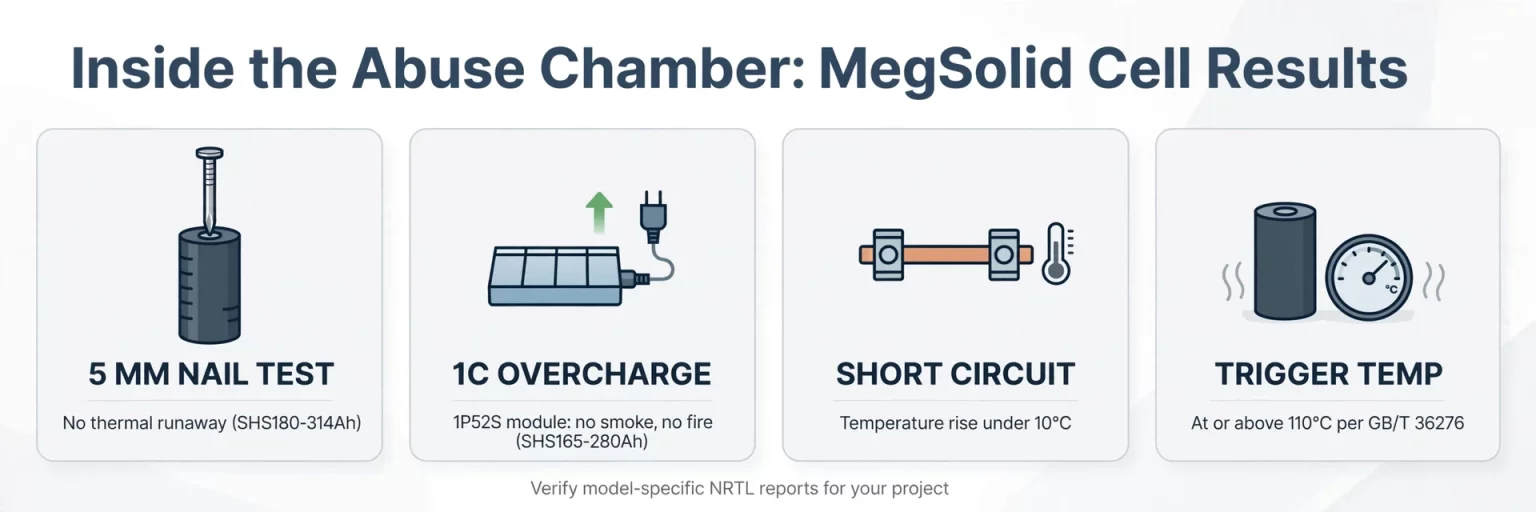
| Cell-Level Nail Penetration Test | 5 mm steel nail penetration: no thermal runaway under tested conditions | Verify model-specific cell nail test report and sample conditions |
| Cell-Level Thermal & Short-Circuit Tests | GB/T 36276-2023 method: thermal runaway trigger temp ≥ 110°C; external short-circuit large-face ΔT < 10°C | GB/T 36276-2018 method: cell surface temp > 120°C during thermal runaway test |
| Module-Level 1C Overcharge Test | Verify module-level overcharge report per pack configuration | 1P52S module 1C overcharge test: no smoke, no fire, no explosion |
| Standards Referenced on Cell Sheet | GB/T 36276-2023 test methods | GB/T 36276-2018, UL 1642, UL 1973, UL 9540A, IEC 62619, RoHS, UN 38.3 |
Engineering Verification Notes on Reported Cell and Module Tests:
- Separate Test Boundaries: Cell-level nail penetration, cell-level thermal/short-circuit tests (per GB/T 36276-2023 or GB/T 36276-2018), and module-level 1C overcharge tests (on a 1P52S module configuration) represent distinct test procedures. Buyers should request the corresponding test reports from MegSolid to confirm exact model numbers, sample quantities, and test boundaries.
- Conditional Thermal Response: Under the specified nail-penetration and overcharge test conditions, the tested MegSolid hybrid solid-liquid cell configurations demonstrated the reported thermal response. Actual safety performance depends on cell design, module architecture, operating conditions, and the complete test configuration.
Aligning MegSolid Packs and C&I Systems with Project Permitting
When selecting assembled battery modules, C&I cabinets, or utility containers, EPC engineers should verify the exact configuration and certification scope for each model:
- 51.2V Rack and Movable Battery Packs:
- — MEG-Solid-512314FL1 (51.2V, 314Ah, 16.07 kWh hybrid solid-state LiFePO4 pack, 200A max charge and continuous discharge current, ≤ 15 mΩ internal impedance, 8,000 cycles at 80% DoD): The official product page lists IP21/IP65 protection and UL, CE, and UN 38.3 references. Because IP21 and IP65 correspond to different enclosure configurations (a single unit does not simultaneously hold both ratings), buyers should specify the required enclosure rating and confirm the exact UL standard scope per order.
- — MG 512314 Movable Pack (314Ah, 16,076 Wh, 40V to 58.4V operating voltage, 200A max current, ≥ 6,000 cycles): The product specification page lists UL 1741, IEC 62109-1, IEC 62109-2, EN 61000-6-1/-6-3, FCC Part 15 Class B, and RoHS. Because UL 1741 and IEC 62109-1/-2 are power conversion and inverter safety standards rather than standalone battery pack standards, buyers should confirm with MegSolid whether those listed standards apply to an associated inverter or complete system configuration, and verify applicable battery pack certification documents for their project site.
- Commercial Cabinets, Liquid-Cooled Racks, and Utility Containers:
- — ESSA Outdoor Cabinet Series (30 kW to 100 kW / 55.296 kWh to 215.04 kWh at 400V AC, IP54): Features such as built-in isolation transformers, Aerosol or Novec 1230 fire suppression, and standard LFP vs. optional project-specific solid-state cell configurations depend on the selected ESSA model and contract specification.
- — Energon Liquid-Cooled LFP C&I System (261.24 kWh, 125 kVA, 1P260S 314Ah LFP configuration, 676V to 936V DC working voltage, IP54, up to 90% max system efficiency; note that this datasheet figure represents maximum system efficiency rather than round-trip efficiency), 5000INTL Liquid-Cooled Container (5,015.9 kWh, 2,700 kW at 690V AC, 1,123.2V to 1,497.6V DC, IP55), and PMA080/105/125 Modular PCS (80 kW to 125 kW, 615V to 950V DC input).
Important Compliance Boundary: Favorable cell or module abuse test results do not automatically exempt a BESS installation from fire code requirements or automatically reduce NFPA 855 separation distances. All fire protection measures, thermal barriers, and installation setback distances depend on the adopted fire code edition, system-level UL 9540 listing, model-specific UL 9540A test reports, and formal approval by the local AHJ.
FAQ
How does UL 1973 differ from UL 2580?
While UL 1973 evaluates batteries for stationary storage, vehicle auxiliary power, and light electric rail applications, UL 2580 (Standard for Batteries for Use in Electric Vehicles) specifically evaluates traction battery packs and modules designed for electric vehicle propulsion in on-road and off-road automotive applications, emphasizing severe automotive crash, immersion, and road-vibration profiles.
Why is UL 2054 generally not a substitute for UL 1973 in stationary BESS installations?
UL 2054 is written for household and commercial portable battery packs used in handheld tools, mobile electronics, and portable equipment. While UL 2054 is appropriate within its portable scope, stationary energy storage installations governed by NEC Article 706, NFPA 855, and the International Fire Code typically require battery modules evaluated to UL 1973 (including stationary dielectric withstand and internal cell failure containment requirements) as part of a system-level compliance path, subject to local code and AHJ requirements.
Under what conditions do UL 991 and UL 1998 apply to a BMS?
UL 991 and UL 1998 are not mandatory standalone certificates required for every BMS. They apply as functional safety evaluation standards when a battery pack or energy storage system relies on solid-state electronic controls (UL 991) or programmable software/firmware (UL 1998) to execute primary safety-critical protective cutoffs, and where those controls are not solely protected by passive electromechanical devices or already qualified under an alternative recognized functional safety standard (such as UL 60730-1, IEC 61508, or ISO 13849) accepted within the parent UL 1973 or UL 9540 investigation.
What is the difference between UL 9540 certification and UL 9540A testing?
UL 9540 is a product safety standard that evaluates a complete energy storage system and grants a certification listing mark upon compliance. UL 9540A is a fire test method (not a certification listing) that measures thermal runaway fire propagation, heat release rates, and off-gas composition to provide engineering test data for fire code review under NFPA 855 and the IFC.
What are the testing levels in UL 9540A, and how do the 5th and 6th Editions differ?
In the 5th Edition of UL 9540A, testing was structured across four levels: Cell Level, Module Level, Unit Level, and Installation Level. In the 6th Edition of UL 9540A, the standard retains Cell-Level, Module-Level, and Installation-Level Large-Scale Fire Testing while revising the applicability and scope of Unit-Level testing. Under both editions, not every test report requires executing all levels; whether testing proceeds to higher levels depends on the thermal and propagation results observed at earlier stages and the intended installation configuration.
How does an AHJ review BESS test reports during project permitting?
During plan review, the local Authority Having Jurisdiction (building official and fire marshal) typically verifies that the equipment carries an applicable system listing (such as UL 9540) from an accredited NRTL for the exact battery and PCS configuration, reviews the model-specific UL 9540A fire test report to assess thermal runaway propagation and flammable gas generation, and checks that system capacity, separation distances, ventilation, deflagration control, and fire suppression comply with the locally adopted editions of NFPA 855, the IFC, the IBC, and the NEC.
Does an ETL, CSA, or TUV mark have the same acceptance as a UL mark?
ETL, CSA, or other NRTL certifications may provide an accepted alternative to a UL-issued certification when the issuing organization is accredited by OSHA (or the Standards Council of Canada in Canada) for the specific product category and test standard (such as UL 1973 or UL 9540), and the listing covers the exact equipment configuration. Because OSHA NRTL recognition is limited to each laboratory's published standard scope, and local AHJs and property insurers maintain independent review authority, buyers should confirm laboratory scope and local AHJ/insurer acceptance prior to procurement.
What are the compliance options if a project has a UL 1973 battery rack but lacks a joint UL 9540 listing with the selected inverter?
When a battery assembly and power conversion system are not jointly covered under an existing UL 9540 system listing, project teams generally evaluate several pathways depending on local code requirements and AHJ policies: selecting an inverter/PCS model that is already included in the battery manufacturer's multi-PCS UL 9540 listing matrix, working with the manufacturer to extend the factory UL 9540 listing to include the target PCS, or (where permitted by the local AHJ and applicable codes) engaging an accredited NRTL to perform a site-specific Field Evaluation supported by component listings and UL 9540A test data.
How does IEC 62619 relate to UL 1973 and UL 9540?
IEC 62619 is an international safety standard for secondary lithium cells and batteries used in industrial applications (including stationary storage, telecom, and motive equipment). While IEC 62619 shares certain abuse test concepts with UL 1973 and is widely required in European, Asian, and international markets, an IEC 62619 test report alone does not substitute for UL 1973 or UL 9540 listing in North American jurisdictions enforcing the NEC, CEC, or NFPA 855.
How do BESS certification and procurement requirements differ across the United States, Canada, and North America?
In the United States, installations are governed by the National Electrical Code (NEC Article 706), the International Fire Code (IFC), and NFPA 855, using certifications issued by OSHA-recognized NRTLs (tested to standards such as UL 1973 and UL 9540). In Canada, installations must comply with the Canadian Electrical Code (CEC Part I) and provincial fire codes, requiring certification marks accepted by provincial electrical inspection authorities and issued by Certification Bodies accredited by the Standards Council of Canada (SCC), such as CSA, cUL, or cETL marks evaluated to harmonized binational standards (including ANSI/CAN/UL 1973 and ANSI/CAN/UL 9540) and applicable Canadian national standards. For cross-border North American procurement, buyers should specify dual US/Canadian certification markings (cULus, cETLus, or CSA c/us) covering the exact system model.
Accelerate Your Energy Storage Project with Verified Engineering Support
Securing permit approval and commercial insurance for North American battery installations requires aligning cell, module, control, and system-level documentation before equipment leaves the factory. Selecting storage platforms with verified abuse test data and transparent certification scope protects project schedules from permitting delays.
During your request for quotation (RFQ) and technical due diligence, contact MegSolid's engineering team to verify model-specific NRTL test reports, applicable standard scopes, and PCS compatibility matrices for your target jurisdiction:
- Explore High-Safety Turnkey Architectures: Review our cell, rack, and containerized Solid-State Energy Storage Systems.
- Configure Modular C&I Cabinets and Racks: Compare voltage windows, cooling topologies, and cabinet specs across our Commercial & Industrial (C&I) Energy Storage portfolio.
