 Skip to content
Your site can lose a cabinet's price advantage through lifting access, unusable floor space or an expensive expansion path. Compare MegSolid Battery Energy Storage Systems in parallel modular outdoor cabinets, such as 215 kWh or 261 kWh configurations, with ESSC container blocks using the installed layout and final power duty. Send the equipment zone and growth plan so the offer prices a format the site can install and service.
According to NFPA 855 (2023), the standard for the installation of stationary energy storage systems , local Authorities Having Jurisdiction (AHJ) heavily scrutinize site layout, fire suppression integration, and structural foundations. Choosing the wrong deployment strategy can lead to months of permitting delays and unforeseen civil construction costs.
This engineering analysis explains how modern hybrid solid-state BESS architectures evaluate the trade-offs between modular cabinets and containerized systems to optimize grid interconnection compliance, operational scalability, and total cost of ownership (TCO).
Key Takeaways
- Modular cabinets can support phased capital purchases and distributed placement when the access, parallel and site designs are approved.
- A container offers a larger integrated block; compare its actual delivery, civil, collection and commissioning scope.
- Cabinet/container layout options must satisfy the accepted model-specific fire and site design; enclosure count alone does not grant approval.
- Compare the delivered isolation paths and common dependencies. Current 5000INTL uses six 450 kW conversion blocks, not one assumed central PCS.
- Compare complete installed and lifecycle costs at the same supported power, usable energy, contract year and fault condition.
Deployment Architecture and Site Preparation Strategy
To visualize the engineering differences, EPCs must examine the physical footprint and logistical requirements of each strategy.
Figure 1: Deployment Architecture Comparison. Modular cabinets offer distributed placement, while containers require concentrated heavy infrastructure.
Civil Engineering and Logistical Constraints
The physical deployment of energy storage systems dictates the initial engineering feasibility of a C&I project.
Foundation and Load Bearing
Use the delivered model's weight, support reactions and foundation interface for the civil design. ESSA0100B-0215 publishes 3900 kg and a 2450 × 1550 × 2400 mm envelope; the current 5000INTL is a 2700 kW / 5015.9 kWh container with a 6058 × 2438 × 2896 mm envelope. Neither figure approves an existing slab or gravel pad. Price the controlled GA, anchors, access and site structural work against the same scope before treating modular cabinets as the cheaper deployment.
Site Access and Crane Logistics
Plan the access and lifting route from the delivered equipment's weight, lifting instructions, centre of gravity and local rigging design. A cabinet may suit restricted access, but forklift handling needs an approved model-specific method; a container does not always require the same 50–100-ton crane. Put transport, offloading, lifting, site preparation and service access into both bids. The useful comparison is the installed equipment path and priced responsibilities, not a default no-crane promise.
NFPA 855 Fire Safety and Compliance Engineering
Fire marshal approval is the most critical hurdle in BESS deployment. NFPA 855 (2023) mandates specific isolation distances, fire suppression systems, and thermal runaway mitigation strategies based on the physical architecture of the ESS.
Modular Isolation vs. Concentrated Risk
Agree the applicable code edition and fire-authority requirements for the exact cell/system, layout, exposure, detection, isolation and fire-test evidence. A generic 3 m clearance or 2-hour barrier is not a universal release rule for every container or cabinet installation. The site fire designer and authority should approve the required separation and protective measures before the final footprint is priced.
Five ESSA0100B-0215 cabinets provide 500 kW rated AC and 1075.2 kWh nominal energy, not an automatically approved 1 MWh AC duty. Separate enclosures give layout options, but fire isolation, cable trenches and placement near switchgear still need the actual model reports and accepted site design. Compare the approved separation and service clearances before claiming a trenching or permitting advantage.
Thermal Runaway Propagation Mitigation
Modern hybrid solid-state architectures utilize a stable solid electrolyte matrix designed to reduce the release of flammable electrolyte under thermal stress compared with conventional liquid-electrolyte systems. Designed according to UL 9540A evaluation methodology, both modular and containerized systems aim to mitigate cell-to-cell thermal propagation. (For foundational knowledge on system safety, read our BESS thermal runaway prevention guide).
System Scalability and Phased Capex Deployment
C&I facility load profiles often grow over time. A manufacturing facility may plan to expand its production line in Phase 2, requiring additional energy capacity.
The All-or-Nothing Constraint of Containers
A containerized ESS is typically a monolithic block. Scaling a 2.5MWh container to 5MWh requires purchasing and installing a second, entirely separate container, along with a second set of AC cabling and switchgear integration. This represents a massive, lumpy Capex expenditure.
The Daisy-Chain Scalability of Cabinets
Five ESSA0100B-0215 cabinets give 500 kW rated AC and 1075.2 kWh nominal energy. Two more would add 200 kW and 430.08 kWh, for 700 kW / 1505.28 kWh nominal, only within an approved parallel design. Expansion still needs connection capacity, switchgear/protection, cables, EMS/BMS configuration and acceptance. It is a phased capital purchase, not an automatic Opex increment or a guarantee that the old PCS and switchboard accept more current.
Electrical Topology and Efficiency Considerations
The choice of deployment strategy also impacts DC bus topology and system efficiency.
Distributed vs. Centralized Architectures
An AC-parallel cabinet design can place each cabinet's conversion stage behind an individual isolation path. The delivered controls, protection and communications must show whether one fault leaves the required remaining load supplied. A DC voltage such as 768 V or 832 V does not establish PV MPPT functionality, N+1 capacity or independent operation by itself.
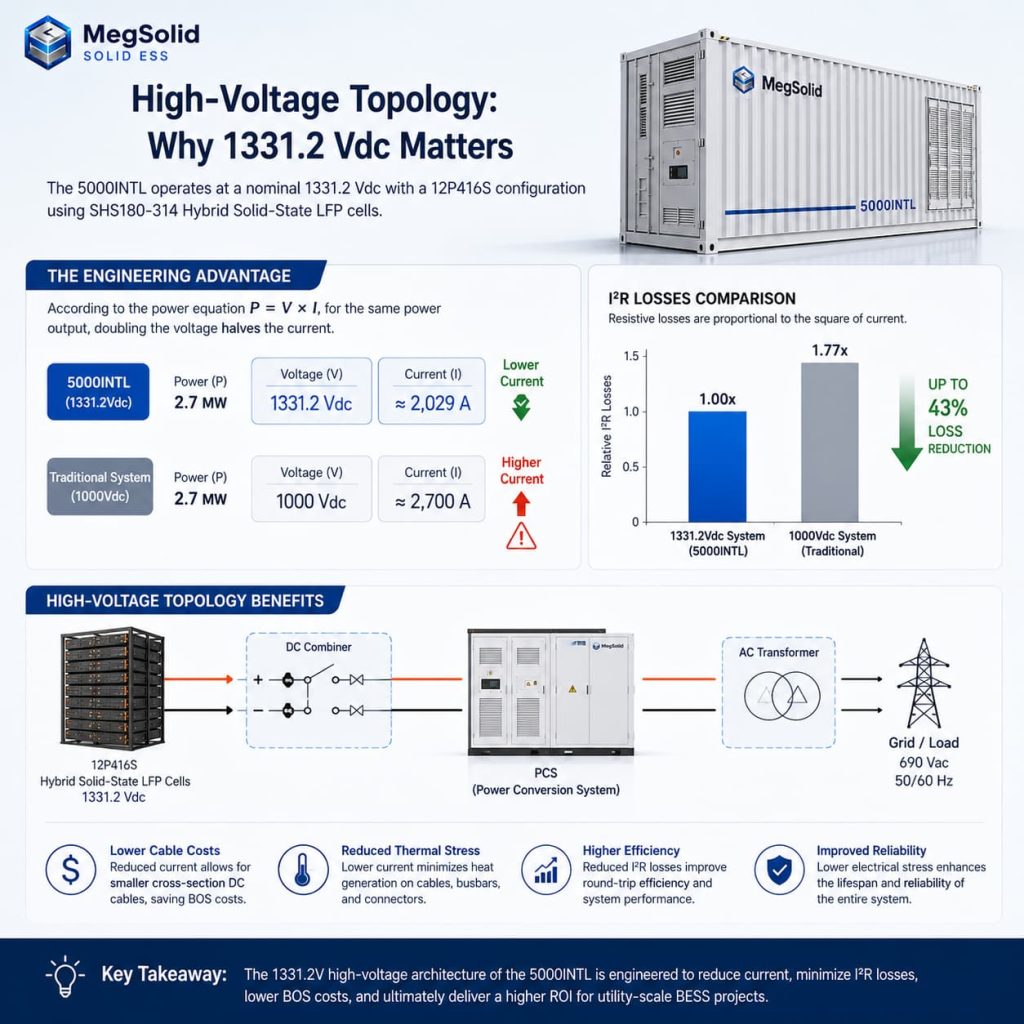
A container is not necessarily one central PCS. The current 5000INTL publishes six 450 kW AC blocks for 2700 kW total at 690 V, with 1331.2 Vdc nominal and 5015.9 kWh rated energy. Define the actual converter/rack isolation, common cooling/control dependencies and supported output after the agreed component outage. That identifies the available redundancy and repair scope without assuming every container loses 100% output after one PCS fault.
Engineering Comparison Matrix
EPCs must evaluate the total cost of ownership and operational resilience when designing backup power systems.
|
Parameter |
Modular Cabinets |
Containerized ESS |
|---|---|---|
| Civil Work | Controlled cabinet support/anchor design and actual site works | Controlled container foundation/support design and actual site works |
| Crane Logistics | Approved model-specific lifting/handling and access route | Approved rigging plan from delivered weight and lift geometry |
| Expansion | Approved cabinet increments; connections and controls reviewed | Container block increments; connection and controls reviewed |
| Fire Compartment | Separate enclosures; actual accepted fire-isolation design | Actual model fire compartment, tests and accepted site layout |
| Site Access | Check delivered dimensions, transport and service paths | Check delivered dimensions, transport and service paths |
| Maintenance | Verify individual isolation and remaining supported duty | Verify converter/rack isolation and common dependencies |
| Scalability | Approved future cabinet quantity and parallel duty | Approved future block quantity and electrical duty |
| Commissioning | Stage-by-stage site integration and acceptance | Factory integration plus actual collection/site acceptance |
Deployment Cost Comparison (1MWh Example)
To quantify the economic impact of deployment architecture, consider a 1MWh C&I installation. While containerized ESS may offer slightly lower hardware CapEx per kWh, the balance-of-system (BOS) costs tell a different story.
|
Cost Parameter |
Modular Cabinets (5x 215kWh) |
Containerized ESS (1x 1MWh) |
|---|---|---|
| Civil Work | $10,000 | $35,000 |
| Crane Logistics | $0 illustrative assumption; actual handling/rigging must be quoted | $15,000 |
| Commissioning | $8,000 | $5,000 |
| Expansion Cost | Price the additional cabinet plus approved connection/control works | Price the chosen container increment plus connection/control works |
The table is an illustrative cost worksheet, not a MegSolid quote or verified project outcome. Replace the $10,000/$35,000 civil, $0/$15,000 handling and $8,000/$5,000 commissioning assumptions with installed bids for the same power, usable AC energy and scope. Five ESSA0100B-0215 cabinets total 500 kW / 1075.2 kWh nominal; make the competing container offer meet the same operating duty before comparing cost.
Which Architecture Delivers the Lowest Total Cost of Ownership (TCO)?
Price lifecycle TCO against the same supported load and outage conditions. Compare hardware, civil/lifting work, approved expansion, auxiliaries, replacement assumptions and repair downtime. Cabinets can offer phased deployment and individual service paths; containers can offer larger integrated power/energy blocks. Neither architecture wins the TCO calculation until the actual design and service contract support those benefits.
|
TCO Parameter |
Modular Cabinets |
Containerized ESS |
|---|---|---|
| Initial CapEx | Compare actual hardware bids for the same duty | Compare actual hardware bids for the same duty |
| Civil Work | Price approved support, access and local works | Price approved support, access and local works |
| Maintenance Downtime | Remaining load after cabinet isolation must be proved | Actual converter/rack/common-system outage duty must be proved |
| Expansion Cost | Price cabinet increment and all connection/control changes | Price container increment and all connection/control changes |
| Availability | N+1 only when required duty survives the agreed outage | Compare actual conversion blocks and common dependencies |
| Lifecycle TCO | Calculate installed, operating, replacement and service costs | Calculate the same costs at the same contracted duty |
Individual cabinet isolation can make a phased installation easier to service if the remaining units can still carry the contracted load and reserve. Apply the same outage test to the container's converter/rack and common-system design. Put the supported power/energy, repair access, response terms and spare-parts plan after an agreed fault into the offer; enclosure count alone does not establish availability or N+1.
Decision Matrix: When Should EPCs Choose Modular vs. Containerized ESS?
Choosing the right architecture depends on specific project conditions. EPCs can use the following decision matrix:
|
Project Condition |
Recommended Architecture |
|---|---|
| Limited Site Access | Modular Cabinets |
| Phased Expansion | Modular Cabinets |
| Fast Utility-Scale Deployment | Containerized ESS |
| Remote Mining Site | Modular Cabinets |
| Brownfield Industrial Retrofit | Modular Cabinets |
| Greenfield Utility Project | Containerized ESS |
2025 Chilean Mining Scenario: Deployment Evidence to Request
Use the Atacama scenario as a deployment review until its named engineering, FAT and SAT records are available. The buyer must verify the access route, cabinet lifting and support design, parallel control and critical-load duty. Five 215.04 kWh cabinets total 1075.2 kWh nominal; neither that quantity nor a confidential-project label proves the stated site outcomes or an AC-energy guarantee.
Deployment Checks Before Applying the Scenario
- Access review: Check the actual road, trailer, equipment weight and delivery/lifting route before selecting five 215.04 kWh cabinets or a container.
- Lifting and cost review: Obtain the approved cabinet handling method and priced local rigging. The 100-ton crane, 200 km route and $45,000 saving require the named project records; they are not a generic cabinet saving.
- Parallel-control review: If the supplied PCS/EMS uses master/follower or PQ modes, identify exact firmware, Volt-VAR response, command priority and test conditions. Witness stable parallel operation rather than assuming the described private tuning result.
Project Outcomes Requiring Named Records
- Civil acceptance: The controlled support/anchor design and site engineer must approve the actual pad. An existing gravel or slab surface is not accepted merely because the equipment is modular.
- Grid acceptance: Require the applicable protection, permitted import/export envelope and witnessed site tests for the exact installation.
- Critical-load acceptance: Define remaining power/energy after an agreed component outage and test the actual transfer and recovery duty; no universal 100% continuity is established.
- Evidence boundary: Keep any project savings or performance result tied to its named records, tariff, configuration and test conditions.
Why Factory Integrated BESS Matters for Deployment Strategy
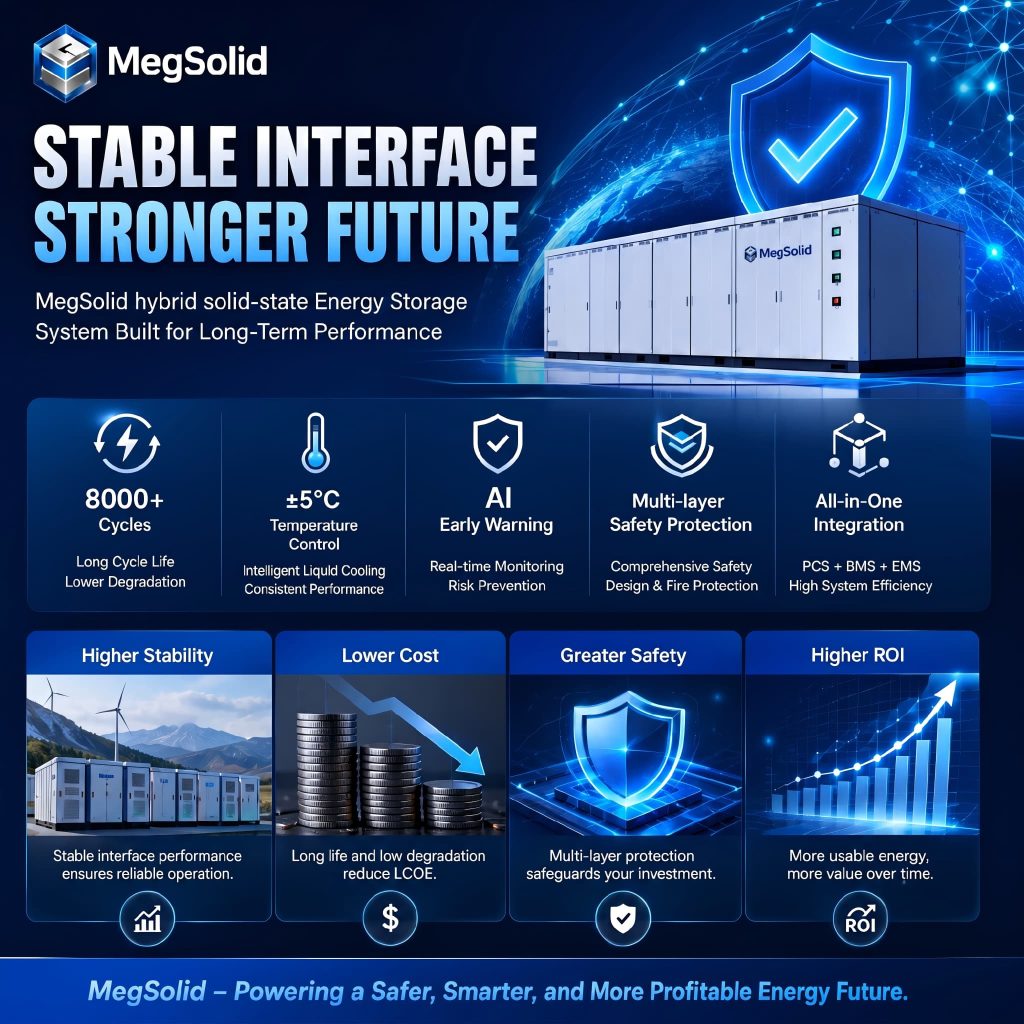
Factory integration has purchase value when the supplier takes responsibility for the exact battery/converter/control interface and demonstrates it in the agreed tests. The contract should identify included equipment, firmware, drawings, test records and the site interfaces left to the EPC. That gives the buyer an accountable integration boundary for either architecture.
Factory integration is valuable when the purchase order names the exact battery, PCS, BMS/EMS, firmware and interfaces to be tested. Agree parallel operation, synchronization, communications loss, thermal limits and traceability checks in the witnessed FAT; the SAT then tests the installed collection, transformer, site meter and protection. A FAT does not guarantee that a financial model is correct or that every local code requirement has been met.
MegSolid Manufacturing Authority
MegSolid's 215kWh Outdoor Cabinet ESS publishes ESSA0100B-0215 at 100 kW / 215.04 kWh with air cooling, while MegSolid Energon 5000INTL offers 2700 kW / 5015.9 kWh at 690 V with liquid cooling. Compare those real blocks against the required load, usable duration and approved layout. Use microgrid solutions for unstable grids for the microgrid architecture and OEM/ODM manufacturing for custom manufacturing; ask the quote for exact reports, drawings, tested interfaces, delivery scope and repair responsibilities. Certification-provider names alone do not release the ordered model or site design.
References & Industry Standards
Use the following references to build the destination project's design and evidence register. The actual code edition, model reports and installation requirements must be agreed with the local project engineer and authority. A standard name in an article is not proof that the ordered cabinet or container has a particular certification or accepted site layout.
- NFPA 855 (2023): Standard for the Installation of Stationary Energy Storage Systems.
- UL: 9540A test method for evaluating thermal-runaway fire propagation in battery energy storage systems; UL 9540 addresses energy storage systems and equipment.
- IEEE: 1547-2018 Standard for Interconnection and Interoperability of Distributed Energy Resources.
- IEEE: 519-2022 Recommended Practice and Requirements for Harmonic Control in Electric Power Systems.
- IEC: 62619 Safety requirements for secondary lithium cells and batteries in industrial applications.
- ISO 668: Series 1 freight containers - Classification, dimensions and ratings.
FAQ
Q1: When should I choose modular cabinets instead of a containerized ESS?
Evaluate cabinets where phased purchases or distributed placement help the site. Confirm access, support/lifting, approved parallel operation, service clearances and the required remaining load after a fault. Restricted access does not automatically remove civil or crane work.
Q2: Is a containerized BESS always cheaper?
Compare actual installed bids at the same power and usable AC-energy duty. Include civil/lifting, connection, controls, approved expansion, auxiliaries, replacements and repair responsibilities. Neither cabinet nor container is automatically the lower deployment or lifecycle cost.
Q3: Does NFPA 855 require larger separation distances for containers?
The exact model reports, layout and authority's accepted requirements determine separation and protective measures. A generic 3 m distance or 2-hour barrier is not a universal release rule; separate cabinet enclosures alone do not establish an approved fire compartment or closer placement.
Q4: Can modular cabinets be expanded after commissioning?
Expansion is possible only within the approved quantity, connection, switchgear/protection, cables and controller/firmware design. Reconfigure and test the increased duty. Adding cabinets does not guarantee automatic EMS recognition or that no additional integration work is needed.
Q5: Which deployment strategy reduces civil engineering costs?
ESSA0100B-0215 publishes 3900 kg, but the controlled support/anchor interface, ground conditions and structural design determine actual civil work. A modular cabinet does not automatically approve a standard slab or eliminate a foundation.
Q6: Do modular cabinets simplify maintenance?
Verify isolation and the supported remaining duty for the delivered design. Individual cabinets may have their own service paths, while a container may have multiple converter/rack sections. Common cooling, controls or protection can affect both; do not assume every container requires a whole-system shutdown.
Q7: How does deployment architecture affect fire safety?
Separate enclosures offer layout options, but propagation and fire isolation require the exact cell/module/system evidence and approved installation measures. ESSA0100B-0215 uses standard LFP in its published configuration; do not transfer a solid-electrolyte claim or UL9540A result from another model.
Q8: What crane capacity is typically required for containerized ESS?
Obtain the delivered container weight, centre of gravity and lifting instructions, then have the local rigging design select equipment. The 30,000–45,000 kg and 50–100-ton figures discussed here are not established ratings for every MegSolid container or every lift geometry.
Q9: Are modular cabinets suitable for mining sites?
A cabinet may suit a restricted road or site, but transport and forklift handling need the actual dimensions, weight, lifting points and approved method. Include local offloading, rigging, support and service access in the quote rather than assuming standard flatbed/forklift access is sufficient.
Q10: How does PCS topology differ between modular and containerized systems?
Compare the actual converter and common-system architecture. ESSA0100B-0215 publishes 768 V nominal battery voltage; Energon 261.24 kWh publishes 832 V. Current 5000INTL publishes 1331.2 Vdc and six 450 kW AC blocks. Those ratings alone do not establish N+1 or a 100% outage after one PCS fault; define isolation and remaining duty.
Q11: How to choose between modular and containerized BESS?
Compare approved site access, phased quantity, collection voltage, power/usable-energy requirement, accepted fire layout and service after a fault. Cabinet increments and container blocks have different installed design costs. Select the actual configuration that satisfies the same contracted duty.
Q12: What are the foundation requirements for a containerized ESS?
The delivered model's weight, support reactions, anchor interface and local ground conditions determine the foundation. The 30,000–45,000 kg range in this discussion is not a universal container specification. Use the controlled GA and site structural approval for the ordered configuration.
Q13: Does NFPA 855 apply to modular battery cabinets?
Agree the applicable code and edition with the project's engineer and authority, and match the model/test evidence to the accepted site design. Modular separation does not automatically reduce a 3 m clearance requirement or establish regulatory approval.
Get Your Custom Microgrid Engineering Consultation
Send the single-line diagram, critical-load and charging profile, AC-energy requirement, future phases, connection limit, site layout and delivery/lifting restrictions. Ask MegSolid to compare cabinet and container configurations at the same meter and contract year, with supported power/energy, remaining output after a fault, expansion work, civil/rigging exclusions, FAT/SAT and service responsibility. Buy the architecture that fits the installed operating duty before committing to the hardware footprint.
Global Sales & HQ (Hong Kong):
FLAT 7, 11/F BLK C HANG WAI IND CTR, 6 KIN TAI ST, TUEN MUN, HONG KONG
- Email: [email protected]
- Phone: +852 59811073
R&D & Manufacturing Facility (Huzhou):
No. 898 Mengxi Road, South Taihu New Area, Huzhou City, Zhejiang Province, P.R.China
- Website: https://www.solidess.com/
