 Skip to content
Commercial and industrial (C&I) Battery Energy Storage Systems (BESS) are no longer isolated backup power boxes. They are actively integrated into facility SCADA systems and Virtual Power Plant (VPP) networks via cloud APIs. This connectivity exposes critical power infrastructure to cyber threats.
According to the IBM X-Force Threat Intelligence Index 2024, energy and manufacturing sectors experienced a significant surge in OT-targeted attacks, accounting for over 70% of all ransomware incidents in industrial environments. Similarly, the Verizon DBIR highlights a 50% year-over-year increase in vulnerability exploitation in industrial control systems.
According to NIST SP 800-82, industrial control systems must implement defense-in-depth strategies. A malicious actor breaching the Energy Management System (EMS) could alter dispatch commands, forcing the BESS to overcharge into thermal runaway or disconnect during a grid emergency. The Cybersecurity and Infrastructure Security Agency (CISA) actively tracks these vulnerabilities. Recent CISA Advisories (e.g., ICSA-24) have highlighted active exploits targeting unauthenticated Modbus TCP ports in grid-tied inverters , making advanced cybersecurity protocols mandatory for critical infrastructure.
This engineering analysis explains how modern BESS architectures integrate IEC 62443 and NERC CIP standards to mitigate cyber threats, secure EMS/SCADA communication, and protect C&I facilities from unauthorized control.
Key Takeaways
- BESS network segmentation isolates the control network (BMS/EMS) from external enterprise networks using DMZs.
- TLS 1.3 encryption and cryptographic signatures prevent man-in-the-middle attacks on PCS dispatch commands.
- Role-Based Access Control (RBAC) and physical port disabling restrict unauthorized local access.
- Secure boot processes and firmware integrity checks prevent malicious code injection into the BMS.
- Compliance with IEC 62443 and NERC CIP is increasingly mandatory for utility and large-scale C&I interconnections.
Why Are Commercial Battery Storage Systems Targets for Cyber Attacks?
The digitalization of energy storage has expanded the attack surface. A modern BESS communicates with the grid operator (AGC signals), the facility SCADA, and remote monitoring centers.
The Impact of Malicious Dispatch and Disconnection
If an attacker gains unauthorized access to the EMS, they can manipulate the PCS dispatch logic. For example, they could command the BESS to charge beyond its safe current limits, intentionally driving the cells into thermal runaway. Alternatively, during a grid frequency event, a hacker could disable the frequency response, causing the local feeder to trip and halting facility operations.
IEC 62443 and NERC CIP Compliance Engineering
Distributed energy resources interconnected to utility dispatch systems must comply with stringent cybersecurity frameworks.
Defense-in-Depth Architecture
IEC 62443-3-3 defines system security requirements and security levels. The BESS must be engineered with a defense-in-depth architecture. This means implementing multiple layers of security controls, so if one layer is breached, others remain intact. In North America, facilities connected to the Bulk Electric System (BES) must comply with NERC CIP standards, which mandate strict asset identification, access management, and incident response logging.
IEC 62443 Compliant vs. Non-Compliant BESS Architecture
EPCs and facility managers must evaluate the cybersecurity posture of BESS hardware before procurement. The difference between a compliant and non-compliant system is structural.
|
Security Feature |
IEC 62443 Compliant BESS |
Non-Compliant BESS |
|---|---|---|
| Secure Boot | ✓ (Hardware signature validation) | × (Firmware can be overwritten) |
| TLS 1.3 Encryption | ✓ (Encrypted SCADA/VPP traffic) | × (Plaintext Modbus TCP) |
| RBAC | ✓ (Granular user privileges) | × (Shared admin passwords) |
| Firmware Signing | ✓ (Cryptographic rejection of tampered code) | × (Unsigned updates allowed) |
| Audit Logs | ✓ (SIEM integration for incident response) | × (No local event logging) |
DMZ and Network Segmentation Architecture
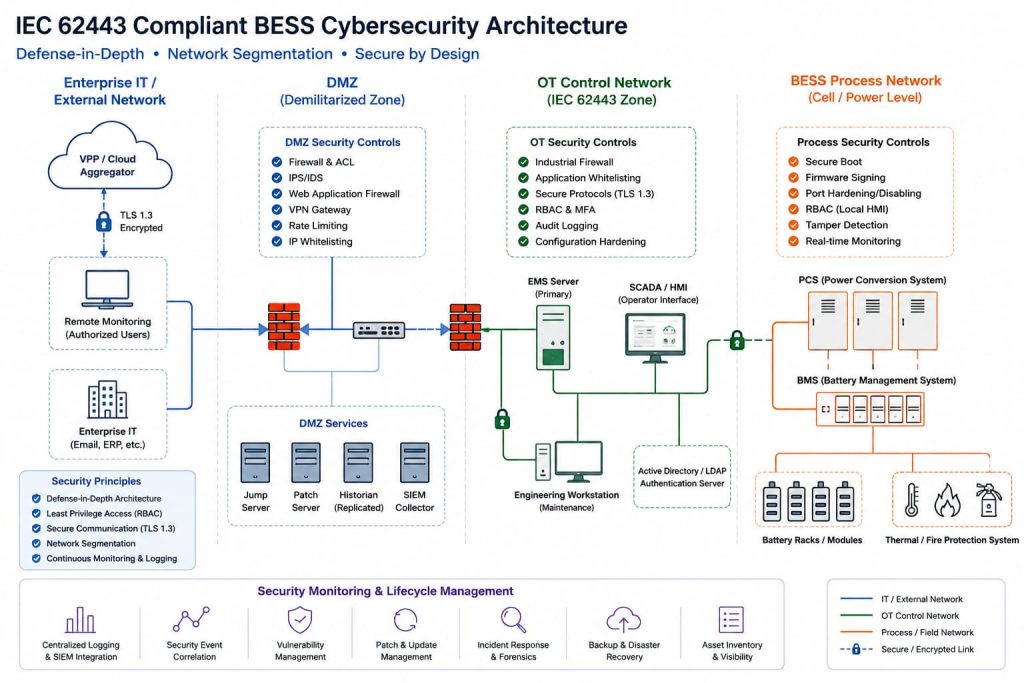
To prevent lateral movement from compromised enterprise IT networks to the operational technology (OT) control network, the BESS must utilize strict network segmentation.
Figure 1: BESS Network Segmentation. A DMZ isolates external VPP/Cloud traffic from the internal OT control network, preventing direct access to the BMS and PCS.
Encrypted Communication and Anti-Tampering Engineering
Data integrity is critical. If a grid dispatch command (AGC signal) is intercepted and altered in transit, the BESS could execute unsafe power commands.
TLS 1.3 and Cryptographic Signatures
The EMS utilizes TLS 1.3 encryption for all external communication with the SCADA system or VPP aggregator. This prevents man-in-the-middle attacks. Furthermore, critical dispatch commands are appended with cryptographic signatures. The PCS Engineering modules and BMS verify these signatures before executing any power limit changes, ensuring the command originated from an authenticated source.
Physical Security and Firmware Integrity
Cybersecurity is not limited to network protocols. Physical access to the BESS cabinets presents an equal threat.
Secure Boot and Port Disabling
- Secure Boot: The BMS and EMS controllers utilize secure boot processes. The hardware validates the cryptographic signature of the firmware before execution. If an attacker attempts to upload malicious firmware via a physical JTAG port, the system will reject the code and halt the boot process.
- Physical Port Disabling: Unused physical ports (USB, Ethernet, serial) on the PCS and BMS are disabled by default. Configuration and maintenance require authenticated access via a dedicated, locked maintenance port.
- Role-Based Access Control (RBAC): Local HMI access requires multi-factor authentication. RBAC ensures that a facility operator can view system status but cannot alter critical protection limits (e.g., overvoltage thresholds) without elevated engineering privileges.
Cybersecurity Checklist Before Purchasing a BESS
To ensure grid resilience and compliance, EPCs and facility managers should verify the following security features before procuring a commercial battery storage system:
- TLS 1.3 Encryption for all external SCADA/VPP communication.
- Role-Based Access Control (RBAC) with Multi-Factor Authentication (MFA).
- Hardware-enforced Secure Boot process.
- IEC 62443-3-3 Security Level 2 (or higher) compliance documentation.
- Cryptographic Firmware Signing for all OTA and local updates.
- SIEM-compatible Audit Logs for intrusion detection and incident response.
- Physical port disabling (USB, Ethernet) on internal controllers.
- DMZ-ready network architecture for OT/IT segmentation.
Field Experience: 2025 Hospital Microgrid Deployment in Houston, Texas
In early 2025, a medical center in Houston, Texas, deployed a hybrid solid-state BESS for critical life-support resilience during hurricane season. The hospital’s IT security team mandated strict IEC 62443 compliance. Customer identifiers are withheld under NDA, but the following project parameters and commissioning data are verified against factory FAT logs, site SAT reports, and third-party penetration testing.
Project Parameters & System Configuration
- Commissioning Date: March 2025
- Rated Power: 500 kW PCS
- Battery Capacity: 1 MWh (Hybrid Solid-State LFP)
- PCS Model: MegSolid PCS-500 with built-in isolation transformer
- Testing Agency: Independent Third-Party OT Security Firm
Engineering Lessons Learned (Based on commissioning records)
- API Polling DoS Risk: During commissioning, the VPP aggregator’s high-frequency API polling caused a Denial of Service (DoS) condition on the EMS firewall. The engineering team implemented rate-limiting and IP whitelisting in the DMZ to stabilize the data flow.
- Firmware Verification: A routine firmware update via the local HMI failed the cryptographic signature check. The secure boot process halted the update, preventing a potential rollback attack, and logged the event to the SCADA security information and event management (SIEM) system.
- Physical Intrusion Detection: The cabinet doors were integrated with tamper switches. During testing, opening a cabinet door without authentication triggered an immediate alert to the facility security center and locked out the local HMI.
Verifiable Project Outcomes
- Security Assessment: No critical vulnerabilities were identified during third-party penetration testing conducted prior to commissioning.
- Compliance Approval: Successfully met IEC 62443-3-3 Security Level 2 requirements.
- Energy Resilience: Maintained 100% operational continuity for critical medical loads during a simulated grid blackout.
- Note: Results vary depending on site configuration, local tariffs, and environmental conditions.
Engineering Cybersecurity Through Factory Integration
Cybersecurity performance depends not only on software configuration, but also on factory integration, secure manufacturing processes, firmware signing, and lifecycle quality control. These engineering capabilities vary significantly between manufacturers.
Factory Acceptance Testing (FAT) must include network penetration testing, firmware integrity validation, and communication latency verification prior to shipment. Factory integration guarantees BOM traceability down to the control board, ensuring that no counterfeit or compromised network modules are introduced into the supply chain. As a factory-integrated manufacturer, MegSolid ensures that these cybersecurity protocols are embedded into the Hybrid Solid-State Battery architecture and Microgrid EMS from the ground up. We provide comprehensive OEM/ODM manufacturing services, ensuring that the 215kWh Outdoor Cabinet ESS and its internal BMS Communication and EMS networks are hardened against physical and network threats. (For foundational knowledge on system safety, read our Thermal Runaway prevention guide).
MegSolid Manufacturing Authority
MegSolid's manufacturing authority is verified through third-party testing protocols administered by TÜV Rheinland and SGS. BOM traceability and solid electrolyte matrix engineering are audited under IEC 62619 guidelines, and the 215kWh outdoor cabinet architecture is designed according to UL 9540A evaluation methodology. Operating as a direct manufacturer, MegSolid provides these integrated engineering solutions for global EPC partners.
References & Industry Standards
MegSolid's engineering design and testing protocols align with the following regulatory frameworks and industry standards:
- IEC 62443-3-3:2013: Industrial communication networks - Network and system security - System security requirements and security levels.
- NIST SP 800-82: Guide to Operational Technology (OT) Security.
- CISA: Cybersecurity and Infrastructure Security Agency OT Vulnerability Guidelines.
- IBM X-Force: Threat Intelligence Index 2024.
- Verizon DBIR: Data Breach Investigations Report.
- NERC CIP: Critical Infrastructure Protection standards for the Bulk Electric System.
- IEEE: 1547-2018 Standard for Interconnection and Interoperability of Distributed Energy Resources.
- IEC: 62619 Safety requirements for secondary lithium cells and batteries in industrial applications.
- UL: 9540A Standard for Safety of Energy Storage Systems and Equipment.
FAQ
Q1: Why do commercial battery storage systems need cybersecurity?
Modern BESS are connected to SCADA and VPP networks. Without cybersecurity, hackers could breach the EMS, alter dispatch commands, force the battery into thermal runaway, or disconnect power during a grid emergency.
Q2: What is IEC 62443 compliance for BESS?
IEC 62443-3-3 is an international standard for industrial control system security. It requires a defense-in-depth architecture, including network segmentation, encrypted communication, and secure boot processes to protect the BESS from cyber threats.
Q3: How does network segmentation protect a BESS?
Network segmentation uses a DMZ and firewalls to isolate the internal OT control network (BMS/EMS) from external enterprise IT networks. This prevents lateral movement if the corporate network is compromised.
Q4: Can a hacker alter the BESS dispatch commands?
Without encryption, yes. To prevent this, the EMS utilizes TLS 1.3 encryption and cryptographic signatures. The PCS and BMS verify these signatures before executing any power commands, preventing man-in-the-middle attacks.
Q5: What happens if someone tries to upload malicious firmware to the BMS?
The BMS utilizes a secure boot process. The hardware validates the cryptographic signature of the firmware. If the signature is invalid or tampered with, the system rejects the code and halts the boot process.
Q6: Is physical access to the BESS cabinets secured?
Yes. Unused physical ports (USB, Ethernet) are disabled by default. Cabinet doors are equipped with tamper switches, and the local HMI requires multi-factor authentication and Role-Based Access Control (RBAC).
Q7: Does the BESS comply with North American grid cybersecurity standards?
Yes. Systems connected to the Bulk Electric System (BES) are engineered to comply with NERC CIP standards, which mandate asset identification, access management, and incident response logging.
Q8: How does the system handle high-frequency API polling from a VPP?
High-frequency polling can cause a Denial of Service (DoS) condition. The EMS DMZ implements rate-limiting and IP whitelisting to stabilize data flow and ensure system availability.
Q9: Is factory testing required for cybersecurity compliance?
Yes. Factory Acceptance Testing (FAT) includes network penetration testing, firmware integrity validation, and communication latency verification to ensure no vulnerabilities exist before deployment.
Q10: What communication protocols are supported for secure SCADA integration?
The EMS Controller supports secure Ethernet-based Modbus TCP and DNP3 with authentication, allowing encrypted remote monitoring and control from industrial SCADA platforms.
Q11: How to secure a battery energy storage system against hacking?
Secure a BESS by implementing IEC 62443 defense-in-depth architecture. This includes DMZ network segmentation, TLS 1.3 encrypted communication, cryptographic signatures for dispatch commands, secure boot processes, and physical port disabling.
Q12: What is NERC CIP compliance for energy storage?
NERC CIP (Critical Infrastructure Protection) is a set of cybersecurity standards mandatory for assets connected to the North American Bulk Electric System. It requires strict access control, incident logging, and system integrity management for BESS.
Q13: Can a cyber attack cause thermal runaway in a BESS?
If an attacker breaches the EMS and alters the overcharge protection limits, it could theoretically force the battery into thermal runaway. Secure boot, RBAC, and cryptographic signatures are engineered to prevent unauthorized changes to these critical limits.
Get Your Custom Microgrid Engineering Consultation
For technical consultation, microgrid system selection, OEM/ODM cooperation, and distributor opportunities, contact our engineering team:
Global Sales & HQ (Hong Kong):
FLAT 7, 11/F BLK C HANG WAI IND CTR, 6 KIN TAI ST, TUEN MUN, HONG KONG
- Email: [email protected]
- Phone: +852 59811073
R&D & Manufacturing Facility (Huzhou):
No. 898 Mengxi Road, South Taihu New Area, Huzhou City, Zhejiang Province, P.R.China
- Website: https://www.solidess.com/
