
A fire-safety gap discovered after the BESS order can strand equipment, reopen the civil design and leave the owner paying for a system that cannot operate. Put NFPA 855 BESS compliance into the procurement scope before award. Identify the adopted installation requirements, Authority Having Jurisdiction (AHJ), actual equipment and site hazards. Then make the supplier’s reports and drawings answer that project basis.
Your C&I energy storage system needs a defined installation and fire-response scope. Ask MegSolid for the offered cabinet/PCS configuration, controlled BOM, relevant report scope and installation inputs. The EPC and qualified fire designer can then determine the separation, detection, suppression, ventilation and explosion-control provisions that apply at this site. Make those decisions part of the order and responsibility matrix.
Use this NFPA 855 review to challenge equipment evidence, layout assumptions and project economics before the deposit. A hybrid solid-state label does not establish a permit, a fire-test result or an exemption from installation requirements. A model-level scope gives your EPC and authority something concrete to evaluate.
In this guide you'll learn:
- Map the adopted requirements, site hazards and exact equipment evidence before permit submission.
- Check unit-to-unit, building, property-line, access and ventilation clearances as separate design questions.
- Review detection, shutdown, suppression and emergency-response responsibilities for the delivered system.
- Specify ventilation and explosion control from the actual hazard and qualified design basis.
NFPA 855 BESS Compliance Checklist
Make this NFPA 855 BESS compliance checklist an evidence request. Battery technology, installation location, energy arrangement and the adopted project requirements determine the limits and remedies. Assign an owner to each unresolved item before the deposit:
|
Requirement
|
Engineering Validation
|
|---|---|
|
Separation distance
|
Adopted limits for equipment, buildings, property lines and emergency/service access
|
|
Fire suppression
|
Qualified detection, response and suppression scope for the actual system and site
|
|
Thermal runaway
|
Relevant full UL 9540A report and tested-configuration applicability review where required
|
|
Gas detection
|
Relevant gas species, sensors, alarm limits and response defined by the hazard/design basis
|
|
Explosion control
|
Applicable qualified explosion-control design and protected discharge/access zones
|
|
Fire alarm
|
Approved fire/safety interface, shutdown and reset responsibilities
|
What is NFPA 855 and Why Does it Matter for EPCs?
NFPA 855 addresses stationary energy-storage installation. Its applicable edition and legal effect depend on the adopted project requirements and the authority responsible for the site. Establish that basis with the EPC and AHJ before assigning clearances, maximum energy or fire-response conditions.
The AHJ Approval Bottleneck
The permitting team needs documents that describe the equipment and layout being proposed. Match model numbers, revisions, cells, battery/system configuration and conditions of use across the reports, drawings and quotation. Ask the authority and qualified designer which evidence they require. A generic brochure or one test summary does not close every installation question.
Key NFPA 855 Distance and Separation Requirements
A property line, another battery unit and an occupied building are different exposure questions. Identify the applicable separation and access criteria for each one, along with ventilation outlets, explosion-control zones and emergency access. Do not copy one distance across the site plan and call the job complete.
Confirm the Separation Requirement Before Buying a Barrier
Do not apply a universal 3-foot property-line clearance or an automatic 2-hour blast-wall alternative. A fire-rated barrier and an explosion-resistant structure serve different design functions. The qualified designer must establish the adopted criteria, permitted alternatives and supporting equipment/fire-test evidence for this location.
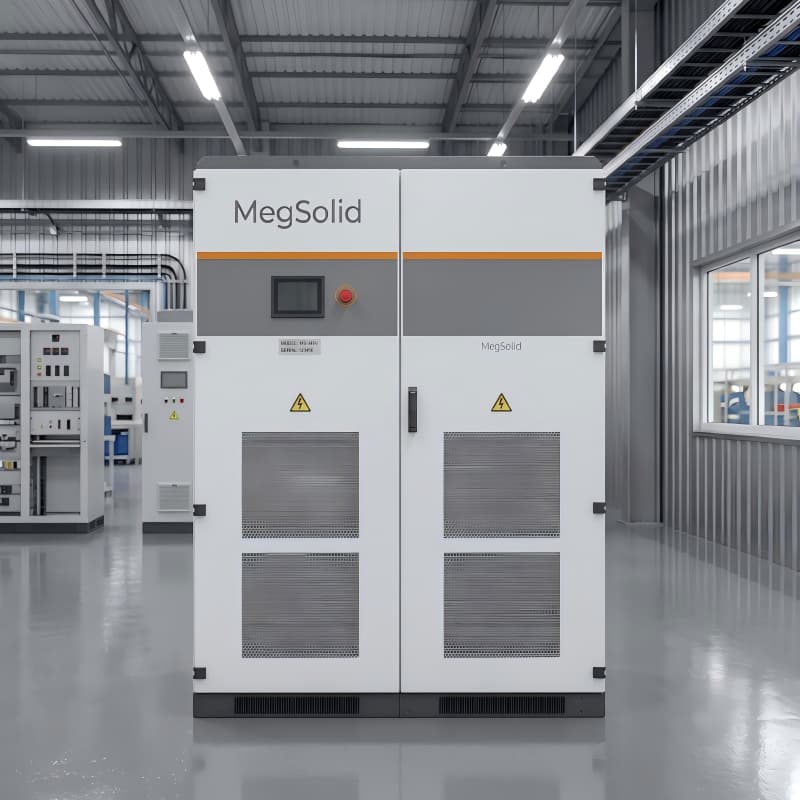
The MegSolid C&I energy storage cabinet provides a cabinet route to compare with container options in the actual site layout. The 215kWh outdoor cabinet ESS publishes ESSA0100B-0215 as 100kW/215.04kWh air-cooled LFP. Ask for exact dimensions, access/cooling instructions and relevant evidence, then have the EPC price the civil and cable work. Cabinet quantity and modular format do not automatically reduce approved separation or remove a barrier.
Fire Suppression System Engineering
Select the fire-response arrangement through the qualified project design and relevant equipment evidence. Coordinate detection, shutdown, ventilation, suppression, water supply where applicable and emergency procedures. A cooling label or brand of agent does not establish approval or prove that every battery thermal event will stop.
Aerosol vs. NOVEC 1230 vs. Water Sprinklers
- Water-based protection: determine its required role through the adopted requirements, qualified design and relevant fire-test evidence. Do not reject it merely because batteries contain electrical equipment.
- Clean agents, including NOVEC-labelled equipment where actually offered: confirm the selected agent, availability, equipment approval, enclosure conditions and intended protection objective. An agent name does not establish control of cell thermal runaway.
- Aerosols: verify the actual listed/approved arrangement, relevant evidence, enclosure limits and cause-and-effect sequence where used. Do not prescribe one suppression medium for every battery or site.
Thermal Runaway Mitigation and Ventilation
Battery faults can produce flammable and toxic gases. The relevant species, release conditions, enclosure and response need a configuration-specific hazard/design basis. A hydrogen and carbon-monoxide checklist alone does not describe every battery chemistry or fault.
Explosion Control and Deflagration Venting
Where explosion control is required, obtain the applicable qualified design, calculations, equipment instructions and protected discharge/access zones. A roof pressure-relief panel is not automatically an engineered deflagration vent. Ventilation and explosion control are different questions that must be coordinated.
Request the actual cabinet gas-detection, ventilation, pressure-management and shutdown documents. Confirm sensor capability, location, calibration, alarm and fault handling, fan control, safe discharge zones and witness criteria. Do not assume that every MegSolid model has a roof vent or that a BMS fan command proves gas dilution below the lower explosive limit (LEL).
For the BESS configuration and report review, match the actual cell, module, cabinet/container and relevant fire-test report before describing a tested configuration. Confirm chemistry model by model; public ESSA air-cooled LFP data must not be relabelled as hybrid solid-state. Use the BESS thermal runaway prevention guide to frame the separate detection, isolation and response questions that belong in the project.
How Much Can Facilities Save? (Transparent ROI Derivation)
Avoided civil work and schedule delay can be worth money. Your finance team still needs the priced baseline and evidence that the revised design actually removes those costs. Keep one-time avoidance separate from recurring energy and demand savings; compliance paperwork is not an annual revenue stream.
Use the following hypothetical arithmetic to test the business case: $540,000 project investment, $35,000 of genuinely avoided civil work, $50,000 of genuinely avoided delay cost and $17,900 net annual cash flow. These are model inputs, not verified EPC quotations or a US market benchmark. Replace them with the actual scope, tariff and approved alternative before investing.
Step 1: Assumptions Breakdown
- Illustrative location: a US commercial/industrial site; obtain its actual adopted requirements.
- Illustrative gross time-shift spread: $0.15/kWh on 400kWh/day, before losses and tariff constraints.
- Hypothetical avoided civil work: $35,000, only if the approved alternative actually removes that baseline cost.
- Hypothetical avoided delay cost: $50,000, based on an evidenced schedule and business impact.
- Hypothetical annual reserve: $4,000; this is an assumption, not a demonstrated annual degradation rate.
- Hypothetical project investment: $540,000; replace it with a current itemized equipment and installed-scope quotation.
Step 2: Calculation Steps
- Avoided civil cost: $35,000, subject to the priced baseline and approved alternative.
- Avoided delay cost: $50,000, subject to schedule and financial evidence.
- Assumed one-time avoidance: $35,000 + $50,000 = $85,000; adjusted comparison investment: $540,000 − $85,000 = $445,000.
- Illustrative gross arbitrage: 400kWh/day × $0.15/kWh × 365 = $21,900/year, before conversion losses and other costs.
- Illustrative net annual cash flow: $21,900 − $4,000 = $17,900. Charging losses, auxiliaries, downtime, finance, tax and discounting still need modelling.
Step 3: Financial Results
The stated assumptions give $85,000 of one-time avoidance, or 15.7% of $540,000. The adjusted comparison investment is $445,000. At $17,900 a year, simple payback is approximately 24.9 years before additional costs or discounting. Ten years produces $179,000, below $445,000. These numbers do not support a 3.5-year payback or a 25% ten-year return. Add only evidenced demand or resilience value, or revise the real equipment and installed scope. Challenge the business case before signing.
Visual Engineering Assets for NFPA 855 Compliance
Use the review sequence below to make the equipment evidence and site assumptions visible before construction. Each stage needs named inputs, an accountable reviewer and a closure decision.
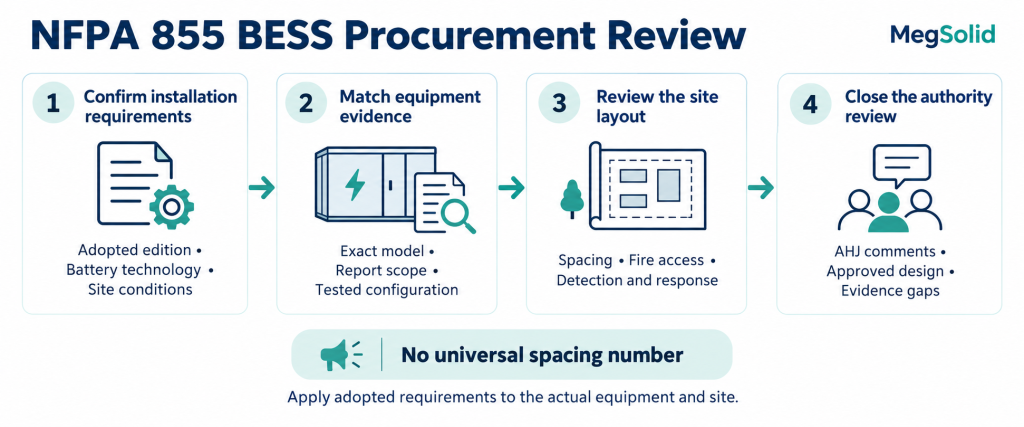
Figure 1—procurement review sequence: confirm adopted installation requirements, match exact-model evidence, review the site layout and close authority comments. The actual equipment and site determine the requirements.
A procurement sketch identifies unresolved dimensions, applicable criteria and the responsible designer. It becomes a construction drawing after the actual equipment, site conditions and required review are complete. Keep the approved revision aligned with the delivered BOM.
Figure 2—conceptual detection and response interfaces. Select the actual gas detection, ventilation, shutdown and explosion-control arrangement from the qualified hazard/design basis. This schematic does not prove gas dilution below LEL or a validated pressure-relief path.
Witness the approved cause-and-effect sequence for the delivered configuration. Check applicable alarms, trips, failed inputs and reset conditions, with responsibilities split between local protection, BMS, PCS, fire panel and site controls. Do not treat a generic BMS interlock as proof that structural damage is prevented.
Boston Procurement Example: Review a 1MWh-Class Layout
Consider an illustrative Boston commercial-facility microgrid selecting a 1MWh-class BESS. The purchasing team must resolve the layout, equipment evidence and installed-system responsibilities before award. Use this scenario to build the evidence request; it is not a claimed MegSolid installation or authority approval result.
A Boston facility considering a 1MWh-class array should compare each offer’s actual layout, power path, hazards and report scope. A proposed hybrid solid-state BESS needs a controlled BOM and applicable test evidence. Neither a chemistry label nor a 500kW nameplate establishes installation approval.
Project Parameters & System Configuration
- Illustrative application: commercial-facility microgrid; not a claimed installed project.
- Illustrative location: Boston, Massachusetts; establish the adopted local requirements.
- Candidate quantity: five ESSA0100B-0215 units total 1,075.2kWh nominal energy. Verify usable AC energy and any approved parallel arrangement.
- Candidate power: five 100kW cabinet ratings sum to 500kW on paper. Define the integrated power path before adding a separate PCS or assigning system output.
- Schedule: set actual document, permit, FAT, delivery and SAT milestones.
- Site elevation: obtain the survey and model derating basis.
- Ambient conditions: specify temperature, solar exposure and environmental limits for the offered model.
Engineering Decision & Risk Mitigation
Compare the actual cabinet quantity, cell/BOM, report configuration, separation, fire/service access and power/control integration. Modular cabinets can change civil and cable work, but do not automatically waive a barrier or demonstrate fire containment. Have the qualified designer and authority evaluate any permitted alternative before pricing the revised layout.
Resolve These Design and Commissioning Questions
- Detection: confirm the relevant hazards, sensor capabilities, locations, calibration, alarm and fault sequence. Smoke or hydrogen-only detection is not automatically adequate for every configuration.
- Pressure and suppression: have the qualified designer review enclosure, discharge and vent interactions against equipment instructions. Do not alter a vent latch or pressure setting without the approved engineering basis and authorization.
- Interlocks: witness the specified detector/fire-panel/local-protection/PCS shutdown and reset sequence. A charge-stop command does not prove that every ignition source or cell fault is eliminated.
Engineering Evidence Section
Request records that describe your own project and offered equipment. Name the document owner, revision, delivery milestone and review criterion for each item:
- Relevant complete fire-test report and configuration/applicability review where required.
- Agreed FAT procedure and actual equipment/witness records.
- Delivered fire/safety schematic and equipment-to-site responsibility scope.
- Approved cause-and-effect, alarm/trip/reset and failed-input logic.
- Actual authority comments, accepted layout, conditions and sign-off.
Evidence Needed to Measure the Project Outcome
- Approval: retain the authority decision, applicable conditions and actual review timeline.
- Civil cost: compare itemized, approved layouts to measure genuine avoidance.
- Safety and acceptance: retain witnessed tests, deviations and operating restrictions. A site walkdown does not establish that all thermal-runaway hazards are absent.
- Note: Results vary depending on site configuration, local tariffs, and environmental conditions.
Project Implementation Workflow
Assign evidence owners and decision milestones from site assessment to operating release. Keep the equipment configuration and site requirements consistent through quotation, permit review, FAT, delivery and handover. Any changed cell, enclosure or safety arrangement needs an applicability review.
Figure 3—project review route: site assessment, authority discussion, applicable equipment reports/FAT, permit submission, installed-site checks and operating release. Each stage needs its own accepted inputs and responsible party.
Coordinate equipment reports and fire-response installation documents before submission. Track comments and changed configurations through closure. Factory testing proves agreed equipment functions; installed-site acceptance proves the defined site interfaces. Keep their witness records separate and connected.
Compare the Evidence Behind Each Compliance Offer
A lower price is useful when it buys the duty, installed scope and evidence your site needs. Compare supplied equipment, qualified installation design, report applicability, approval work and lifecycle costs on the same boundary. Unpriced interface work becomes the owner’s bill later.
|
Metric
|
Unresolved proposal
|
Evidence-based project response
|
|---|---|---|
|
AHJ Approval Risk
|
Adopted criteria or report applicability unclear
|
Qualified designer and AHJ review against the actual project basis
|
|
Property Line Clearance
|
No approved layout basis
|
Accepted site criteria, separations and permitted alternatives
|
|
Fire Suppression
|
Unspecified protection and response
|
Delivered and approved fire-response scope
|
|
Thermal Runaway Ventilation
|
Hazard and ventilation basis missing
|
Configuration-specific assessment and design
|
|
Explosion Control
|
No qualified basis or validated equipment
|
Applicable qualified explosion-control design
|
|
UL 9540A Documentation
|
Report model/configuration unmatched
|
Relevant full report mapped to the offered equipment
|
|
Gas Detection
|
Applicable hazards/sensors undefined
|
Specified detectors, alarms and witnessed response
|
|
BMS Interlock
|
Undefined command/safety ownership
|
Approved local protection and cause-and-effect
|
|
Civil Retrofit Cost
|
Civil work not priced
|
Accepted layout and itemized civil/cable costs
|
|
Maintenance Frequency
|
Tasks and competence not defined
|
Model-specific O&M schedule and authorized service
|
|
Overall Economics
|
Unverified value or cost claim
|
Actual tariff, duty, investment, O&M and cash-flow model
|
Engineering Validation Checklist for Fire Marshal Approval
Use the supplier checklist below to request deliverables and assign reviewers. Approval needs actual configuration evidence and accepted site documents; a tick in a sales article does not verify the equipment.
|
Engineering Validation
|
Project-specific evidence required
|
|---|---|
|
Relevant fire-test report and configuration mapping
|
Request full report and applicability review
|
|
Applicable hazard/installation assessment
|
Qualified designer and adopted requirements
|
|
Actual separation, access and barrier layout
|
Accepted drawings and design basis
|
|
Applicable explosion-control design
|
Qualified calculations and equipment instructions
|
|
Applicable gas detection and response
|
Sensor/alarm scope and cause-and-effect test
|
|
Delivered fire-response/suppression drawings
|
Actual equipment, site interfaces and maintenance
|
|
Safety/protection interlock logic
|
Witnessed alarm/trip/reset and failed-input responses
|
|
Enclosure and environmental boundary
|
Model IP rating, conditions, clearances and site requirements
|
For MegSolid OEM/ODM manufacturing, send the country, installation layout, required kW/kWh, site connection, proposed models and authority requirements. Ask for available exact-model reports, controlled BOM, installation inputs, FAT/SAT scope and missing-evidence deadlines. A defined quotation lets your EPC price the equipment and site approval work together.
Technical References
Use official standards and the adopted local requirements within their scopes. The references below identify reviews to complete; they do not certify every MegSolid model or approve the proposed site.
- NFPA 855 (2023): National Fire Protection Association. Standard for the Installation of Stationary Energy Storage Systems.
- UL 9540A: UL Solutions. Test Method for Evaluating Thermal Runaway Fire Propagation in Lithium-Ion Energy Storage Systems.
- NFPA 70 (NEC): National Fire Protection Association. National Electrical Code. Article 706 (Energy Storage Systems).
- NFPA 72: National Fire Protection Association. National Fire Alarm and Signaling Code.
- IEEE 1547-2018: Institute of Electrical and Electronics Engineers. Standard for Interconnection and Interoperability of Distributed Energy Resources.
- IEC 62619: International Electrotechnical Commission. Safety requirements for secondary lithium cells and batteries used in industrial applications.
FAQ
Q1: What is NFPA 855 compliance?
NFPA 855 addresses stationary energy-storage installation. Applicable edition, adoption, battery category and site conditions determine the requirements. Obtain the project basis from the EPC, qualified designer and AHJ before assigning clearances or fire-response provisions.
Q2: Does NFPA 855 require a blast wall?
Determine the actual separation criteria and permitted alternatives for the equipment and site. A fire-rated barrier and blast-resistant structure serve different design functions. There is no universal 3-foot property-line/2-hour-wall rule to copy into every BESS layout.
Q3: What fire suppression is best for lithium BESS?
Use the qualified fire design, relevant equipment reports and adopted requirements. Water-based protection, clean agents and aerosols have different roles and limitations. Confirm the selected arrangement and objective for the actual configuration; no agent universally stops cell thermal runaway.
Q4: What is deflagration venting?
Where applicable, deflagration venting is an engineered explosion-control measure with a defined design basis, equipment, installation and protected discharge zone. A cabinet roof pressure-relief panel is not automatically a validated deflagration vent.
Q5: How does the BMS interact with the fire panel?
Define and witness the detector, fire panel, local protection, BMS and PCS responsibilities, including failed inputs, shutdown and reset. A charge-stop command alone does not prove all ignition sources or cell faults are eliminated.
Q6: Can modular cabinets avoid blast wall construction?
Modular cabinets can change the layout and civil scope. They do not automatically remove a barrier or approval duty. Compare actual spacing, access, hazards, report configuration and civil/cable costs through the qualified project review.
Is solid-state chemistry safer for AHJ approval?
Review the offered cell/module/system evidence and installation requirements. A hybrid solid-state label is not a fire test or permit exemption. Confirm the chemistry and BOM of the actual model; public ESSA air-cooled LFP data must not be relabelled as another chemistry.
Q8: What gas detection is required?
Select sensors from the configuration-specific hazard/design basis. Confirm relevant gases, range, locations, alarm/fault response and maintenance. Hydrogen/CO-only detection or one universal LEL arrangement does not answer every BESS fault.
Q9: How long does AHJ approval take?
Review time depends on the site, applicable requirements, actual submission and outstanding comments. Assign document owners and closure milestones before award. Do not base the project schedule on a guaranteed 14-day authority approval.
Q10: What is the typical ROI for an NFPA 855 compliant BESS?
In the stated hypothetical model, $540,000 less $85,000 of one-time avoidance gives $445,000. At $17,900 net annual cash flow, simple payback is about 24.9 years before additional costs or discounting. Use actual itemized scope and evidenced value streams when evaluating your project.
Q11: Does NFPA 855 apply to indoor installations?
Check the adopted requirements for the actual indoor battery category, energy arrangement, enclosure/location, ventilation, fire protection and access. An outdoor concept drawing does not approve an indoor installation.
Q12: What is the UL 9540A test?
UL 9540A is a thermal-runaway fire-propagation test method. Request the complete relevant report, tested configuration and applicability review. It is not a generic no-propagation certificate or automatic authority approval.
Q13: Can existing BESS be retrofitted for NFPA 855?
Start with a qualified gap assessment of the existing system, accepted design, report scope and site requirements. Compare an authorized retrofit with replacement on the same installed-scope and evidence basis. Do not prescribe a universal sensor, roof-vent or suppression-agent retrofit.
Request an Exact-Model NFPA 855 Evidence and Installation Scope
Send the project location, layout, proposed models, required power/energy, report list, authority requirements and review deadline. Ask our engineering team to identify available equipment records, installation inputs and the scope gaps your EPC must close:
Global Sales & HQ (Hong Kong):
FLAT 7, 11/F BLK C HANG WAI IND CTR, 6 KIN TAI ST, TUEN MUN, HONG KONG
- Email: [email protected]
- Phone: +852 59811073
R&D & Manufacturing Facility (Huzhou):
No. 898 Mengxi Road, South Taihu New Area, Huzhou City, Zhejiang Province, P.R.China
- Website: https://www.solidess.com/