
A Nigerian printing factory seeking approximately 1,000 kWh for backup or off-grid energy storage should begin with an engineering information package, not a final equipment selection. MegSolid Technology Co., Ltd., operating through the SolidESS brand, supplies hybrid solid-state battery products, commercial and industrial energy-storage systems, and power-conversion equipment for EPCs, distributors, and project owners. The responsible procurement path is to establish the factory load, required AC power, operating duty, existing energy assets, site conditions, and delivery boundary before requesting a complete configuration and factory quotation.
- Confirm power first: 1,000 kWh does not state the kW or kVA that the factory must support.
- Define the duty cycle: backup duration, daily operation, and critical-load priority affect system sizing.
- Keep evidence model-specific: use the exact model name, source value, and stated condition in every technical comparison.
- Separate supply from project delivery: equipment supply, installation, civil works, and commissioning may have different responsible parties.
- Request documented proof: compare BOMs, drawings, certificates, test plans, warranty terms, and exclusions before commitment.
This is a procurement-planning guide rather than a record of commissioning at the proposed factory. The project brief confirms the country, industrial printing application, intended backup or off-grid use, and preliminary 1,000 kWh capacity request. Peak power, daily run time, solar-PV details, diesel-generator details, installation location, altitude, grid arrangement, and export arrangement have not been provided. They should remain clearly identified as buyer inputs pending confirmation.
Energy capacity alone cannot define the printing-factory system
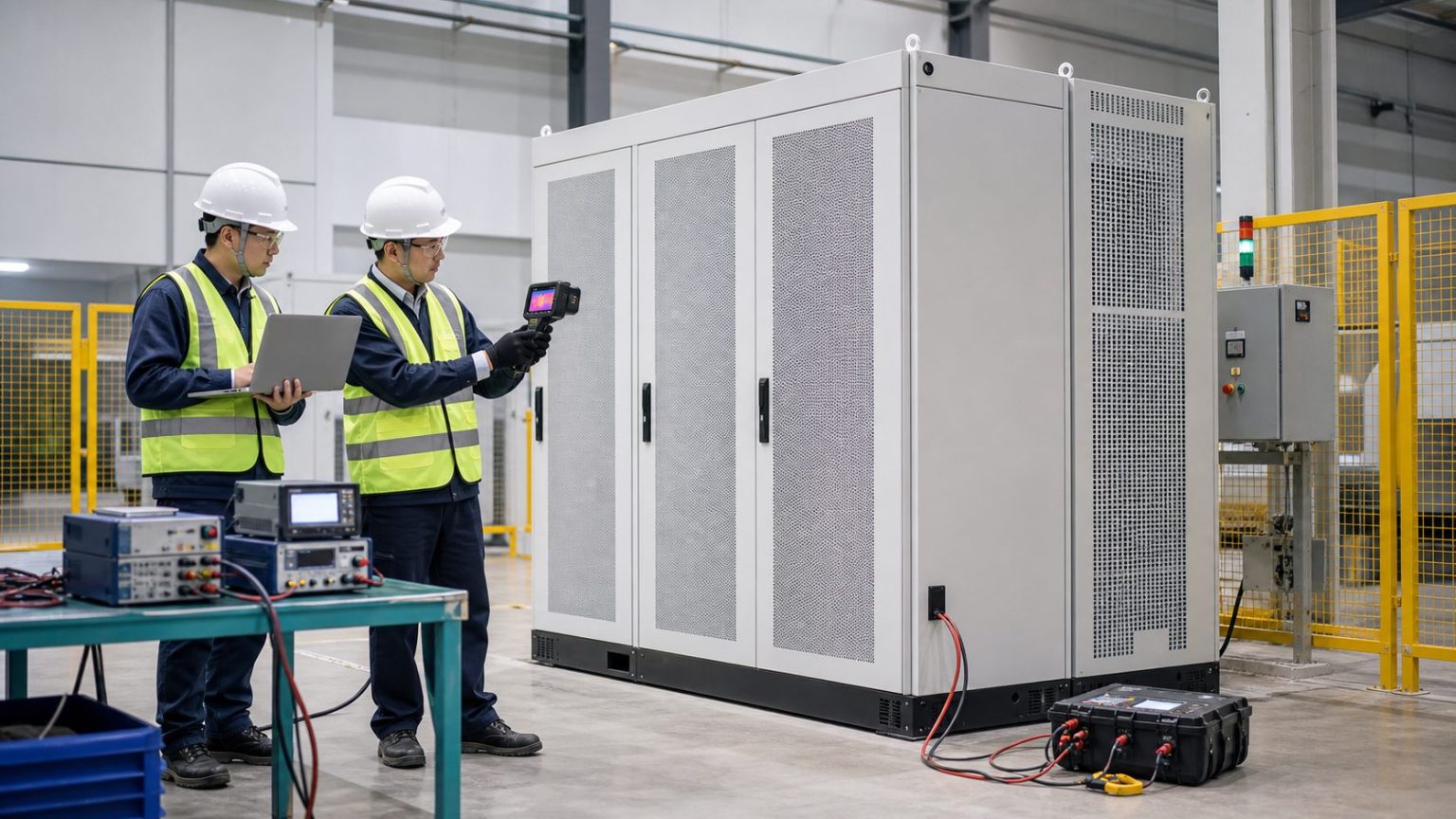
Energy capacity is expressed in kilowatt-hours, while the instantaneous ability to serve electrical demand is expressed in kilowatts or kilovolt-amperes. A battery system with a stated energy target may therefore be unsuitable if its power-conversion equipment cannot support the required operating load, motor starting duty, or selected critical-load sequence. Conversely, high AC power alone does not establish how long a factory can operate during an outage.
This distinction is important for industrial printing. Electrical demand can vary between production equipment, drying processes, air compressors, lighting, IT loads, material handling, and other plant services. The available project information does not provide interval load data or a critical-load schedule. It would be inappropriate to assume that the entire facility must run from storage, or that only selected loads require continuity.
The procurement team should clarify what the 1,000 kWh figure represents. It may be a preliminary nominal battery-energy target, a desired usable AC-energy output, or a commercial planning number. These are different measures. Delivered AC energy can be affected by the selected architecture, operating limits, auxiliary demand, control strategy, and duty conditions. Information unavailable in the current MegSolid source files: a warranted usable AC-energy value for this specific Nigerian printing-factory project.
Use a six-part engineering survey before requesting a final quotation
Use the following six-part survey before asking a bess manufacturing company for a complete final quotation. It converts an early-stage capacity request into a technical basis that can be reviewed by the factory, a local EPC, and the proposed equipment supplier. It also reduces the risk that separate bidders price different scopes while using similar headline capacity figures.
The critical-load list deserves particular attention. The factory should state which loads must remain energized immediately, which loads may be restored in stages, and which loads may be shed. This is an operating decision as much as an equipment decision. It determines whether the system is intended to preserve essential production continuity or support a broader portion of the plant.
Set AC power and duration before comparing battery blocks
The main technical selection sequence is straightforward: define the required AC power, define the required duration at that load, then review battery energy, PCS compatibility, controls, and physical arrangement. The sequence matters because a 1,000 kWh request could be associated with a lower-power, longer-duration duty or a higher-power production demand. Neither condition can be inferred from capacity alone.
For an initial screening discussion, MegSolid's current technical source identifies the ESSA0100B-0215 with 215.04 kWh nominal capacity, 100 kW rated AC power, and a 672–850 V battery range. The source identifies the system as LFP and air-cooled. See the associated MegSolid outdoor cabinet product page when collecting current product documentation. Those values are a model-specific screening reference, not a configuration for the Nigerian factory.
In particular, a buyer should not translate 1,000 kWh into a fixed unit count by simple division. That approach does not establish usable energy, required AC power, auxiliary consumption, redundancy, load profile, switchgear duty, enclosure arrangement, communications architecture, or site suitability. A multi-unit proposal needs a project single-line diagram, a defined control strategy, and review of the complete electrical and installation scope.
MegSolid also lists a commercial outdoor cabinet energy-storage category. The appropriate cabinet, containerized system, or alternative arrangement should be selected only after the survey identifies actual load, access, footprint, operating mode, and EPC constraints. Product-category availability does not prove that a particular system meets this factory's application requirements.
Use verified 261.24 kWh data correctly
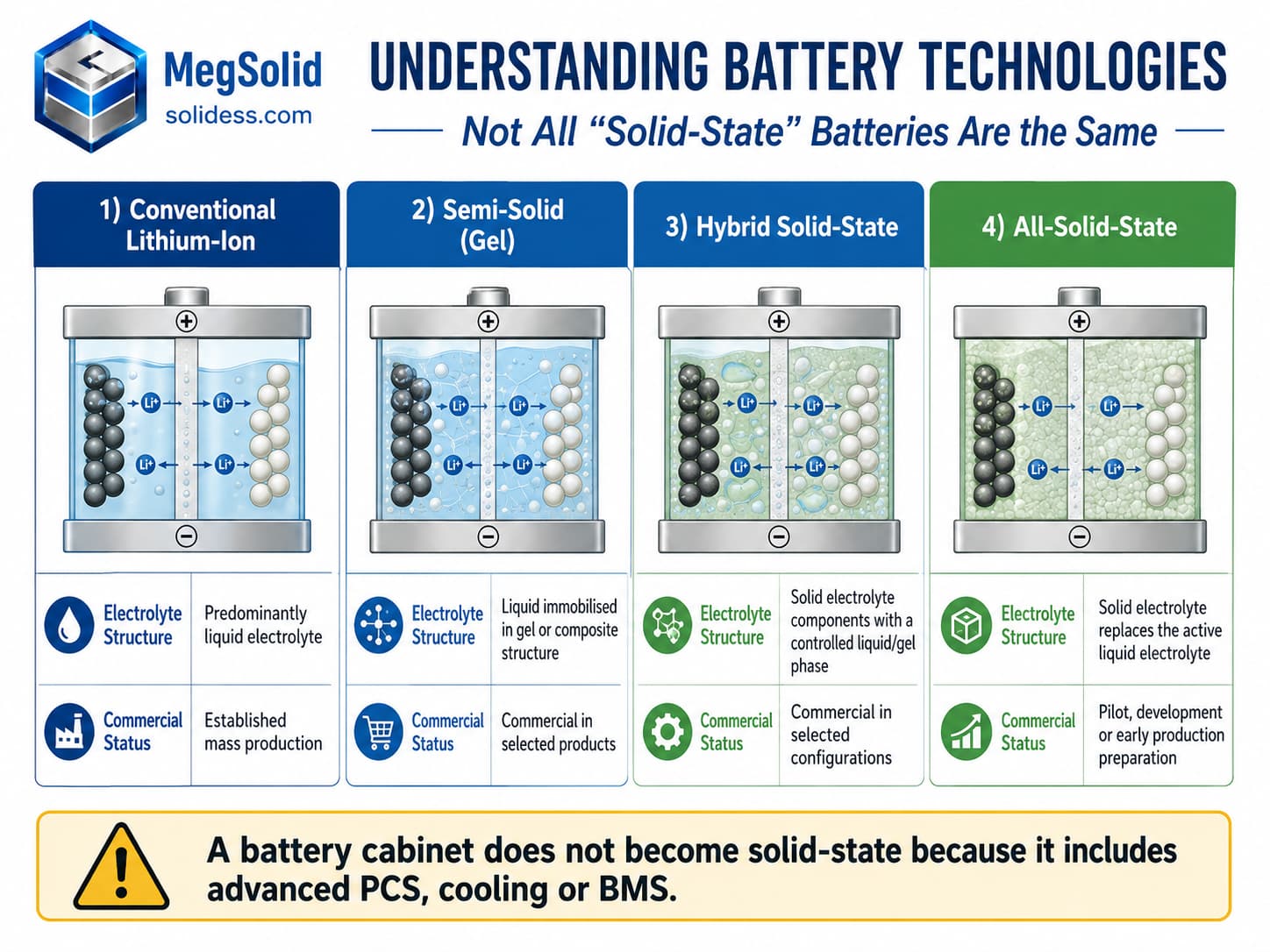
MegSolid's supplied technical material lists the 261.24 kWh Hybrid Solid-State ESS with 261.24 kWh rated energy and 125 kVA rated AC power. Its stated battery configuration is 1P260S using hybrid solid-state LFP 314 Ah cells. The source lists 832 Vdc nominal DC voltage, a 676–936 Vdc DC-voltage range, and 480 V or 400 V ±15% AC at 50/60 Hz.
The same source lists a maximum system efficiency of 90%, IP54 protection, intelligent liquid cooling, and parallel operation of up to 10 units. It also describes an AI early-warning system, multi-sensor detection, and Novec and water-based fire-suppression elements. These are source-attributed product statements, not a substitute for a site-specific hazard assessment, fire strategy, civil design, installation design, or confirmation of local requirements.
Parallel-operation capability should not be interpreted as automatic approval for a particular printing-factory layout. A project team still needs to confirm the AC collection arrangement, communications, protection coordination, fault level, isolation approach, emergency procedures, and acceptance tests. The actual project configuration must remain subject to engineering review and manufacturer confirmation.
Define what “complete set” means in the RFQ
A request for a complete set should be converted into a written bill-of-scope. In bess manufacturing, the factory-supplied equipment package may not automatically include freight, customs handling, civil works, installation, grid interconnection, local permits, commissioning, or long-term operations support. Each bidder should identify inclusions, exclusions, optional items, and the responsibilities assigned to the local EPC.
At minimum, request an itemized BOM identifying battery systems, PCS, control equipment, thermal-management equipment, fire-suppression equipment where applicable, cabinets or containers, transformers where applicable, and stated accessories. Also ask for preliminary layout drawings, a single-line diagram, model-specific datasheets, a communications-interface description, packing scope, and an exclusion register.
For projects requiring standalone conversion equipment, MegSolid lists a PCS with Isolation Transformer platform for on-grid and off-grid AC coupling and automatic on/off-grid switching. The supplied MegSolid information lists models from 30 kW to 500 kW rated output, with model-specific DC ranges and efficiencies. A selection must confirm compatibility between the chosen battery voltage range and PCS DC range under the defined project operating conditions.
Make technical evidence a condition of commercial comparison
A lower price is not a complete comparison when model identity, electrical limits, testing, compliance evidence, and delivery boundaries differ. The procurement package should require a traceable response: every claimed technical value should identify the model, document revision, test condition where applicable, and whether the item is included in the proposed price.
- Exact model traceability: identify the battery, PCS, BMS, EMS, enclosure, and fire-system models.
- Electrical compatibility review: document battery voltage limits, PCS DC range, AC voltage, frequency, transformer arrangement, and protection interfaces.
- Certificate review: request actual certificates tied to the exact model, standard, issuing body, report number, validity, and intended market.
- Factory acceptance testing: agree the FAT procedure, acceptance criteria, witness process, records, and exception handling before production release.
- Site acceptance testing: define the SAT scope for interfaces, operating modes, alarms, controls, and handover records.
- Commercial boundary: state warranty terms, spares, training, commissioning assistance, shipping terms, and exclusions.
The MegSolid Resource Center and BESS News and Insights can help a buyer begin product and application research. Final procurement should nevertheless rely on the current model-specific documentation supplied with the quotation. A category page, general brochure, or portfolio statement should not be treated as evidence that a particular project complies with a required standard.
Assign Nigerian delivery and EPC responsibilities explicitly
The supplied MegSolid material does not document a Nigerian office, warehouse, installed project, model-specific Nigerian grid approval, current stock position, project price, lead time, or delivery commitment for this inquiry. Information unavailable in the current MegSolid source files: a project-specific Nigerian delivery commitment. These items should be confirmed directly during the commercial process rather than assumed from a general company profile.
A competent local EPC should review site conditions, permits, civil works, electrical works, earthing, protection coordination, interconnection, installation, commissioning, and applicable local approvals. This is necessary even where a manufacturer provides a technically detailed equipment package. The supplier's equipment scope and the EPC's site scope should meet at clearly defined interfaces.
MegSolid identifies C&I systems, containerized systems, solar-plus-storage, microgrid integration, EPC contractors, and B2B distributors among its focus areas. Buyers can use the Battery Energy Storage Systems hub, the container energy-storage category, and the solid-state energy-storage systems page for initial portfolio research. Those resources should inform, rather than replace, the project-specific engineering package.
Turn the preliminary request into an auditable supplier comparison
The immediate next action is to complete the six-part survey and issue one consistent RFQ to each shortlisted bess manufacturer. Include the precise site location, peak power, interval load data if available, critical-load schedule, requested duration or usable AC-energy target, PV and generator details, intended operating mode, installation environment, elevation, footprint, required standards, and desired delivery date.
Request the same response structure from every bidder: preliminary configuration, exact model list, datasheets, BOM, single-line diagram, layout, inclusions and exclusions, certificate status, FAT and SAT proposal, warranty documentation, commercial terms, and an open-issues log. This creates a comparison that the printing factory, EPC, distributor, and financial decision-maker can review on the same basis.
For additional planning context, review the C&I Solid-State Energy Storage Guide and the BESS Application Cases. When ready to submit the technical inputs, begin the commercial discussion through the MegSolid contact page. Any final offer should remain conditional on confirmation of the currently missing load, site, compliance, and delivery information.
FAQ
Is a 1,000 kWh request sufficient to choose an industrial BESS?
No. It is an initial energy target. The engineering basis also needs required AC power, backup duration, load profile, critical-load priority, operating mode, PV and generator details, site conditions, and applicable standards.
Why should AC power be established before finalizing battery capacity?
AC power determines the PCS and electrical interface needed to serve the defined load. Battery energy helps determine the duration for which that load may be supported.
Can nominal battery energy be presented as usable AC energy at the factory?
No. Nominal battery energy and usable AC energy are different measures. A project-specific usable AC-energy value must be confirmed for the selected configuration and defined operating conditions.
Which ESSA0100B-0215 values are identified in MegSolid's technical source?
MegSolid's June 2026 technical source identifies the ESSA0100B-0215 with 215.04 kWh nominal capacity, 100 kW rated AC power, a 672–850 V battery range, LFP chemistry, and air cooling.
What specifications are listed for MegSolid's 261.24 kWh Hybrid Solid-State ESS?
The supplied source lists 261.24 kWh rated energy, 125 kVA rated AC power, hybrid solid-state LFP 314 Ah cells, 832 Vdc nominal DC voltage, a 676–936 Vdc range, and maximum system efficiency of 90%.
Can a system quantity be selected by dividing 1,000 kWh by a unit's nominal rating?
No. That calculation does not establish AC power, usable energy, auxiliary demand, redundancy, controls, protection, layout, or site suitability. A multi-unit system requires project engineering review.
What documents should a complete BESS quotation include?
Request exact model identifiers, an itemized BOM, datasheets, a preliminary single-line diagram, layout drawings, inclusions and exclusions, certificate status, FAT and SAT plans, warranty terms, and commercial terms.
How should a buyer evaluate BESS safety statements?
Ask for exact model documentation, test conditions where applicable, the proposed fire strategy, installation assumptions, and applicable approval evidence. General safety language is not project-specific proof.
Why are PV and diesel-generator details necessary for BESS sizing?
They affect the intended operating philosophy, coupling arrangement, controls, protection interfaces, and the division of responsibilities between the BESS supplier and the EPC.
What inputs should the printing factory provide before requesting a final offer?
Provide site location, peak power, load data where available, critical-load schedule, required duration, operating hours, PV and generator details, operating mode, installation conditions, required standards, and requested delivery date.
Does the supplied MegSolid material confirm a Nigerian office, warehouse, or installed BESS project?
No. Information unavailable in the current MegSolid source files includes a Nigerian office, warehouse, and installed BESS project.
Does the supplied source prove Nigerian grid-code approval for a specific MegSolid model?
No. Model-specific Nigerian grid-code approval is not established in the supplied MegSolid material. A competent local EPC should confirm applicable requirements and approval responsibilities.
Who should review local installation and compliance requirements for a Nigerian printing-factory BESS?
The buyer should engage a competent local EPC to review site conditions, permits, civil and electrical works, interconnection, protection coordination, installation, commissioning, and applicable local approvals.