
Your data centre buys continuity first. An energy-dense battery that cannot support the protected bus, survive the transition sequence or keep enough reserve during peak shaving is the wrong purchase. Start a solid-state ESS review with the critical IT kW/kVA, existing UPS, generator sequence, allowed interruption and backup duration. Then challenge the supplier to show the architecture, usable AC energy and acceptance evidence behind the proposal.
Replacing an ageing VRLA bank is a chance to recover space and reduce maintenance work, but neither benefit is automatic. Compare the installed battery rooms, ventilation, access routes, protection and replacement plan against the proposed Battery Energy Storage Systems configuration. Availability depends on the full electrical path and operating procedure; a different chemistry alone does not establish Tier III or Tier IV performance.
This guide separates Hybrid Solid-State Battery cell claims from the delivered cabinet and critical-power architecture. It shows how to compare footprint, UPS ride-through, generator bridging, peak-shaving reserve and lifetime cost without treating a PCS charge/discharge specification as proof of a zero-break UPS. Ask MegSolid for the exact battery/PCS configuration and its test scope, then compare it with the duty your data centre must protect.
Key Takeaways
- Compare installed footprint, access and cooling; a cell energy-density figure does not prove 70% room savings.
- Keep UPS continuity, PCS direction reversal and grid/island transition as separately defined and witnessed tests.
- Reserve emergency usable energy before allocating daily peak-shaving dispatch.
- Request model-specific cycle/retention curves and warranty throughput; IEC 62619 safety testing alone does not validate cycle life.
- Calculate PUE from facility and IT energy; lower peak demand is a bill benefit, not automatic PUE improvement.
What Are the Engineering Limitations of VRLA in Modern Data Centers?
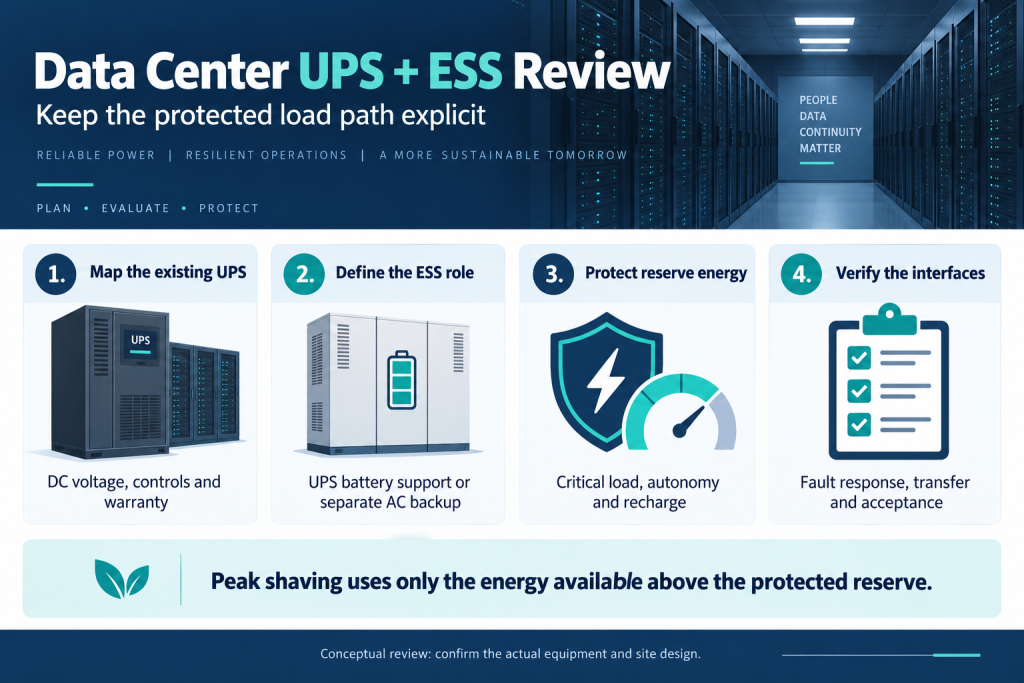
VRLA replacement decisions should use the installed bank’s age, condition, duty, access restrictions and maintenance records. Look at the following project burdens before deciding whether to retain the existing UPS battery arrangement or change the system architecture:
- Replacement and maintenance: use the actual VRLA design-life basis, inspection records and temperature history. Price battery changes, isolation windows and disposal rather than applying one universal cycle or replacement interval.
- Space: compare complete installed areas, including battery racks, electrical clearance, access and cooling. Nameplate cell Wh/kg does not tell you how much revenue space the proposed outdoor BESS can recover.
- Ventilation and protection: assess the installed VRLA ventilation and charging arrangement and the proposed lithium battery’s fire-response design. Each architecture requires its own qualified risk review; neither is intrinsically risk-free.
Can a Solid-State ESS Fit the Data Centre’s Protected Power Architecture?
Choose the supplied model and chemistry, not a portfolio label. The public specification for MegSolid’s ESSA0100B-0215 outdoor cabinet lists a 100 kW / 215.04 kWh air-cooled LFP system. A hybrid solid-state quotation requires its own controlled cell, module and system BOM. Keep both routes in the procurement review when they match the site duty, and request configuration-specific evidence before making the choice.
Installed Footprint and Configuration-Specific Fire Evidence
An outdoor cabinet can change where battery equipment sits, but it also adds cable routes, outdoor access, civil work and environmental checks. Compare the complete proposed layout with the current battery-room layout. Ask the supplier for dimensions, mass, service/fire clearances, cooling conditions and the exact scope of cell, module and system reports.
- Layout selection: MegSolid’s C&I storage includes integrated cabinet routes. ESSA0100B-0215 publishes 100kW and 215.04kWh nominal energy with air cooling and IP54. Confirm usable AC energy, quantity, isolation and access before calculating recovered floor area.
- Fire evidence: obtain the offered model’s reports, test configuration, protection and emergency response documents. Hybrid solid-state is not a no-fire guarantee, and an LFP cabinet must not be relabelled as solid-state. Use the BESS thermal runaway prevention guide to prepare the report and installation review.
Prove the Required UPS Transfer at the Protected Bus
The permitted interruption comes from the protected equipment and approved UPS architecture. Define the critical bus, IT ride-through, redundancy, bypass and generator sequence. A supplier’s charge/discharge switching time measures a different event from loss-of-grid transfer; the acceptance waveform must show voltage and frequency at the actual protected bus.
Ultra-Fast Transfer and Genset Synchronization
MegSolid’s MEGA PCS family publishes transformer-integrated converters from 30kW to 500kW. MEGA0100TS lists 100kW rated AC, 110kVA maximum output and a 420–850V battery interface. Those figures support equipment matching. UPS continuity, permitted interruption, off-grid controls and the generator handover still need project drawings and witnessed tests for the offered configuration.
- Transition test: specify grid loss, brownout, bypass/recovery and the required protected-bus limits. Record waveform, event timestamps and load state. Do not substitute PCS direction reversal or an inverter’s backup-switch figure for the complete UPS test.
- Generator bridge: calculate reserved usable AC energy for the approved start, synchronization and failed-start sequence. Keep generator acceptance, minimum loading, BESS recharge and return-to-grid logic in the same cause-and-effect plan.
Use Peak Shaving Without Spending the Emergency Reserve
A dual-purpose BESS may support demand control while holding emergency energy, but the dispatch budget must be explicit. The owner should see how much energy remains reserved, when charging is possible and which command has priority during a grid fault. A lower monthly peak can reduce a bill even when total facility energy and PUE do not improve.
Peak Shaving and 10-Year TCO Model
Build dispatch around the guaranteed critical-power reserve. The EMS should block non-critical discharge when available battery energy approaches the agreed reserve and suspend tariff commands during emergency operation. Account for ageing, temperature, auxiliaries, charge opportunity and generator availability before offering daily peak-shaving savings.
- Reserve arithmetic: 1MW of critical load for 15 minutes needs 250kWh of delivered AC energy before additional reserve or ageing allowance. Energy used for demand control is unavailable to that emergency duty until recharged; it cannot retain 100% of the same capacity at the same time.
- TCO: compare quoted CapEx, installation, auxiliary energy, inspection, replacement/augmentation, warranty, downtime windows and residual value over the same period. Model demand savings from the actual tariff and interval load. A 3–4 year payback or ten years without replacements needs project evidence, not a chemistry slogan.
Frankfurt Data Centre Example: Test the 2MWh Architecture Before Award
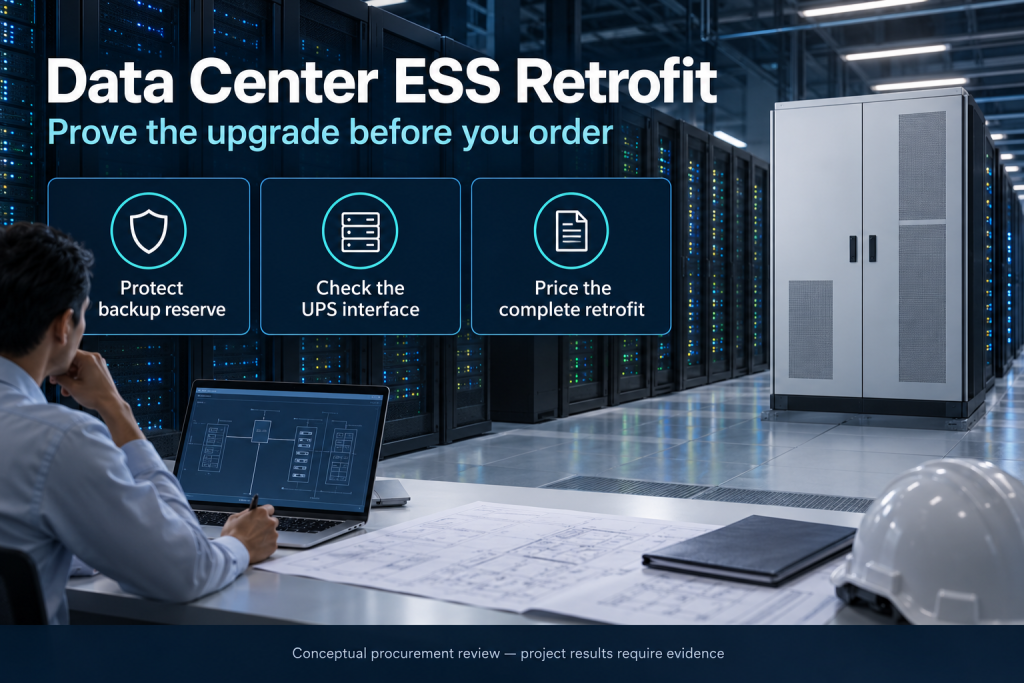
Use the Frankfurt scenario as an illustrative design review, not a verified MegSolid installation. The earlier 2025 deployment narrative is not supported here by releasable drawings, customer acceptance or operating records. For a facility with a 5MW IT load and a 3MW protected bus, the useful purchase question is what part of that load the proposed BESS can actually serve, for how long and through which UPS path.
A nominal 2MWh battery array does not establish a 3MW continuous output rating. At 3MW for 15 minutes the protected load requires 750kWh AC, before allowance for losses, auxiliaries, reserve and ageing. The offered battery discharge capability, PCS rating, fault duty and redundant power path must all satisfy that duty. Treat these numbers as engineering arithmetic, not site results.
Evidence the EPC Should Demand for This Scenario:
- Layout evidence: approved outdoor/indoor placement, civil and cable route, equipment mass, clearances and cooling. The previous 400m² recovered-space and 18% HVAC claims require a measured before/after basis; they are not used as product promises.
- Continuity evidence: witnessed grid-loss and recovery waveforms at the protected bus with load, test count, redundancy and acceptance limits recorded. The prior 8.7ms and March 2025 sag narrative is unverified; obtain actual results for your project.
- Dispatch evidence: time-aligned PCS, EMS, BMS and facility-meter data showing reserve maintained during peak shaving and the approved response to generator failure or delayed recharge.
Build the Financial Case From the Site’s Own Records:
- PUE: compare facility energy with IT energy over aligned periods, explaining IT-load and HVAC changes. The earlier 1.58→1.42 result is not a verified outcome for this example.
- Demand charges: calculate savings using measured billed peaks, tariff rules and available dispatch. A 31% reduction cannot be assumed for another site.
- Recovered-space revenue: obtain approved layout and actual rack/power/cooling plans before valuing floor area. The earlier 150-rack and $2.1M figures are unverified; keep them out of the investment case.
- Note: Results vary depending on site configuration, local tariffs, and IT load density.
Engineering Comparison: VRLA UPS vs. MegSolid Solid-State ESS
Compare a UPS battery replacement and a wider BESS architecture against the same protected load, interruption limit, reserve duration, installed area and lifetime cost. Different equipment boundaries need different evidence:
|
Engineering Feature
|
Traditional VRLA UPS
|
MegSolid BESS route for project review
|
|---|---|---|
|
Primary Function
|
UPS battery reserve under the installed design
|
Backup reserve plus permitted demand-control dispatch
|
|
Switchover Time
|
Existing UPS waveform and acceptance record
|
Offered UPS/BESS architecture must be witnessed
|
|
Energy Density
|
Installed rack/room energy and area
|
Model-specific cabinet energy, mass and clearance
|
|
Cycle Life
|
Installed-bank duty, condition and warranty
|
Model-specific cycle/retention and throughput basis
|
|
Thermal Runaway Risk
|
Ventilation, charge and fault risk review
|
Configuration-specific cell/system fire evidence
|
|
HVAC Requirements
|
Installed battery-room ventilation and cooling
|
ESSA is IP54 air-cooled; other routes need exact datasheet
|
|
Footprint
|
Measure racks, room and access
|
Measure cabinets, access, civil and cable routes
|
|
PUE Impact
|
Measure facility/IT energy and HVAC load
|
Demand savings do not by themselves lower PUE
|
MegSolid Authority & Turnkey Scalability
Request MegSolid’s OEM/ODM manufacturing review with the critical-bus SLD, measured kW/kVA, existing UPS and generators, interruption limit, reserve duration, redundancy and peak-shaving schedule. Ask for exact battery/PCS models, controlled chemistry and ratings, usable-energy basis, drawings, BMS/EMS interfaces, applicable reports and a FAT/SAT scope. A supplier response with those deliverables gives your EPC a proposal it can challenge before award.
References & Industry Standards
Use the named documents to define the equipment and acceptance evidence. A standard reference in an article is not a certificate for the offered BESS or proof of a completed data-centre test:
- Uptime Institute: use the applicable facility topology and operational assessment criteria; battery chemistry alone does not confer a Tier rating.
- NREL: use specific published storage guidance as background, with the exact document and application boundary confirmed.
- UL 9540A: thermal-runaway fire-propagation test method; request the complete report and tested configuration. It is not a generic no-fire certificate.
- IEC 62619: industrial lithium battery safety requirements; it does not alone substantiate a 5,000-cycle retention claim.
- IEEE 519: evaluate the applicable harmonic limits at the defined PCC. A PCS THDi figure does not automatically establish full-site compliance.
FAQ
Q1: Can solid-state batteries replace VRLA UPS batteries in Tier IV data centers?
A BESS can be assessed as part of a VRLA replacement project, but the offered power path must meet the critical load, reserve, redundancy, interruption and fire requirements. Compare exact models and installed layouts. Neither hybrid solid-state chemistry nor an outdoor cabinet alone establishes a Tier IV UPS replacement.
Q2: What battery chemistry is best for Tier IV data centers?
Select chemistry together with usable AC energy, discharge capability, model-specific safety reports, degradation, warranty and service support. MegSolid can review an identified configuration against those requirements; a hybrid solid-state label does not prove zero thermal risk or whole-site continuity.
Q3: How much space can solid-state ESS save compared to VRLA?
Calculate the actual installed areas of both designs, including electrical/fire clearance, access, cable routes and cooling. A 70% reduction requires a documented before/after layout and is not guaranteed by the battery energy-density figure.
Q4: Can ESS perform peak shaving and UPS simultaneously?
It can be engineered for both duties if the critical-power path and reserve are defined and validated. Peak-shaving discharge reduces stored energy until recharge; the EMS must protect an agreed usable-energy reserve and give emergency operation priority.
Q5: What is the transfer time of MegSolid PCS for data center UPS?
Require the interruption limit set by the protected IT equipment and UPS design, then verify it with voltage/frequency waveforms at the protected bus. PCS charge/discharge reversal is a separate measurement. No sub-10ms whole-system transfer is promised without the project test.
Q6: How does solid-state ESS reduce data center PUE?
It depends on the total facility energy and IT energy over the same period. Moving batteries outdoors may change HVAC use, while a BESS adds conversion and auxiliary losses. Peak-demand reduction can save tariff costs without lowering PUE; calculate both outcomes separately.
Q7: How long does a data center solid-state ESS last?
Use the offered model’s cycle/retention curve, temperature, rate, DOD, throughput and warranty to plan replacement or augmentation. A 5,000-cycle claim or IEC 62619 safety report alone does not prove ten years with no mid-life replacement.
Q8: What standards should a UPS ESS meet for data center deployment?
Ask the EPC and authorities for the applicable system/listing, fire-test, industrial battery safety, electrical and harmonic requirements for the actual configuration. UL 9540A is a test method; IEC 62619 is a safety standard; PCC harmonic limits need their own assessment.
Q9: Can ESS replace diesel backup generators entirely?
An ESS can bridge approved generator start and synchronization or support specified short outages. Size the protected load, usable AC reserve and failed-start allowance, and verify the sequence. Removing a generator requires a separate resilience and redundancy decision.
Q10: How is MegSolid different from traditional lithium-ion UPS?
Evaluate the delivered cell/module/system, protection, thermal management and fire-test evidence. Hybrid solid-state is not a guarantee against fire or hazardous gas. A public air-cooled LFP cabinet must not be advertised as a different chemistry without its controlled BOM.
Q11: What is the best battery technology for data center UPS replacement?
The best replacement fits the actual critical bus, reserve duration, redundancy, interruption requirement, installation and support plan. Ask MegSolid for exact models and a testable scope, then compare lifetime cost on the same protected-power boundary.
Q12: How does a dual-purpose BESS lower data center PUE?
A dual-purpose BESS reduces the billed peak only when available dispatch and tariff conditions support it. PUE measures facility energy divided by IT energy, so conversion losses, auxiliary load and HVAC changes must be assessed separately from demand-charge savings.
Q13: How fast must a data center UPS switch over during a power outage?
Use the interruption tolerance of the protected equipment and the approved UPS architecture. Record grid-loss, recovery and bypass behavior at the critical bus under the agreed load. A universal under-10ms assertion cannot replace those acceptance requirements.
Get Your Custom Microgrid Engineering Consultation
For technical consultation, microgrid system selection, OEM/ODM cooperation, and distributor opportunities, contact our engineering team:
Global Sales & HQ (Hong Kong):
FLAT 7, 11/F BLK C HANG WAI IND CTR, 6 KIN TAI ST, TUEN MUN, HONG KONG
- Email: [email protected]
- Phone: +852 59811073
R&D & Manufacturing Facility (Huzhou):
No. 898 Mengxi Road, South Taihu New Area, Huzhou City, Zhejiang Province, P.R.China
- Website: https://www.solidess.com/