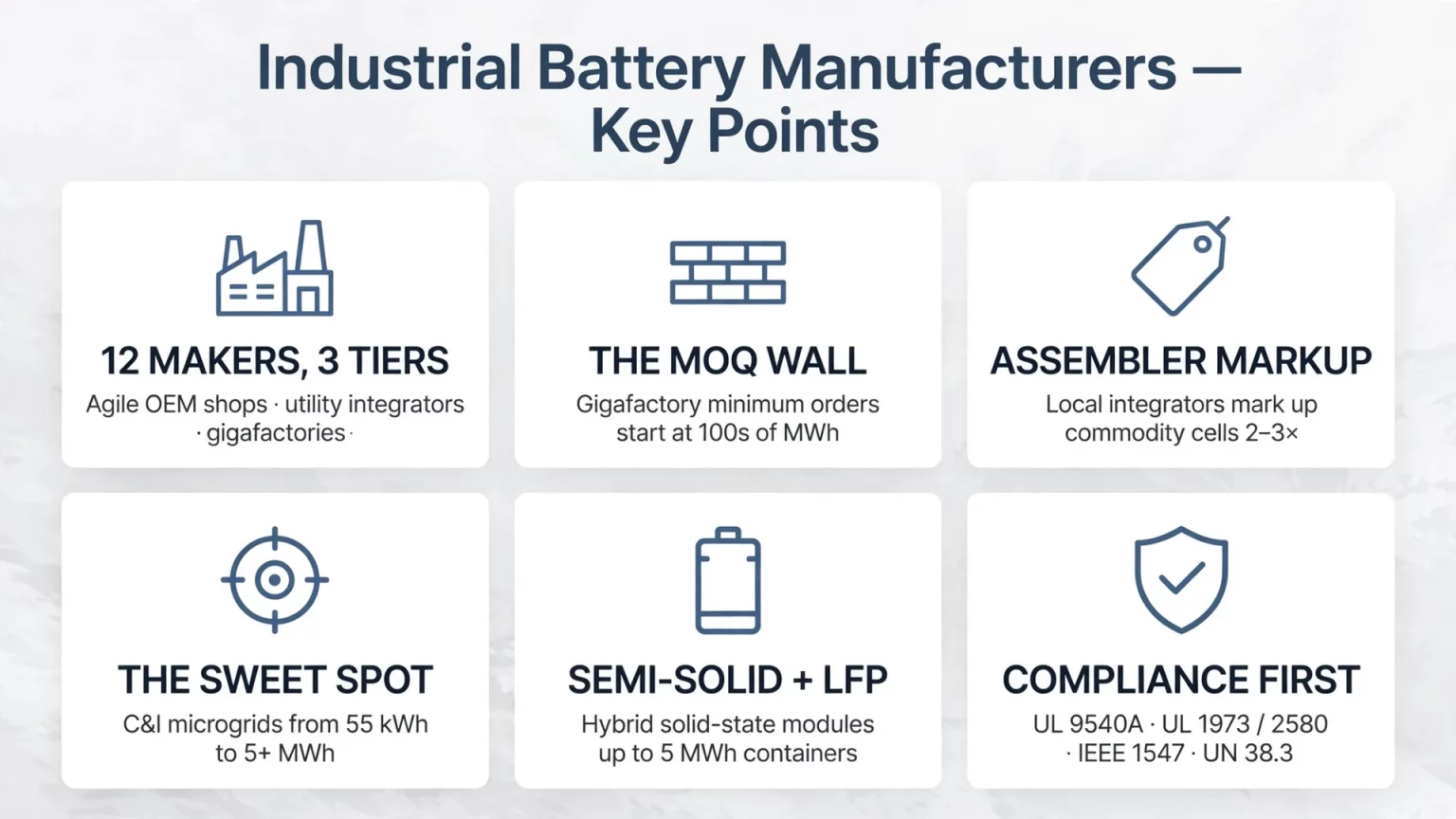
North American EPC contractors, robotics OEMs, and industrial equipment builders searching for top lithium battery manufacturers frequently run into a procurement wall. Most industry directories recite consumer electric vehicle cell giants such as CATL, Panasonic, or LG Energy Solution. Yet when an engineering team approaches a Tier-1 EV gigafactory for a 2 MWh commercial microgrid, an explosion-proof offshore power skid, or 500 custom 48V autonomous mobile robot (AMR) packs, inquiries routinely go unanswered. Gigafactory minimum order quantities (MOQs) start in the hundreds of megawatt-hours, and high-speed automated cell lines only ship standardized prismatic, cylindrical, or pouch formats without mechanical, enclosure, or BMS customization.
Turning to small local pack assemblers in North America creates the opposite problem. Regional third-party integrators buy commodity cells through distribution channels, mark up hardware prices by two to three times, and lack proprietary cell-level safety innovations such as hybrid solid-state (semi-solid) electrolytes.
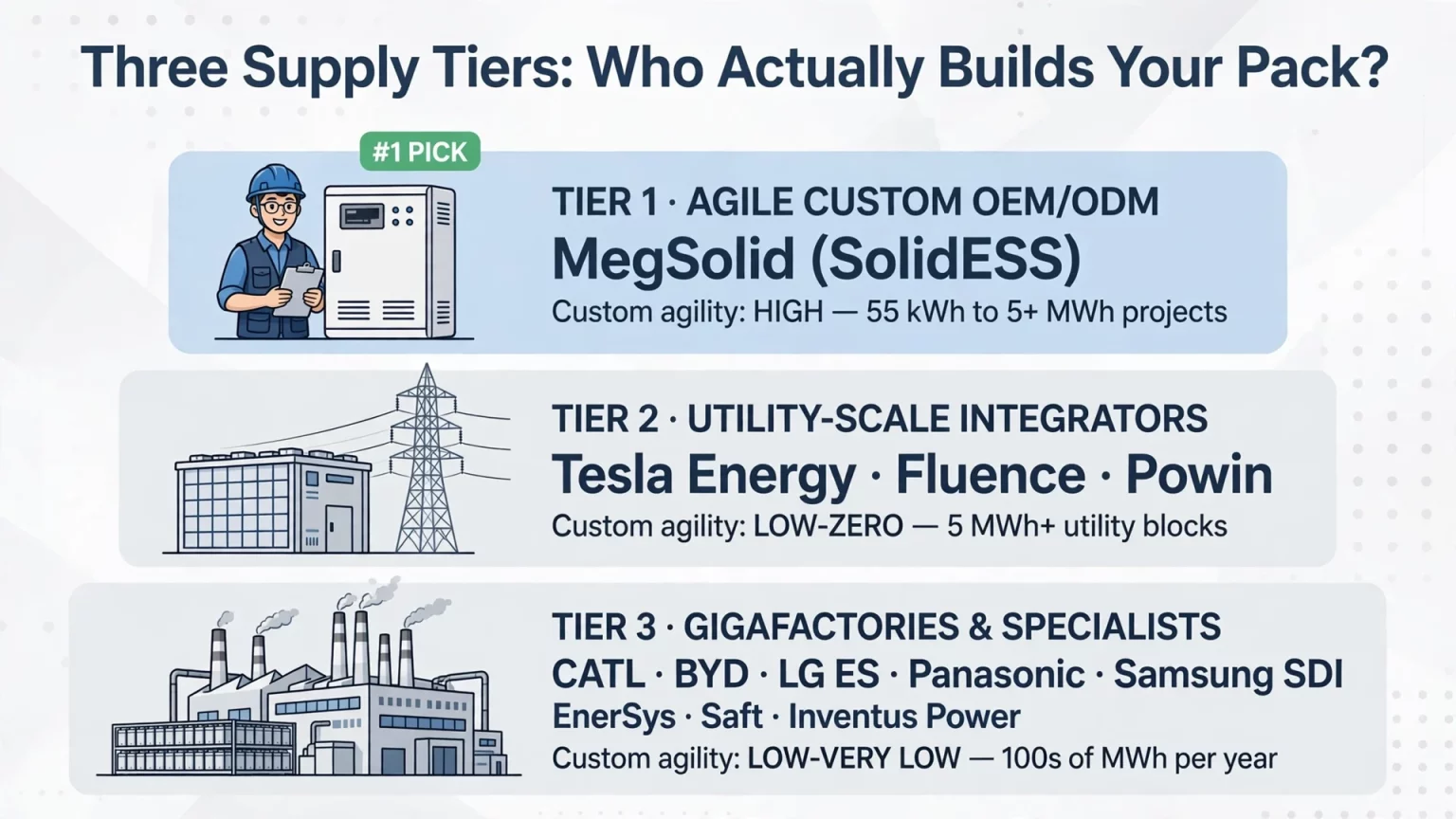
To help procurement directors, electrical engineers, and microgrid developers match supplier capabilities to actual project volumes, this 2026 B2B guide evaluates the 12 leading Li-ion and industrial battery manufacturers across three distinct supply tiers:
- Agile Custom Semi-Solid BESS and Industrial Pack Manufacturers (led by MegSolid / SolidESS)
- Utility-Scale BESS Integrators (Tesla Energy, Fluence, Powin)
- Global Tier-1 Cell Gigafactories and Specialty Industrial Veterans (CATL, BYD, LG ES, Panasonic, Samsung SDI, EnerSys, Saft, Inventus Power)
Industrial Battery Pack Manufacturer Comparison: 2026 Master B2B Matrix
Selecting an industrial battery pack manufacturer requires evaluating four procurement metrics simultaneously: core cell chemistry, North American regulatory readiness, custom OEM/ODM mechanical and BMS agility, and realistic minimum order thresholds. Table 1 compares the 12 leading suppliers for 2026 commercial, industrial, and utility deployments.
Table 1: 12 Leading Li-Ion & Industrial Battery Manufacturers Comparison (2026)
| Rank & Manufacturer | Primary Specialty | Core Chemistries | North America & International Compliance Scope | Custom OEM / Pack Agility | Best For (Ideal B2B Buyer Profile) |
|---|---|---|---|---|---|
| 1. MegSolid (SolidESS) – Top Pick for Custom & Semi-Solid | Hybrid Solid-State & LFP BESS, Custom Industrial Packs & C&I Storage | Hybrid Solid-State (Semi-Solid LFP) in 51.2V MEG-Solid-512314FL1; Solid LFE (electrolyte architecture unconfirmed) in MG 512314; LFP in Energon liquid-cooled & ESSA/ESSC cabinets and containers (optional project-specific solid-state in ESSA) | Published UL / UL 1741 / IEC 62109 / CE / UN 38.3 listings on specific product pages (applicable scope verified per model); project-specific compliance evaluated via OEM/ODM consultation | High Agility (Project-based OEM/ODM pack and BESS customization, direct factory engineering consultation, MOQ evaluated per RFQ) | C&I Microgrids (55 kWh to 5+ MWh), Robotics/AGV OEMs, Telecom & Custom Pack Buyers |
| 2. EnerSys (USA) | Telecom Reserve, Motive Power (Forklifts) & Defense Batteries | Thin Plate Pure Lead (TPPL), LiFePO4, NMC | UL 1973, UL 2580, MIL-STD | Medium (Standardized motive & telecom enclosures) | Enterprise warehousing fleets & US defense/telecom contractors |
| 3. Saft / TotalEnergies (France/USA) | Aerospace, Defense, Rail & Harsh Industrial Backup | Li-SOCl2, Ni-Cd, Li-ion (LFP / NCA) | UL 1973, UL 9540, IECEx, MIL-Spec | High (High-cost defense & aerospace qualification programs) | Aviation, railway rolling stock, and Arctic or oilfield telemetry |
| 4. Inventus Power (USA) | Medical, Military Conformal & Commercial Pack Assembly | NMC, LiFePO4 (Third-party cells) | UL 2054, UL 2580, IEC 62133 | High for small-to-medium 12V to 48V packs | Medical carts, portable power tools, and light commercial equipment |
| 5. Tesla Energy (USA) | Utility-Scale & Large C&I Megapack BESS | LiFePO4 (Prismatic) | UL 9540, UL 9540A, IEEE 1547 | Zero (Closed turnkey hardware and software ecosystem only) | 10 MWh to 1 GWh+ utility substations & hyperscale projects |
| 6. Fluence (USA) | Grid-Scale Utility Energy Storage Integrator | LiFePO4 (Gridstack / Ultrastack) | UL 9540, UL 9540A, NFPA 855 | Low (Standardized utility-scale blocks only) | Independent Power Producers (IPPs) & transmission utilities |
| 7. Powin (USA) | Utility & Large Commercial StackOS BESS | LiFePO4 | UL 9540, UL 9540A | Low (Standardized Centipede modular blocks) | 5 MWh+ community solar and utility storage developers |
| 8. CATL (Global) | World #1 EV & Utility Storage Cell Gigafactory | LiFePO4, NMC, Condensed-Matter, Sodium-Ion | UL 1973, UL 9540A, IEC 62619 | Very Low for mid-market (Requires multi-hundred MWh to GWh volume) | Global automakers & multi-GWh utility integrators |
| 9. BYD Energy Storage (Global) | Blade LFP Cells, Cube BESS & Commercial Cabinets | LiFePO4 (Blade) | UL 9540, UL 9540A, UL 1973 | Low (Standardized MC Cube and Chessboard systems) | Utility-scale EPCs & standardized dealer networks |
| 10. LG Energy Solution Vertech (KR/USA) | US Domestic EV & Grid Storage Cells and Racks | NMC, LiFePO4 | UL 1973, UL 9540A | Low (High MOQs; standardized utility racks) | US IRA-incentivized utility solar-plus-storage projects |
| 11. Panasonic Energy (JP/USA) | High-Density Cylindrical EV & Consumer Cells | NCA, NMC (2170 / 4680 formats) | UL 1642, UL 2580 | Low (Cell supplier; requires third-party pack integrator) | High-drain power tools, passenger EVs, and consumer electronics |
| 12. Samsung SDI (KR/USA) | High-Energy Prismatic & Cylindrical Cells / SBB BESS | NCA, NMC, LiFePO4 | UL 9540A, UL 1973 | Low (Standardized Samsung Battery Box container) | Data center UPS & utility substation integrators |
Top Lithium Battery Manufacturers: Deep-Dive Profiles & B2B Capabilities
Evaluating top lithium battery manufacturers beyond marketing brochures requires inspecting verified cell architectures, voltage windows, thermal derating envelopes, and OEM customization boundaries. Below is an engineering breakdown of all 12 suppliers.
1. MegSolid / SolidESS: #1 for Custom Semi-Solid BESS & Industrial OEM/ODM Packs
While cell gigafactories restrict mid-market buyers to rigid liquid-electrolyte modules with massive volume commitments, MegSolid (SolidESS) combines advanced hybrid solid-state electrochemistry with agile, factory-direct pack and container engineering.
MegSolid differentiates its B2B portfolio across three core technical pillars:
- Hybrid Solid-State (Semi-Solid LiFePO4) Architecture: In confirmed semi-solid product lines (such as the 51.2V MEG-Solid-512314FL1), MegSolid adopts a hybrid solid-state LiFePO4 design intended to reduce free liquid electrolyte content compared with conventional flooded liquid-electrolyte cells, while avoiding the water-electrolysis hydrogen gassing associated with traditional lead-acid batteries during normal charging. Because specific electrolyte formulations and mechanical or thermal abuse-test performance depend on the selected cell model, engineering teams should request model-specific technical documentation and third-party test reports during RFQ evaluation. Explore the product line on the hybrid solid-state and semi-solid LiFePO4 technology hub and the Solid-State Energy Storage Systems page.
- Verified Standard Product Portfolio (51.2V Modules to 5 MWh Containers): – 51.2V Hybrid Solid-State Modules and Movable Packs: The MEG-Solid-512314FL1 (51.2V 314Ah / 16.07 kWh Solid Energy Storage Battery) operates across 43.2V to 57.6V with a 57.6V charging voltage, 200A maximum charging current, 200A maximum continuous discharging current, pack internal impedance ≤15 mΩ, and 8,000 cycles at 80% DoD. Its operating temperature spans 0°C to 45°C for charging and -20°C to 60°C for discharging, with RS485, RS232, and CAN communication and IP21/IP65 enclosure ratings (specific enclosure configuration and listed UL, CE, and UN 38.3 certificates should be verified per order). For mobile or modular floor deployment, the MG 512314 Movable Lithium Battery Pack provides 16,076 Wh (314Ah, listed as Solid LFE on the official product page, with specific electrolyte architecture unconfirmed in public documentation), 40V to 58.4V operating range, 200A maximum charge/discharge current, assemblage impedance ≤80 mΩ, ≥6,000 cycles at 25°C and 80% EOL, parallel support up to 6 units, 0°C to 50°C charging and -15°C to +50°C discharging temperature range, RS485/CAN/RS232 communication, and listed IEC 62109-1, IEC 62109-2, UL 1741, EN 61000-6-1/6-3, FCC Part 15 Class B, and RoHS references (because IEC 62109-1/-2 and UL 1741 are inverter/power-conversion standards, buyers should verify certificate applicability and scope for the standalone battery pack versus an integrated inverter system). – Commercial & Industrial (C&I) All-in-One Cabinets: On the containerized and cabinet C&I BESS platform, the air-cooled ESSA Series Outdoor Cabinet Energy Storage System covers 30 kW / 55.296 kWh (ESSA0030B-0055, 1C), 50 kW / 55.296 kWh (ESSA0050B-0055, 1C), 50 kW / 100.352 kWh (ESSA0050B-0100, 0.5C), and 100 kW / 215.04 kWh (ESSA0100B-0215, 0.5C, 672V to 850V DC) with LFP cells and optional project-specific solid-state configurations, built-in isolation transformers, THDi below 3%, IP54 protection, and Aerosol/Novec 1230 fire suppression. For higher-density liquid-cooled LFP C&I deployments, the Energon 261.24 kWh / 125 kVA Liquid-Cooled C&I ESS integrates a 1P260S 314Ah LFP liquid-cooled battery system (832 Vdc nominal, 676V to 936V DC window), 90% maximum system efficiency, IP54 protection, Novec plus water fire suppression, parallel expansion up to 10 units (2.61 MWh), and operation from -20°C to 55°C (power derating required above 45°C) at altitudes up to 4,000 m (derating required above 2,000 m). – Utility Containers & Modular PCS: For multi-megawatt plants, the liquid-cooled 5000INTL 5,015.9 kWh / 2,700 kW Containerized ESS operates at 1,331.2 Vdc rated voltage (1,123.2V to 1,497.6V DC range, 690 Vac grid interface, IP55, up to 4,000 m altitude), complemented by air-cooled ESSC0500B-1075 (500 kW / 1.0752 MWh) and ESSC1000B-2150 (1,000 kW / 2.1504 MWh) LFP containers. For 615V to 950V DC battery strings (such as Energon or ESSA0100B-0215 voltage classes, rather than the 1,500V-class 5000INTL), the PMA080 / PMA0105 / PMA0125 Modular PCS (80 kW to 125 kW) delivers 98.7% peak efficiency, sub-20 ms mode switching, and operation from -30°C to +60°C (with power derating above 45°C) at altitudes up to 5,000 m (with derating above 3,000 m).
- Custom Industrial Pack OEM/ODM Engineering Consultation: Through its custom industrial battery pack OEM/ODM division, MegSolid provides OEM/ODM engineering consultation for custom battery packs and storage systems, evaluating customer mechanical CAD envelopes, target voltage and C-rate profiles, thermal management requirements, enclosure protection ratings, and target certification pathways on a project-by-project basis.
2. EnerSys: The Industrial Motive & Telecom Veteran
Headquartered in Reading, Pennsylvania, EnerSys is a mainstay in North American warehouse motive power (NexSys TPPL and NexSys iON lithium forklift batteries) and telecommunications DC reserve systems (OutBack Power and Alpha Technologies). EnerSys offers strong nationwide field service coverage for standardized material-handling fleets and US defense contracts. However, buyers seeking custom mechanical form factors, hybrid solid-state cell chemistry, or factory-direct pricing on mid-sized C&I microgrids often find EnerSys's catalog-driven pricing and legacy lead-acid/NMC focus less adaptable than dedicated OEM/ODM manufacturers.
3. Saft (TotalEnergies): Aerospace, Defense & Rail Specialist
Operating as a subsidiary of TotalEnergies, Saft specializes in mission-critical primary lithium (Li-SOCl2), aviation nickel-cadmium (Ni-Cd), railway onboard backup, and Arctic oilfield instrumentation batteries. While Saft excels in extreme aerospace and military qualification programs, its engineering NRE (Non-Recurring Engineering) fees, extended lead times, and government-oriented cost structure are rarely aligned with commercial robotics OEMs or mid-market C&I energy storage developers.
4. Inventus Power: Light Commercial & Medical Pack Assembler
Based in Woodridge, Illinois, Inventus Power designs and assembles low-voltage battery packs (primarily 12V to 48V) for medical carts, military conformal wearable batteries, and commercial portable equipment, along with its PROTRXion motive line. Inventus Power is a strong US pack assembler for small-format devices, but it relies on third-party cells rather than proprietary hybrid solid-state cell manufacturing and does not produce 100 kWh to 5 MWh commercial and industrial BESS containers.
5–7. The Utility Integrator Titans: Tesla Energy, Fluence & Powin
Tesla Energy (Megapack 2 XL), Fluence (Gridstack Pro and Ultrastack), and Powin (Centipede StackOS) dominate utility-scale grid storage deployments across North America:
- – Tesla Energy (USA): Manufactures the 3.9 MWh Megapack 2 XL in Lathrop, California, pairing prismatic LFP cells with integrated silicon-carbide inverters and Autobidder wholesale trading software. While ideal for 20 MWh to 1 GWh+ utility substations, Tesla operates a strictly closed hardware and software ecosystem with zero custom pack OEM capability, no third-party PCS integration, and multi-megawatt minimum order thresholds.
- – Fluence (USA): Backed by Siemens and AES, Fluence supplies modular Gridstack Pro and Ultrastack enclosures for Independent Power Producers (IPPs) and regulated transmission utilities. Fluence focuses exclusively on front-of-the-meter utility blocks and does not engineer sub-5 MWh behind-the-meter industrial peak-shaving cabinets or custom equipment battery packs.
- – Powin (USA): Integrates third-party LFP cells into its modular Centipede platform managed by StackOS software for 5 MWh+ community solar and utility storage developers. Like Tesla and Fluence, Powin does not offer custom 12V to 800V industrial machine packs, specialized ATEX/IP68 enclosures, or small-to-medium commercial microgrid skids.
8–12. The Global Tier-1 Cell Gigafactories: CATL, BYD, LG ES, Panasonic & Samsung SDI
CATL, BYD Energy Storage, LG Energy Solution, Panasonic Energy, and Samsung SDI manufacture the vast majority of the world's raw lithium-ion cells:
- – CATL (Global): As the world's largest EV and stationary storage cell producer (280Ah, 306Ah, and 314Ah prismatic LFP cells plus EnerC/EnerOne utility containers), CATL supplies automakers and gigawatt-scale integrators. Direct factory procurement requires multi-hundred-megawatt-hour annual commitments, leaving mid-market C&I developers and robotics OEMs unable to request custom sheet-metal housings or bespoke BMS firmware directly from CATL.
- – BYD Energy Storage (Global): Produces structural Blade LFP cells and standardized MC Cube utility containers alongside Chessboard commercial cabinets. BYD's vertical integration serves high-volume utility EPCs and authorized residential distribution networks, but offers minimal agility for custom industrial form factors or non-standard voltage windows.
- – LG Energy Solution Vertech (KR/USA): Operates domestic US cell manufacturing and supplies standardized utility storage racks coupled with Vertech software and lifecycle services for Inflation Reduction Act (IRA) domestic-content utility projects. High MOQs and fixed rack geometries limit its suitability for custom OEM equipment builders.
- – Panasonic Energy (JP/USA): Specializes in high-energy-density cylindrical NCA and NMC cells (18650, 2170, and 4680 formats) produced in Japan, Nevada, and Kansas primarily for passenger EVs and consumer power tools. Panasonic sells bare cells at massive volume rather than turnkey UL-listed C&I storage cabinets or custom industrial LFP/semi-solid packs.
- – Samsung SDI (KR/USA): Manufactures prismatic and cylindrical NCA, NMC, and LFP cells along with the pre-configured Samsung Battery Box (SBB) for utility substations and hyperscale data center UPS strings. Custom mechanical packaging and sub-megawatt microgrid integration require external pack engineering partners.
Working with an agile, vertically integrated manufacturer like MegSolid bridges this supply chain gap by pairing LFP and hybrid solid-state product lines with project-based OEM/ODM engineering consultation.
Leading Custom Battery Manufacturers for North America Projects: 5 Compliance Rules You Cannot Ignore
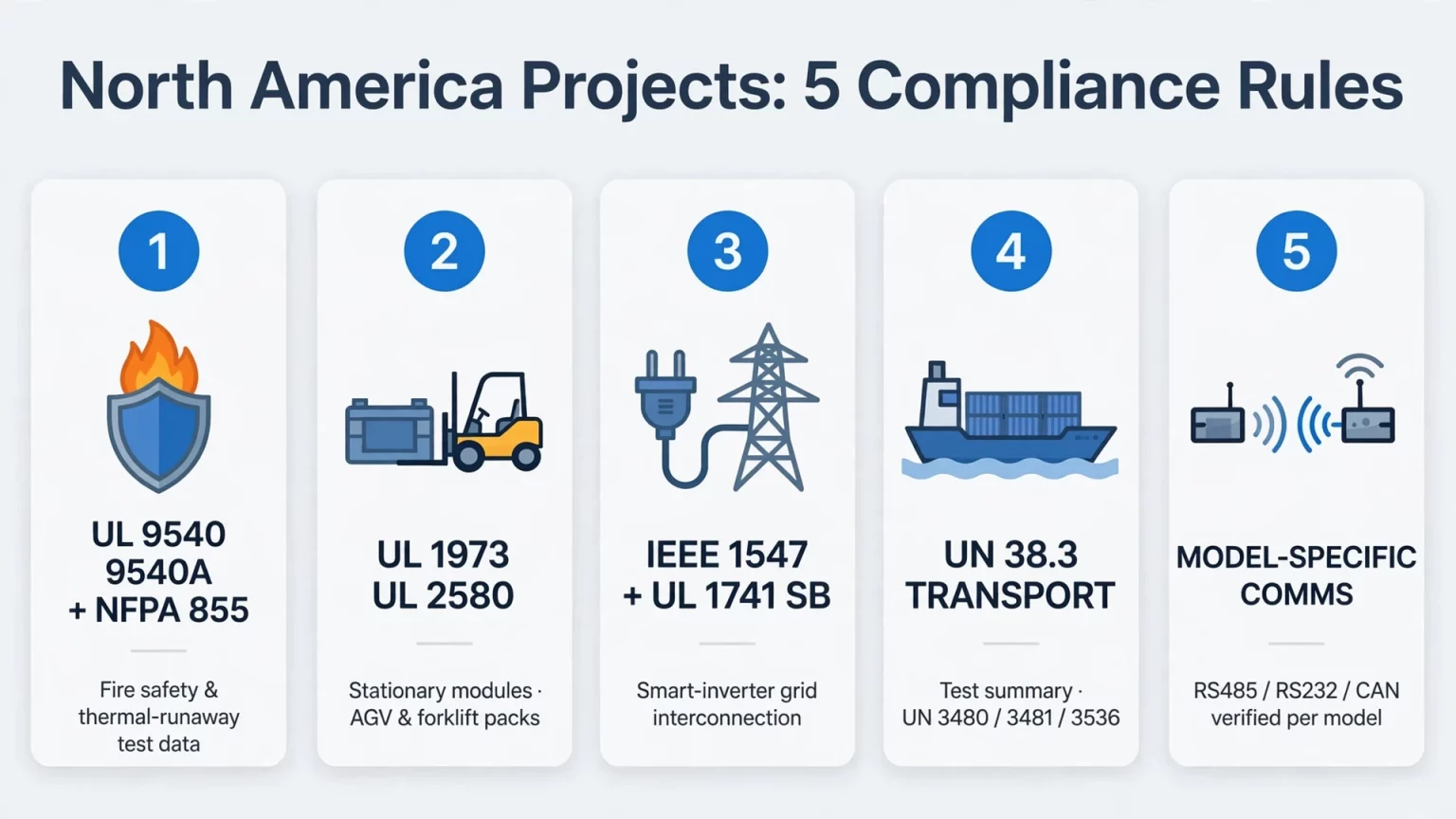
When sourcing from leading custom battery manufacturers for North America projects, facility owners, EPCs, and equipment OEMs must satisfy strict safety and grid codes enforced by local Authorities Having Jurisdiction (AHJs), fire marshals, and commercial property insurers. Before issuing a purchase order, verify these five compliance pillars:
1. UL 9540, UL 9540A & NFPA 855 Fire Safety Readiness
Across the United States and Canada, commercial BESS installations are governed by NFPA 855 (Standard for the Installation of Stationary Energy Storage Systems) and the International Fire Code (IFC). AHJs require UL 9540 system listing and UL 9540A thermal runaway fire propagation test reports to determine indoor/outdoor spacing, deflagration venting, and fire suppression requirements. Rather than relying on generic chemistry assumptions, fire marshals evaluate verified cell-, module-, and unit-level UL 9540A test reports alongside cabinet-level fire protection hardware (such as the Novec plus water fire suppression integrated into MegSolid's Energon 261.24 kWh LFP liquid-cooled system and Aerosol/Novec 1230 suppression in standard LFP ESSA cabinets, which also offer optional project-specific solid-state configurations). Whether specifying LFP or hybrid solid-state (semi-solid) configurations, buyers must request and verify model-specific UL 9540 / UL 9540A test reports and certification scope with the engineering team during RFQ scoping.
2. UL 1973 (Stationary Batteries) & UL 2580 (Motive / AGV Packs)
Stationary telecom, UPS, and microgrid battery modules require evaluation under UL 1973, whereas mobile industrial batteries powering electric forklifts, automated guided vehicles (AGVs), and autonomous mobile robots (AMRs) fall under UL 2580 (or UL 2271 for light electric vehicles) alongside ISO 3691-4 functional safety interlocks. Custom OEM pack buyers should specify target UL 1973 or UL 2580 certification pathways during initial BMS and enclosure design so redundant hardware safety relays, fuse coordination, and flame-retardant potting meet laboratory witness-testing criteria from day one.
3. IEEE 1547 & UL 1741 SB Smart Inverter Interconnection
Grid-interactive C&I storage systems operating in California (Rule 21), New York (NY-SUN), Texas (ERCOT), and Ontario must comply with IEEE 1547-2018 and UL 1741 Supplement B (SB) for voltage/frequency ride-through and reactive power support. While MegSolid's MG 512314 movable pack page lists UL 1741 and IEC 62109-1/-2 alongside EMC standards, those standards primarily govern power conversion equipment (inverters/PCS), so buyers must verify the exact certificate holder, applicable equipment scope, and inverter pairing documentation during procurement.
4. UN 38.3 & Class 9 Dangerous Goods Customs Clearance (UN 3480 / 3481 / 3536)
Every lithium battery imported into North American ports (such as Los Angeles/Long Beach, Houston, Savannah, New York/Newark, or Vancouver) must carry a valid UN 38.3 Test Summary and adhere to IMDG Code / 49 CFR Hazmat regulations under UN 3480 (standalone lithium-ion batteries), UN 3481 (batteries packed with or contained in equipment), or UN 3536 (lithium batteries installed in cargo transport units for containerized BESS). Verify that your manufacturer provides complete UN 38.3 documentation, SDS sheets, and CIF or DDP logistics coordination.
5. Model-Specific Communication Interfaces & EMS Interoperability
Proprietary utility storage systems often lock site owners into closed software ecosystems and complicate third-party solar or diesel generator integration. Communication interfaces should always be verified per specific product model: within MegSolid's published catalog, the 51.2V MEG-Solid-512314FL1 and MG 512314 battery packs specify RS485, RS232, and CAN communication interfaces on their official datasheets, while C&I cabinets (ESSA, Energon), utility containers (5000INTL, ESSC), and custom OEM packs require model-specific BMS/EMS protocol and inverter register verification during project engineering.
How to Choose Between a Tier-1 Gigafactory and a Custom Industrial Battery Manufacturer
Use this three-step procurement framework to select the right manufacturing partner for your 2026 project:
- Choose a Tier-1 Gigafactory or Utility Integrator (CATL, LG ES, Tesla, Fluence) IF: You are an automotive OEM or utility IPP procuring more than 200 MWh per year of identical, non-customized standard blocks with an 18-month development horizon.
- Choose a Specialty Defense Supplier (Saft, EnerSys) IF: You are bidding on a military aviation, submarine, or legacy lead-acid replacement contract that mandates specific MIL-STD primary cells or TPPL lead-acid blocks.
- Choose MegSolid / SolidESS IF: – You are evaluating hybrid solid-state (semi-solid LiFePO4) 51.2V modules or LFP C&I cabinets with integrated fire suppression for commercial buildings, warehouses, telecom hubs, or industrial plants, and require model-specific technical and test documentation. – You need bespoke OEM/ODM battery pack engineering evaluated for your mechanical CAD dimensions, charge/discharge C-rate targets, thermal operating profile, and project-specific certification requirements. – You are deploying a 55 kWh to 5+ MWh commercial and industrial microgrid (peak shaving, solar self-consumption, diesel hybrid, or backup power) and want factory-direct pricing, verified BMS/PCS protocol coordination, and direct access to battery systems engineers.
FAQ
How do battery cell manufacturers differ from industrial battery pack OEMs?
Cell producers supply standardized electrochemical components. Industrial battery OEMs integrate cells with mechanical enclosures, BMS interfaces, thermal management and application-specific verification. Ask whether the bid covers a bare cell, a tested pack or a complete listed energy storage system.
Which MegSolid battery platform is confirmed as semi-solid LiFePO4?
The published MEG-Solid-512314FL1 is a 51.2 V, 314 Ah, 16.07 kWh hybrid solid-state residential battery using semi-solid LiFePO4 chemistry. Other cabinet and container lines have separate chemistry specifications; request documentation for the exact ordered configuration.
Which MegSolid outdoor system fits a 100 kW and 215 kWh C&I requirement?
ESSA0100B-0215 is listed at 100 kW and 215.04 kWh with IP54 outdoor protection and a 672–850 V DC battery range. Confirm the AC connection, usable energy, peak-duty profile, ambient limits and applicable model-specific certification before placing an order.
When should an EPC evaluate Energon 261 rather than an ESSA cabinet?
Energon provides a 261.24 kWh, 125 kVA liquid-cooled LFP platform with a published 676–936 V DC range and expansion up to ten units. Compare heat management, available site space, cooling maintenance and AC electrical integration against ESSA before choosing.
Can the MegSolid 5000INTL container connect directly to a PMA modular PCS DC input?
No direct DC compatibility follows from the published voltage windows: 5000INTL operates at 1,123.2–1,497.6 V DC, above the PMA series 950 V DC upper input limit. A suitable conversion architecture must be engineered and documented separately.
What specifications should a buyer include in a custom industrial battery RFQ?
Provide voltage, continuous and peak current, energy and runtime, charge C-rate, battery cavity dimensions, weight constraints, temperature range, ingress protection, BMS communications, production quantity and required test standards. Include duty-cycle logs and target country.
How should buyers validate UL and IEC claims for industrial battery products?
Request the certificate or test report for the exact model and configuration, including issuing laboratory, standard edition, report number, conditions and system boundary. UL 9540A test data and a UL 9540 system listing serve different purposes; a component certificate does not automatically cover an entire installation.
Which North American requirements should US BESS EPCs review?
Check the authority having jurisdiction, applicable fire and building codes, NFPA 855, UL 9540 system listing and relevant UL 9540A test evidence. For grid-interactive systems verify the specified inverter pairing and IEEE 1547 or UL 1741 SB requirements applicable to the project.
What should Canadian industrial battery buyers verify before import or installation?
Confirm the applicable provincial and local electrical and fire approval route, accepted equipment certification or field evaluation, battery transport documentation, cold-climate derating, service arrangements and model-specific communications. US certification references alone do not guarantee Canadian acceptance.
What should European industrial equipment OEMs check when sourcing lithium packs?
Identify the applicable EU product and battery rules, conformity responsibilities, battery transport requirements under UN 38.3, appropriate IEC/EN testing and documentation for the final equipment. Match the BMS and pack configuration to the intended installation and its required approvals.
Conclusion: Request a Direct Engineering Quote for Your 2026 Storage or OEM Project
Selecting the right battery partner is not about picking the largest consumer EV cell brand; it is about matching cell chemistry, verified test documentation, and engineering support to your exact commercial or OEM application. Whether you are evaluating custom industrial battery packs or commissioning a megawatt-scale C&I microgrid, MegSolid provides factory-direct hybrid solid-state and LFP storage solutions backed by project-specific OEM/ODM engineering consultation.
- Need Custom Industrial, AGV/AMR, or Commercial Battery Packs? Request a project feasibility evaluation via our custom industrial battery pack OEM/ODM hub.
- Planning a 55 kWh to 5+ MWh North American or Global C&I Microgrid? Explore our air-cooled and liquid-cooled cabinets and containers on the UL 9540A commercial energy storage and C&I BESS page.
- Evaluating Next-Generation Cell Architectures? Review our hybrid solid-state LiFePO4 product lineup on the hybrid solid-state and semi-solid LiFePO4 technology hub.