

Do not size UK commercial solar battery storage by multiplying rooftop PV kWp by a fixed battery ratio. Start from the grid boundary, the solar left after the building has used it and the half-hour demand window the battery must cover.
Three records control the first sizing pass:
- DNO boundary: permitted import and export at the connection point
- Solar surplus: the electricity left after the building has used its daytime PV
- Half-hour demand: the repeated peak or evening period the battery must cover
Large roofs do not automatically need large batteries. The cabinet size follows the measured gap between those three records, not a kWh-per-kWp shortcut.
Battery Size Comes From Three Separate Site Records
UK commercial solar storage has two sizing jobs. The PCS has to move enough power when the event occurs, while the battery has to hold enough energy to sustain that event for the required period.
| Site record | What it sets | What it prevents |
|---|---|---|
| DNO connection agreement and approved limits | Maximum import and export at the point of connection | A PCS configuration that cannot operate under the agreed connection |
| PV generation and site-load data recorded at the same interval | Chargeable solar surplus in kWh | Buying capacity that the roof rarely fills |
| Twelve months of half-hour demand | Required discharge kW and the duration of each event | A battery that runs out halfway through the target period |
The grid boundary, chargeable solar surplus and target half-hour demand window all have to agree. Systems that pass only one or two of those checks are not ready for equipment selection.
Existing PV can remain on its present inverter while a separate I-MEGA TS PCS gives the battery its own AC-coupled path, subject to switchboard, transformer, protection and DNO checks.
PCS Power Starts at the DNO Boundary
The DNO sees the AC power that can cross the connection point, not the battery's energy label. The same 500 kWh battery presents a different network case behind a 100 kW PCS than behind a 250 kW PCS. Existing PV generation also counts when the DNO assesses the aggregate arrangement.
Separate the Connection Capacity from the Control Setpoint
UK connection documents may state a Maximum Import Capacity and a Maximum Export Capacity. These are site boundaries, not battery commands. Customers limitation scheme then uses a Maximum Import Limit, Maximum Export Limit or equivalent approved setpoints to keep measured power inside the agreed boundary.
Charging makes that distinction obvious. The battery is an electrical load while it charges, so an EMS focused only on export can let the combined factory load and battery exceed the permitted import. During discharge, the same site can breach its export limit if factory demand suddenly falls or rooftop output rises.
The control point sits at the site boundary. Its meter and CTs must see grid import, grid export, PV, battery action and changes in the factory load. The PCC zero-export control method goes deeper into that measurement boundary, while the PCC peak-shaving article covers import control against a demand target.
G98: The Microgeneration Notification Boundary
G98 covers microgenerating plant whose aggregate nominal current does not exceed 16 A per phase. At 230 V, that is about 3.68 kW on one phase; a three-phase installation applies the current limit to each phase. This is not the normal route for a factory-scale battery.
G99: The Connection Approval Route
Commercial PV and storage above the G98 boundary normally go through G99 before connection instead of notification after installation. The DNO assesses the aggregate arrangement, including existing PV and the proposed battery PCS. The Energy Networks Association connection guide sets out the current definitions and application routes.
The 50 kW threshold shown by a DNO can be an application-service boundary instead of a national G98/G99 rule. UK Power Networks, for example, separates its 5–50 kW automated route from projects at 50 kW or above.
G100: Import and Export Limitation
G100 sets the technical requirements for customer import and export limitation schemes. It governs how the site measures the connection point, limits controlled devices and fails safe when a meter, controller or communications path is lost.
Do not write “G100 responds in 15 seconds” as the control specification. G100 Issue 2 Amendment 2 treats short excursions, the return-to-limit period and fail-safe timing as separate requirements; the accepted project settings still have to be defined and tested.
| Rule or boundary | What it governs | Who must carry it through the UK project |
|---|---|---|
| G98 | Notification route for qualifying microgeneration | Installer and relevant DNO |
| G99 | Connection of generation and storage above the G98 route | Applicant / UK electrical project party and relevant DNO |
| G100 | Approved import/export limitation scheme, measurement, response and fail-safe behaviour | UK controls / electrical project party, equipment supplier and relevant DNO |
| MIC / MEC | Contracted or agreed site import and export capacity | Site owner, supplier / network parties as applicable |
| MIL / MEL or approved setpoints | Operating limits enforced by the control scheme | Site EMS / limitation controller under the approved design |
MegSolid can provide equipment data, PCS configuration information and control-interface support. The UK-appointed EPC, electrical contractor, ICP or other responsible project party must be named for the G99 submission, G100 scheme integration, energisation / commissioning and fault-response handover; the relevant DNO remains the network approval authority.
Limited Grid Power Can Support a Longer-Duration Battery
Import limits mainly constrain how fast the battery can charge; they do not set stored energy to the same number. Sites with spare capacity overnight may charge a 215 kWh or 261.24 kWh cabinet slowly, then use that energy during a shorter daytime peak. The calculation must prove that the available charging window can restore the required state of charge before the next event.
The equipment schedule should not be frozen until the DNO has accepted the proposed generating capacity, operating limits and control arrangement. MegSolid power ratings describe what the equipment can do; they are not evidence that a particular PCS or limitation scheme has UK connection approval.
Daily Charging Energy Comes From Measured Solar Surplus
The solar array rating describes DC output under test conditions, not the energy that actually reaches the battery. The building takes its share first, and only the remaining power is available for charging.
Each half-hour interval uses:
Solar surplus_i = max(PV output_i-site load_i,0)×0.5 h
Add those intervals across each day, then separate working days, weekends and seasons. The annual generation total can hide the hours when the roof and the battery can actually meet.
The grid meter may not reveal both values because behind-the-meter PV has already reduced recorded import.
| Same half-hour interval | Amandla |
|---|---|
| Grid import seen at the PCC | I-100 kW |
| Rooftop PV serving the building | Amashumi amahlanu eekhilowathi |
| Actual site load | 150 kW |
PV inverter records or a correctly placed site meter are needed to reconstruct the coincident load; treating 100 kW of import as 100 kW of factory demand hides 50 kW of on-site consumption.
| Site profile | What the same PV array can produce for storage |
|---|---|
| Standard-hours warehouse | Little weekday surplus if conveyors, ventilation and handling equipment use solar as it is generated |
| Office or school | More weekend and holiday surplus, but less on-site demand available to consume it later |
| Cold store or two-shift factory | A steadier load can absorb solar directly; storage is useful where a repeatable surplus remains for the evening shift |
| Farm or seasonal processor | Surplus can change sharply by month, so annual averages can point to the wrong cabinet size |
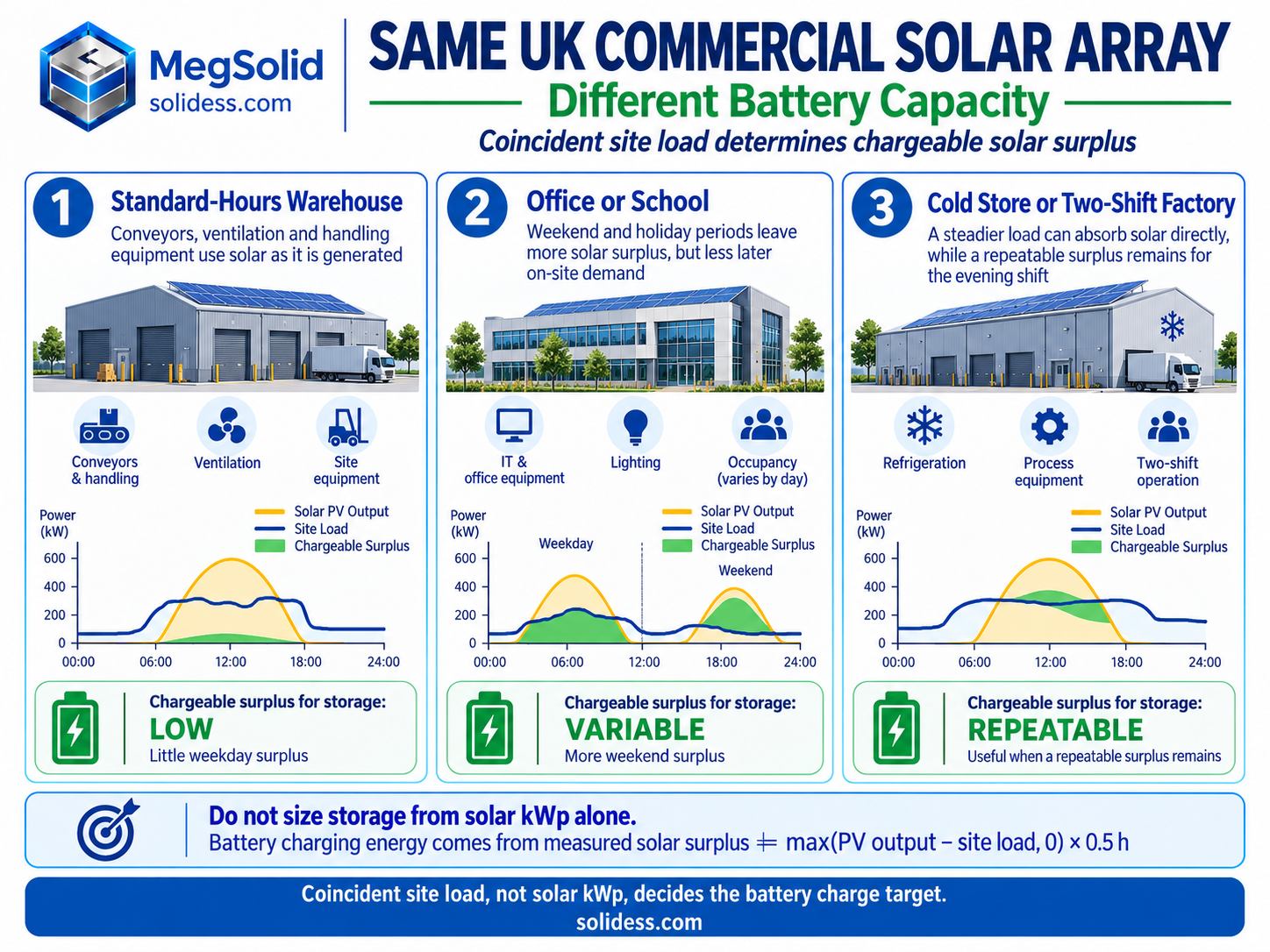
The first energy target is the smaller repeatable quantity: daytime solar surplus or the later load available to consume it. Detailed sizing must then allow for conversion losses, protected state-of-charge limits and the usable energy promised at the required life point.
Screening ratios such as 0.4–0.8 kWh of storage per kWp of solar may help compare early concepts. They cannot release a purchase order. The 500 kWp roof with 60 kWh of repeatable weekday surplus has no routine use for a 400 kWh solar-only charge target, while the same roof above an idle weekend site could justify a different operating plan.
I- PV charging priority should be set only after this surplus is visible. Otherwise the battery may fill from the grid before the strongest solar hours, leaving nowhere for the electricity the project intended to retain.
Half-Hour Demand Separates PCS kW From Battery kWh
Half-hour data shows the part of the load curve the battery must remove from the grid meter. Choose an import target first, then calculate the gap above that target in every settlement interval:
Battery power_i=max(site demand_i-import target,0)
The highest repeated gap sets the starting PCS power; the area under that event sets the energy requirement:
Event energy=Σ(battery power_i×0.5 h)
Suppose a factory reaches 420 kW against a 300 kW target. The battery needs to supply 120 kW at the connection point. If that gap lasts for one half-hour, it represents 60 kWh.
If it remains for four half-hour intervals, it represents 240 kWh. Both events ask for the same discharge power; the second needs four times the energy.
Those figures expose two bad shortcuts. The 100 kW / 215.04 kWh cabinet has enough nameplate energy for the first event but cannot remove the full 120 kW gap by itself. Larger battery behind the same 100 kW PCS would run longer, yet it would still leave at least 20 kW above the target while the peak continues.
Run the same calculation across the full year. One accidental spike may not justify more PCS, while a lower peak appearing every weekday can dominate the savings. Examine these patterns separately:
- the highest measured import;
- the peak that repeats often enough to matter;
- the number of consecutive half-hours above the chosen target;
- the evening or tariff window scheduled for discharge;
- the lowest load that could cause export while the battery is discharging.
Peak shaving still controls against measured power at the connection point. If a motor starts inside a half-hour interval, the settlement record may show its billing effect but hide the sub-second electrical event. Voltage support and motor starting require a separate high-resolution check; they cannot be inferred from the half-hour energy model.
Nameplate kWh is not the same as energy available to the target load. Reserve state of charge, operating limits, ageing assumptions and the contractual measurement boundary all reduce the amount that can be scheduled. The final comparison should use warranted usable energy at an agreed boundary and life point, not nominal battery capacity alone.
A UK Factory Example Puts the Three Records on One Timeline
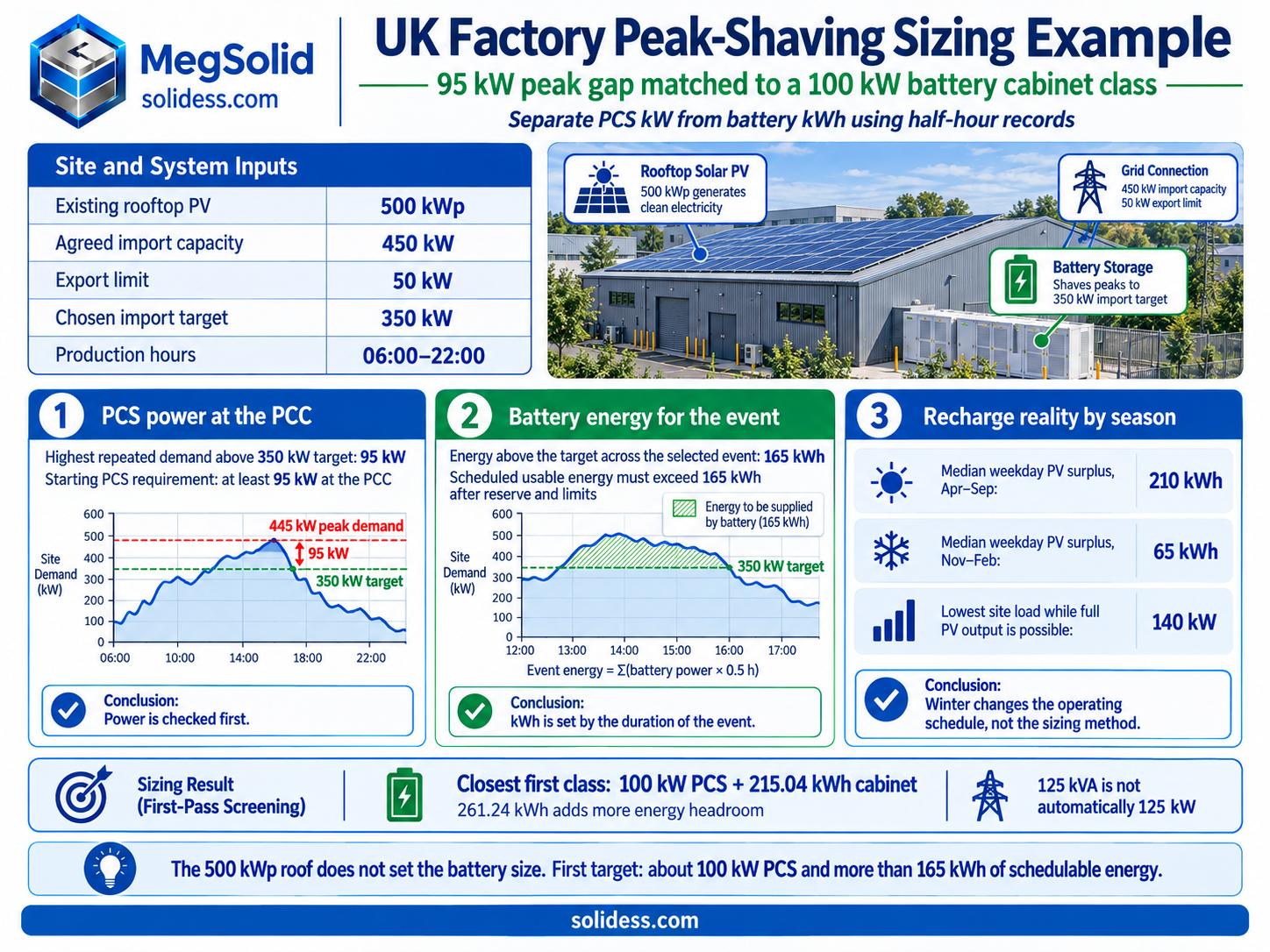
Consider a factory with 500 kWp of existing rooftop PV, a 450 kW agreed import capacity and a 50 kW export limit. Production runs from 06:00 to 22:00. The energy manager wants to keep grid import below 350 kW during a recurring late-afternoon production period. This is a hand-calculation yardstick, not a preferred MegSolid project size: a 200 kW site and a 500 kW site use the same half-hour method against their own PCC target.
Twelve months of half-hour records produce the following screening result:
| Rekhoda | Measured result | Effect on the battery decision |
|---|---|---|
| Highest repeated demand above the 350 kW target | 95 kW | PCS must deliver at least 95 kW at the PCC |
| Energy above the target across the selected event | 165 kWh | Scheduled usable energy must exceed 165 kWh after applicable limits and reserve |
| Median weekday PV surplus from April to September | 210 kWh | Enough solar is normally available to cover the event before losses and operating margins are applied |
| Median weekday PV surplus from November to February | 65 kWh | Solar alone cannot restore the planned discharge every winter day |
| Lowest site load while full PV output is possible | 140 kW | Export control still needs to respond if production drops unexpectedly |
The 500 kWp roof does not, by itself, justify 200–400 kWh of storage. Its first equipment target is about 100 kW of PCS power and more than 165 kWh of schedulable energy. The exact battery capacity depends on the usable-energy guarantee, state-of-charge reserve, expected degradation and whether the operator accepts a smaller winter discharge.
ESSA0100B-0215 provides 100 kW rated AC power and 215.04 kWh nominal capacity, putting it close to the measured requirement without moving the project to a megawatt-hour container. It still needs a usable-energy check: 215.04 kWh on the nameplate does not prove that 165 kWh will be available at the required AC boundary throughout the contracted life.
The 261.24 kWh MegSolid liquid-cooled system adds energy headroom and has a 125 kVA rated AC output. That 125 kVA must not be treated as 125 kW without the project's power-factor and operating limits. It becomes the stronger candidate if the factory wants a longer evening window, a larger reserve or less sensitivity to ageing, provided the power study confirms the required real-power output.
Winter Changes the Schedule, Not the Sizing Method
Winter changes the operating schedule, not the sizing basis. The factory can reduce the scheduled discharge, use spare import capacity for controlled off-peak charging, or add capacity only when the extra energy has a second repeatable job. The EMS must stop grid charging before the site's combined demand reaches the approved import boundary.
If the factory later adds a second production line, the original half-hour calculation can be rerun against the new target. That evidence shows whether another cabinet, more PCS power or a move to the 500 kW / 1.0752 MWh class is justified.
Product Selection Starts After the Site Numbers Are Known
MegSolid offers several power-to-energy combinations. The measured load, DNO boundary and operating window decide which class is relevant.
| Site result | MegSolid product path | What it can do on the site | Boundary to confirm |
|---|---|---|---|
| Existing commercial PV remains in service | MEGA TS PCS, 30–500 kW | Gives the battery a separate AC-coupled power path and allows PCS power to be selected independently from battery energy | Aggregate G99 capacity, approved G100 control, battery DC match and switchboard rating |
| Up to 100 kW with a roughly two-hour nominal energy ratio | ESSA0100B-0215, 100 kW / 215.04 kWh | Covers repeated peak shaving or moves measured solar surplus into a later operating window | Warranted usable energy, seasonal recharge, PCC control and IP54 siting |
| A longer energy window around the 100 kW class | MegSolid 261.24 kWh liquid-cooled system | Adds nominal energy headroom and uses controlled liquid cooling; published systems can operate in parallel | 125 kVA real-power capability, auxiliary load, usable-energy definition and parallel control |
| Campus or industrial hub approaching 500 kW | ESSC0500B-1075, 500 kW / 1.0752 MWh | Moves the project into a single containerised power-and-energy block | About 6 m and 21 t of equipment, transformer capacity, 400 V current, protection and DNO study |
ESSA is the closest match when the site data points to a 100 kW ceiling and roughly two hours of nominal storage. Energon becomes useful when the power requirement stays in a similar class but the discharge window, reserve or future ageing allowance needs more energy. ESSC belongs at a different electrical and civil scale; it should not replace several small cabinets merely because its cost per nominal kWh appears lower.
MEGA TS lets the project add battery energy without replacing a serviceable solar inverter. That flexibility also creates another interface: the DNO will assess the combined generation arrangement, and the site controller must coordinate the old PV inverter with the new battery PCS at the connection point.
Product ratings do not grant G99 acceptance. The selected PCS variant, type-test evidence, protection settings and customer limitation scheme must be checked against the current DNO application before the equipment schedule is released.
When the measured requirement sits between 215.04 and 261.24 kWh, compare both configurations against the same PCC power target and operating window.
Send One Boundary-Matched Data Pack
Useful first email does not need a web form. Attach the three records that decide the battery:
- DNO: approved import and export kW, plus the current G99 / G100 position;
- 12 months of half-hour data: PCC import / export aligned with PV output over the same intervals;
- Operating window: peak-shaving target in kW, consecutive half-hours to cover and whether controlled off-peak grid charging is allowed.
Ask for the ESSA 100 kW / 215.04 kWh path, the 125 kVA / 261.24 kWh liquid-cooled path and any separate MEGA TS PCS requirement to be compared against that same boundary. the factory example above, the reply should also show how the 65 kWh median winter solar surplus changes the operating schedule instead of hiding it inside an annual average.
EMS Control Sits Behind the DNO Boundary
Tariff optimisation has to stay inside the DNO limits. Weekday control can follow this sequence:
- 1. Supply the building directly from rooftop PV.
- 2. Charge from measured solar surplus while preserving import headroom.
- 3. Hold enough state of charge for the selected late-afternoon event.
- 4. Discharge as PCC import approaches the chosen target.
- 5. Reduce discharge if falling factory demand or rising PV would push the site towards its export limit.
The controller needs live PCC measurement because battery power inside the cabinet does not show what the DNO sees after PV and factory demand are combined.
CT warning: reversed polarity or a wrong phase assignment can make the EMS increase the import or export breach it is meant to correct. The metering and CT polarity guide covers the commissioning check.
G100 logic overrides the ordinary tariff schedule. With only 35 kW of import headroom, a requested 100 kW charge must be reduced; if a production line trips during discharge, battery output must fall before the site crosses the approved export limit. Loss of metering, controller power or communications must trigger the fail-safe response accepted by the DNO.
State-of-charge priority then decides how much energy remains for the selected event. The EMS priority logic covers the conflict between PV charging, peak shaving and reserve.
Grid-connected peak shaving and backup are separate operating cases. Maintaining factory loads during an outage requires an approved islanding arrangement, a defined backed-up board, switching and a PCS operating mode that can establish voltage without the grid. The distinction is covered in the grid-tied battery backup guide and should not be added to the savings case unless the electrical design includes it.
Savings Depend on the Bill Item the Battery Actually Changes
Each discharged kilowatt-hour has value only through the charging source and bill item it actually changes. Treating every stored unit as an avoided peak-price import overstates the result.
Solar charging starts with:
Gross value per discharged kWh =avoided import price-foregone export value
Conversion losses, auxiliary consumption, battery wear and maintenance still have to be deducted. If a site avoids buying electricity at 28 p/kWh but gives up an 8 p/kWh export payment, the starting spread is 20 p/kWh, not 28 p/kWh. Those figures illustrate the calculation; the model must use the site's current import contract and export agreement.
Grid charging uses a different value calculation. Its value begins with the discharge-period import price minus the cost of buying extra charging energy during the selected low-price period. The charging schedule must also fit beneath the permitted import and leave enough headroom for the factory.
Network Charges Need the Site's Tariff Schedule
| Charge | Ubungqina obuzokusetyenziswa | Common modelling error |
|---|---|---|
| DUoS | Current supplier bill, DNO area, voltage level, tariff class and charging year | Copying another site’s red / amber / green periods or assuming every component falls with battery discharge |
| TNUoS | Supplier treatment and current NESO tariff method | Treating a reduction in one half-hour as removal of the whole TNUoS bill |
| Triad exposure | Winter forecast, actual three settlement periods and available battery SOC | Booking the value as guaranteed income before the actual Triads are known |
DUoS can contain time-related, capacity and fixed components, and the supplier may bundle or pass them through differently. Use the site's current tariff schedule instead of a generic UK assumption.
I- National Energy System Operator defines Triads as the three half-hour settlement periods with the highest system demand. Battery held for the wrong winter evening earns no Triad benefit, and one already committed to a factory peak may not have enough SOC for both jobs. Treat Triad avoidance as a site-specific scenario, not guaranteed annual income.
| Value stream | Ubungqina buyafuneka | Main reason the estimate changes |
|---|---|---|
| Ukusetyenziswa kwelanga ngokwakho | Coincident PV and load data, import price, export payment | The roof may have less surplus than its annual yield suggests |
| Time shifting | Half-hourly energy prices and charging opportunity | Price spreads and operating hours change |
| Peak reduction | Half-hour demand and the exact billed charge | A short maximum may not control the bill item assumed |
| Connection-capacity management | Connection agreement, proposed new load and reinforcement option | The battery may defer work without removing the eventual need |
| Triad exposure | Supplier treatment, winter forecast and available SOC | Only the actual three periods determine the locational charge |
| Flexibility services | Aggregator terms, metering, availability and dispatch conflicts | Revenue and access can change during the project life |
Installed cost cannot be reduced to one UK-wide £/kWh figure. The 215 kWh outdoor cabinet and 1 MWh container carry different civil works, cabling, transformer, switchgear, fire strategy, communications and DNO-study costs. Compare complete delivered scopes at the same AC power, usable-energy definition and operating duty before calculating payback. The BESS lifetime-cost method can then test whether a lower equipment price actually produces cheaper delivered energy.
Four Inputs That Commonly Distort the Purchase Decision
1. Multiplying Solar kWp by a Fixed Battery Ratio
Fixed ratios ignore when the factory consumes solar power. The result can sit full on summer weekends, remain partly empty through winter and still run out during the evening event it was bought to cover.
Use instead: repeatable half-hour surplus compared with the later load that can consume it.
2. Using Grid Import as the Whole Building Load
Behind-the-meter PV reduces the import shown at the grid meter. Reading that value as total site demand makes both the load and the midday solar contribution look smaller than they are. It can also hide the drop in demand that would turn battery discharge into export.
Use instead: aligned PV inverter data, connection-point data and the relevant internal meter.
3. Choosing kWh Before Checking PCS kW
Putting 400 kWh behind a 100 kW PCS still leaves a 150 kW peak constrained by the PCS. The battery may have enough energy to cover the event, yet the grid meter will still record at least 50 kW above the target while that gap remains.
Use instead: the maximum repeated kW gap first, then the half-hour event energy.
4. Freezing the Equipment Before the DNO Position Is Known
The DNO may assess the new PCS together with existing PV and ask for different export settings, protection, studies or reinforcement. An equipment order based on unrestricted operation can leave the system permanently curtailed or force a late redesign.
Use instead: carry the proposed PCS rating, operating mode and limitation scheme through the connection review before locking quantities. Where a battery is intended to avoid an immediate transformer increase, the transformer-upgrade assessment explains the load evidence needed to prove the claim.
Wrong inputs can leave the battery usable while making the commercial result unpredictable. Smaller systems based on measured limits can deliver a clearer result than larger cabinets bought from a solar ratio or headline payback figure.
The Final Product Choice Follows the Same Five Site Records
ESSA0100B-0215 is the direct candidate when the repeated PCC gap stays within 100 kW, the scheduled energy fits the warranted usable window and the cabinet can recharge before the next event. Its all-in-one outdoor format suits a factory that needs one defined peak-shaving or solar-shifting job at 400 V.
The 261.24 kWh liquid-cooled system fits the same general power class when the site needs more energy headroom, a longer discharge period or a larger reserve. Its 125 kVA rating must be checked against real power and power factor. Parallel expansion is available, but adding cabinets solves an energy shortage only when the PCS path, controls and connection point can also carry the required power.
ESSC0500B-1075 belongs where repeatable demand is already in the several-hundred-kilowatt range and the electrical infrastructure can support the block. At 400 V, 500 kW represents roughly 722 A at unity power factor before project-specific allowances.
The matching voltage label on the switchboard does not prove that its busbars, transformer, protection or fault level can accept that current. If the existing board and transformer were not designed to carry the added current and fault duty, the 500 kW option is not connection-ready even though both sides say 400 V. Detailed 400 V integration is covered in the existing-switchboard connection guide.
Put five records on the same timeline before the final product choice:
- approved or proposed import and export limits;
- connection-point demand in half-hour intervals;
- PV output over the same intervals;
- the operating window the battery will serve;
- enough charging time and headroom to repeat the schedule.
Once those records agree, product choice is evidence-based. MegSolid can supply the battery and PCS path that follows the measured power and energy requirement, while the UK connection design still needs the project-specific DNO application, protection, switchgear, civil works and commissioning evidence.
If the result points to two plausible configurations, compare them against the same usable-energy boundary, seasonal schedule and DNO operating limit before choosing the larger system.
Imibuzo Ebuzwa Rhoqo
How do you size commercial solar battery storage in the UK?
Use the DNO import and export boundary to constrain PCS power, calculate half-hour solar surplus after site consumption, and measure the kW and duration of the load window the battery will cover. Check that the chosen system can recharge before the next scheduled discharge.
Can battery capacity be calculated from commercial solar kWp?
Solar kWp can support an early screening range, but it cannot set the purchase size. Two premises with the same roof can have very different daytime consumption, weekend operation and winter surplus. Coincident PV and load data reveal how much energy is actually available for storage.
What half-hour data is needed for a UK commercial battery?
Use at least 12 months of connection-point import and export, aligned with PV inverter output over the same intervals. Mark shutdowns, holidays, seasonal production and planned new loads so an abnormal month does not determine the equipment size.
Does a commercial battery need a G99 application?
Commercial generation and storage above the G98 limit of 16 A per phase normally follows G99. The DNO assesses the aggregate installation, including existing PV and the proposed battery PCS. Application details depend on the system size, connection voltage and network operator.
What does G100 do for battery storage?
G100 sets requirements for customer import and export limitation schemes. It covers measurement, control states, response, fail-safe behaviour, testing and records. It does not replace G99 approval, and installing an EMS with an export setting does not by itself demonstrate G100 compliance.
Can a battery keep a factory below its Maximum Import Capacity?
It can reduce measured import when its PCS power, available energy and control response cover the load above the target. The design also needs a charging window below the import boundary. Battery does not change the contractual capacity unless the relevant parties approve that change.
Can commercial battery storage operate with zero export?
Yes, if the approved control scheme measures the connection point and reduces PV or battery output before export exceeds the agreed limit. The response must also remain safe when site demand falls, a CT fails or communications are lost.
Is AC coupling suitable for an existing commercial solar system?
AC coupling often lets a serviceable PV inverter remain in place while the battery uses a separate PCS. The DNO still assesses the aggregate generation and limitation arrangement. Switchboard capacity, transformer loading, protection and control coordination decide whether the retrofit is practical.
Is a 100 kW / 215.04 kWh battery enough for a factory?
It is a candidate when the repeated grid-power gap stays within 100 kW and the scheduled usable-energy requirement fits within the product's warranted operating window. Longer events, larger reserve or insufficient recharge time can require another configuration.
How should a UK business estimate battery payback?
Model solar self-consumption, time shifting and peak reduction separately. Deduct foregone export income, charging cost, conversion losses, auxiliary use, maintenance and battery wear. Add network-charge or flexibility value only where the site's contract and operating rules support it.
What sets battery power in a UK C&I project?
Battery power comes from the largest repeated difference between measured site demand and the chosen import target, subject to the DNO-approved operating boundary. The PCS must cover that kW gap while meeting the site's voltage, current and control requirements.
What sets battery energy in a commercial solar project?
Battery energy comes from the accumulated kWh across the discharge window, limited by the repeatable solar or grid-charging energy available beforehand. Reserve, operating limits and ageing must be included before nominal capacity is converted into schedulable energy.
Which MegSolid system suits UK commercial solar storage?
ESSA0100B-0215 suits measured requirements near 100 kW and 215 kWh nominal, while the 261.24 kWh liquid-cooled system adds energy headroom in a similar power class. ESSC0500B-1075 serves larger sites only after the DNO and site infrastructure support a 500 kW block.