 Skip to content
Why C&I Energy Storage Requires Advanced Inverters
Commercial and industrial (C&I) energy storage systems bear extremely high requirements for grid stability and continuity. Industrial sites commonly face non-linear loads, large inrush currents from heavy motor start-ups, and high-frequency fluctuations in grid voltage.
Conventional inverters face engineering bottlenecks in severe harmonic distortion and delayed grid-tied response when handling these harsh conditions. Modern C&I facilities require highly precise commercial energy storage inverters to control DC and AC bus voltages in real-time, guarantee power quality under unbalanced three-phase loads, and ensure microsecond-level seamless off-grid switching during grid collapse.
The inverter's topology directly determines the charge/discharge efficiency and fire safety of the entire energy storage system.
As the underlying cell technology of industrial energy storage evolves from traditional liquid batteries to hybrid solid-state batteries, fundamental changes occur in the cell's energy density, charge/discharge C-rate, and safe voltage operating window. The inverter's underlying algorithms must undergo physical-level calibration to match the specific impedance characteristics and discharge curves of hybrid solid-state batteries.
In demanding C&I environments, the inverter is not merely a DC/AC energy conversion hardware; it is the data interaction core for the microgrid Energy Management System (EMS) and Battery Management System (BMS), handling multi-channel real-time communication and executing millisecond-level power dispatch commands.
Why C&I Energy Storage Requires Advanced Inverters
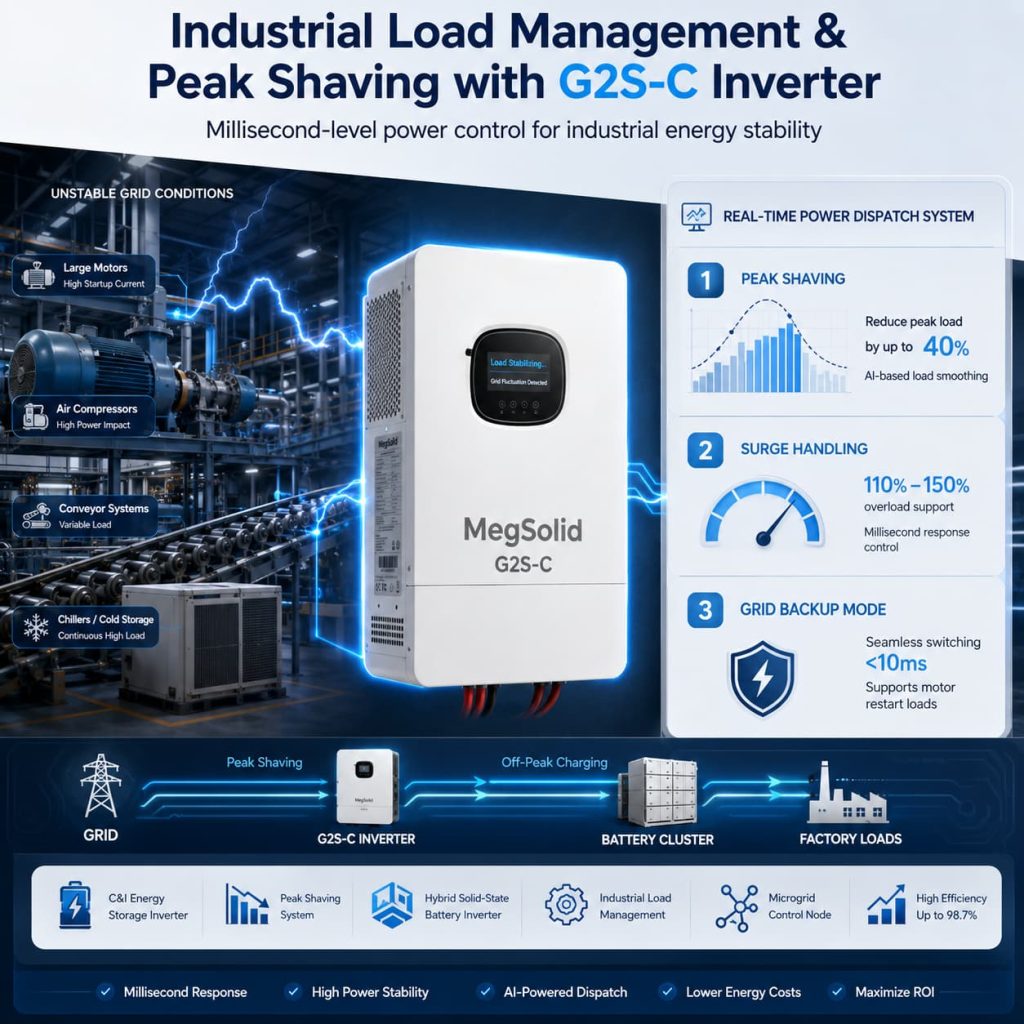
Grid peak shaving and factory-level load management rely on the inverter's extreme bidirectional power dispatching capabilities on both the DC and AC sides.
The G2S-C C&I inverter is specifically designed for such high-frequency, deep dispatch requirements. The underlying technical data of the MegSolid G2S-C series single-phase energy storage inverter supports a broad battery input voltage of 40V to 58V, with a rated input standard of 48V.
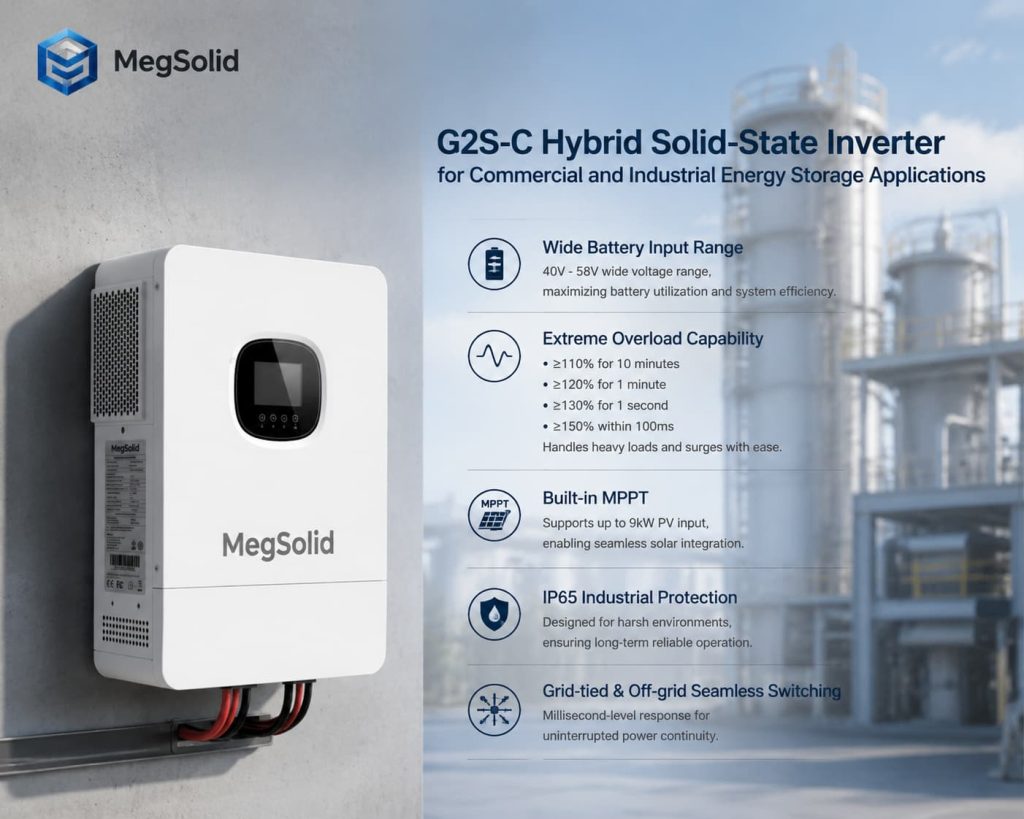
This wide voltage window ensures the inverter extracts the maximum depth of discharge (DOD) from the underlying cells without easily triggering undervoltage hardware protection under high loads.
Under extreme conditions like off-grid operation or sudden load surges, the G2S-C's Back-Up Peak Output demonstrates rigorous engineering redundancy: the system can sustain an overload output of ≥110% for 10 minutes. The system sustains ≥120% overload for 1 minute.
The system sustains ≥130% overload for 1 second.
The system withstands transient full-load impacts of ≥150% within 100 milliseconds.
This extreme transient stress tolerance is critical for starting industrial water pumps, air compressors, or heavy CNC machinery with high starting currents.
In grid load areas facing structural power shortages and frequent load shedding, such as South Africa, grid-tied energy storage inverters with ultra-high overload capabilities serve as the core physical guarantee to maintain factory production line continuity.
Enterprises utilize high-capacity grid-tied storage and precise energy arbitrage strategies to shift low-cost AC power from non-working hours to peak daytime production periods, while leveraging the inverter's off-grid AC coupling function to take over critical factory loads within milliseconds when the municipal grid fails.
Why C&I Energy Storage Requires Advanced Inverters
Industrial-grade inverter engineering applications must precisely match the specific load characteristics and environmental tolerance standards of different scenarios.
1. Factories
In a large food processing plant project in Gauteng, South Africa, unpredictable power outages cause the complete spoilage of materials across the entire temperature-controlled cold chain and biological fermentation assembly lines.
Heavy inductive loads in such facilities are typically supported by 920kW/4.6MWh centralized hybrid solid-state energy storage systems to withstand prolonged load shedding outages.
Within this complex facility electrical architecture, G2S-C series inverters act as completely independent distributed control nodes.
They provide uninterrupted, highly purified power for high-value precision PLCs, cleanroom constant-temperature ventilation systems, and core environmental sensors, completely blocking physical interference from main AC bus voltage fluctuations on microelectronic control signals.
2. Farms
High-voltage irrigation systems and greenhouse climate control systems on large farms span vast geographical areas, chronically facing severe voltage drop issues caused by long-distance low-voltage transmission.
The G2S-C features an industrial-grade IP65 protection rating.
This protection rating ensures the inverter maintains long-term stable operation for a decade in harsh agricultural environments with high dust and high humidity outdoors.
Its built-in MPPT tracking system supports up to 9kW of PV DC input (taking the R6KL1DA-G2S-C specification as an example).
This configuration directly integrates large-area PV arrays on farm roofs or the ground, achieving complete power self-sufficiency for agricultural irrigation edge nodes.
3. EV Charging
Commercial DC fast charging stations face extremely high transient power peaks and unpredictable random grid impacts.
Integrating multiple G2S-C inverter units in parallel with large-capacity battery clusters smooths the local grid load curve with millisecond-level response speed, massively reducing the transformer capacity expansion requirements in the area where the new charging station is located.
4. Data Centers
Server clusters demand absolutely pure sine wave AC output and zero-millisecond power interruption.
For data center main control rooms requiring megawatt (MW) level redundancy, engineering blueprint designs typically incorporate MegSolid's heavy-duty centralized 100kW inverter systems, such as the MEGA0100TS.
This system utilizes its built-in high-frequency isolation transformer and a maximum system conversion efficiency of 97.1%.
This configuration is specifically designed to handle the massive power consumption of high-density server arrays.
The G2S-C is separated and deployed independently at edge computing nodes or independent security monitoring rooms, providing flexible and interference-resistant single-phase AC output protection.
Why C&I Energy Storage Requires Advanced Inverters
The performance output ceiling and fire safety baseline of large C&I energy storage systems are entirely determined by the physical limits of the connected DC-side battery chemistry.
Traditional liquid lithium-ion batteries face extremely severe thermal runaway cascading diffusion risks in C&I scenarios, especially under industrial-grade high-rate discharge or external hard short-circuit penetrations.
MegSolid's proprietary technology completely abandons the single reliance on pure liquid flammable electrolytes, shifting the entire energy storage architecture comprehensively toward hybrid solid-state battery underlying technology.
Hybrid solid-state technology combines the intrinsic thermal stability of solid electrolytes with specific liquid components to maintain high lithium-ion conductivity, eliminating the thermal runaway combustion hazards of traditional Lithium Iron Phosphate (LFP) batteries from the physical atomic substrate.
The G2S-C inverter's BMS serial communication protocols and underlying algorithms are deeply adapted to this hybrid chemical characteristic.
The inverter achieves seamless backward compatibility with hybrid solid-state, standard liquid lithium-ion, and traditional lead-acid batteries.
The inverter hardware natively supports plug-and-play on-grid/off-grid AC coupling networking architectures.
|
Technical Parameters |
Traditional Liquid LFP |
MegSolid 314Ah Hybrid Solid-State Module |
|---|---|---|
| Electrolyte State | 100% liquid flammable electrolyte | Solid-liquid hybrid electrolyte |
| Thermal Runaway Risk | High risk (highly dependent on BMS forced intervention and external fire suppression) | Intrinsically safe (eliminates risk from the underlying chemical structure) |
| Cell Capacity | 280Ah industry standard ceiling | 314Ah / 16.07kWh system-level module |
| Cycle Life | 4,000 - 6,000 cycles | 8,000 cycles (80% DOD strict standard) |
| Discharge Temp Window | 0°C to 45°C | -20°C to 60°C extreme wide temperature range |
| Self Discharge | Approx. 3-5% per month | ≤ 2% per month (at 25°C & 50% SOC) |
| Internal Impedance | ≥ 30mΩ (system module level) | ≤ 15mΩ (cell-level ultra-low AC impedance) |
Economic Benefits (ROI / Energy Cost Reduction)
The Return on Investment (ROI) model for heavy-asset industrial energy storage systems is precisely built on the foundation of hardware physical degradation life, long-term Depth of Discharge (DOD), Round-Trip Efficiency (RTE), and backend passive maintenance costs.
MegSolid systems configured with 314Ah hybrid solid-state battery packs deliver a physical cycle life of up to 8,000 cycles (tested under strict 80% DOD conditions).
Calculated at a dispatch frequency of one 1C or 0.5C deep charge/discharge cycle per day in high-energy-consumption industrial sites, the underlying electrochemical lifespan of the system exceeds 20 years.
This extreme long-tail effect massively dilutes the Levelized Cost of Storage (LCOS) over the entire lifecycle.
Taking a MegSolid R6KL1DA-G2S-C inverter operating at full load outdoors as an example, its panel maximum PV DC input power reaches 9.0kW.
This inverter's rated AC output stabilizes at 6kW.
The maximum rated output current for this model reaches 26.1A. In target markets implementing strict Time-of-Use (TOU) electricity pricing with industrial peak-valley price differences reaching $0.15/kWh, a single 6kW inverter paired with one 16.07kWh basic solid-state storage module can precisely shift 12.85kWh of high-priced electricity daily (based on a strict 80% DOD limit algorithm).
Direct electricity bill reductions achieved solely through the most basic automated peak shaving strategies annually, combined with the factory's standard 5-year system warranty commitment, can brutally compress the static payback period of a standard C&I distributed storage microgrid project to within 3.5 - 4.2 years.
The long-term maintenance-free characteristics and extremely low local fire compliance approval costs brought by hybrid solid-state batteries further slash the exorbitant OPEX (Operating Expenses) during the project lifecycle in hidden financial statements.
Typical System Configurations (8kW–10kW / scalable clusters)
In actual heavy industry engineering implementation and strong current blueprint design, the single-node power demands of different production workshops exhibit high fragmentation and differentiation.
The G2S-C series product line provides a total of six standard stepped power segments from R3KL1DA-G2S-C (3kW rated output / 4.5kW max PV input) to R6KL1DA-G2S-C (6kW rated output / 9kW max PV input).
This highly granular hardware array grants system integrators and EPC contractors extreme on-site electrical configuration freedom.
For the typical 8kW-10kW power supply cluster configurations required by small and medium-sized C&I plants, electrical engineers utilize AC Coupling technology to directly network multiple G2S-C inverters in parallel on the AC side.
This forms a highly redundant, infinitely scalable distributed microgrid cluster.
Physically paralleling two R5KL1DA-G2S-C inverters (single unit rated output 5kW, max PV input 7.5kW) precisely constructs a 10kW-class independent three-phase or single-phase Uninterruptible Power Supply (UPS) node at the workshop level.
Any single-point hardware failure is isolated and absolutely will not cause the entire workshop cluster to crash.
When the total factory load scale extends to hundreds of kilowatts (100kW+) or the megawatt (MW) level, single low-voltage string or single-phase inverter clusters cause AC line copper losses to multiply, and CAN bus communication latency fails to meet the EMS's underlying real-time dispatch requirements.
The system architecture must evolve toward a centralized high-voltage DC topology.
For such trunk line scenarios, system integrators forcibly introduce heavy-duty equipment like the MegSolid MEGA0100TS with a rated AC output of 100kW.
The rated current of this MEGA0100TS centralized 100kW inverter system reaches 144A.
This system features an extremely wide DC input high-voltage range of 420-850V. This equipment achieves a maximum grid-tied conversion efficiency of 97.1%.
This system is specifically designed to match industrial-grade heavy inductive loads and liquid-cooled containerized hybrid solid-state energy storage heavy systems (such as the 5000INTL unit with a system capacity reaching 5,015.9 kWh).
Production line edge computing nodes and precision control cabinets are powered independently by distributed G2S-C inverters, while the core power bus of the factory area adopts a mixed-level physical deployment of centralized 100kW high-voltage systems.
This constitutes the standardized system configuration paradigm for today's large and medium-sized industrial parks, covering all scenarios while balancing precision and raw power.
Conclusion
The architectural pairing of the G2S-C inverter and the 16.07kWh / 314Ah hybrid solid-state battery module dictates the operational ceiling for decentralized C&I microgrids.
The inverter leverages its 40~58V DC input tolerance to execute maximum depth of discharge, isolating environmental interference through its IP65-rated enclosure.
By structurally eliminating the flammable liquid electrolyte substrate, this hardware loop enforces an 8,000-cycle baseline at 80% DOD.
This direct integration of high-overload AC coupling and intrinsic thermal stability enforces the exact engineering specifications required for uninterrupted, heavy-duty industrial power dispatch.
FAQ
Q1: How does the G2S-C C&I inverter prevent material spoilage in industrial cold chains or fermentation lines during sudden power outages?
The G2S-C features millisecond-level seamless off-grid switching. During a grid collapse, its back-up peak output sustains ≥110% overload for 10 minutes and withstands a ≥150% transient impact within 100 milliseconds. This absorbs the startup surge of heavy industrial compressors, ensuring temperature control equipment remains operational.
Q2: What is the approximate ROI payback period for C&I energy storage utilizing a hybrid solid-state battery system?
In markets with a peak-valley electricity price difference of $0.15/kWh, a distributed microgrid using a 16.07kWh solid-state module and a 6kW G2S-C inverter compresses the static investment payback period to 3.5 - 4.2 years. The underlying electrochemical lifespan of the system reaches 8,000 cycles under strict 80% DOD dispatch.
Q3: Why should indoor factory environments mandate hybrid solid-state batteries over traditional liquid LFP?
Traditional liquid batteries pose cascading thermal runaway risks during hard short-circuits or high-rate discharges. MegSolid's hybrid solid-state technology utilizes a solid-liquid hybrid electrolyte, intrinsically eliminating combustion hazards from the physical atomic substrate and reducing fire compliance costs for indoor C&I projects.
Q4: Can the existing commercial energy storage inverter architecture be smoothly upgraded as factory production capacity expands?
Yes. The G2S-C hardware natively supports AC Coupling parallel networking. Paralleling two 5kW rated R5KL1DA-G2S-C units constructs a 10kW redundant node. When total factory loads reach the megawatt level, centralized 100kW inverter systems can be directly integrated at the bus level.
Q5: How is the long-term reliability of the inverter guaranteed in high-dust environments like outdoor agricultural irrigation?
The G2S-C utilizes an industrial-grade IP65 protection rating. This completely isolates internal control boards and power components from physical corrosion by external moisture and dust, ensuring maintenance-free operation in harsh outdoor environments.
Q6: CNC machine workshops experience severe unbalanced three-phase loads. How does the inverter maintain power quality?
For three-phase trunk lines, MegSolid three-phase hybrid inverters (e.g., R50KH3) support 100% unbalanced load output. For highly sensitive single-phase microelectronic control cabinets, distributed G2S-C inverters directly isolate voltage fluctuations from the main AC bus.
Q7: Can the G2S-C inverter directly integrate with large-area PV arrays on factory roofs?
Taking the highest specification R6KL1DA-G2S-C as an example, a single unit supports up to 9.0kW max PV DC input with a stable rated AC output of 6kW. This fulfills the power self-sufficiency needs of high-energy-consuming edge nodes.
Q8: How does the G2S-C maximize the usable capacity of the 314Ah solid-state cells through its underlying algorithms?
The inverter supports an extremely wide battery input voltage window of 40V to 58V. This wide-range discharge logic extracts deep depth of discharge (DOD) during high-load operations without triggering hardware-level undervoltage protection.
Q9: What inverter topology is typically used for megawatt-level redundancy in data center main control rooms?
High-density loads at the data center level mandate centralized high-voltage DC topologies. The standard configuration is the MegSolid MEGA0100TS, which features a built-in isolation transformer, a rated output of 100kW, and a peak grid-tied efficiency of 97.1%.
Q10: How does the hybrid solid-state battery perform regarding discharge in extreme low-temperature environments?
Traditional liquid batteries suffer severe discharge capacity degradation below 0°C. The MegSolid 314Ah solid-state module possesses an extreme wide-temperature discharge capability from -20°C to 60°C, eliminating reliance on complex external battery preheating systems.
Q11: What are the main technical differences between the MegSolid G2S-C and conventional commercial energy storage inverters?
The MegSolid G2S-C natively integrates with hybrid solid-state batteries via hardware-calibrated algorithms. It features a wide 40~58V DC input window, extreme transient overload of ≥150% for 100ms, and IP65 environmental protection, bridging the engineering gap left by standard inverters.
Q12: Which MegSolid model is classified as a heavy-duty 100kW inverter system for C&I deployment?
The MEGA0100TS is the designated 100kW inverter system. It operates on a high-voltage DC bus of 420~850V, delivers a rated AC current of 144A, and achieves a peak grid-tied conversion efficiency of 97.1%.
Q13: How does the MegSolid 314Ah hybrid solid-state cell architecture reduce the Levelized Cost of Storage (LCOS)?
The 314Ah (16.07kWh) module delivers a physical lifecycle of 8,000 cycles at 80% DOD and maintains an ultra-low internal impedance of ≤15mΩ. This structural longevity strictly minimizes cell replacement frequency and passive maintenance OPEX.
