 Skip to content
For European EPCs, the primary engineering challenge is no longer battery performance, but proving traceability throughout the entire battery lifecycle. The European Commission Battery Regulation (EU 2023/1542) mandates that from February 2027, all industrial batteries with a capacity over 2 kWh must be accompanied by a digital "Battery Passport."
This Digital Product Passport acts as a digital twin accessible via a Battery Passport QR Code, detailing the battery's origin, chemical composition, and environmental impact. Sourcing BESS cabinets from opaque trading companies will result in customs holds and severe financial penalties under the EU Corporate Sustainability Due Diligence Directive (CSDDD).
This analysis details how to source Battery Passport-compliant BESS by verifying direct manufacturer integration, BOM traceability, and lifecycle data engineering.
Key Takeaways
- The EU Battery Passport requires a digital record of the battery's supply chain, carbon footprint, and composition, accessible via a QR code.
- Direct manufacturer integration is mandatory to provide verifiable BOM traceability down to the cell batch level.
- Cobalt-free LFP chemistry mitigates conflict mineral risks under the Circular Economy framework.
- Internal Resistance Data (≤15mΩ measured during factory FAT) and cycle life validation (≥5,000 cycles per IEC 62619) are embedded in the BMS for ESG reporting.
- Compliance requires verified factory testing protocols and global UN38.3 transport certifications.
EU Battery Regulation Compliance Timeline
EPCs must prepare for phased regulatory requirements. The transition to full Battery Passport implementation follows a strict timeline mandated by the European Commission.
|
Regulation Requirement |
Effective Date |
|---|---|
| Carbon Declaration (LCA) | February 2025 |
| Battery Passport (Digital Twin) | February 2027 |
| Recycled Content Minimums | Phased from 2031 |
What is the EU Battery Passport Regulation (2023/1542)?
The European Commission Battery Regulation (2023/1542) fundamentally shifts the responsibility of battery lifecycle management onto the importers and manufacturers. For Commercial and Industrial (C&I) BESS, the Battery Passport requires a comprehensive Lifecycle Assessment (LCA) and Carbon Declaration.
Battery Passport Data Fields
To ensure transparency, the digital passport must contain specific operational and manufacturing data fields accessible to regulators and recyclers.
|
Data Field |
Description |
|---|---|
| Manufacturer ID | Verifiable factory origin |
| Cell Chemistry | Cathode and electrolyte formulation |
| Carbon Footprint | LCA per kWh delivered over lifecycle |
| Recycled Content | Percentage of recovered Co, Pb, Li, Ni |
| SOH & Cycle Count | Real-time BMS data for lifecycle updates |
| Safety Certificates | IEC 62619, UL 9540A batch-linked |
| QR Code | Access point to the digital passport platform |
According to the European Commission, the regulation requires a strict declaration of the carbon footprint per kWh of total energy delivered over the lifecycle. Furthermore, as defined by the Global Battery Alliance (GBA) Battery Passport initiative, it enforces Circular Economy principles by mandating minimum percentages of recycled materials in new batteries.
Engineering BOM Traceability for Carbon Footprint Calculation
To accurately calculate the carbon footprint for the Battery Passport Platform, EPCs need granular data on the solid electrolyte formulation, cathode material origin, and manufacturing energy mix. This level of transparency is impossible with multi-layered supply chains.
Direct Manufacturer Data Integrity
A dedicated hybrid solid-state battery manufacturer controls the entire value chain from electrolyte mixing to final system integration. The manufacturer must provide complete BOM documentation, directly linking the IEC 62619 certification of the cells to the specific production batches installed in the 215kWh outdoor cabinets. This ensures that the carbon footprint data submitted to the EU is verifiable and defensible during third-party audits by organizations like TÜV Rheinland or SGS.
Supply Chain Due Diligence: Conflict Minerals and Safety
The EU Battery Passport requires evidence that raw materials (such as lithium and cobalt) are sourced ethically, without financing conflict or human rights abuses.
Solid Electrolyte Stability and LFP Chemistry
Utilizing Lithium Iron Phosphate (LFP) chemistry inherently mitigates certain supply chain risks. The LFP chemistry does not rely on cobalt, a mineral heavily scrutinized under conflict mineral regulations. Furthermore, the solid electrolyte matrix formulation data must be provided to EPCs, ensuring that the materials meet stringent EU safety and environmental standards. (For foundational knowledge on safety, read our BESS thermal runaway prevention guide).
Lifecycle Data Integration: BMS and EMS Role in ESG Reporting
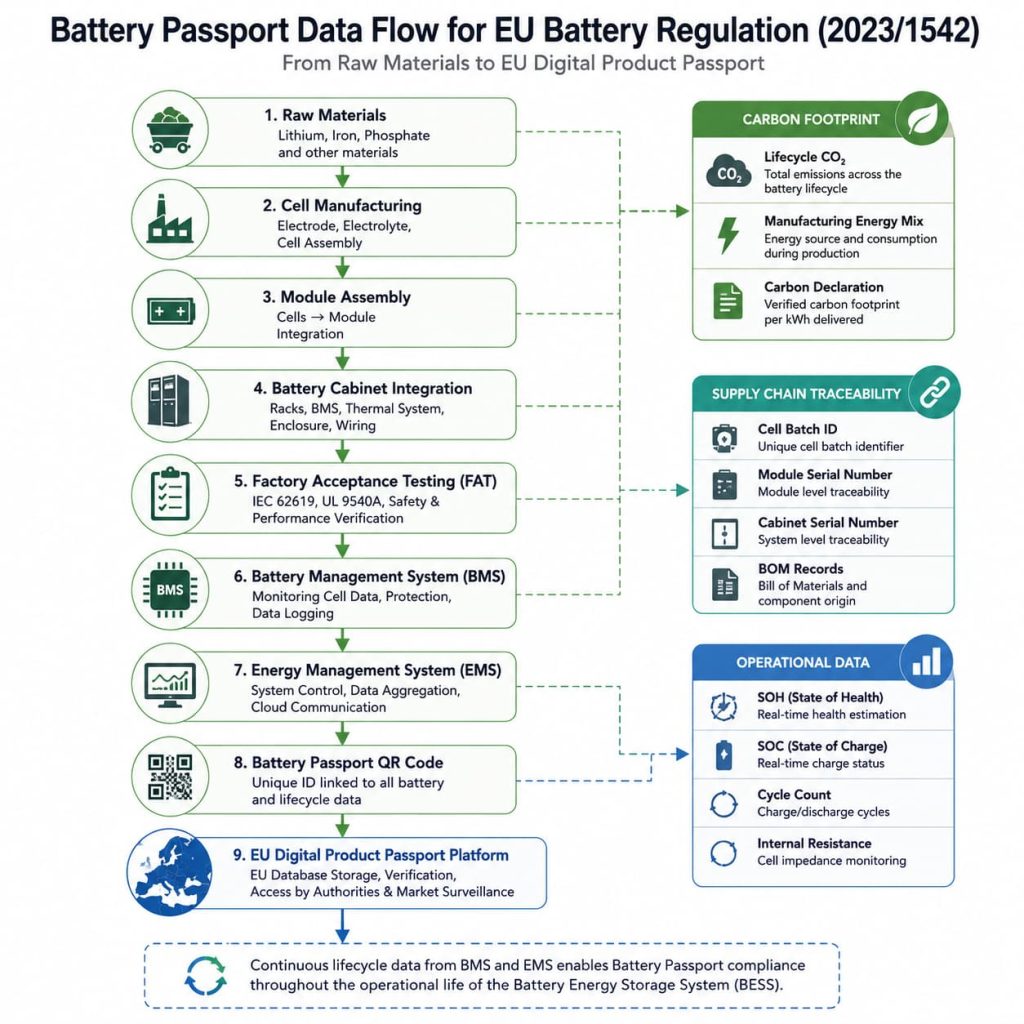
The Battery Passport is not just a static manufacturing record; it must be updated throughout the battery's operational life via the digital twin. The Battery Management System (BMS) and Energy Management System (EMS) play a critical role in feeding real-time ESG data.
State of Health (SOH) and Cycle Life Validation
According to IEC 62619, safety requirements for secondary lithium cells dictate strict monitoring of electrical parameters. The BMS continuously logs internal impedance data (≤15mΩ for 51.2V modules, verified during factory FAT) and cycle counts. This data validates the State of Health (SOH) over time, which is essential for calculating the actual carbon footprint per kWh delivered. With validated cycle lives exceeding 5,000 cycles (validated via IEC 62619 methodologies), the total lifecycle environmental impact is significantly reduced compared to standard liquid LFP batteries requiring mid-life replacement.
Field Experience: 2025 EPC Compliance Audit in Hamburg, Germany
In Q1 2025, an EPC contractor in Hamburg, Germany, faced a customs hold on a 1MWh BESS shipment due to incomplete material origin documentation from a third-party supplier. Customer identifiers are withheld under NDA, but the following project parameters and compliance data are verified against factory FAT logs and site SAT reports.
To resolve the hold, the EPC procured a 1MWh hybrid solid-state BESS array.
Project Parameters & System Configuration
- Project Scope: 1MWh facility microgrid for an automotive parts manufacturing plant.
- Cabinet Layout: 5x 215kWh outdoor cabinets in parallel.
- Grid Voltage: 400V AC, 3-phase.
- PCS: 500kW with isolation transformer.
- Commissioning Duration: 4 weeks.
- Acceptance Date: April 2025.
Engineering Lessons Learned (Based on compliance records)
- Documentation Gap: The previous supplier provided generic IEC 62619 certificates unlinked to the cell batch. The new manufacturer provided a digital BOM package linking the SHS180-314 cell batch numbers directly to the specific production run, clearing the customs hold.
- UN38.3 Verification: According to the UN Recommendations on the Transport of Dangerous Goods, lithium battery shipments require strict UN38.3 certification. The internal testing lab provided the complete test summary, satisfying German logistics requirements.
- Battery Passport API: The EMS was configured to export SOH and cycle count data directly into the EPC’s cloud platform via secure Modbus TCP, preparing them for the 2027 digital passport live-update requirement.
Verifiable Project Outcomes
- Customs Release: Achieved rapid customs clearance with complete and verifiable compliance documentation.
- Audit Pass: Successfully passed the German EPC's internal ESG and supply chain due diligence audit.
- System Stability: The BESS operated flawlessly, with BMS logs indicating stable SOH degradation over the first six months.
- Note: Results vary depending on site configuration, local tariffs, and environmental conditions.
Engineering Comparison: Opaque Supply Chain vs. Direct Manufacturer Traceability
When sourcing BESS for European projects, EPCs must assess the supply chain risk profile to ensure compliance.
|
Engineering Feature |
Opaque Supply Chain / Trading Co. |
Direct Manufacturer Traceability |
|---|---|---|
| BOM Traceability | Hidden / Unverifiable | Full cell batch & formulation traceability |
| Carbon Footprint Data | Estimated / Generic | Verifiable per manufacturing batch |
| Conflict Mineral Risk | High (Unknown sources) | Low (Cobalt-free LFP, audited supply) |
| Safety Certifications | Generic certs (Not batch-linked) | IEC 62619, UL, CE linked to production runs |
| Warranty Liability | Multiple intermediaries | Direct manufacturer warranty |
| FAT (Factory Acceptance) | Not possible | Conducted at Huzhou facility prior to shipment |
Engineering Checklist for Selecting a Battery Passport-Compliant Manufacturer
To ensure compliance, EPCs must vet potential BESS suppliers against strict engineering criteria:
- Verifiable BOM batch traceability (linked to IEC 62619 certifications).
- Factory Acceptance Testing (FAT) prior to shipment.
- UN38.3 transport test summary availability.
- BMS data logging capabilities for Passport API integration.
- Cobalt-free chemistry (e.g., LFP) to mitigate conflict mineral risk.
- Cloud-based QR code database readiness for digital twin updates.
- Third-party audited environmental management systems (ISO 14001).
MegSolid is one example of a manufacturer providing this level of integration. Operating as a direct manufacturer, MegSolid offers comprehensive OEM/ODM manufacturing services for global EPC partners. (Explore our microgrid solutions for unstable grids and our 215kWh Outdoor Cabinet ESS).
References & Industry Standards
MegSolid's engineering design and testing protocols align with the following regulatory frameworks and industry standards:
- European Commission: EU Battery Regulation (2023/1542).
- Global Battery Alliance (GBA): Battery Passport initiative guidelines.
- IEC: 62619 Safety requirements for secondary lithium cells and batteries in industrial applications.
- UL: 9540A Standard for Safety of Energy Storage Systems and Equipment.
- ISO 14001: Environmental management systems framework.
- UN38.3: Recommendations on the Transport of Dangerous Goods - Lithium Battery Testing.
FAQ
Q1: What is the EU Battery Passport?
The EU Battery Passport is a digital record mandated by the European Commission Battery Regulation (2023/1542) from 2027. It requires batteries over 2 kWh to have a QR code detailing their origin, chemical composition, carbon footprint, and recycled content.
Q2: Can existing BESS comply with the EU Battery Passport?
Existing BESS deployed before 2027 may not require a retroactive passport, but any new industrial batteries imported after the deadline must comply. Upgrading existing systems with compliant BMS data logging is challenging if the original BOM traceability is missing.
Q3: Does the Battery Passport apply to imported batteries?
Yes. All industrial batteries, regardless of manufacturing origin, must comply with the EU Battery Regulation (2023/1542) to be legally placed on the European market.
Q4: What information is stored in a Battery Passport?
The passport stores the battery model, manufacturer info, manufacturing date, chemical composition, carbon footprint per kWh (LCA), recycled material declaration, and supply chain due diligence information.
Q5: How does the Battery Passport affect EPC contractors?
EPC contractors are legally responsible for ensuring the BESS they import and deploy complies with the regulation. Sourcing from opaque supply chains risks customs holds, project delays, and severe financial penalties.
Q6: Who is responsible for Battery Passport compliance?
The responsibility is shared across the supply chain, but the importer (often the EPC or distributor) bears the legal liability for ensuring the digital passport is accurate, verifiable, and maintained throughout the battery lifecycle.
Q7: How does a direct manufacturer help with EU Battery Passport compliance?
Direct manufacturers provide verifiable BOM traceability down to the cell batch, linking safety certifications (IEC 62619) to specific production runs. This ensures the carbon footprint and material origin data submitted to the EU is accurate and auditable.
Q8: Does LFP chemistry help with EU Battery Regulation compliance?
Yes. LFP (Lithium Iron Phosphate) chemistry is cobalt-free, which significantly reduces supply chain due diligence burdens regarding conflict minerals mandated by the EU Battery Regulation.
Q9: What lifecycle data is required for the Battery Passport?
The passport requires operational data. The BMS must log SOH and cycle life data for carbon footprint reporting, and the EMS must be able to export this data to the Battery Passport Platform via secure APIs.
Q10: What certifications are provided for European customs clearance?
Manufacturers must provide complete IEC 62619, UL, CE, and UN38.3 certifications, all linked to the specific production batch, ensuring rapid customs clearance and ESG audit pass.
Q11: How to comply with the EU Battery Passport regulation?
Comply by sourcing BESS from a direct manufacturer that provides full BOM traceability, linking cell batches to IEC 62619 certifications. The BMS must log SOH and cycle life data for Lifecycle Assessment (LCA) reporting, and the chemistry should avoid conflict minerals like cobalt.
Q12: What data is required in the EU Battery Passport?
The passport requires the battery model, manufacturer info, manufacturing date, chemical composition, carbon footprint per kWh, recycled material content, and supply chain due diligence information.
Q13: Does LFP chemistry help with EU Battery Regulation compliance?
Yes. LFP (Lithium Iron Phosphate) chemistry is cobalt-free, which significantly reduces supply chain due diligence burdens regarding conflict minerals mandated by the EU Battery Regulation.
Get Your Custom Microgrid Engineering Consultation
For technical consultation, microgrid system selection, OEM/ODM cooperation, and distributor opportunities, contact our engineering team:
Global Sales & HQ (Hong Kong):
FLAT 7, 11/F BLK C HANG WAI IND CTR, 6 KIN TAI ST, TUEN MUN, HONG KONG
- Email: [email protected]
- Phone: +852 59811073
R&D & Manufacturing Facility (Huzhou):
No. 898 Mengxi Road, South Taihu New Area, Huzhou City, Zhejiang Province, P.R.China
- Website: https://www.solidess.com/
