 Skip to content
Commercial and industrial (C&I) facility developers and EPC contractors frequently face a critical procurement decision: selecting between standard Tier 1 liquid lithium iron phosphate (LFP) Battery Energy Storage Systems (BESS) and emerging hybrid solid-state architectures. Evaluating suppliers solely on initial $/kWh may overlook important lifecycle, safety, and integration factors documented in technical datasheets.
This engineering datasheet comparison deconstructs the exact parameters procurement directors must evaluate. We compare a conventional Tier 1 liquid LFP baseline (representing standard industry specifications from leading liquid battery manufacturers) against the 100kW 215kWh Air-Cooled C&I Energy Storage System architecture.
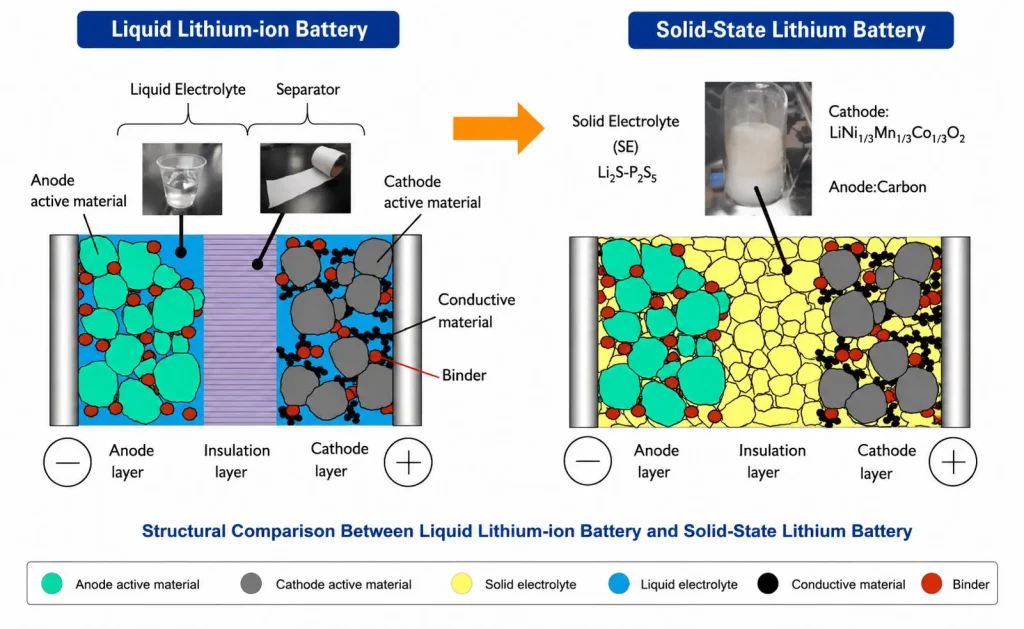
Core Datasheet Parameter Comparison
The following table provides a direct parameter-by-parameter comparison for a standard 1MWh C&I deployment (e.g., 5x 215kWh cabinets).
|
Engineering Parameter |
Conventional Tier 1 Liquid LFP |
MegSolid Hybrid Solid-State |
|---|---|---|
| Electrolyte State | Volatile Liquid | Stable Solid Matrix |
| Cycle Life (0.5C, 25°C, 80% DOD) | 3,000-6,000 cycles depending on cell chemistry and operating conditions | ≥ 5,000 cycles under specified operating conditions; safety validated according to IEC 62619 |
| Capacity Fade (Year 8) | >20% (May require augmentation) | <10% projected degradation under specified operating conditions (augmentation requirements reduced) |
| Thermal Stability & Propagation | Lower thermal stability window; high propagation tendency via vaporized electrolyte | Wider thermal stability window; lower thermal propagation tendency due to non-volatile matrix |
| Blast Wall Requirement (NFPA 855) | May require additional separation distances or blast walls depending on local AHJ | May require additional separation distances or blast walls depending on local AHJ |
| Fire Suppression Agent | Requires extensive clean agent / water | NOVEC 1230 / Aerosol (Reduced volume) |
| THDi Performance | ~5% (Often requires external filters) | Designed to achieve <3% THDi under specified grid conditions |
| Grid Code Compliance Tuning | Standard firmware | Custom-tuned PCS firmware (IEEE 1547) |
Physical Footprint & Logistics Parameters
The physical weight and form factor of the BESS dictate the hidden civil costs and installation timeline of a project.
|
Logistics Parameter |
Conventional Tier 1 Liquid LFP |
MegSolid Hybrid Solid-State |
|---|---|---|
| Cabinet Weight (215kWh) | ~4,200 kg - 4,500 kg | ~3,900 kg |
| 1MWh Array Weight | ~21,000 kg | ~19,500 kg |
| Installation Equipment | 50-ton to 100-ton mobile crane | Standard industrial forklift |
| Foundation Requirement | Reinforced concrete pad | Standard industrial concrete slab |
| Onsite Installation Time (1MWh) | 5 - 7 working days | < 2 working days |
| Site Access Constraints | Requires wide heavy-haul roads | Standard flatbed truck access |
An anonymized field deployment example from a Southeast Asia industrial site:
- Deployment scenario: 5 × 215kWh cabinets
- Installation method: Forklift-based modular deployment
- Observed result: Reduced onsite installation duration from 5 working days to <2 working days
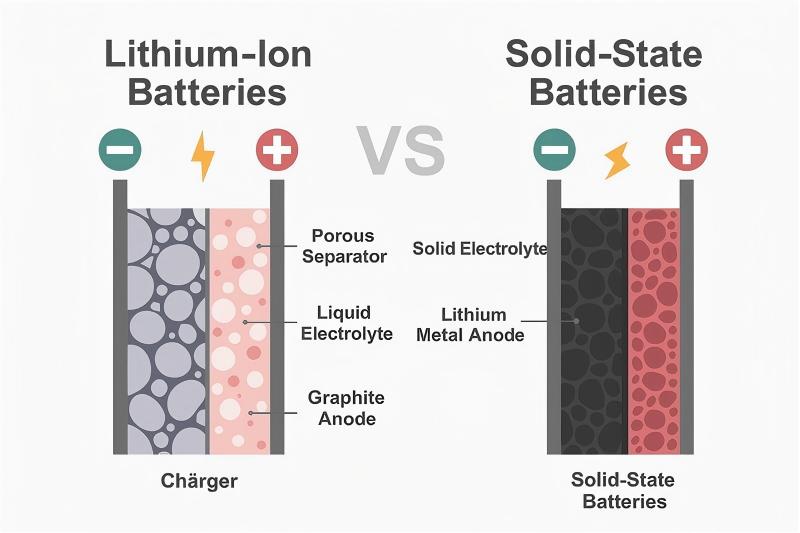
What EPC Contractors Should Ask Before Selecting a Solid-State BESS Supplier
To verify the engineering claims of any solid-state BESS supplier, EPC procurement teams must ask the following technical questions during the RFQ phase:
- Is the solid-state claim supported by cell-level documentation? Request the IEC 62619 certification and internal impedance spectroscopy data proving the solid electrolyte matrix.
- What is the thermal validation method? Ask for UL 9540A unit-level test reports to verify propagation risk mitigation.
- How is SOH degradation modeled? Request the 10-year capacity fade projection validated by internal laboratory accelerated aging tests under C&I peak-shaving profiles.
- Can the supplier provide PCS compatibility data? Verify that the PCS firmware is custom-tuned for the specific solid-state chemistry to ensure <3% THDi and IEEE 1547 compliance.
- What is the field service capability? Ensure the manufacturer provides direct engineering team remote diagnostic support, not just third-party maintenance.
- Does the supplier provide third-party validation data? Ensure test reports are backed by independent bodies like TÜV, UL, SGS, or Intertek, not just internal claims.
Illustrative Lifecycle Cost Model
The initial CapEx quotation rarely reflects the true 15-year cost.
Assumptions: 1 cycle/day; 15-year evaluation period; No electricity revenue included; No financing included; Regional installation cost varies. Actual project economics vary based on electricity tariffs, demand charges, incentives, and operating strategy.
|
Cost Parameter (1MWh System) |
Conventional Tier 1 Liquid LFP |
MegSolid Hybrid Solid-State |
|---|---|---|
| Initial Hardware CapEx | $450,000 | $500,000 |
| Civil & Crane Logistics | $50,000 | $10,000 |
| Grid Compliance Retrofit | $20,000 (External THDi filters) | $0 (Built-in isolation) |
| Mid-Life Augmentation (Year 8) | $200,000 (Battery rack replacement) | $0 (5,000+ cycles covers lifecycle) |
| 15-Year Total Cost | $0 (5,000+ cycles covers lifecycle) | $510,000 |
| TCO Advantage | Baseline | ~29% Lower |
MegSolid C&I BESS Solutions Selection Guide
Selecting the correct architecture depends on project scale, grid connection requirements, and footprint constraints. Below is a product matching guide based on capacity needs.
|
Application Scale |
Recommended Size |
Recommended MegSolid Solution |
Key Engineering Benefit |
|---|---|---|---|
| Small Factory Peak Shaving | 215kWh – 430kWh | 100kW 215kWh Outdoor Cabinet ESS | Modular, forklift installable, 0.5C C-rate |
| Medium C&I Facility | 645kWh – 1MWh | 5x 215kWh Cabinet Array | Parallel operation, scalable CapEx |
| Industrial Microgrid | 1MWh+ | MPS Integrated Microgrid System | Grid-forming PCS, <10ms off-grid switch |
| Utility Deployment | MWh Container System | MegSolid 5000INTL Containerized ESS | High-density 1331.2V DC bus, liquid cooling |
Engineering Validation Checklist for BESS Procurement
|
Validation Item |
Why It Matters |
|---|---|
| BOM Batch Traceability (IEC 62619) | Cell consistency and quality control |
| Cell consistency and quality control | Thermal propagation validation |
| Designed <3% THDi (IEEE 519) | Power quality and grid compliance |
| 15-Year SOH Degradation Curve | Lifecycle planning and augmentation risk |
| Modular Cabinet Design (Forklift) | Civil engineering and installation cost reduction |
| Solid-State Electrolyte Matrix Specs | Cell-level safety verification |
| Closed-Loop Liquid Cooling Specs | Thermal management and derating prevention |
| Fire Suppression Schematics (NFPA 72) | Explosion control and AHJ approval |
FAQ
Q1: What is the main difference between solid-state and Tier 1 liquid LFP BESS?
The primary difference is the electrolyte state and cycle life. Liquid LFP uses volatile electrolytes and typically offers 3,000-6,000 cycles depending on operating conditions. MegSolid solid-state utilizes a stable matrix, offering ≥5,000 cycles under specified conditions, reducing mid-life augmentation risk.
Q2: Does solid-state chemistry really eliminate thermal runaway?
No battery is completely immune. However, the solid electrolyte matrix provides a wider thermal stability window and lower thermal propagation tendency compared to conventional liquid systems, mitigating cell-to-cell propagation risk.
Q3: Why does a modular 215kWh cabinet reduce civil engineering costs?
Why does a modular 215kWh cabinet reduce civil engineering costs?
Q4: What is the cycle life of MegSolid's solid-state BESS?
Validated via IEC 62619 methodologies, the hybrid solid-state architecture achieves ≥5,000 cycles for the 215kWh outdoor cabinet under specified operating conditions, supporting typical 10-year commercial warranty periods.
Q5: Is the initial CapEx of a solid-state BESS higher?
Yes, the initial hardware CapEx is typically higher. However, the illustrative 15-year TCO is approximately 29% lower because solid-state architecture eliminates the Year 8 battery augmentation and heavy civil retrofit costs associated with liquid LFP.
Q6: Does the system include a built-in isolation transformer?
Yes. The PCS features a built-in isolation transformer, providing galvanic isolation and is designed to achieve <3% THDi under specified grid conditions, complying with IEEE 519 standards without the need for external harmonic filters.
Q7: How to compare solid-state vs. liquid LFP BESS?
Compare the systems based on cycle life (solid-state offers ≥5,000 cycles vs. liquid's 3,000-6,000 depending on conditions), thermal propagation tendency (solid-state offers a wider stability window), and 15-year TCO (solid-state eliminates mid-life augmentation and heavy crane logistics).
Q8: What is the thermal runaway risk of liquid LFP?
Liquid LFP systems use volatile electrolytes that can vaporize and propagate fire rapidly, often requiring blast walls. Solid-state matrices utilize non-volatile electrolytes, mitigating propagation risk.
Q9: What is the 15-year TCO of a solid-state BESS?
Based on an illustrative lifecycle cost model (1 cycle/day, 15-year evaluation), the 15-year TCO of a solid-state BESS is approximately 29% lower than a standard liquid LFP system, primarily due to the elimination of mid-life battery augmentation and civil retrofits.
Get Your Custom Microgrid Engineering Consultation
For technical consultation, microgrid system selection, OEM/ODM cooperation, and distributor opportunities, contact our engineering team:
Global Sales & HQ (Hong Kong):
FLAT 7, 11/F BLK C HANG WAI IND CTR, 6 KIN TAI ST, TUEN MUN, HONG KONG
- Email: [email protected]
- Phone: +852 59811073
R&D & Manufacturing Facility (Huzhou):
No. 898 Mengxi Road, South Taihu New Area, Huzhou City, Zhejiang Province, P.R.China
- Website: https://www.solidess.com/
