 Skip to content
Procuring raw LiFePO4 cells instead of integrated Battery Energy Storage Systems (BESS) for Australian C&I projects introduces severe engineering risks regarding AS 4777.2 grid compliance and thermal management.
Without system-level PCS and EMS integration, bare cells cannot perform AEMO arbitrage or pass local AHJ reviews.
Procuring an integrated solid-state ESS ensures compliance, safety, and 10-year ROI.
Need Help Evaluating an Australian C&I BESS Supplier?
Secure your project timeline with our standardized verification tools.
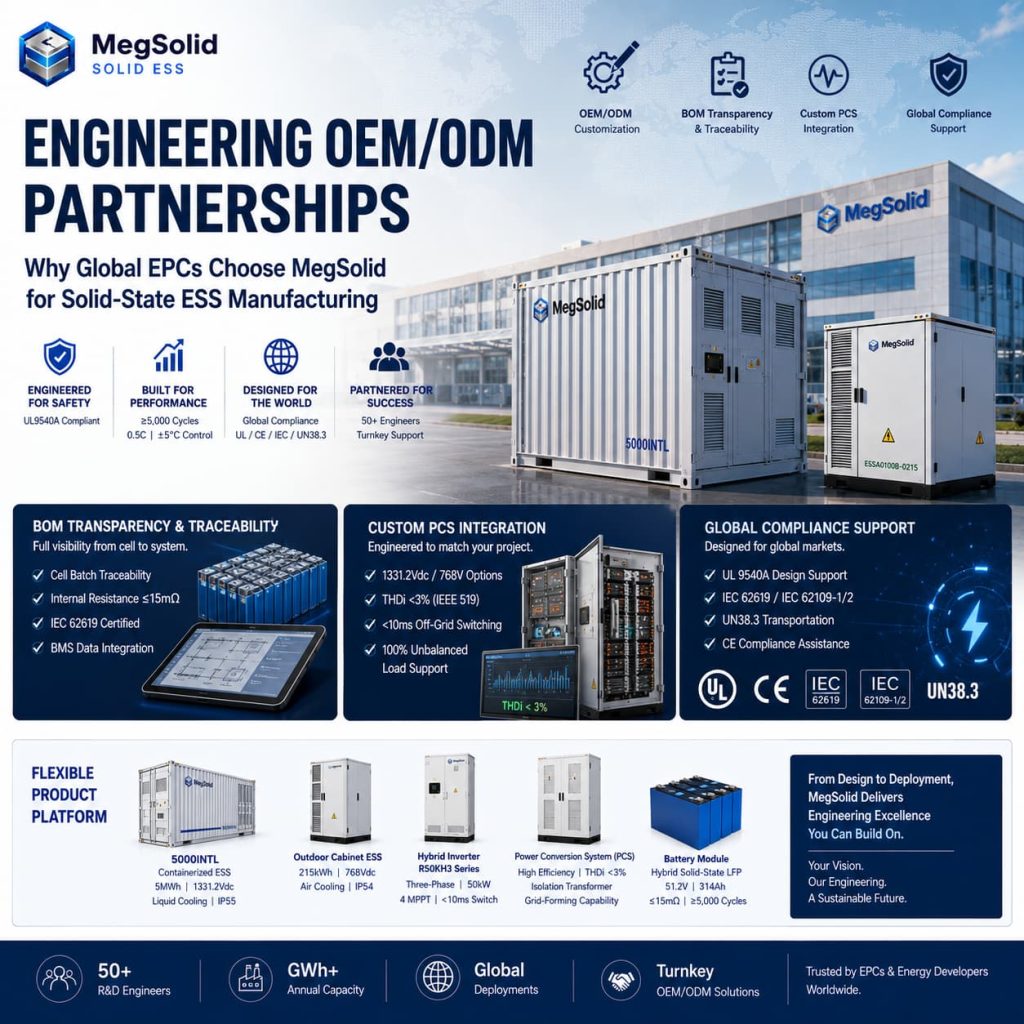
Cell Supplier vs. Integrated BESS Supplier: Engineering Comparison
EPC contractors must understand that procuring bare cells shifts the engineering risk entirely to the project site. An integrated BESS supplier mitigates these risks through factory validation.
|
Engineering Parameter |
Raw LiFePO4 Cells |
Integrated MegSolid BESS |
|---|---|---|
| PCS Integration | ❌ (EPC must source & integrate separately) | ✅ (Factory integrated & tuned) |
| EMS Control & AEMO API | ❌ (No system controller) | ✅ (EMS-enabled market participation) |
| Grid Compliance (AS 4777.2) | EPC Responsibility | Supplier Supported (Factory tuned) |
| Thermal Management | EPC Design Risk | Factory Validated (Closed-loop liquid cooling) |
| Warranty Responsibility | Split (Cell vs. PCS) | Single Supplier (Complete system) |
The Engineering Risks of Fragmented Cell Procurement in Australia
Many Australian EPC contractors attempt to reduce CapEx by sourcing raw LiFePO4 cells and assembling BESS cabinets locally.
However, this fragmented procurement approach introduces critical engineering failures:
- Grid Compliance & AS 4777.2: Bare cells lack a Power Conversion System (PCS). Without a PCS tuned for AS 4777.2 Volt-VAR response and <3% THDi, the project will face grid operator rejection.
- AEMO Arbitrage Failure: To profit from negative spot prices in the NEM, the EMS must integrate with the AEMO 5-minute dispatch API. Raw cells cannot execute this autonomously. (Explore our previous analysis on commercial energy storage procurement).
- Thermal Runaway in Extreme Heat: Australia experiences ambient temperatures exceeding 40°C. Liquid LFP cells require careful thermal management. Without an integrated closed-loop liquid cooling system, cells will suffer accelerated degradation. (For foundational knowledge, read our BESS thermal runaway prevention guide).
Core Datasheet Parameters for Australian C&I BESS
When assessing battery storage companies for Australian deployments, procurement teams must demand verifiable engineering data across three critical pillars.
1. AS 4777.2 & AEMO API Integration
An Australian C&I BESS must interconnect seamlessly and participate in automated market arbitrage.
EPCs should mandate that the supplier integrates a PCS architecture supporting AS 4777.2 compliance, with grid-forming capability where required by project requirements, and a built-in isolation transformer.
Furthermore, the EMS must be capable of EMS-enabled energy market participation through AEMO-related dispatch data integration to capture negative price revenue.
2. Solid-State Chemistry for High-Temperature Safety
Liquid electrolyte LFP systems require careful thermal management during extreme heat conditions.
MegSolid's hybrid solid-state matrix is designed to reduce thermal propagation risk and improve intrinsic safety characteristics compared to conventional liquid electrolyte systems.
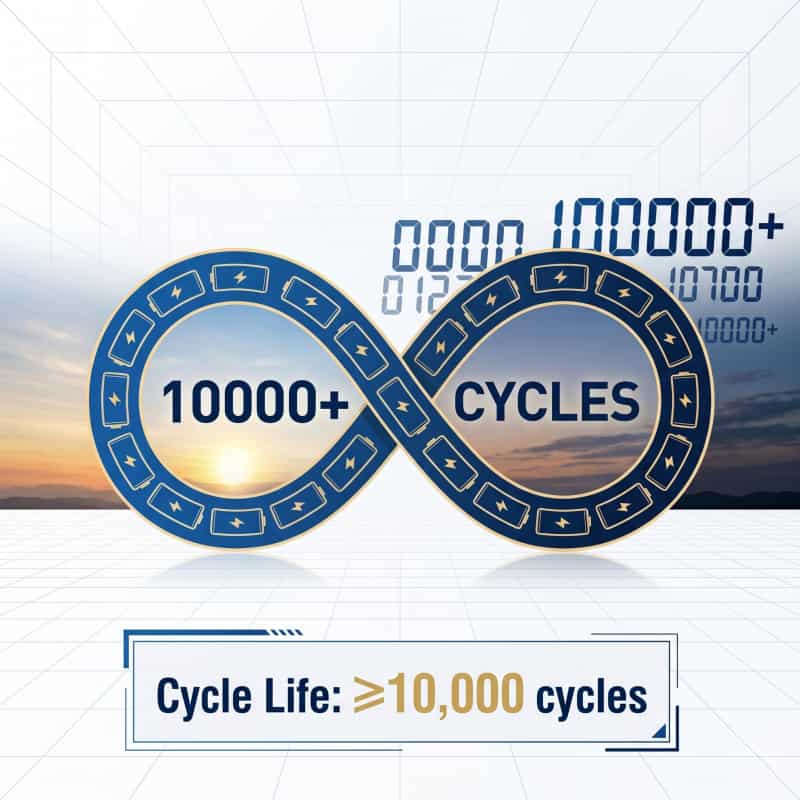
Validated to ≥5,000 cycles under specified operating conditions; safety is validated according to IEC 62619. (Explore our previous analysis on solid-state vs. liquid LFP BESS).
3. High-Density Modular Deployment
Standard liquid LFP containers require reinforced pads.
Direct manufacturers like MegSolid engineer modular 215kWh outdoor cabinet architectures.
Weighing approximately 3,900 kg, these cabinets can be deployed on standard industrial slabs using an industrial forklift, reducing dependence on heavy crane logistics. (Explore our 215kWh C&I Energy Storage Cabinet for modular logistics).
Engineering Case Study: NSW 500kW Manufacturing Facility Evaluation
The following engineering scenario demonstrates how MegSolid evaluates a typical Australian C&I peak-shaving architecture during technical pre-assessment.
- Project Evaluation Date: March 2026
- System Architecture: 5 × 215kWh Outdoor ESS Cabinet, 500kW PCS, 415V AC Industrial Connection
- System Architecture: 5 × 215kWh Outdoor ESS Cabinet, 500kW PCS, 415V AC Industrial Connection
- Validation Documents: Thermal chamber test report, PCS harmonic measurement, FAT checklist.
- Outcome: Designed for streamlined grid integration review with <3% THDi. The EMS was configured to predictively charge during negative price events.
MegSolid Engineering Validation Reference Data
To support procurement decisions, the following engineering evidence is available for review:
|
Parameter |
Evidence Available |
|---|---|
| Cell Safety | IEC 62619 test documentation |
| Thermal Performance | Environmental chamber test records |
| Cycle Performance | Internal cycle validation report |
| Manufacturing Quality | Cell batch traceability records |
| System Safety | UL 9540A evaluation status: Available upon technical request |
7 Questions to Ask Before Selecting an Australian C&I BESS Supplier
To ensure system integrity and project success, EPC procurement teams must ask these critical questions during the RFQ phase:
- Does the supplier provide complete PCS + EMS integration? Verify that the system is delivered as a turnkey solution, not just a collection of components.
- Can they provide AS 4777.2 compliance documentation? Request evidence of Volt-VAR tuning and <3% THDi performance under specified grid conditions.
- How is thermal propagation tested? Ask for UL 9540A unit-level test reports to verify safety.
- Is cell traceability available? Request IEC 62619 certifications linked directly to specific production batches.
- What is the SOH warranty model? Request 10-year capacity fade projections under Australian load profiles.
- Can FAT be performed before shipment? Confirm that Factory Acceptance Testing protocols are available and can be witnessed.
- Who owns system responsibility after commissioning? Ensure single-supplier warranty for the complete BESS, avoiding split responsibilities.
How to Verify an Australian BESS Supplier Before RFQ Approval
Before entering technical discussions, procurement teams must verify the foundational reliability of the supplier.
|
Verification Item |
Purpose |
|---|---|
| Factory Audit | Confirm manufacturing capability and automated production lines |
| Cell Traceability | Verify quality control via IEC 62619 batch records |
| Production Capacity | Ensure delivery reliability for project timelines |
| Warranty Terms | Clarify lifecycle risk and capacity fade guarantees |
| Service Network | Confirm O&M support and remote diagnostic capabilities |
Illustrative Lifecycle Cost Comparison
Illustrative engineering model based on: 1MWh capacity, 365 cycles/year, 15-year analysis period, Australia industrial installation conditions.
The following model demonstrates potential lifecycle cost differences under defined assumptions. Actual results depend on duty cycle, climate conditions, warranty terms and maintenance strategy. The following values are illustrative assumptions for engineering comparison and should be replaced by project-specific quotations and operating conditions.
|
Cost Parameter (1MWh System) |
Conventional Liquid LFP UPS |
MegSolid Dual-Purpose Solid-State |
|---|---|---|
| Initial Hardware CapEx | $450,000 | $500,000 |
| Civil & Crane Logistics | $50,000 | $10,000 |
| Grid Compliance Retrofit | $20,000 (External THDi filters) | $0 (Built-in isolation) |
| Mid-Life Augmentation (Year 8) | $200,000 (Battery rack replacement) | Reduced augmentation requirements under specified operating conditions |
| 15-Year Total Cost | $720,000 | $510,000 |
| Lifecycle Impact | Baseline | Potential lifecycle impact under defined assumptions |
Australian C&I BESS Supplier Evaluation Matrix
To assist in the objective selection of a BESS supplier, EPC teams can utilize the following weighted evaluation matrix:
|
Evaluation Criteria |
Weight |
|---|---|
| AS 4777.2 & AS/NZS 5139 Validation | 25% |
| Cycle Degradation Data | 20% |
| AEMO API Integration | 20% |
| Factory FAT Capability | 15% |
| BOM Traceability | 10% |
| 15-Year TCO Model | 10% |
About MegSolid Engineering Team
MegSolid's engineering capabilities are built on deep expertise in industrial ESS deployment:
- Battery System Design: Hybrid solid-state matrix development.
- PCS Integration: Custom firmware tuning for VDE-AR-N 4110 and IEEE 519 compliance.
- Thermal Safety Validation: Environmental chamber FAT and UL 9540A testing protocols.
Regulatory References
MegSolid's engineering design aligns with the following external standards:
- AS 4777.2: Inverter requirements for grid connection in Australia.
- AS/NZS 5139: Electrical installations - Safety of battery systems for use with power conversion equipment.
- IEC 62619: Safety requirements for secondary lithium cells and batteries used in industrial applications.
- UL 9540A: Test Method for Evaluating Thermal Runaway Fire Propagation in Lithium-Ion Energy Storage Systems.
(Explore our comprehensive C&I ESS solution and OEM/ODM manufacturing services).
FAQ
Q1: Why is buying raw LiFePO4 cells instead of an integrated BESS risky for Australian C&I projects?
Procuring raw cells shifts the engineering risk to the EPC. Without factory-integrated PCS and EMS, the system cannot guarantee AS 4777.2 grid compliance, cannot perform AEMO arbitrage, and risks thermal runaway in extreme heat without validated closed-loop cooling.
Q2: How does an integrated BESS ensure AS 4777.2 grid compliance in Australia?
The integrated PCS is factory-tuned to support AS 4777.2 Volt-VAR response and features a built-in isolation transformer designed to achieve <3% THDi under specified grid conditions, preventing grid operator rejection without external retrofits.
Q3: How does the EMS participate in AEMO arbitrage in the Australian NEM?
The EMS integrates with the AEMO 5-minute dispatch API. It autonomously commands the PCS to charge during negative spot price events and discharge during peak pricing, maximizing ToU arbitrage revenue without manual intervention.
Q4: What are the thermal management risks for liquid LFP cells in Australia?
Australia experiences ambient temperatures exceeding 40°C. Liquid electrolytes require careful thermal management. Without an integrated closed-loop liquid cooling system, cells suffer accelerated degradation and increased thermal propagation risks.
Q5: How does warranty responsibility differ between buying cells vs. an integrated BESS?
Buying raw cells splits the warranty (cell vs. PCS). An integrated BESS provides a single-supplier warranty for the complete system, simplifying claims and ensuring system-level accountability after commissioning.
Q6: How does modular cabinet design reduce civil engineering risks in Australia?
Modular 215kWh cabinets weigh approximately 3,900 kg and can be deployed on standard industrial slabs using an industrial forklift. This reduces dependence on 100-ton mobile cranes and reinforced concrete pads required by heavier liquid containers.
Q7: Why is cell traceability critical for Australian C&I BESS procurement?
EPCs must request IEC 62619 cell certifications linked directly to specific production batches. Direct manufacturers like MegSolid provide complete BOM documentation, ensuring cell consistency and simplifying warranty claims.
Q8: Does procuring a solid-state BESS reduce mid-life augmentation requirements?
Yes. Validated via IEC 62619 methodologies, MegSolid's hybrid solid-state architecture achieves ≥5,000 cycles under specified operating conditions. This reduces mid-life augmentation requirements compared to conventional liquid LFP systems.
Q9: Why is PCS compatibility data essential when evaluating Australian BESS suppliers?
Without custom-tuned firmware for <3% THDi and AS 4777.2 compliance, the BESS may cause harmonic distortion on the local grid, leading to utility penalties or commissioning delays.
Q10: Can MegSolid customize the PCS firmware for specific Australian grid codes?
Yes. As a direct manufacturer, MegSolid engineers tune active power filtering and anti-islanding parameters at the factory level to meet specific regional standards like Australian AS 4777.2 or IEEE 1547.
Q11: How to evaluate telecom energy storage suppliers in Germany?
Evaluate suppliers based on AS 4777.2 and AS/NZS 5139 compliance, AEMO API integration capability, cycle life (solid-state offers ≥5,000 cycles vs. liquid's 3,000-6,000), thermal propagation tendency, and 15-year TCO.
Q12: What are the engineering risks of buying LiFePO4 cells for Australian C&I BESS?
Buying raw LiFePO4 cells lacks PCS and EMS integration, leading to AS 4777.2 grid compliance failures, inability to perform AEMO arbitrage, and thermal degradation risks in extreme heat without integrated liquid cooling.
Q13: How much does a commercial battery storage system cost in Australia?
Based on an illustrative lifecycle cost model (1MWh capacity, 365 cycles/year, 15-year evaluation), the 15-year TCO of a solid-state BESS demonstrates a potential lifecycle cost reduction compared to a standard liquid LFP system, primarily due to reduced mid-life augmentation requirements and civil retrofits.
Get Your Custom Microgrid Engineering Consultation
For technical consultation, microgrid system selection, OEM/ODM cooperation, and distributor opportunities, contact our engineering team:
Global Sales & HQ (Hong Kong):
FLAT 7, 11/F BLK C HANG WAI IND CTR, 6 KIN TAI ST, TUEN MUN, HONG KONG
- Email: [email protected]
- Phone: +852 59811073
R&D & Manufacturing Facility (Huzhou):
No. 898 Mengxi Road, South Taihu New Area, Huzhou City, Zhejiang Province, P.R.China
- Website: https://www.solidess.com/
