 Skip to content
A commercial and industrial battery energy storage system selected for a mild climate cannot be assumed to deliver the same output, efficiency or operating life at a Saudi industrial site.
Direct solar exposure, heat reflected from concrete, dust accumulation, restricted ventilation and thermal discharge from nearby transformers can raise the temperature entering the BESS above the regional ambient temperature.
For a Saudi C&I project, select the BESS according to the equipment-intake temperature and verified full-power derating curve—not only the maximum operating-temperature limit. The RFQ should define battery and PCS derating, cooling auxiliary consumption, dust maintenance, solar exposure, SEC connection requirements and high-temperature FAT acceptance criteria.
As MegSolid’s Mfg & Supply Chain Director with 15 years of battery manufacturing and international project-delivery experience, I recommend treating thermal performance as a procurement requirement. It should not be left for the commissioning team to solve after the equipment reaches the site.
The supplier must prove how the battery, PCS, cooling system and EMS operate together under the project design conditions.
Why Regional Climate Data Is Not the BESS Design Temperature
The Saudi National Center for Meteorology climate overview states that maximum temperatures generally range from 35°C to 45°C during the Saudi summer.
This range is useful for preliminary screening, but it is not an equipment-selection temperature.
The project design basis must consider:
- Maximum temperature at the BESS cooling-air intake
- Direct solar radiation and shading
- Heat reflected from concrete, asphalt and nearby walls
- Heat discharged by transformers or diesel generators
- Clearance between adjacent cabinets
- Duration of extreme-temperature events
- Dust loading and filter pressure loss
- Coastal salt exposure where applicable
A cabinet installed against a sun-heated wall can experience a materially higher intake temperature than the value shown in a city climate table.
The RFQ should state a defined maximum equipment-intake temperature and require the supplier to provide battery and PCS output curves at that condition.
Maximum Operating Temperature Does Not Mean Full Rated Output
A datasheet may list operation up to 55°C while requiring power derating above 45°C.
These two statements are not contradictory. The maximum operating temperature indicates an environmental limit, while the derating curve shows how much power remains available as temperature increases.
The EPC should ask for:
- Full-power temperature range
- Derating start temperature
- Power available at the project design temperature
- Warning and shutdown thresholds
- Recovery logic after temperature falls
- Maximum cooling auxiliary consumption
- Warranty restrictions at high temperature
A supplier response stating only “operating temperature: -20°C to 55°C” is incomplete for a project that requires full discharge power at 50°C.
Verified MegSolid C&I Product Parameters
MegSolid product chemistry and cooling method must be stated at the exact model level. Specifications from a residential hybrid solid-state battery must not be transferred to a C&I cabinet that is listed as LFP.
ESSA0100B-0215 Intelligent Air-Cooled Cabinet
The MegSolid ESSA0100B-0215 outdoor battery cabinet is an LFP C&I system using intelligent air cooling.
| Parameter | Verified value |
|---|---|
| Rated AC power | 100kW |
| Rated energy | 215.04kWh |
| Cell | 3.2V, 280Ah LFP |
| Battery configuration | 1P240S |
| Nominal battery voltage | 768V |
| Battery voltage range | 672–850V |
| Charge/discharge rate | 0.5C at 25°C |
| Listed cycle life | ≥5,000 cycles |
| Rated AC voltage | 400V |
| Grid-current THD | <3% |
| Operating temperature | 0–45°C |
| Cooling method | Intelligent air cooling |
| Ingress protection | IP54 |
| Dimensions | 2,450 × 1,550 × 2,400mm |
| Net weight | 3,900kg |
This model must not be described as liquid-cooled or hybrid solid-state. Its suitability for Saudi Arabia depends on whether the equipment-intake temperature can be maintained within its verified 0–45°C operating range.
For an outdoor Saudi installation, the supplier should explain how shading, airflow, cabinet spacing and filter maintenance will prevent the intake condition from exceeding that limit.
Meg-Solid Energon 261.24kWh Liquid-Cooled System
The MegSolid 261.24kWh liquid-cooled C&I system uses 314Ah LFP cells.
| Parameter | Verified value |
|---|---|
| Rated energy | 261.24kWh |
| Rated AC capacity | 125kVA |
| Cell chemistry and capacity | LFP, 314Ah |
| Battery configuration | 1P260S |
| Nominal DC voltage | 832V |
| DC voltage range | 676–936V |
| Cooling method | Liquid cooling |
| Operating temperature | -20°C to 55°C |
| Derating | Above 45°C |
| Maximum system efficiency | 90% |
| Parallel operation | Up to 10 units |
| Ingress protection | IP54 |
| Communications | RS485, LAN and 4G |
| Dimensions | 1,300 × 1,350 × 2,200mm |
The current controlled knowledge base does not classify this system as hybrid solid-state or semi-solid. Its trade name must not be used as evidence of electrolyte architecture.
The published 90% value is maximum system efficiency. It must not be rewritten as round-trip efficiency without defining:
- AC-to-AC or DC-to-AC measurement boundary
- PCS and transformer losses
- Cooling and auxiliary consumption
- Starting and ending SOC
- Charge and discharge power
- Battery temperature
- Rest periods
- State of health
Using “maximum system efficiency” on one page and “round-trip efficiency exceeds 90%” on another creates an unresolved technical conflict unless both test methods are disclosed.
Larger Liquid-Cooled Projects
For multi-megawatt-hour projects, the MegSolid 5000INTL containerized BESS lists 5,015.9kWh rated energy, 2.7MW rated AC power, smart liquid cooling, IP55 protection and an operating-temperature range of -30°C to 55°C.
Its battery type is published as SHS180-314, but the current product page does not explicitly define the chemistry as LFP, hybrid solid-state or semi-solid. The code must not be expanded into an unsupported chemistry claim. Its 87.5% maximum-efficiency value is also not an explicitly defined round-trip efficiency.
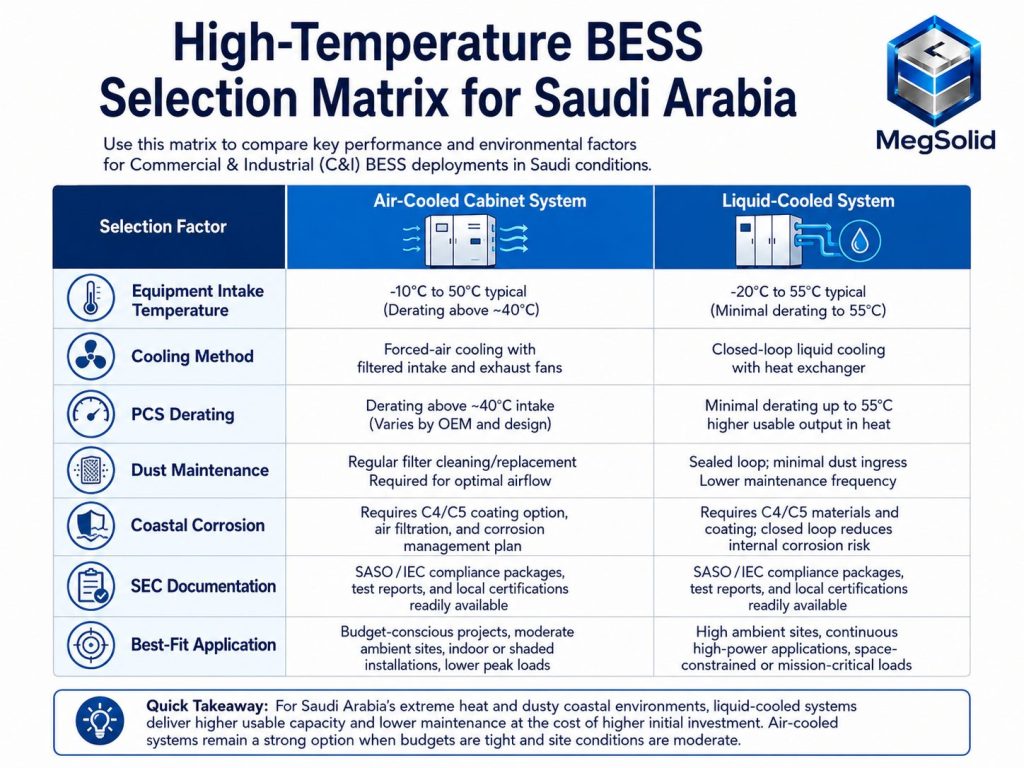
Air Cooling vs Liquid Cooling for Saudi Projects
Air cooling and liquid cooling should be compared according to the project thermal load, not through a generic claim that one method is always superior.
| Procurement factor | Air-cooled cabinet | Liquid-cooled system |
|---|---|---|
| Heat transfer | Depends directly on cooling airflow | Coolant transfers heat from battery modules |
| Dust sensitivity | Filters and air paths are critical | External heat rejection remains dust-sensitive |
| Temperature control | Suitable within verified environmental limits | Generally supports tighter temperature control |
| Auxiliary equipment | Fans and filters | Pumps, coolant loop and heat exchanger |
| Maintenance focus | Filters, fans and internal airflow | Coolant, pumps, seals and external exchanger |
| Best fit | Moderate thermal duty and controlled intake | Higher thermal load or wider operating range |
Air cooling and liquid cooling should be compared according to the project thermal load, not through a generic claim that one method is always superior.
Air cooling can remain commercially suitable where the site provides effective shading, adequate clearance, controlled intake temperature and a realistic filter-maintenance programme.
PCS Derating Must Be Reviewed Separately
The battery may remain within its operating range while the PCS has already reduced output.
The MegSolid MEGA PCS range covers 30kW to 500kW and lists operation from -30°C to 55°C. It uses forced-air cooling and has an IP21 enclosure.
IP21 means the PCS requires a suitably protected room, cabinet or container rather than direct unprotected desert exposure. Its full-power derating curve should be obtained for the selected model.
The PMA modular PCS range operates from -30°C to 60°C but derates above 45°C. Its power compartment is IP20, so the surrounding electrical enclosure and HVAC design become part of the complete BESS specification.
The project power guarantee should therefore be based on the combined battery-and-PCS limit at the site design temperature.
Illustrative High-Temperature Heat-Load Review
Illustrative Engineering Calculation — Not a Test Result
The cooling system must reject heat from more than the battery cells.
A simplified thermal boundary is:
Required heat-rejection capacity = battery heat generation + PCS conversion losses + internal transformer losses + control and cooling auxiliary heat + solar and enclosure heat gain
For example, the MEGA0100TS lists a maximum conversion efficiency of 97.1%. At 100kW AC output, the theoretical PCS conversion loss at that maximum-efficiency point is approximately 3kW.
That value is not a Saudi high-temperature design loss. Maximum efficiency may occur at a different power, voltage and temperature from the project operating condition. The actual thermal calculation must use the project-specific PCS efficiency curve and ambient derating data.
A procurement-grade thermal calculation should document:
| Input | Evidence required |
|---|---|
| Battery heat generation | Model-level thermal data |
| PCS loss | Efficiency curve at required power and temperature |
| Transformer loss | Transformer test data |
| Solar heat gain | Enclosure surface and radiation calculation |
| Intake temperature | Site thermal assessment |
| Cooling capacity | Manufacturer performance curve |
| Auxiliary consumption | Maximum high-temperature value |
| Design margin | Project engineering calculation |
This calculation is more valuable than a general statement that the cabinet includes “advanced thermal management.”
IP54 Does Not Prove Desert Performance
The IEC explanation of ingress-protection ratings states that IEC 60529 classifies the protection provided by enclosures against intrusion by solids and liquids.
IP54 does not by itself define:
- Filter-clogging intervals
- Sand-abrasion resistance
- Cooling-airflow reduction
- Heat-exchanger fouling
- Long-term heat-rejection performance
- Salt-mist corrosion resistance
The supplier should provide the filter design, applicable dust-test evidence, airflow or pressure-loss alarms, cleaning method, maintenance interval and spare-filter requirements.
For Jeddah, Dammam and other coastal locations, the RFQ should also request:
- Coating-system specification
- Salt-mist test evidence
- Heat-exchanger corrosion protection
- Stainless-steel fastener requirements
- Outdoor connector and cable-gland protection
An IP rating is not a corrosion classification.
Use SEC’s Dedicated BESS Requirements
Saudi projects should use the SEC Battery Energy Storage Systems resource centre, which provides BESS-specific connection, inspection and testing documents.
The EPC and supplier should review the SEC BESS Connection Guidelines before finalising the single-line diagram, interface protection, metering, controls and point-of-connection architecture.
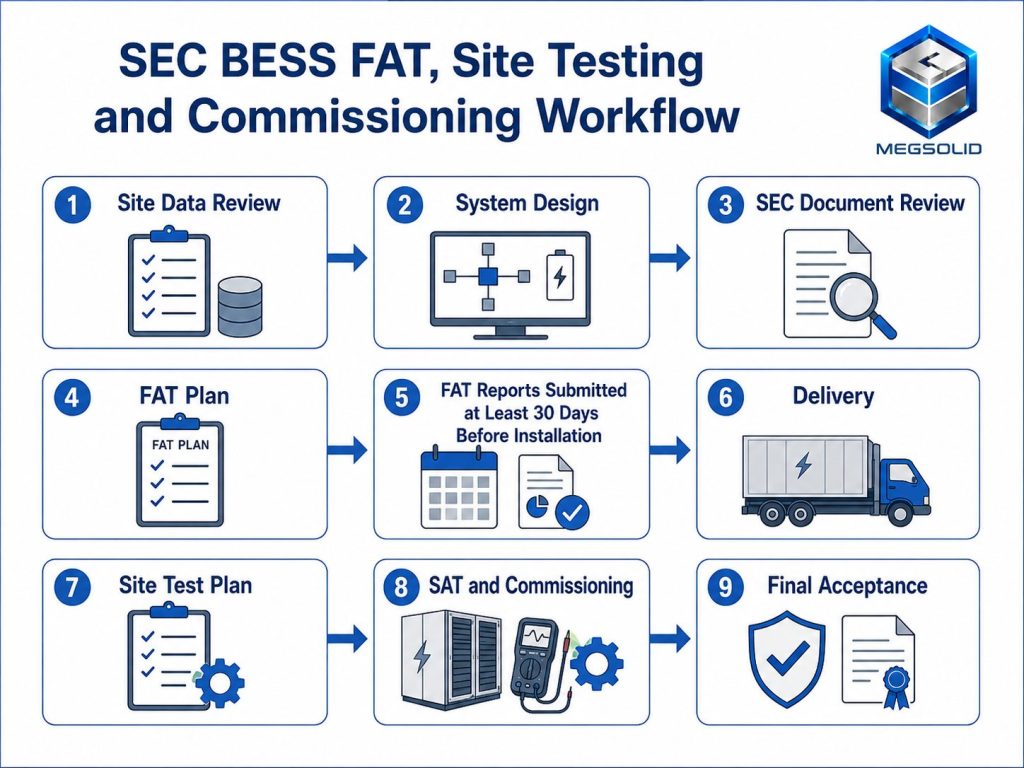
They should also review the SEC BESS Inspection and Testing Guidelines during RFQ and FAT planning.
The guidelines require the supplier to provide applicable FAT reports at least 30 days before planned installation and to provide a Site Test Plan at contract execution. The Site Test Plan must address controller communication, charge-discharge commands, capacity, response time, signal-following accuracy and grid-compliance testing.
The RFQ should include:
The supplier shall submit all project-applicable FAT reports at least 30 days before planned installation and shall provide a preliminary Site Test Plan during contract execution, subject to project-owner, EPC and SEC review.
The SEC BESS Inspection and Testing Checklists also request protection details, electrical diagrams, equipment datasheets, applicable SASO standards, equipment certification information, site-test reports and attached FAT documentation.
High-Temperature FAT Must Test More Than Alarm Logic
Control-logic simulation can verify sensor inputs, temperature alarms, derating commands and shutdown sequences.
It does not prove that the cooling system can reject the required heat at the project design temperature.
A Saudi high-temperature FAT should distinguish between:
- Control verification: sensors, alarms, derating and shutdown commands
- Electrical verification: charge and discharge power, PCS response and EMS setpoints
- Thermal verification: battery temperature, coolant or airflow response and auxiliary consumption
- Communication verification: BMS, PCS, EMS, meters and remote monitoring
- Protection verification: emergency stop, trip logic and fire-system interfaces
The FAT scope should include:
- Battery charge and discharge at the agreed power
- BMS-to-PCS communication
- EMS charge-discharge commands
- Temperature-sensor verification
- Cooling-system operating sequence
- High-temperature warning and derating logic
- Cooling auxiliary-power measurement
- Communication-loss response
- Emergency shutdown
- Grid-loss response
- Generator coordination where included
- Remote monitoring and data export
The MegSolid BESS Factory Acceptance Testing guide should be used as a starting structure, then revised for the Saudi project, SEC requirements and agreed acceptance criteria.
SASO Documentation Must Be Confirmed Before Shipment
A general IEC document package does not automatically establish Saudi conformity.
The importer, EPC and supplier should review the SASO Technical Regulation for Electrical Batteries and confirm which requirements apply to the exact cell, battery module, cabinet, PCS and complete BESS configuration.
The procurement package should identify:
- Applicable SASO regulation and standards
- Exact product model
- Certificate holder
- Certificate validity and scope
- Product labelling requirements
- Importer responsibilities
- Country-of-origin documentation
- UN38.3 documentation where applicable
- Arabic and English documentation requirements
- Any required Saudi conformity or registration process
The supplier should provide the actual report or certificate. A standards list on a webpage is not sufficient evidence that the complete BESS model is certified.
What First-Hand Evidence Should Be Added to the Page?
A high-ranking engineering article needs more than professional analysis. It should show evidence that MegSolid understands how the equipment is manufactured and tested.
Add at least two of the following:
Project Intake Temperature and Derating Review
Include a project-specific chart showing:
- Ambient temperature
- BESS intake temperature
- Battery power limit
- PCS power limit
- Cooling-system status
- Derating threshold
- Shutdown threshold
Without real project data, label the graphic:
Illustrative Engineering Diagram — Not a Test Result
FAT Interface or Test Record
Add a real, commercially redacted FAT screenshot displaying:
- Model under test
- Test date
- Battery SOC
- Charge or discharge power
- Battery temperatures
- PCS status
- Cooling-system status
- Active alarms
- Acceptance result
Do not describe a rendered illustration as an actual FAT record.
Product Cooling Detail
Use a factory photograph showing one of the following:
- ESSA cabinet airflow path
- Filter construction
- Fan arrangement
- 261.24kWh liquid-cooling pipework
- Heat exchanger
- Temperature-sensor location
A real engineering photograph provides stronger Experience evidence than another generic product rendering.
Which MegSolid System Should the EPC Evaluate?
| Project condition | Initial product direction |
|---|---|
| Up to 100kW with verified intake temperature within 0–45°C | ESSA0100B-0215 |
| 125kVA-class project requiring liquid cooling | 261.24kWh LFP system |
| Separate 30–500kW isolated PCS | MEGA PCS |
| Indoor modular PCS | PMA series |
| 2.7MW / 5.0159MWh liquid-cooled project | 5000INTL |
| Hybrid solid-state chemistry explicitly required | Request a model-specific C&I datasheet and BOM |
MegSolid does offer products explicitly identified as hybrid solid-state, including the MEG-Solid-512314FL1 residential battery.
However, those chemistry claims cannot be transferred to the ESSA0100B-0215, the 261.24kWh C&I system or the 5000INTL without an exact model-level source. Buyers seeking solid-state technology should review the MegSolid solid-state energy storage portfolio and request a project-specific proposal identifying the cell and system BOM.
Final Procurement Recommendation
A Saudi C&I BESS should be selected using the maximum equipment-intake temperature and the verified battery-and-PCS power available at that temperature.
Before issuing the purchase order, confirm:
- Battery operating and derating limits
- PCS full-power temperature range
- Cooling heat-rejection capacity
- Hot-weather auxiliary consumption
- Dust and coastal maintenance requirements
- SEC connection-document responsibility
- FAT submission schedule
- Site Test Plan and SAT scope
- SASO conformity and import documentation
- Model-specific chemistry and efficiency terminology
For controlled installations within 0–45°C, the ESSA0100B-0215 can be evaluated as a 100kW/215.04kWh intelligent air-cooled LFP cabinet.
Where liquid cooling and a wider listed operating range are required, the 261.24kWh LFP system may be evaluated, with its derating above 45°C included in the system design.
The final decision should be based on the site thermal study, load profile, SEC requirements and controlled project datasheet—not a catalogue temperature limit alone.
Need a Saudi High-Temperature BESS Proposal?
Submit:
- Project city and coordinates
- Maximum BESS intake temperature
- Direct-sun or shaded installation
- Coastal or inland environment
- Dust and sand exposure
- Twelve months of interval load data
- Existing or planned PV capacity
- Grid connection voltage
- Generator capacity
- Required backup load and duration
- Single-line diagram
- Site layout
- Target commissioning date
MegSolid will provide:
- High-temperature derating review
- Air-cooled or liquid-cooled recommendation
- Battery and PCS configuration
- SEC connection-document checklist
- Preliminary FAT and SAT scope
- Budgetary quotation
- Delivery and commissioning options
FAQ
Q1: What temperature should be used to specify a Saudi BESS?
Use the maximum expected temperature at the BESS cooling-system intake, including direct sun, reflected heat, adjacent equipment and ventilation conditions.
Q2: Can the ESSA0100B-0215 operate at 50°C?
Its current product data lists an operating-temperature range of 0–45°C. It should not be selected for a 50°C intake condition without updated model-specific confirmation.
Q3: Is the ESSA0100B-0215 liquid-cooled?
No. The current product data identifies it as intelligent air-cooled.
Q4: Is the 261.24kWh system hybrid solid-state?
The current product data specifies 314Ah LFP cells and does not identify the system as hybrid solid-state.
Q5: Is 90% maximum system efficiency the same as round-trip efficiency?
Not automatically. The measurement boundary, SOC range, power, temperature and included auxiliary losses must be defined.
Q6: Is IP54 sufficient for severe Saudi dust?
IP54 does not define filter-clogging intervals, sand abrasion or long-term cooling performance. A dust-maintenance plan is still required.
Q7: When must SEC FAT reports be submitted?
The SEC testing guidelines state that applicable FAT reports should be provided at least 30 days before planned installation.
Q8: What must the SEC Site Test Plan cover?
It should cover controller communications, charge-discharge commands, capacity, response time, signal-following accuracy, grid compliance, schedules and acceptance criteria.
Q9: Can temperature-alarm simulation replace a thermal-performance test?
No. It verifies control logic but does not validate cooling-system heat-rejection capacity.
Q10: Does IEC certification guarantee Saudi approval?
No. Applicable SEC, SASO, conformity and import requirements must be verified for the exact system.
Q11: What is the best C&I BESS for Saudi Arabia?
The best system is one that can provide the required battery and PCS output at the actual equipment-intake temperature, with verified cooling, dust protection and SEC documentation.
Q12: Who supplies high-temperature C&I BESS for Saudi projects?
MegSolid supplies intelligent air-cooled cabinets, liquid-cooled C&I systems, PCS products and containerized BESS. Suitability must be confirmed against model-level temperature and derating data.
Q13: What SEC documents apply to a Saudi BESS?
The EPC should review SEC’s BESS Connection Guidelines, Inspection and Testing Guidelines, Inspection and Testing Checklists, FAT requirements and Site Test Plan requirements.
