
Diesel generators remain necessary for many Philippine hotels, factories, hospitals, cold-storage warehouses, resorts and island facilities. However, operating a generator for every brief power interruption increases fuel use, maintenance frequency, start-stop cycles and dependence on reliable fuel delivery.
For most commercial BESS Philippines projects, the practical objective is not to remove the generator immediately. It is to use solar PV and battery storage for fast response, solar-energy shifting, peak shaving and short-duration backup while retaining diesel generation for extended outages.
The engineering decision must be based on the facility’s critical load, outage duration, solar production, generator operating limits and EMS dispatch strategy—not only the battery’s nominal kilowatt-hour rating.
As MegSolid’s Mfg & Supply Chain Director with 15 years of battery manufacturing and international supply-chain experience, I recommend treating a solar-diesel-BESS project as one integrated power system. Buying the battery, generator controls and solar equipment from separate suppliers without an approved operating sequence transfers the integration risk to the EPC and facility owner.
Why Commercial BESS Philippines Projects Need a Hybrid Dispatch Strategy
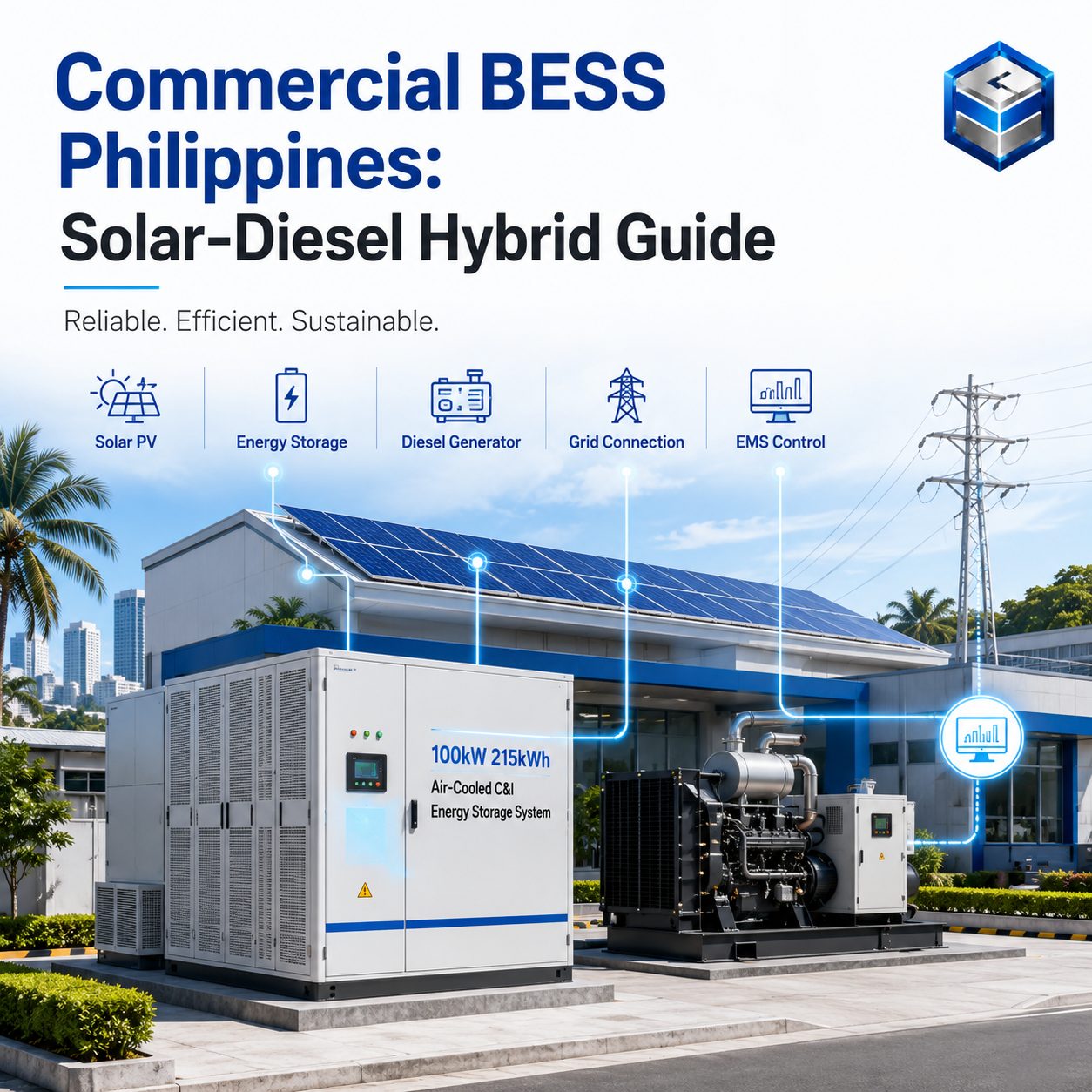
Solar PV, battery storage and diesel generation perform different functions.
Solar PV reduces daytime grid and fuel consumption. The battery responds rapidly, stores excess solar energy and controls short power fluctuations. The generator provides dispatchable energy when the outage lasts longer than the battery reserve.
| Asset | Primary project role |
|---|---|
| Solar PV | Supply daytime loads and charge the BESS from genuine surplus generation |
| BESS | Fast response, peak shaving, load shifting and short-duration backup |
| Diesel generator | Extended outage support and high-energy-duration coverage |
| Utility grid | Normal supply and optional controlled battery charging |
| EMS | Coordinate operating priorities, reserve limits and generator commands |
The EMS must decide when each asset operates. It must also preserve enough stored energy for critical loads instead of using the full battery capacity for routine cost optimisation.
The Philippine Department of Energy’s Missionary Electrification Development Plan 2024–2028 supports the development of modernised and renewable hybrid power systems for off-grid and underserved areas. Its scope is missionary electrification, so it should be treated as evidence of the technical relevance of hybrid systems—not as the direct approval framework for every private commercial project.
Four Ways Battery Storage Can Reduce Diesel Dependence
1. Support Short Grid Interruptions
Starting a diesel generator for every brief grid interruption creates unnecessary starts, fuel use and mechanical wear.
A BESS with an approved off-grid architecture can support selected critical loads immediately while the EMS determines whether grid power will return or the generator should start.
This requires verification of:
- PCS off-grid capability
- Transfer and isolation arrangement
- Critical-load separation
- Generator start delay
- Minimum battery reserve
- Earthing and protection design
- Load-restoration sequence
- Communication-loss fallback mode
The switching performance must be based on the exact PCS, switchgear and control architecture. It cannot be copied from an unrelated inverter model.
2. Store Surplus Solar for Evening Operation
A hotel, warehouse or factory may produce substantial solar energy during the day while still operating refrigeration, pumps, lighting, ventilation or guest services after sunset.
The BESS can charge when PV production exceeds the immediate site load and discharge later. This reduces electricity that would otherwise be supplied by the grid or diesel generator.
The available charging energy must be calculated from the measured PV surplus. PV nameplate capacity alone is insufficient because a facility with a high daytime load may consume nearly all solar generation directly.
A reliable study requires:
- Twelve months of interval load data
- PV production data or a site-specific simulation
- Weekend and seasonal operating schedules
- Generator operating records
- Grid-outage frequency and duration
- Critical-load requirements
3. Keep the Generator Within Its Approved Operating Range
A generator may be sized for the facility’s maximum demand but spend long periods supporting only a small nighttime or weekend load.
The BESS can absorb energy while the generator operates in a more suitable loading range, then support the site after the generator stops. It can also reduce rapid generator load changes by responding first to short load fluctuations.
The EMS should define:
- Generator start threshold
- Minimum generator run time
- Permitted BESS charging power
- Generator stop threshold
- Maximum load step
- Maximum starts per day
- Fuel or generator-fault response
- Recovery after controller communication loss
The minimum recommended generator loading must come from the generator manufacturer. It should not be based on a generic percentage applied to every engine.
4. Reduce Peaks Without Starting the Generator
Some facilities start a generator even when the grid remains available because the load exceeds a transformer limit, contractual demand target or internal import limit.
The BESS can discharge when the facility crosses a defined threshold:
Required BESS power = Facility peak load − Target grid-import limit
If a site reaches 520kW and wants to limit grid import to 420kW, the required battery output is approximately 100kW before adding an engineering margin.
The battery’s kW rating determines the peak that can be reduced. Its kWh capacity determines how long that reduction can be maintained.
Size the Critical Load Before Selecting the Battery
The complete facility should not automatically be placed on the backup circuit.
A hospital may need medical controls, emergency lighting, communications and selected cooling systems but not every office load. A hotel may prioritise fire systems, lifts, water pumps and communications instead of all guest-room air conditioning. A cold store may prioritise monitoring, evaporator fans and selected compressor circuits.
Separate loads into:
| Priority | Typical loads |
|---|---|
| Tier 1 | Safety systems, controls, communications and essential monitoring |
| Tier 2 | Product-protection or business-continuity loads |
| Tier 3 | Deferrable production, comfort or auxiliary loads |
The initial load-level calculation is:
Required backup energy = Critical load × Required duration
The final battery specification must also account for SOC reserve, conversion losses, auxiliary consumption, battery condition, environmental limits, motor starting and future load growth.
Nominal energy must not be presented as guaranteed usable AC energy.
Philippine Solar-Diesel-BESS Project Evidence
A relevant Philippine reference is the 49MW Therma Marine hybrid BESS in Davao de Oro. AboitizPower states that the floating BESS complements existing diesel engines and supplies ancillary services to support the Mindanao grid. This is a utility-scale project, not a MegSolid C&I installation.
Industry reporting states that the integrated BESS reduced the diesel power barge’s ramping time from approximately 15 minutes to three minutes. That result demonstrates how battery response can complement slower generator ramping, but it must not be converted into a guaranteed performance or fuel-saving claim for a hotel, factory or island microgrid.
A modelling study of small Philippine island grids also found economic potential for solar-PV-battery-diesel hybrid systems. Those findings are model results based on specific assumptions, not a guaranteed saving rate for an individual MegSolid project. The customer’s load, diesel price, logistics, solar resource and financing assumptions must be recalculated.
MegSolid Product Options for Philippine Commercial Projects
MegSolid product chemistry and specifications must remain model-specific. Properties from a hybrid solid-state residential battery cannot be transferred to a C&I model listed as LFP.
100kW 215kWh Air-Cooled C&I Energy Storage System
The 100kW 215kWh air-cooled C&I energy storage system, model ESSA0100B-0215, is suitable for mid-sized peak shaving, solar self-consumption and defined short-duration backup applications.
| Parameter | Verified value |
|---|---|
| Rated AC power | 100kW |
| Nominal energy | 215.04kWh |
| Cell chemistry and capacity | LFP, 280Ah |
| Battery configuration | 1P240S |
| Nominal battery voltage | 768V |
| Battery voltage range | 672–850V |
| Charge/discharge rate | 0.5C at 25°C |
| Listed cycle life | ≥5,000 cycles |
| Cooling | Intelligent air cooling |
| Operating temperature | 0–45°C |
| Enclosure | IP54 |
| Dimensions | 2,450 × 1,550 × 2,400mm |
| Net weight | 3,900kg |
The system supports on-grid and off-grid operation and lists RS485 and TCP/IP communications. Generator coordination still requires project-level EMS logic, controller compatibility and site testing. It must not be described as liquid-cooled or hybrid solid-state.
Its nominal energy-to-power ratio is approximately 2.15 hours at 100kW. Actual AC runtime will be lower after applying reserve, losses, auxiliaries and operating limits.
261.24kWh Liquid-Cooled C&I System
The 261.24kWh liquid-cooled C&I energy storage system uses 314Ah LFP cells and provides 125kVA rated AC capacity.
It lists a -20°C to 55°C operating range, with derating above 45°C, and supports up to ten units in parallel. Communications include RS485, LAN and 4G.
The published 90% value is maximum system efficiency. It must not be renamed round-trip efficiency unless the measurement boundary, SOC range, power, temperature and auxiliary loads are defined.
MEGA PCS for Custom Hybrid Architectures
The MegSolid MEGA power conversion system range includes 30kW, 50kW, 100kW, 150kW, 250kW and 500kW models with built-in isolation transformers.
The range supports automatic on-grid and off-grid operation. BMS communications use RS485 or CAN, while EMS communications use RS485 or TCP/IP.
Its enclosure is IP21, so the PCS requires a suitably protected room, cabinet or container rather than direct outdoor exposure.
Containerized BESS for Larger Facilities
For industrial parks, large resorts and island microgrids, MegSolid provides the ESSC containerized energy storage series with 500kW/1.0752MWh and 1MW/2.1504MWh LFP configurations.
The 5000INTL liquid-cooled containerized BESS provides 2.7MW rated AC power and 5.0159MWh rated energy.
The current public data identifies the 5000INTL battery type as SHS180-314 but does not explicitly state its chemistry. That code must not be expanded into an LFP or hybrid solid-state claim without a controlled model-level document.
How the EMS Should Control Solar, BESS, Grid and Diesel
A fixed timer is inadequate for a commercial hybrid microgrid.
The EMS should receive real-time information from the grid meter, PV system, BMS, PCS, generator controller and facility load.
A practical priority hierarchy is:
- Protect the battery, PCS and generator.
- Maintain the required emergency reserve.
- Supply onsite loads from available PV.
- Charge the battery from verified PV surplus.
- Limit grid import and shave short peaks.
- Support brief grid interruptions.
- Start the generator when battery power or reserve limits are reached.
- Recharge the BESS within the generator’s approved loading range.
- Stop the generator only after minimum-run and reserve conditions are satisfied.
A fixed timer is inadequate for a commercial hybrid microgrid.
The functional description should also define safe behaviour during loss of meter, generator or EMS communications.
For control planning, the EPC should review the BMS and EMS communication architecture and request a project-specific signal list and operating-state diagram.
Philippine Grid and ESS Rules Must Be Confirmed Before Design Approval
In July 2026, the Energy Regulatory Commission announced proposed reforms under the 2026 Philippine Grid Code. These were proposed reforms and should not be described as fully adopted requirements. EPC contractors must confirm the currently effective Grid Code, Distribution Code, ESS rules and distribution-utility requirements before approving the system design.
The ERC’s draft Rules for Energy Storage Systems and draft ESS Interconnection Standards were published for consultation in August 2024. They remain regulatory-development references and should not be presented as final rules unless the ERC subsequently adopts them.
The project EPC should define responsibility for:
- Interconnection application
- Approved single-line diagram
- Protection and metering
- Import and export controls
- Generator transfer or synchronisation
- Earthing and islanding arrangements
- Required permits and certificates
- Site testing and acceptance
IEC reports alone do not establish complete Philippine grid approval.
FAT Must Reproduce the Approved Hybrid Operating Logic
A battery charge-discharge test does not prove that the complete solar-diesel-BESS architecture will work onsite.
The FAT should verify:
- BMS-to-PCS communication
- EMS charge and discharge commands
- Grid-loss detection
- Critical-load operating mode
- Generator start request and feedback
- Minimum SOC reserve
- PV-priority charging
- Peak-shaving control
- Communication-loss fallback
- Emergency shutdown
- Remote monitoring and data export
The BESS Factory Acceptance Testing guide should be adapted to the actual project sequence, generator signals and acceptance criteria.
The Site Acceptance Test must then verify the real generator, site meter, switchgear, critical-load circuits and utility interface.
What the Buyer Should Include in the RFQ
A procurement-ready RFQ should provide:
- Twelve months of interval load data
- Historical outage frequency and duration
- Generator model, rating and datasheet
- Generator fuel and maintenance records
- Existing or planned PV capacity
- Critical-load schedule
- Required backup duration
- Connection voltage and single-line diagram
- Site environmental conditions
- Target commissioning date
The supplier should return:
- Proposed BESS power and nominal energy
- Usable-energy calculation basis
- PCS and switchgear configuration
- Generator operating strategy
- EMS functional description
- Communication matrix
- FAT and SAT scope
- Shipping and commissioning responsibilities
- Warranty and spare-parts plan
Final Procurement Recommendation
The most reliable route to lower diesel consumption is not to remove the generator before completing the load and outage study.
Solar PV should reduce daytime purchased energy. Battery storage should provide fast response, solar shifting, peak shaving and short-duration backup. The generator should remain available for extended outages until the project model proves that an alternative design is technically and commercially justified.
MegSolid can support this architecture with air-cooled C&I systems, liquid-cooled LFP systems, PCS products, containerized BESS and project-level EMS integration.
MegSolid also manufactures products explicitly classified as hybrid solid-state. However, a solid-state claim can only be applied to a C&I proposal when the exact model datasheet and BOM confirm that chemistry. Buyers can review the MegSolid solid-state energy storage portfolio and request a model-specific technical proposal.
Request a Philippine Solar-Diesel-BESS Assessment
Submit:
- Project location
- Interval load profile
- Generator rating and operating records
- Historical outage duration
- Existing or planned PV capacity
- Critical-load list
- Required backup duration
- Connection voltage
- Single-line diagram
- Target commissioning date
MegSolid will provide a preliminary battery and PCS configuration, diesel-reduction strategy, EMS operating sequence, FAT and SAT scope, budgetary quotation and delivery plan.
FAQ
Q1: Can a BESS completely replace a diesel generator?
It may replace the generator for short-duration interruptions, but extended outages can require more stored energy than is commercially practical. The answer depends on critical load, outage duration and available charging energy.
Q2: How does a BESS reduce diesel consumption?
It supports short outages, stores surplus PV, reduces generator starts, controls peak demand and can charge under an approved generator-loading strategy.
Q3: Is the 100kW 215kWh system a solid-state BESS?
No. Its current model-level data identifies it as an LFP system with intelligent air cooling.
Q4: How long can 215.04kWh support a 100kW load?
The nominal energy-to-power ratio is approximately 2.15 hours. Actual usable AC runtime is lower after reserve, losses and auxiliary consumption are applied.
Q5: Can the BESS start large motors?
Only if the PCS overload capability, voltage response and controlled motor-starting sequence have been verified.
Q6: Can MegSolid equipment work with an existing generator?
It can form part of a generator-supported system, subject to controller compatibility, protection, signal mapping, EMS programming and site testing.
Q7: Should the BESS charge from the generator?
It may be beneficial when it keeps the generator within its approved operating range. The strategy must be based on the generator manufacturer’s data.
Q8: What information is required for sizing?
Provide interval load data, outage history, generator data, solar production, critical loads, backup duration and connection details.
Q9: What should be tested during FAT?
Test the battery, PCS, EMS, generator commands, reserve limits, grid-loss response, communications, alarms and emergency shutdown.
Q10: Does a MegSolid quotation guarantee Philippine grid approval?
No. The EPC and project owner must confirm current ERC, utility, Grid Code, Distribution Code and permitting requirements.
Q11: Who supplies commercial BESS for Philippine solar-diesel projects?
MegSolid supplies air-cooled C&I systems, liquid-cooled LFP systems, PCS and containerized BESS for international projects. Generator compatibility and local approval remain project-specific.
Q12: What BESS size is suitable for a Philippine hotel or factory?
A 100kW/215.04kWh system may suit a facility requiring up to 100kW of peak reduction or defined short-duration backup. Final sizing requires measured load and outage data.
Q13: Can solar PV and BESS reduce generator runtime on island projects?
Yes. Solar can supply daytime loads and charge the BESS, while storage supports later loads and short interruptions. The generator remains available when solar and stored energy are insufficient.